© 2018, IRJET | Impact Factor value: 6.171 | ISO 9001:2008 Certified Journal | Page 1867
Interactive Gesture Based System with Email Access and Voice
Command for
the People with Visual, Hearing and Speech
Impairment
Using IoT
Srilakshmi S
1, Dr. Shabana Sultana
21
PG Student, Department of Computer Science, The National Institute Of Engineering, Mysuru, India,
2Associate Professor, Department of Computer Science, The National Institute Of Engineering, Mysuru, India.
---***---Abstract - The advancement in communication technology in
coordination with IoT made the communication easy. These emerging technologies have been helping the mankind with its wide range of applications. However it is difficult for the visually impaired (blind) to access these technologies because they require visual sensitivity. According to the survey in our country 2.78% people have Hearing and Speech Impairment (dumb).In order to communicate with others Visual, Hearing and Speech Impaired people use the motion of their hands and expressions (gestures) as this method of communication involves a lot of ambiguity. So there is a need for a system to
establish communication between the Visual, Hearing and
Speech Impaired with the society. A large-scale
microcontroller system and a data glove equipped with the accelerometer are proposed to facilitate the communication among the dumb, deaf and visually impaired and their communication with the common people. This system can be dynamically reconfigured to work as a "smart device”. In this system, Gestures are made using data glove equipped with accelerometer sensor. And the microcontroller based system converts specified movements into human recognizable voice and generates an email with predefined images and subject.
Key Words
:
IoT, Accelerometer, Raspberry Pi, Gestures, Lx Terminal.1. INTRODUCTION
Gestures are the expressions which are mostly used in communication between human beings. Learning of their use begins with the first years of life. Research is in progress that aims to integrate gesture as an expression in Human-Computer Interaction (HCI).
In human communication, the use of speech and gestures is completely coordinated. Machine gesture and sign language recognition are about recognition of gestures and sign language using computers. A number of hardware techniques are used for gathering information about body positioning, typically either image-based (using cameras, moving lights etc) or device-based (using instrumented gloves, position trackers etc.), although hybrids are beginning to come about. However, getting the data is only the first step. The second step, that of recognizing the sign or gesture once it has been captured is much more challenging especially in a continuous stream. In fact currently, this is the focus of this paper.
1.1 HAND GESTURE RECOGNITION
This paper aims to reduce the hindrance in communication between the Visual, Hearing and Speech Impaired person
with the society Therefore, the system is developed for recognizing the signs or gesture and their conversion into voice and generates an auto email with predefined images and subject.
An instrumented data glove equipped with accelerometer sensor is used for generating the gestures which carry some useful information that helps the blind and dumb people to communicate with the common people. The microcontroller based system receives the gestures remotely and converts some specified movements into human recognizable voice and generates an email with predefined images and subject.
2. LITERATURE REVIEW
The number of research has shown clear signs that gesture-controlled technologies are now in the interest of the people. Though there are different aspects and many points to mention from the research, but this survey study has more interest in the following categories, as these are important areas of gesture-based user interface. It has been about 30 years of research, and the researchers have been working continuously on gesture-based system. Most of the research is based on hand gestures. Direct control via hand posture is immediate, but limited in the number of choices. There is research about body gesture, finger point movement. In the early stage, researchers used gloves with a microcontroller and connected with the device through a wire. Head gesture and gesture with voice were also in the research, but hand gesture was the most dominant part of gesture control system. Most of the research of the survey use or target the general users of any age. Initially, it was meant for computer users to work on the objects or presentation. Wheelchair users are also highly considered for the accelerometer-based gesture controlled system. Most of the last 5 years investigations are focused on elderly and disabled people. Research shows that gesture-based applications can be used for many different things, such as entertainment, controlling home appliance, tele-care, tele-health, elderly or disabled care.
© 2018, IRJET | Impact Factor value: 6.171 | ISO 9001:2008 Certified Journal | Page 1868 are to replace traditional input devices like keyboard and
mouse, accessible application for elderly-disable like the accelerometer. Now people can interact with any media using gesture to control the wide range of applications. Gesture-based commercial products reached our markets in 2003itself.
Gestures were captured by using infrared beams, data glove, still camera, wired and many inter-connected technologies like gloves, pendant, infrared signal network server etc in the past. Recent vision technique, video, and webcam based gesture recognition has made it possible to capture any intuitive gesture for any ubiquitous devices from the natural environment with 3D visualization.
In [3] to support deaf-blind people in communication a low cost and open source assistive wearable device is designed using the Malossi alphabet for communication.
Many scientists are working in the field of gesture recognition. A wonderful and latest survey of the work done in this field is described in [4]
Here [5] and [6] evaluate the gesture acknowledgment for human automaton assembly and human automaton useful interaction. Visual touchpad and two gave gestural info gadget [6] gives the human obvious touch screen, less cost visual-based information gadget this will permit the interchanges of the PC's, Laptops, Public stands, or Large divider mounted presentations. By utilizing camera we can get the 3D places of the fingertips and the stereo vision can decide the separation amongst fingertip and Visual touchpad.
[7] Offers a novel “signal-level” perspective by exploring prosodic phenomena of spontaneous gesture and speech co-production. It also presents a computational framework for improving continuous gesture recognition based on two phenomena that capture voluntary (co-articulation) and involuntary (physiological) contributions of prosodic synchronization.
[8]Discusses diverse classifications for motion acknowledgment, motion acknowledgment can be done in various courses, by utilizing the camera and by movement sensors signals can be acquired effortlessly.
This [9] paper gives information about flag affirmation to moronic and hard of hearing individuals. and for designing propose a microcontroller AT89S52 and flex sensor are used and it also shows how the Bluetooth can be used to carry the remote data.
In [10] human Interface Devices have reliably been a confinement for joint effort between the human and propelled world. The advancing example is to encourage this we have been using a Mouse and a Keyboard to interface with Computers. In any case, it is further less requesting to collaborate with the PC if trademark signals, for instance,
just a tilt of an arm or a point could control the mouse. This has seen a conventional measure of use in the field of gaming wiping out handheld wired controllers, for instance, joysticks transcending to trademark hand advancements which are incorporated into the redirection to get control over the automated end. These puzzling systems are dealt with through the item end middleware which interprets data from sources, for instance, cameras and sensor.
This paper proposes to give an introduced insignificant exertion course of action which does in like manner in primitive conditions without greatly multifaceted nature. The same here is recognized through an assortment of sensors whose data is arranged and mapped to a particular parameter that can be controlled in the physical world. This paper looks at the structure prototyped to control the mouse of a PC through movements and tilt of the wrist. The same is recognized utilizing Accelerometer, Reed Switch, and a Flex sensor.
3. PROPOSED METHODOLOGY
© 2018, IRJET | Impact Factor value: 6.171 | ISO 9001:2008 Certified Journal | Page 1869 Transmitter
[image:3.595.47.294.93.656.2]Receiver
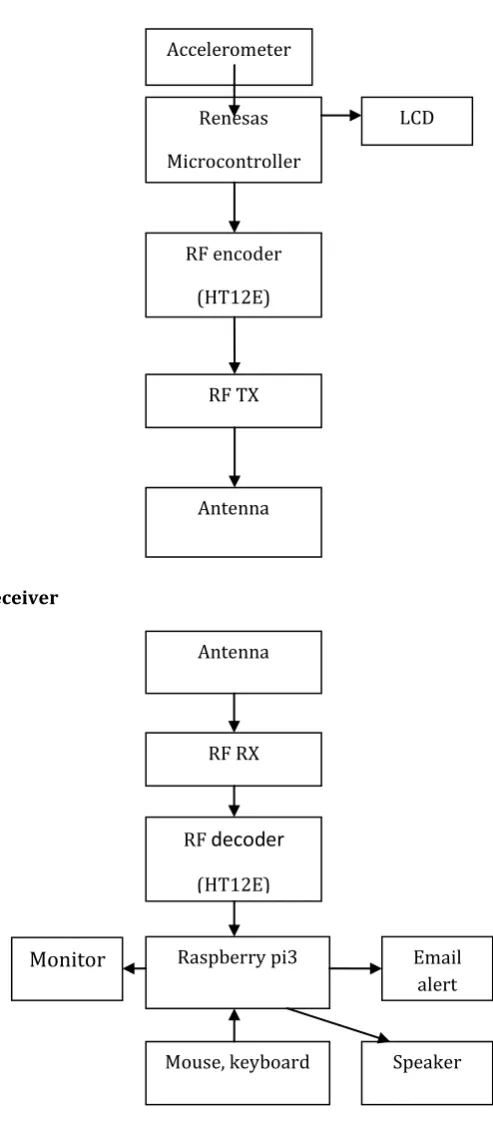
Fig-1: Block Diagram
R5F102AA microcontrollers from Renesas are used in the implementation of this proposed work. Microcontroller acts as the heart of this system, which controls the whole system. It contains Flash ROM 16KB, RAM 2KB, and Data Flash 2KB, and it has High-speed on-chip oscillator, Self-reprogrammable under software control, 23 GPIO’s, 3
UART’s, Simplified I2C, 10-bit resolution ADC, 28 Interrupt Sources, ISP programming support etc.
Raspberry Pi 3 microprocessor is 64-bit architecture, it has 40 I/O pin. It has following features.CPU: Quad-core 64-bit ARM Cortex A53 clocked at 1.2 GHz.GPU: 400 MHz, Video Core IV multimedia. Memory: 1GB LPDDR2-900 SDRAM (i.e. 900MHz) USB ports: 4.Video outputs: HDMI, composite video (PAL and NTSC) via 3.5 mm jack. Network: 10/100Mbps Ethernet and 802.11n Wireless LAN.
The accelerometer will be placed on the hand glove and some of the gesture for communication for blind and dumb people with the common people will be obtained from the accelerometer as shown in the Fig-1 Block Diagram and fed into microcontroller RL78, the obtained commands are transmitted remotely via RF transmitter to the receiver end. At the receiver end, the commands are processed by Raspberry Pi 3 and generate email with predefined images with respect to each gesture and subject to a concerned person with whom the physically challenged person needs to communicate. Simultaneously, the voice output is obtained for some of the gesture via speaker.
This proposed system is developed for recognizing the signs or gesture and their conversion into voice and generates an auto email with predefined images and subject. An instrumented data glove is used for generating the gestures which carry some useful information that helps the blind and dumb people to communicate with the common people. The microcontroller based system receives the gestures remotely and converts some specified movements into human recognizable voice and generates an email with predefined images and subject.
Gesture discussed is basically a data glove and a microcontroller based system. Data glove can detect almost all the movements of a hand and microcontroller based system converts some specified movements into human recognizable voice and generates an email with predefined images and subject. The data glove is equipped with accelerometer sensor.
4. IMPLEMENTATION
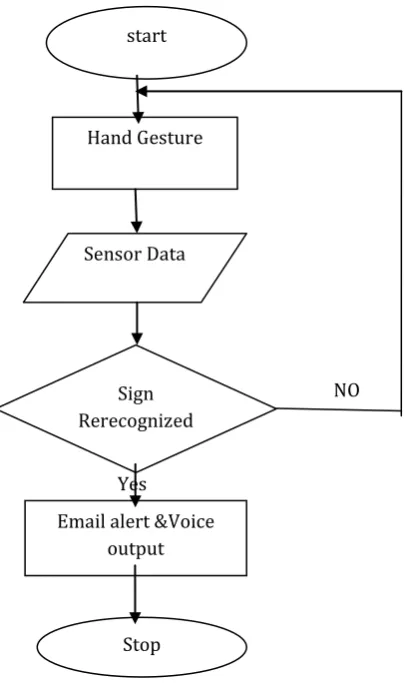
The working of the complete framework can be obtained in a flow diagram. The framework starts when the instrumented data glove is used for generating the gestures which carry some useful information that helps the blind and dumb people to communicate with the common people and the microcontroller based system receives the gestures remotely and converts some specified movements into human recognizable voice and generates an email with predefined images and subject.
The implementation details can be represented in steps as shown in the Fig-2: Workflow diagram
Accelerometer
Renesas
Microcontroller
RF encoder
(HT12E)
RF TX
Antenna
LCD
Antenna
RF RX
RF decoder
(HT12E)
Raspberry pi3 Email
alert
Mouse, keyboard Speaker
© 2018, IRJET | Impact Factor value: 6.171 | ISO 9001:2008 Certified Journal | Page 1870 1. All the devices like LCD, accelerometer, RF
transmitter and receiver, speaker are initialized.
2. Generate some commands through gesture for communication purpose using the data glove.
3. Display all the operations on LCD that is interfaced with the microcontroller.
4. Based on the data Received from the accelerometer, the microcontroller will send the commands to the receiver end.
5. On receiver end for the gesture command received an email will be generated with predefined images and subject and voice output is obtained via speaker.
NO
[image:4.595.85.288.308.650.2]
Yes
Fig-2: Workflow diagram
5. SOFTWARE USED
In this proposed work, CubeSuite is used which is the integrated development environment for microcontrollers by providing an integrated environment. It is possible to perform all development using just this product, rather using many different tools separately.
To program the microcontroller Embedded C language is used. Python code is used to create the application and run in the Raspbian Os. Integrated development environment (IDE) Eclipse Kepler is also used which provides the workspace and an extensible plug-in system for customizing the environment. All the codes written in the Python and Java are dumped to the microcontroller Renesas R5F102AA, using the Renesas flash programmer and the results are displayed in the default terminal application for Raspberry Pi which is LX Terminal. The voice output can also be checked in the Raspberry Pi’s audio jack using the speaker or headphones.
6. RESULTS OBTAINED
[image:4.595.313.556.411.557.2]The prototype developed using Raspberry Pi 3 board, Renesas R5F102AA microcontroller, and data glove equipped with accelerometer sensor as shown in Fig-3: Prototype Developed. In the proposed work, to ease the communication of blind and dumb, certain commands are created with the threshold values. Likewise, N number of commands can be created by making Slight changes in the program for the required hand movements (gestures). When the blind and the dumb person do the gesture in order to establish communication with the particular threshold range, an email alert is sent and the voice output is obtained.
Fig-3: Prototype Developed
The commands with set threshold values are as follows,
1. >=175and<=185: command 1: Hello&welcome
2. >=186: command 2: route map start
Hand Gesture
Sensor Data
Sign Rerecognized
e
Email alert &Voice output
© 2018, IRJET | Impact Factor value: 6.171 | ISO 9001:2008 Certified Journal | Page 1871 Fig-4: Raspberry Pi Email alert for Command 1
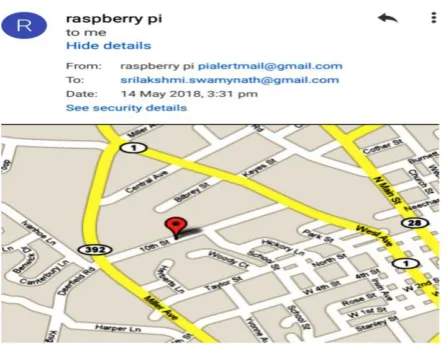
When the gestures are made by blind and dumb using data glove within the threshold range >=175and<=185 the command1 is executed and sends an email alert and play the voice output “Hello&welcome" as shown in the Fig-4: Raspberry Pi Email alert for Command 1.
Fig-5: Raspberry Pi Email alert for Command 2
When the gestures are made by blind and dumb using data glove within the threshold range >=186 the command2 is executed and sends an email alert and play the voice output “route map” as shown in the Fig-5: Raspberry Pi Email alert for Command 2.
7. ADVANTAGES
1. Boon for physically challenged people.
2. Low power requirement.
3. Simple circuitry as it does not require special hardware.
4. Higher security as directionality of the beam helps ensure that data isn't leaked or spilled to nearby devices as it is transmitted.
5. Devices can be controlled more comfortably.
6. Easy to use.
7. Efficient and reliable.
8. DISADVANTAGES
Carrying power supply
9. CONCLUSIONS
This proposed work describes the design and working of a system which is useful for dumb, deaf and blind people to communicate with one another and with the common people. The dumb people use their standard sign language which is not easily understandable by common people and blind people cannot see their gestures. This system converts the sign language into a voice which is easily understandable by blind and common people. The sign language is translated into some text form, images and sent via email to facilitate the deaf people as well.
ACKNOWLEDGEMENT
I wish to acknowledge my guide and co-author Dr. Shabana Sultana, Associate Professor, Department of Computer Science, The National Institute Of Engineering, Mysuru for the valuable Suggestions, support, and guidance.
REFERENCES
[1] Wolf, C. G. Can people use gesture commands? IBM Research Report, (RC 11867), April 7, 1986.
[2]Sanna K., Juha K., Jani M. and Johan M (2006), Visualization of Hand Gestures for Pervasive Computing Environments, in the Proceedings of the working conference on advanced visual interfaces, ACM, Italy, p. 480-483.
[3] Silvia Mirri, Catia Prandi, Paola Salomoni “Fitting like a GlovePi: a wearable device for deaf-blind people” 14th IEEE Annual Consumer Communications & Networking Conference (CCNC), 2017.P. 1057-1062
[4] Jani M., Juha K., Panu K., and Sanna K. (2004). Enabling fast and effortless customization in accelerometer based gesture interaction, in the Proceedings of the 3rd international conference on Mobile and ubiquitous multimedia. ACM, Finland. P. 25-31
[5]http://www.telegraph.co.uk/news/uknews/1563076/El derly-addicted-to-Nintendo-Wii-atcare-home.html
[6] Malik, S. and Laszlo, J. (2004). Visual Touchpad: A Two-handed Gestural Input Device. In Proceedings of the ACM International Conference on Multimodal Interfaces. P. 289
[image:5.595.55.279.322.495.2]© 2018, IRJET | Impact Factor value: 6.171 | ISO 9001:2008 Certified Journal | Page 1872 wheelchair”, Industrial Robot: An International Journal,
Emerald, P.60-68.
[8]WII Nintendo, 2006, http://www.wii.com, Available at http://www.wii.com [Last accessed April 21, 2009]. 9. W. K. Edwards and R. E. Grinter, "At home with ubiquitous computing: seven challenges," presented at Ubicomp, Atlanta, USA, 2001.
[9]Divyanshee Mertiya#1, Ayush Dadhich#2, Bhaskar Verma#3, DipeshPatidar* “A Speaking module for Deaf and Dumb”, #student, *assistant professor Department of Electronics & comm. Poornima Institute of Engineering and Technology, Jaipur, Rajasthan, India.
[10] Rithesh M Nanda1, Harshini H K1, Praveen Kuruvadi1, Ankhit B V1, C Gururaj2,”wireless Gesture Controlled System”, 1Student, Dept. of Telecommunication, BMS College of Engineering, Bangalore, India 2Assistant Professor, Dept. of Telecommunication, BMS College of Engineering, Bangalore, India.
[11]Pooja Dongare1,Omkar Kandal Gaonkar2, Rohan Kanse3, Sarvesh Kukyan4,” Innovative Tool For Deaf, Dumb And Blind People”, B.E Students K.C. College Of Engineering & Management Studies & Research, Kopri, Thane(E)-400 603, India.