© 2013, IJCSMC All Rights Reserved 62
Available Online atwww.ijcsmc.com
International Journal of Computer Science and Mobile Computing
A Monthly Journal of Computer Science and Information Technology
ISSN 2320–088X
IJCSMC, Vol. 2, Issue. 10, October 2013, pg.62 – 70
RESEARCH ARTICLE
Calculating Optimal Cost of Using DGs
in Micro Grids by Using Imperialistic
Competitive Algorithm (ICA)
Navid Javidtash1, Reza Sedaghati2
¹Department of Electrical Engineering, Beyza Branch, Islamic Azad University, Beyza, Iran
²Department of Electrical Engineering, Beyza Branch, Islamic Azad University, Beyza, Iran
Abstract— How to use renewable sources has been a great problem for many years. Researchers have invented and developed Microgrids, flexible networks with a central control system; nevertheless, for installing renewable sources on them there is still questions. As a result, researchers started to use different algorithms in order to solve problems and find best answers for electrical functions. One of the most novel algorithms for this purpose is Imperialistic Competitive Algorithm (ICA). It is based on historical events and provides marvelous results and speed in comparison with similar algorithms such as Genetic Algorithm or PSO. In this paper we will investigate best answers for cost function in a 14-Bus Microgrid by using ICA algorithm. Finally answers will be compared with GA and PSO so that it can be shown that proposed algorithm is more efficient than its counterparts.
Keywords— Distributed Generation; Imperialistic Competitive Algorithm (ICA); Microgrid; PSO; GA
I. INTRODUCTION
© 2013, IJCSMC All Rights Reserved 63
analytical approaches [4] numerical programming and heuristic [5,6]. Some researches are based on evolutionary algorithms. In [7] the DG allocation problem is solved using artificial bee colony.
In this paper we review structure of Microgrids and their abilities. Afterwards ICA algorithm flow chart is investigated, then we consider a standard 14-Bus Microgrid for optimizing cost function in it using ICA algorithm. At the end results are compared with conventional approaches to show the quality of proposed algorithm.
II. THEMICROGRIDSTRUCTURE
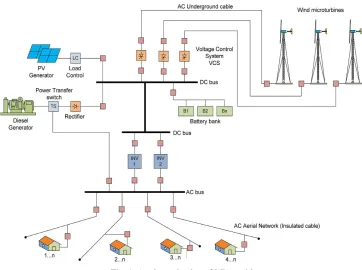
In contrary to previous networks generation with conventional power plants, Microgrids have a lot of properties such as producing base and backup power, high reliability, high efficiency, high security and so on. Microgrids have been used in some countries, for instance in USA, UK, Japan and other modern countries. Additionally, Microgrids are good option to utilize DGs because Microgrids are so much flexible comparing older networks that many countries try to distribute this modern network to improve use of renewable sources. Microgrids can work in two modes, connected to other networks and isolated from other networks, island mode. In each mode we have two controlling parts, local controller and central controller. Local controller gives data of each source to central controller and gets command from it while central controller gets data, analyzes it and gives the best command to keep network stable and secure [8]. If a Microgrid have connection with other Microgrids central controllers exchange data’s between each other. In this paper we use a Microgrid in our simulation. A schematic plan of Microgrid has been shown on figure (1) [9].
© 2013, IJCSMC All Rights Reserved 64 III.PROPOSEDALGORITHM
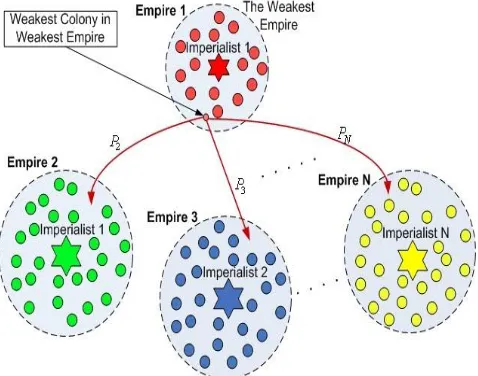
As using algorithms for optimizing objective functions has recently become common, a variety of algorithms have been developed and utilized for optimizing goals. Most of algorithms have been created based on natural process of life whereas ICA algorithm, for the first time, is based on political events during history. In ICA algorithm we have some data as initial countries, and then we chose some of them as imperialists and the others as colonies hence some empires are created in this section. After that, two stage of competition occurs between countries, intra competition and inter competition. In intra competition each country tries to improve itself and dominate on imperialist, while in inter competition empires make efforts to get the weakest colony from the weakest empire. This procedure continues until all of colonies are conquered by other colonies and eventually one empire remains. When there is no colonies remained in an empire, imperialist of that colony becomes like a colony and is taken by other empires and that empire will be eliminated [10]. A schematic plan of ICA has been shown on figure(2).
Fig. 2 Competition between empires
During this process two important events occur, assimilation and revolution. In assimilation part we have some changes inside each empire, in this action imperialist of empire try to change structure of colonies based on their needs, therefore it change some parameters of colonies. This action has historical roots in imperialistic history. In revolution that also has historical root, one colony or more inside each empire may change suddenly and these changes could improve level of colony resulting in its domination on imperialist, so it can increase cost of colony to an upper level than imperialist and become imperialist. In revolution action some parameters of colony change suddenly and other colonies or imperialists don’t have any impact on this action [11].
In each part of ICA algorithm, we should evaluate cost function because value of each country is demonstrated via result of cost function. Since we aim to minimize cost function in this study, a country is better than others when its cost is the least. Utilizing ICA algorithm, it can be seen that results are more accurate and time of convergence is less than older algorithms such as Genetic algorithm or PSO algorithm. Generally cost of each empire can be calculated by following equation:
) 1 (
© 2013, IJCSMC All Rights Reserved 65
Where F (Imp) stands for the cost of imperialist and impact of average cost function of
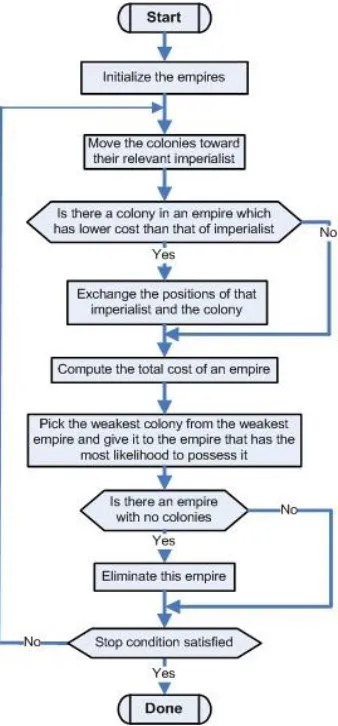
colonies is modelled by a constant coefficient, ξ. A block diagram for ICA algorithm has been
shown in figure (3) [12].
Fig. 3 Block diagram of ICA algorithm
IV.SIMULATIONRESULTS
In previous sections, Microgrids and main structure of ICA algorithm were discussed, now we want to implement proposed algorithm in a Microgrid and evaluate it considering cost of determining DG’s capacity. So our cost function is [13]:
) 2 (
Cost P( ) a b P*
) 3 (
a=
) 4 (
b= Fuel Cost ($/Kw h) + O & M Cost (($/Kw h)
Lf is the load factor, Gr is the annual interest rate and the O & M cost is the operation and maintenance cost. So our equation is:
) 5 (
© 2013, IJCSMC All Rights Reserved 66
Where Cost(PDG i) shows cost of i’th DG’s and Cost sub denotes cost of installation of substations. Here we consider three kind of DG’s which their data can be found in Table (1).
TABLE 1 Data of DGs
DG Type CHP Photovoltaic Wind Turbine
Rated Capacity(kw) 200 100 10
Capital Cost($/kw) 3674 6675 3866
Fuel Cost($) 0.029 0 0
O & M Cost($/kwh) 0.01 0.005 0.005
Life Time(year) 10 20 20
Constraints:
The voltage of the network should always be kept within the permissible limits:
) 6 (
Vmin ≤ |VK| ≤ Vmax
Where Vmin and Vmax are the lower and upper voltage limits, respectively. Also, |Vk| is the voltage magnitude at bus k.
DG size:
Depending on the maximum allowable investment of DG, the total DG size should be governed by:
) 7 (
1 DG
NDG K
K KW Pload
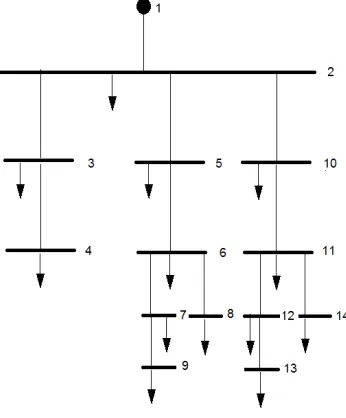
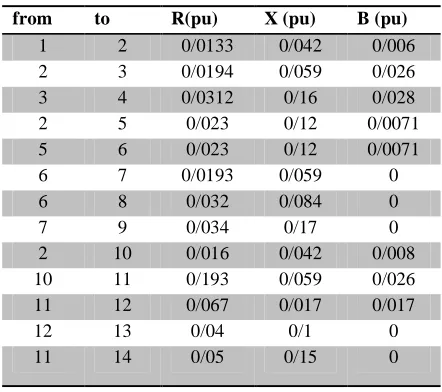
Where KWKDG is the capacity of the Kth DG and Pload is the total load power. Moreover, NDG is number of DGs. For implementation of ICA algorithm we use a standard 14-BUS Microgrid that is depicted in figure (4) and its data are represented in Table(2) and Table(3).
© 2013, IJCSMC All Rights Reserved 67 TABLE 2
Bus Data of Microgrid
No.Bus Pli Qli
1 0 0
2 20 6
3 85 27
4 40 1
5 20 6
6 20 6
7 76 16
8 10 30
9 61 16
10 12 75
11 10 90
12 16 61
13 90 59
14 35 61
Table 3 Line Data of Microgrid
B (pu) X (pu) R(pu) to from 006 / 0 042 / 0 0133 / 0 2 1 026 / 0 059 / 0 0194 / 0 3 2 028 / 0 16 / 0 0312 / 0 4 3 0071 / 0 12 / 0 023 / 0 5 2 0071 / 0 12 / 0 023 / 0 6 5 0 059 / 0 0193 / 0 7 6 0 084 / 0 032 / 0 8 6 0 17 / 0 034 / 0 9 7 008 / 0 042 / 0 016 / 0 10 2 026 / 0 059 / 0 193 / 0 11 10 017 / 0 017 / 0 067 / 0 12 11 0 1 / 0 04 / 0 13 12 0 15 / 0 05 / 0 14 11
In given Microgrid our power demand is brought by a mixture of conventional substations and DG’s so we want to find the best state of using them when our cost is near to minimum.
© 2013, IJCSMC All Rights Reserved 68
stopped in a chancy point; however, we can simulate this action in a line. For example if we have 4 probabilities we can show 4 different parts in a line like figure (5).
Figure. 5 Roullette Wheel Selection Method
Each probability is derived from rate of propriety, thus we can write proper codes for this action. At first we should select a random point between 0 and 1:
) 8 (
P1+P2+P3+P4 =1
) 9 (
r ~ Random Point(0,1)
) 10 (
0 ≤ r≤ 1
) 11 (
If r ≥0 & r P1; so first regional is selected
) 12 (
If r P1 & r≤P1+P2; so second regional is selected
) 13 (
If r P1+P2 & r≤ P1+P2+P3; so third regional is selected
) 14 (
If r P1+P2+P3 & r≤ P1+P2+P3+P4; so last regional is selected
For implementation of revolution in ICA algorithm we can use various methods but in this paper we use normal distribution. In this method the density of selection near X point is more than other points.
) 15 (
X ' ~ N(X, σ2) ~ X+ σ N(0,1)
) 16 (
σ = γ (XMax - XMin)
Where γ=0.1 and σ represents step size. If σ is a large number, accuracy of checking is high but time of searching is long and vice versa (, inversely, if σ is a small number, accuracy of
checking is low but time of checking is short.)
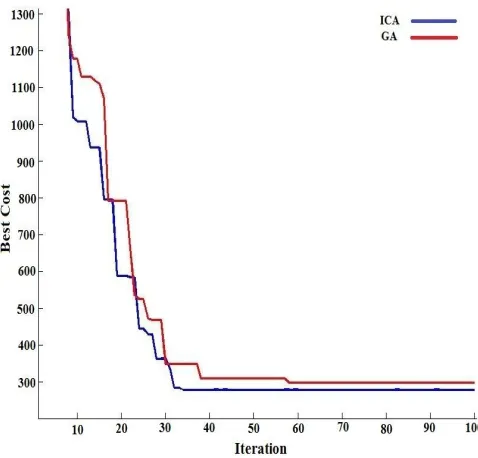
© 2013, IJCSMC All Rights Reserved 69 Fig. 6 Comparison of ICA and GA
Table 4
Comparison of different methods
Method Best Cost Time
Genetic Algorithm 301.26 1.341
PSO 287.37 1.138
Proposed Algorithm (ICA) 279.71 0.972
V. CONCLUSION
© 2013, IJCSMC All Rights Reserved 70 REFERENCES
[1] Piagi, P., Lasseter, R.H., 2006., Autonomous Control of Microgrids, IEEE PES Meeting, Montreal, PP. 1.
[2] Lasseter R.H., Piagi P., 2004., “Microgrid: A Conceptual Solution”, Proc. PowerElectronics Specialists Conf, Aachen, Germany, Volume. 6, Issue.1, pp. 4285–4290.
[3] Ng HN, Salama MM, Chikhani AY., 2000., “Capacitor allocation by approximate reasoning: fuzzy capacitor placement”. IEEE Trans Power Deliv;15(1):93–398.
[4] Augugliaro A, Dusonchet L, Mangione S. 1990., “Optimal capacitive compensation on radial distribution system using nonlinear programming”. Electric Power Syst Res;19:129–35.
[5] Gallego RA, Monticelli AJ, Romero R. 2001., “Optimal capacitor placement in radial distribution networks”. IEEE Trans Power Syst;16(4):630–7.
[6] Varilone P, Carpinelli G, Abur A. 2002., “Capacitor placement in unbalanced power systems”. In: Proc 14th PSCC, Sevilla, Session 3, Paper 2 .
[7] Fahad S. Abu-Mouti and El-Hawary M. E., 2011, “Optimal Distributed Generation Allocation and Sizing in Distribution Systems via Artificial Bee Colony Algorithm,” IEEE TRANSACTIONS ON POWER DELIVERY, VOL. 26, NO. 4.
[8] Chowdhury, S., Chowdhury, S.P., Crossley, P., 2009, Microgrids and Active Distribution Networks, London, Pub. TheInstitution of Engineering and Technology, PP. 145-157.
[9] Rebeiro, L., Saveedra, O.R., Lima, S.L., 2011, Isolated Micro-Grids With Renewable Hybrid Generation: The Case of Lençóis Island, IEEE TRANSACTIONS ON SUSTAINABLE ENERGY, VOL. 2, NO. 1, PP. 3-5.
[10] Atashpaz-Gargari, E., & Lucas, C., 2007. Imperialist competitive algorithm: An algorithm for optimization inspired by imperialistic competition. IEEE Congress on Evolutionary Computation, 4661– 4667.
[11] www.ICAsite.info
[12] Nazari-Shirkouhi, S., Eivazy, Ghodsi, H.R., 2010., “Solving the integrated product mix outsourcing problem using the Imperialist Competitive Algorithm”, Expert Systems with Applications. 7615–7626.