IJPSR (2016), Vol. 7, Issue 5 (Research Article)
Received on 15 December, 2015; received in revised form, 25 January, 2016; accepted, 13 February, 2016; published 01 May, 2016
FORMULATION DEVELOPMENT OF DONEPEZIL HYDROCHLORIDE ORAL
DISINTEGRATING TABLETS USING QUALITY BY DESIGN APPROACH
Tejas B. Patel*, Tushar R. Patel and B. N. Suhagia
Faculty of Pharmacy, Dharmsinh Desai University, Nadiad-387001, Gujarat, India
ABSTRACT: This study posed a challenge for the risk management to research and development projects in a highly regulated and volatile pharmaceutical industry, in which projects are extremely long, complex, costly and prone to failure. Project management in new product development, must be efficient and effective. This emphasizes the importance of risk management. Quality by design (QbD) refers to an advanced approach toward drug development. QbD is a vital part of the modern approach to pharmaceutical quality. There is much confusion among pharmaceutical scientists in generic drug industry about the appropriate element and terminology of QbD. The purpose of this research was to discuss the pharmaceutical QbD for formulation development with a case study of Orally Disintegrating Tablet (ODT) of Donepezil Hydrochloride (DPH). The study describes elements of the QbD for DPH ODT, include: Defining quality target product profile, identifying critical quality attributes, establishing design space, control strategy. ODT of DPH was prepared by direct compression method using Crospovidone, MCC and level of polymer was optimized, factorial design was used as part of risk analysis to optimize the level of other excipients. Thus, the work facilitates the adoption and implementation of QbD for formulation development using QbD and could increase efficiencies,
provide regulatory support.
INTRODUCTION: Quality risk management is a systematic process for the assessment, control, communication and review of risks to the quality of the drug (medicinal) product across the product lifecycle. Quality risk management should include systematic processes designed to coordinate, facilitate and improve science-based decision making with respect to risk 1.
QUICK RESPONSE CODE
DOI:
10.13040/IJPSR.0975-8232.7(5).2097-08
Article can be accessed online on:
www.ijpsr.com
DOI link: http://dx.doi.org/10.13040/IJPSR.0975-8232.7 (5).2097-08
Possible steps used to initiate and plan a quality risk management process might include: (a) Define the problem and/or risk question, including pertinent assumptions identifying the potential for risk; (b) Assemble background information and/ or data on the potential hazard, harm or human health impact relevant to the risk assessment; (c) Identify a leader and necessary resources; (d) Specify a timeline, deliverables and appropriate level of decision making for the risk management process 2, 3
. Quality risk management supports a scientific and practical approach to decision-making.
It provides documented, transparent and
reproducible methods to accomplish steps of the quality risk management process based on current
Key words:
QBD, Quality Risk Management, Factorial Design, Orodispersible
Tablets.
Correspondence to Author: Dr. Tejas B. Patel
Sr. Assistant Professor
Faculty of Pharmacy, Dharmsinh Desai University, Nadiad-387001, Gujarat, India
knowledge about assessing the probability, severity and sometimes detectability of the risk 4.
A risk assessment of the drug substance attributes was performed to evaluate the impact that each attribute could have on the drug product CQAs. The outcome of the assessment and the accompanying justification is provided as a summary in the pharmaceutical development report. The relative risk that each attribute presents
was ranked as high, medium or low. The high risk attributes warranted further investigation whereas the low risk attributes required no further investigation. The medium risk is considered acceptable based on current knowledge. Further investigation for medium risk may be needed in order to reduce the risk 5-8. The same relative risk
ranking system was used throughout
pharmaceutical development and is summarized in
Table 1.
TABLE 1: OVERVIEW OF RELATIVE RISK RANKING SYSTEM
Low Broadly acceptable risk. No further investigation is needed.
Medium Risk is acceptable. Further investigation may be needed in order to reduce the risk
High Risk is unacceptable. Further investigation is needed to reduce the risk.
The manufacturing and use of a drug (medicinal) product, including its components, necessarily entail some degree of risk. The risk to its quality is just one component of the overall risk. It is important to understand that product quality should be maintained throughout the product lifecycle such that the attributes that are important to the quality of the drug (medicinal) product remain consistent with those used in the clinical studies 9-11
. An effective quality risk management approach can further ensure the high quality of the drug (medicinal) product to the patient by providing a proactive means to identify and control potential
quality issues during development and
manufacturing. Additionally, use of quality risk management can improve the decision making if a quality problem arises. Effective quality risk management can facilitate better and more informed decisions, can provide regulators with greater assurance of a company’s ability to deal with potential risks and can beneficially affect the extent and level of direct regulatory oversight 12, 13.
Orally disintegrating dosage forms has to be placed in mouth and then get dispersed in saliva without the need of water. Orally disintegrating tablets are also called as or disperse, mouth dissolving, rapidly disintegrating, fast melt, and quick dissolve system. From past decade, there has been an increased demand for more patient-friendly and compliant dosage forms. As a result, the demand for developing new technologies has been increasing day by day 14, 15. United States Food and Drug Administration (FDA) define orally disintegrating tablets as “A solid dosage form which contain a
medicinal substance or active ingredient which disintegrates rapidly within a matter of seconds when placed upon a tongue”.
The aim of the present work is to develop oral disintegrating tablets of donepezil hydrochloride using quality risk management tool of the Quality by Design (QbD) approach. Various process variables involved in the development of ODT was indentified and it was optimized for minimum risk level using design of experiments (DoE) tool for efficient reduction in the risk assessment. Risk assessment was done before applying DoE and it was again reassessed after applying DoE. This will reduce the risks involved in the development of ODTs and yields a good quality product. The Quality risk management assesses the risk involved in the development of oral disintegrating tablets and reducing this risk during development for the
continuous improvement in the product
development and to manufacture high quality product with reduced process variables and higher product quality.
MATERIALS AND METHODS:
Donepezil Hydrochloride was obtained as gift sample from Astron Research centre, Ahmedabad, India. all other excipients used in the development of ODTs was obtained as received from the supplier and were of analytical grade.
Methods:
Characterization of Donepezil Hydrochloride:
include the drug-excipients compatibility study during development of ODTs.
Quality Target Product Profile (QTPP) element analysis of drug product:
The QTPP is “a prospective summary of the quality characteristics of a drug product that ideally will be achieved to ensure the desired quality, taking into account safety and efficacy of the drug product.” The QTPP is an essential element of a QbD approach and forms the basis of design of the generic product 16, 17. The QTPP is a quantitative substitute for aspects of clinical safety and efficacy. QTPP includes following elements:
Dosage form` Tablet color Tablet shape
Tablet weight Mode of administration Dosage straight Pharmacokinetic Physical attributes Identification
Assay Content uniformity In vitro-dissolution Friability Disintegration time Hardness
Study of Critical Quality Attributes (CQA) of Formulation and Process:
It was stated that the ICH working definition of CQA was: “A CQA is a quality attribute (a physical, chemical, biological or microbiological property or characteristic) that must be controlled (directly or indirectly) to ensure that the product meets its intended safety, efficacy, stability and performance.”18, 19
CQA includes following elements:
weight variation Hardness Identification Assay Content uniformity Dissolution Disintegration Product degradation Appearance
Initial Risk Assessment of Formulation Variable:
In this initial risk assessment for formulation development, the detailed manufacturing process has not been established. Thus, risks were rated assuming that for each formulation attribute that changed, an optimized manufacturing process would be established. For these studies, disintegrating agent level, diluents level and magnesium stearate levels are considered as formulation variables 20-23. While hardness is considered as process variable and risk assessment had been discussed.
Preformulation Studies in Development of ODTs:
Angle of Repose:
Angle of repose is a measure of flowability of powders and granules. It was measured using procedure described in USP. A funnel was kept vertically in stand at a specified height above a paper placed on horizontal surface. The bottom was closed and 10 gm of sample powdered was filled in funnel. The funnel was opened to release the powered on paper to form a smooth conical heap. The height of heap was measured at four points. The average diameter was calculated and radius was found out form it. The angle of repose was calculated using following formula:
Tan θ = h/r
Where; h = height of the heap, r = radius of the heap
Bulk density:
The powdered to be tested was sized appropriately to break lumps during storage. A weighed quantity of this powered was then poured in to the measuring cylinder up to ¾ capacities. Bulk density of powder was calculated by using following equation:
Tapped density:
Cylinder was put in the holder of USP tapped density apparatus where it was tapped at an average rate of 100 times. After 100 taps volume of powder (v1) was noted and again tapped for another 100 taps. This gave a new volume (v2). If difference between v1 anmdv2 was more than 25%, another taps are given repeatedly until the difference reduces to less than 2%. Tapped density was calculated using following equation:
Compressibility index
The Compressibility Index of the blends is
determined by compressibility index.
Hausner’s ratio:
A similar index to indicate the flow properties can be defined by Hausner’s ratio. Hausner’s ratio can be calculated by using following formula:
and
Where, TB= Tapped density, BD= Bulk density
Optimization of the formulation of ODTs using 32 Full Factorial Design:
Factorial design is suitable for exploring quadratic response surface and constructing second order polynomial models. The design consists of replicated center points and the set of point lying at the midpoint of the multidimensional cube that defines the region of interest 24, 25. The nonlinear
quadratic model generated by the design in the form;
Y =b0 b1X1 + b2X2+ b11X12 + b22X22 + b12X1X2
Where; Y is response, b0 is intercept, X1 and X2 are
coefficient of independent factors.
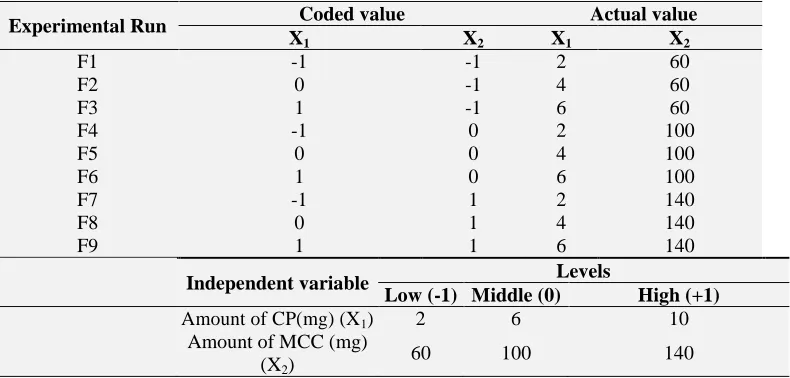
The coefficients with second order term (b11 and b22) indicate the quadratic nature and b12 is the interaction term (combining effect of independent factors). This study investigated utility of a 2- factor, 3- level factorial design and optimization process for matrix tablet prepared by direct compression method. Amount of Crospovidone and Microcrystalline Cellulose were selected as the independent variables. Table 2 indicated levels and experimental runs as per experimental design.
TABLE 2: LEVELS AND EXPERIMENTAL RUNS FOR FORMULATION OPTIMIZATION OF ODTS OF DONEPEZIL HYDROCHLORIDE (DPH)
Experimental Run Coded value Actual value
X1 X2 X1 X2
F1 -1 -1 2 60
F2 0 -1 4 60
F3 1 -1 6 60
F4 -1 0 2 100
F5 0 0 4 100
F6 1 0 6 100
F7 -1 1 2 140
F8 0 1 4 140
F9 1 1 6 140
Independent variable Levels
Low (-1) Middle (0) High (+1)
Amount of CP(mg) (X1) 2 6 10
Amount of MCC (mg) (X2)
60 100 140
Evaluation of ODTs of Donepezil Hydrochloride Thickness:
Thickness of the tablets was determined using a Micrometer screw gauge. Five tablets from each batch were used and average values were calculated. It is expressed in mm.
Hardness:
The resistance of tablets to shipping, breakage, under conditions of storage, transportation and handling before usage depends on its hardness. For batch formulation, the hardness of 6 tablets was determined using the Monsanto hardness tester. The tablet was held along its oblong axis in between the two jaws of the tester. At this point,
reading should be zero kg/cm2. Then constant force was applied by rotating the knob until the tablet fractured. The value at this point was noted.
Friability:
[image:4.612.110.505.337.526.2]Weight Variation Study:
In weight variation test, 20 tablets from each batch formulation were weighed individually using an electronic balance, average weight was calculated and individual tablet weight was then compared with average value to find deviation in weight.
Wetting Time Determination:
A piece of tissue paper folded twice containing amaranth powder on the upper surface was placed in a small Petri dish (ID =6.5 cm) containing 6 ml of phosphate buffer pH6.8, a tablet was put on the paper and the time required for formation of pink color on the surface of tablet was measured as wetting time. (n=3).
Content Uniformity:
Accurately weighed amount of drug-excipients blend was dissolved in small amount in a 100 ml volumetric flask volume of solution was made up using distilled water. This solution was filtered and
absorption was measured using
UV-spectrophotometer at 271 nm.
Determination of Disintegration Time:
The disintegration time for or dispersible tablets was measured using the conventional test for tablets as described in the Pharmacopoeia. Tablets were placed in the disintegration tubes and time required for complete disintegration, that is without leaving any residues on the screen was recorded as disintegration time.
In-vitro Dissolution Study:
In vitro dissolution test of tablets was carried out in USP apparatus II (paddle apparatus). Paddle was rotated at 50 rpm & 900 ml phosphate buffer solution pH 6.8 was selected as dissolution medium. Apparatus temperature was at 37±1˚C. after an interval of 10 second 10ml aliquot was withdrawn & at same time fresh 10ml dissolution medium was replaced to maintained sink condition. Aliquot was analyzed for drug content using UV-Spectrophotometer at 271 nm λmax. In-vitro dissolution test was performed until almost drug released from the dosage form.
Comparison of optimized formulation with marketed formulation using model independent method:
Model independent approach (similarity factor F2) was used for comparison of in-vitro dissolution profiles of optimized batch and marketed formulation. Equivalent similarity factor (F2) value between 50 to100. F2 value was formed by following equation.
Where F2 is similarity factor, n is the number of observations, Wt is optional weight, Rt is
percentage drug dissolved from marketed
formulation as reference, and Tt is percentage drug dissolved from test formulation.
RESULTS AND DISCUSSION: Characterization of DPH:
[image:5.612.315.557.192.240.2]DPH and excipients were characterized using FT-IR and DSC studies. FT-FT-IR spectra was analyzed and it indicated that drug is pure as received. FT-IR spectra of drug-excipient complex were also indicated there was no any in compatibility between drug and excipients. FT-IR spectra were presented in Fig. 1.
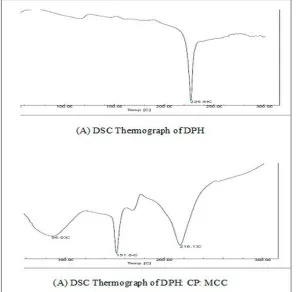
Fig. 2 showed DSC spectra of drug and excipients. It indicated no shifting of endothermic peak in complex. It indicated absence of sharp endothermic
[image:6.612.160.457.110.402.2]peak of DPH at 226.66ºC this might be due to complex formation of DPH with MCC and CP.
FIG.2: DSC THERMOGRAPHS OF DPH AND COMPLEX OF DPH: CP: MCC
Quality Target Product Profile (QTPP) and CQA element analysis of drug product:
QTPP profile for the development of DPH oral disintegration tablets were indicated in Table 3. Table 4 showed CQA for the Oral Disintegrating Tablets of DPH. CQA of ODT for DPH indicated which attributes were classified as drug product
[image:6.612.53.549.541.755.2]critical quality attributes for this product assay, weight variation, identification of drug, content uniformity, in-vitro dissolution and in-vitro disintegration time were initiated as the CQA that have potential to be impacted on product development and it would be investigated for product development.
TABLE 3: QTPP ANALYSIS FOR DPH ORAL DISINTEGRATION TABLETS Quality Target Product
Profile (QTPP)
Target Requirement
Dosage form Tablet Pharmaceutical equivalence requirement: Same dosage form
Dosage design Oral disintegrating Tablet Same as RLD
Route of administration Oral Pharmaceutical equivalence requirement: Same route of administration
Dosage strength 10 mg Pharmaceutical equivalence requirement: Same strength
Color White White
Pharmacokinetics Absorbed throughout oral cavity Bioequivalence
Requirement needed to ensure rapid onset and efficacy
Drug product quality attributes Physical attributes Pharmaceutical equivalence requirement: Must meet the same compendia or other applicable (quality)
standards (i.e., identity, assay, purity)
Identification IR
CU More than 90% as per IP In vitro availability Mean dissolution 100 %
Dissolved in 60 second
Orally disintegrate but complete drug release can be displayed in phosphate buffer solution. (pH 6.8) Friability Not more than 1.00 % Pharmaceutical equivalence requirement: as per USP Disintegration time < 30 sec As per the FDA guideline for ODT. (equivalent to
RLD)
[image:7.612.74.549.145.541.2]Hardness 3.5 to 5 Kg/cm2 Pharmaceutical equivalence : as per USP
TABLE 4: CQA ANALYSIS FOR DEVELOPMENT OF ODTS OF DPH
Drug product Target Is this a
CQA? Justification
Physical attributes
Appearance No
Color, shape and appearance are not directly linked to safety and efficacy. Therefore, they are not critical. The target is
set. To ensure patient acceptability.
Size & Odor No In general, a noticeable odor is not directly linked to safety and efficacy, but odor can affect patient acceptability.
Weight variation Yes It is carried out when the Tablet has 90-95% of active ingredient.
Friability No
Friability is a routine test per compendia requirements for Tablets. A target of NMT 1.0% w/w of mean weight loss assures a low impact on patient safety and efficacy and
minimizes customer complaints.
Identification Positive for DPH Yes
Though identification is critical for safety and efficacy, this CQA can be effectively controlled by the quality management system. Formulation and process variables do
not impact identity.
Assay
Pharmaceutical equivalence requirement: 90 % to 110 % as per IP
Yes
Assay variability will affect safety and efficacy. Process variables may affect the assay of the drug product. Thus, assay will be evaluated throughout product and process
development.
CU More than 95% Yes
Variability in CU will affect safety and efficacy. Both formulation and process variables impact CU, so this CQA
will be evaluated throughout product and process development.
Disintegration
Complete disintegration Within 30 sec
Yes OTD Tablet should be easily disintegrated so that API will be available for absorption.
Dissolution
Complete drug release can be displayed in phosphate buffer solution. (pH 6.8)
Yes
Failure to meet the dissolution specification can impact bioavailability. Both formulation and process variables affect the dissolution profile. This CQA will be investigated
throughout formulation and process development.
Initial Risk Assessment of Formulation Variables for Development of ODTs of DPH:
A risk assessment of the drug substance was performed to evaluate the impact of CQA in product development. The relative risk assessment ranking system was used during development and it was summarized in Table 5. Justification for assigned level of risk was presented in Table 6.
Optimization of Formulation Variables for Development of DPH Oral Disintegrating Tablets using 32 Factorial Design:
A 32 full factorial experimental design was implemented to prepare ODT Tablet of DPH by
using direct compression method. Experimental design was used to optimize formulation parameter as well as process parameter of ODT. Two independent factors were selected among them one was amount of Crospovidone (X1) and another was amount of microcrystalline cellulose (X2).
Evaluation of Preformulation Parameters for Development of DPH oral disintegrating Tablets: Results of various preformulation
parameters were showed in Table 7. It indicated all
parameters met the requirements for the
development of ODTs for DPH.
TABLE 5: INITIAL RISK ASSESSMENT OF THE FORMULATION VARIABLE
Drug product CQA Identification of Risk
DPH Disintegrating Agent MCC Lactose Magnesium Stearate
Identification High Low Low Low Low Disintegration Time Low High Medium Low Low
Assay High Low Low Low Low
Content Uniformity High Medium Medium Low Low Dissolution High High Medium Medium Medium
TABLE 6: JUSTIFICATION OF RISK ASSESSMENT OF CQA FOR DEVELOPMENT OF ODTS
Formulation variables CQA’s Justification
Disintegrating agent
Disintegration time Pharmaceutical equivalence requirement: Same dosage form Assay Polymer can impact the flow properties of the blend. This, in turn, can impact
Tablet CU. The risk is high. Occasionally, poor CU can also adversely impact assay. The risk is medium CU.
Dissolution Release of drug from Tablet depends on the amount of polymer in formulation so the risk is high
MCC Disintegration time MCC as diluents so that effect on Tablet disintegration time Assay Polymer can impact the flow properties of the blend. This, in turn, can impact
Tablet CU. The risk is high. Occasionally, poor CU can also adversely impact assay. The risk is medium CU.
Dissolution Release of drug from Tablet partially depends on the amount of polymer in formulation so the risk is medium.
TABLE 7: RESULTS OF PREFORMULATION STUDIES FOR DEVELOPMENT OF ODTS
Batch Bulk Density(g/ml) Tapped Density(g/ml) Carr’s Index Hausner Ratio Angle of Repose(θ)
F1 0.5 0.7 28.57 1.4 39
F2 0.54 0.73 26.02 1.35 38
F3 0.41 0.66 37.87 1.60 43
F4 0.42 0.64 34.37 1.49 45
F5 0.42 0.6 30.00 1.42 39
F6 0.32 0.5 36.00 1.50 36
F7 0.47 0.73 35.61 1.55 42
F8 0.69 0.69 39.13 1.64 41
F9 0.46 0.66 30.30 1.42 35
Evaluation of Oral Disintegrating Tablets for DPH:
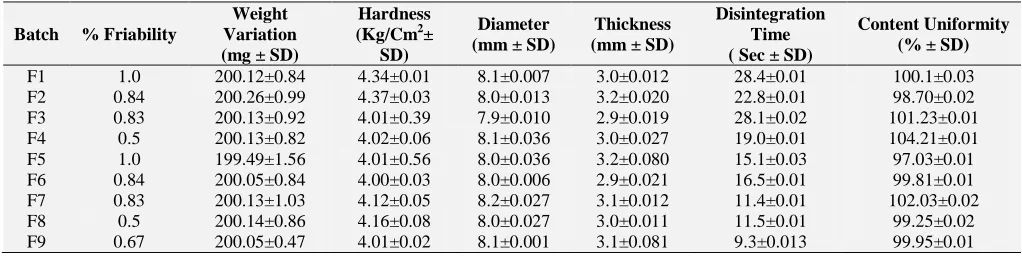
Prepared tablets were evaluated for different parameters like thickness, hardness, content uniformity, weight variation, % friability, and disintegration time and in-vitro dissolution studies.
Table 8 showed results of different evaluation parameters like thickness, hardness, content
[image:8.612.50.561.620.748.2]uniformity, weight variation, % friability, a disintegration time. Results indicated by applying DoE one can optimize the different formulation parameters. All the formulation showed the results in the desired range. For selection of more optimized batch from all 9 formulations multiple regression analysis was done.
TABLE 8: RESULTS OF EVALUATION OF ODTsFOR DONEPEZIL HYDROCHLORIDE
Batch % Friability
Weight Variation (mg ± SD)
Hardness (Kg/Cm2±
SD)
Diameter (mm ± SD)
Thickness (mm ± SD)
Disintegration Time ( Sec ± SD)
Content Uniformity (% ± SD)
In-vitro Dissolution Study:
[image:9.612.318.561.77.193.2]Results of in-vitro dissolution study showed that almost all drug was released within 100 seconds. Batch F1 to F3 showed in100% drug release within 100 seconds. Batch F4 to F5 showed almost 100% drug release within 70 seconds. While batch F7 to F8 showed almost all drug release within 60 seconds. This must be due to increased amount of CP and MCC in batch F1 to F9 among all batches F9 showed almost drug release within 50 second. Hence, it may be a good formulation for further studies. Fig. 3 showed in-vitro drug release profile curve of F1 to F9.
FIG.3: IN-VITRO DRUG RELEASE PROFILE CURVE FOR BATCH F1 TO F9
Optimization of Formulation:
Experimental runs and response for optimization of ODT formulation was resulted in Table 9. Responses surface curvature was examined when the two variables were investigated at three levels. The design was provided the following empirical second order equation (Full Model).
Y=b0++b1X1+b2X2+b12X11+b22X22+b1b2X12
Where Y was represented response, b0 was intercept, b1 and b2 are the coefficient of main effects, b12 was the coefficient for the interaction term and b11 and b22 were the coefficients for the second order quadratic terms. Non-significant estimated coefficients were dropped from the full model by adopting a significance test for the regression coefficient. Design expert (version 9.0.4) was used to identify non-significant terms. A coefficient was significant if <0.05. The refined model was used for calculation of residuals or for drawing contour plots and 3D response surface plots.
TABLE 9: RESULTS OF RESPONSE OF DEPENDANT VARIABLES FOR OPTIMIZATION OF FORMULATION
Batch Factors Response
X1 X2 Disintegration Time (Sec) D60 (%)
F1 -1 -1 22.8 57.09 F2 0 -1 28.1 55.60 F3 1 -1 28.4 55.62 F4 -1 0 11.4 85.31 F5 0 0 15.1 89.21 F6 1 0 19 90.18 F7 -1 1 16.5 98.25 F8 0 1 11.5 98.64 F9 1 1 9.3 98.64
Disintegration time:
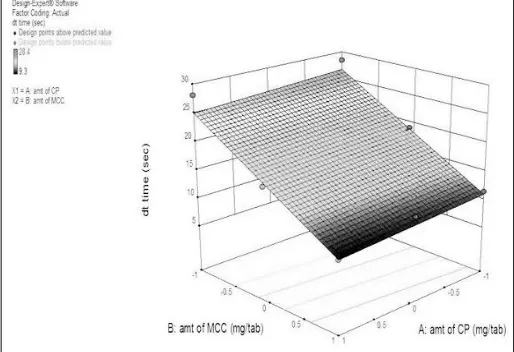
ANOVA of disintegration time indicated the model F-value of 34.36 implies the model is significant. Where the p value < 0.05, p value greater than 0.05 was omitted from the model & refined model was developed. P value of co-efficient of X1 is greater than 0.05 but it indicates main effects so not omitted in refined model. In this model coefficient of X2 has p –value less than 0.05, that means it was considered has significant term in optimization of formulation. The polynomial equation generated by using regression analysis was described below.
Positive value of B0 indicated positive effect of variables on disintegration time. Negative value of coefficient X1 (-0.82) indicated negative effect on disintegration time increased in value of X1 range in value of disintegration time. Figure 4 presented the 3D response surface plot showing effect of X1 and X2 on disintegration time respectively. It
indicated that amount of MCC increased
disintegration time was increased.
[image:9.612.46.298.247.400.2] [image:9.612.314.571.551.727.2]D60 (%):
ANOVA of D60 indicated the model F-value of 193.75 implies the model is significant. Where the p value < 0.05, p value greater than 0.05 was omitted from the model & again regression analysis was done. P value of co-efficient of X1 is greater
than 0.05 but it indicates main effects so not omitted in reduced model. In this model coefficient of B has p –value less than 0.05, that means it was considered has significant term. The polynomial equation generated by busing regression analysis was described below.
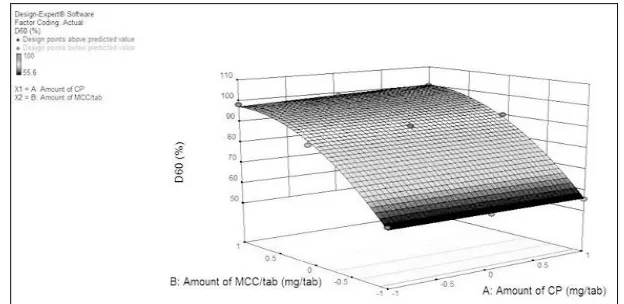
Positive value of B0 indicated positive effect of variables on D60. Positive coefficient value of X1 (0.85) was showed positive effect of X1 on D60. Amount of X1 changed the value of D60 significantly. Partial value of coefficient of X2
[image:10.612.149.461.249.401.2](21.43) showed positive effect on D60. This indicated change in amount of X2 does not change the value of D60 from desired value. Fig. 5 indicated response surface plot showing effect of amount of CP and MCC on D60 of ODTs.
FIG. 5: 3D RESPONSE SURFACE PLOT SHOWING EFFECT OF X1 AND X2 ON D60
Comparison of Optimized Batch (F9) and Marketed Formulation:
Fig.6 showed comparison in-vitro dissolution profile of batch F9 and marketed preparation. Model independent approach (similarity factor F2) was used for comparison of in-vitro dissolution profiles. Similarity factor (F2) value was 91 that were in range 50 to 100 indicated there was no significant difference in the in-vitro release profiles between F9 and marketed formulation.
Updated Risk Assessment for Formulation Variables:
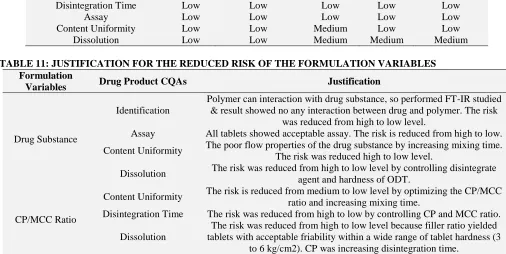
After optimization of the formulation variables using experimental design tool, risk assessment of the variables was done. It showed that variables which were in high risk at initial level of the development were now at low level of f the development. Updated risk assessment of the formulation variable and justification for the same was summarized in Table 10 and Table 11
[image:10.612.164.451.586.737.2]respectively. \
TABLE 10: UPDATED RISK ASSESSMENT OF THE FORMULATION VARIABLE
Drug product CQA
Identification of Risk
DPH Disintegrating
Agent MCC Lactose
Magnesium Stearate
Identification Low Low Low Low Low
Disintegration Time Low Low Low Low Low
Assay Low Low Low Low Low
Content Uniformity Low Low Medium Low Low
[image:11.612.49.555.114.368.2]Dissolution Low Low Medium Medium Medium
TABLE 11: JUSTIFICATION FOR THE REDUCED RISK OF THE FORMULATION VARIABLES Formulation
Variables Drug Product CQAs Justification
Drug Substance
Identification
Polymer can interaction with drug substance, so performed FT-IR studied & result showed no any interaction between drug and polymer. The risk
was reduced from high to low level.
Assay All tablets showed acceptable assay. The risk is reduced from high to low.
Content Uniformity The poor flow properties of the drug substance by increasing mixing time. The risk was reduced high to low level.
Dissolution The risk was reduced from high to low level by controlling disintegrate agent and hardness of ODT.
CP/MCC Ratio
Content Uniformity The risk is reduced from medium to low level by optimizing the CP/MCC ratio and increasing mixing time.
Disintegration Time The risk was reduced from high to low by controlling CP and MCC ratio.
Dissolution
The risk was reduced from high to low level because filler ratio yielded tablets with acceptable friability within a wide range of tablet hardness (3
to 6 kg/cm2). CP was increasing disintegration time.
CONCLUSION: In the present study initial risk assessment was done and QTTP, CQA for oral disintegration tablet was identified. According to this study disintegration time and in vitro dissolution was found to be a CQA for the development of ODT. Hence, this CQA was optimized using 32 full factorial design. Design expert (version 9.0.4) was used for statistical evaluation of the optimization. Amount of disintegrating agent and amount of directly compressible diluents was selected as independent variable on the basis of initial risk assessment study. All prepared batches F1 to F9 was showed disintegration time in between 28.4 sec to 9.3 sec. and had almost 100% drug release within 100secs. From the optimization study F9 batch was selected as optimized batch.
From the findings obtained so far, it can be concluded that, development of formulation using Quality by Design approach DPH ODT can successfully similar to the marketed preparation. QbD is very important approach for pilot scale up. Production of generic as well as branded product. Ensures better design of products with fewer problems in manufacturing. It is a cost effective method to develop generic drug production The
product can be consistently produced without batch to batch variations. From the findings obtained so far, it can be concluded that, prepared ODT of DPH was similar as marketed product in terms of product quality.
ACKNOWLEDGEMENT: The authors of the manuscript are very much thankful to Astron Research Centre, Ahmedabad for providing a gift sample of Donepezil Hydrochloride.
DECLARATION OF INTEREST: The authors of the manuscripts report no declaration of interest. The authors are alone responsible for the content and writing of the paper.
REFERENCES:
1. Zidan AS, Sammour OA, Hammad MA, Megrab NA, Habib MJ, Khan MA. Quality by design: Understanding the formulation variables of a cyclosporine A self-nanoemulsified drug delivery systems by Box–Behnken design and desirability function. International journal of pharmaceutics. 2007;332(1):55-63.
2. Lawrence XY. Pharmaceutical quality by design: product and process development, understanding, and control. Pharmaceutical research. 2008;25(4):781-91.
Biopharmaceuticals: Principles and Case Studies. 2008:161-74.
4. Xie L, Wu H, Shen M, Augsburger LL, Lyon RC, Khan MA, et al. Quality‐ by‐ design (QbD): Effects of testing parameters and formulation variables on the segregation tendency of pharmaceutical powder measured by the ASTM D 6940‐ 04 segregation tester. Journal of pharmaceutical sciences. 2008;97(10):4485-97.
5. Gibson M. Pharmaceutical preformulation and formulation: a practical guide from candidate drug selection to commercial dosage form: CRC Press; 2009. 6. Sun CC, Hou H, Gao P, Ma C, Medina C, Alvarez FJ.
Development of a high drug load tablet formulation based on assessment of powder manufacturability: moving towards quality by design. Journal of pharmaceutical sciences. 2009;98(1):239-47.
7. Teng Y, Qiu Z, Wen H. Systematical approach of formulation and process development using roller compaction. European journal of pharmaceutics and biopharmaceutics. 2009;73(2):219-29.
8. Mockus LN, Paul TW, Pease NA, Harper NJ, Basu PK, Oslos EA, et al. Quality by design in formulation and process development for a freeze-dried, small molecule parenteral product: a case study. Pharmaceutical development and technology. 2011;16(6):549-76.
9. Kuentz M, Nick S, Parrott N, Röthlisberger D. A strategy for preclinical formulation development using GastroPlus™ as pharmacokinetic simulation tool and a statistical screening design applied to a dog study. European journal of pharmaceutical sciences. 2006;27(1):91-9.
10. Hao J, Fang X, Zhou Y, Wang J, Guo F, Li F, et al. Development and optimization of solid lipid nanoparticle formulation for ophthalmic delivery of chloramphenicol using a Box-Behnken design. Int J Nanomedicine. 2011;6:683-92.
11. Singh B, Kapil R, Nandi M, Ahuja N. Developing oral drug delivery systems using formulation by design: vital precepts, retrospect and prospects. Expert opinion on drug delivery. 2011;8(10):1341-60.
12. Vogt FG, Kord AS. Development of quality‐ by‐ design analytical methods. Journal of pharmaceutical sciences. 2011;100(3):797-812.
13. Wen H, Park K. Oral controlled release formulation design and drug delivery: theory to practice: John Wiley & Sons; 2011.
14. Xu X, Khan MA, Burgess DJ. A quality by design (QbD) case study on liposomes containing hydrophilic API: I. Formulation, processing design and risk assessment. International journal of pharmaceutics. 2011;419(1):52-9.
15. Awotwe-Otoo D, Agarabi C, Wu GK, Casey E, Read E, Lute S, et al. Quality by design: Impact of formulation variables and their interactions on quality attributes of a lyophilized monoclonal antibody. International journal of pharmaceutics. 2012;438(1):167-75.
16. Charoo NA, Shamsher AA, Zidan AS, Rahman Z. Quality by design approach for formulation development: a case study of dispersible tablets. International journal of pharmaceutics. 2012;423(2):167-78.
17. Fahmy R, Kona R, Dandu R, Xie W, Claycamp G, Hoag SW. Quality by design I: application of failure mode effect analysis (FMEA) and Plackett–Burman design of experiments in the identification of “main factors” in the formulation and process design space for roller-compacted ciprofloxacin hydrochloride immediate-release tablets. AAPS PharmSciTech. 2012;13(4):1243-54.
18. Chang R-K, Raw A, Lionberger R, Yu L. Generic development of topical dermatologic products: formulation development, process development, and testing of topical dermatologic products. The AAPS journal. 2013;15(1):41-52.
19. Park S-J, Choo G-H, Hwang S-J, Kim M-S. Quality by design: screening of critical variables and formulation optimization of Eudragit E nanoparticles containing dutasteride. Archives of pharmacal research. 2013;36(5):593-601.
20. DeGrazio F, Vedrine L. Quality by Design for Primary Container Components. Quality by Design for Biopharmaceutical Drug Product Development: Springer; 2015. p. 365-401.
21. Kona R, Fahmy RM, Claycamp G, Polli JE, Martinez M, Hoag SW. Quality-by-Design III: Application of Near-Infrared Spectroscopy to Monitor Roller Compaction In-process and Product Quality Attributes of Immediate Release Tablets. AAPS PharmSciTech. 2015;16(1):202-16.
22. Sreedhara A, Wong RL, Lentz Y, Schoenhammer K, Stark C. Application of QbD Principles to Late-Stage Formulation Development for Biological Liquid Products. Quality by Design for Biopharmaceutical Drug Product Development: Springer; 2015. p. 115-35.
23. Garg RK, Singhvi I. optimization techniques: an overview for formulation development. Asian J Pharm Res Vol. 2015;5(3):217-21.
24. Kolluru LP, Gala RP. Design of Experiments: A Valuable “Quality by Design” Tool in Formulation Development. Nanoparticulate Vaccine Delivery Systems. 2015:61. 25. Wagh DG, Shahi S, Ingle DMT, Khadabadi S, Karva
RGG. Quality by design in product development: a review. Journal of Pharm Research. 2015;5(05).
All © 2013 are reserved by International Journal of Pharmaceutical Sciences and Research. This Journal licensed under a Creative Commons Attribution-NonCommercial-ShareAlike 3.0 Unported License.
This article can be downloaded to ANDROID OS based mobile. Scan QR Code using Code/Bar Scanner from your mobile. (Scanners are available on Google Playstore)
How to cite this article: