ISSN: 1992-8645 www.jatit.org E-ISSN: 1817-3195
AN INTEGRATED MODEL OF KNOWLEDGE
MANAGEMENT ENABLERS AND ORGANIZATIONAL
CREATIVITY: THE MEDIATING ROLE OF KNOWLEDGE
MANAGEMENT PROCESSES IN SOCIAL SECURITY
CORPORATION IN JORDAN
1MAHA ALKHAFFAF, 2MONIRA MUFLIH, 3 MAHMOUD AL-DALAHMEH* 1Associat professor,
Department of Management Information System, World Islamic Sciences and Education University, Jordan
2Assistant Professor, Department of Business, World Islamic Sciences and Education University, Jordan
3Assistant Professor, Department of Management Information Systems. The University of Jordan, Jordan
E-mail: [email protected], 2 [email protected] 3 [email protected]
ABSTRACT
This paper intends to make a contribution to the overall understanding of the relationship of organizational creativity to the enablers of knowledge management, including culture, structure, people and information technology, through examining the role of knowledge management processes, comprising the creating, sharing and codification of knowledge, as a mediating factor in this relationship. This research Integrated three well known models in KM area; Lawson’s model (2003) for identifying one of the knowledge management enablers; Organizational Culture, Lee & Choi Model (2003) for measuring the other enablers; Structure, People, Information Technology and the Allameh Model (2011) in order to measure knowledge management process as a mediating factor. The study aims to find out the impact of these factors in Organizational creativity, An empirical survey study has been adopted in this research paper by distributing questionnaires amongst social security corporation employees in Jordan. A total of 572 questionnaires were collected and analyzed using the smart Partial Least Square (PLS) technique. The main findings derived showed that knowledge management enablers, namely people and structure support, affect organizational creativity better with the mediate factor (KM process), whilst other enablers, namely culture and IT support, do not impact organizational creativity without a mediating role (KM Process). This paper might be valuable for academic people who are considered with understanding the linkage between organizational creativity and knowledge management enablers, furthermore, the paper might be helpful for scholars to discover additional mediating factors in this relationship; consequently, these new mediators possibly raise the organizational creativity.
Keywords: Creativity, Knowledge Management Enablers, Knowledge Management Process.
1. INTRODUCTION
The concept of organisational creativity has been defined in literature differently; it is a process of capturing concepts, principles that are related to organisational development and transformation, which may result from exploring new ways of completing work and that are based on individual inherent creativity [27]. However; knowledge management may also be defined as the management of organisational knowledge in order to create value and initiatives to improve sharing, storing and creating knowledge [33]. From such definitions, it may be stated that both organisational creativity and knowledge management have the same objective, with both
677
aiming at creating new knowledge and ways of doing work. Furthermore, knowledge management enablers, including structure, culture, people and information technology, are acknowledged as factors that enable the better application of knowledge management, providing mechanisms in the organisation to foster knowledge [40] and helping to facilitate knowledge-sharing whilst protecting knowledge amongst organisations.
ISSN: 1992-8645 www.jatit.org E-ISSN: 1817-3195
and innovation as imperative strategies in order to pioneer in the field of competitiveness, in which knowledge management identifies the extraction of the systematic ways of doing work; on the other hand, creativity allocates the necessary time and resources in the creation of new ways of thinking. Personnel training also plays a critical role in this.
The importance of this study trunks of the fact that knowledge management process has acritical role in achieving organizational creativity and innovation by knowledge creation, codifying and sharing [10], For this reason, this paper analyses previous studies that has shortage in studying the role of mediate factor (KM Process) and attempts to identify the relationship amongst knowledge management enablers, KM processes and organisational creativity. Furthermore reaserchers in this study was motivated to present the integrated model since it provide a new idea of linking KM enablers and processes in a competitive environment like Social Security Corporation in Jordan. This environment in Social Security Corporation has been selected since it is one of the most governmental corporations in Jordan that seeks to improve its organizational creativity and innovation by knowledge management programs and other techniques, Moreover the social security corporation competes other governmental agencies in Jordan to achieve King Abdulla II Award for Excellence in Government Performance and Transparency; this will apparently lead for better organizational creativity and knowledge management processes.
2. LITRATURE REVIEW
2.1 Knowledge Management Benefits
distinguishing and clarifying between knowledge and information in mind of reducing the side effects of information overload in organisations [32], as well as by providing a suitable environment for workers to receive explicit knowledge, which then may be turned into individual knowledge. On the other hand, tacit knowledge can be successfully transferred between workers, with new knowledge then created by workers [39].
2.2 Knowledge Management Enablers
Definition
A number of factors have been considered as enablers of knowledge management, as documented by many resources and literature written in this field. For example, Lee & Choi [30] used culture, structure and people as social perspective enablers and the information technology as a technical perspective enabler. Moreover, Lawson [29], in his model of innovation and capability, also used culture and climate as enablers of knowledge management, resulting in an end to innovative performance. Furthermore, Chin [10] provides a summary of these enablers from different points view, including management leadership, culture, motivation aids and IT. Another study by Woong [50] includes team activity, learning orientation and reward as KM enablers, which is comparable to the study by Yu et al. [52]. This summary concludes that all the researchers in the field of knowledge management identify KM enablers across four main categories, namely strategy and leadership, corporate culture, people, and information technology.
2.3 Knowledge Management Process Definition
In more recent years, knowledge management has become a critical subject for discussion. Organisations with power of knowledge can improve their competitive advantage, workers’ skills and innovation. Some researchers have considered knowledge management as a valuable business tool in today’s organisations [49] and as significant organisational resources [2]; however, knowledge management systems aim to support the creation, transfer and application of knowledge in organisations. Accordingly, as a result of all previous benefits of knowledge management, knowledge may be seen as a key source of advantage [22]. It can enhance innovation and creativity capabilities by
678
ISSN: 1992-8645 www.jatit.org E-ISSN: 1817-3195
Knowledge management processes can be divided across various dimensions, namely knowledge creation, knowledge acquisition, organisation of knowledge, knowledge sharing and knowledge implementation. Furthermore, another classification of knowledge management process has been discussed by Fattahiyan et al. [17] through consideration to organisational structure, knowledge acquisition, knowledge application and knowledge protection. The study found a significant relationship of these processes in line with organisational performance. Ooi [38] discussed knowledge management activities in terms of knowledge gaining, knowledge distribution and receptiveness to knowledge. In addition, Lee et al. [31] highlight these processes as knowledge formation, knowledge accumulation, knowledge sharing, knowledge utilisation, and knowledge internalisation [1]. Subrahmanyam [46] illustrates KM processes in an integration research model with TQM as comprising knowledge identification, knowledge acquisition, knowledge transfer, knowledge integration, knowledge implementation, archival/retention and transfer/dissemination, and provides the assurance that the loss of critical knowledge has been recognised as one of the central problems in any organisation. By reviewing the literature in the field of knowledge management processes, it can be concluded that most of the used and common processes include knowledge creation, sharing and codification [35]; thus, for this reason, these three knowledge processes are used in this research model.
2.4 Organisational Creativity Definition
There are several definitions of creativity used in the literature in this field, all of which agree that creativity is viewed as part of the process of generating new ideas [26]. If this idea is devised by organisational members or employees, it is then referred to as organisational creativity [18]. Rezaei [40], on the one hand, linked creativity and innovation to knowledge management. The results of this linkage help to achieve a better competitive advantage for organisations. Hooge et al, [24], on the other, have hand linked the success of organisational creativity to the needs of radical innovation capabilities rather than using the traditional approach for achieving a creative and innovative organisation.
The early articles published in the field of organisational creativity have discussed the
679
definition of the concept of organisational creativity by listing its benefits, which is considered as helping organisations to explore and achieve creative solutions within an organisation so as to solve many different issues. Furthermore, organisational creativity helps organisations to capture new and valuable experiences. Gurteen [21]defined creativity as ‘trying to make a change in the social or economic purpose of the organisation’. This definition agrees with ours in regards organisational creativity, through which creativity requires change that within the organisation. Ekvall [15] also discusses an instrument to measure and validate structures, organisational setting and climate in organisations, which helps in organisational creativity. However, Cirella et al. [12] used this model to explore organizational creativity amongst firms within the creative industries in the UK. All of these researchers have discussed and tested the Creative Climate, which is considered an essential factor to the success of the organisational creativity. Laird & McLean [28] also agrees with Ekvall and Cirella, focusing on the social environment that can affect the creative behaviour rather than focusing on individuals, as in the case of other studies in the field of creativity.
3. THE INEGRATED KM ENABLERS
MODEL
By using earlier studies related to the topic of this paper, the researchers propose a study model by choosing the most common and widely used factors across these studies. This study integrated three models; Lawson’s model [29], Lee & Choi Model [30] and Allameh Model [6] to find out the effect of these factors in organizational creativity when incorporated in one model as well as while KM Processes used as a mediate factor as previous studies Allameh [6] stated there is a need to conduct more research in this area.
ISSN: 1992-8645 www.jatit.org E-ISSN: 1817-3195
The Integrated model includes three dimensions, as shown in Figure 1. Firstly, independent variables referred to as knowledge management enablers, which include five factors (culture, structure, vision and strategy, people, information technology), with the first four factors falling under a social perspective, whilst
the last (information technology) falls under the technical perspective. Secondly, a mediating variable referred to as the knowledge management process. Finally, a dependent variable recognized as organizational creativity.
Knowledge management enablers Knowledge management process Organizational
creativity
(dependent factors) (mediate factor) (independent factor)
Culture
H0.4
Collaboration
Trust
learning
Social
Structure
perspective Formalization
Knowledge
management
H0.2
Process
H0.3People
Organizational
creativity
Knowledge skills Creation
Sharing
Technical
Codification
Information
perspective.
technology
H0.1IT support
Direct impact
indirect impactFigure 1: [ Study Integrated Model] From knowledge management enablers to organisational creativity model
3.1 Constructs Measurement
Figure 1 details seven elements (culture, structure, people, strategy and vision,
680
[image:4.612.88.545.235.637.2]ISSN: 1992-8645 www.jatit.org E-ISSN: 1817-3195
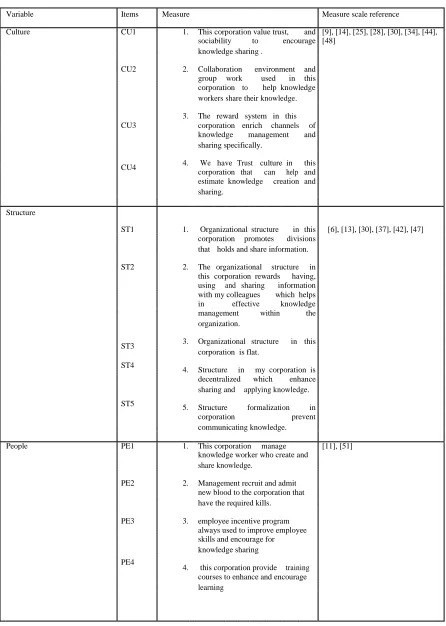
items from prior researches to ensure the validity of the content, where the scales used to measure the research constructs that were adapted from previous studies on knowledge management enablers, knowledge management process and organisational creativity appears in table 1-Appendix1. details the research constructs measurement and items, and measures the scale references for each factor. Based on (Table 1- Appendix1) the researchers tested the following hypotheses.
Firstly, the paper argues the direct effects of knowledge management enablers/factors and organisational creativity in H1. Thus, H1 is divided into four sub-hypotheses, as follows:
H1.1 Culture has an influence on organisational creativity in social security corporations in Jordan at (α ≤ 0.05).
H1.2 Structure has an influence on organisational creativity in social security corporations in Jordan at (α ≤ 0.05).
H1.3 People have an influence on organisational creativity in social security corporations in Jordan at (α ≤ 0.05).
H1.4 IT has an influence on organisational creativity in social security corporations in Jordan at (α ≤ 0.05).
Secondly, the paper argues the direct effects of knowledge management enablers on knowledge management processes in H2. Therefore, H2 is divided into four sub-hypotheses, as follows:
H2.1 Culture has an influence on KM processes in social security corporations in Jordan at (α ≤ 0.05).
H2.2 Structure has an influence on KM processes in social security corporations in Jordan at (α ≤ 0.05).
H2.3 People have an influence on KM processes in social security corporations in Jordan at (α ≤ 0.05).
H2.4 IT has an influence on KM processes in social security corporations in Jordan at (α ≤ 0.05).
Thirdly, the paper argues the direct effects of the
knowledge management process and
organisational creativity in H3, as follows:
H3.1 The knowledge management process has an influence on organisational creativity in social security corporations in Jordan at (α ≤ 0.05).
Finally, the paper argues the indirect effect between knowledge management enablers factors mediation through the knowledge management process on organisational creativity. Therefore, H4 is divided into five sub-hypotheses, as follows:
H4.1 The knowledge management process has mediated the relation of culture and organisational creativity in social security corporations in Jordan at (α ≤ 0.05).
H4.2 The knowledge management process has mediated the relation of structure and organisational creativity in social security corporations in Jordan at (α ≤ 0.05).
H4.3 The knowledge management process has mediated the relation of vision and strategy and organisational creativity in social security corporations in Jordan at (α ≤ 0.05).
H4.4 The knowledge management process has mediated the relation of people and organisational creativity in social security corporations in Jordan at (α ≤ 0.05).
H4.5 The knowledge management process has mediated the relation of IT and organisational creativity in social security corporations in Jordan at (α ≤ 0.05).
4. RESEARCH METHODOLOGY
A quantitative method has been used in this research paper, notably through the application of a survey approach to gather data. The researchers selected a questionnaire method to gather the data related to proposed model of organisational creativity, which helps to analyse
ISSN: 1992-8645 www.jatit.org E-ISSN: 1817-3195
the way in which social security corporations in Jordan use knowledge enablers and knowledge management processes so as to improve organisational creativity However, the researchers have used the Partial Least Square (PLS) method in order to examine the data collected during this study; this statistical method was used since it was recognised as the most suitable in regards the effects of independent factors on dependent ones with the existence of the mediating factor (knowledge management process) Furthermore, PLS has parameters that are recognised as the latest and most practical in the literature, written in that same type of studies [3].
4.1 Survey Size
[image:6.612.72.301.376.560.2]According to the 21 branches for social security corporations in Jordan selected as the research population, an online questionnaire was distributed over the official social security corporation website in Jordan so as to represent
Table 2: Parts of the corporation
Parts of Number Number of Number of
corporation of employees
parts of
in these returned
parts questionnaires
the
corporati from these
on parts
Branch 16 782 350
Sub-branch 3 48 42
Centralized 18 527 179
Directories
Total 37 1357 571
employees
the research population (all members and employees in the corporation). Firstly, the social security corporations in Jordan consisted of 1,350 working employees distributed across 21 branches in different locations in Jordan, with 1,000 of these employees recognised as knowledge workers with computers who perform their tasks through the use of technology. Secondly, 357 employees are support staff working in the corporation, such as in the roles of cleaners and drivers, etc.; therefore, this part of the research population was excluded from the survey questionnaires. As a result, 1,000 questionnaires were distributed, with 571 returned. All 571 questionnaires were fully completed. Finally, based on the parts of the social security corporations in Jordan, a total of 571 questionnaires were used for analysis. Furthermore, the survey size for 21 social security corporations and the number of questionnaires distributed across all three types of the corporations are presented in Table 2.
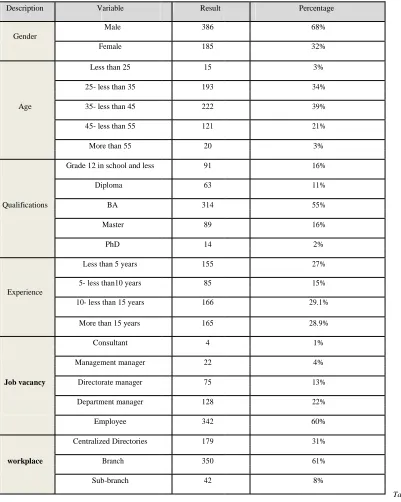
BA, whilst the smallest group in terms of qualifications related to PhD employees (14 or 2%). The largest group of respondents (166 or 29.1%) indicated that their years of experience ranged from 10 to 15 years, whilst the smallest group of respondents (4 or 1.7%) indicated that their years of experience ranged from 5 to 10 years. The largest group of respondents (342 or 60%) indicated that their job role was ordinary employee, whilst the smallest group of respondents (4 or 1%) indicated that their job role was consultant. Lastly, the largest group of respondents (350 or 61%) indicated that their role was as a branch employee, whereas the smallest group of respondents (42 or 8%) indicated that their workplace was a sub-branch. This demographic data is detailed in Table 3-Appendix2.
5.DATA ANALYSIS AND RESULT
5.1Demographic Data Results
The study population comprises 386 male respondents with a total percentage of 68% and 185 female responders with a total percentage of 32%. Additionally, the largest group of respondents (222 or 39%) ranged between 35 and 45 years of age. The smallest group (34 or 14.2%) of respondents were younger than 25 years old. Furthermore, the largest group of respondents (314 or 55%) were found to have a
5.2 Constructs Measurements Analysis
The smart Partial Least Square-Structure Equation Modelling (PLS-SEM) software has been adopted in this work as an approach to analysis in order to examine and anayse the data associated with all hypotheses. Accordingly, the expert data analysis and testing carried out by the researchers through the adoption of two respective stages [8]; investigated the content, convergent and discriminant validity of variables, and further implementing data testing in regards each of the inidivudal hypotheses, in line with the study framework.
ISSN: 1992-8645 www.jatit.org E-ISSN: 1817-3195
5.2.1 Path Loadings for the Integrated Model
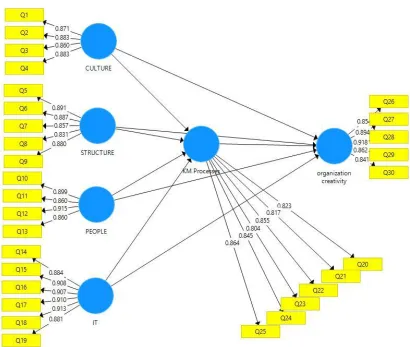
[image:7.612.94.504.259.606.2]In accordance with the preliminary stage, all factor loadings were found to value at least 0.55, which therefore means all factors linked with the study framework were correct and therefore deemed valid for analysis [16]. Figure 2 provides an overview of the path loadings results across all variables associated with the suggested framework
Figure 2: Path loadings for the Integrated Model
ISSN: 1992-8645 www.jatit.org E-ISSN: 1817-3195
[image:8.612.314.522.64.430.2]Figure 2 depicts the six individual elements, notably comprising the knowledge management enablers of culture, structure, people, IT, KM processes and organisational creativity. Furthermore, Table 4 provides a generalised overview of the factor loadings of the different research constructs.
Table 4: Constructs measurement
Variables Item Factors Result
loading
Knowledge Q1 0.871 Accept
Management
enablers Q2 0.883 Accept
Q3 0.860 Accept
Culture
Q4 0.883 Accept
Q5 0.891 Accept
Knowledge
Management
enablers
Q6 0.887 Accept
Structure
Q7 0.857 Accept
Q8 0.831 Accept
Q9 0.880 Accept
Knowledge Q10 0.899 Accept
Management
enablers
Q11 0.860 Accept
People
Q12 0.915 Accept
Q13 0.860 Accept
Q14 0.884 Accept
Knowledge
Management
Q15 0.908 Accept
enablers Q16 0.907 Accept
IT
Q17 0.910 Accept
Q18 0.913 Accept
Q19 0.881 Accept
Knowledge Q20 0.823 Accept
Processes
Q21 0.817 Accept
Q22 0.855 Accept
Q23 0.804 Accept
Q24 0.845 Accept
Q25 0.864 Accept
organizationa Q26 0.850 Accept
l creativity
Q27 0.894 Accept
Q28 0.918 Accept
Q29 0.869 Accept
Q30 0.841 Accept
In line with Table 4, it is possible to validate and therefore accept all items owing to the fact that, for all indicators, the standardised path loadings were found to exceed 0.55, meaning all are recognised as [16].
5.2.3 Reliability and Validity Test
The reliability and validity established in any research survey is ultimately influenced by the survey being well designed. In this vein, it would be accurate to state that these are the simple standards when evaluating the study’s accuracy and validity. In an effort to ensure the chance of receiving incorrect responses is lessened to the greatest possible extent, two particular components in the study design need to be taken into account: reliability and validity. In order to
684
[image:8.612.86.285.205.574.2]ISSN: 1992-8645 www.jatit.org E-ISSN: 1817-3195
In order to ensure the items in the questionnaire were recognised as both valid and reliable, Table 5-Appendix3 has been created so as to explain the Cronbach Alpha (CA) result, Composite Reliability (CR) result, and Average Variance Extracted (AVE) result for all model constructs. In terms of internal consistency reliability: Cronbach’s alpha was applied as the lower bound of the internal consistency reliability, with all CA and CR results recognised as being at least the minimum recommended value of 0.65 [36], which therefore suggests that all variables possessed acceptable reliability. One of the most widely adopted criterion inherent in regards convergent validity is the AVE [19], where an AVE value of at least 0.50 is recognised as suggesting that a construct can rationalise more than half of its indictators’ variance, which therefore highlights adequate convergent validity. Importantly, all fo the AVEs detailed in the table can be seen to range in value from 0.756 through to 0.811, meaning all constructs satisfy the convergen validity.
5.2.4 Discriminant Validity Test
The calculation of Latent Variable Correlations is carried out in mind of calculating the discriminant validity, which suggests that a construct needs to share a greater proportion of
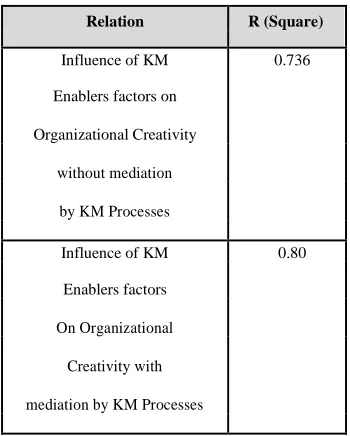
Table 7: R (Square) value
Relation R (Square)
Influence of KM 0.736
Enablers factors on
Organizational Creativity
without mediation
by KM Processes
Influence of KM 0.80
Enablers factors
On Organizational
Creativity with
mediation by KM Processes
variance with its measures than with other constructs detailed in a particular framework [19]. The results of the Latent Variable Correlations (discriminant validity) can be seen in the table below, with all constructs clearly seen to demonstrate a greater degree of variance with their indicators when contrasted alongside other constructs.
In line with Table 6-Appendix4, the findings suggest acceptable discriminant validity, where all of the correlation coefficients should not be greater than 0.8 so as to ensure multicollinearity between factors is not included. Any correlation coefficient found to exceed 0.80 would ultimately suggest an issue in terms of multicollinearity [23]. Following measurement model testing, with attention directed towards all parameters as detailed above, the framework may be viewed as both valid and reliable.
5.2.5 R (Square) Test
Path coefficient results values provide a clear insight into the link between all constructs in line with those mediation constructs used and those not used. As such, it was recognised that the application of the R (Square) test would be warranted in order to explain such interpretation capacities. The table below provides an explanation as to the values of R (Square). The R (Square) value, Table 7 linked with the variable KM enablers factors, without the adoption of KM processes as a mediation variable, was found to be 0.70, meaning it exceeded 25%; this defines a satisfactory and accepted prediction level in line with that suggested in the work of Gaur & Gaur [20]. In regards the value of the R (Square) related to the KM enablers factors variable and with the use of KM processes as a mediation variable, on the other hand, the value was recognised as 0.80, therefore exceeding 25%. This therefore may be expressed as an acceptable prediction level, in line with that emphasised by Gaur & Gaur [20]. Moreover, the R (Square) value is recognised as having changed from 70% to 80%; this may be inferred to mean that KM processes increased the percentage of R (Square) by as much as 10% when applied as the mediation variable in the framework under examination.
[image:9.612.89.264.486.704.2]ISSN: 1992-8645 www.jatit.org E-ISSN: 1817-3195
5.3 Hypotheses Testing
The logical analysis was implemented by the researchers in order to complete testing on the suggested framework so as to provide a comprehensive conclusion regarding the findings linked with the hypotheses through the adoption
[image:10.612.103.510.188.494.2]of the Bootstrapping analysis in smart PLS software. Lastly, through the conduction of the test, the rate of (T value) for all Influence of KM Enablers factors on Organisational Creativity, notably without the mediation of KM Processes, has been established. This can be seen in Figure 3.
Figure 3: Bootstrapping (T value) for KM Enablers factors on Organisational Creativity without the mediation of KM Processes
The rate of the (T value) can be seen in Figure 3, which focused on testing the hypotheses associated with the four individual KM enablers factors, namely culture, people, structure, and .
technology support, on Organisational Creativity, without the application of KM Processes as a mediation variable. Table 8 details
these results and their values
ISSN: 1992-8645 www.jatit.org E-ISSN: 1817-3195
Table8: Test results of KM Enablers factors on
Organisational Creativity without the
mediation of KM Processes
Relation T value Beta
(direct effect)
value
KM enablers
factors (culture)
2.675 0.153
on Organizational
Creativity
KM enablers
factors (structure)
4.024 0.311
on Organizational
Creativity
KM enablers
factors ( people)
3.834 0.238
on Organizational
Creativity
KM enablers
factors
(technology support) 4.150 0.231
on Organizational
Creativity
As a first point, this report discusses and considers the direct influences stemming from knowledge management enablers factors and organisational creativity, as outlined in H1. Accordingly, H1 is broken down into four individual sub-hypotheses, as follows.
In Table 8, the hypothesis analysis results are seen to be clarified for H1.1: Culture has an influence on organisational creativity in social security corporations in Jordan at (α ≤ 0.05), where the statistics T value was found to be (2.675) whilst the (Beta) Value ratio was (0.153), which provides a clear specification as to the alteration of one amount in Culture as reasoning a change equal to (0.153) in organisational creativity. Accordingly, it may be stated that culture has a positive influence on organisational creativity in social security corporations in the context of Jordan.
Additionally, Table 8 clarifies H1.2: Structure has an influence on organisational creativity in social security corporations in Jordan at (α ≤ 0.05), where the statistics T value was found to be (4.024), whilst the (Beta) Value ratio was (0.311), which provides a clear specification as to the alteration of one amount in Structure as reasoning a change equal to (0.311) in organisational creativity. Accordingly, it may be stated that structure has a positive influence on organisational creativity in in social security corporations in the context of Jordan.
Table 8 also clarifies H1.3: People have an influence on organisational creativity in social security corporations in Jordan at (α ≤ 0.05)., where the statistics T value was found to be (3.834), whilst the (Beta) Value ratio was (0.238), which provides a clear specification as to the alteration of one amount in People as reasoning a change equal to (4.150) in organisational creativity. Accordingly, it may be stated that People has a positive influence on Social Security corporations in the context of Jordan.
Lastly, Table 8 clarifies H1.4: IT has an influence on organisational creativity in social security corporations in Jordan at (α ≤ 0.05), where the statistics T value was found to be (4.150), whilst the (Beta) Value ratio was (0.231), which provides a clear specification as to the alteration of alteration of one amount in Technology support as reasoning a change equal to (0.231) in ERP Implementation success. Accordingly, it may be stated that the ERP Vendor Environment has a positive influence on Organisational Creativity in social security corporations in the context of Jordan.
As a second point, the test found (T value) influences KM Enablers factors on Organisational Creativity with the mediation of KM Processes. The (T value) for the research framework can be seen in Figure 4.
ISSN: 1992-8645 www.jatit.org E-ISSN: 1817-3195
Figure 4: Bootstrapping (T value) KM Enablers factors on Organisational Creativity with the mediation of KM Processes (Study Model)
[image:12.612.321.521.527.597.2]In line with Figure 4, the researchers established the (T value) through the adoption of the Smart Partial Least Square (PLS-SEM), which examined and tested all hypotheses associated with KM Enablers factors, namely culture, structure, people and IT, and KM Processes. Table 9 provides a summarised overview of the results.
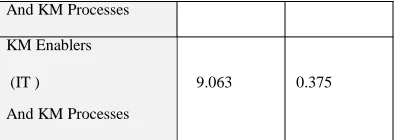
Table 9: Test results for KM enablers and KM processes
Relation T value Beta value
(direct effect)
KM Enablers
(culture ) 3.921 0.183
And KM Processes
KM Enablers
(structure ) 2.047 0.126
And KM Processes
KM Enablers
5.692 0.294
(people )
And KM Processes
KM Enablers
(IT ) 9.063 0.375
And KM Processes
This report focuses on the direct influences associated with knowledge management enablers in line with knowledge management processes. In this vein, H2 is devised and accordingly broken down into four individual sub-hypotheses, as discussed as follows:
The results detailed in Table 9 provide clarification for H2.1: Culture has an influence on KM processes in social security corporations
ISSN: 1992-8645 www.jatit.org E-ISSN: 1817-3195
in Jordan at (α ≤ 0.05), where the statistics T value was found to be (3.921), whilst the (Beta) Value ratio was (0.183), which provides a clear specification as to the alteration of one amount in Culture as reasoning a change equal to (0.183) in KM Processes. Accordingly, culture may be seen to have a positive influence on KM processes in in social security corporations in Jordan.
Table 9 further clarifies H2.2: Structure has an influence on KM processes in social security corporations in Jordan at (α ≤ 0.05), where the statistics T value was found to be (2.047), whilst the (Beta) Value ratio was (0.126), which provides a clear specification as to the alteration of one amount in Structure as reasoning a change equal to (0.126) in KM processes. Accordingly, structure shows a positive influence on KM processes in social security corporation in the context of Jordan.
[image:13.612.87.295.453.526.2]Table 9 provides clarification as to H2.3: People has an influence on KM processes in social security corporations in Jordan at (α ≤ 0.05), where the statistics T value was found to be (5.692), whilst the (Beta) Value ratio was (0.294), which provides a clear specification as
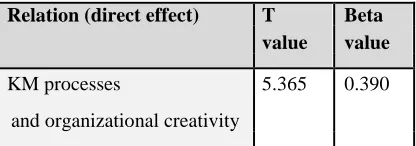
Table 10: Test results for KM processes and organisational creativity
Relation (direct effect) T Beta
value value
KM processes 5.365 0.390
and organizational creativity
Table 10 clarifies the acceptance of H3.1: Knowledge management processes have an influence on organisational creativity in social security corporations in Jordan at (α ≤ 0.05), where the statistics T value was found to be (5.365), whilst the (Beta) Value ratio was recognised as (0.390), which provides a clear specification as to the alteration of one amount in Knowledge management processes as reasoning Table 11-Appendix5 clarifies the acceptance of H4.1: Knowledge management processes are recognised as mediating the link between culture and organisational creativity in social security corporations in Jordan at (α ≤ 0.05). Culture is recognised as not having any impact on Organisational Creativity, whereas the statistics
to the alteration of one amount in People as reasoning a change equal to (0.294) in KM processes. Accordingly, People shows a positive influence on KM processes in social security corporations in the context of Jordan.
Lastly, the hypothesis analysis results detailed in Table 9 clarify H2.4: IT has an influence on KM processes in social security corporations in Jordan at (α ≤ 0.05), where the statistics T value was found to be (9.063), whilst the (Beta) Value ratio was (0.375), which provides a clear specification as to the alteration of one amount in IT as reasoning a change equal to (0. 375) in KM processes in social security corporations in Jordan. Accordingly, IT may be seen to have a positive influence on KM processes in social security corporations in the context of Jordan.
Furthermore, as can be seen when examining Figure 4, the (T value) test in the smart Partial Least Square.
(PLS-SEM) is applied in this work in order to analyse the hypotheses linked with KM processes and organisational creativity. In this vein, a summary of the results are provided in Table 10.
a change equal to (0.390) in organisational creativity. Accordingly, knowledge management processes may be seen to have a positive influence on organisational creativity in social security corporations in the context of Jordan.
1. Discussion and Implications
As can be seen in the last section, the statistical analysis results highlight that the T value test result was adopted through the use of the smart Partial Least Square (PLS-SEM) in order to confirm the variety of KM processes as adopting a mediatory role in the link between KM Enablers (culture, people, structure, and technology support) and Organisational Creativity. Details can be found in Tables 11,12,13 and 14 respectively. Organisational Creativity in social security corporations in the
context of Jordan.
T value has been recognised as (1.633), with the KM processes seen to have a significant influence on Organisational Creativity, where the statistics T value was found to be (5.365). Furthermore, the (Beta) Value ratio for (Indirect Effect) was calculated at (0.071), which provides a clear specification as to the alteration of one
ISSN: 1992-8645 www.jatit.org E-ISSN: 1817-3195
amount in Culture on KM processes as reasoning a change equal to (0. 071) in Organisational
Creativity. Accordingly, Knowledge
management processes is recognised as being completely mediated between Culture and
It is apparent from table 12-Appendix6 that Knowledge management processes mediate the relation of Structure and Organisational creativity in social security corporations in Jordan at (α ≤ 0.05). It may be seen that Structure has an influence on Organisational Creativity, where the statistics T value was found to be (3.813), with KM processes recognised as having a key influence on Organisational Creativity, where the statistics T value was found to amount to (5.365). Furthermore, the (Beta) Value ratio for (Indirect Effect) was calculated (0.049), which provides a clear specification as to the alteration of one amount in Structure on KM processes as reasoning a change equal to (0. 049) in
Organisational Creativity. Accordingly, Knowledge management processes are recognised as partially mediated when considering Structure and Organisational Creativity in social security corporations in the context of Jordan.
likewise, Knowledge management processes are seen from table 13-Appendix7 to mediate the link of people and Organisational creativity in social security corporations in Jordan at (α ≤ 0.05). People has an influence on Organisational Creativity, in which the statistics T value was found to be (2.374), with KM processes recognised as demonstrating a key impact on Organisational Creativity, where the statistics T value was calculated as (5.365). Furthermore, the (Beta) Value ratio for (Indirect Effect) is seen to be (0.114), which provides a clear specification as to the alteration of one amount in people on KM processes as reasoning a change equal to (0. 114) in Organisational Creativity. As a result, Knowledge management processes can be seen to be partially mediated between People and Organisational Creativity in social security corporations in Jordan.
What is more Knowledge management processes are seen from table 14-Appendix8 to mediate the relation of IT and Organisational creativity in social security corporations in Jordan at (α ≤ 0.05). Owing to IT being recognised as having no impact on Organisational Creativity, the statistics T value was seen to be (1.394), with KM processes demonstrating a significant influence on
Organisational Creativity, where the statistics T value was found to be (5.365). Furthermore, the (Beta) Value ratio for (Indirect Effect) has been calculated at (0.146), which provides a clear specification as to the alteration of one amount in IT on KM processes as reasoning a change equal to (0. 146) in Organisational Creativity. Accordingly, Knowledge management processes may be seen to adopt a complete mediated role between IT and Organisational Creativity in Social Security corporations in the context of Jordan.
The implications of this study are both practical and theoretical. At the practical level an investigation shows firstly; whether the institute is using the enablers of knowledge management and implementing KM processes which in turn affects the improvement and advanced in organizational creativity. Secondly; the study shows a significant role of KM enablers on organizational creativity with the mediate factor KM processes and this means that organization cant benefit from KM enablers to improve their organizational creativity without a clear use and understanding of KM processes, However, social security corporation and any other governmental institution in Jordan with similar circumstances must put in its consideration the ways must be taken to identify and enhance its knowledge management processes in order to achieve better organizational creativity. as well as to develop the appropriate policy, procedure, and funds to ensure this KM framework can be deployed in sustainable ways with considerable effects.
At the theoretical level; first; If we compare previous research and work in the field of Knowledge management and this research, we will find that this research clearly characterized by providing new integrated model that facilitates understanding of the relationship between KM enablers and organizational creativity, and which most of today's organizations seek to achieve in order to survive. Second; This integrated model is necessary, especially when applying the study in one of the most important institutions in Jordan; It is a general organization of financial and administrative independence that is always striving for excellence, transparency, social protection, economic development, and ensuring justice in the achievement of social security and economic development, therefore organizational creativity plays a critical role in such institution, which can be achieved in different ways such as
ISSN: 1992-8645 www.jatit.org E-ISSN: 1817-3195
knowledge management and its processes. This research framework is new of its kind which dealt with these two issues and came out with the above. At the end more empirical research is needed to determine the ways and extent to which this KM framework can be adopted in other public domain in Jordan.
2. Conclusion and Future Research
At the onset of this paper, focus was directed towards developing more in-depth insight into the direct and indirect relationships between
knowledge management enablers and
organisational creativity. Upon concluding this study, the indirect relationship centered on the link between culture and organisational creativity could not be validated, with acceptance recognised only in line with the presence of the mediating factor, notably knowledge management processes, which ensures the value of the role adopted by KM processes in the provision of innovative and creative systems in large-scale firms, such as the Social Security Corporations in Jordan. Nonetheless, the hypothesis centred on the role played by IT support in organisational creativity is also rejected, with the role of the mediating factor KM processes the only vein to be accepted, which suggests that all IT hardware, software and telecommunication advances, as well as those in the database of the social security corporation, do not provide contributions or influences in terms of organisational creativity; rather, it contributes only in terms of knowledge creation, sharing and codification (KM processes) . Moreover, the present study highlights a link in structure, in one way, and people, in another way, in line with organisational creativity; this link provides improved indicators in regards the KM processes role. Thus, knowledge management processes are valuable in regards organisational creativity in social security corporations in the context of Jordan. Such a finding may be considered in line with other firms of comparable circumstance and operations.
Without question, however, there is a need for further research with emphasis placed on establishing other components that could adopt a mediatory role in improving organisational creativity. In addition, Social Security Corporations and other similarly large-scale entities need to apply their policies in mind of improving attitudes and ethics that enrich the culture of creativity, thus meaning new ideas are introduced into and implemented within the firm. Lastly, organisational management needs to make sure their staff are on board in terms of acknowledging the creation and sharing of knowledge, and the definitions of such, through courses or workshops teaching of the advantages to be garnered in the IT sector in its corporation.
ACKNOWLEDGEMENT
We thank social security corporation in Jordan for supporting this research, we also thank our colleagues there who provided insight and expertise that greatly assisted the research. We would also like to show our gratitude to Nadia Alrawabdeh, General director of a social corporation in Jordan, for assistance with supporting the distribution of questionnaires over the official employee portal in all social security departments in Jordan and for comments that greatly improved the manuscript. We thank Abdallah Abujamous, chief assistant of general director in a social security corporation in Jordan for sharing his pearls of wisdom with us during the course of this research.
Corresponding Author:
Dr Mahmoud Al-dalahmeh
Department of Management Information Systems School of Business
The University of Jordan Amman 11942 Jordan
Email: [email protected]
*Appendix (construct coding) Available upon request
ISSN: 1992-8645 www.jatit.org E-ISSN: 1817-3195
REFERENCES
[1] Abraham, C. and Paul B. P. (2015) ‘CEO Ideational Facilitation Leadership and Team Creativity: The Mediating Role of Knowledge Sharing’, The Journal of Creative Behavior, Vol 49, No. 1,pp. 53.
[2] Alavi M. and Leidner E. D. (2001) Knowledge Management and Knowledge
Management Systems: Conceptual
Foundations and Research Issues, MIS Quarterly, Vol. 25, No. 1, pp. 107-136 [3] Alhawari, Samer, (2016), Relationship
among Project Management Processes and Knowledge Repository for Project Success, International Journal of Enterprise Information Systems (IJEIS), 12, No. 4, p. 16-30.
[4] Khalil, S. S., Dahiyat, S. E., & Al-dalahmeh, M. A. (2014). Intellectual capital development and its effect on technical innovation in banks operating in Jordan. Journal of Management Research, 6, No. 1, 211–238.
[5] Allahawiah, S., Al-Mobaideen, H., & al-Nawaiseh, K. (2013) The Impact of Information Technology on Knowledge Management Processes. International Business Research ,Vol 1, No. 6,pp. 235-252.
[6]Allameh, S., Zare, M. & Davoodi, S. (2011) “Examining the Impact of KM Enablers on Knowledge Management Processes,” Procedia Computer Science, Vol. 3, pp. 1211-1223.
doi:10.1016/j.procs.2010.12.196
[7] Anand, V., C.C. Manz, and W.H. Glick. 1998. An organizational memory approach to information management. Academy of Management Journal Vol 23, No.4, 796–809.
[8] Anderson, J.C. and Gerbing, D.W. (1988) Structural Equation Modeling in Practice: A Review and Recommended Two-Step Approach. Psychological Bulletin, 103, 411-423. https://doi.org/10.1037/0033-2909.103.3.411
[9] Carmeli, A. , Dutton, J.E. and Hardin, A.E. (2015), “Respect as an engine for
new ideas: linking respectful engagement, relational information processing and creativity among
employees and teams”, Human Relations , Vol. 68 No. 6, pp. 1021-1047.
[10] Chin, T. H. (2009) ‘The relationship between knowledge management enablers and performance’, Industrial Management & Data Systems, Vol. 109 No. 1, pp.98-117.
[11]Choi, B., S.K. Poon, and Davis J.G. (2008) ‘Effects of knowledge management strategy on organizational performance: A complementarity theory-based approach’, Omega 36: 235–251.
[12] Cirella, S., Canterino, F., Guerci, M., Shani, A.B. (2016) organizational Learning Mechanisms and Creative Climate: Insights from an Italian Fashion Design Company, Creativity and Innovation Management ,Vol 25, No. 2. pp. 211-222.
[13] Davenport, T. H., Prusak, L. (1998) Working knowledge: How organizations manage what they know, Harvard Business School Press, Boston
[14] DeTinne, K.B., Dyer, G., Hoopes, C., & Harris, S. (2004). Toward a model of effective knowledge management and direction for future research: Culture, Leadership, and CKOs. Journal of Leadership & Organizational Studies, Vol. 10, No 4, 26-43.
[15] Ekvall, G. (1996) ‘Organizational climate for creativity and innovation’, European Journal of Work and Organizational Psychology , Volume 5, Issue 1 .
[16] Falk, R. F., & Miller, N. B. (1992). A primer for soft modeling: Ohio: University of Akron Press.
[17]Fattahiyan, S., Hoveida, R., Siadat, S. A., & Tallebi, H. (2013) ‘Study of Relationship
Between Knowledge Management
Enablers and processes with Organization Performance’, Interdisciplinary journal of contemporary research in business, Vol 1, No. 11, pp 36-44.
[18] Fay, D., Shipton, H., West, M and Patterson, M. (2015) Teamwork and
Organizational Innovation: The
Moderating Role of the HRM Context, Creativity and Innovation Management, Vol 24, No.2, pp 261
[19] Fornell, C., & Larcker, D. F. (1981). Evaluating structural equation models with unobservable variables and measurement error. Journal of marketing research,
ISSN: 1992-8645 www.jatit.org E-ISSN: 1817-3195
Vol.18,No.1, 39-50.
http://dx.doi.org/10.2307/3151312
[20] Gaur, Ajaj S. & Gaur, Sanjaya S. Gaur (2006). Statistical Methods for Practice ,i < » and Research. New Delhi: Sage Publication.
[21]Gurteen, D. (1998) ‘Knowledge, Creativity and Innovation’, Journal of Knowledge Management, Vol. 2, No. 1, pp.5-13. [22] Hajir, J.A., Obeidat, B.Y., Al-dalahmeh,
M.A. and Masa’deh, R. (2015) The Role of Knowledge Management Infrastructure in Enhancing Innovation at Mobile Telecommunication Companies in Jordan. European Journal of Social Sciences, Vol. 50, No. 3, 313- 330.
[23] Hair, W. Black, R. Anderson, B.R. Babin, R.L. Tahtam Multivariate Data Analysis with Readings Mcmillan Book Company, London (2006)
[24] Hooge, S., Bejean, M. and Arnoux, F. (2016) ‘Organizing for radical innovation: The benefits of the interplay between cognitive and organizational processes in KCP workshops’, International Journal of innovation management .Vol. 20, No. 4, pp 33.
[25] Hurley, T.A. and Green, C.A. (2005),
“Knowledge management and the
nonprofit industry: a within and between approach”, Journal of Knowledge Management Practice, available at: www.tlainc.com/articl79.htm, Vol. 6. [26]Klaus, P. S., Silke, G., Christian, W., Jens,
K. (2015) ‘Toolkit-Based Modelling and Serious Play as Means to Foster Creativity in Innovation Processes’, Creativity and Innovation Management, Vol. 24, No.2, 323.
[27] Koustab, G.(2015) ‘Developing organizational creativity and innovation’, Management Research Review, Vol. 38, No. 11.
[28] Laird D. McLean (2005) ‘Organizational Culture’s Influence on Creativity and Innovation: A Review of the Literature and Implications for Human Resource Development’, Advances in Developing Human Resources. Vol. 7 , No2, pp 226-246
[29] Lawson, S. (2003). Examining the relationship between organizational culture and knowledge management. Doctoral dissertation, Nova Southeastern University.
[30] Lee, H. & Choi, B. (2003) ‘Knowledge Management Enablers, Processes, and
Organizational Performance: An
Integrative View and Empirical Examination’, Journal of Management Information Systems, Vol. 20 ,No. 1. [31] Lee, K. C., Lee, S., & Kang, I. W. (2005)
‘KMPI: measuring knowledge management performance’, Information & Management Journal, Vol 42, No.1, pp 469–482.
[32] Maruta R. (2014) ‘The Creation and
Management of Organizational
Knowledge’, Knowledge based systems (Elsevier), Vol 67. No 1 pp 26-34.
[33]Navimipour,N. J. and Charband, Y. (2016) ‘Knowledge sharing mechanisms and techniques in project teams: Literature review, classification, and current trends’, Computers in Human Behavior, Vol 62, No. C, 730-742.
[34] Ngoc, P.T. B. (2005). An empirical study of knowledge transfer within Vietnam’s information technology companies. Http:// diuf.unifer.ch/is/staff/ngoct/files/internal working paper- 10-6.pdf
[35] Nonaka. I., and Takeuchi, H. (1995) The Knowledge Creating Company. New York: Oxford press.
[36] Nunnally, J. C., & Bernstein, I. H. (1994) Psychometric theory (3rd ed.). New York, NY: McGraw-Hill, Inc.
[37] O'Dell, C. & Grayson, C.J. (1998) If only we knew what we know: the transfer of internal knowledge and best practice. New York: Free Press.
[38] Ooi, K.(2009) “ TQM and knowledge management. African Journal of Business Management , Vol.3 No.11.
[39] Ramadan, B., Dahiyat, S., Bontis, N. and Al-dalahmeh, M. (2017) Intellectual Capital, Knowledge Management and Social Capital within the ICT Sector in Jordan. Journal of Intellectual Capital, Vol. 18. No. 2.
[40]Rezaei, Z., Azam, R., Mojtaba, L. (2015)
Survey The Role Of Knowledge
Management On The Creativity And Innovation To Create Sustainable
Competitive Advantage For Organizations, Indian Journal of
Fundamental and Applied Life Science, Vol. 10, No. 4.
[41] Saulais, P., Ermine, J.L. (2012) ‘Creativity and knowledge management’, VINE, Vol. 42, No. 3, pp.416-438.
ISSN: 1992-8645 www.jatit.org E-ISSN: 1817-3195
[42] Schminke, M., Ambrose, M. L., & Cropanzano, R. (2000). The effect of organizational structure on perceptions of fairness. Journal of Applied Psychology, 85, 294-304.
[43] Scott. J.E. (2000) ‘ Facilitating inter organizational learning with information technology’. Journal of Management Information Systems, Vol. 17, No. 2, PP 81-113.
[44] Slater, L. (2004). Collaboration: A framework for school improvement. International Electronic Journal For Leadership in Learning, Vol.8, No.5, http://www.ucalgary.ca/~iejll/volume8/Slat er5.html.
[45] Song, M. & Fang Zhang & Bij, van der H.. & Weggeman, M.C.D.P.( 2001). "Information Technology, Knowledge Processes, and Innovation Success," ECIS Working Papers 01.07, Eindhoven Centre for Innovation Studies, Eindhoven University of Technology.
[46] Subrahmanyam, V. (2008) ‘systems approach for integrating knowledge management to total quality management in learning organizations’, national systems conference (NSC).
[47]Tata, J., & Prasad, S. (2004). Team self-management, organizational structure, and judgment of team effectiveness. Journal of Managerial Issues, Vol. 16, No. 2, 248-65. [48]Theriou, N., Maditinos, D., Theriou, G.
(2011) ‘Knowledge Management Enabler Factors and Firm Performance: An Empirical research of the Greek medium and large firms; European Research studies. VOL. XIV, No.2.
[49] Wiig, K. (2000). Knowledge management: An emerging discipline rooted in a long history. In D. Charles & D. Chauvel (Eds.), Knowledge horizons: the present and the promise of knowledge management (pp. 3– 26). Oxford: Butterworth-Heinemann. [50] Wong, K. Y. (2005) “Critical Success
Factors for Implementing Knowledge Management in Small and Medium Enterprises”, Industrial Management & Data Systems, Vol. 105, No. 3, pp 261-279. [51] Ying, J. Y., Sun, Q. L., Chin,T.H. (2006)
"Knowledge management enablers: a case study", Industrial Management & Data Systems, Vol. 106, No. 6, pp.793-810.
[52] Yu, S.-H., Kim, Y.-G., & Kim, M.-Y. (2007). Do we know what really drives KM performance?
Journal of Knowledge Management, Vol. 11, No. 6, 39-5.
ISSN: 1992-8645 www.jatit.org E-ISSN: 1817-3195
Table (1)- Appendix1 construct measurement (adapted from previous studies)
Variable Items Measure Measure scale reference
Culture CU1 1. This corporation value trust, and [9], [14], [25], [28], [30], [34], [44],
sociability to encourage [48]
knowledge sharing .
CU2 2. Collaboration environment and
group work used in this
corporation to help knowledge
workers share their knowledge.
3. The reward system in this
CU3 corporation enrich channels of
knowledge management and
sharing specifically.
CU4 4. We have Trust culture in this
corporation that can help and
estimate knowledge creation and
sharing.
Structure
ST1 1. Organizational structure in this [6], [13], [30], [37], [42], [47]
corporation promotes divisions
that holds and share information.
ST2 2. The organizational structure in
this corporation rewards having,
using and sharing information
with my colleagues which helps
in effective knowledge
management within the
organization.
ST3 3. Organizational structure in this
corporation is flat.
ST4
4. Structure in my corporation is
decentralized which enhance
sharing and applying knowledge.
ST5 5. Structure formalization in
corporation prevent
communicating knowledge.
People PE1 1. This corporation manage [11], [51]
knowledge worker who create and
share knowledge.
PE2 2. Management recruit and admit
new blood to the corporation that
have the required kills.
PE3 3. employee incentive program
always used to improve employee
skills and encourage for
knowledge sharing
PE4
4. this corporation provide training
courses to enhance and encourage
learning
[image:19.612.84.530.111.737.2]
ISSN: 1992-8645 www.jatit.org E-ISSN: 1817-3195
Technological support (IT) IT1 1. Information technology in this [3], [7], [13], [34], [43], [45]
corporation heavily enable
communication of information and
then enhance knowledge
IT2 management
2. This corporation owns a suitable
IT infrastructure that is capable to
IT3 support knowledge management
architecture.
3. Our corporation Invest in IT
IT4 which raise the level of
knowledge management project.
4. Knowledge transfer can be
IT5 enhanced when using information
technology.
5. IT used in this corporation helps
IT6 better in storage and codification
of knowledge.
6. IT support automating some tasks
in the corporation which enhance
transforming tacit into explicit
knowledge .
Knowledge management KC1 1. We contact our clients regularly to [1],[11],[13],[30],[33]
process identify their needs in present and
future.
KC2 2. Our system provide its users best
1. Knowledge creation practice and success stories we can
learn from other organization.
KS1 3. Our corporation aims are clear and
well known by all corporation
members.
KS2 4. This corporation has a periodically
2. Knowledge sharing meeting to inform employee about
the corporation achievement and
innovation.
3. Knowledge KCO1 5. Employee in this corporation
usually use and consults its
codification KCO2
database.
6. Our database kept up to date all the
time.
Organizational creativity OC1 1. Managers in this corporation can [18], [40]
receive the ideas of employees
without intermediaries.
OC2 2. my corporation respect its people.
OC3 3. Our corporation believe that its
employee help their corporation to
ISSN: 1992-8645 www.jatit.org E-ISSN: 1817-3195
grow.
OC4 4. my corporation main goal gives
attention to satisfying its clients
and community.
OC5 5. our corporation employee enjoy
their job security and other
features in this corporation
Table (3)- Appendix2 Demographic data
Description Variable Result Percentage
Gender
Male 386 68%
Female 185 32%
Less than 25 15 3%
25- less than 35 193 34%
Age
35- less than 45 222 39%
45- less than 55 121 21%
More than 55 20 3%
Grade 12 in school and less 91 16%
Diploma 63 11%
Qualifications
BA 314 55%
Master 89 16%
PhD 14 2%
Less than 5 years 155 27%
Experience
5- less than10 years 85 15%
10- less than 15 years 166 29.1%
More than 15 years 165 28.9%
Consultant 4 1%
Management manager 22 4%
Job vacancy
Directorate manager 75 13%
Department manager 128 22%
Employee 342 60%
Centralized Directories 179 31%
workplace
Branch 350 61%
Sub-branch 42 8%
Table
[image:21.612.99.500.237.739.2]
ISSN: 1992-8645 www.jatit.org E-ISSN: 1817-3195
Table (5)-Appendix3 validity and reliability results
Constructs Cronbach Alpha Average Composite
(CA)
Variance
Reliability
Extracted
(CR)
(AVE)
Culture 0.897 0.764 0.928
Structure 0.919 0.756 0.939
People 0.906 0.781 0.935
IT 0.953 0.811 0.963
Knowledge 0.913 0.698 0.932
Processes
Organizational 0.923 0.764 0.942
Creativity
Table (6) Discriminant
validity-Appendix4
Constructs Culture IT KM Processes People Structure Organizational
creativity
1.00
Culture
IT 0.718 1.00
KM Processes 0.788 0.825 1.00
0.785 0.759 0.828 1.00
People
Structure 0.839 0.762 0.814 0.846 1.00
Organizational 0.768 0.760 0.841 0.798 0.817 1.00
Creativity
[image:22.612.86.519.87.557.2]
![Figure 1: [ Study Integrated Model] From knowledge management enablers to organisational creativity model](https://thumb-us.123doks.com/thumbv2/123dok_us/8904793.956347/4.612.88.545.235.637/figure-study-integrated-knowledge-management-enablers-organisational-creativity.webp)