270
AN INTEGRATED AHP-TOPSIS METHODOLOGY TO
EVALUATE FOR ADOPTION COTS DATABASE
COMPONENTS BASED ON USABILITY
AWNI HAMMOURI
Associate Professor, CS Department, Faculty of Information Technology, Mutah University, Mutah, Karak, Jordan
Email: [email protected]
ABSTRACT
The judicious use of commercial off-the-shelf (COTS) components in development projects of large systems has effectively accommodated the changing business landscape in addition to providing better software reuse functionalities. Greater productivity, flexibility, ownership and reusability, accelerated development, increased dependability, and reduced process risk being some of the many. A bigger risk is involved in choosing a right component among many available alternatives, which is also considered a hard process. The involvement and contribution of different stakeholders with vested interests further complicates this process. End users would prefer being abstracted from such a process and are primarily concerned with an easy product usage, effectively making Usability a much focused attribute. This drives the need for a mechanism to help stakeholders make such abstracted decisions. Multiple conflicting criteria during decision making can be explicitly evaluated through MCDA and MCDM - Sub-Disciplines of Operations research. Here we introduce one such decision-making methodology. Well-known MCDM techniques, namely Analytic Hierarchy Process (AHP) and Technique for Order Preference by Similarity to Ideal Solution (TOPSIS) have been employed to generate a hybrid approach from AHP and TOPSIS. This approach facilitates the ability to analyze and select the best alternative from a number of COTS components, a crucial feature in decision making. We begin with obtaining the weights of selected criteria and then the structure of the database software selection problem will be analyzed. Finally, the alternatives’ ratings COTS or Database Software component will be calculated by using TOPSIS Technique.
Keywords: Commercial of the shelf (COTS), Technique for Order Preferences by Similarity to the Ideal Solution (TOPSIS), Analytical Hierarchy Process (AHP), usability, Multiple Criteria Decision Making (MCDM), Entity Relation Model (ERM), Data Flow Diagram (DFD)
1. INTRODUCTION
Using commercial off-the-shelf (COTS) software products in large systems provides many benefits, including the potential of rapid delivery to end users, lower risk, and the opportunity to reuse software components that are already tested and validated. During the
system development life cycle, many
stakeholders contribute from their own objectives, perspectives, and interests. For example, a business owner would primarily be concerned with meeting system requirements within an allotted budget and schedule. Analysts would want the product built per requirements.
Quality assurance would focus on the quality of products and services as provided to the customers. End users would desire a product that is easy to use, difficult to misuse, and performs as intended. A project manager would want to construct and manage the development process. Consequently, for systems that depend on COTS products, the evaluation and selection of appropriate products is essential to the success of the entire system.
Numerous systems are being built using COTSs worldwide under different circumstances
and different operational environment
271 products, the benefits can be outlined easily. However, the process of choosing a particular COTS package among several existing ones is a hard one for organizations. The choice of adopting the best COTS has to be completely investigated and carefully understood.
This contribution suggests an evaluation process that serves the purpose of choosing the appropriate COTS in an organization by a group of developers. The evaluation process provides the knowledge that is necessary to be certain about choosing a particular method, and without such knowledge the uncertainty will compromise the benefits. Thus, choosing the appropriate COTS achieves a high degree of reusability and the desired benefits. Although in the literature several methodologies can be found to assess decision makers to evaluate COTS alternatives for adoption, none of them used three levels of criteria, and there was no attempt to integrate AHP with other techniques used in such
circumstances. The importance of our
methodology herein is the fact that it overcomes previous shortfalls through applying three levels
of criteria, characteristics, and
sub-characteristics, along with the concept of integrating AHP with TOPSIS.
The starting point for our work is the Matalkah and Rawashdeh model [2] simply because it includes the common software quality characteristics. The following is the evaluation discussion of the high-level of characteristic Usability, along with their associated sub-characteristics.
Usability is the capability of the software product to be understood, learned, used and attractive to the user, when used under specified conditions. Usability is related to the set of attributes that bear on the effort needed for use, and on the individual assessment of such use, by a stated or implied set of users. In addition, Usability is the effort required to learn, operate, prepare input, and interpret output of a program [1]. In Commercial of The Shelf (COTS), most stakeholders of components are the application developers, designers that have to build applications with them, and end-users who interact with COTS. Thus, the Usability of a component should be interpreted as its ability to be used by the application developer and designer when constructing a new software product. The sub-characteristics of usability are
"Learnability, operability, understandability and complexity" [2]. "Learnability": The capability of the software product to enable the user to learn its application, "Understandability: The capability of the software product to enable the user to understand whether the software is suitable, and how it can be used for particular tasks and conditions of uses, “Operability": The capability of the software product to enable the user to operate and control it or the ease of operating a program. An evaluation is made, for each of the attributes, by comparing the corresponding feature among Oracle 9i and SQL Server 2005. The objective of this step is to obtain pairwise comparison judgment matrices; which will be used to determine the normalized weights. The Analytic Hierarchy Process (AHP) methodology developed by Thomas L. Saaty [9] is probably the best-known and most widely-used model in decision-making. It is a powerful traditional decision-making tool in determining the priorities among different criteria, the Technique for Order Preference by Similarity to Ideal Solution (TOPSIS) method is used to solve problems using multi-criteria decision-making process. On the other hand, the new developed model, herein, features the ability to analyze and select the best alternative from a number of COTS components using AHP and TOPSIS techniques as a hybrid approach.
The remainder of this paper is organized as follows: Section II presents the Literature Review. Section III describes the AHP methodology. Section IV describes the TOPSIS method. Section V. Proposed integrated multi criteria decision methodology. Section VI. Defining the Attributes and Assigning their Appropriate Metrics. Section VII. Weights Generation Methods with TOPSIS Approach in the AHP, section VIII. Reasoning the choice of best alternative, Finally, Section IX draws out the Conclusions and Future work.
2. LITERATURE REVIEW
272 architectural, functional and non-functional aspects. in [4] tells that Multi Criteria Decision Making Methods helps the decision makers to solve the problem of selection and evaluation of software components in which problem is defined as a collection of multiple criteria that needs to be taken into account. It gives the overview of Multi Criteria Decision Making Methods like: Analytic Hierarchy Process (AHP), Weighted Scoring Method (WSM) and Hybrid Knowledge Based System (HKBS). It compares the three approaches and concludes that HKBS is better than AHP and WSM. Arvinder Kaur et al. in [5] provide a brief overview of the evolutionary techniques. It also derives a hierarchical decomposition method to draw goals from that impact factors. It introduces Off-The-Shelf-Option (OSTO) method for the selection of software components which compares the scores and cost associated to each alternative and their relative comparison. It introduces various factors in the selection of reusable software components. It also presents the evaluation criteria based on various classifications as functional requirements, product quality attributes, strategic concerns and architecture and domain compatibility. It gives the result of two case studies using Off-The-Shelf-Option (OSTO) method. The component which have good quality assurance score is selected for consideration. Wei et al. In [6] used the AHP method to identify priority in selecting ERP System. Similarly, Yigit et al. In [7] developed an interactive model using AHP to facilitate the selection of Web-based learning object software. In [8] applied ANP method to appraise and select the best Operating system with regard to organizational factors and strategic performance metrics.
3. THE ANALYTICAL HIERARCHY PROCESS (AHP) METHODOLOGY
The AHP is developed by Thomas L. Saaty [9], probably the best-known and most widely-used model in decision-making. It is a powerful decision-making tool in determining the priorities among different criteria. The AHP encompasses six basic steps
Step1. AHP decomposes a complex decision problem into several sub-problems forming a hierarchy. The goal of the problem is placed at the top level, representing the root, and the characteristics are decomposed into several
nested sub-levels representing the process of breaking down the criteria into sub-criteria.
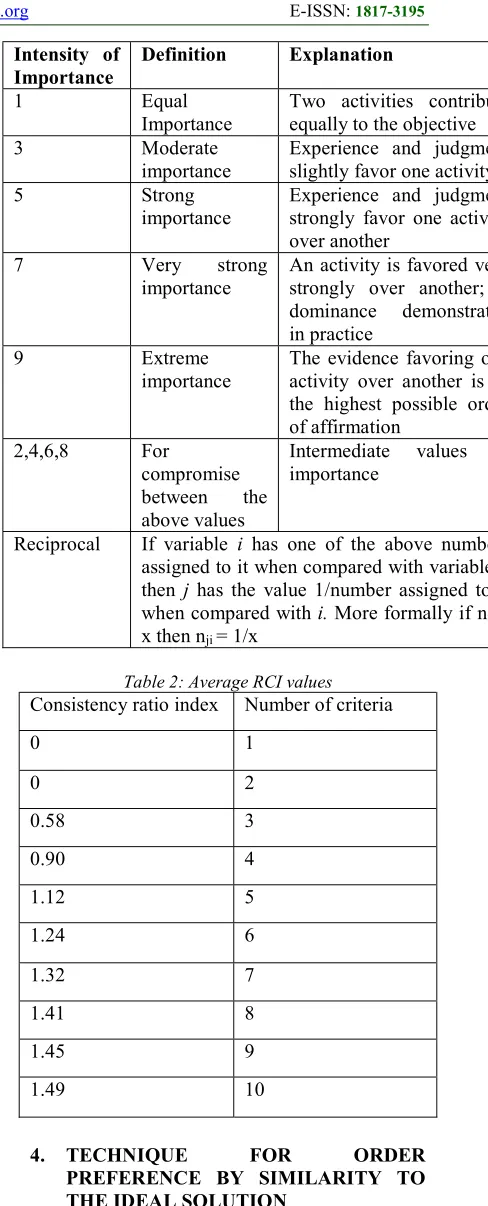
Step2. A decision matrix, based on Saaty's nine-point scale, is constructed. The decision maker uses the fundamental 1-9 scale to assess the priority score. In this context, the assessment of 1 indicates equal importance, 3 moderately importance, 5 strongly importance, 7 very strongly importance, and 9 indicate extreme importance (Table 1). The values of 2, 4, 6, and 8 are intermediate values of importance. The decision matrix involves the assessments of each alternative in respect to the decision criteria. If the decision making problem consists of n criteria and m alternatives; the decision matrix takes the form:
Step3. The third step involves the comparison in pairs of the elements that make up the hierarchy. The aim is to set their relative priorities with respect to each of the elements at the next level up. The Pairwise comparison matrix, based on the Saaty's one-to-nine scale, has the following format, where wi represents the weight value of the criteria:
Decision-Matrix
Pair-Comparison-Matrix
Assuming n is the number of criteria, and then the number of pairwise comparisons between them is equal to n (n-1)/2. Each value (aij) in the left-hand matrix is matched with the corresponding (wi/wj) value in the right hand matrix. Each pairwise, aij wi/wj, is computed as follows:
273 criteria over jth criteria. It appears that the weight determination of criteria is more reliable when using pairwise comparisons compared to the method of obtaining them directly, because it is easier to make a comparison between two attributes than to make an overall weight assignment.
Step4: Verify the consistency of judgments
across the Consistency Index (CI) and the Consistency Ratio (CR)
where λmax is the Eigen value corresponding to the matrix of pair-wise comparisons and n is the
number of elements being compared,
Consistency ratio (CR) is defined by:
where, (RCI) is a random consistency index defined in Table 2. A value of CR less than 0.1 is generally acceptable; otherwise the pair-wise comparisons should be revised to reduce incoherence.
Step5. The comparison matrix has to be normalized. Therefore, each element has to be divided by the sum of the entries of the corresponding column. In that way, a normalized matrix is obtained in which the sum of all elements vector is 1.
[image:4.612.309.553.73.676.2]Step6. The eigenvalues of this matrix need to be calculated, which would give the relative weights of criteria. The relative weights obtained in the third step should satisfy the formula: A * W = λmax Where A represents the Pairwise comparison matrix, W represents the weight and λmax represents the highest eigenvalues. If there are elements upward on the hierarchy, the weight vector is calculated by multiplying each element (weight coefficient) by its parent at the higher level, this process continues until the top of the hierarchy is reached. The alternative with the highest weight coefficient value should be taken as the best alternative.
Table 1: Scale of relative importance according to [9]
Intensity of
Importance Definition Explanation
1 Equal
Importance Two activities contribute equally to the objective
3 Moderate
importance Experience and judgment slightly favor one activity
5 Strong
importance Experience and judgment strongly favor one activity over another
7 Very strong
importance An activity is favored very strongly over another; it dominance demonstrated in practice
9 Extreme
importance
The evidence favoring one activity over another is of the highest possible order of affirmation
2,4,6,8 For
compromise
between the
above values
Intermediate values of importance
Reciprocal If variable i has one of the above numbers
assigned to it when compared with variable j,
then j has the value 1/number assigned to it
when compared with i. More formally if nij =
x then nji = 1/x
Table 2: Average RCI values
Consistency ratio index Number of criteria
0 1
0 2
0.58 3
0.90 4
1.12 5
1.24 6
1.32 7
1.41 8
1.45 9
1.49 10
4. TECHNIQUE FOR ORDER PREFERENCE BY SIMILARITY TO THE IDEAL SOLUTION
[image:4.612.317.528.399.681.2]274 and Yoon [10]. Its basic concept is that the chosen alternative should have the shortest distance from the ideal solution and the farthest from the negative-ideal solution. TOPSIS assumes that we have m alternatives (options) and n attributes/criteria and we have the score of each option with respect to each criterion. The steps of TOPSIS model are as follows:-
Step 1: Construct normalized decision
matrix. This step transforms various attribute dimensions into non-dimensional attributes, which allows comparisons across criteria. Normalize scores or data as follows
rij = xij/ (x2ij) for i = 1, …, m; j = 1, …, n Step 2: Construct the weighted normalized decision matrix. Assume we have a set of weights
for each criteria wj for j = 1,…n, Multiply each
column of the normalized decision matrix by its associated weight, An element of the new matrix is: vij = wj rij
Step 3: Determine the ideal and negative ideal solutions. Using the following equations A* = { v1*, …, vn*}, where vj*={ max (vij) if j
J ; min (vij) if j J' } for ideal solution A' = { v1', …,vn' }, where v' = { min (vij) if j
J ; max (vij) if j J' } for negative solution Step 4: Calculate the separation measures for each alternative. Using the following equations : Si *= [ (vj*– vij)2 ] ½ i = 1, …, m for the ideal alternatives
S'i = [ (vj' – vij)2 ] ½ i= 1,……,m for the negative alternatives
Step 5: Calculate the relative closeness to the ideal solution Ci*
Ci*= S'i / (Si* +S'i ) , 0 < Ci*< 1 Step 6: Select the option with Ci* closest to 1.
5. PROPOSE INTEGRATED MULTI-CRITERIA DECISION METHODOLOGY.
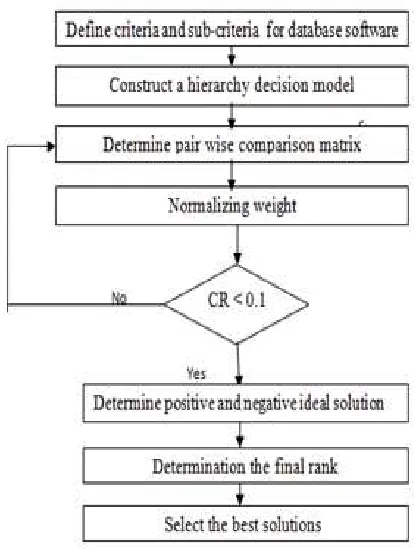
The proposed methodology is designed in such a way that makes the use of Multiple Criteria Decision Making (MCDM) techniques as efficient as possible. Two different techniques, namely AHP and TOPSIS, are combined in order to rank alternative software according to criteria. The reason for using the well-known AHP technique is to structure the decision hierarchy of the problem. Finally, to rank the alternatives, one of the most efficient MCDM techniques such as TOPSIS is used. The main steps of the proposed integrated
methodology to be elaborated by decisions-makers for the database software selection problem are as follows:
Step 1: Define criteria and sub-criteria that are most affecting in the Database software
selection problem
.
Step 2: Construct a hierarchy decision model for the Database software.
Step 3: Determine the comparison matrix for each level (level of criteria and sub-criteria) by using AHP technique.
Step 4: Determine the global weight by normalizing the local weight.
Step 5: Use the TOPSIS technique to assess the alternatives.
[image:5.612.328.535.292.566.2]Step 6: Select the best Database software alternative
Figure 1: illustrates the process of the proposed integrated methodology to evaluate and select the
Database software.
275 the uncertainty will compromise the benefits. Thus, choosing the appropriate COTS achieves a high degree of reusability and the desired benefits. The starting point for our work is the Matalkah and Rawashdeh model [2] simply because it includes the common software quality characteristics.
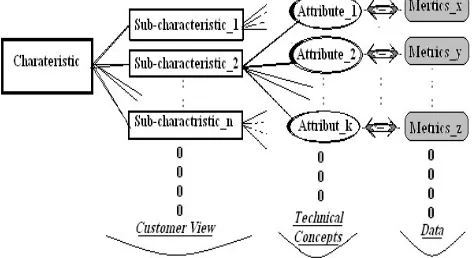
Our suggested framework is useful for its integrated approach to quality. Each high-level characteristic of database software product is associated with a set of sub-characteristics. A sub-characteristic is, further, represented by sets of software quality attributes. This chain of software quality attributes can be classified into a hierarchy of three levels as shown in Figure 2. At the top level the so-called "characteristic" from a customer or stakeholders perspectives:, usability . At the second level the so-called " Sub-characteristics" or quality factors from a
customer or stakeholders perspectives:
[image:6.612.64.300.410.539.2]Learnability, operability, understandability and complexity. At the third level are the quality criteria (attributes), which represent technical concepts. At the fourth level the "metrics" that measure the quality criteria (attributes) of database software product.
Figure 2: Framework of COTS Quality Attributes
The following is the evaluation discussion of the high-level of characteristic Usability, along
with their associated sub-characteristics.
Usability is the capability of the software product to be understood, learned, used and attractive to the user, when used under specified conditions. Usability is related to the set of attributes that bear on the effort needed for use, and on the individual assessment of such use, by a stated or implied set of users. In addition, Usability is the effort required to learn, operate, prepare input, and interpret output of a program [1]. In COTS, most stakeholders of components are the application developers, designers that
have to build applications with them, and end-users who interact with COTS. Thus, the Usability of a component should be interpreted as its ability to be used by the application developer and designer when constructing a new software product. The sub-characteristics of
usability are "Learnability, operability,
understandability and complexity" [2] .
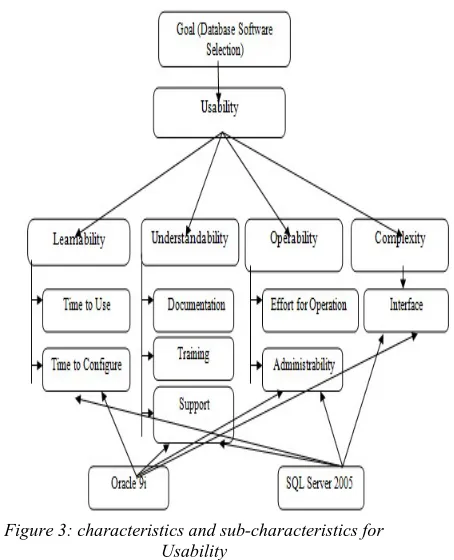
Learnability: The capability of the software product to enable the user to learn its application [11], it requires attention to the needs of the novice and uninitiated users, the uninitiated user is one that has no previous experience with the software or similar software, the novice user has either had some experience with similar software or has limited experience with the software [12]. There is a set attributes that try to measure the time needed to master some specific task (such as usage or configuration). Here in, Learnability attributes will be decomposed into the following: (i) Time to Use: Attribute measures the average time needed for a developer to learn how to correctly use the database software component, (ii) Time to Configure: Attribute measures the Average time needed for a developer to learn how to correctly configure the component, and for properly understanding its configuration parameters.
276 vendor through surveys, web, discussion, groups, interview, and news.
Operability: The capability of the software product to enable the user to operate and control it [11], or the ease of operating a program [13]. Here in the Operability attributes will be decomposed into the following: (i) Effort for Operating attribute indicate the level of effort needed to properly operate the software component. (ii) Administrability attribute indicates the level of effort needed to properly administer the software component.
Complexity: This characteristic aims at measuring the complexity of using and integrating the component into the final system. For that we will measure the number of provided and required interface, and average number of operations per interface. Here in the Complexity attributes will be decomposed into the following : (i) Required Interface: number of interfaces that the COTS component requires from other components to operate.
A new framework, dedicated to COTS-based reuse, has been built to support a standard set of software quality characteristics suitable for evaluating COTS components, along with newly defined sets of sub-characteristics associated with them. The new framework avoids some of the limitations found in other existing framework. The new framework ignores quality characteristics that are not applicable to COTS components and is empowered with new ones that are. The same new framework has been further enhanced through identifying new attributes for the quality sub-characteristics in the framework, and defining metrics rules to measure the quality of these new attributes. Figure 3 in shows the breakdown of the attributes along with their associated metrics and criteria.
[image:7.612.326.553.100.380.2]In this contribution, the framework is tested with Integrated AHP-TOPSIS Methodology to evaluate and select the favorable COTS product among Oracle 9i and SQL Server 2005.
Figure 3: characteristics and sub-characteristics for Usability
Using Saaty scaling-table, and the AHP six steps, a weight value is assigned for each of
the characteristics: learnability,
understandability, operability, complexity. The outcome is shown in Matrix-1
Matrix-1: Pairwise Comparisons Judgment for the Sub-Characteristics According to Usability
Usability learnability understandability operability complexity Priority
learnability 1 2 5 5.6 0.52
understand ability
0.50 1 2.50 2.80 0.27
operability 0.20 0.40 1 1.12 0.11
complexity 0.18 0.30 0.89 1 0.10
CR =0.013 ∑priority = 1
A weight value is assigned for each of the sub-characteristics: Time to Use, Time to Configure. The outcome is shown in Matrix-2.
Matrix-2: Pairwise Comparisons Judgment for the Sub-Characteristics According to Time to Use, Time
to Configure
learnability Time to Use Time to
Configure Priority
Time to Use 1 2 0.67
Time to
Configure
0.5 1 0.33
277 A weight value is assigned for each of the sub-characteristics: Documentation, Tanning, and Support. The outcome is shown in Matrix-3.
Matrix-3: Pairwise Comparisons Judgment for the Sub-Characteristics According to Documentation,
Tanning, Support
Understand
ability Documentation Tanning Support Priority
Documenta
tion 1 2 2 0.50
Tanning 0.50 1 1 0.25
Support 0.50 1 1 0.25
CR = 0.0 ∑priority = 1
A weight value is assigned for each of the
sub-characteristics: Effort for Operating,
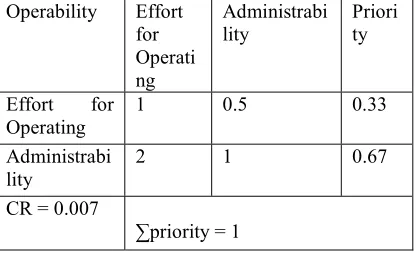
Administrability. The outcome is shown in Matrix-3
Matrix-3: Pairwise Comparisons Judgment for the Sub-Characteristics According to Effort for
Operating, Administrability
Operability Effort
for Operati ng
Administrabi lity
Priori ty
Effort for
Operating 1 0.5 0.33
Administrabi
lity 2 1 0.67
CR = 0.007 ∑priority = 1
A weight value one is assigned to the attribute Required Interface because Complexity sub-characteristic is decomposed into one attributes.
6. WEIGHTS GENERATION METHODS WITH TOPSIS APPROACH IN THE AHP
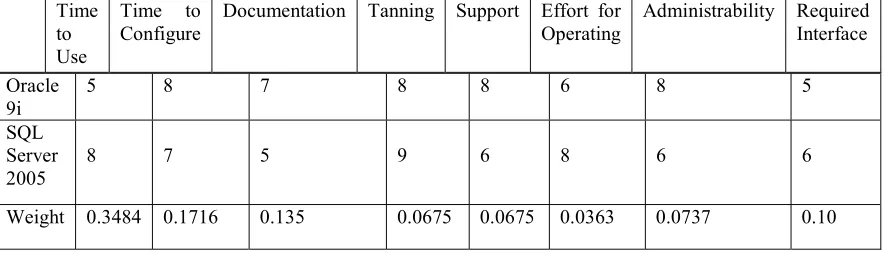
[image:8.612.87.295.379.513.2]TOPSIS method is applied in order to rank the alternative database software. The global weights of each sub-criterion which are calculated by AHP table 3, can be used as the input in TOPSIS method. Then using the scale in Table 1, the decision-makers are asked to evaluate the alternatives according to each sub-criterion Table 4.
Table 3: the normalized sub-criteria weightings
Criteria weight Sub-criteria weight Level
two
Learnability 0.52 Time to Use 0.67 0.3484
Time to
Configure
0.33 0.1716
Understanda
bility 0.27 Documentation 0.50 0.135
Tanning 0.25 0.0675
Support 0.25 0.0675
Operability 0.11 Effort for
Operating 0.33 0.0363 Administrability 0.67 0.0737
Complexity 0.10 Required
Interface 1.0 0.10
⅀ weight
=1.0 Level ⅀
278
Table 4 Input values of the TOPSIS analysis
Time to Use
Time to Configure
Documentation Tanning Support Effort for Operating
Administrability Required Interface
Oracle
9i 5 8 7 8 8 6 8 5
SQL Server
2005 8 7 5 9 6 8 6 6
Weight 0.3484 0.1716 0.135 0.0675 0.0675 0.0363 0.0737 0.10
The second step is calculate (x2
ij )1/2 for each column as illustrated in Table 5, third step divide
each column by (x2ij )1/2 to get rij as illustrated in table 6.
Table 5: calculate (x2
ij )1/2 for each column Tim
e to Use
Time to Configur e
Documentatio n
Tannin g
Suppor t
Effort for Operatin g
Administrabilit y
Require d Interfac e Oracle
9i 25 64 49 64 64 36 64 25
SQL Server
2005 64 49 25 81 36 64 36 36
⅀Xij2 89 113 74 145 100 100 100 61
(⅀Xij2)0.
5 9.43 10.63 8.60 12.04 10 10 10 7.81
Table 6: divide each column by (x2ij )1/2 Tim
e to Use
Time to Configur e
Documentatio
n Tanning Support Effort for Operatin
g
Administrabilit
y Required
Interfac e Oracl
e 9i 0.53 0.75 0.81 0.66 0.80 0.60 0.80 0.64
SQL Serve r 2005
0.85 0.66 0.58 0.75 0.60 0.80 0.60 0.77
Table 6 divides each column by (x2ij )1/2 to get r
ij Fourth step is multiply each column
by wj to get vij. as illustrated in table 7, fifth step
279
Table 7:ideal solution
Time to Use
Time to Configur e
Documentatio
n Tanning Support Effort for Operatin
g
Administrabilit
y Required
Interfac e Oracl
e 9i
0.18 5
0.129 0.109 0.046 0.054 0.022 0.059 0.064
SQL Serve r 2005
0.30 0
[image:10.612.88.527.74.260.2]0.113 0.078 0.051 0.041 0.029 0.044 0.077
Table 7 multiply each column by wj to
get vijSixth step find negative ideal solution A' ,
A' = {0.185, 0.113, 0.078, 0.046, 0.041, 0.022, 0.044, 0.064}, seventh step determine separation
from ideal solution, Si*= [ (vj*– vij)2 ] ½ for each row as illustrated in table8 Si*= {0.0135, 0.0019}.
Table 8: separation from ideal solution
Time
to Use Time to Configur e
Documentatio
n Tanning Support Effort for
Operatin g
Administrabili
ty Required
Interfac e Oracl
e 9i 0.01323 0.0 0.0 0.000003 0.0 0.00005 0.0 0.00017
SQL Serve r 2005
0.0 0.00056 0.00096 0.0 0.0001
7 0.0 0.00023 0.0
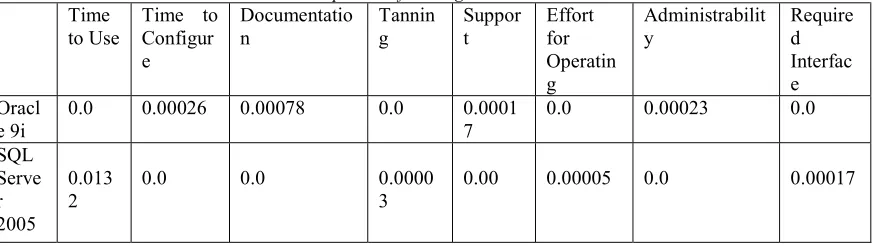
Eighth step find separation from negative ideal solution Si'= [ (vj'– vij)2 ] ½ for each row as illustrated in table 9, Si'= {0.038,
0.116}, final step calculate the relative closeness to the ideal solution Ci*= S'i / (Si* +S'i ).
C* = 0.038/ (0.0135+ 0.038) = 0.74 for Oracle 9i
C* = 0.116/ (0.0019+ 0.116) = 0.98 for SQL server 2005 (which is the best)
Table 9: separation from negative ideal solution
Time
to Use Time to Configur e
Documentatio
n Tanning Support Effort for
Operatin g
Administrabilit
y Required
Interfac e Oracl
e 9i 0.0 0.00026 0.00078 0.0 0.00017 0.0 0.00023 0.0
SQL Serve r 2005
0.013 2
0.0 0.0 0.0000
3
[image:10.612.85.529.324.520.2] [image:10.612.92.529.559.682.2]280
7. REASONING THE CHOICE OF BEST ALTERNATIVE
Once computing the normalized priority weights for each Pairwise Comparison Judgment Method (PCJM) of the Integrated AHP-TOPSIS Methodology has been carried out, the next step is to synthesize the solution for the database selection problem. As mentioned in Section VII above, the normalized local priority weights of the characteristics, sub-characteristics and attributes are added together to obtain the global composite priority weights. Accordingly, for Oracle 9i, the formula will be applied as follows: Ci*= S'i / (Si* +S'i ). C* = 0.038/ (0.0135+ 0.038) = 0.74 for Oracle 9i . On the other hand, for SQL Server 2005, the formula will be applied as
follows: C* = 0.116/ (0.0019+ 0.116) = 0.98. It
can be seen that AHP-TOPSIS integration projects the winner component as to have a value 0.98; while the other component is 0.74. Therefore, SQL Server is the winner of this evaluation process and thus would be selected as the best COTS database component.
Consequently, our methodology produces a clear cut numeric value which contributes to an easy decision to make. In addition, adopting the hybrid approach of AHP and TOPSIS in our methodology overcomes the limitation of previous work as mentioned in the Literature Review. Thus, the distinction here is the computation that leads to a numeric preference value which facilitates the decision-making process.
8. CONCLUSION AND FUTURE WORK
The objective of the proposed methodology for database software selection is to find the best database software component among available ones in Commercial off the Shelf (COTS) systems by using the appropriate decision-making technique.
After checking the aggregations on various
process parameters under different
circumstances, as illustrated in Sections VI and VII above, it can be observed that the proposed model is rather simple to use and meaningful for
any aggregation of the process parameters
.
Asdescribed in the literature review, there are several existing techniques used to assess decision makers to evaluate COTS alternatives, however none of them used three levels of criteria for alternatives, and there was no attempt to integrate AHP with another technique. Our
methodology herein overcomes previous
shortfalls through applying the three levels of criteria, characteristics, and sub-characteristics along with the concept of integrating two techniques.
Our contribution presents an application of methodology based on a hybrid multi-criteria decision-making process. The methodology consists of two techniques: Analytical Hierarchy Process (AHP) and Technique for Order Preference by Similarity to the Ideal Solution (TOPSIS) for order preference. Although our testing sample only used two COTS components, the proposed methodology can be applied for any other software selection problem involving several COTS components with multiple and conflicting criteria. In addition, the hybrid concept in our model and the fact that the preference indication computed as an explicit numeric value does facilitate the decision-making process and overcomes the limitations encountered with previous research work mentioned in the Literature Review Section.
For further work, there are several different techniques of MCDM, these include: The Elimination Et Choix Traduisant la Realite’ (elimination and choice expressing reality – (ELECTRE)), Measuring Attractiveness by a
Categorical Based Evaluation Technique
(MACBETH), Preference Ranking Organization
Method for Enrichment Evaluation
(PROMETHEE), and Višekriterijumsko
Kompromisno Rangiranje (VIKOR). Each of these techniques can be integrated with AHP and adopted to carry out a comparison based on ‘Usability’ in a similar fashion as it has been accomplished in this research work, however with multiple integrated mechanisms. We believe that, analyzing and exploring the possible results will bring useful recommendations for decision makers in organizations. In addition, considering the AHP with the fuzzy environment would be a promising line of research
REFERENCES
[1]. Abbas Mardani 1, Edmundas Kazimieras
Zavadskas, Kannan Govindan, Aslan Amat Senin, and Ahmad Jusoh (2016). VIKOR Technique: A Systematic Review of the State of the Art Literature on Methodologies
and Applications. Sustainability 2016, 8(1),
37; doi:10.3390/su8010037. Open access
article,
281 January 2016. Academic Editor: Giuseppe Ioppolo
[2]. Mehtap Dursun. Evaluation of Wastewater
Treatment Alternatives Using Fuzzy VIKOR Method. Journal of Advanced Management Science Vol. 4, No. 4, July 2016.
[3]. Wanzhen Liu, 2016. VIKOR Method for
Group Decision Making Problems with Ordinal Interval Numbers. International Journal of Hybrid Information Technology, Vol.9, No.2 (2016), pp. 67-74.
[4]. Yigit T, Isik AH, Ince M (2014) Web-based
learning object selection software using analytical hierarchy process. IET Software 8(4):174–183
[5]. Behzadian M, Otaghsara SK, Yazdani M
(2012) Ignatius J (2012) A State-of the-art Survey of TOPSIS Applications. Expert Syst Appl 39(17):13051–13069.
[6]. Thanassoulis, E., Kortelainen, M., and
Allen, R. (2012). Improving Envelopment in Data Envelopment Analysis Under Variable Returns to Scale. European Journal of Operational Research, 218(1): 175-185.
[7]. Behzadian M, Otaghsara SK, Yazdani M
(2012) Ignatius J (2012) A state-of the-art survey of TOPSIS applications. Expert Syst Appl 39(17):13051–13069
[8]. Balmat, J., Lafont, F., Maifret, R., and
Pessel, N. (2011). A Decision-making System to Maritime Risk Assessment. Ocean Engineering, 38(1): 171-176.
[9]. Kaur, A., & Mann, K. S. (2010). Component
Selection for Component-Based Software Engineering. International Journal of Computer Applications, 2(1), 109-114.
[10]. Jadhav, A., & Sonar, R. (2009,
December). Analytic Hierarchy Process (AHP), Weighted Scoring Method (WSM), and Hybrid Knowledge Based System (HKBS) for Software Selection: A Comparative Study. In Emerging Trends in Engineering and Technology (ICETET), 2009 2nd International Conference on (pp. 991-997). IEEE.
[11]. Huang, J. J., Tzeng, G. H. and Liu, H.H.
(2009), "A Revised VIKOR Model for Multiple Criteria Decision Making - The
Perspective of Regret Theory",
Communications in Computer and
Information Science, 35 (11): 761–768.
[12]. Saaty, T. (2008). Decision Making with
the Analytic Hierarchy Process.
International Journal of Services Sciences, 1(1): 83-98.
[13]. Li, H. and Sun, J. (2008).
Ranking-order Case-based Reasoning for Financial
Distress Prediction. Knowledge-Based
Systems, 21(8): 868-878.
[14]. Rawashdeh, Adnan and Matalkah,
Bassem (2006) "A New Software Quality Model for Evaluating COTS Components". Journals of Computer Science 2 (2): xx-xx, 2006 ISBN 1549-3636, © Science Publications.
[15]. Wei C-C, Chien C-F, Wang M-J (2005)