Mitton, Roger (1996) English spelling and the computer. Harlow, Essex:
Longman Group. ISBN 0 582 23479 4.
Downloaded from:
Usage Guidelines:
Please refer to usage guidelines at or alternatively
Birkbeck ePrints: an open access repository of the
research output of Birkbeck College
http://eprints.bbk.ac.uk
Mitton, Roger (1996).
English spelling and the
computer.
Harlow, Essex: Longman Group.
This is an exact copy of a book published by the Longman Group(ISBN 0 582 23479 4). Copyright © Roger Mitton, 1996.
All articles available through Birkbeck ePrints are protected by intellectual property law, including copyright law. Any use made of the contents should comply with the relevant law.
Citation for this version:
Mitton, Roger (1996). English spelling and the computer. London: Birkbeck ePrints. Available at: http://eprints.bbk.ac.uk/archive/00000469
Citation for the publisher’s version:
Mitton, Roger (1996). English spelling and the computer. Harlow, Essex: Longman Group.
http://eprints.bbk.ac.uk
ENGLISH SPELLING
AND THE COMPUTER
ROGER MITTON
Longman
Contents
Publisher’s acknowledgements vii Author’s acknowledgements viii Phonetic symbols used in the text x
CHAPTER1 Introduction 1
CHAPTER2 A short history of English spelling 9
CHAPTER3 Pros and cons of English spelling 23
CHAPTER4 A corpus of spelling errors 41
CHAPTER5 Misspellings 54
CHAPTER6 Slips and typos 77
CHAPTER7 Spelling checkers and correctors 93
CHAPTER8 Generating a list of suggestions 110
CHAPTER9 Restricting the search 131
CHAPTER10 Using context and other information 139
APPENDIX1 The prototype implementation 172
APPENDIX2 A list of function words 182
APPENDIX3 The test passages 185
Publisher’s acknowledgements
We are indebted to the following for permission to reproduce copyright material:
the author, David Holbrook and Cambridge University Press for samples of young people’s writing in Appendix Three from his
English for the Rejected(CUP, 1964);
This book is based on the research I carried out for my PhD in Computer Science as a part-time student at Birkbeck College, London University. My first thanks are therefore to my PhD supervisor, Dr Trevor Fenner. A mathematician supervising a lapsed social scientist might have been tempted to take only a perfunctory interest in the work, but, on the contrary, he applied his mind to it with some enthusiasm. He is a sharp critic and a prolific generator of bright ideas and I am grateful for his contributions.
Others of my colleagues have also given assistance at various times, particularly Jim Inglis on programming and my former office companions Richard Murphy and Nigel Martin. From time to time I have inflicted spelling tests or spelling-related guessing games on various groups of people, notably the staff and students of the Department of Computer Science, and these have been borne with mostly good humour.
Early in the project I had a number of collections of spelling errors keyed into the computer, which involved a good deal of clerical work and data input. Philip Baker did much of this work and also, at a later stage, gave advice on linguistics. Others who contributed to this part of the project were John and Kate Murray and the staff of the Birkbeck Data Preparation Service – Lin Bailey, Sheila Hailey and Barbara Whitmore. This collecting of spelling errors was partly funded by a grant from the University of London Central Research Fund.
ACKNOWLEDGEMENTS
two years. A large part of this time was spent putting the machine-readable text of a published dictionary into a form suitable for my spelling corrector. People who helped with data entry or proofreading of my derived dictionary include Sylvia Davidson, Susan Drew, Ed Hastings, Ann Jones and Diana Whitaker.
For help with the test passages I am grateful to Anne Brewin, Ian Collett, David Holbrook and the students of Cassio College.
Uta Frith and Roger Garside, my PhD examiners, first encour-aged me to turn my thesis into a book for publication.
Jim Inglis, Geoff Leech, Morag Stuart, Mick Short, Chris Upward and Peter Willmott kindly read drafts of the book or parts of it and gave me their comments.
Phonetic symbols used in the text
Consonants
p inpig s insap ng in sing
b big z zap θ th in thin
t tog m map th in then
d dog n nap sh in cash
k hiker r rag ge in beige
tiger l lag t tch in etch
f fan w wag d dge in edge
v van h hag j y in yard
Vowels
i: inbead e day bid a eye
e bed c boy
æ bad e
go
: bard a
cow
cod
e beer
c : cord e e bare
good e
tour
u: food
bud
: bird
e ain ago
The symbols are taken from the International Phonetic Alphabet. The consonants are mostly represented by letters from the Roman alphabet and nearly all of these (the first two columns in the above table) have the values that an English reader would expect. The exception is /j /which has the sound of y inyellow and not jin junk
(jinjunkis represented byd ). The Roman alphabet does not have
enough vowel letters for the vowel sounds of English, hence the extensive use of less familiar symbols for the vowels. Pronunciations in the text are in Southern British English and are given between slashes; for example, the pronunciation of the word
English would appear as /
l /. (The symbol indicates
CHAPTER ONE
Introduction
One of the discomfiting things about living abroad is that people tend to treat you as an official representative of your home nation, taking you to be personally responsible for any aspect of it that they disapprove of. This does not stop at your government’s current policies, with which, just conceivably, you might be vaguely associated, but extends to regrettable incidents in your nation’s history and to aspects of your national customs and culture.
Thus it was that I found myself, some years ago, defending the English language over lunch in a staff canteen in Paris. I carried the flag as best I could but was hopelessly outnumbered, and the discussion was wound up by a middle-aged French lady, to general approval, with the statement, ‘There are no rules in English, only exceptions.’ Thinking about this later, I decided that she was probably talking about the spelling, and I also decided that there was some truth in what she said.
had particular difficulty with spelling.
In Lesotho, the country I had just returned from, the spelling of the language was straightforward; if you could pronounce a word, you could spell it. This is true of many African languages, especially those written down for the first time in this century, and it is true also, in varying degrees, of some other languages written down for much longer, such as Spanish and Italian. There is no linguistic reason why the spelling of English has to be more difficult; the difficulty is just a product of its history. It seemed absurd to me that people should be enrolling for adult literacy tuition simply in order to spell the words of their own language. There is, perhaps, some unavoidable difficulty in expressing one’s thoughts in writing, but there need not be any in just spelling the words. If people are having trouble with English spelling, it’s the spelling that needs attention, not the people.
My first thought was that the orthography – the way that English is spelt – should be made easier, but I soon discovered that I was not the first person to think of this. People have been proposing schemes of spelling reform for at least four centuries, the movement reaching its apogee about ninety years ago when it enjoyed the support of eminent linguists, writers, educators, industrialists, politicians and many more, funded, in America, by a quarter of a million dollars from Andrew Carnegie (Scragg 1974, Venezky 1980). Despite this support and despite the eminent reasonableness of the cause – albeit somewhat overstated by the devotees – the movement has had almost no impact at all on English spelling. I see no reason to expect that it will succeed now when it has failed so completely in the past.
I had reached this melancholy point in my thinking when I became interested in computers, initially through my work in social research rather than because of any connection with spelling. As I learnt more about them, it occurred to me that computers could provide a partial answer to the problem.
INTRODUCTION
are being created or processed like this and, as personal computers become both cheaper and more powerful, even humble documents such as students’ essays, committee minutes, personal letters and the like will be routinely produced in this way.
With handwritten, typed, or printed material, the message is locked to the medium. You write a note on a piece of paper, and it is that very piece of paper, with your writing on it, which gets read. If you want to change something you’ve written, you have to either cross it out, in which case the reader sees the crossings out, or throw away that piece of paper and write it all out again on a new one. In a computer, the storage of text is completely distinct from its presentation. The text is stored as electronic dots on disc or tape or chip. In this electronic form, it is malleable; you can put things in, take things out or move things around. Programs can act on the text. It is very easy, for instance, to turn all the small letters into capitals or to encrypt the text into a secret code. More usefully, programs can check it for typing mistakes, or arrange it into pages for printing, or generate an index from it or translate it (after a fashion) into a foreign language. When it needs to be presented for human consumption, it can be converted into visible (or even audible or tactile) form by whatever devices are available; it may be displayed on a screen, or printed on paper, or transferred to film or fed through a voice box or a braille device.
To anyone who knows about word-processing, I am labouring the obvious, but it’s an important point. The reason that poor spellers are unhappy about their spelling is not, generally, that their spelling is so bad that no-one can understand what they write (though the spelling of very poor spellers can be that bad) but rather that poor spelling gives a bad impression; people tend to think that someone who can’t spell is dim-witted or slipshod. If the poor speller writes or types straight onto paper, he lays himself open to this since the reader sees exactly what’s been written, misspellings and all, but if the text first goes into a computer, the computer may be able to correct the misspellings before the text gets printed or displayed for any readers.
the correct spellings. It should do the job about as well as a good typist would – someone who had no knowledge of the writer or of the content of the document but who knew English and whose spelling was good. If the text was incomprehensible, the computer would not be likely to correct it properly, but neither would the typist.
Spelling, I have discovered, is a topic on which everyone has an opinion. Some critics accuse me of exaggerating the problem. Most people have no great difficulty with spelling, they say, and anyway poor spelling is not a problem so long as people can still understand what you write. They often follow this with references to people who have achieved greatness (Winston Churchill is a favourite) despite this supposed handicap of poor spelling.
My impression, first, is that even good spellers are not as good as they think they are. In tests I have administered informally to various groups of graduates, only a few (under twenty per cent) have been able to spell minuscule, sacrilegious and ecstasy, and I often encounter misspelt versions of occurrence, accommodation and other perfectly ordinary words. At the other end of the scale, a survey in 1981 of a representative sample of people in Great Britain in their early twenties (Hamilton and Stasinopoulos 1987) found that ten per cent had had difficulties with writing or spelling since leaving school, the difficulties being sometimes quite severe:
I went for a job as an ambulance driver and the writing and spelling let me down. It stops me getting a better job, a more secure one.
It’s embarrassing – very embarrassing in so many ways. For instance, if I send the kid to a shop, I can’t write out what I need – I can’t spell. I’m a nice writer but I can’t spell.
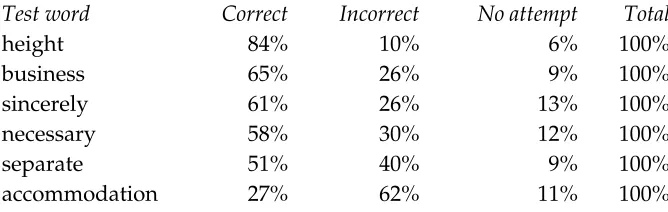
Figures for the population in general are hard to come by. However, a survey was carried out in October 1992 in which a thousand people aged over sixteen were asked to spell six common words which were known to have troublesome spellings.1 They
could respond out loud or on paper, as they wished. The results are given in Tables 1.1 and 1.2.
INTRODUCTION
Table 1.1 Per cent of adults spelling each word correctly
Test word Correct Incorrect No attempt Total
height 84% 10% 6% 100% business 65% 26% 9% 100% sincerely 61% 26% 13% 100% necessary 58% 30% 12% 100% separate 51% 40% 9% 100% accommodation 27% 62% 11% 100%
Table 1.2 Adults’ success in spelling the six words of Table 1.1
Got all six right 17% Got five right 19% Got four right 19% Got three right 14% Got two right 11% Got one right 11% Got none right 9% Total 100%
embarrass.2 Having difficulty in spelling ordinary words is not a
minority problem.
Even if native speakers of English coped well with the spelling, there would remain the problems of foreign speakers. English is an international language. The great majority of users of English worldwide are people who use it as a second language.
As to the idea that poor spelling doesn’t really matter, the quotations above suggest otherwise, as do the enrolments for adult literacy tuition. In the first two years of the Adult Literacy Campaign (1975-77), over 125,000 people enrolled in England and Wales (Gorman 1981). Even allowing for a small group of non-native speakers of English, and for those needing help with reading and handwriting rather than with spelling, this indicates the extent to which poor spellers themselves regard their spelling as a problem.
large proportion of their vocabulary that their writing is rendered dull and repetitive. It is not simply that they avoid rare words. Even high frequency words are danger spots if the spelling is troublesome, causing the children to cast about for safer ways of saying things, or safer things to say.
Other critics, while not accusing me of exaggerating, accuse me of threatening to make an already serious problem even worse. They fear that a computerized spelling corrector, if widely used, would lower (they tend to say ‘yet further’) the general standard of spelling. If children can wave a wand over their text and have it corrected, they will not apply themselves to remembering the correct spellings.
I honestly don’t know how likely this is. It seems plausible, and yet the opposite also seems plausible; if people’s attention is drawn (by a computer) to words that they habitually misspell, and if they become accustomed to reading their own text without misspellings, they may tend to remember the correct spellings. People with severe spelling problems, and their teachers, seem to have no doubt about the value of computer spellcheckers (Singleton 1991, Innes 1990); their complaint is that the spellcheckers do not do the job well enough.
However, I must admit that, even if some decline in people’s spelling ability were confidently predicted, I don’t think this would be a strong enough argument for prohibiting the development or use of the software. There is no intrinsic virtue in memorizing the quirks of English spelling. That the orthography has become fixed in its present form is largely the result of the locking of the message to the medium which is a feature of writing, typing and printing straight onto paper. For several hundred years, people have had to adapt themselves, with varying degrees of failure, to this technology. The technology can now adapt itself to people, and that is surely the right way round.
INTRODUCTION
The first half of the book is about spelling, the second about computers. Chapter Two describes how English spelling came to be in the state that it’s in today. In Chapter Three I summarize the debate between those who propose radical change to the system and those who favour keeping it as it is, and I show how computerized correction can be seen as providing at least some of the benefits that have been claimed for spelling reform. Too much of the literature on computerized spellcheckers describes tests based on collections of artificially created errors; Chapter Four looks at the sorts of misspellings that people actually make, to see more clearly the problems that a spellchecker has to face. Chapter Five looks more closely at the errors that people make when they don’t know how to spell a word, and Chapter Six at the errors that people make when they know perfectly well how to spell a word but for some reason write or type something else.
Chapter Seven begins the second part of the book with a description of the methods that have been devised over the last thirty years for getting computers to detect and correct spelling errors. Its conclusion is that spellcheckers have some way to go before they can do the job we would like them to do. Chapters Eight to Ten describe a spellchecker that I have designed which attempts to address some of the remaining problems, especially those presented by badly spelt text.
Notes
1. The survey was carried out by Gallup for the Adult Literacy and Basic Skills Unit (ALBSU). These figures are taken from a press release prepared by ALBSU. The report gives the number of people interviewed as ‘just over 1,000’. The questions were put in one of Gallup’s regular Omnibus surveys. The respondents formed a quota sample stratified by sex, age, social class and working or non-working, selected by the interviewers at 110 points in England and Wales.
CHAPTER TWO
A short history of English spelling
I said in the Introduction that the spelling of English did not have to be more difficult than, say, the spelling of Spanish or Italian, and that the difficulty arose from its history. I hope in this chapter to justify that statement by showing how the orthography changed from earliest times until it became fixed into something very like its present form about three hundred years ago.
As England emerged from the Dark Ages, writing was widely practised by the clergy for both secular and religious purposes. At first it was mostly in Latin, but from the seventh century more of it was in English and, by the time of Alfred the Great (who died in 899), a number of English books, mainly translations from Latin, were being produced. There was no fixed orthography for English; a scribe’s spelling of a particular word depended partly on the local conventions, partly on his dialect and partly on choice – he might spell the same word in different ways in the same manuscript. The idea that there is one and only one ‘correct’ spelling for a given word is relatively modern (Hogg 1992).
The middle of the tenth century, however, saw a vigorous monastic revival led by Æthelwold, Bishop of Winchester, and, with it, the widespread adoption of a standard form of written English, based on West Saxon. The following example shows the first line of the Lord’s Prayer translated by Ælfric, one of the leading writers of the period, in about 990:
u ure fæder e eart on heofonum sy in nama ehal od.
clearly separated by spaces in the printed form but not so clearly, or not at all, in the original.
The language, of course, is Old English, not readily intelligible to a speaker of modern English, but the words are recognizable as ancestors of present-day words – fæder-father, heofonum-heaven,
nama-name. Nearly all the letters – the ones that had been taken from the Roman alphabet – are the same as those in use today. The unfamiliar ones in this example are æ, called ash and pronounced like theaofcat, , calledthornand pronounced like thethof thisor
thistle,and , calledyogh. This last one has various pronunciations;
the one at the beginning of ehal od is like the yofyellowwhile the
one in the middle corresponds to a sound we do not have any more, a voiced version of the Scottish ch in loch. The following approximation to the pronunciation is given by Scragg (1974):
θu: u:r e fæd e rθeært
n hev e n e n si:θi:n n
m e je h :l
e
d Readers not familiar with the phonetic alphabet can get a (very) rough idea of how it might have sounded by reading this out loud:
thoo oorer fadder, the art ong hevernern, see theen nongmer yeharlgerd.
(This is my own rendition. I imagine it would make an Old English scholar cringe. Thea of artshould be pronounced like the a ofcat.
The ong is meant to be like the vowel sound of the French word
blanc. There is stress on the first syllable of hevernern and on the second ofyeharlgerd.)
The adoption of the Roman alphabet, with only minor extensions, was to have a lasting effect on the orthography, for the Roman alphabet, of course, was devised for representing a different language. Any linguist devising an alphabet for English from scratch would devise one with more letters, especially for vowel sounds, but we are stuck with the Roman ones. This partly accounts for the number of letter-pairs in modern English spelling, like th, sh, ea, ou and so on, where the pair is quite different from the two letters sounded separately.
A SHORT HISTORY OF ENGLISH SPELLING
throughout England. In terms of simplicity, this was the high point of English spelling.
The Norman invasion reduced the amount of writing in English, and the stable spelling system began to fall apart. Manuscripts in English began to show signs of regional dialect and local spelling conventions and the influence of French and Latin. The spoken language was also changing; a sound like thechof the Scottishloch,
for example, gradually disappeared in the middle ages from words like night and there was a good deal of variability in its spelling (Milroy 1992).
The invasion also brought a host of Norman-French words and spelling patterns, and this influence was prolonged by the rise of metropolitan French as the courtly language of international diplomacy in the middle ages; perhaps as much as forty per cent of today’s English vocabulary is derived from French. The words that arrived in the middle ages, especially during the Anglo-Norman period, are now completely assimilated into English and have no foreign tinge at all, such as royal, gentle, chance and danger (as contrasted with those that entered the language much later, in the sixteenth to eighteenth centuries, such as cordon, vogue, moustache, clique, salon and so on). Even within the middle ages, there was a difference between those that arrived early, which came from Norman French, and those that arrived later, from Parisian French. Occasionally the same word was borrowed twice, once from Norman French and later from Parisian French: warden, cattle and
gaol are from Norman French, guardian, chattel and jail from Parisian (Strang 1970).
Many of the scribes would be bilingual and much of what they were copying was in French, so French spelling patterns tended to creep in when they were writing English. Sometimes a French spelling pattern simply replaced a perfectly good Old English one;
qu, for example, replaced the earlier cw in words like queen and
pronounced / / like theshinshin,as it is today.)
Often, however, the new French spellings just caused confusion. A good example of this is the use of initialh. French scribes took to writing French words with h if they were obviously derived from Latin words beginning with h, even though the h was not pronounced in French – modern French habile, honneur, ho ˆpitaland so on. That the French scribes favoured the initialhin writing was not entirely due to their fondness for Latin; the amount they got paid for a legal document depended on the number of letters in it, so superfluous letters may have been a source of income (Ewert 1933).
When these words were introduced into English, the initial h
was retained in the spelling, though manuscripts show a lot of variation in their use of it (Milroy 1992). With some of these words, like able, the hnever caught on; some of them, likehonour,retained the h in the spelling though it continued to be silent, as in French, and some of them, like hospital, have had their pronunciation changed so that the h is now sounded. This process has continued down the years; the words humour, hospital and herb were not uncommonly pronounced without the h as recently as the early 1900s. (Herb is still pronounced without an aitch in America.) Oddly, though dropping one’s aitches has been widely regarded as uncouth since the eighteenth century, the upper classes pronounce some h-words without theh,favouring an old-fashioned pronunci-ation in this respect as in certain others (Strang 1970) – it can be rather posh to say an hotel (with no h). Perhaps this explains why people in formal settings, such as conferences of computer scientists, sometimes make a point of using the an form of the indefinite article (because it seems somehow more refined) before words such ashierarchyorhistorical,though they are equally careful to aspirate the h (not wanting anyone to think they drop their aitches).
Many people today feel that it is contrary to common sense for the spelling of a word to be different from what the pronunciation would lead you to expect. Yet, even from medieval times, people have been respelling words in a way that made the spelling more remote from the pronunciation. The silent h is one example; another is the replacement of u by o in words like come, love, monk
A SHORT HISTORY OF ENGLISH SPELLING
short, unligatured downstrokes, known as ‘minims’ (Lass 1992). Present day v was written as a u and was uu, as its name implies. To further complicate matters, i was written as a single, undotted minim. So a run of four minims could representw, un, uvetc; a run of five could be um, mu, wi,and so on. To help disambiguate such runs, scribes borrowed the late Latin practice (Scragg 1974) of writing o for u (Venezky 1976). They also sometimes used y for i
for the same reason (Strang 1970).
Though diversity was the main feature of English spelling in the middle ages, a standard form eventually emerged. Whereas Winchester had been the earlier centre of political power and the dialect of that area had been the basis of the standard orthography, power shifted to London from the eleventh century and, in time, documents coming from London formed the basis of a new standard. These were writings issuing from the Chancery – legal documents rather than religious or literary ones. For many years these were in Latin or French but, from about 1430, they began to be written in English. These were important documents, circulated round the country, and the spelling was used as a model by scriveners – professional writers of secular manuscripts (records of guilds and boroughs and the like).
The spelling naturally reflected the speech of the London area, which had been influenced mainly by the dialect of the east midlands since many of London’s inhabitants of the time had come from there, but it was not a phonetic system; it was, like today’s orthography, a written form of the language existing alongside the spoken one. The Chancery scribes did not invent a new spelling system; they settled on a restricted set of the spellings that were current at the time. In many cases the ones they had adopted by 1450 are the ones we have today, such as such in preference tosich, sych, seche and swiche, and which in preference to wich, so the spelling of these documents seems reasonably familiar to a reader of modern English (Blake 1992). Here is a small sample:1
lond belongyng to e saide office. which e said Thomas hath geton vn to hym be delyuered to e said Sir Iohn Talbot or his sufficiante depute hauyng power of hym to resceiue hit.
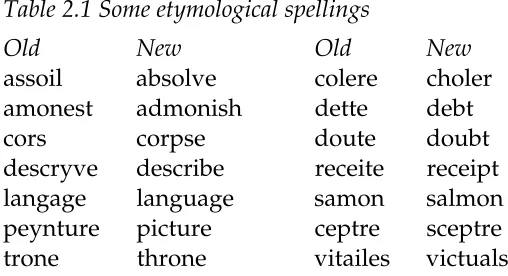
[image:23.612.124.378.296.434.2]The next great influence on English spelling was the revival of interest in Greek and Latin literature which was in full spate by the early sixteenth century. Latin was known, and revered, by most educated people, and they felt that, since so many English words were derived ultimately from Latin (this was because so many of these words had come into the language via French), the spelling of the words should show this. They therefore created new spellings to make the words look more like their Latin originals. Table 2.1 presents a few examples (Scragg 1974):
Table 2.1 Some etymological spellings
Old New Old New
assoil absolve colere choler amonest admonish dette debt cors corpse doute doubt descryve describe receite receipt langage language samon salmon peynture picture ceptre sceptre trone throne vitailes victuals
That so many of the new spellings now seem the more natural is because of a process known as ‘spelling-pronunciation’; in the intervening centuries, people have changed their pronunciation of the words to bring it into line with the spelling. This has clearly happened with those on the left in Table 2.1 but not with those on the right.
A SHORT HISTORY OF ENGLISH SPELLING
Table 2.2 Some recent spelling-pronunciations
Spelling Old pronunciation New pronunciation
again / e en/ (a-genn) / e e n/ (a-gain)
conduit / k nd t/ (kundit) / k ndw t/ (kondwit)
forehead / f r d/ (forrid) / f c :hed/ (forhedd)
nephew / nevju:/ (nev-yoo) / nefju:/ (neff-yoo) often / fn/ (off’n) / ft e n/ (offt’n)
waistcoat / wesk t/ (weskit) / we sk e
t/ (waisscoat) The new spellings which the Latin scholars invented were sometimes based on faulty etymology. They changed sisoures and
sithe toscissors and scythe on the false assumption that these words were derived from Latinscindere (to cut). They put ans into island
(medieval yland) by analogy with isle (from French) and insula
(Latin) though the word came from Old English and had never had an s. They put a d in advantage, an l in emerald and an h in anchor
which had no business being there (Scragg 1974). Etymologically justified or not, however, a large number of these quirky spellings remained.
These new spellings did not always get established. Saint, for example, was respelt sanct, but then saint reasserted itself (Scragg 1974);conceitand deceitwere writtenconceiptanddeceipt for a while (Strang 1970). It is possible that more of them would have gone the way of sanct had it not been that the orthography was becoming fixed at this time, due to the rise of printing, though the initial effect of the new technology, introduced by Caxton in the 1470s, was not to stabilize spelling but to confuse it still further.
One effect was to force out of use the handful of non-Latin letters that had survived from the Old English alphabet. The founts of type were manufactured on the continent and did not contain these letters. Thorn ( ) was still in use in the fifteenth century, though it had changed in shape and had come to look like a y, sometimes backwards, so printers used the nearest-looking letter they had – a y. It was especially popular in abbreviations of
the and that – ye and yt. It survives tenuously to this day in mock-archaic signs such asYe Olde Tea Shoppe where the first word is not reallyyebut an old spelling ofthe. Yogh ( ) was also still in use. In
depending on its role in the word. In Scotland, printers used a z,
thus creating spellings that have survived in certain names; the middle letter of Dalziel and Menzies, for example, is really a yogh, not a z, and there is no /z/ in the Scottish pronunciation – /di: jel/ and/ m s/, something likeDee-yellandMing-iss(Lass 1992).
Most of the early compositors were foreigners and it took some time before the printing houses developed their house styles. Caxton himself had spent much of his life in the Low Countries and this was reflected in his spelling – he is responsible, for instance, for respelling gost as ghost. Different compositors used different spellings, and any one compositor would use different spellings of the same word in different places; a pamphlet of 1591 about catching rabbits spells coney (an old word for ‘rabbit’) as cony, conny, conye, conie, connie, coni, cuny, cunny and cunnie (Baugh and Cable 1978). One reason for this was to adjust the lengths of lines so as to get a straight right-hand margin. Of the two principal compositors who set Shakespeare’s First Folio (published in 1623), one favoured doe, goeand here, while the other favoured do, go and
heere, but each occasionally borrowed the variant preferred by the other if he needed to lengthen or shorten a line (Scragg 1974).
While it might have suited the printers to use alternative forms, it did not please their readers. From about the middle of the fifteenth century, people began to voice criticism of the state of the orthography and in particular the practices of printers. An early spelling reformer called John Hart, writing in 1551, argued that ‘vicious’ writing ‘bringeth confusion and uncertainte in the reading’ (Salmon forthcoming). He criticized, among other things, the use of superfluous letters, as in stoppe (where stop would do), and additions made by the etymologists such as thebindoubt,theg
ineight,thelinsouldioursand theoinpeople.
A SHORT HISTORY OF ENGLISH SPELLING
spellings came eventually to be adopted, his principles and his list were taken up by another schoolmaster called Edmond Coote who published The English Schoole-maister in 1596. While Mulcaster’s book was a learned work for the instruction of teachers, Coote’s was more like a school textbook. It evidently filled a need – it ran to over forty editions and was still being published in the early eighteenth century (Scragg 1974).
By 1600 there was a trend to uniformity in the spelling of printed matter and by 1650 it was largely complete. The reasons seem to have been the desire of schoolteachers, on the one hand, for an accepted orthography which they could teach to their pupils – several more spelling books followed Coote’s – and the desire of printers, on the other, to meet the expectations of their readers. The idea of ‘correct’ spelling, coupled with the technology of print, was self-reinforcing. Simply because many copies of a given work could exist, many people could share the same standard. The spellings of the established printing houses were codified and taught to schoolchildren; the children would grow up to expect the same spellings in their reading matter, and the printers would be careful to stick to them. There was no place for innovation in this cycle, and the argument for conservatism grew stronger as the mountain of material in print grew ever larger.
The following extracts illustrate the change from an orthography which, though readable, clearly belongs to earlier times, to one which is hardly different from that used today:2
Roger Ascham, ‘Toxophilus’, 1545
Richard Mulcaster, ‘Elementarie’, 1582
It were a thing verie praiseworthie in my opinion, and no lesse profitable then praise worthie, if som one well learned and as laborious a man, wold gather all the words which we vse in our English tung, whether naturall or incorporate, out of all professions, as well learned as not, into one dictionarie, and besides the right writing, which is incident to the Alphabete, wold open vnto vs therein, both their naturall force, and their proper vse: that by his honest trauell we might be as able to iudge of our own tung, which we haue by rote, as we ar of others, which we learn by rule. The want whereof, is the onelie cause why, that verie manie men, being excellentlie well learned in foren speche, can hardlie discern what theie haue at home . . .
John Chamberlain, from a letter describing Sir Walter Raleigh’s execution, 1618 When the hangman asked him forgivenes he desired to see the axe, and feeling the edge he saide that yt was a fayre sharpe medicine to cure him of all his diseases and miseries. When he was laide downe some found fault that his face was west-ward, and wold have him turned, whereupon rising he saide yt was no great matter which way a mans head stoode so his heart lay right. He had geven order to the executioner that after some short meditation when he strecht forth his handes he shold dispatch him. After once or twise putting foorth his handes, the fellow out of timerousnes (or what other cause) forbearing, he was faine to bid him strike, and so at two blowes he tooke of his head, though he stirred not a whit after the first. The people were much affected at the sight insomuch that one was heard say that we had not such another head to cut of.
Edward Phillips, ‘The New World of English Words’, 1658
Whether this innovation of words deprave, or inrich our English tongue is a consideration that admits of various censures, according to the different fancies of men. Certainly as by an invasion of strangers, many of the old inhabitants must needs be either slain, or forced to fly the Land; so it happens in the introducing of strange words, the old ones in whose room they come must needs in time be forgotten, and grow obsolete . . .
A SHORT HISTORY OF ENGLISH SPELLING
meet used to be pronounced differently, and their spellings were a reasonable representation of their pronunciation. During this period, however, both vowels changed and also fell together to their present pronunciation, but the spellings remained fixed in their previous forms. There used to be a word quean, meaning
harlot, but, by the same process, it came to be pronounced in the same way as queen and fell out of use (Samuels 1972). Consonants also were affected in this period of change. The spelling of knight,
for instance, was a fair representation of how it had been pronounced in 1400, but, by 1600, the sounds to which thekand the
gh corresponded had disappeared from this word. The spelling, however, had become fixed by then.
Though the spelling of published books was stabilized in the seventeenth century, the spelling of private, handwritten documents remained variable for much longer. In Elizabethan times, people did not have the feeling, as they have today, that there was just one correct spelling of any given word; it was acceptable even for an educated writer such as Queen Elizabeth herself, writing in the 1580s, to spell a word in two different ways in the same letter. But as the idea of ‘correct’ spelling gained force, people felt they should try to conform to book-spelling in their own writing. Coote’s spelling book of 1596 was dedicated to people who, for want of the ability to spell, ‘are ashamed to write unto their best friends.’
Good spelling also became a necessary qualification for many types of employment; a schools inspector of the nineteenth century observed that ‘out of 1,972 failures in the Civil Service examin-ations, 1,866 candidates were plucked for spelling; that is, eighteen out of every nineteen who failed, failed in spelling.’ Schools responded to this pressure with large amounts of spelling drill; an educational researcher visiting a class of ten-year-olds in America in the late nineteenth century found them being drilled on the wordsexogen, cylindrical, coniferal, resinousandwhorls, when results from his own spelling test found that many of the same children were having trouble with words such asrunning, slipped andbelieve
(Venezky 1980).
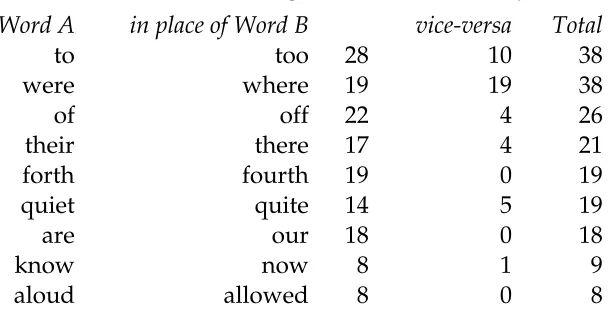
Since schools are supposed to teach spelling, the general standard of people’s spelling has come to be regarded as a measure of how well or badly the schools are doing their job. Those who have been alarmed by what they see as a decline in British educational standards since the war have often cited people’s spelling as a clear indicator: ‘an external examiner of colleges of education writes that it is common to find many students who write his for is, who do not know the difference betweentheir and
there or where and were, who cannot punctuate and cannot spell.’3
More recently, Prince Charles’s derogatory remarks about his secretaries’ spelling received wide publicity, and the Secretary of State for Education instructed that candidates in public examinations should be penalized for poor spelling regardless of the subject of the examination.
It is significant that I have reached this stage in my account of the history of English spelling without using the word dictionary.
Contrary to the popular view, dictionary makers do not decide how words are to be spelt. They merely record current practice. Even the enormously authoritative Dr Johnson, whose dictionary was published in 1755, only set down the already established spellings of words; he himself lamented the state that the orthography had got itself into, pointing out the inconsistency of
A SHORT HISTORY OF ENGLISH SPELLING
Dictionaries do, however, tend to fix the spellings of words. If people come to think that there are correct and incorrect spellings, they want a reference book that will tell them the correct ones, and this is partly what dictionaries do. Bilingual dictionaries – English-Latin, English-French – had existed since the fifteenth century, but the idea of a book that explained English words in English for native speakers of English did not arise till the late sixteenth. At first these were spelling lists, perhaps with some notes on meanings, concentrating on harder words. It was not until the eighteenth century that people produced dictionaries that attempted to cover all the words of English, or anyway a very large number of them. Dr Johnson’s dictionary was perhaps the final nail that pinned the orthography down; everyone could now use the same authoritative work of reference, whether for private writing or for publication. The Oxford and the other major dictionaries play that role nowadays, and their authority is unchallenged. It does not matter how convinced you are of the spelling extacy, or how often you think you’ve seen it written that way, or what reasons you can give for why it should be spelt like that; if the dictionary saysecstasy,you’re wrong.
Today’s writers do not use exactly the spellings of Johnson’s dictionary – he has horrour, terrour, musickand physick,for example – but the changes since Johnson’s time have been minor. The only important part of the story that remains is the curious tale of Noah Webster, whose dictionary had the same status in America that Dr Johnson’s had in Britain. He made a fortune from a conservative spelling book first published soon after independence, and then ploughed much of it into schemes of spelling reform, largely ineffective. In the dictionary that he then wrote he incorporated a few of the reformed spellings that he favoured; it is not that he invented these, but rather that he chose to include certain variant spellings then in use in preference to others. Not all of the reformed spellings in the first edition of his dictionary caught on – he included ake, crum, fether, ile and spunge (Venezky 1980) – but most of the now-familiar distinctively American spellings are Webster’s – theater, meter for theatre, metre; honor, favor for honour, favour; defense fordefence, check forcheque andtraveling for travelling
following anecdote:4
The present printer [1881] of Webster’s Dictionary remembers that when he was a boy of thirteen, working at the case in Burlington, Vermont, a little pale-faced man came into the office and handed him a printed slip, saying, ‘My lad, when you use these words, please oblige me by spelling them as here: theater, center, etc.’ It was Noah Webster traveling about among the printing-offices, and persuading people to spell as he did.
Some American spellings have infiltrated British English, often with a special meaning – computer programsas opposed to television programmes,for instance – but nationalism seems to have kept most of them out.
For over a thousand years, since the establishment of Old English orthography, people have been changing and extending English spelling in various ways, some of which seem to us nowadays rather odd; they have never demolished the structure to start again from scratch, but have rather modified and extended what was there already. The monks of Anglo-Saxon England, the Norman invaders, medieval French scribes, Latin scholars of the Renaissance, Elizabethan schoolmasters and the printers and lexicographers of the Enlightenment have all left their mark on the orthography. Add to that the great capacity of English for assimilating words, and spellings, from other languages –spaghetti, moccasin, jodhpurs, sheikh – and the result is a jumble of systems, subsystems and exceptions. It didn’t have to be like that, but that is how it is, and, despite the strenuous efforts of spelling reformers, it looks set to stay that way.
Notes
1. This sample is taken from an anthology (Fisher et al. 1984) and is quoted by Blake (1992).
2. All these extracts are taken from Baugh and Cable (1978).
3. This and the quotations in the preceding two paragraphs are all taken from Scragg (1974).
CHAPTER THREE
Pros and cons of English spelling
Opinions about English orthography vary over the widest possible range. Some see it as a burden to schoolchildren and their teachers (Pitman 1969), a block on the path to literacy (Dewey 1971), an obstacle to foreign learners of English (Mont Follick 1965) and a persistent nuisance to writers, typists and printers. At the other extreme, no less an authority than Noam Chomsky (Chomsky and Halle 1968) has described it as ‘near optimal’. My own position is somewhere in between. It seems to me implausible that a system so knocked about by history should turn out to be nearly optimal; indeed, such an outcome would be little short of miraculous. The system is full of quirks, and it would make life easier for many people if these were ironed out. On the other hand, I have doubts about the root-and-branch reforms proposed by many reformers; for all its faults, the system has some virtues.
English orthography is basically alphabetic; there is sufficient consistency between letter and sound for it to be possible at least to begin the teaching of reading by sounding the letters individually and showing how they form words. The b of bat corresponds to /b/, the a to /æ/ and the t to /t/, so bat spells /bæt/. (Items between slashes represent pronunciations in Southern British English – see the table on page x.) The extent to which teachers actually use this method varies a good deal from one teacher to another, but the method is at least possible.
What the critics complain about is that it is not consistently
the idea of letter-sound correspondence than they begin to encounter a host of words where the system breaks down. In fact they begin to encounter them when they have hardly got started since some of the most peculiarly spelt words in the language are among the commonest; the f in the word of, for example, does not correspond to /f/.
The alphabetic principle is simple. Out of the several hundred distinguishable sounds that the human vocal equipment can produce, any given language uses only a few, though different languages use different sets. English speakers can make coughing noises with the throat and clicking noises with the tongue, but these are not part of the English language, though they may be used in other languages. The smallest units of speech that distinguish one word from another in a language are called the phonemes of the language. Estimates of the number of phonemes in English vary from one authority to another, but, according to one writer (Gleason 1961), there are thirty-six vowels and consonants in English. To devise an orthography for English on the alphabetic principle, you would have an alphabet of thirty-six letters, one for each consonant or vowel phoneme.1
One person’s rendering of a particular phoneme may differ from another person’s, and even the same person’s rendering may vary in subtle ways from one occasion to another. For example, the way you pronounce the p in pill differs perceptibly from the way you pronounce it in spill. (Hold a slip of paper close to your lips and you’ll see that there’s an explosion of air with pill that there isn’t withspill.) But this difference is of no significance in English, so we are not concerned about it and indeed we hardly notice it. So far as the English language is concerned, they are different realizations of the same phoneme. If a phonetician were noting down the sounds of the language, he might want to distinguish between the two, but ordinary users of English would not. Strictly speaking, then, it is phonemes, rather than sounds, that are represented in an alpha-betic orthography.
Obviously, English orthography departs seriously from the alphabetic principle. To start with, there are only twenty-six letters to represent these thirty-six phonemes, so letter-pairs are often used instead of single letters to represent a single phoneme, such as
PROS AND CONS OF ENGLISH SPELLING
confusion when the letters are not to be taken as a pair (a bishop’s mishap, a swarthy warthog, an inchoate moan, a coopers’ cooperative, an orthoepist’s toecap). (The dieresis exists for alerting the reader to some of these problems, as in na" i ve, but it is not often used – Fowler (1968) describes it as ‘an obsolescent symbol’. A hyphen is sometimes used instead, as inco-operativeforco" o perative;more often there is no mark at all –cooperative, naive.)
This would be only a minor nuisance if the letters and the phonemes corresponded consistently, but they don’t. Many phonemes have several different representations; /f/, for instance, can be written asf (often), ff (off), ph (graph), gh (enough)and, in some foreign names, v (Chekhov). Conversely, many letters or letter-patterns have more than one pronunciation; considerouinout, four, through, tough, cough, dough and borough. At times the principle breaks down so badly that one hesitates to say what corresponds with what. To what does the gh correspond in night and bought? Which letters represent the /t / in picture or the /w/ in choir? If it’s theshinfashionthat corresponds to the / /, presumably it’s the
ss inmission and the tin nation? Or is it theti? In which case, was it the shi in fashion?2 Viewed purely as an alphabetic system,
English spelling is a mess, a fact which spelling reformers enjoy parading at great length.
If English spelling were redesigned on strict alphabetic lines, there would be more letters in the alphabet; each phoneme would be represented by just one letter, and each letter would represent just one phoneme. The benefits are obvious. Children would learn their reading and writing more quickly and more easily, and more of them would reach an acceptable level of competence. Foreign learners of English (who far outnumber native speakers) would find the spelling a reliable guide to pronunciation, and vice-versa. Spelling problems would largely disappear – no more worrying overoccurrence, accommodation, principal, ecstasyand the like. There would also be a modest reduction in the average number of letters per word, leading to savings in paper, ink and computer storage space and in the time spent actually writing or typing.
conservative view, the important thing was to settle on one spelling for each word and have everyone stick to it, accepting inconsist-encies in the system for the sake of stability. But there was another more radical view, namely that spelling should be brought back into line with pronunciation. The proponents of the more radical view were characteristic of the sorts of people who supported spelling reform over the next four centuries – eminent scholars, phoneticians and schoolteachers. They were often as concerned to spread good pronunciation as good spelling, the idea being that books printed in an alphabetic orthography based on the ‘best’ pronunciation would be a model of how English should be spoken for people who spoke it ‘badly’ – rural folk, the lower classes, speakers of regional dialects and the like.
Sadly for subsequent generations of schoolchildren, it was the more conservative view that prevailed. As the orthography settled down into its present form in the seventeenth century, even fairly timid attempts at reform were sternly rebuked. Dr Johnson probably summed up the general view on the matter by the middle of the eighteenth century in his condescending reference to spelling reformers as ‘ingenious men’ who ‘endeavoured to deserve well of their country, by writing honor and labor for honour and labour, redforread, in the preter-tense,saisforsays, repeteforrepeat, explane
for explain, or declame for declaim. Of these it may be said, that as they have done no good, they have done little harm; both because they have innovated little, and because few have followed them.’3
PROS AND CONS OF ENGLISH SPELLING
The movement came as close to success as it has ever come when President Theodore Roosevelt ordered the Government Printer to use a list of three hundred reformed spellings advocated by the Simplified Spelling Board, an organization funded by the millionaire Andrew Carnegie. The reforms were modest. Some of the three hundred were Webster’s preferred forms already in widespread use in America – honor, theater and the like; others involved only the deletion of ane (acknowledgment, judgmentand so on) or the dropping of ue (catalog, demagog), though some others were more radical (pur, dript, husht). But the order, issued in August 1906, was revoked in December in the face of public outcry. Apart from consolidating the use of those forms which were already accepted as American variants, this small and short-lived victory for the reformers had little effect except to galvanize the forces of conservatism. The movement did not die, but it lost its impetus (Venezky 1980).
Though the alphabetic principle itself is simple enough, there are many decisions to be made in applying it. Consequently, though reformers have agreed on what is wrong with the traditional orthography, they have differed widely in their proposals for a new one. Do you make do with the Roman alphabet or do you supplement it with new characters? The latter is essential if you wish to have an orthography with one letter for each phoneme but it obviously runs into severe practical problems. Or perhaps you go for a half-way solution using diacritics? Do you compromise on the alphabetic principle in order to retain as much continuity as possible with traditional orthography or, on the contrary, do you advocate a complete break with the old system? Whose interests do you have uppermost in your mind in choosing this or that new spelling – English-speaking children learning to read, foreigners learning English, or skilled readers and writers of English who do a great deal of reading and writing? These and other questions have exercised the minds of reformers down the years.
possible to traditional spellings. Here are two samples, the first a sentence already familiar to readers, the second probably unfamiliar (MacCarthy 1969a):
Forskor and seven yeerz agoe our faadherz braut forth on dhis kontinent a nue naeshon, konseevd in liberti, and dedikaeted to dhe propozishon dhat aul men ar kreeaeted eekwal.
We instinktivli shrink from eni chaenj in whot iz familiar; and whot kan be mor familiar dhan dhe form ov wurdz dhat we hav seen and riten mor tiemz dhan we kan posibli estimaet? . . . At dhe furst glaans a pasej in eni reformd speling looks "kweer" or "ugli." Dhis objekshon iz aulwaez dhe furst to be maed; it iz purfektli natueral; it iz dhe hardest to remuuv. Indeed, its efekt iz not weekend until dhe nue speling iz noe longger nue, until it haz been seen ofen enuf to be familiar.
This is the version of New Spelling devised by Walter Ripman and William Archer in the early years of the century (Ripman and Archer 1940). The Society has made small modifications since then. This system, called New Spelling (or Nue Speling), strives to maintain a regular correspondence between letters and phonemes – / / (theth ofthen) is alwaysdh,/e / (theaofmate) is alwaysae, and
so on, though it is not completely rigorous about this since it allows variant spellings for unstressed vowels; in the above passage,
longgerends with the same sound asfamiliar,but one is spelterand the otherar (because of the link withfamiliarity). As well as trying to keep the correspondences regular, it also tries to keep them simple and therefore it largely eschews the various devices in traditional orthography whereby one letter tells the reader something about the pronunciation of another, such as the ‘silent’e
in kite and the double p in hopping. As a consequence, only a minority of words remain unchanged; a passage in New Spelling is readable but it looks decidedly strange.
A more pragmatic approach is taken by Dr Axel Wijk in his Regularized Inglish (Wijk 1969). He is prepared to allow one symbol to represent more than one phoneme, or one phoneme to be represented by more than one symbol, so long as this does not cause confusion. He identifies those patterns that occur most frequently in the vocabulary – the ‘regular’ ones – and alters the exceptions to bring them into line. For example, he allows a to stand for /æ/ (mat) or /e / (mate), but want and any have to be
PROS AND CONS OF ENGLISH SPELLING
sound-spelling correspondences, though not as simple as in New Spelling, are regular and rule-governed, so that both native speakers of English and foreigners could have some confidence in using written English, the former in using their knowledge of pronunciation to guide their spelling, the latter in using their knowledge of the spelling to guide their pronunciation. In contrast to New Spelling, fewer then ten per cent of the words of English need to be changed, as can be seen in this example:
We instinctivly shrink from eny chainge in whot iz familiar; and whot can be more familiar than the form ov wurds that we hav seen and written more times than we can possibly estimate? . . . At the first glaance a passage in eny reformd spelling looks ‘queer’ or ‘ugly’. This objection iz aulwayz the first to be made; it iz perfectly natural; it iz the hardest to remoove. Indeed, its effect iz not weakend until the new spelling iz no longer new, until it haz been seen offen enuff to be familiar.
A similar pragmatism informs a more recent proposal, called Cut Spelling (Upward 1992). The idea is to remove redundant letters – hymn becomes hym, kneel becomes neel, people becomes
peple, apple becomes apl, for example – on the grounds that these letters cause a lot of trouble and, since they perform no useful function, they will not be greatly missed. A few substitutions are also made, including j for dg (so edge is spelt ej) and f for gh (so
cough is speltcof). About ten per cent of letters disappear, and this is achieved, it is claimed, without excessive disruption to the appearance of more than a handful of words. Here is the example passage once more:
We instinctivly shrink from any chanje in wat is familir; and wat can be mor familir than th form of words that we hav seen and ritn mor times than we can posbly estmate? . . . At th first glance a passaj in any reformd spelng looks ‘queer’ or ‘ugly’. This objection is always th first to be made; it is perfectly natrl; it is th hardst to remove. Indeed, its efect is not weaknd until th new spelng is no longr new, until it has been seen ofn enuf to be familir.
reformer, it was introduced as an experiment in the early 1960s and by 1966 was being used in nine per cent of infant schools in England and Wales (Warburton and Southgate 1969). More than seventy publishers were producing schoolbooks in it (Pitman and St John 1969) and it looked set to gain widespread acceptance among teachers but, despite achieving positive results, it fell out of favour and is little used today. About twenty characters were added to the Roman alphabet so as to have enough letters to maintain a regular sound-symbol correspondence. Not all of these extra characters were brand new; several were formed just by linking two ordinary letters, like o-u to represent /a / (the ow of
how). The idea was that children would learn the basic principle of alphabetic reading and writing for the first year or so without being confused by the quirks of traditional orthography and then they would be led gradually into standard spelling. The extra characters were designed to be suggestive of common letter patterns. Here is how the phrase ‘the initial teaching alphabet’ looks in the Initial Teaching Alphabet:
e ini
al t
i
alfabet
The other non-Roman system is the Shaw alphabet. George Bernard Shaw was a vigorous campaigner for spelling reform, arguing that the superfluous letters in traditional orthography were a terrible waste of time for writers – he did his own writing in Pitman’s shorthand. He saw no future in rearranging the Roman letters, as other reformers have tended to, since he felt that the results would inevitably strike an ordinary reader as the work of an illiterate.4 He left instructions in his will for the creation of a new
alphabet for English, strictly on the principle of one letter for one phoneme. A competition was held, a winner eventually chosen from over four hundred entrants, and one of Shaw’s plays, ‘Androcles and the Lion’, published in both the new and the old alphabets, side by side (Shaw 1962). He did not imagine that the new alphabet would replace the old one, but that the two would coexist, rather like Arabic and Roman numerals (MacCarthy 1969b). Here is the name ‘George Bernard Shaw’ written in the Shaw alphabet:
PROS AND CONS OF ENGLISH SPELLING
The case for reforming the orthography along alphabetic lines has counted many eminent linguists among its supporters, especially in the early part of this century. Classical philologists of the nineteenth century tended to regard modern languages such as English as degenerate forms of ancient languages, and it was partly as a reaction against this view that the modern science of linguistics emerged, asserting that modern languages were deserving of study in their own right. Allied to this was the feeling that the spoken language was the real language and that the written form was merely a somewhat inadequate representation of the spoken form (Sweet 1876). If the task of writing is simply to represent speech, then English spelling is a poor system, hence the linguists’ support for spelling reform.
Since the Second World War, however, linguistic opinion has shifted. Writing is no longer seen merely as a reflection of speech, but as an alternative means of linguistic expression; not just a mirror of the speech system, but a system in its own right. Its primary purpose is not to show how words are pronounced but to convey meaning to the (generally silent) reader – ‘to speak quickly and distinctly to the eyes’.5
That written language is not just speech written down becomes obvious when you realize that writing includes symbols that have no direct relationship to pronunciation. The $10 ofIt costs $10, for instance, does not represent the sound of ten dollars – compare C ¸ a coute $10, or Das kostet $10. The apostrophe conveys something to the eyes for which there is no counterpart in speech in the girl’s dresses and the girls’ dresses. In fact punctuation in general, though it performs some of the functions of intonation in speech, is a quite different sort of system for which there is no direct spoken counterpart.
Defenders of English spelling (Albrow 1972, Venezky 1970) point out that it is sometimes a positive virtue to depart from the pronunciation. Consider, for example, cats and dogs. The plural marker – the thing that turnscattocatsanddogtodogs– is different in pronunciation; it is /s/ on the end of/kæ t/but /z/ on the end of /d
adding a plural marker. We could, if we chose, indicate the plurality in writing by attaching some arbitrary symbol – say2– to the end of the word, thus writing cat2 and dog2. The 2 here is not meant to correspond to any particular sound, any more than an apostrophe does; it just means ‘plural form’. It is not indicating a phoneme; it indicates an element of meaning, which linguists call a
morpheme. Well, up to a point, this is what English orthography does in using the letters to mark the plural, regardless of whether the pronunciation is /s/ or /z/. It is a mistake to regard the s of
dogs as a funny way of representing /z/; it is, rather, the standard marker of plurality.
The past tense of the verb provides another example of this. Suppose we used the symbol < to indicate past tense. Jumped, crawledandlandedwould be written jump<, crawl<andland<. Up to a point, this is what English orthography does in usinged as a past tense marker, regardless of the pronunciation. The ed is not a funny representation of /t/ (jumped), /d/ (crawled) and / d/
(landed);it is the standard marker of past tense.
In these examples, English orthography is not being perverse in abandoning the alphabetic principle. There is something to be said for keeping a consistent representation for a given morpheme, and, if you choose to do this, you cannot also keep a totally consistent representation for phonemes. For complete consistency of the morpheme representation, we ought to write mice as mouses and
bred as breeded, but when the forms are irregular (like mice and
bred), the alphabetic principle reasserts itself and the orthography abandons the morpheme in favour of the phonemes.
Another feature of English spelling is to have sets of words looking the same if they are related in meaning, even though they may not sound the same, such as photograph, photography and
photographic, where the pronunciation of the vowels varies because of the placement of the stress (Chomsky 1970). The silentbofbomb
arguably helps to show its relationship tobombard;likewise thegof
signand signature and thecof muscle andmuscular (Venezky 1970). The a of polar and theo of author, though they are pronounced the same, show the relationships of these words to polarity and
authority(Haas 1969).
PROS AND CONS OF ENGLISH SPELLING
that a speaker generates the appropriate stress pattern for a derived form, such as national or nationality, by applying a set of rules to this underlying form. These underlying forms are, obviously, not open to direct inspection, so it is a matter of conjecture what they look like (so to speak), but Chomsky and Halle argue that one can infer what the underlying forms must be, assuming that their theory is correct. It turns out, according to their theory, that their representation of the underlying form of a word often resembles the spelling more than the pronunciation. It is as though the orthography represents the underlying forms directly, and it is for this reason that they claim that the orthography is ‘near optimal’.
There are other ways in which abandoning the alphabetic principle enables the orthography to make things clearer for the reader. It becomes possible to distinguish between homophones – words that sound the same but have different meanings, such as
bear and bare orthere and their. The final sound ofhanded and fated
is the same as that ofsplendid and fetid,but theedindicates that the first pair are inflected forms of verbs whereas the id marks the second as adjectives (Albrow 1972).
Word length is an important cue to the eye (Smith 1980a), and the orthography uses this by reserving the distinctiveness of two-letter words almost exclusively for function words – in, be, by, do
and the like. (The would also be a two-letter word if we had not lost the letter Thorn.) Content words that would, on alphabetic grounds, be two-letter words usually get lengthened either by doubling – inn, egg, ebb, bee – or by the addition of an e – bye, axe, doe, ore(Albrow 1972).
It can be argued (Smith 1980b) that the peculiar spellings of words taken from other languages serve a function in indicating to the reader the foreign origins of the words and perhaps giving a hint as to the meanings. How do you pronounce sopracella and what is it? (I’ve invented the word.) If you felt, as you well might, that the word had an Italian look to it, then you might reasonably pronounce the c as in cello, even though this pronunciation of a singlecis most unusual in English, and you might guess that it had something to do with music or Italian food.
One writer even rises to the defence of the silent b in debt