Full Length Research Article
SEAFOOD EXPORT PROCESSING SECTOR IN KERALA – ISSUES AND CHALLENGES
1,*
Ancy, V. P. and Dr.
2Raju, K.V.
1
Assistant Professor, Department of Economics, Maharaja’s College, Ernakulam, Kerala, India
2Associate Professor, Department of Economics, Sacred Heart College, Thevara, Kochi, Kerala, India
ARTICLE INFO ABSTRACT
The fishing industry not only acts as foreign exchange earner but also plays an important role in Kerala economy. This study analyses the issues of seafood processing export industry and examines the state’s position in the international market. The study employs, non-parametric tests, Kruskal Wallis H Statistic test to rank the various problems faced by the seafood export processing surveyed units. The success of fish and fishery export processing industry can be achieved by minimizing the cost of production and improving the quality standards to attain higher economies of scale. Marketing and distribution channels should be made efficient and should keep up good industrial relations with product and process innovation. For efficient finance and administration easy access to capital, effective cost control and efficient information system are needed.
Copyright © 2016, Ancy and Raju.This is an open access article distributed under the Creative Commons Attribution License, which permits unrestricted use, distribution, and reproduction in any medium, provided the original work is properly cited.
INTRODUCTION
Quality and food safety is the foundation of seafood export processing industry. The seafood service sector has subject to drastic changes in terms of the types of products in demand. By exporting seafood worth of US $ 5.5 billion, the seafood sectors have earned a remarkable position in India’s export basket. Fishing industry is facing a lot of problems. Demand side issues are Quality Issues, International Standards and Regulations, Labeling and Certification Requirements, SPS, Codex Standards and Anti-dumping duty. Supply side issues are low levels of mechanization, low productivity, low capacity utilization, varying quality safety and hygiene, insignificant infrastructure, inadequate supply and quality of raw material, lack access to finance, marketing, changing business cycle and Government legislation.
Demand side Issues
There are various demand side issues faced by the fish and fishery export processing industry. Fish export processing industry faces new challenges ensuring safety and quality standards issues which continue to be an important element in the industries development.
*Corresponding author: Ancy,
Assistant Professor, Department of Economics, Maharaja’s College, Ernakulam, Kerala, India.
A food substance is said to unsafe when it contains any physical, chemical or biological agent that can cause adverse health effects. Such hazardous matter could include bacteria, viruses, parasites, worms that cause various kinds of food borne illness or biological toxins, chemicals contaminants like residues of fertilizers, pesticides, insecticides, industrial wastes, veterinary drug, allergens, additives and preservatives or heavy metals like copper, mercury, arsenic and tin etc.
Food Safety and Quality Standards
Demand side issues are mainly quality issues related to international standards and regulations. To ensure the quality of exported seafood, the processing enterprises have been gradually instructed to follow the international quality management system, such as Hazard Analysis and Critical Control Points (HACCP) created by Food and Drug Administration (FDA) and the National Oceanic and Atmospheric Administration (NOAA), the Seafood Quality Management Criteria by Canadian Fishery and Marine Ministry and the related regulations by the European Union. HACCP system is important for maintaining food safety in fish export processing industry. The development of national standards for food safety and quality assurance ensure acceleration of export trends as well as upgrading the quality of domestic market.
ISSN: 2230-9926
International Journal of Development Research
Vol. 6, Issue, 03, pp. 7214-7221, March,2016
International Journal of
DEVELOPMENT RESEARCH
Article History:
Received 21st December, 2015 Received in revised form 22nd January, 2016
Accepted 29th February, 2016 Published online 31st March, 2016
Available online at http://www.journalijdr.com
Key Words:
US Anti-dumping Issue
India’s seafood export industry is facing a serious threat after an American shrimp producer’s organization has filed a petition against subsidizing shrimp export by seven countries including India. Coalition of Gulf Shrimp Industries(COGSI), filed petitions with the US government seeking relief from the subsidized shrimp imports from China, Ecuador, India, Indonesia, Malaysia, Thailand and Vietnam. The petition seeks imposition of CVD on shrimp from these countries. Indian seafood industry faced deep crisis as the US is the largest importer of Indian seafood in value terms. The best way to evade the AD duty is product differentiation with value added products like ready to pan or ready to eat. This will surely enrich fish processing exporters to capture greater gains from trade and wider market access which will automatically develop brand name for our products. Recent records showed that around 5 percent of Kerala’s shrimp exports are value added products. U.S. antidumping law is a tangled and confusing subject because U.S. law and procedures have changed substantially over time. As a result of this Indian Frozen Shrimp exporters foresee a market diversification and product differentiation challenges in order to attain better exporter earnings.
Indian Quality Standards Regulation
The Export Inspection Council (EIC) is the apex designated agency to regulate the quality standards of fish and fishery export products. EIC imposes three types of inspection and certification namely, consignment wise inspection, in-process quality control and a food safety management system based certification. EIC encourages to facilitate worldwide access for Indian exports through a credible and efficient inspection and certification system and earn global recognition as India’s premier organization for certifying quality and safety to meet international norms. All consignment of Indian Fishery products exported to the EU are required to be accompanied by a numbered original health certificate, comprising a single sheet duly completed, signed and dated. Only the officials of Export Inspection Agency are authorized to issue and sign the health certificates for exports of fishery products to EC. As per the directive it is clear that if the health certificate is obtained from any authority other than Competent Authority, approval granted to their units for exporting to EU will be withdrawn forthwith.
Russia’s ban on US products a boon for Indian Trade
Russia has imposed embargo on food imports from US, Canada, Australia and European Union. Indo-Russian consulting firms have come forward to help step up seafood exports to Russia. Fish export processing industry with the support of MPEDA is also trying to increase marine food exports to Russia by contracting major exporters which can fetch good foreign exchange to India. According to MPEDA, India is exporting 7,400 tonnes of seafood including shrimp and other fish varieties worth about Rs. 310 crore to Russia in a year. There were 262 seafood processing establishments and 37 independent cold storages approved by the EU. Federal Service for Veterinary and Phytosanitary Surveillance (FSVPS) has so far approved 84 Indian seafood processing
establishment for export of marine products to Russian Federation.
SPS, Codex Standards, US FSMA Act
SPS measures the regulations setting the maximum residue levels for toxins or contaminants, approval procedures for additives, quarantine requirements to minimize the spread of pests and diseases, labeling requirements to notify consumers of potentially-harmful foodstuffs (such as allergen-containing products), regulations governing the process or production method whereby the product is made, inspection or certification requirements or outright bans on potentially hazardous products(WTO,2005) . USFDA has brought in the Food Safety Modernization Act (FSMA) amending the existing Federal Food Drug and Cosmetics Act which in turn had amended the Bio-Terrorism Act of 2002. The same has been circulated among the exporters through the field offices. The prospective exporters to USA have registered themselves with USA.
Health Certificate Requirement for export to Canada
The Canadian Food Inspection Agency (CFIA) brought out guidelines for import of aquatic animals on 10th December 2011 with amendments to Health of Animal Act. These new guidelines are operational from 10th December 2012. Regulation is applicable to live, chilled and frozen products of fish, crustaceans except cephalopods and products which are processed and packed for ready consumption. MPEDA offered comments to DAHDF regarding CFIA comments on the Aquatic Animal Health Certificate for export to Canada.
New Requirement for registration with Chinese Authority
The General Administrative of Quality Supervision, Inspection and Quarantine (AQSIQ) has amended Implementation Catalogue for Registration of Overseas Manufacturers of Imported Food to include seafood. All overseas enterprises desires of exporting seafood to China will now need to be registered with the certification and Accreditation Administration of China (CNCA). According to CNCA the deadline for completion of registration is 1st May, 2013. The manufacturer shall be approved by relevant competent authority in India. Manufacturer should be under the effective control and surveillance of competent authority. The sanitary conditions of the manufacturer shall meet relevant provisions of the laws and regulations, standards and codes of China.
Resolving Quality Problems in Japan
Supply Side Issues
Marine products contribute a major portion to national export earnings. Customers like retailers, wholesalers, and distributors have high bargaining power because of the short life of the products. Building up strong customer partnerships, sound market research, and excellent quality of products, reliability of supply, and a constant drive for improvement, price competitiveness and attractive packaging are the key to the success of the industry. The strategic business unit has been able to bring the product to the market faster than its competitors. Development of brackish water shrimp farming and fresh water prawn farming has been well supported by the process of backward and forward integration with necessary ancillary industries.
Production wise Issues
Enhanced production and trade is unavoidable to tackle the projected gap in demand and supply of fishery products from the anticipated rise in consumption and imports due to increasing population and rising purchasing power in many countries. Marine industry in Kerala is characterized by lack of domestic competition. The rivalry among existing competitors in the international market is very high. The firms are trying to diversify production processes. The existence of a large number of firms is a feature of marine industry. Since the firms under study have been in existence for more than 40 years they are able to withstand the rivalry of competing firms. A large number of firms seem to be competing for the same customers and resources. High storage costs and perishable marine products intensify competition for customers. Supply and demand in this particular industry is so volatile that it will affect rivalry among firms. Stringent quality and environmental regulations are the major obstacles for the seafood export.
Issues in Marketing and Price Mechanism
Fish and fishery export processing industry is highly concentrated on export market and a limited percent is concentrated on domestic market with value added products. Marine products are facing depletion around the world and the supply is not able to keep up with the demand and the market structure of marine products is imperfectly competitive. Full capacity utilization is impossible due to non-availability of raw materials. Marketing of fish and fishery product export are highly dependent on consumer preferences which can change at any time. It is a very dynamic industry and the profitability is unpredictable.
Shrimp constitute a major share in seafood export earnings of the country. Shrimp is a short duration crop that receives high investment returns and enjoys an expanding market. The bargaining leverage and the buyer volume of marine products are very high. Buyers have access to information regarding scientific improvement in the various countries exporting marine products. The market is further characterized by changing preferences due to increasing health awareness. Prices are very sensitive. There are differences in day to day prices due to price mechanism in the open market. The success of fish and fishery export processing industry can be attained
by minimizing the cost of production with high quality standards achieving economies of scale. For this marketing and distribution channels should be efficient and should keep up good industrial relations with product and process innovation. Common problems like lack of good packaging material, bad quality cartons, incorrect information on the labels on the carton boxes, spots on the skin of the products due to insects and fungus are the common quality issues from Kerala. Fish boxes often are damaged due to rough handling during the transport. Lack of information regarding the packaging demands of the buyer also may be a reason for various packaging and labeling issues in the seafood export processing industry which may lead to rejection. It has also been noticed that the fish products are sometimes transported by not maintaining the proper temperature due to various reasons resulting in deteriorating of the quality of the products before reaching the destination. In some instances the process used for packing materials which had not been tested for tensile strength, puncture resistance and transport worthiness.
Processing infrastructure and value addition
Value addition being the thrust area for increasing seafood’s exports from India, it is necessary to equip the seafood processors to create state-of-art technology in handling, preprocessing, processing, packaging, warehousing and transportation. New facilities of value addition need to be created and the existing facilities needs to be expanded and additional facilities for value addition should be created. Fish is a very versatile ingredient and is suitable for all kinds of cooking, including grilling, baking, poaching, frying, in curries and kebabs. Price movement depends on demand and supply and both factors are hard to predict in the shrimp business. At present the price is fixed in the international market with the help of information technology and the negotiations for price is done through phone, email or fax. The purchase price offered by the firms to the fishermen depends to a great extent on the price that the importers are ready to offer them. Being a highly perishable commodity the farmers are not able to meet the high cost of transporting the products to better markets. Hence have no better option than to sell it to the nearest and highest bidder. Forward integration is not possible and there are absolutely no switching costs for the buyers of raw materials. Increasing scope for export of value added fishery products from developing countries to developed market is evident from the trade pattern during the past few decades. Value added fishery products marketed in consumer packs requires more demand outlets.
centers. It is seen that there is a serious shortage of potable water to wash the catch to maintain the quality. Better hygiene practice should be involved in handling fish.
Eco-labeling and Sustainability of Fisheries
The sustainable development of capture and culture fisheries highlighted the need for finding new methods
production. Besides Eco-labeling and Certification of fishery products by Marine Stewardship Council have proved to be few of the trade impediments. The Marine Stewardship Council (MSC) is an international non-profit organization set up to help transform the seafood market to a sustainable basis. The MSC runs the only certification and ecolabelling programme for wild-capture fisheries.
Marine (MSC) implemented the first certification program Worldwide, more than 19,500 seafood products, which can be traced back to the certified sustainable fisheries, bear the blue MSC ecolabel. FAO Guidelines for Ecolabelling of Fish and Fishery Products from Inland Capture Fisheries was adopted on 27 May 2010 to facilitate certification and ecolabelling of products from well-managed inland capture fisheries, with focus on sustainability (FAO, 2010).
industry doesn't have a coordinated conservation and fisheries policy. The states have different policies and this has an effect on the industry. With the exception of Goa, the state governments have not put in place any conservation measures.
Adoption of TQM
A large percent of the Indian seafood firms are traditionally family owned companies rather than professionally managed firms. This would result in the promulgation of old ideas of management whereby, conflict was seen as a healthy exercise which helped to build up each department’s e
Implementation of market orientation principles will lead to increase in business performance (Smitha, 2007).The business performance may be economic performance and non economic performance and will help the seafood firms in gaining competitive advantage in exporting and strengthening the position of Indian seafood in the global market. Decentralization of decision making facilitates the participation of the lower level of employees and builds up their motivational levels and commitment to the f
employees are encouraged to make their own decisions so that they can deal with customers faster and more efficiently. Rewards systems help improve and employee’s morale provides encouragement and helps inculcate commitment and loyalty. Adoption of TQM will increase the market value of the product and will act as a face lift to the industry as a whole besides fulfilling its primary aim of ensuring product of good and consistent quality (Smitha, 2007).
Analysis of Seafood Export Processing Units
This part attempts to analyse the outline of the 55 seafood export processing units on the basis of the surveyed data. An analysis of the profile of the seafood industry shows that structure of the seafood industry has changed from the traditional scenario and transformed into modernized and systematically run sector for the export market. The survey revealed that 73 percent of the seafood export processing centers. It is seen that there is a serious shortage of potable water to wash the catch to maintain the quality. Better hygiene practice should be involved in handling fish.
labeling and Sustainability of Fisheries
The sustainable development of capture and culture fisheries highlighted the need for finding new methods for enhancing labeling and Certification of fishery products by Marine Stewardship Council have proved to be The Marine Stewardship profit organization set up to help transform the seafood market to a sustainable basis. The MSC runs the only certification and ecolabelling In 1996 the (MSC) implemented the first certification Worldwide, more than 19,500 seafood products, which can be traced back to the certified sustainable fisheries, FAO Guidelines for Ecolabelling y Products from Inland Capture Fisheries was adopted on 27 May 2010 to facilitate certification and managed inland capture fisheries, with focus on sustainability (FAO, 2010). Fishing
conservation and fisheries policy. The states have different policies and this has an effect on the industry. With the exception of Goa, the state governments have not put in place any conservation measures.
seafood firms are traditionally family owned companies rather than professionally managed firms. This would result in the promulgation of old ideas of management whereby, conflict was seen as a healthy exercise which helped to build up each department’s efficiency. Implementation of market orientation principles will lead to increase in business performance (Smitha, 2007).The business performance may be economic performance and non-economic performance and will help the seafood firms in
advantage in exporting and strengthening the position of Indian seafood in the global market. Decentralization of decision making facilitates the participation of the lower level of employees and builds up their motivational levels and commitment to the firm. Thus employees are encouraged to make their own decisions so that they can deal with customers faster and more efficiently. Rewards systems help improve and employee’s morale and provides encouragement and helps inculcate commitment and ion of TQM will increase the market value of the product and will act as a face lift to the industry as a whole besides fulfilling its primary aim of ensuring product of good
Analysis of Seafood Export Processing Units
This part attempts to analyse the outline of the 55 seafood the surveyed data. An analysis of the profile of the seafood industry shows that stry has changed from the traditional scenario and transformed into modernized and systematically run sector for the export market. The survey revealed that 73 percent of the seafood export processing
companies have a brand name and 75 percent of the surve units have their own website.
seafood export processing industry are recapitulated into seven components. These are the issues related to raw materials, labour, production, finance, administration & technical, and marketing. Based on the intensity of each component, it is again subdivided and ranked using the scale from 1 to 5. These problems are encountered by the surveyed units and is analysed with the help of Kruskal Wallis H test.
Kruskal-Wallis H test
A popular nonparametric test to compare outcomes among more than two independent groups is the Kruskal Wallis test. The Kruskal Wallis test is used to compare medians among k comparison groups (k > 2) and is sometimes described as an ANOVA with the data replaced by
research hypotheses for the Kruskal Wallis nonparametric test are stated as follows:
H0: The k population medians are equal versus H1: The k population medians are not all equal
The procedure for the test involves pooling the
from the k samples into one combined sample, keeping track of which sample each observation comes from, and then ranking lowest to highest from 1 to N, where N = n1+n2 nk.
Test Statistic for the Kruskal Wallis Test
The test statistic for the Kruskal Wallis test is denoted H and is defined as follows:
where k=the number of comparison groups,
N= the total sample size,
nj is the sample size in the jth group ranks in the jth group.
If the observed value of H is greater than or equal to the critical value, we reject H0 in favor of H1; if the observed value of H is less than the critical value we do not reject H0. To determine the appropriate critical value we need sample sizes (n1=3, n2=5 and n3=4) and our level of significance is (α=0.05). We reject the null hypothesis in favor of the alternative hypothesis if any two of the medians are not from this test. The study found identifies the core issues with ranking and ensure and identified the main
seafood industry and helps to resolve it amicably for its smooth functioning and lead to better economic performance
Raw Material Problems
The first and foremost problem faced by the industry is the scarcity of raw material, its inferior quality, delayed supply and unexpected price variations. Test results (Table 1) shows that H test Static is greater than the critical value so we reject the Null Hypothesis.
companies have a brand name and 75 percent of the surveyed units have their own website. The major problems faced by seafood export processing industry are recapitulated into seven components. These are the issues related to raw materials, labour, production, finance, administration & technical, and g. Based on the intensity of each component, it is again subdivided and ranked using the scale from 1 to 5. These problems are encountered by the surveyed units and is analysed with the help of Kruskal Wallis H test.
nonparametric test to compare outcomes among more than two independent groups is the Kruskal Wallis test. The Kruskal Wallis test is used to compare medians among k comparison groups (k > 2) and is sometimes described as an ANOVA with the data replaced by their ranks. The null and research hypotheses for the Kruskal Wallis nonparametric test
The k population medians are equal versus The k population medians are not all equal
The procedure for the test involves pooling the observations from the k samples into one combined sample, keeping track of which sample each observation comes from, and then ranking lowest to highest from 1 to N, where N = n1+n2 + ...+
Test Statistic for the Kruskal Wallis Test
statistic for the Kruskal Wallis test is denoted H and is
where k=the number of comparison groups,
group and Rj is the sum of the
ed value of H is greater than or equal to the in favor of H1; if the observed value of H is less than the critical value we do not reject H0. To determine the appropriate critical value we need sample ) and our level of significance is (α=0.05). We reject the null hypothesis in favor of the alternative hypothesis if any two of the medians are not from this test. The study found identifies the core issues with ranking and ensure and identified the main problem in the seafood industry and helps to resolve it amicably for its smooth functioning and lead to better economic performance
Among the issues, price increase is the main issue related to raw materials; secondly scarcity of raw materials, then delayed supply of raw materials and finally inferior quality of raw materials. The issues are ranked according to the survey data analysis. As mentioned, the most difficult situation faced by the industry is the fluctuations in price may be due to price mechanism- change in the demand for and supply of fishery products, dollar value fluctuations, changes in the political, social and economic structure and its changes due to share market price variations. This price fluctuation may be one of the sources of exploitation among the supply chain actors and may lead to an artificial scarcity of raw materials.
Labour Issues
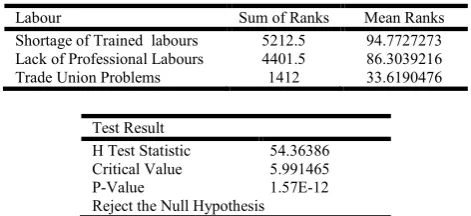
[image:5.595.43.282.83.203.2]The second component is labour issues and is sub divided into shortage of trained labours, lack of professional labour and trade union problems. Test Result shows (Table 2) that H test Static is greater than the critical value so we reject the Null Hypothesis. Shortage of Trained Labours is the core concern faced by seafood industry.
Table 2. Labour Issues
Labour Sum of Ranks Mean Ranks
Shortage of Trained labours 5212.5 94.7727273 Lack of Professional Labours 4401.5 86.3039216 Trade Union Problems 1412 33.6190476
Test Result
H Test Statistic 54.36386 Critical Value 5.991465
P-Value 1.57E-12
Reject the Null Hypothesis Source: computed from surveyed data
Availability of local labours are significantly limited as Kerala’s occupational structure changes due to higher education status and on the other hand opportunity cost is higher in other industries like textile, construction and other manufacturing industry. Hence Seafood export processing industry depends on interstate labours from Bihar, West Bengal, Orissa, and Assam. These labours are unskilled and are initially trained by the seafood industry but later move to other employment sectors due to higher wages, and it creates additional financial burden for training and instructing the new labourers again. The second rank is the issue related to lack of professional labours and third ranking issue is the problems of trade unions which is not very significant as majority of the labourers are from other states.
Production and Technical Issues
Issues on production are classified into higher demand, lack of energy conservation measures, lack of new technology and lack of value added products. Test Result shows (Table 3) that H test Static is greater than the critical value and so we reject the Null Hypothesis. The major problem found in the production sector is the fluctuation in the demand, lack of raw materials according to the demand of the buyer’s perspective. Second issue is related to lack of value added products like ready-to-eat and cook products.
The modern customer demand better quality and ready- to- cook products. Third ranking problem is related to the new technological adaptation that reduces the wastage of energy and time. The energy conservation measures are demanded by future generation in order to generate a sustainable development in the fishery sector. Firms should adopt the solar energy system, power saving technology, innovate cost and energy saving methods of production to achieve maximum profit margin.
Marketing Problems
The fourth and most important component is ‘Marketing issues’ and is sub -divided into competition from branded firms, lack of export orders, lack of market infrastructure, changes in the market trends, delay in the approval of importing countries, and lack of quality control measures. Test Result shows (Table 4) that H test Static is greater than the critical value, so we reject the Null Hypothesis. Holistic marketing concept can be applied for expanding fish and fishery product export. The core issue in Marketing is the changes in the market trends and the competition from the branded firms. These issues are mainly confronted by the seafood processing export units. Hence, the exporter should be aware of the risk elements, marketing returns, current trends and opportunities in the marine export.
Third issue in this area is lack of market infrastructure and fourth issue is the delay in approval from the importing country. To avoid such problems, a structured market infrastructure is must and proper documentation and relevant clearance certificates should be prepared according to the requirement of the importing countries. Lack of export orders is another issue faced by the industry and this is interlinked with lack of quality control measures. Once the company’s reputation gets strained due to quality issues of rejection and detention and they automatically face the related issues in marketing. To avoid such circumstances total quality management is a necessary condition in the seafood export processing industry.
Financial Problems in the Seafood Industry
Finance is the backbone of the seafood industry. The main allied issues related to it are taken as lack of funds for expansion, high interest rates, delay in official procedures, and lack of returns from investment and insurance claims. Test Result shows (Table 5) that H test Static is greater than the critical value and so we reject the Null Hypothesis. The main issues in the finance sector are the high interest rates and the delayed official procedures which definitely affect rolling of
Table 1. Raw Materials Issues: Kruskal Wallis H Statistic Analysis
Raw Material Sum of Ranks Mean Ranks Scarcity of Raw Materials 7017.5 127.5909091 Inferior Quality 2863.5 56.14705882 Delayed Supply of Raw materials 3707.5 72.69607843
Price Increase 8989.5 163.4454545
Test Result
H Test Statistic 103.7477895 Critical Value 7.814727764
P-Value 2.43E-22
Reject the Null Hypothesis
Source: computed from surveyed data. [image:5.595.44.280.481.589.2]
Table 3. Production Problems
Production Sum of Ranks Mean Ranks
Unable to meet Demand 5921.5 111.7264151
Lack of Energy Conservation measures 3887.5 82.71276596
Lack of New Technology 4936.5 96.79411765
Lack of Value Added Products 5555.5 111.11 Test Result
H Test Statistic 8.224800179
Critical Value 7.814726664
P-Value 0.041587197
[image:6.595.138.448.73.173.2]Reject the Null Hypothesis Source: Computed from Surveyed Data
Table 4. Marketing: Kruskal H Statistic Analysis
Marketing Sum of Ranks Mean Ranks
Competition from branded firms 11120 205.925926
Lack of export orders 7001 132.09434
Lack of market infrastructure 8007 148.277778
Changes in the market trends 11913 216.6
Delay -Approval of importing Countries 8241 152.611111 Lack of quality control measures 6368 117.925926
Test Result
H Test Statistic 49.60686
Critical Value 11.0705
P-Value 1.67E-09
[image:6.595.135.452.212.329.2]Reject the Null Hypothesis Source: Computed from Surveyed Data
Table 5. Finance Problems: Kruskal H statistic Analysis
Finance Sum of Ranks Mean Ranks
Lack of funds for expansion 7448 137.925926
High Interest Rates 9538.5 173.427273
Delay in Official Procedures 8132 147.854545 Lack of returns from Investment 7314.5 132.990909
Insurance claims 4695 88.5849057
Test Result
H Test Statistic 33.05715
Critical Value 9.487729
P-Value 1.16E-06
Reject the Null Hypothesis Source: Computed from Surveyed Data
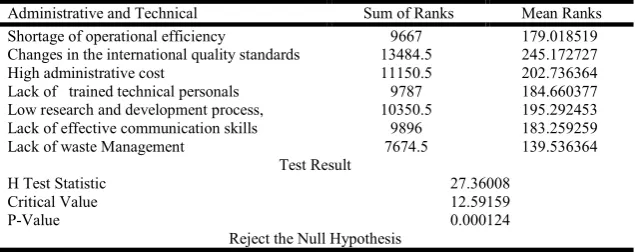
Table 6. Administrative and Technical Issues: Kruskal H statistic Analysis
Administrative and Technical Sum of Ranks Mean Ranks Shortage of operational efficiency 9667 179.018519 Changes in the international quality standards 13484.5 245.172727
High administrative cost 11150.5 202.736364
Lack of trained technical personals 9787 184.660377 Low research and development process, 10350.5 195.292453 Lack of effective communication skills 9896 183.259259
Lack of waste Management 7674.5 139.536364
Test Result
H Test Statistic 27.36008
Critical Value 12.59159
P-Value 0.000124
Reject the Null Hypothesis Source: Computed from Surveyed Data
Table 7. Quality Issues: Kruskal H statistic Analysis
Quality Issues Sum of Ranks Mean Ranks
HACCP Training 3315 97.5
Water Scarcity 1397.5 42.3484848
Power scarcity 4198.5 63.6136364 Technological up gradation 4198.5 63.6136364
Test Result
H Test Statistic -323.651
Critical Value 7.814728
P-Value 0.031728121
Reject the Null Hypothesis Source: Computed from Surveyed Data
[image:6.595.149.439.368.478.2] [image:6.595.135.453.519.645.2]cash trend in the seafood business. Third ranking problem is the lack of funds for expansion, especially to convert the traditional frozen pattern to value added product like ready to pan implementation and it requires huge investment and it will return its profit margin only in the long run. This leads to lack of return from investment in the short run and resulted in a financial dilemma. Insurance claims are not a significant problem if the official documentation procedures are perfect otherwise the exporter has to face losses in the way of insurance claims.
Administrative and Technical Problems
The important issues of administrative and technical issues are taken as shortage of operational efficiency, changes in the international quality standards, high administrative cost, lack of trained technical personals, low research and development process, lack of effective communication skills and lack of waste management practices. Test Result shows (Table 6) that H test Static is greater than the critical value so we reject the Null Hypothesis. In the administrative and technical side, the main problems are the changes in the international quality standards. The seafood industry should always be updated on the changing standards and should be able to prepare relevant certification and documentation accordingly. This leads to additional appointments of staff for documentation and other dealings with international agents and thus increases the administrative cost expenditures. Another problem is the lack of research and development for the analysis of their development. As the marine export industry deals with cultural and language diversification, it should ensure that language proficiency exist for its employees, or else it creates various related issues and countenance of additional risk to the industry. Another problem is the shortage of operational efficiency and that can be overcome through proper training and resource management and both these are interlinked.
Quality Issues
The last but the most relevant component is quality issues linked with HACCP training, water scarcity, power scarcity and technological up gradation. Test Result shows (Table 7) that H test Static is greater than the critical value so we reject the Null Hypothesis. The foremost ranking issue identified is power scarcity and technological up gradation and both are interrelated and as for the technological up gradation power supply is the most requisite factor.
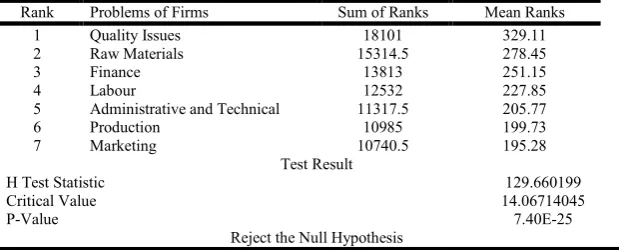
The next issue is HACCP training which is mandatory for the functioning of marine export industry. Training labourers is another issue. Language barriers is a crucial problem. Workers are from other state. Another issue is water scarcity and is a key problem in future as it is observed that there is a shortage of potable water in all stages of processing from catch to table. The Table No 8 scrutinizes the problems faced by in the surveyed units and ranked with the help of Kruskal H statistic analysis. Out of the seven parameters, quality Issue is identified as the major problem faced by the seafood processing industry. The second key problem recognized by the analysis is the raw material scarcity and the third problem is finance. The fourth problem is identified as Labour and fifth as Administrative and Technical issues. The sixth rank identified as production. The least rank examined was issues related to marketing.
Conclusion
The major problems faced by the fish export processing industry in Kerala are finance, labour, marketing, infrastructure, waste utilization, power, electricity charges, trade expenses, tax escalation, and increase in raw material cost, wages and salaries resulting in cost of production and profit margin. The fish storage facility in Kerala is grossly inadequate compared to the potential for fish production and processing. Extensive network of refrigerated handling, transport, storage and retailing has to be put in place. Also we have to make better use of fish waste and its by-products. Fish and fishery products in Kerala are facing crisis due to stagnation in production, low capacity utilization and highest cost of production due to overcapitalization and low productivity. There are various challenges faced by Kerala fish export processing industry on account of product diversification, dynamic market access, changing quality standards, climatic change, and global pressures and changing world scenarios.
REFERENCES
Annon, 2005. ‘Poor logistics costing seafood industry Rs.6000 crores annually’ Business Line, The Hindu December 15th Cochin Edition, Cochin.
COGSI 2013. Coalition of Gulf Shrimp Industries Fact Sheet on Shrimp Subsidy Trade Cases.http://www.
Table 8. Problems Faced in the Surveyed Unit: Kruskal H statistic Analysis
Rank Problems of Firms Sum of Ranks Mean Ranks
1 Quality Issues 18101 329.11
2 Raw Materials 15314.5 278.45
3 Finance 13813 251.15
4 Labour 12532 227.85
5 Administrative and Technical 11317.5 205.77
6 Production 10985 199.73
7 Marketing 10740.5 195.28
Test Result
H Test Statistic 129.660199
Critical Value 14.06714045
P-Value 7.40E-25
Reject the Null Hypothesis Source: computed from surveyed data
[image:7.595.145.455.81.206.2]gulfshrimpcoalition.com/pdfs/RevisedCOGSIFactSheetFor mattedAugust1.pdf accessed on 10th January 2013. Francis, C.A. 1992. Export Development: Process and
Potential A Study with Special Reference to the Marine Products Industry in India, Thesis, Cochin University of Science and Technology, Cochin
FAO 2010. “The State of world fisheries and aquaculture”, Rome, pp.24
MPEDA 2013. Marine Products Export Development Authority, Kochi.
Smitha Nair 2007. “Market Orientation in Indian seafood Processing firms” Thesis, School of industrial Fisheries, CUSAT 2007.
U.S. Food and Drug Administration 2015. “President’s FY
2016 Budget Request: Key Investments for Implementing the FDA Food Safety Modernization Act
(FSMA)”http://www.fda.gov/Food/GuidanceRegulation/F
SMA/ucm432576.htm?source=govdelivery&utm_medium =email&utm_source=govdelivery accessed on February 2nd,2015
USDA United States Department of Agriculture Economic Research Service.http://www.ers.usda.gov/data-products/aquaculture-data.aspx Accessed on April 17,2015.
US uphold Anti-dumping duties against Thai and Indian shrimphttp://www.ictsd.org/bridges-news/biores/news/us- upholds-anti-dumping-duties-against-thai-and-indian-shrimp accessed on 23rd December 2012.
WTO, 1995. The results of the Uruguay Round of Multilateral Trade Negotiations. The Legal Texts, Geneva, WTO. The World Trade Organization (2005): “Legal, Economic
and Political Analysis” Geneva, pp 231-370