ISSN: 1992-8645 www.jatit.org E-ISSN: 1817-3195
SOLVING A PROBLEM OF RESOURCE-INTENSIVE
MODELING OF DECODERS ON MASSIVELY PARALLEL
COMPUTING DEVICES BASED ON VITERBI ALGORITHM
ALEXEY VIKTOROVICH BASHKIROV, ALEXANDER VASILIEVICH MURATOV, OLEG YURIEVICH MAKAROV, VASILY IVANOVICH BORISOV,
KSENIA NIKOLAEVNA LAPSHINA
Voronezh State Technical University,
Moscow Avenue, 14, Voronezh, 394066, Voronezh region, Russia
ABSTRACT
In this paper, we consider the problem of resource-intensive simulation of coding/decoding which corrects errors made at the preliminary stages of modern telecommunication system development. We propose to use the technology of parallel computing on GPU (GPGPU) to solve the problem of the process acceleration. We discuss the aspects of encoding/decoding simulation, which corrects errors in heterogeneous systems. The results of this technology applying in the convolutional codec parameters simulation, decoded by Viterbi algorithm, are given as well. Another problem concerned with limitation of the interaction speed with the computing device tail part and a random access to memory is also considered. We propose a solution by communication minimization at host-computing device level, as well as the use of caching. The simulation tools are described in the paper, including the use of computing technique of general purpose on GPU allowing to reduce the time required to optimize the noiseless coding system and thus for the development and implementation of telecommunication devices. We describe the solutions of tasks on codecs characteristics research using massively parallel computing, differing by simplified initialization of flow pseudorandom-number generator (PRNG) ensuring high performance with sufficient accuracy of calculations by reducing the number of calls to an external status register.
Keywords: Parallel Computing, Viterbi Algorithm, Noiseless Coding, GPU Of The Opencl Standard, Communication Channels, Heterogeneous System.
1. INTRODUCTION
1.1 Introduce the problem
Continuously growing requirements to devices for processing, receiving and transmission of digital information cause the necessity of involving significant resources, primarily intellectual, to solve the problem of improving efficiency of means, specific algorithms and methods which implement technologies of data processing, transmission and receiving in such devices. One of the fastest growing ways to solve this problem is the coding theory, the noiseless coding in particular.
At the preliminary stages of development of telecommunication systems, containing the noiseless coding modules as inadvertent error correction means in communication channels, the optimization of these modules was an essential step. There is a promising way to reduce time given for this stage – to use the untapped resources of heterogeneous computing systems, in particular – the computing power of GPUs
(Graphics Processing Unit) [1-3]. In case of sufficient parallelism of implemented calculations using GPGPU technology (General-Purpose computing on Graphics Processing Units) [4], it is possible to achieve a significant time saving compared to the same calculations, produced in series on CPU (central processing unit). The paper presents the results of this technology implementation by using an open OpenCL (Open Computing Language) standard [5] for simulation of classical convolutional encoder with Viterbi decoding.
ISSN: 1992-8645 www.jatit.org E-ISSN: 1817-3195 performance and stability takes the CUDA
technology from Nvidia, but the hardware and software architecture is limited to using only the Nvidia hardware solutions. Using CUDA leads to the lack of hardware independence, and under current conditions it is quite an important factor, forcing to refuse from using this technology in favor of its competitor from AMD – OpenCL. OpenCL is a completely open standard implementation of GPGPU technology, providing implementation of cross-platform (hardware-independent) applications executed in heterogeneous systems.
This task is relevant due to the fact that the means of noiseless coding are widely introduced all over the world allowing to move to new data transmission standards, to reduce the number of receiving and transmitting stations, to reduce transmitter power, to reduce the harmful effects of electromagnetic radiation on human, to improve the reliability of data transmission, and to increase data transfer speed.
The traditional approach to the noiseless coding does not allow to detect adequately, correct errors and to achieve the required level of energy efficiency; it does not fully utilize the hardware capabilities of data transmission systems.
Thus, the problem of organization of parallel computing in heterogeneous systems and the development of appropriate tools for decoder performance simulation based on the Viterbi algorithm to reduce their design time requires further research.
The problem of the parallel PRN generation today is a relevant objective and is actively being worked on [9-12]. Let us briefly consider methods of generating parallel flows of PRN.
Viterbi algorithm is the most efficient among the decoding algorithms based on the lattice diagram, since it allows to get the most realistic (MR) estimation of the transmitted code word. Standard decoder implementing Viterbi algorithm does not allow achieving the required reliability and quality, and noise immunity.
The techniques described herein and simulation tools imply the use of general-purpose computing on GPU and will allow reducing the time required to optimize the error-correcting coding system and thus reduce the time for the
development and implementation of
telecommunication devices. 2. METHOD
2.1 Computing performance in heterogeneous systems
One of the ways to solve the problem of reducing the time costs for the simulation process is the use of unused resources of heterogeneous computers during the calculations: in addition to the CPU resources (central processing unit), the computing resources of GPU (graphics processing unit). With the sufficient parallelizability of simulation algorithms, GPU computing is less costly in terms of time resources [3].
In [3], the problem of communication interactions of the host-computing device level was considered. In this paper, we consider the second fundamental problem – the problem of random access to memory and a high-latency of a global memory.
ISSN: 1992-8645 www.jatit.org E-ISSN: 1817-3195
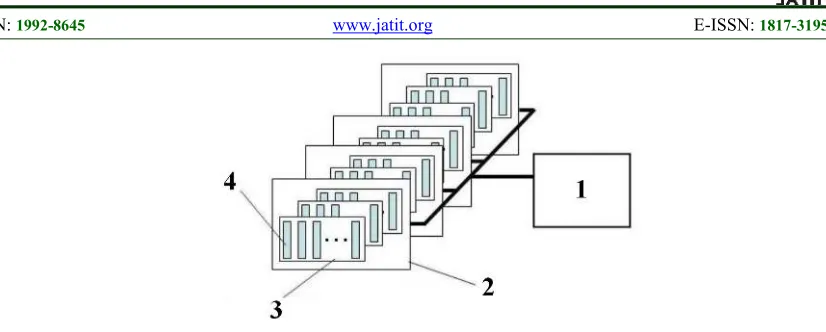
Figure 1. Architecture Of Heterogeneous Systems: 1 – Host; 2 – Computing Device; 3 – Computing Unit; 4 – Processing Element
This architecture assumes that there is one or more OpenCL devices connected to the host part (Host, receiving guests) – a device providing access services to a number of OpenCL devices, divided into several computing units with a number of processing elements. Calculations are made on the device processing elements. Commands of OpenCL application are addressed by the host to run on the processor elements inside the device. The processor elements run a single flow as SIMD (Single Instruction, Multiple Data) and SPMD (Single Program, Multiple Data) instructions.
Thus, a significant problem of GPU computing use is a set of constraints associated with the low bandwidth of the host-computing device connecting bus. This is a PCI bus for the graphics card (Peripheral Component Interconnect). For example, for a card used for the simulation in this paper, PCI Express 2.1 bus has a 5 Gb/s limit of maximum speed in one line [7-8].
The problem of PRN parallel generation is still a relevant one for today and it is actively being worked on [9-12]. Let us briefly consider methods of parallel flow generation of PRN.
As suggested in [3], the consistent PRNG (PRN generator) can be used for the parallel pseudorandom number flows generation. In applications with parallel numerical methods of statistical simulation – Monte-Carlo, additional requirements are to be met by a perfect generator, suitable for the designing of parallel PRNG:
1) scalability of generation flows, sufficient to generate the desired number of flows;
2) locality of generated flows, allowing to obtain the PRN sequences with no need for interaction with other flows; 3) mutual independence of sequences
generated by different flows.
The main methods of obtaining parallel PRN flows are, in accordance with [9, 13-14]:
1.Random selection of initialization values (Random seeding).
Each flow uses the same PRNG, and different initialization values are used for different flows.
This method is applicable in case of no strict requirements for flows correlation.
2.Parameterization.
Each flow uses the same type of PRNG, with different sets of parameters for the selected flows. The example is the use of different increments c or factors a for linear congruence method Xn = (aXn -1 + c) mod m, where X0 is value initializing the generator state.
The method also does not guarantee the absence of correlation flows, in addition, the number of generated flows is restricted with the set of variable parameters, i.e. scalability is not guaranteed.
1.Block Splitting.
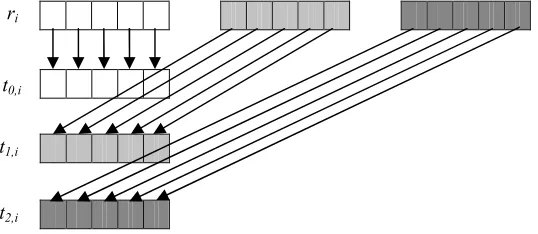
The output sequence of generator r is divided into blocks of M length (Figure 2) [15], where M is biggest number needed for solving tasks of PRNG implementations.
To use the method these options are required: a) Possibility to estimate in advance the
ISSN: 1992-8645 www.jatit.org E-ISSN: 1817-3195 b) Presence of an effective method for
skipping values blocks by PRNG. The result of this method depends on the existence of correlation between elements of sequence at M spaces.
2.Leapfrog.
[image:4.612.166.460.170.287.2] [image:4.612.181.450.405.522.2]Flows use one generator, at that each of the flows performs skipping p-1 implementations of PRNG, where p is the required number of flows (Figure 2).
Figure 2. Parallelization With "Leapfrog" Method
The "leapfrog" parallelization method is reliable enough, before computing it is not required to estimate the amount of PRNG implementations needed to complete the task; however, it requires an efficient algorithm of generator skipping of a predetermined number of values.
The effect of flows correlation generated by PRN is not so great during the simulation of noiseless coding of low-density, in contrast to, for example, cryptography applications, so the parameterization and random initialization were chosen to parallelize PRNG.
Figure 3 Parallelization With Block Splitting
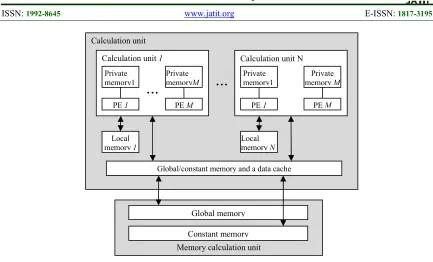
Random access to the memory of the graphics accelerator and the high latency of its global sections have a significant impact on heterogeneous computing performance. Let us address the memory model, provided by OpenCL standard in this issue (Figure 4) [4].
The standard provides for the following types of memory:
1) global:
• reading and writing; • low-speed access;
2) constant:
• access from all the processing elements (PE) to reading;
3) local:
• reading and writing one group to all PE (computing unit);
• high-speed access;
4) private:
• allocated by the compiler;
• reading and writing exclusively within PE; • high-speed access;
t0,i
t1,i
t2,i
ri
t0,i
t1,i
t2,i
ISSN: 1992-8645 www.jatit.org E-ISSN: 1817-3195
Figure 4. The Memory In Accordance With The Opencl Standard
According to this model, the main problems are:
Access to global memory itself, due to the fact it is conjugate with high latency and low speed;
[image:5.612.155.447.434.566.2]Problems of random access to memory – delays during simultaneous multiple access of PEs to memory cells (collision) (Figure 5);
Figure 5. Conflicts Of Access To Memory: A) Conflict-Free Access; B) Collision
• problems of access synchronization within the computing device in terms of inability to access the memory of another computer unit. Thus, when working with memory, the main principles are as follows:
• first minimize calls to slow global memory and second – to the local memory;
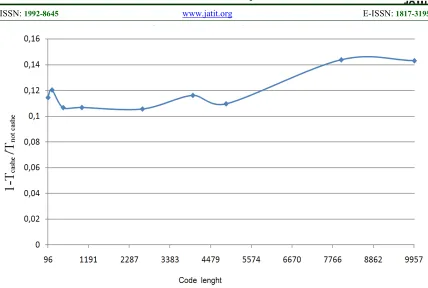
• use caching – copy commonly used slow memory units to a faster memory. In papers [16-17], the caching procedure is used. The benefits of using caching procedures for some variables are shown on the diagram of Figure 6.
PE
Memory
PE
Memory
PE
Memory
Conflicts: 0 1 0 0 1
a) b)
Calculation unit
∙∙∙
Calculation unit 1
∙∙∙
Private memory1
PE 1
Private memoryM
PE M
Local memory 1
Calculation unit N
Private memory1
PE 1
Private memory M
PE M
Local memory N
Global/constant memory and a data cache
Memory calculation unit Global memory
ISSN: 1992-8645 www.jatit.org E-ISSN: 1817-3195
Figure 6. The Gain From The Using Caching Procedures
In Figure 6, Tcashe is the decoding time with the use of caching procedures and Tnot cache is the decoding time without caching procedures. Decoding was produced in 10 iterations and 3,408 simulations per one value of SNR (10 values of SNR were simulated: from 0.1 to 2.5 with the resolution of 0.25 dB). Graphics accelerator Radeon HD 5770 was used as a computing device (800 stream processors, 850 MHz).
2.2. Modified algorithm of parallel calculation performing
The code performed during the calculations on the GPU corresponds to counting of path metrics, selection of these survivors and updating array of metrics for the current and the previous steps [18-20]. To enable running in parallel with the necessary calculations, the operation algorithm is modified as follows:
Legend:
l – length of code constraint;
M0 [2l-1] – the array for storing the metrics of surviving paths calculated at the previous step;
M1 [2
l-1
] – the array of calculated metrics;
P [n ∙ 2l-1] – the array storing the number of the previous states of the survivor path state;
i – number of processing element (kernel in OpenCL terminology);
m0 is a metric value, provided that for the
previous state of i (or i - 2l -2, if i ≥ 2l - 2) there was a state i ∙ 2 ((i - 2l - 2) ∙ 2);
m1 is a metric value, provided that the
previous state of i or i - 2l – 2, there was a state i ∙ 2 + 1 ((i - 2l - 2) ∙ 2 + 1);
t – a number of flow metrics counting step. Each processing element:
1. Calculates M1 [i],
- In case of i < 2l-2, equal to a bigger of the values M0 [i ∙ 2] + m0 and M0 [i ∙ 2 + 1] + m1;
i ∙ 2 is written in P [t] if M0 [i ∙ 2] + m0> M0 [i ∙ 2 + 1] + m1 and i ∙ 2 + 1 otherwise.
- In case of i ≥ 2l-2, according to the larger value of M0 [(i - 2l-2) ∙ 2] + m0 and M0 [(i - 2l-2) ∙ 2 + 1] + m1;
i ∙ 2 is written in P [t] if M0 [(i - 2l-2) ∙ 2] + m0
> M0 [(i - 2l - 2) ∙ 2 + 1] + m1 and i ∙ 2 + 1
ISSN: 1992-8645 www.jatit.org E-ISSN: 1817-3195 2. Sets of metrics are updated:
- on the first step of metrics calculation – M0 [i] = M1 [i] = -∞, M0 [0] = 0;
- In other cases – M0 [i] = M1 [i], M1 [i] = -∞. This solution is justified by the structure of the convolutional encoder trellis diagram. For example, according to the diagram of a convolutional code with a constraint equal to “4”, as shown in Figure 7, it is obvious that at
[image:7.612.86.529.548.740.2]step t of metrics calculation, states i ∙ 2 and i ∙ 2 + 1, 0 ≤ i <2l - 2 on the trellis diagram are the previous ones to states 0 ≤ i <2l-2, if at step t – 1, “0” was a new information bit, and they are the previous ones to states 2l - 2≤ i <2l - 1, if “1” was a new information bit at step t – 1.
Figure 7. The Trellis Diagram Of A Convolutional Code With A Constraint Equal To “4” For Three Steps Of Counting Metrics
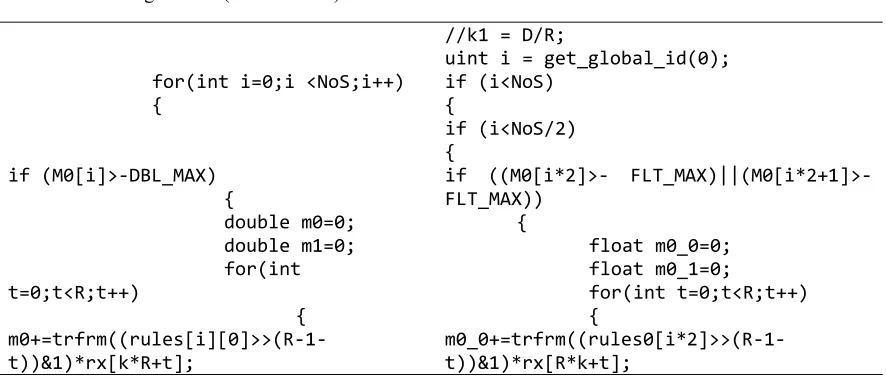
This fact was used for the parallelization of metrics calculation algorithm. Abbreviated code implementing the algorithm was adapted in accordance with the requirements of OpenCL and it is shown below (left – shortened code
implementing the algorithm in sequence on the CPU, right – parallel version for computing on GPU):
1. Counting metrics (Kernel No. 1).
for(int i=0;i <NoS;i++) {
if (M0[i]>-DBL_MAX) {
double m0=0; double m1=0; for(int t=0;t<R;t++)
{ m0+=trfrm((rules[i][0]>>(R-1-t))&1)*rx[k*R+t];
//k1 = D/R;
uint i = get_global_id(0); if (i<NoS)
{
if (i<NoS/2) {
if ((M0[i*2]>- FLT_MAX)||(M0[i*2+1]>-FLT_MAX))
{
float m0_0=0; float m0_1=0;
for(int t=0;t<R;t++) {
m0_0+=trfrm((rules0[i*2]>>(R-1-t))&1)*rx[R*k+t];
000 001 010 011
100 101 110 111
000 001 010 011
100 101 110 111
000 001 010 011
100 101 110 111
1 2 3
ISSN: 1992-8645 www.jatit.org E-ISSN: 1817-3195
m1+=trfrm((rules[i][1]>>(R-1-t))&1)*rx[k*R+t];
}
if (M1[i/2]<M0[i]+m0) {
M1[i/2]=M0[i]+m0; prev[i/2][k]=i; }
if (M1[i/2+NoS/2]<M0[i]+m1)
{
M1[i/2+NoS/2]=M0[i]+m1;
prev[i/2+NoS/2][k]=i; }
} }
m0_1+=trfrm((rules0[i*2+1]>>(R-1-t))&1)*rx[R*k+t];
} if
((M0[i*2]+m0_0)>(M0[i*2+1]+m0_1)) {
M1[i]=M0[i*2]+m0_0; prev[i*k1+k]=i*2; }
else {
M1[i]=M0[i*2+1]+m0_1; prev[i*k1+k]=i*2+1; }
} }
else {
if ((M0[(i-NoS/2)*2]>-FLT_MAX)|| (M0[(i- NoS/2)*2+1]>-FLT_MAX)) {
float m1_0=0; float m1_1=0;
for(int t=0;t<R;t++) {
m1_0+=trfrm((rules1[(i-NoS/2)*2]>> (R-1-t))&1)*rx[R*k+t]; m1_1+=trfrm((rules1[(i-NoS/2)*2+1]>>
(R-1-t))&1)*rx[R*k+t]; }
if ((M0[(i-NoS/2)*2]+m1_0)> (M0[(i-NoS/2)*2+1]+m1_1))
{
M1[i]=M0[(i-NoS/2)*2]+m1_0;
prev[i*k1+k]=(i-NoS/2)*2; }
else {
M1[i]=M0[(i-NoS/2)*2+1]+m1_1;
prev[i*k1+k]=(i-NoS/2)*2+1;
} }
ISSN: 1992-8645 www.jatit.org E-ISSN: 1817-3195 2. Updating arrays of metrics (Kernel No. 2).
1. Counting metrics with synchronization (Kernel No. 3).
3. RESULTS
In the provided short listing on the right – the code, that runs separately by GPU 2l-1cores [21-23]. Code get_global_id(0) provides the identification of kernel executing the code instance. Thus, in the pseudo code to the left, cycles for (int i=0; i < NoS; i++), where NoS = 2l-1
run parallel on GPU. The number of running flows Thg (globalThreads)
and the size of a working group Thl
(localThreads) for running on the GPU 2l-1
instances of code are defined by the expression:
(
)
[
]
, . 2 , 2 ; , mod 2 2 , 2 1 max1 max max
1 max 1 max 1 = = ≤ = − + = > − − − − − l l g l
l l l l
l l l g l l Th Th Th Th Th Th Th Th Th (1)
where Thlmax is the maximum size of a
one-dimensional local workgroup
(CL_KERNEL_WORK_GROUP_SIZE). for(int i=0;i<NoS;i++) { M0[i]=M1[i]; M1[i]=-DBL_MAX; }
uint i = get_global_id(0); if (i<NoS)
{
if(k==k1-1) {
M0[i]=-FLT_MAX; if (i==0) {M0[0]=0;} } else M0[i]=M1[i]; M1[i]=-FLT_MAX; } for(int i=0;i<NoS;i++) { M0[i]=M1[i]=-DBL_MAX; for(int k=0;k<D/R;k++) prev[i][k]=-1; } M0[0]=0; for(int k=0;k<size/R;k++) { for(int i=0;i<NoS;i++) { if (M0[i]>-DBL_MAX) {. . . } } for(int i=0;i<NoS;i++) { M0[i]=M1[i]; M1[i]=-DBL_MAX; } }
//k1 = D/R;
uint i = get_global_id(0); if (i<NoS)
for(int k=0;k<k1;k++) {
if(k==0) {
ISSN: 1992-8645 www.jatit.org E-ISSN: 1817-3195 If the 2l-1 ≤ Thlmax, is performed only by
Kernel No. 3, or sequentially for D/R times in one after another Kernel No. 1 and Kernel No. 2, starting from Kernel No. 1 are performed, where D is the length of decoded packet and R is a value of inverse code rate.
In these modes, calculations were performed on a AMD Radeon HD 5770 graphic card (800 flow processors with a frequency of 850 MHz), AMD Radeon HD 4650 (320 flow processors
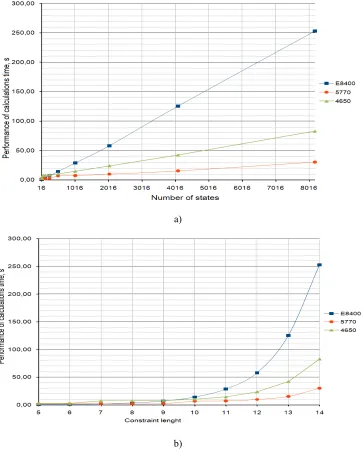
with a frequency of 600 MHz) and CPU – Intel Core 2 Duo E8400 in single-flow mode with a frequency of 3.6 GHz. The simulation was performed at 100 iterations of coding, decoding and noise pollution of packet with the length of 1024 bit, with the noise level of 1; 1.5; 2; 2.5 dB with the code rate of 0.5. Diagrams of time dependency on the number of states during the simulation and the constraint length are shown in Figure 8 a) and b).
a)
b)
[image:10.612.128.492.238.690.2]ISSN: 1992-8645 www.jatit.org E-ISSN: 1817-3195 Applying this model we managed to reduce
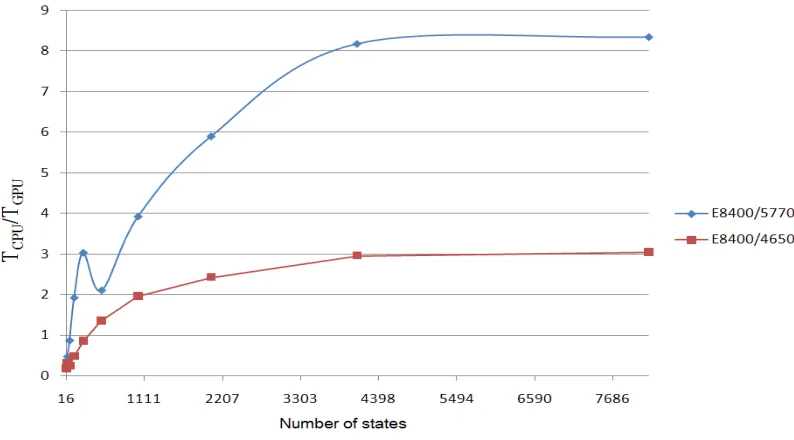
the payment execution time. Figure 9 shows the time benefit of applying the parallelization scheme described above, depending on the code length.
4. DISCUSSION
Curves on Figure 9: E8400 – corresponds to the time required for modeling sequential computing on CPU Intel Core 2 Duo E8400;
[image:11.612.108.505.253.473.2]5770 – costs of simulation using parallel computing on GPU Radeon HD 5770; 4650 – on the GPU Radeon HD 4650 respectively. For GPU Radeon HD 5770, time gain compared to the CPU E8400 becomes apparent at 2l-1 = 128; for the Radeon HD 4650 – at 2l-1 = 512. For clarity, Figure 8 shows the dependency graphs of the time ratio of calculation performing with the calculations of the CPU to the GPU on the number of convolutional encoder states.
Figure 9. Relative Time Gain Of Gpu Computing
The dip in the curve "E8400/5770" at the point corresponding to the value of the 2l-1 = 512 is associated with the size limitations of "working group" during the calculations on Radeon HD 5770. The driver of graphic card limits the size of the value to 256. At 2l-1 ≤ 256 kernel No. 3 runs, corresponding to the algorithm with synchronization of the local group, which provides the possibility to perform metrics calculation of the paths for each step of initializing kernel only at the first step and provides the possibility to update sets of metrics at the time of guaranteed completion of the metrics counting within a single kernel, resulting in reduced communication costs of host-kernel levels.
Thus, for small length values (N=96), the time gain is 80% and decreases to 60% at N=204, and 41% when N=273. Then there is a stable site with
an average gain value of 21%, when the code length is in range from N=504 to 3000.
The scope of this method is limited by the condition Q < Maxsim. It should be noted that
basically this method can be implemented in heterogeneous systems with multiprocessor CPU, based with the full load of all CPU cores.
5. CONCLUSION
ISSN: 1992-8645 www.jatit.org E-ISSN: 1817-3195 follow the principles of minimizing costly accesses
to slower memory and applying caching procedures.
The effect of a low flow capacity of a global and local memory of GPU on computing performance of automated simulation tools of decoders can be reduced by the use of developed computational schemes by minimizing request to these memory sections and applying caching procedures. Experimentally estimated computing performance increase for code length of 96... 9972 comprises 11% on average.
The problem of reducing the computing performance as the result of interactions of two communication levels of CPU-GPU. To limit communication interactions, the model of noise source should be implemented at the level of processing elements of GPU. The use of the developed simulation method of the noise source provides sufficient accuracy of the results and the increase in computing performance by reducing the number of requests to an external status register of
the pseudorandom number generator.
Experimentally estimated computing performance increase reaches 30%. The results of the conducted research can be applied for decoder simulation used in the wireless, interference-proof networks, such as WLAN, WPAN, WMAN.
The results of GPGPU technology application give reason to believe this approach to be promising to solve the problem of reducing the time spent on resource-intensive simulations of error-correcting codec characteristics even in the case of classical convolutional codes decoded by Viterbi algorithm.
REFERENCES:
[1] Bashkirov, A.V., Klimov, A.I., Muratov, A.V., Naumenko, Yu.S., & Tsymbalyuk, V.S. (2013). Perspektivy modelirovaniya parametrov algoritmov pomekhoustoychivogo kodirovaniya s vysokoy stepen'yu parallelizma pri pomoshchi apparatnoy platformy na baze GPU [Outlooks for Simulation of Parameters of Noiseless Coding Algorithms with a High Degree of Parallelism with the Help of Hardware Platform Based on GPU]. Radiotekhnika, 12, 26-29.
[2] Naumenko, Yu.S. (2014). Problemy modelirovaniya pomekhoustoychivykh kodekov v geterogennykh sistemakh [Problems of Noiseless Codecs Simulation in Heterogeneous Systems]. Radiotekhnika, 3, 80-82.
[3] Naumenko, Yu.S. (2014). Massivnye parallel'nye vychisleniya v geterogennykh sistemakh pri modelirovanii nizkoplotnosnykh kodekov [Massive Parallel Computations in Heterogeneous Systems during Simulation of Low-Density Codecs]. Radiotekhnika, 6, 43-46.
[4] Boreskov, A.V., & Kharlamov, A.A. (2010).
Osnovy raboty s tekhnologiey CUDA [Basic
Operation with CUDA Technology]. Moscow: DMK Press.
[5] Khronos OpenCL Working Group. (2013, November 14). The OpenCL Specification. Version: 2.0. Document Revision: 19. [6] Zhmurov, A.A., Varsegov, V.A., Trifonov,
S.V., Kholodov, Ya.A., & Kholodov, A.S.
(2011). Effektivnye generatory
psevdosluchaynykh chisel pri molekulyarnom modelirovanii na videokartakh [Effective Pseudorandom Number Generators for Molecular Simulation on Graphic Cards]. Komp'yuternye issledovaniya i modelirovanie, 3(3), 287-308.
[7] Bauke, H., & Mertens, S. (2007). Random Numbers for Large Scale Distributed Monte Carlo Simulations. Physical Review E, 75(6). [8] Manssen, M., Weigel, M., & Hartmann, A.
(2012). Random Number Generators for Massively Parallel Simulations on GPU. Eur.
Phys. J. Special Topics, 210(1), 53-71.
[9] Giles, M. (2011). Approximating the Erfinv Function. In W.W. Hwu (Ed.), GPU
Computing Gems (Vol. 2) (pp. 109-116).
Burlington: Morgan Kaufman.
[10]Bradley, T., Toit, J., Giles, M., Tong, R., & Woodhams, P. (2010). Parallelisation Techniques for Random Number Generators. In W.W. Hwu (Ed.), GPU Computing Gems (Vol. 1). Morgan Kaufmann.
[11]Blahut, R. (1986). Teoriya i praktika kodov,
kontroliruyushchikh oshibki [Theory and
Practice of Error Control Codes] (I.I. Grushko, & V.M. Blinovskiy, Trans.). Moscow: Mir.
[12]Bauke, H. (2014, August 5). Tina’s Random
Number Generator Library. Version 4.17.
Retrieved August 1, 2016, from
http://numbercrunch.de/trng/.
[13]Blahut, R. (1989). Bystrye algoritmy tsifrovoy
obrabotki signalov [Fast Algorithms for
Digital Signal Processing] (Trans. from English). Moscow: Mir.
[14]Barash, L.Yu., & Schur, L.N. (2013). O
ISSN: 1992-8645 www.jatit.org E-ISSN: 1817-3195 psevdosluchaynykh chisel [About Generation
of Parallel Flows of Pseudorandom Numbers].
Programmnaya inzheneriya, 1, 24-32.
[15]Falcao, G., Sousa, L., & Silva, V. (2009). How GPUs Can Outperform ASICs for Fast LDPC Decoding. In ICS '09: Proceedings of
the 23rd international conference on
Supercomputing (pp. 390-399). New York:
ACM.
[16]Bykov, V.V. (1971). Tsifrovoe modelirovanie
v statisticheskoy radiotekhnike [Digital
Simulations in Statistical Radio]. Moscow: Sovetskoe radio.
[17]Komashinskiy, V.I., & Maksimov, A.V. (2007). Sistemy podvizhnoy radiosvyazi s paketnoy peredachey informatsii. Osnovy
modelirovaniya [Mobile Radio Systems with
Packet Data Transmission. Basics of modeling]. Moscow: Goryachaya liniya – Telekom.
[18]Savinkov, A.Yu. (2006). Avtomatizatsiya proektirovaniya sistem tsifrovoy obrabotki signala na osnove integrirovannoy sredy imitatsionnogo modelirovaniya i optimizatsii:
Dis. d-ra tekhn. nauk [Computer-Aided
Design of Digital Signal Processing Systems Based on Integrated Environment Simulation and Optimization (Doctoral Thesis in Technical Sciences)]. Voronezh.
[19]Tikhonov, V.I., & Kharisov, V.N. (1991).
Statisticheskiy analiz i sintez
radiotekhnicheskikh ustroystv i system
[Statistical Analysis and Synthesis of radio Engineering Devices and Systems]. Moscow: Radio i svyaz'.
[20]MacKay, D.J.C., & Davey, M.C. (2000). Evaluation of Gallager Codes for Short BlockLength and High Rate Applications. In B. Marcus, & J. Rosenthal (Eds.), Codes,
Systems and Graphical Models: Vol. 123 of