ISSN: 1992-8645 www.jatit.org E-ISSN: 1817-3195
EXPLORING THE USE OF SOCIAL MEDIA TOOLS AMONG
STUDENTS FOR TEACHING AND LEARNING PURPOSE
1NUR SHAMSIAH ABDUL RAHMAN, 2MOHD SHAHIZAN OTHMAN, 3WALEED AL-RAHMI
1, 2, 3
Department of Information System, Faculty of Computing, Universiti Teknologi Malaysia, Johor
Bahru, 81310, Malaysia
E-mail: [email protected], [email protected], [email protected]
ABSTRACT
Social media network is a fairly recent word used to define a form of learning that can be performed via websites online learning. The exploring of the potential use of social media tools and impact of contingent factors on the relationship between three predictors was investigated. A total of 235 valid responses were received from undergraduate students Faculty of Computing, Universiti Teknologi Malaysia (UTM) in the study. Several factors have been found to correlate with social media use, active learning both to affect teaching and learning. The researchers made use of the structural equation modelling (SEM) method with the SmartPLS program to shed a light on the adoption process. The results show that the use of social media positively and significantly relates to active learning, which in turn affect teaching and learning.
Keywords: Social Media, Teaching and Learning, Higher Education, Active Learning
1. INTRODUCTION
Social media sites such as Facebook, Twitter, Instagram, YouTube and Blog have attracted millions of users and they are used for many different purposes [1]. Social medias are used not only for social and entertainment purpose, but widely used in various field such as business [2], engineering [3], medical [4], educational [5, 6] and also for teaching and learning [7, 8]. With the increasing use of social media in educational environment has attracted the attention of previous researchers to determine how such tools could be used for teaching and learning. Research studies show that social medias can be used for educational purpose and have a positive impact on students [9, 10, and 11]. Many educational institutions also have taken advantage of social media site for maintaining their teaching and learning activities [12] and putting great effort into adopting such technologies to communicate with their faculty members and students to provide better services [13]. This is
because social medias have an important
educational potential that support educational activities by making interaction, collaboration, active participation, information and resource sharing, and critical thinking possible [14].
Despite the significant increase in the number of papers that examine potential educational use of social media, Kalin [15] stated that, before we can realize the benefits of technology, we must better
understand how students use it. Furthermore, while many educators and researchers would attest to the potentials of social media for learning, there are also those who argue that young adult learners view and use social medias as a platform for socializing more than learning [16]. Therefore, this study aimed to identify the activities using social media sites that facilitate student’s learning and to discover student view about the potential use of social media for teaching and learning. We propose a conceptual framework based on the literature review and posit that social media positively affects teaching and learning process. To verify the model, we conduct a survey among undergraduate students of Universiti Teknologi Malaysia using adopted questionnaire. In this study, a quantitative approach is applied and the reliability and validity of the scales were tested.
ISSN: 1992-8645 www.jatit.org E-ISSN: 1817-3195
2. LITERATURE REVIEW
Social media sites are the latest online communication tool that allows users to create a public or private profile to interact people in their network [17]. The social media has become a part of university students’ live as it helps them build their online social connections with others. Through the social media use, students understand how to share, communicate, collaborate and socialize information and knowledge.
The uses of social media among students in universities and colleges have been a topic of great discussion among researchers throughout the world. Many studies discovered that social media influence the effectiveness of learning and teaching in general [18]. Social media demonstrated in many studies have discovered a positive impact on learning and teaching foreign language as they can enhance and improve students’ written and oral language skills [19]. Kabilan et al. [11] found that university students consider Facebook as a useful and meaningful online environment that can support and improve their learning of English. Social media technologies have several advantages such as create new methods of interaction, collaboration, improving learning motivation, enhancing relationship, ability to share and create content, developing collaborative abilities and offering personalize course material [20, 21]. With this characteristics, social media are recognized as important tools for reshaping the learning and educational environment.
Despite the significant increase in the number of papers that examine potential educational use of social media, it may also give a bad influence on student engagement in learning [22]. Students who spent more times and involve in multitasking would have lower GPA [23] and significantly associated with lower performance [24]. These applications may also a source of distraction and can effect or divert students’ attention from their academic goals [25]. In addition, several studies concluded that slightly more than a quarter of the students surveyed said they would like to see greater use of social media in their course [26, 27]. Although they increasingly use technology in their personal lives, they feel comfortable with traditional learning ways and prefer moderate use of information and communication technologies in their courses [28]. After doing a comprehensive literature review, it is necessary to conduct more empirical research on the use of social media for teaching and learning purpose [29]. To shed light upon this topic, we conduct a study to identify the activities using
social media sites that facilitate student’s learning and to discover students view about the potential use of social media for educational purposes. Conclusions extracted from this research will help us to understand and improve our use of social media tools in educational contexts so that we can adapt our teaching strategies to the educational needs.
3. RESEARCH HYPOTHESES
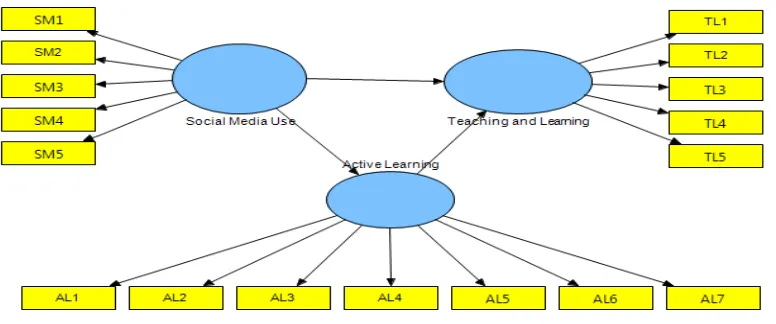
Figure 1 shows the research framework for this study. This study combines the relevant factors namely social media use, active learning and teaching and learning into a single model that can be tested and validated – such integration of social media aspects was never conducted in prior studies. The main study hypotheses of the current study are as follows:
H1: There’s a significant relationship between social media used and teaching and learning. H2: There’s a significant relationship between social media use and active learning.
H3: There’s a significant relationship between active learning and teaching and learning.
3.1 Social Media Use
Social media can be defined as a social structure for a group of individuals that connects both directly or indirectly based on each interest or importance and allow the creation and exchanges of user-generated content [30, 31]. The popularity of social media has grown extensively over the past few years [32]. Social media used has the ability to promote collaboration and cultural understanding among students. Plus, social media has a great potential as an educational tool to support the interactions between students and lecturers. Some previous researchers believe that social media can be used as an effective teaching tool in higher education because of its ease of use, ready availability, and individual affordability and network effects [33]. According to Greenhow et al. [34], social media have made communication, collaboration and interaction possible and more
efficiently. Consequently, they have been
ISSN: 1992-8645 www.jatit.org E-ISSN: 1817-3195 so on. Greenhow and Robelia [36] found that social
media as social learning resources provided students with opportunities for the validation and appreciation of creative work and school-task related support. Murphy and Lebans [37] also found that the integration of social media tools in
[image:3.612.113.501.191.353.2]learning increased student engagement with content, quality of assignments and a sense of responsibility for their learning.
Figure 1: Research Model
3.2 Active Learning
Learning is a process of interaction among students and instructors to get a variety of information, knowledge and experience lead to changes in behaviour. Active learning refers to a general type of learning methods that focus on active participation of learners [38]. Active learning
practices favour student participation and
engagement in learning activities, such as active writing, discussion, problem solving, case study and learning by teaching. Many social media technologies support active learning such as blog, social network, forum and other community of practice [38]. In recent years, many studies have emphasized the importance of active learning [39, 40, 41] because it can promote the development of self-efficacy, enhance learning motivation and active learning attitudes and lead to improved learning outcomes. Many researchers have started to explore the technology in enhancing their teaching as well as in promoting active learning for students. Zheng [38] focused on the use of blogs to promote active and collaborative learning and found that blogging activities was used to engage students in the learning process by active student contribution and interaction with peers. In promoting active learning among their medical students, George et al. [39] found that Google Docs can facilitate interaction and provide students with control over content and flow of lecture-based
courses, but educators must be mindful of practical and conceptual limitations.
3.3 Teaching and Learning
Learning is more meaningful when students can create and build their own knowledge. According to Batchelder [42], the activities in social media provide students with an active process that gives a significant meaning to them. Social media tools have a significant role to transform teaching and learning process because they provide specialized services for learning including blogs, microblogs, social bookmarking, media sharing and social media sites. The use of social media tools can
support students’ creativity and collective
formation [43]. Recent years, many researches have uncovered the use of social media that have been used by students from various countries. Zakaria et al. [44] found that students in Malaysia are
reasonably well exposed to social media
ISSN: 1992-8645 www.jatit.org E-ISSN: 1817-3195 performance, but with the help of collaborative
learning.
4. RESEARCH METHODOLOGY
A total of 235 questionnaires were collected in this study. Using systematic random sampling technique, participants were chosen randomly from among all undergraduate students studying at Faculty of Computing at Universiti Teknologi Malaysia. In this study, students come from the Department of Information System, Department of Software Engineering, Department of Computer Graphic and Multimedia, Department of Industrial Computing and Modelling and Department of Computer System and Communication.
Data analysis was carried out through the SPSS
application, Version 20 and Smart PLS.
Specifically, the instrument utilized in this study was developed based on the study objectives, after which it was piloted and the Cronbach’s alpha reliability and validity was found to be 0.814. Such
validity is acceptable and thus, the instrument was deemed to satisfy the reliability requirement. Also, a five-point Likert scale with 1 depicting strongly disagree and 5 depicting strongly agree was employed in this study. The questionnaire was refined according to the results of the pilot study conducted among students. The questionnaire comprised of 17 items.
5. RESULTS AND DISCUSSIONS
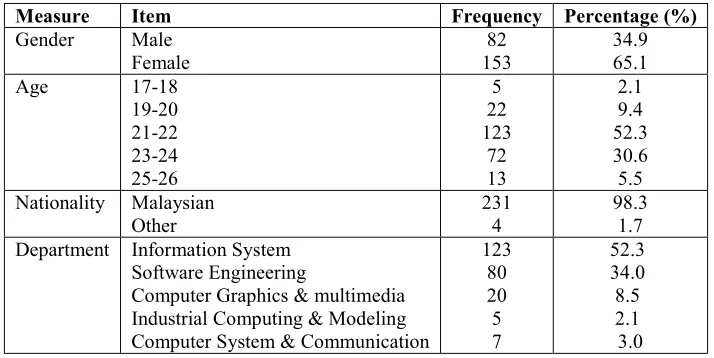
[image:4.612.128.485.368.547.2]Table 1 illustrates the demographic profiles and descriptive statistics of respondents. Two hundred and thirty five responses were received. Regarding the gender, it is evident that the majority of the population consists of female students. The females students comprised 65.1% (f=153) of the population, while male students comprised 34.9% (f=82).
Table 1: Demographic Profiles and Descriptive Statistics of Respondents
Measure Item Frequency Percentage (%)
Gender Male
Female
82 153
34.9 65.1
Age 17-18
19-20 21-22 23-24 25-26
5 22 123
72 13
2.1 9.4 52.3 30.6 5.5
Nationality Malaysian
Other
231 4
98.3 1.7
Department Information System
Software Engineering
Computer Graphics & multimedia Industrial Computing & Modeling Computer System & Communication
123 80 20 5 7
52.3 34.0 8.5 2.1 3.0
The majority of the students are from the age group of 21-22 years old (52.3%). This is followed by the age of 23-24 years old (30.6%), 9.4% (f=22) were at the age of 19-20 years old, 5.5% (f=13) were at the age of 25-26 years old and 2.1% (f=5) were at the age of 17-18 years old. Out of 235 respondents, only 1.7% (f=4) is non-Malaysian, while the rest are Malaysian (f=231). According to the distribution, 52.3% (f=123) of the students were studying at the Department of Information System, 34.0% (f=80) at the Department of Software Engineering, 8.5% (f=20) at the Department of Computer Graphics and Multimedia, 3.0% (f=7) at the Department of Computer System and
Communication where 2.1% (f=5) of the students were at the Department of Industrial Computing and Modeling.
5.1 Measurement and Instrumentation
The initial phase in confirming the validity and reliability of the measurement model is through the use of Partial Least Square Structural Equation Modelling (PLS-SEM), Smart PLS 3.0. Before the hypotheses are tested, two steps were conducted to establish the model’s goodness-of-fit; first the
construct validity test that includes the
ISSN: 1992-8645 www.jatit.org E-ISSN: 1817-3195 validity. According to [46], the criterion test should
be used to confirm discriminant validity. The tests are discussed in the following sub-sections in detail.
5.2 Construct Validity of the Measurements
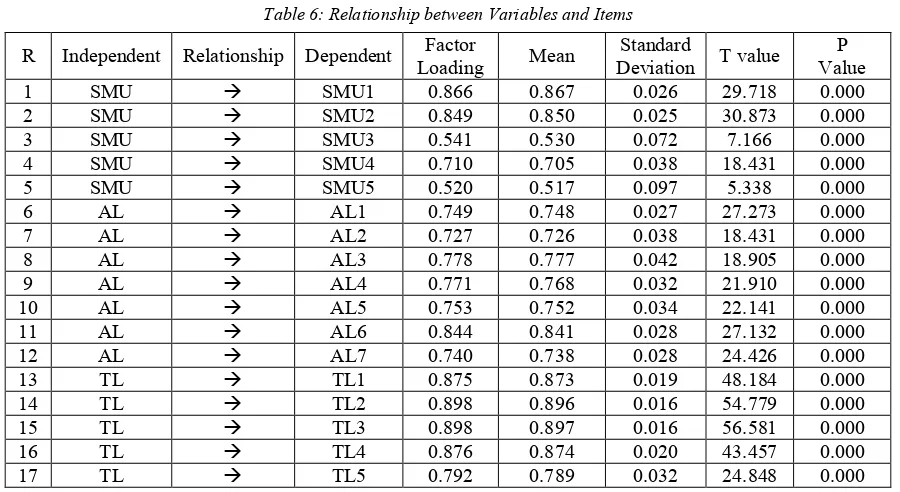
Construct validity is considered as the level to which the items developed to measure a construct can suitably measure the concept they are intended to measure [47]. It is important for the entire measures developed to measure a construct to load higher on their construct compared to other constructs. This was guaranteed through a thorough literature review of prior studies to identify items that whose reliability has already been established and tested. On the basis of the results of factor analysis, all items were appropriately assigned to their constructs as they revealed high loadings to their respective constructs in comparison to other constructs (See Table 2) according to the criterion proposed by [48].
5.3 Convergent Validity of the Measurements
The values of composite reliability in Table 3 reveal that the values differ from 0.832- 0.939, where they all exceeded the recommended value of 0.70. Additionally, the values of Cronbach’s alpha differ from 0.741 to 0.918 exceeding the recommended value of 0.70, and the average variance extracted (AVE) values differ from 0.508 - 0.754, all over the recommended value of 0.50. The entire factor loadings are significant and exceeded 0.50 indicating that the recommendations provided by [46&47] were satisfied. Table 3 also displays the CFA results for the measurement model.
5.4 Discriminant Validity of the Measures
Discriminant validity is a test that assesses the level to which a concept and its indicators vary from one concept to the next [49]. The discriminant validity is achieved when the square root of the construct’s AVE exceeds the inter-correlation between each construct and the reset of the
constructs. Table 4 depicts that the results of each indicator item and it shows that all the AVE values exceeded the 0.50 recommended value with p= 0.001. From the results shown, it is found that the criteria of discriminant validity are adequate and indicates that the discriminant validity is supported for the entire constructs [46&47].
5.5 Analysis of the Structural Model
Following the establishment of the
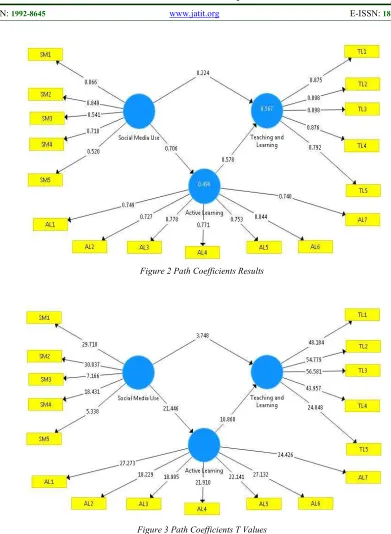
measurement model’s goodness of fit, the next phase involved the testing of the hypothesized relationships among the constructs and this is carried out through Smart PLS 3.0, specifically through the PLS algorithm. In this test, all value for factors loading, R-Square, Cronbach’s alpha, composite reliability and AVE were accepted. The path coefficients were produced as displayed in Figures 1 based on the illustrations in Figures 2, 3 and Table 3 and 4.
Table 5 shows that all the hypotheses were supported. Based on the analysis, the results revealed that social media use positively and significantly influenced teaching and learning at (β=0.224, t=3.743, p< 0.001) and active learning at (β=0.706, t=21.446, p< 0.001). Further from the analysis, it shows that active learning was positively and significantly related to teaching and learning at (β=0.578, t=10.860, p< 0.001). This indicates that H1, H2 and H3 are supported.
ISSN: 1992-8645 www.jatit.org E-ISSN: 1817-3195
Table 2: Loadings and Cross-loadings Of the Items
No Variables Code SMU AL TL
1
Social Media Use
SMU1 0.866 0.582 0.516
2 SMU2 0.849 0.582 0.488
3 SMU3 0.541 0.340 0.328
4 SMU4 0.710 0.572 0.468
5 SMU5 0.520 0.373 0.422
6
Active Learning
LA1 0.511 0.749 0.702
7 LA2 0.564 0.727 0.676
8 LA3 0.526 0.778 0.479
9 LA4 0.435 0.771 0.522
10 LA5 0.563 0.753 0.494
11 LA6 0.503 0.844 0.512
12 LA7 0.649 0.740 0.504
13
Teaching and Learning
TL1 0.417 0.561 0.875
14 TL2 0.591 0.668 0.898
15 TL3 0.572 0.642 0.898
16 TL4 0.534 0.672 0.876
17 TL5 0.602 0.634 0.792
Table 3: Loadings and Cross-loadings Of the Items
No Variables Code Factors
Loading
R-Square
Cronbach’s Alpha
Composite
Reliability AVE
1
Social Media Use
SMU1 0.866
0.000 0.741 0.832 0.508
2 SMU2 0.849
3 SMU3 0.541
4 SMU4 0.710
5 SMU5 0.520
6
Active Learning
AL1 0.749
0.498 0.883 0.909 0.588
7 AL2 0.727
8 AL3 0.778
9 AL4 0.771
10 AL5 0.753
11 AL6 0.844
12 AL7 0.740
13
Teaching and Learning
TL1 0.875
0.567 0.918 0.939 0.754
14 TL2 0.898
15 TL3 0.898
16 TL4 0.876
17 TL5 0.792
Table 4: Discriminant Validity
Variables SMU AL TL
Social Media Use 0.767
Active Learning 0.706 0.712
ISSN: 1992-8645 www.jatit.org E-ISSN: 1817-3195
[image:7.612.104.495.68.602.2]Figure 2 Path Coefficients Results
Figure 3 Path Coefficients T Values
Table 5: Hypotheses Testing for Variable
H Independent Relationship Dependent Path
Coefficient
Standard Error
T value
P
value Result
H1 SMU TL 0.224 0.055 3.743 0.000 Supported
H2 SMU AL 0.706 0.033 21.446 0.000 Supported
H3 AL TL 0.578 0.048 10.860 0.000 Supported
ISSN: 1992-8645 www.jatit.org E-ISSN: 1817-3195
Table 6: Relationship between Variables and Items
R Independent Relationship Dependent Factor
Loading Mean
Standard
Deviation T value
P Value
1 SMU SMU1 0.866 0.867 0.026 29.718 0.000
2 SMU SMU2 0.849 0.850 0.025 30.873 0.000
3 SMU SMU3 0.541 0.530 0.072 7.166 0.000
4 SMU SMU4 0.710 0.705 0.038 18.431 0.000
5 SMU SMU5 0.520 0.517 0.097 5.338 0.000
6 AL AL1 0.749 0.748 0.027 27.273 0.000
7 AL AL2 0.727 0.726 0.038 18.431 0.000
8 AL AL3 0.778 0.777 0.042 18.905 0.000
9 AL AL4 0.771 0.768 0.032 21.910 0.000
10 AL AL5 0.753 0.752 0.034 22.141 0.000
11 AL AL6 0.844 0.841 0.028 27.132 0.000
12 AL AL7 0.740 0.738 0.028 24.426 0.000
13 TL TL1 0.875 0.873 0.019 48.184 0.000
14 TL TL2 0.898 0.896 0.016 54.779 0.000
15 TL TL3 0.898 0.897 0.016 56.581 0.000
16 TL TL4 0.876 0.874 0.020 43.457 0.000
17 TL TL5 0.792 0.789 0.032 24.848 0.000
Note: p < 0.001
6. CONCLUSION AND FURTHER
RESEARCH
This study aimed to explore the potential use of social media tools and impact of contingent factors on the relationship between three predictors (social media used, active learning, teaching and learning) was investigated. In order to accomplish that goal, we propose a conceptual framework based on the literature review and posit that social media positively affects teaching and learning process. The findings indicate that social media use positively and significantly related to affect active learning in turn affect teaching and learning. These results are in agreement with [32] who reported that most students did realize academic benefits in using social media sites. Lecturers also thought that using social media as an instrument for teaching and learning enhanced the academic performance of their students. Overall, as a result of these findings, hypotheses H1, H2 and H3 are confirmed, which agree with the results of several past studies [50, 51 and 52] but contradict the findings of past studies that suggested that the frequent use of social media harms academic performance [53].
The present study supported the contention that social media use is effective both active learning and teaching and learning. In the field of social media use, no study has been conducted to identify the factors causing teaching and learning with active learning by social media use. Therefore, the present study highlighted such factors in the context
of Malaysian higher education institutions. The findings revealed enhancement of students’ perceptions of social media use. The present study’s results led the researcher to conclude that the model well represents the data collected based on its goodness-of-fit. For future studies, it is recommended that researchers include other factors that align with the educational environment, in terms of the barriers of integrating instructional technology into higher education in various countries. Such factors include discussion, sharing, generating knowledge and collaborative learning.
ACKNOWLEDGEMENTS
This material is based upon work supported by The World Academy of Sciences (TWAS), Research Grant Agreement (RGA), under No: 14-317 RG/ITC/AS_C-- UNESCO FR: 3240283418.
REFERENCES:
[1] F. Isik, “Comparison of the use of social
network in education between North and
South Cyprus”, Procedia Social and
Behavioral Sciences, Vol. 103, 2013, pp. 210-219.
[2] N. J. Oxborrow, “Social Media Helps Small
Businesses” UNLV
ISSN: 1992-8645 www.jatit.org E-ISSN: 1817-3195
[3] A. Begel, R., DeLine, and T. Zimmermann.
“Social Media for Software Engineering”,
FoSER 2010. Santa Fe, New Mexico, USA.
November 7–8, 2010, pp. 33-38.
[4] N. M. Deiorio, M. T. Fitch, J. Jung, S. B.
Promes, L. G. Thibodeau, W. L. Woolley, M. A. Gisondi, and L. D. Gruppen, “Evaluating educational interventions in
emergency medicine”. Acad Emerg Med,
Vol. 19, No. 12, 2012, pp.1442–1453.
[5] Y. Gulbahar, and F. Kalelioglu, “Use Flickr
for Language Teaching”. IETC. Istanbul
(Turkey). April 26-28, 2010.
[6] J. Kincaid, “Academia.edu Raises $1.6
Million to help researchers connect with
each other”. Online article:
http://techcrunch.com/2010/04/28/academia- edu-raises-1-6-million-to-help-researchers-connect-with-each-other/, 2010.
[7] M. D. Roblyer, M. McDaniel, M. Webb, J.
Herman, and J. V. Witty, “Findings on Facebook in higher education: A comparison of college faculty and students uses and perceptions of using social networking
sites”, Internet and Higher Education, Vol.
13, 2010, pp. 134-140.
[8] L. Lockyer, and J. Patterson, “Integrating
social networking technologies in education: A case study of a formal learning
environment”, 8th IEEE International
Conference on Advanced Learning
Technologies, 2008, pp. 529-533.
[9] H. Bicen, and H. Uzunboylu, “The use of
social networking sites in Education: A case
study of Facebook”, Journal of Universal
Computer Science, Vol. 19, No. 5, 2013, pp. 658-671.
[10] A. Kamenetz, “Gates foundation bets on Facebook app to help kids graduate. Fast Company” Retrieved 21 January, 2014 from, http://www.fastcompany, 2011.
[11] M. K. Kabilan, N. Ahmad, and M. J. Z. Abidin, “Facebook: An online environment for learning of English in institutions of
higher education?”, Internet and Higher
Education, Vol. 13, 2010, pp. 179-187. [12] H. Tinmaz, “Social networking websites as
an innovative framework for connectivism”,
Contemporary Educational Technology,
Vol. 3, No. 3, 2012, pp. 234-245.
[13] E. M. Al-Mukaini, W. S. Al-Qayoudhi and A. H. Al-Badi, “Adoption of social networking in education: A study of the use of social networks by higher education
students in Oman”, Journal of International
Education Research – Second Quarter, Vol.
10, No. 2, 2014.
[14] S. G. Mazman, and Y. K. Usluel, “Modeling
educational usage of Facebook”, Computers
& Education, Vol. 55, No. 2, 2010, pp. 444-453.
[15] J. Kalin, “Doing what comes naturally? Students perceptions and use collaborative
technologies”, International Journal
Scholarship Teaching Learning, Vol. 6, No.
1, 2012, pp. 1-21.
[16] A. Hamat, A. A. Embi and H. A. Hasan, “The use of social networking sites among
Malaysian University Students”,
International Education Studies, Vol. 5, No. 3, 2012.
[17] D. M. Boyd, and N. B. Ellison, “Social networks sites: definition, history, and
scholarship”, Journal of Computer-Mediated
Communication, Vol. 13, No. 1, 2007. [18] A. M. Elkaseh, K. W. Wong, and C. C.
Fung, “Perceived Ease of use and perceived usefulness of social media for e-Learning in Libyan higher education: A structural
equation modeling analysis”, International
Journal of Information and Education Technology, Vol. 6, No. 3, 2014.
[19] R. Harrison, and M. Thomas, “Identity in online communities: Social networking sites
and language learning”, International
Journal of Emerging Technologies and Society, Vol. 7, 2009, pp. 109-124.
[20] W. Rifkin, N. Longnecker, J. Leach, L. Davis, and L. Orthia, “Motivate students by having them publish in new media: An invitation to science lecturers to share and
test”, Australian Conference on Science and
Mathematics Education, 2012.
[21] A. L. Harris, and A. Rea, “Web 2.0 and virtual world technologies: A growing
impact on IS education”, Journal of
Information Systems Education, Vol. 20, 2009.
[22] R. Junco, “Too much face and not enough books: The relationship between multiple indices of Facebook use and academic
performance”, Computers and Education,
Vol. 58, 2012, pp. 187-198.
[23] L. Burak, “Multitasking in the university
classroom”, International Journal for the
Scholarship of Teaching and Learning, Vol. 6, No. 2, 2012, pp. 1-12.
[24] Haq, and S. Chand, “Pattern of Facebook
usage and its impact on academic
ISSN: 1992-8645 www.jatit.org E-ISSN: 1817-3195
based comparison”, Bulletin of Education
and Research, Vol. 32, No. 2, 2012, pp. 19-28.
[25] M. Ali, R. A. I. Raja Yaacob, M. N. A.
Endut, “Evaluating students information sharing behavior through social media: A
pilot study”, Australian Journal of Basic and
Applied Sciences, Vol. 9, No. 19, 2015, pp. 94-100.
[26] EDUCAUSE: Center of Applied Research.
ECAR study of undergraduate students and information technology 2012. (Research Report). Lousville, CO: EDUCAUSE: Center for Applied Research, 2012.
[27] S. D. Smith, and J. B. Caruso, “The ECAR study of undergraduate students and information technology”, In Research study (Vol 6) Boulder, CO: EDUCAUSE Center for Applied Research.
[28] C. Jones, and B. Shao, “The net generation and digital naïve: implications for higher education”. York, UK: Higher Education Academy, 2011.
[29] Y. Yang, Q. Wang, H. L. Woo, and C. L. Quek, “Using Facebook for teaching and learning: A review of the literature”,
International Journal of Continuing
Engineering Education and Life-Long
Learning, Vol. 21, No. 1, 2011, pp. 72-86. [30] L. Adamic, and E. Adar, “How to search a
social network”, Social networks, Vol. 27,
2005, pp.187-203.
[31] M, Ralph, and L. Ralph, “Weapons of Mass Instruction: The Creative use of Social
Media in Improving Pedagogy”, Issues in
Informing Science and Information
Technology, Vol. 10, 2013, pp. 449-460. [32] I. Govender, and D.W. Govender, “Using
Social Networks for Teaching and Learning: An Exploratory study”, In T. Amiel & B.
Wilson (Eds.), Proceedings of EdMedia:
World Conference on Educational Media
and Technology, Association for the
Advancement of Computing in Education (AACE), 2012, pp. 2421-2427.
[33] Y-W. Liao, Y-M. Huang, H-C. Chen, and S-H. Huang. “Exploring the antecedents of collaborative learning performance over social networking sites in a ubiquitous
learning context”, Computers in Human
Behavior, Vol. 43, 2015, pp. 313–323. [34] C. Greenhow, E. Robelia, and J. Hughes.
“Research on learning and teaching with
Web 2.0: Bridging conversations”,
Educational Researcher, Vol. 38, No. 4, 2009, pp. 280–283.
[35] R. Klamma, M. A. Chatti, E. Duval, H., Hummel, E. T. Hvannberg, M. Kravcik, E., Law, A. Naeve, and P. Scott, “Social
software for life-long learning”,
Educational Technology & Society, Vol. 10, No. 3, 2007, pp. 72-83.
[36] C. Greenhow, and E. Robelia, “Informal learning and identity formation in online
social networks”, Learning, Media and
Technology, Vol. 34, No. 2, 2009, pp.119– 140.
[37] J. Murphy, and R. Lebans, “Unexpected outcomes: Web 2.0 in the secondary school
classroom”, International Journal of
Technology in Teaching and Learning, Vol. 4, No. 2, 2008, pp.134–147.
[38] J. Zheng, “Active and Collaborative
Learning through a Blog Network”,
Proceedings of the Southern Association for Information Systems Conference, Savannah, GA (USA). March 8–9, 2013.
[39] D. R. George,, T. D. Dreibelbis, and B. Aumiller, “How we used two social media tools to enhance aspects of active learning
during lectures”, Medical Teacher, Vol. 35,
No. 12, 2013, pp. 985-988.
[40] C. McLoughlin, and M. J. W. Lee, “Personalised and self regulated learning in the web 2.0 era: International exemplars of innovative pedagogy using social software”,
Australasian Journal of Educational
Technology, Vol. 26, No. 1, 2010, pp. 28– 43.
[41] N. Selwyn, “Looking beyond learning: Notes towards the critical study of
educational technology” Journal of
Computer Assisted Learning, Vol. 26, No. 1, 2010, pp. 65–73.
[42] C. W. Batchelder, “Social software:
Participants experience using social
networking for learning” Doctoral
Dissertation, Capella University, 2010.
ProQuest. (UMI No. 3398679).
[43] A. Musa, and Z. Tasir, “Implikasi Alatan
Rangkaian Sosial Terhadap Proses
Pengajaran dan Pembelajaran” EduPress, 2010.
[44] M. H. Zakaria, J. Watson, and S. L. Edwards, “Investigating the use of Web 2.0
technology by Malaysian students”,
ISSN: 1992-8645 www.jatit.org E-ISSN: 1817-3195 [45] W. M. Al-Rahmi, M. S. Othman, L. M.
Yusof, and M. A. Musa, “Using social media as a tool for improving academic performance through collaborative learning
in Malaysian Higher education”, Review of
European Studies, Vol. 7, No. 3, 2015, pp. 265-275.
[46] C. Fornell, and D. F. Larcker, “Evaluating
structural equation models with
unobservable variables and measurement
error”, Journal of Marketing Research, Vol.
18, No. 1, 1981, pp. 39-50.
[47] J. F. Hair, C. M. Ringle, and M. Sarstedt,
“PLS-SEM: Indeed a silver bullet”, Journal
of Marketing Theory and Practice, Vol. 19, No. 2, 2011, pp. 139–152.
[48] M. Chow, D. K. Herold, T. M. Choo, and K. Chan, “Extending the technology acceptance model to explore the intention to use Second Life for enhancing healthcare education”, Computers & Education, Vol. 59, No. 4, 2012, pp. 1136-1144.
[49] R.P. Bagozzi, F.D. Davis, & P.R. Warshaw, 1992. “Extrinsic and intrinsic motivation to
use computers in the workplace”, Journal of
Applied Social Psychology, Vol. 22, No. 14, 1992, pp. 111-1132.
[50] W. M. Al-rahmi, M. S. Othman, and L. M. Yusuf, “Social Media for Collaborative
Learning and Engagement: Adoption
Framework in Higher Education Institutions
in Malaysia”, Mediterranean Journal of
Social Sciences, Vol. 6, No. 3, 2015, pp. 246-252
[51] W. Al-rahmi, and M. Othman, “The impact
of social media use on academic
performance among university students: A
pilot study”, Journal of information systems
research and innovation, Vol. 4, No. 12, 2013, pp. 1- 10.
[52] S. Ainin, M. Naqshbandi, S. Mogavvemi,
and N. Jaafar, “Facebook usage,
socialization and academic performance”, Computers & Education, Vol. 83, 2015, pp. 64-73.
[53] J. Kirschner, F. Erkens, G. Kirschnker, and F. Paas, “Making the black box of
collaborative learning transparent:
Combining process-oriented and cognitive
load approaches”, Educational Psychology
ISSN: 1992-8645 www.jatit.org E-ISSN: 1817-3195
APPENDIX: Questionnaire
Social Media Use
SMU1 I can get a lot of knowledges about my learning through my friends through social media tools.
SMU2 Through the media tools, I can share ideas or information’s that I know to the others without fear of being ridiculed partners. SMU3 I learn from the ideas and comments given
by friends in a social media tool.
SMU4 Social media tools can help users to express their ideas and opinions.
SMU5 I'm not embarrassed to ask other friends through social media tools about something that I do not understand in the learning process.
Active Learning
AL1 Upload/download/share files
AL2 Join groups
AL3 Online quizzes
AL4 Playing games
AL5 Become a fan on any page
AL6 Surfed the official website related to study
AL7 Health information
Teaching and Learning
TL1 Social media tools should use by instructors
for teaching and learning outside the lecture time.
TL2 Social media tools can be used as a medium
of teaching and learning between students and instructors.
TL3 The use of social media tools are new ways
of teaching and learning process more interactive than the teaching and learning in the classroom.
TL4 Social media tools like Facebook and blogs
potentially are used for teaching and learning process.
TL5 Social media tools can be a good learning
tool because the information’s is