1425
TECHNIQUES FOR HANDLING IMBALANCED DATASETS
WHEN PRODUCING CLASSIFIER MODELS
1ROZIANIWATI YUSOF , 2KHAIRUL AZHAR KASMIRAN, 3AIDA MUSTAPHA, 4NORWATI MUSTAPHA, 5NOR ASMA MOHD ZIN
1,5
Faculty of Computer and Mathematical Sciences,UiTM Shah Alam, Selangor, Malaysia
2,4
Faculty of Computer Science and Information Technology, UPM Serdang, Selangor, Malaysia
3
Faculty of Computer Science and Information Technology, UTHM Batu Pahat, Johor, Malaysia
E-mail: [email protected], [email protected], [email protected],
4
[email protected], [email protected]
ABSTRACT
Imbalanced datasets are a well-known problem in data mining, where the datasets are composed of two classes; the majority class and minority class. A majority class has more instances compared to the minority class. Recent years have brought increased interest in handling imbalanced datasets since many datasets produced are naturally imbalanced. Most existing techniques for classifying data ignore the imbalanced condition, but focused on the accuracy of the model produced where it is biased to the majority class while giving poor accuracy towards the minority class. Although the minority class is something that rarely happens, but in some conditions it will give an important influence to the classifier model. This paper attempts to list all the techniques in handling imbalanced datasets, as well as to compare all the techniques for producing the best classifier model for imbalanced datasets. These techniques have been categorized into sampling, feature selection and algorithmic approaches in the form of a taxonomy for handling imbalanced datasets. The strengths and the weaknesses of these approaches will be discussed in order to identify an appropriate technique that will improve the performance of a classifier model produced. The recent trends in handling imbalanced datasets also will be discussed based on domain and problems exist in dataset.
Keywords: Imbalanced Data, Sampling, Feature Selection, Cost Sensitive Learning, Classification
1. INTRODUCTION
The tremendous growth of technology has produced many raw datasets without giving any knowledge. It is thus an opportunity for researchers to produce great knowledge in order to use a dataset without wasting the production of data. However, most datasets are naturally imbalanced and can cause biased knowledge. Imbalanced datasets are normally composed of two classes; the majority (negative) class and minority (positive) class. A majority class has more class instances compared to the minor class [1]. In recent years, the problem of imbalanced datasets has seen an increase in occurrence and has become a major concern due to the performance of the algorithms and models produced that are significantly degraded because of it.
The imbalanced dataset will give a big impact in producing knowledge in real applications such as
1426 There are many major factors that influence the performance of a classifier model for imbalanced datasets such as the size of datasets, imbalance ratio, characteristics of imbalanced data like small disjunctions, ambiguous boundary between classes, classes overlapping in feature spaces, noisy data and dimensionality data [4]. Normally, the small sample size will influence the process of classifying imbalanced data. The minority data samples are not sufficient to train properly and will cause poor overfitting and poor generalization. Meanwhile, the problem of small disjunction also relates to the minority class. This happens due to the lack of sample of each sub-concept in the minority class [5]. Ambiguous boundary is also caused by the lack of minority data in the boundary area. Therefore, the decision that the boundary produced can be far less than the true boundary and results in poor minority prediction [4]. Besides that, a class overlapping will lead to poor performance for an object in the overlapped area. Class overlapping happens when discriminative rules are constructed to reduce misclassification of data. Producing a classifier model without considering imbalanced datasets is biased towards the major class dataset as well as giving poor accuracy towards the minor class dataset. The minor class instance can be misclassified as a major class instance. Although the minority class is something that rarely happens, but in some conditions, it will give an important influence to the classifier model. Therefore, it is very important to know the condition or the problem occurred on data before producing a classifier model.
In handling imbalanced datasets, there are three major approaches that have been introduced such as sampling, feature selection and algorithmic approaches [6]. The algorithmic approaches consist of cost-sensitive learning and one class learning approach. The combination of these approaches is called the ensemble method. However, all the approaches introduced should focus on the identification of the minor classes since the imbalanced data will cause bias to it. Therefore, the research question is how to choose the best techniques in handling imbalanced datasets in producing classifier model. The strengths and the weaknesses of these approaches are very important to clarify in order to identify an appropriate technique that will improve the performance of a classifier model produced. The condition or problems exist in datasets also will give some influences in producing a good classifier model. So, from this survey paper, the researchers may define
the best techniques to produce classifier model based on domain and the condition of dataset. The techniques show in form of taxonomy will make them more easiest to choose the suitable technique based on the strength and weakness of the techniques.
This paper is organized as follows: handling imbalanced techniques will be discussed in Section 2. The strengths and weaknesses of the approaches introduced will be discussed in Section 3. Section 4 will highlight on the trends of techniques in handling imbalanced datasets based on the domain and problems to solve. Finally, the conclusion and discussion are presented in Section 5.
2. HANDLING IMBALANCED
TECHNIQUES
2.1.Sampling Techniques
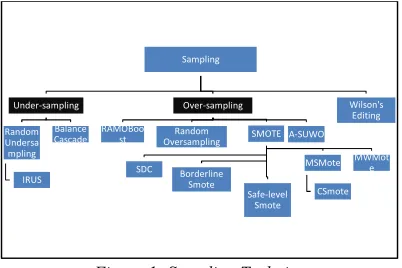
[image:2.612.314.515.438.572.2]Sampling approach is a technique used without needing to change an algorithm. This is a common practice used in handling imbalanced datasets. This technique modifies data distribution or resize the dataset in order to balance the dataset. In the data sampling approach, different techniques have been tested such as under-sampling and over-sampling, as well as random sampling as shown in Figure1 below.
Figure 1: Sampling Techniques
The under-sampling technique is for the majority class where data are randomly removed from the majority class sample. Meanwhile, over-sampling randomly replicates data from the minority class. Both techniques have disadvantages in which under-sampling can cause information loss whereas over-sampling will disturb the data distribution within the class either by overfitting or generating synthetic data points; which do not follow the real class distribution [7]. Recently, from the basic sampling techniques, there are many techniques that have been extended such as random
Sampling
Under-sampling Random Undersa mpling IRUS
Balance Cascade
Over-sampling RAMOBoo
st Oversampling Random SMOTE
SDC Borderline Smote
Safe-level Smote
MSMote
CSmote MWMot
e A-SUWO
1427 sampling. Random sampling is a combination of under-sampling and oversampling where the data are randomly selected to replicate or to be removed [8]. Random under-sampling samples the data by randomly removing examples from the majority class. Meanwhile, random oversampling is the random replication of data from the minority class. Resampling the data whether to remove or replicate it is based on specific data points such as class boundary and noisy data [7]. However, random sampling will change data drastically from the original data and sometimes will leave outliers in the data. This technique can also cause the loss of information and overfitting.
The IRUS or inverse random under-sampling is produced from random under-sampling. The idea of IRUS technique is to change the ratio of cardinality between the majority and minority classes by under-sampling the majority class repeatedly. Meanwhile, the BalanceCascade technique is focused on a training model to sample the data purposely for classifying a training pattern which is difficult to classify. However, this technique will omit potentially useful data from the majority class [9]. Based on [10], Chawla created a new technique for sampling in c2002 called SMOTE. This technique will add new data of minority class by interpolating between existing minority instances rather than duplicating the original instances. The new instances cause the minority regions of the feature space to be fuller [11]. SMOTE is also employed by the oversampling method for generating synthetic points in the majority class feature space. In recent years, many researchers found that there are many extension for SMOTE technique such as SDC that combines the variant of SMOTE. However, the SMOTE technique is useful only for low dimension datasets [12]. Based on observation, the SDC is much better than SMOTE [13]. Meanwhile, the Modified Smote or MSMOTE is modified from SMOTE. The MSMOTE will divide the data into three parts; safe, border and noise. The MSMOTE is better than SMOTE because it will remove latent noisy instances to
create new synthetic instances [9]. The
RAMOBoost technique purposely to classify binary classes dataset. [9]. The minority class will be oversample based on adaptive weight adjustment method. Besides that, Safe-level SMOTE will calculate a value for each minority instance called safe level value. Safe level value is defined as the number of other minority among its NN-nearest neighbours [14]. A new technique based on over-sampling has been introduced by [14] known as
A-SUWO. This method will clusters the minority objects using a semi-unsupervised hierarchical clustering approach and get the size of each subcluster to oversample using complexity of classification and cross validation. This technique avoid from overlapping between synthetic minority instances with majority instances.
Meanwhile, Wilson’s Editing technique
reduced a dataset with instance-based learning technique [10]. It will reduce all misclassified data in majority classes. This technique does not require specifying the class distribution. However, this technique will not change the correlation between attributes compared to random oversampling and random under-sampling as SMOTE changes the correlation structure in datasets [10].
2.2 Feature Selection
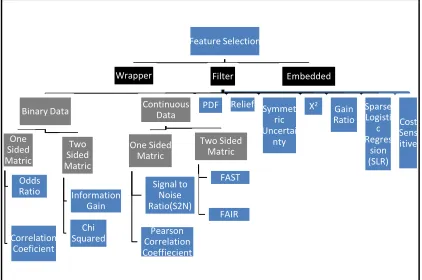
[image:3.612.314.525.416.556.2]Feature selection is an important phase in data mining, especially for high-dimensional datasets. Feature selection is a reduction of features [15] which attempts to select an informative feature [16] based on some criteria [17]. These features will represent the whole data without changing the original meaning. Figure 2 below shows the categories of feature selection.
Figure 2: Feature Selection Techniques
The feature selection technique can be categorized into three approaches; wrapper, embedded and filter [18]. The wrapper method selects the features based on the classification of algorithm and must retrain the algorithm with the
feature subsets. Meanwhile, the embedded
approach is like the wrapper method that relates to the learning algorithm, but the link is stronger than the wrapper method. This method works in conjunction with the learning algorithm to find feature subsets. The filter method used independent criteria to evaluate the subset of features. The
Feature Selection
Wrapper Filter
Binary Data One Sided Matric Odds Ratio
Correlation Coeficient
Two Sided Matric
Information Gain Chi Squared
Continuous Data
One Sided Matric
Signal to Noise Ratio(S2N)
Pearson Correlation Coeffiecient
Two Sided Matric
FAST
FAIR PDF Relief Symmet
ric Uncertai
nty X2
Gain Ratio
Sparse Logisti c Regres
sion (SLR)
1428 independent criteria include distance measures, information measures, dependency measures and soft computing-based measures [19]. Based on [18], the filter based approach is more efficient than the wrapper as this technique does not depend on induction algorithm and requires less computation [20]. However, the wrapper approach will produce a good result, but it depends on the classification algorithms. Sometimes, the features selected are not suitable with other classification algorithms. The wrapper approach normally has high computational cost and risk of overfitting to model [21]. Based on [11], neither the wrapper nor embedded methods have been proposed to handle imbalanced datasets in high-dimensional applications. However, past researchers only applied some heuristic techniques to improve the classifier of imbalanced datasets without selecting relevant features. They applied the embedded method to handle imbalance by embedding backward feature selection with the Support Vector Machine [11].
The feature selection method is necessary in handling imbalanced datasets because imbalance
problem commonly comes with high
dimensionality of data [22]. Based on [22], this technique is good in handling overfitting and can handle the imbalance problem alone without another technique if it involves high dimensionality data. In selecting the features, highly correlated features s[hould be considered in imbalanced datasets compared to the independent features [23]. There are many ways in handling imbalance by feature selection such as selecting features based on the feature selection metric. [22] proposed a new framework to select features such as selecting positive and negative classes separately. Meanwhile [24] proposed an iterative feature selection and [25] choosing features based on weight for negative and positive features.
For the feature selection metric, it can be measured by one-sided metric or two-sided metric. The one-sided metric measures positive features which indicate the membership in a class. Meanwhile, the two-sided metric selects both positive and negative features scores based on the metric. The negative feature is featured with the lack of membership in a class. Some researchers select the features by filtering strategies to examine the relevance of each feature for classes using the
metric. The common filtering strategies are the X2
statistic, Information gain, Gain ratio, Relief and ReliefF, Symmetric Uncertainty, and chi-square [10], [26]. The X2 statistic tests the distribution of
class. Information gain, gain ratio, and symmetrical uncertainty are measured based on the concept of entropy, which is based on information theory. Information gain metric checks the importance of the attributes of each class. It is about a target class that measures the decrease of the weighted average impurity of the sub attributes compared to the complete attributes. However, it will give the best result with the complete attributes. To avoid from this condition, the gain ratio strategy is applied. To improve the results, symmetrical uncertainty is used to avoid bias toward attributes with more values
[26]. Meanwhile, the chi-square tests the
association between two attributes, whether it is dependent on each other or not [26]. The Relief and ReliefF strategy can handle noise and multiclass
datasets. Based on [10], the X2 statistic, Information
gain, Symmetric Uncertainty and Gain Ratio are highly correlated to each others. The Relief and ReliefF strategy has an average correlation. Correlation is to define which techniques produce the same results to similar data in selecting the best features to represent the data without affecting the condition of data.
[23] introduced a new feature of the selection metric; Feature Assessment by Sliding Threshold (FAST) to handle small samples of imbalanced datasets. Based on [6], this technique is better compared to relief, correlation coefficient (CC) and baseline in selecting features. This technique is a two-sided metric. The FAST is measured by the area under the receiver operating characteristic (AUC) and handled using an even-bin distribution to move the decision boundary of a single feature classifier. However, this is not the best way to obtain a decision boundary. This problem can be handled by gathering the statistics for each boundary from the sample of multiple thresholds [6]. The AUC is good for predictor performance for imbalanced datasets where this score can be used for the feature ranking of attributes in which features with the highest scores are the best features for prediction [6].
1429 Assessment by Information Retrieval (FAIR) and signal to noise correlation coefficient (S2N) are used.
Based on [7] among all features metric, the sparse logistic regression (SLR) has shown higher stability in the selection of various features. Regression is a technique in modelling prediction which investigates dependent and independent variable. There are many techniques from regression such as logistic regression, linear regression, stepwise regression, ridge regression and lasso regression. The SLR is an improvement of logistic regression (LR). This technique can handle very high dimensional data and limited sample size. The features will be selected based on weight in which irrelevant features are given a zero weight. Meanwhile, other features are ranked in a decreasing order of their weight [7]. For example, the WSMOTE algorithm [27]. In this algorithm, the important attribute will be assigned with more weight using the mean and standard deviation of each individual attribute.
Based on [2], they handled imbalance by using unsupervised feature selection based on the filtering technique. This technique is considered for the minority class according to the relation between the distributions of features based on the probability density function (PDF). The features with higher covering areas with the PDF are considered as redundant features and will be removed. The feature selection techniques can also handle
imbalanced datasets by using a different
framework. Based on [21], the proposed iterative feature selection with different sample data can be employed. This approach identifies a ranked feature list which is effective on the dataset. This technique has been proven better than single iteration while selecting the features. Besides that, a stochastic algorithm Optimal Feature Weighting (OFW) and one- vs-one SVM are also used to find the optimized features from imbalanced and high-dimensional feature space [28]. According to [29], they select a subset of features based on cost sensitive as a feature weight. This technique known as Cost Sensitive Feature Selection using Chaos Algorithm (CSFSG).
2.3 Algorithmic Approaches
An algorithmic approach is a technique in handling imbalance involving changing or creating an algorithm [30] to modify the learning cost, adjusting the probability, threshold and recognition based on one class learning [24]. This approach
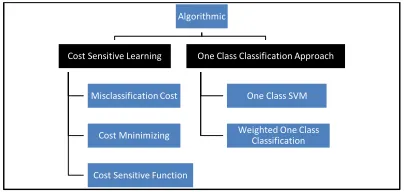
[image:5.612.316.518.150.246.2]optimizes the performance of learning algorithm through unseen data. Figure 3 shows show that types of algorithmic approaches consists of Cost Sensitive Learning and One Class Classification.
Figure 3: Algorithmic Approaches
2.3.1 Cost sensitive learning
Cost sensitive learning is a technique to define a different cost to misclassification errors such as false negative and false positive patterns [9]. It is also called as reweighting or adjusting the cost of various imbalanced classes [31]. In this technique, the misclassification cost is the important cost to be evaluated and should be minimized. Based on [32], the best metric for evaluating the classifier performance is the total cost. The formula for the total cost is shown in Equation 1:
Total cost = (FN x CFN) + (FP x CFP) (1)
Many researchers used the algorithmic approach in cost sensitive learning by using different classification algorithms such as Decision Trees and Support Vector Machines [7]. The purpose of algorithmic approach is to optimize the learning performance. There are three categories in implementing cost sensitive learning such as the use of misclassification cost to form dataspace weighting, cost minimizing techniques to combine schemes of ensemble method and combining the cost sensitive function with classifiers [8]. Misclassification cost can be divided to example dependent costs and class dependent costs [29]. Other algorithmic approaches include cost sensitive methods [30], [33], and kernel-based approach such as SVM [30].
2.3.2 One class classification approach This approach is recognition-based where classes are learned separately [31]. In this approach, training is done only on a sample of one class known as the target class. The purpose of the approach is to create a decision surface that covers all the available data samples. However, all the represented data outside the target concept are
Algorithmic
Cost Sensitive Learning
Misclassification Cost
Cost Mninimizing
Cost Sensitive Function
One Class Classification Approach
One Class SVM
1430 labelled as outliers. In handling the imbalance problem, this approach normally focuses on identification of the minority class samples as the target class [34]. The one-class classification is a technique that handles imbalanced dataset through the learning algorithm. This technique has one class target as the normal class whereas outliers is the abnormal class [35]. The distance or similarity between data with the target class will be measured. The threshold value will be identified to evaluate the data.
One of the common one class learning approaches is the one class SVM. This technique attempts to match an object with the target class by measuring the similarity [11]. However this technique only gives good performance when training using the minority sample [23]. Based on [34], they proposed the one class classifier based on weight. This technique will consider the details of minority class samples in the training set. This is because the normal learning algorithm produces a decision boundary that is biased toward the majority class and leads to a high rate of error in the minority class [34]. The calculation of weight for the minority sample is based on the borderline sample, rare sample and outlier’s sample. However, this technique is only suitable for the binary classes.
[image:6.612.102.298.446.708.2]2.4 Ensemble Methods
Figure 4: Ensemble Techniques
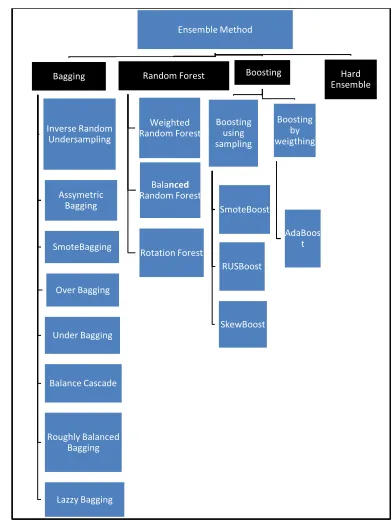
An ensemble method is a technique to combine or aggregate more than one technique such as two learning algorithms, a classifier with sampling techniques or feature selection and others as in Figure 4 above. Ensembling classifiers is a process of aggregating classifications of diverse classifiers [36]. The most prominent ensemble methods are bagging and boosting. These techniques employ sampling techniques to obtain different training sets for classifiers. Bagging is a process of individual classifier training using different bootstraps of data or by assigning weights to the observations. The bagging technique will reduce the variance of mean squared error (MSE). There are several techniques produced from bagging such as the Inverse Random Undersampling (IRUS), Asymmetric Bagging (AB), SmoteBagging (SB), Over Bagging (OB), Under Bagging (UB), Balance Cascade (BC), Roughly Balanced Bagging (RBB) and Lazy Bagging (LB) [9], [23], [36]–[38]. The IRUS technique will invert the ratio between the majority class and minority class by under-sampling the majority class and oversampling the minority class multiple times. This technique will control the false positive rate. Meanwhile, the AB maintains the size of the minority class, but a partition of equal size is derived from majority class for each bootstrap iteration. The SB generates synthetic observation to the minority class and does bagging to the majority class. The OB technique applies the random oversampling technique to the minority class during each bootstrap iteration. As for the UB, it applies random undersampling. The BC is based on the under-sampling strategy where it investigate the instances of majority class ignored by the under-sampling process. It uses both bagging and AdaBoost. The BC will produce a higher F-Measure, AUC and G-Mean. However, for the RBB, it uses the concept of weightage to balance the data between each class for each bootstrap iteration. The LB technique applies bagging to the nearest points using the nearest neighbouring algorithm. Meanwhile, the RF uses decision trees based on bagging for training. An easy Ensemble technique is produced from the under-sampling technique. This technique will sample the majority class into subsets to train separate classifiers. The results will combine in order to get a decision [9].
Meanwhile, in the boosting technique,
classifiers in the ensemble method are trained serially [37]. The first classifier in the ensemble method is trained using bootstrap data and it tests the model produced for the whole set of data. It will determine which sample is correctly predicted and
Ensemble Method
Bagging
Inverse Random Undersampling
Assymetric Bagging
SmoteBagging
Over Bagging
Under Bagging
Balance Cascade
Roughly Balanced Bagging
Lazzy Bagging
Random Forest
Weighted Random Forest
Balanced
Random Forest
Rotation Forest
Boosting
Boosting using sampling
SmoteBoost
RUSBoost
SkewBoost Boosting
by weigthing
AdaBoos t
1431 which is not. For incorrect prediction, it will be drawn in the next sample. It means that correctly predicted sample decreases and incorrect predicted sample increases [23]. There are a few techniques that apply the boosting technique such as AdaBoost, SmoteBoost, Random Under Sampling Boost (RUSBoost) and skewBoost. The boosting technique can be divided into two groups based on sampling and by weighting. However, according to [27], the boosting based sampling is better than by weighting because it can be applied on any base learner. The AdaBoost is an iterative boosting by allocating the variants weight to the observations during training time. The weight for misclassified data will increase for each iteration while the weight for correctly classified will decrease [38]. This technique will focus on misclassified data and very efficient ensemble method of classification [12]. Meanwhile, the SmoteBoost is an integration between Smote and AdaBoost [8]. It employs the synthetic sampling for each time boosting. The RUSBoost is a combination between sampling and Boosting. The RUSBoost applies the concept of random under sampling by removing data from the majority class. This technique is similar with AdaBoost where it applies the weightage concept for each time training iteration. This technique is less computational complex and time consuming [9]. The SkewBoost technique is based on SMOTE sampling where it is considered only for majority instances without compromising the accuracy of classifier for the majority instances [27].
Recently, many techniques have been extended from the Random Forest such as Weighted Random Forest, Balanced Random Forest [38] and Rotation Forest [12]. The Rotation Forest will rotate all the subspaces from the original dataset. It will increase the diversity and accuracy of the classifier. However, the ensemble method between classifier methods will cause dependency on the classifier algorithm [7]. Based on [9], they introduced a novelty technique called the HardEnsemble. This technique is a combination between under-sampling and sampling techniques. For the over-sampling technique, they applied the CSMOTE technique and for under-sampling, they applied the Reduced Reward Punishment technique.
The ensemble feature selection is a technique where multiple feature selection techniques are combined together. Based on [39], the ensemble methods will give a promising result compared to the single feature selection especially to high dimensional data and small size data. Based on
[21], they handled imbalanced datasets by combining feature selection technique with data sampling. The features have been selected for feature rankings such as chi-square, information gain, gain ratio, relief and symmetrical uncertainty. The process of sampling is repeated many times while selecting the features. They produced the best result for highly imbalanced datasets.
3 THE STRENGTH AND THE WEAKNESS OF THE APPROACHES
All the approaches discussed above have their strengths and weaknesses. However, it depends on the condition of data. There are many factors that will influence the classifier model produced from imbalanced datasets such as the ratio of skewness in the dataset and the characteristics of imbalanced datasets such as small disjunctions, small data size, class overlapping, dimensionality of data and noisy data [4]. However, most cases of imbalanced datasets are due to nonsufficient number of minority class instances that will cause improper training. The result produced thus tends to overfitting. Besides that, class overlapping can lead to poor performance over the minority class especially for the objects or data in overlapped areas. Meanwhile, small disjuncts problem happen to minority class where low number of samples for each subconcepts and lack of diversity for minority instances. Despite of that, the consideration of which technique is best for handling a problem of data distribution highly depends on the nature of datasets used for experiment. For the sampling technique, it is suitable for highly imbalanced ratio among datasets [30] and also for large datasets [24]. Based on [14], A-SUWO technique works better compare to other sampling techniques for datasets with higher imbalance ratio. However, the
combination of sampling techniques with
algorithms can improve the performance compared to using one sampling technique only. This method will improve the accuracy of the minority class, but not for the majority class. Sometimes, this method is biased from the original dataset. This is because it will change the correlation structure extremely. Thus the subset of features produced is not accurate for different samples [40].
1432 feature selection techniques is essential. This technique can reduce susceptibility, overfitting, and
reducing storage, memory and processing
requirements. Besides that, it will enhance the speed of the training process. However, some of the attributes will be omitted as they will influence the classification of performance. Based on [6], the feature selection technique is better in handling overfitting compared to handling using the classification algorithm. According to [12], feature selection is very important when handling high dimensional imbalanced dataset and can handle overfitting problem caused by oversampling the minority data. Based on past researches, feature selection based on metric measurement for filtering features is the best approach in handling imbalanced dataset. Based on [41], this approach is robust against overfitting compared to the wrapper methods that cannot produce the best feature subset and cause poor classifier performance especially for
high dimensional and imbalanced datasets.
However, based on [42], the feature selection metrics can be chosen based on the condition of data whether binary data or continuous data. It does not depend on classifiers.
Besides that, the skewness of dataset should also be considered. When the dataset involve continuous data, highly imbalanced and have two classes, then it is better to use the FAST metric in the ratio of 1:5 of minority between majority data [43]. Meanwhile, information gain performs better for a ratio of 1:3 and odd ratio performs well for a ratio of 1:2 or less. The feature selection metrics also perform better through continuous data when using non parametric measurements such as precision recall and ROC. This is because this measurement is used on all possible confusion metrics and can give a threshold to result with the highest performance [41]. Besides that, the number of dataset attributes should also be considered. FAST technique perform better when the data have attributes between 10 and 50. Meanwhile, the S2N can be more effective than FAST when the dataset have more than 100 attributes [42]. However, CSFSG technique can perform better when applied to minority class. According to [22], the feature selection metric is not good enough to handle imbalance because this technique measures each feature independently. The interactions between different features need to be considered in selecting features. Thus it is suitable to involve interaction between features, wrapper and embedded method, but it is costly with high time complexity.
For the cost-sensitive learners, it will handle bias for the minority class by shifting the minority class. This technique is good when the dataset is extremely imbalanced [4]. Meanwhile, the OCC is an interesting solution for real imbalanced datasets especially for the minority class. This technique perform training process on a single class only and can be done through a single model or multiple based classifier. A single model OCC classifier has a difficulty to find a good model due to the small training dataset, high dimensionality of the feature space and the properties of classifier which might produced an overfitting model [1]. However, multiple based classifier on OCC can reduce the risk of producing overfitting model. Furthermore, the OCC can outperform multiclass algorithms and as single-class classifiers are robust in handling many condition embedded in the real data.
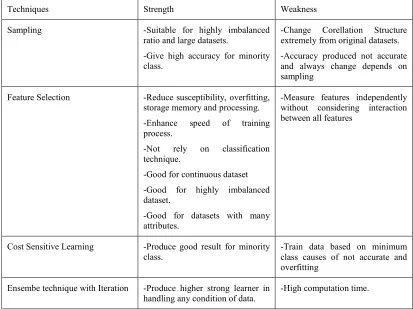
The ensemble method is a good technique in handling whatever dataset condition. It is because the ensemble method is a technique that combines many kinds of techniques in handling imbalanced datasets such as the combination of classification methods, sampling with feature selection, sampling with learning algorithms and others. The ensemble technique with algorithmic approaches is good for skewed distributions of data by modifying the classifier [30]. Besides that, the ensemble method can also handle multiclass imbalanced data through Adaboost. However, the Adaboost technique is susceptible to outliers and noisy datasets. Besides that, if there are no constraints on computation time, iteration for many times before ensemble the techniques is better because iteration will not deteriorate the performance and it will be useful to know a priori [9]. It is also known that when ensembles the diversity of classifiers technique, weak learners provide an improvement significantly higher than strong learners due to diversity among weak learners is higher than the strong learners [9]. Besides that, based on [12], the main advantages when combining various classifiers that, it can improve accuracy and reduce the error rate of classifiers compared to using the single classifier technique. Table 1 in the appendix shows the summary of the strength and the weakness of the techniques in handling imbalanced datasets.
4 RECENT TRENDS IN HANDLING
IMBALANCED DATASETS BASED ON DOMAIN AND PROBLEMS
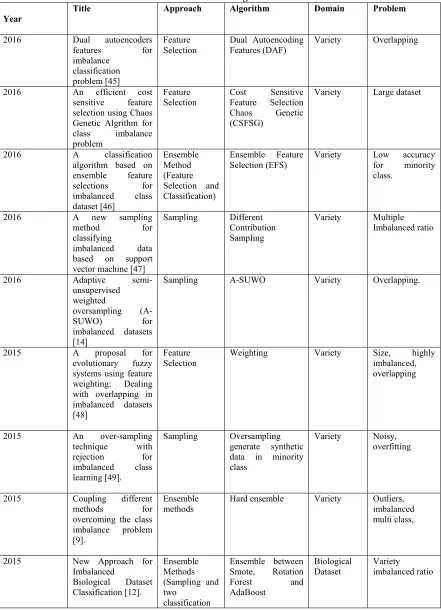
1433 handling imbalance that stem from different problems.
Based on the table below, most past research focused on the sampling technique since it is relevant in handling imbalanced datasets without concerning the condition of data. However, this technique will change the correlation of datasets for each sampling technique. Thus the results might not be valid. Recent papers proposed for the ensemble method to handle the limitation of sampling techniques by combining sampling techniques with others. Most researchers combine sampling and feature selection techniques when involving high dimensional datasets like images and microarray datasets. This is because selecting the features of high dimensional imbalanced datasets is crucial when without adding or losing data in balancing the data [44]. However, when it involves noisy datasets and highly imbalanced ratios, most researchers apply the sampling technique to handle these problems.
5 DISCUSSION AND CONCLUSION
The techniques of handling imbalanced datasets explored in this paper are useful for particular conditions of data such as small disjunctions, small data size, class overlapping, high dimensionality and noisy data. All of the techniques investigated can be classified into sampling, feature selection and algorithmic. The algorithmic technique consists of cost sensitive learning and one class classification. Each of the
techniques has their own advantages and
disadvantages. All the strengths and weaknesses of the techniques have also been explored by researchers and handled by extending the current techniques.
Practically, it has been reported that the sampling technique is mostly used by researchers in handling imbalanced datasets without concerning the condition of data. With no sampling process, a classifier model produced sometimes gives a high accuracy but has a huge gap between sensitivity
and specificity. However, under-sampling
technique is better than over-sampling because over-sampling can disturb the original class distribution. Besides that, based on this survey, ensembling the feature selection technique with sampling is the best way to handle imbalanced datasets for high dimensional datasets. It is because ensemble the techniques can complement to each others. Feature selection metric technique is the
best way in handling imbalanced by using feature selection especially if measurement of feature metric is separated for minority class and majority class. Since the condition of dataset can vary, applying more than one technique with iteration can give better solutions for handling imbalanced datasets. The solutions produced can be selected by using rank aggregation to make sure the best classifier model will be generated. Besides that, the best way in handling imbalanced dataset is not to change the condition of data but find the best feature set that will clear the decision boundary between maximum class and minimum class.
In the future, further discussion on techniques in handling imbalanced datasets on big data will be more challenging since big data having many problems or conditions occurred on datasets.
REFERENCES
[1] B. Krawczyk, G. Schaefer, and M.
Wozniak, “Combining One-Class
Classifiers For Imbalanced Classification
Of Breast Thermogram Features,” Fourth
International Workshop on Computational Intelligence in Medical Imaging (CIMI), 2013, pp. 36–41.
[2] M. Alibeigi and A. Hamzeh, “Unsupervised
Feature Selection Based On The
Distribution of Features Attributed to Imbalanced Data Sets,” Int. J. Artif. Intell. Expert Syst., vol. 2, no. 1, pp. 14–22, 2011.
[3] A. K. Mohanty, M. R. Senapati, and S. K.
Lenka, “A Novel Image Mining Technique For Classification Of Mammograms Using
Hybrid Feature Selection,” Neural Comput.
Appl., vol. 22, no. 6, Feb. 2016, pp. 1151– 1161..
[4] W.-J. Lin and J. J. Chen,
“Class-Imbalanced Classifiers For
High-Dimensional Data.,” Brief. Bioinform., vol.
14, no. 1, Jan. 2013, pp. 13–26.
[5] B. Krawczyk, M. Woźniak, and G.
Schaefer, “Cost-Sensitive Decision Tree
Ensembles For Effective Imbalanced
Classification,” Appl. Soft Comput., vol. 14,
Jan. 2014, pp. 554–562.
[6] H. Pant and R. Srivastava, “A Survey on
Feature Selection Methods For Imbalanced
Datasets,” Int. J. Comput. Eng. Appl., vol.
9, no. 2, 2015, pp. 197–204.
[7] R. Dubey, J. Zhou, Y. Wang, P. M.
1434
An N=648 ADNI Study.,” Neuroimage,
vol. 87, Oct. 2013, pp. 220–241.
[8] E. a. He, H., Garcia, “Learning from
Imbalanced Data,” IEEE Trans. Knowl.
Data Eng., vol. 21, no. 9, Sept. 2009, pp. 1263–1284.
[9] L. Nanni, C. Fantozzi, and N. Lazzarini,
“Coupling Different Methods For
Overcoming The Class Imbalance
Problem,” Neurocomputing, vol. 158, Jun.
2015, pp. 48–61.
[10] J. Van Hulse, T. M. Khoshgoftaar, A.
Napolitano, and R. Wald, “Feature
Selection with High-Dimensional
Imbalanced Data,” in 2009 IEEE
International Conference on Data Mining Workshops, 2009, pp. 507–514.
[11] S. Maldonado, R. Weber, and F. Famili,
“Feature Selection For High-Dimensional Class-Imbalanced Data Sets Using Support
Vector Machines,” Inf. Sci. (Ny)., vol. 286,
Dec. 2014, pp. 228–246.
[12] Z. A. O. Seyyedali Fattah, Zalinda Othman,
“New Approach For Imbalanced Biological
Dataset Classification,” J. Theor. Appl. Inf.
Technol., vol. 72, no. 1, 2015, pp. 41–57.
[13] S. Zhang, S. Sadaoui, and M. Mouhoub,
“An Empirical Analysis of Imbalanced Data Classification,” vol. 8, no. 1, 2015, pp. 151–162.
[14] I. Nekooeimehr and S. K. Lai-Yuen,
“Adaptive semi-unsupervised weighted
oversampling (A-SUWO) for imbalanced
datasets,” Expert Syst. Appl., vol. 46, 2016,
pp. 405–416.
[15] Y. Chen, Y. Lan, and H. Ren, “A Feature
Selection Method Base on GA for CBIR
Mammography CAD,” 2012 4th Int. Conf.
Intell. Human-Machine Syst. Cybern., Aug. 2012, pp. 175–178.
[16] C. Velayutham and K. Thangavel, “Entropy
based unsupervised Feature Selection in digital mammogram image using rough set
theory.,” Int. J. Comput. Biol. Drug Des.,
vol. 5, no. 1, Jan. 2012, pp. 16–34.
[17] I. L. Aroquiaraj and K. Thangavel,
“Unsupervised Feature Selection in Digital Mammogram Image Using Tolerance
Rough Set Based Quick Reduct,” Fourth
International Conference on Computational Intelligence and Communication Networks, 2012, pp. 436–440.
[18] I. L. Aroquiaraj and K. Thangavel,
“Mammogram Image Feature Selection Using Unsupervised Tolerance Rough Set
Relative Reduct Algorithm,” International
Conference on Pattern Recognition, Informatics and Mobile Engineering, 2013, pp. 479–484.
[19] A. Shakoor, “Soft Computing Based
Feature Selection For Environmental Sound Classification,” Blekinge Institute of Technology, April 2010.
[20] B. O. Alijla, A. T. Khader, L. C. Peng, M.
A. Al-Betar, and W. L. Pei, “Fuzzy Rough Set Approach for Selecting the Most
Significant Texture Features in
Mammogram Images,” Palestinian
International Conference on Information and Communication Technology, 2013, pp. 51–56.
[21] T. M. Khoshgoftaar, K. Gao, A.
Napolitano, and R. Wald, “A Comparative Study Of Iterative And Non-Iterative Feature Selection Techniques For Software
Defect Prediction,” Inf. Syst. Front., Apr.
2013.
[22] M. Wasikowski, X. Chen, and S. Member,
“Combating the Small Sample Class
Imbalance Problem Using Feature
Selection,” IEEE Trans. Knowl. Data Eng.,
vol. 22, no. 10, 2010, pp. 1388–1400.
[23] M. Wasikowski, “Combating the Class
Imbalance Problem in Small Sample Data Sets,” University of Kansas School of Engineering in, 2009.
[24] S. Kotsiantis, D. Kanellopoulos, and P.
Pintelas, “Handling Imbalanced Datasets :
A Review,” Int. Trans. Comput. Sci. Eng.,
vol. 30, 2006.
[25] J. Wang, J. You, Q. Li, and Y. Xu, “Extract
minimum positive and maximum negative
features for imbalanced binary
classification,” Pattern Recognit., vol. 45,
no. 3, Mar. 2012, pp. 1136–1145.
[26] H. Wang, B. Raton, and A. F. F. R.
Techniques, “A Comparative Study of Filter-based Feature Ranking Techniques,”, 2010, pp. 43–48.
[27] S. Hukerikar, A. Tumma, A. Nikam, and V.
Attar, “SkewBoost : An Algorithm for
Classifying Imbalanced Datasets,” in
International Conference on Computer and Communication Technology, 2011, pp. 46– 52.
[28] P. Phoungphol, “A Classification
Framework for Imbalanced Data,” Georgia State University, 2013.
[29] J. Bian, X. Peng, Y. Wang, and H. Zhang,
1435 Selection Using Chaos Genetic Algorithm
for Class Imbalance Problem,” J. Math.
Probl. Eng., vol. 2016, 2016.
[30] R. Longadge, S. S. Dongre, and L. Malik,
“Class Imbalance Problem in Data Mining :
Review,” Int. J. Comput. Sci. Netw., vol. 2,
no. 1, 2013.
[31] E. Duchesnay, A. Cachia, N. Boddaert, N.
Chabane, J.-F. Mangin, J.-L. Martinot, F. Brunelle, and M. Zilbovicius, “Feature selection and classification of imbalanced datasets: application to PET images of children with autistic spectrum disorders.,”
Neuroimage, vol. 57, no. 3, Aug. 2011, pp. 1003–14.
[32] G. M. Weiss, K. Mccarthy, and B. Zabar,
“Cost-Sensitive Learning vs . Sampling : Which is Best for Handling Unbalanced Classes with Unequal Error Costs ?,” in
DMIN, 2007, pp. 35–41.
[33] V. López, A. Fernández, and F. Herrera,
“On The Importance Of The Validation
Technique For Classification With
Imbalanced Datasets: Addressing Covariate
Shift When Data Is Skewed,” Inf. Sci. (Ny).,
vol. 257, Feb.2014, pp. 1–13.
[34] B. Krawczyk and M. Wo, “Weighted
One-Class One-Classification for Different Types of Minority Class Examples in Imbalanced
Data,” IEEE Symposium on Computational
Intelligence and Data Mining (CIDM).,
2014, pp.337-344.
[35] K. Ganesan, U. R. Acharya, C. K. Chua, C.
M. Lim, and K. T. Abraham, “One-Class Classification of Mammograms Using
Trace Transform Functionals,” IEEE Trans.
Instrum. Meas., vol. 63, no. 2, pp. 304–311, 2014.
[36] D. Zhu, “A Hybrid Approach For Efficient
Ensembles,” Decis. Support Syst., vol. 48,
no. 3, Feb. 2010, pp. 480–487.
[37] N. V Chawla, “Data Mining and
Knowledge Discovery Handbook,” 2010.
[38] M. Bekkar, “Imbalanced Data Learning
Approaches Review,” Int. J. Data Min.
Knowl. Manag. Process., vol. 3, no. 4, 2013, pp. 15–33.
[39] T. M. Khoshgoftaar, K. Gao, and N. Seliya,
“Attribute Selection and Imbalanced Data: Problems in Software Defect Prediction,” in
2010 22nd IEEE International Conference on Tools with Artificial Intelligence, 2010, pp. 137–144.
[40] T. M. Khoshgoftaar, B. Raton, and J. Van
Hulse, “A Novel Feature Selection
Technique for Highly Imbalanced Data,” 2010, pp. 80–85.
[41] P. G. Kumar and J. B. B. Bell, “Using
Continuous Feature Selection Metrics to Suppress the Class Imbalance Problem,”
Int. J. Sci. Eng. Res., vol. 3, no. 3, 2012, pp. 1–9.
[42] I. Jamali, M. Bazmara, and S. Jafari,
“Feature Selection in Imbalance data sets,”
Int. J. Comput. Sci., vol. 9, no. 3, 2012, pp. 42–45.
[43] X. Chen, “FAST : A ROC-based Feature
Selection Metric for Small Samples and Imbalanced Data Classification Problems,” in KDD 08, 2008, pp. 124–132.
[44] T. Deepa, “A GLFES and DFT Technique
for Feature Selection in High-Dimensional
Imbalanced dataset,” Indian J. Comput. Sci.
Eng., vol. 3, no. 2, 2012, pp. 336–343
[45] W. W. Y. Ng, G. Zeng, J. Zhang, D. S.
Yeung, and W. Pedrycz, “Dual
Autoencoders Features for Imbalance
Classification Problem,” Pattern Recognit.,
vol. 60, 2016, pp. 875–889.
[46] H. Yin, K. Gai, and Z. Wang, “A
Classification Algorithm Based on
Ensemble Feature Selections for
Imbalanced-Class Dataset,” in 2016 IEEE
2nd International Conference on Big Data Security on Cloud (BigDataSecurity), IEEE
International Conference on High
Performance and Smart Computing
(HPSC), and IEEE International
Conference on Intelligent Data and Security (IDS), 2016, pp. 245–249.
[47] C. Jian, J. Gao, and Y. Ao, “A New
Sampling Method For Classifying
Imbalanced Data Based On Support Vector
Machine Ensemble,” Neurocomputing, vol.
193, 2016, pp. 115–122.
[48] S. Alshomrani, A. Bawakid, S.-O. Shim, A.
Fernández, and F. Herrera, “A Proposal For Evolutionary Fuzzy Systems Using Feature Weighting: Dealing With Overlapping In
Imbalanced Datasets,” Knowledge-Based
Syst., vol. 73, Jan. 2015, pp. 1–17.
[49] J. Lee, N. Kim, and J.-H. Lee, “An
Over-Sampling Technique With Rejection For
Imbalanced Class Learning,” Proc. 9th Int.
Conf. Ubiquitous Inf. Manag. Commun. - IMCOM ’15, 2015, pp. 1–6.
[50] L. Sriram, “Imbalanced Multiclass Data
Classification Using Ant Colony
1436
[51] S. Cateni, V. Colla, and M. Vannucci, “A
Method For Resampling Imbalanced
Datasets In Binary Classification Tasks For
Real-World Problems,” Neurocomputing,
vol. 135, Jul. 2014, pp. 32–41.
[52] M. a Mazurowski, P. a Habas, J. M.
Zurada, J. Y. Lo, J. a Baker, and G. D.
Tourassi, “Training Neural Network
Classifiers For Medical Decision Making: The Effects Of Imbalanced Datasets On
Classification Performance.,” Neural Netw.,
1437
Table 1: Summarize the strength and the weakness of the techniques in handling imbalanced dataset
Techniques Strength Weakness
Sampling -Suitable for highly imbalanced
ratio and large datasets.
-Give high accuracy for minority class.
-Change Corellation Structure extremely from original datasets.
-Accuracy produced not accurate and always change depends on sampling
Feature Selection -Reduce susceptibility, overfitting, storage memory and processing.
-Enhance speed of training process.
-Not rely on classification technique.
-Good for continuous dataset
-Good for highly imbalanced dataset.
-Good for datasets with many attributes.
-Measure features independently without considering interaction between all features
Cost Sensitive Learning -Produce good result for minority class.
-Train data based on minimum class causes of not accurate and overfitting
Ensembe technique with Iteration -Produce higher strong learner in handling any condition of data.
1438
Table 2: Recent trends in handling imbalanced dataset
Year
Title Approach Algorithm Domain Problem
2016 Dual autoencoders
features for
imbalance classification problem [45]
Feature Selection
Dual Autoencoding Features (DAF)
Variety Overlapping
2016 An efficient cost
sensitive feature selection using Chaos Genetic Algrithm for class imbalance problem
Feature Selection
Cost Sensitive Feature Selection Chaos Genetic (CSFSG)
Variety Large dataset
2016 A classification
algorithm based on ensemble feature
selections for
imbalanced class dataset [46]
Ensemble Method (Feature Selection and Classification)
Ensemble Feature Selection (EFS)
Variety Low accuracy
for minority class.
2016 A new sampling
method for
classifying
imbalanced data based on support vector machine [47]
Sampling Different Contribution Sampling
Variety Multiple
Imbalanced ratio
2016 Adaptive
semi-unsupervised weighted
oversampling
(A-SUWO) for
imbalanced datasets [14]
Sampling A-SUWO Variety Overlapping.
2015 A proposal for
evolutionary fuzzy systems using feature weighting: Dealing with overlapping in imbalanced datasets [48]
Feature Selection
Weighting Variety Size, highly
imbalanced, overlapping
2015 An over-sampling
technique with
rejection for
imbalanced class learning [49].
Sampling Oversampling
generate synthetic data in minority class
Variety Noisy,
overfitting
2015 Coupling different
methods for
overcoming the class imbalance problem [9].
Ensemble methods
Hard ensemble Variety Outliers,
imbalanced multi class,
2015 New Approach for
Imbalanced
Biological Dataset Classification [12].
Ensemble Methods (Sampling and two
classification
Ensemble between Smote, Rotation
Forest and
AdaBoost
Biological Dataset
1439 techniques)
2015 Imbalanced
Multiclass Data Classification Using
Ant Colony
Optimization Algorithm [50].
Sampling Under-sampling
based ACO
algorithm
Microarray data
High
dimensionality, size, noise
2015 An Empirical
Analysis of
Imbalanced Data Classification [13].
Learning Algorithm
Cost Sensitive Learning –SVM
Variety Imbalanced
ratio, size complexity
2014 A method for
resampling
imbalanced datasets
in binary
classification tasks for real world problem [51]
Sampling Combine
under-sampling and
oversampling techniques
Variety Imbalanced
binary classification
2013 Combining one-class
classifiers for imbalanced
classification of breast thermogram features [1].
Learning algorithm
One Class
Classification (OCC)
Image One Class
Classification
2013 A comparative study
of iterative and non-iterative feature selection techniques for software defect prediction [21].
Ensemble method (sampling and feature selection)
Random
under-sampling with iterative and non iterative feature selection
NASA datasets
High
dimensionality
2012 A GLFES and DFT
Technique for
Feature Selection in High-Dimensional Imbalanced dataset [44].
Ensemble method (sampling and feature selection)
Granularity learning, fuzzy evolutionary sampling, defuzzification technique
Microarray dataset
High
dimensionality
2012 Extract minimum
positive and
maximum negative
features for
imbalanced binary classification [25].
Learning algorithm
Extracting
minimum positive
and minimum
negative features
Image Binary
classification
2011 Feature selection and classification of imbalanced datasets: application to PET images of children with autistic spectrum disorders [31].
Feature selection
Hybrid between
forward,backward
selection. Apply
adaptive log likehood penalization, penalization calibration based on
randomized data,
LOO cross validation
Image High
dimensionality, highly imbalanced
2011 SkewBoost : An
Algorithm for
Classifying
Imbalanced Datasets [27].
Ensemble (sampling and learning algorithm)
WSmote and
boosting algorithm
1440
2010 Using Continuous
Feature Selection Metrics to Suppress the Class Imbalance Problem [41].
Feature selection
Pearson Correlation Coefficient (PCC), Signal to Noise
Ratio (S2N),
Feature Assessment
by Sliding
Threshold (FAST), Feature Assessment by Information Retrieval (FAIR).
Microarray dataset
High
dimensionality
2008 Training neural
network classifiers for medical decision making: the effects of imbalanced datasets on classification performance [52]
Ensemble method (learning algorithm, sampling)
Particle swarm optimization, back propagation, under-sampling,
oversampling
Image Small training
dataset, large
number of
features, correlation among features
2008 FAST: A ROC-based
Feature Selection
Metric for
SmallSamples and Imbalanced Data Classification Problems [43]
Feature selection
FAST Image,
microarray dataset
High