Review Article: Metal-Matrix Nano Composites, Processing,
Manufacturing & Application: An Overview
Vijayalakshmi S.
Lecturer (Senior Grade)
Ayya Nadar Janaki Ammal Polytechnic College, Sivakasi, India
Abstract— This review is designed to be a comprehensivesource for metal matrix nano composite research, including fundamental structure/property relationships, manufacturing techniques and applications of metal-matrix nanocomposites materials. In addition to presenting the scientific framework for the advances in metal- matrix nanocomposites research, this review focuses on the scientific principles and mechanism in relation to the methods of processing and manufacturing with a discussion on commercial applications and health/safety concerns a critical issue for production and scale-up). Hence, this review offer a comprehensive discussion on technology, modeling, characterization, processing, manufacturing, applications, and healthy/safety concerns for metal matrix nanocomposites.
Key words: Nano Composites, Metal Matrix, Fabrication & Processing
I. INTRODUCTION
Nanocomposites are composites in which at least one of the phases shows dimensions in the nano meter range (1 nm = 10–9 m) 1. Nanocomposite materials have emerged as suitable alternatives to overcome limitations of micro composites and monolithic, while posing preparation challenges related to the control of elemental composition and stoichiometry in the nanocluster phase. They are reported to be the materials of 21st century in the view of possessing design uniqueness and property combinations that are not found in conventional composites.
The general understanding of these properties is yet to be reached2, even though the first inference on them was reported as early as 1992.
As in the case of micro composites, nano composite materials can be classified, according to their matrix materials, in three different categories
Ceramic Matrix Nanocomposites (CMNC) Metal Matrix Nanocomposites (MMNC) Polymer Matrix Nanocomposites (PMNC)
Metal matrix composites (MMCs) reinforced with nano-particles, also called Metal Matrix nano-Composites (MMnCs), and are being investigated worldwide in recent years, owing to their promising properties suitable for a large number of functional and structural applications. The reduced size of the reinforcement phase down to the nano-scale is such that interaction of particles with dislocations becomes of significant importance and, when added to other strengthening effects typically found in conventional MMCs, results in a remarkable improvement of mechanical properties [1–4]. The main issue to be faced in the production of MMnCs is the low wettability of ceramic nano-particles with the molten metal matrix, which do not allow the production of MMnCs by conventional casting processes. Small powder aggregates are in fact prone to form clusters, losing their capability to be homogeneously dispersed throughout the
matrix for an optimal exploitation of the strengthening potential. For this reason, several alternative methods have been proposed in order to overcome this problem.
II. MATERIALS
Metal Matrix Composites are composed of a metallic matrix (aluminium, magnesium, iron, cobalt, copper) and a dispersed ceramic (oxides, carbides) or metallic (lead, tungsten, molybdenum) phase.
Several metallic materials have been considered as matrix constituent for the preparation of MMnCs. In particular, the most interesting metals for industrial applications are Al, Mg, Ti, Cu and their alloys. Pure and alloyed aluminum is the most investigated material with the largest number of published research studies describing Al-based composites as possible candidates for structural application. Different species of nano-sized oxides as reinforcement agents. Especially, carborundum and alumina are the most common ceramic reinforcements for MMNCs. Moreover, different allotropes of carbon (carbon black , fullerenes and carbon nanotubes have been investigated as fillers for several research works published in literature. The most used particles are CNTs: they confer very high mechanical properties to the metal matrix and, meanwhile, they lead to increased electrical conductivity, which makes MMnCs very attractive materials for electrical applications. Single wall carbon nanotubes (SWCNT) and multi wall carbon nanotubes (MWCNT) are both used for MMnCs production. In this regard, for example copper-0.1 wt. % MWCNT composites revealed a 47% increase in hardness and bronze-0.1 wt. % SWCNT showed a 20% improved electrical conductivity. Finally, intermetallic compounds (NiAl, Al3Ti) have also been successfully used as reinforcement phase in MMnCs. Al–Al3Ti 38anocomposites revealed good mechanical behavior at hightemperature, while TiAl–NiAl MMnCs showed low fracture toughness and high hardness (Al2O3, Y2O3), nitrides (Si3N4, AlN) , carbides (TiC,SiC), hydrates (TiH2) [47] and borides (TiB2) [28,51] have been employed
III. FABRICATION TECHNIQUES
Processing of metal matrix nano composites (MMNC’s) are classified into solid state and liquid state. Solid state includes Diffusion Bonding, Electroplating, Powder Metallurgy, Spray Deposition, Immersion Plating, Chemical Vapour Deposition and Physical Vapor Deposition etc. Liquid state processing includes Stir Casting, Squeeze Casting, Melt Infiltration, Compo Casting and Melt oxidation processing etc. Researchers have reported the manufacturing processes such as Powder Metallurgy, Stir Casting, High Energy Ball Milling, Squeeze Casting, Mechanical Alloying, Pressure less/Infiltration; Spark Plasma Sintering, Ultrasonic Cavitation’s based solidification, Vortex Process, Sol-Gel synthesis and Laser Deposition for Al based nano composites. There are few limitations of traditional consolidation processes which unable to retain the nano scale grain size owing to the excessive grain growth during processing. The nano particles have the tendency of agglomeration and clustering, due to high surface energy, electrostatic, moisture adhesiveness and attractive Vander Waal’s bonding, which affect its uniform distribution during processing. The various fabrication methods and morphology of nano composites last two decades is reviewed.
A. Liquid State Fabrication of Metal Matrix Composites
It involves incorporation of dispersed phase into a molten matrix metal, followed by its solidification. In order to provide high level of mechanical properties of the composite, good interfacial bonding (wetting) between the dispersed phase and the liquid matrix should be obtained. Wetting improvement may be achieved by coating the dispersed phase particles (fibers). Proper coating not only reduces interfacial energy, but also prevents chemical interaction between the dispersed phase and the matrix. The methods of liquid state fabrication of Metal Matrix Composites: Stir casting, Infiltration like gas pressure infiltration, Squeeze casting infiltration or Pressure die infiltration.
1) Stir Casting
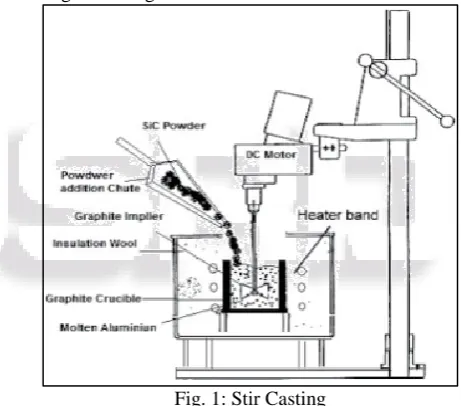
[image:2.595.303.534.322.525.2]It is a liquid state method of composite materials fabrication, in which a dispersed phase (ceramic particles, short fibers) is mixed with a molten matrix metal by means of mechanical stirring. Stir casting as shown in figure is the simplest and the most cost effective method of liquid state fabrication. The liquid composite material is then cast by conventional casting methods and may also be processed by conventional Metal forming technologies.
Fig. 1: Stir Casting 2) Infiltration
It is a liquid state method of composite materials fabrication, in which a preformed dispersed phase (ceramic particles, fibers, woven) is soaked in a molten matrix metal, which fills the space between the dispersed phase inclusions.
The motive force of an infiltration process may be either capillary force of the dispersed phase (spontaneous infiltration) or an external pressure (gaseous, mechanical, electromagnetic, centrifugal or ultrasonic) applied to the liquid matrix phase (forced infiltration).
a) Gas Pressure Infiltration
Fig. 2: Gas Pressurization Infiltration
[image:3.595.314.536.243.403.2]Squeeze Casting Infiltration or pressure die infiltration – It is a forced infiltration method of liquid phase fabrication of Metal Matrix Composites, using a movable mold part (ram) for applying pressure on the molten metal and forcing it to penetrate into a preformed dispersed phase, placed into the lower fixed mold part as shown in figure. The method is used for manufacturing simple small parts like automotive engine pistons.
Fig. 3: Squeeze Infiltration Casting
B. Solid State Fabrication of Metal Matrix Composites Solid state fabrication of metal matrix composites is the process , in which MMC are formed as a result of bonding of matrix metal and dispersed phase due to mutual diffusion occurring between them in solid state at elevated temperature and under pressure.
1) Diffusion Bonding
It is a common solid-state processing technique for joining similar or dissimilar metals. Inter diffusion of atoms between clean metallic surfaces, in contact at an elevated temperature, leads to bonding. It is also used for fabrication of MMC as shown in figure the principal advantages of this technique are the ability to process a wide variety of metal matrices and control of fiber orientation and volume fraction.
Fig. 4: Diffusion Bonding
2) Powder Processing or Powder Metallurgy
These methods in conjunction with deformation processing are used to fabricate particulate or short fiber reinforced composites as shown in figure. This typically involves cold pressing and sintering, or hot pressing to fabricate primarily particle- or whisker-reinforced MMCs. The matrix and the reinforcement powders are blended to produce a homogeneous distribution.
[image:3.595.54.290.292.460.2]The blending stage is followed by cold pressing to produce what is called a green body, which is about 80% dense and can be easily handled. The cold pressed green body is canned in a sealed container and degassed to remove any absorbed moisture from the particle surfaces. The material is hot pressed, uniaxial or ISO-statically, to produce a fully dense composite and extruded.
Fig. 5: Powder Metallurgy
C. Deposition Techniques
These processes for metal-matrix composite fabrication involve coating individual fibers in a tow with the matrix material needed to form the composite followed by diffusion bonding to form a consolidated composite plate or structural shape. The main disadvantage of using deposition techniques is that they are time consuming. Several deposition techniques are available: immersion plating, electroplating, and spray deposition, chemical vapor deposition (CVD), and physical vapor deposition (PVD), spray forming.
1) Spray Forming
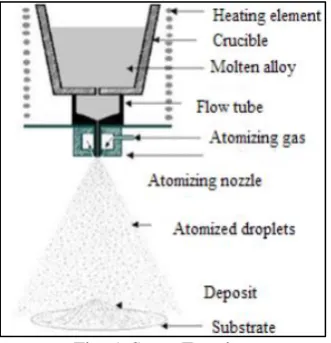
One particular example of this, a co-spray process, uses a spray gun to atomize a molten aluminum alloy matrix, into which heated silicon carbide particles are injected as shown in figure.
[image:3.595.347.513.568.740.2] [image:3.595.59.274.621.757.2]Dipping or immersion plating is similar to infiltration casting except that fiber tows are continuously passed through baths of molten metal, slurry, sol, or organometallic precursors.
2) Electroplating
It produces a coating from a 10 µm solution containing the ion of the desired material in the presence of an electric current. Fibres are wound on a mandrel, which serves as the cathode, and placed into the plating bath with an anode of the desired matrix material.
3) Spray Deposition
This technique typically consists of winding fibers onto a foil coated drum and spraying molten metal onto them to form a monotype. The source of molten metal may be powder or wire feedstock which is melted in a flame, arc, or plasma torch.
4) Chemical Vapour Deposition (CVD)
It is a vaporized component decomposes or reacts with another vaporized chemical on the substrate to form a coating on that substrate. The processing is generally carried out at elevated temperatures.
D. In-situ Fabrication of Metal Matrix Composites
In these techniques the reinforcement phase is formed in situ. The composite material is produced in one step from an appropriate starting alloy, thus avoiding the difficulties inherent in combining the separate components
E. Two-Phase Processes
Two-phase processes like osprey deposition, compo casting, etc. involve the mixing of ceramic and matrix in a region of the phase diagram where the matrix contains both solid and liquid phases.
IV. APPLICATIONS
Metal matrix composites reinforced by nanoparticles or nanotubes are not yet being employed in relevant commercial applications due to their very recent development. However, MMnCs show higher mechanical properties than micro-particles reinforced composites, without any evidence of a strong drop in thermal and electrical conductivity.
For this reason, they are considered as possible candidates for substituting conventional MMCs or related monolithic alloys in structural and electrical RT and HT applications. For example, CNT composites could replace, thanks to their higher strength and stiffness, carbon fibers composite in many applications, especially in high-temperature environments. Another good opportunity for the substitution of traditional MMCs with nano-sized counterparts is related to the loss in fracture toughness and ductility occurring in micro-reinforced MMCs. Toughness can be substantially preserved in nano-reinforced composites owing to the reduced particle volume fraction required to achieve strengthening.
The enhanced wear resistance and the good thermal conductivity combined to the high specific strength make MMnCs attractive materials for aircraft brakes. Moreover, the specific strength and elastic modulus could be exploited in sport industry, for instance for rackets or bicycle frames and other components. A further field of potential application is in electronic devices, for example for heat sinks and solders
(thanks to their thermal properties) or as antennas (thanks to their electrical properties and stiffness). Aerospace and automotive industries may exploit all the above properties for different kind of applications such as structural radiators, gears, aircraft fins, cylinder liners, disk brakes and calipers.
Nanocomposites Applications
Fe/MgO Catalysts, magnetic devices.
Ni/PZT
Wear resistant coatings and thermally graded
coatings. Ni/TiO
2 Photo-electrochemical applications.
Al/SiC Aerospace, naval and automotive structures.
Cu/Al
2O3 Electronic packaging.
Al/AlN Microelectronic industry.
Ni/TiN, Ni/ZrN, Cu/ZrN
High speed machinery, tooling, optical and magnetic storage
materials.
Nb/Cu Structural materials for high
temperature applications. Fe/Fe
23C6/Fe3B Structural materials.
Fe/TiN Catalysts.
Al/Al
2O3 Microelectronic industry.
Au/Ag Microelectronics, optical devices, light energy conversion.
Fe/MgO Catalysts, magnetic devices.
Table 1: Application of Metal Nano Composites
V. CONCLUSION
In conclusion, new technologies require materials showing novel properties and/or improved performance compared to conventionally processed components. In this context, metal matrix nanocomposites are suitable materials to meet the emerging demands arising from scientific and technologic advances. Processing methods for different types of metal matrix nanocomposites are available, but some of these pose challenges thus giving opportunities for researchers to overcome the problems being encountered with Nano size materials.
REFERENCES
[1] Roy R, Roy RA, Roy DM. Alternative perspectives on
“quasicrystallinity”: non-uniformity and
nanocomposites. Materials Letters. 1986; 4(8-9):323-328.
[2] Schmidt D, Shah D, Giannelis EP. New advances in polymer/layered silicate nanocomposites. Current Opinion in Solid State & Materials Science. 2002; 6(3):205-212.
[3] Gleiter H. Materials with ultrafne microstructures: retrospectives and perspectives. Nanostructured Materials. 1992; 1(1):1-19.
[4] Braun T, Schubert A, Sindelys Z. Nanoscience and nanotechnology on the balance. Scientometrics. 1997; 38(2):321-325.
[5] Kamigaito O. What can be improved by nanometer composites? Journal of Japan Society of Powder Metalurgy. 1991; 38:315-321.
[6] Iijima S. Helical microtubes of graphitic carbon. Nature. 1991; 354(6348):56-58.
[7] Biercuk MJ, Llaguno MC, Radosvljevicm, HJ. Carbon nanotube composites for thermal management. Appied Physics Letters. 2002; 80(15):2767-2769.
[8] Ounaies Z, Park C, Wise KE, Siochi EJ, Harrison JS. Electrical properties of single wall carbon nanotube reinforced polyimide composites. Composites Science and Technology. 2003; 63(11):1637-1646.
[9] Weisenberger MC, Grulke EA, Jacques D, Ramtell T, Andrews R. Enhanced mechanical properties of polyacrylonitrile: multiwall carbon nanotube composite fibers. Journal of Nanoscience and Nanotechnology. 2003; 3(6):535-539.
[10]Dalton AB, Coolins S, Muñoz E, Razal JM, Ebron VH, Ferraris JP et al. Super-tough carbon-nanotube fbres: these extraordinary composite fbres can be woven into electronic textiles. Nature. 2003; 423(6941):703-703. [11]Anuj Dixit, Kaushik Kumar. Optimization of Mechanical
Properties of Silica Gel Reinforced Aluminium MMC by using Taguchi Method. Materials Today: Proceeding 2015; 2: 2359-2366.
[12]S.M. Choi, H. Awaji. Nano Composite-a new material design concept. Science and Technology of Advance Materials 2005; 6: 2-10.
[13]J. S. Sureshbabu, P. K. Nair, C. G. Kang. Fabrication and characterization of aluminium based nano-micro hybrid metal matrix composites. 16th International conference on composite materials 2007; 1-5.
[14]X. P. Zhang, L. Ye, Y. W Mai, G. F. Quan, W. Wei. Investigation on diffusion bonding characteristics of SiC particulate reinforced aluminium metal matrix composites (Al/SiCp-MMC). Composites Part A: applied science and manufacturing 1999; 30: 1415-1421. [15]Basak Dogru Mert. Corrosion protection of aluminum by electrochemically synthesized composite organic coating. Corrosion Science, G Model 2015; CS-6546: 7. [16]S. C. Tjong, Z. Y. Ma. High-temperature creep behaviour of powder metallurgy aluminium composites reinforced with SiC particles of various sizes. Composites Science and Technology 1999; 59: 1117-1125.
[17]D. J. Woo, F. C. Heer, L. N. Brewer, J. P. Hooper, S. Osswald. Synthesis of nanodiamond-reinforced aluminum metal matrix composites using cold-spray deposition. Carbon 2015; 86: 15-25.
[18]Jia-lei ZHAO, Jin-chuan JIE, Fei CHEN, Hang CHEN, Ting-ju LI, Zhi-qiang CAO. Effect of immersion Ni plating on interface microstructure and mechanical properties of Al/Cu bimetal. Trans. Nonferrous Met. Soc. China 2014; 24: 1659-1665.
[19]Jie Tang, Genlian Fan, Zhiqiang Li, Xinda Li, Run Xu, Yao Li, Di Zhang, Won-Jin Moon, Sergy Dmitrievich Kaloshkin. Margarita Churyukanova. Synthesis of carbon nanotube/aluminium composite powders by polymer pyrolysis chemical vapour deposition. Carbon 2013; 55: 202-208.
[20]L. ulmer, F. Pitard, D. Poncet, O. Demolliens. Formation of Al3Ti during physical vapour deposition of titanium on aluminium.Microelectronic Engineering 1997; 37/38: 381-387.
[21]Goussous, S.; Xu, W.; Xia, K. Developing aluminum nanocomposites via severe plastic deformation. J. Phys. Conf. Ser. 2010, 240, 012106.
[22]Kubota, M.; Wu, X.; Xu, W.; Xia, K. Mechanical properties of bulk aluminium consolidated from mechanically milled particles by back pressure equal channel angular pressing. Mat. Sci. Eng. A 2010, 527, 6533–6536.
[23]Tjong, S.C. Novel nanoparticle-reinforced metal matrix composites with enhanced mechanical properties. Adv. Eng. Mat. 2007, 9, 639–652.
[24]Li, X.; Yang, Y.; Cheng, X. Ultrasonic-assisted fabrication of metal matrix composites. J. Mater. Sci. 2004, 39, 3211–3212.
[25]Mao, S.X.; McMinn, N.A.; Wu, N.Q. Processing and mechanical behavior of TiAl/NiAl intermetallic composites produced by cryogenic emchnical alloying. Mat. Sci.Eng. A 2003, A363, 275–289.
[26]Mahboob, H.; Sajjadi, S.A.; Zebarjad, S.M. Syntesis of Al-Al2O3 Nanocomposite by Mechanical Alloying and Evaluation of the Effect of Ball Milling Time on the Microstructure and Mechanical Properties. In Proceedings of International Conference on MEMS and Nanotechnology (ICMN ‘08). Kuala Lumpur, Malaysia, 13–15th May, 2008, pp. 240–245.
[27]Gupta, M.; Lai, M.O.; Soo, C.Y. Effect of type of processing on the microstructural features and mechanical properties of Al–Cu/SiC metal matrix composites. Mater. Sci. Eng. A 1996, 210, 114–122. [28]Lu, L.; Lai, M.O.; Su, Y.; Teo, H.L.; Feng, C.F. In situ
TiB2 reinforced Al alloy composites. Scripta Mater. 2001, 45, 1017–1023.
[29]Gupta, M.; Lai, M.O.; Boon, M.S.; Herng, N.S. Regarding the SiC particolates size associated microstructural characteristics on the aging behavior of Al-4.5 Cu metallic matrix. Mater. Res.Bull. 1998, 33, 199–209.