Journal of Chemical and Pharmaceutical Research, 2015, 7(7):1212-1217
Research Article
ISSN : 0975-7384
CODEN(USA) : JCPRC5
1212
Investigation effects of baking processes on folic acid stability in fortified
wheat via high performance liquid chromatography
Mona Ghale Molaei
1and Seyed Mahdi Seyedain*
21Department of Food Science and Technology, Faculty of Advanced Sciences & Technology, Pharmaceutical
Sciences Branch, Islamic Azad University, Tehran, Iran
2Department of Agricultural Engineering, College of Food Science and Technology, Tehran Science and Research
Branch, Islamic Azad University, Tehran, Iran
_____________________________________________________________________________________________
ABSTRACT
The main objective of this study was to investigate the floic acid content in various Iranian breads. Analysis of folic acid content eas performed by high performance liquid chromatography (HPLC) coupled with ultraviolet (UV) detection after extraction and preconcentration of folic acid by using solid phase extraction colume. The effect of various baking process, baking temperature and storage time on the folic acid content of bread in different baking step including wheat, dough before fermentation, dough after fermentation and baked bread was studied. The results showed that fermentation step has important effect in folic acid stability in various flours. Baking temperature and duration do not have a significant impact on folic acid content in various breads. In addition, due to instability of folic acid by exposure to light, air and water, significantly decrease in folic acid contents were observed after storage in stores. Therefore, fresh bread has maximom content of folic acid after backing.
Keywords: Folic acid; High performance liquid chromatography; solid phase extraction; Fourtified bread.
_____________________________________________________________________________________________
INTRODUCTION
1213
fruit, yeast, mushrooms, meat, orange juice and tomato juice. But, most people do not get all the folic acid they need through food alone. Recently, in the many countries, many food products are fortified with folic acid [18-24]. Therefore, folic acid has been added to cold cereals, flour, breads, pasta, bakery items, cookies, and crackers. Folic acid is not stable. It is easily destroyed by exposure to light, air, water, and cooking processes. Like most water-soluble vitamins, folate can frequently be removed from foods during processing. Therefore, it is necessary to determinate loss of folate in the manufacture of foods processing.
Wheat flour in various food products are the mainstays of Iranian diet. Bread was considered the more important food to fortify because it is less expensive than rice and consequently more widely consumed [14, 19, 25-29]. Therefore, Fortification of the wheat flour used for various bread baking with folic acid was recently introduced in Iran. Several methods were used to bake bread. The baking method has essential effect in the folic acid contents in bread.
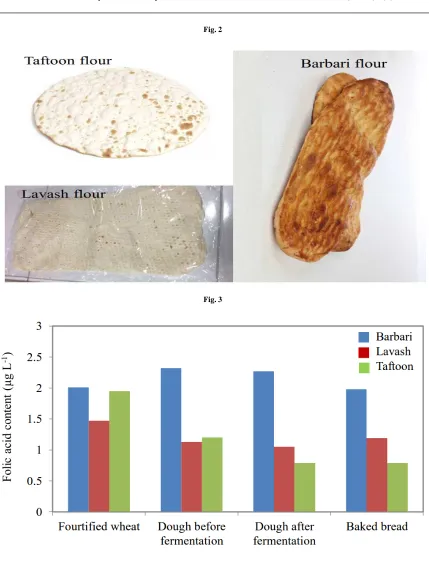
This study aimed to evaluate the effect of baking process on the level of folic acid in various wheat flour before and after baking in different method. For this purpose, three categories of wheat flour including Taftoun, lavash and barbari were selected as model sample ( Fig. 2) and the sample breads were randomly collected from various region of Tehran. For extraction of Folic acid from bread samples SPE Cartridges was used and high performance liquid chromatography with ultraviolet- visible detection was used to detection and determination of folic acid in various bread samples after extraction steps [1, 26, 30-32]. The results obtained from this research can help health professionals and policy-makers to give clear advice about the effects of bread baking method in folic acid level in fortified breads.
EXPERIMENTAL SECTION
2.1. Chemicals and reagents
All chemicals were of analytical-reagent grades. Folic acid standard was obtained from Merck (Darmstadt, Germany). Sodium hydroxide, sodium acetate, acetic acid solution, sodium tetaborate and tricholoro acetic acid were purchased from Merck. HPLC-grade acetonitrile and methanol were obtained from Caledon (Ontario, Canada). Stock solutions of the folic acid about 100 mg L-1 were carefully prepared in methanol. They were all stored in the darkness glass container at 2-8 ˚C and working analyte mixtures were daily prepared by dilution with the suitable volume of distilled water.
2.2. Apparatus
Chromatography was carried out by a Knaure model 2500 HPLC (Knaure, Germany) equipped with a Quaternary HPLC pump, a 4-channel mixing valve with a 10 µL sample loop, vacuum degasser and a UV-Vis detector. Separations were performed on an ODS-3 column (150 mm × 4.6 mm, with particle size of 5 µm) from MZ-Analysentechnik (Mainz, Germany). A isocratic elution of 20 mM acetic acid and acetonitrile mixture (50:50) was employed. The flow rate of the mobile phase was set at 0.2 mL min-1 and total analysis time was 50 min. The injection volume was 10 µL for all of the samples and detection was performed at a wavelength of 254 nm.
A pH meter Model 827 pH Lab digital pH meter from Metrohm with combined glass electrode was used for monitoring pH adjustment. SPE of folic acid from water samples was carried out using 10 mm height, 1.5 mm i.d., 500 mg of C18 sorbent with 6 mL syringe barrels from Supelco. Ultrapure water was deionized by an Aqua MAX water purification system from Younglin (Seoul, Korea). Sample solution was stirred using a MR Hei-standard magnetic stirrer from Heidolph (Schwabach, Germany).
2.3. Extraction of folic acid from various samples
5.0 grams of each sample (wheat, dough and bread) were transferred in centrifuge tube and 45.0 milliliters of sodium tetraborate solution was added to centrifuge tube. The centrifuge tube was then immersed into the ultrasonic water bath. After that the ultrasonic water bath was switched on for 30 min sonication at 40 kHz of ultrasound frequency and 0.138 kW of power at ambinent temperature. Then, the mixture was centrifuged at 3500 rpm for 10 min to complete phase separation. The upper solution, located at the top of the centrifuge tube, was withdrawn using a syringe and collected in glass test tube to load in SPE column.
1214
vacuum pump. Then, the column was rinsed by 5.0 mL distilled water to remove the matrix interferences. The extracted drugs in the SPE column were eluted by 5.0 mL phosphate buffer and the eluent solution was collected in test tube and injected to HPLC for analysis.
2.4. Analytical samples
Three caqtegories of wheat flour including Taftoun, lavash and barbari were selected as model sample and the sample breads were randomly collected from various region of Tehran. All sample were collected in four form including fourtified wheat, dough before and after of fermentation and baked bread. The samples were stored at 4˚C.
2.5. Statistical Analysis
Data were expressed as means ± SD (standard deviation) and examined by one-way analysis of variance (ANOVA) to compare different groups. A value of p < 0.05 is considered statistically significant. Data analysis was executed in IBM spss statistics 21 (New York, USA).
RESULTS AND DISCUSSION
3.1. Investigation of the folic acid content in fourtified wheat
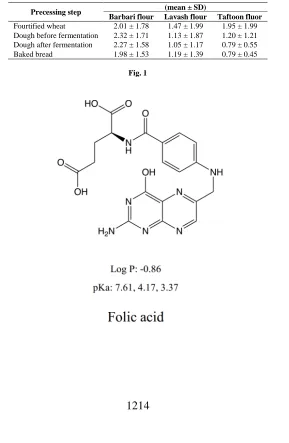
Table 1 shows the folic acid content in fourtifeid wheat. The level of folic acid content in wheat flour were 2.01 ±1.78, 1.47 ± 1.99 and 1.95±1.99 µg L-1 for barbari, lavash and taftoon flour, respectively.
Table 1: Folic acid content in bread processing in different breads
Precessing step (mean ± SD)
Barbari flour Lavash flour Taftoon fluor
[image:3.595.160.449.346.789.2]Fourtified wheat 2.01 ± 1.78 1.47 ± 1.99 1.95 ± 1.99 Dough before fermentation 2.32 ± 1.71 1.13 ± 1.87 1.20 ± 1.21 Dough after fermentation 2.27 ± 1.58 1.05 ± 1.17 0.79 ± 0.55 Baked bread 1.98 ± 1.53 1.19 ± 1.39 0.79 ± 0.45
1215
Fig. 2
1216
Fig. 4
3.2. Investigation of the folic acid content before fermentation of dough
Table 1 also shows the folic acid content in Dough before fermentation. The level of folic acid content in dough before formation were ranged from 2.32 ±1.71, 1.13 ±1.87 and 1.20±1.21 µg L-1 for barbari, lavash and taftoon flour, respectively.
3.3. Investigation of the folic acid content after fermentation of dough
As can be seen in Table 1, the mean of the total foloic acid content after fermentation of dough before baking ranged from 2.27 ±1.58, 1.05 ±1.17 and 0.79±0.55 µg L-1 for barbari, lavash and taftoon flour, respectively.
3.4. Investigation of the folic acid content after bread baking
Folic acid content for baked bread are reported in Table 1. Mean folic acid values were 1.98±1.53, 1.19 ±1.39 and 0.79±0.45 µg L-1 for barbari, lavash and taftoon flour, respectively.
3.5. compartion of the folic acid content in wheat to bread process in various breads
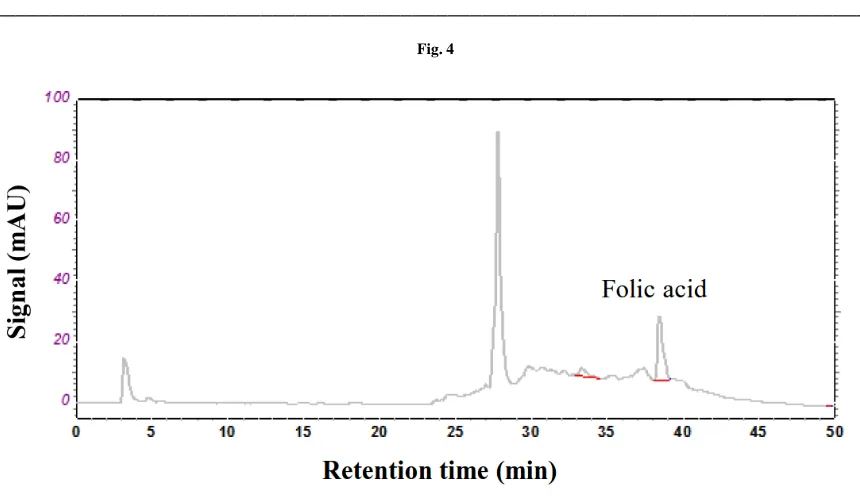
As shown in Fig. 3, folic acid content in all samples were found to decrease significantly after fermentation. Therefore, fermentation step has important effect in folic acid stability in various flours.
By comparion the results that reported in Fig. 3, baking temperature and duration do not have a significant impact on folic acid content in various breads.
In addition, due to unstability of folic acid by exposure to light, air and water, significantly decrease in folic acid contents were observed after storage in stores. Therefore, fresh bread has maximom content of folic acid after backing. Typical Chromatogram obtained for folic acid content in are shown in Fig. 4.
CONCLUSION
1217
Acknowledgement
The authors gratefully acknowledge the financial support from the Islamic Azad University.
REFERENCES
[1] RHF Cheung; JG Hughes; PJ Marriott; DM Small, Food Chem., 2009, 112, 507-514.
[2] S Brämswig; R Prinz-Langenohl; Y Lamers; O Tobolski; E Wintergerst; HK Berthold; K Pietrzik, Int. J. Vitam. Nutr. Res., 2009, 79, 61-70.
[3] Y Lamers; R Prinz-Langenohl; S Brämswig; K Pietrzik, Am. J. Clin. Nutr., 2006, 84, 156-161.
[4] KB Holven; P Aukrust; T Holm; L Ose; MS Nenseter, Arteriosclerosis, Thromb. Vas. Biol., 2002, 22, 699-703. [5] SF Choumenkovitch; PF Jacques; MR Nadeau; PWF Wilson; IH Rosenberg; J Selhub, J. Nutr., 2001, 131, 3277-3280.
[6] T Yildirim; A Yalcin; V Atmis; OK Cengiz; S Aras; M Varli; T Atli, Arch. Geront. Geriatr., 2015, 60, 344-348. [7] MY Yakoob; ZA Bhutta, BMC Public Health, 2011, 11.
[8] AE Czeizel; I Dudás; A Vereczkey; F Bánhidy, Nutrients, 2013, 5, 4760-4775. [9] GPO Jr; KN Bell; MB Weber, Clin. Mol. Teratol., 2004, 70, 835-837.
[10] EP Frenkel; DA Yardley, Hematol. Oncol. Clin. Nor. Am., 2000, 14, 1079-1100. [11] CM Boykin; NA DiPietro Mager, Curr. Pharm. Teach. Learn., 2015, 7, 273-276.
[12] JN Peake; AJ Copp; J Shawe, Birth Defects Res. A .Clin. Mol. Teratol., 2013, 97, 444-451. [13] KY Leung; SCP De Castro; D Savery; AJ Copp; NDE Greene, Brain, 2013, 136, 2836-2841.
[14] MdL Samaniego-Vaesken; E Alonso-Aperte; G Varela-Moreiras, J. Food Compost. Anal., 2010, 23, 419-423. [15] JR Rueda; J Ballesteros; V Guillen; MI Tejada; I Solà, Cochrane database syst. rev., 2011, 5.
[16] GS Fisch; IL Cohen; AC Gross; V Jenkins; EC Jenkins; WT Brown, Am. J. Med. Genet., 1988, 30, 393-399. [17] RJ Hagerman; AW Jackson; A Levitas; M Braden; P McBogg; M Kemper; L McGavran; R Berry; I Matus, Am. J. Med. Genet., 1986, 23, 241-262.
[18] I Galán; ML García; MD Selgas, Meat Sci., 2010, 84, 437-443. [19] M Hefni; CM Witthöft, LWT-Food Sci. Technol., 2011, 44, 706-712.
[20] L Frommherz; Y Martiniak; T Heuer; A Roth; SE Kulling; I Hoffmann, Food Chem., 2014, 159, 122-127. [21] JE Young; MT Matyska; JJ Pesek, J. Chromatogr. A, 2011, 1218, 2121-2126.
[22] YO Li; LL Diosady; S Jankowski, Int. J. Food Sci. Tech., 2011, 46, 379-385.
[23] M Achón; Á Arrate; E Alonso-Aperte; G Varela-Moreiras, Eur. J. Clin. Nur., 2011, 50, 119-125. [24] AM Shojania; K Von Kuster, BMC Res. Notes, 2010, 3.
[25] J Arcot; AK Shrestha; U Gusanov, Food Control, 2002, 13, 245-252.
[26] J Alaburda; AP de Almeida; L Shundo; V Ruvieri; M Sabino, J. Food Compost. Anal., 2008, 21, 336-342. [27] CA Boeneke; KJ Aryana, LWT-Food Sci. Technol., 2008, 41, 1335-1343.
[28] K Dewettinck; F Van Bockstaele; B Kühne; D Van de Walle; TM Courtens; X Gellynck, J. Cereal Sci., 2008, 48, 243-257.
[29] MV Salinas; MC Puppo, LWT-Food Sci. Technol., 2015, 60, 95-101.
[30] RHF Cheung; PD Morrison; DM Small; PJ Marriott, J. Chromatogr. A, 2008, 1213, 93-99. [31] F Rezaei; Y Yamini; M Moradi; B Ebrahimpour, Talanta, 2013, 105, 173-178.