International Journal of Emerging Technology and Advanced Engineering
Website: www.ijetae.com (ISSN 2250-2459,ISO 9001:2008 Certified Journal, Volume 3, Issue 7, July 2013)
429
Minimization of Communication Latency by Mid-Network
Processing for Android Applications
Sandhya M
1, Rekha Pillai
21M Tech student, 2Asst. Professor,Dept of ECE, AMCEC
Abstract—Various mobile applications fetch the requested
data from remotely located servers by means of queries generated by users. These queries need to be processed before the desired content can be identified and provided to users. Processing these requests on user equipments will quickly drain the limited battery resources. Conversely, processing these queries at remote servers will result in slow response time due to the communication latency caused during the transmission of the potentially large user-query. The proposed system utilizes mid-network processing. Leasing the computational power from mid network nodes will help in reduction of communication latency. The uplink transmission and processing of a single user generated request is considered. An Android Mobile Application to list apartments which are geographically in a certain radius using GPS Calculation and ranking Methods is developed. The implementation is accomplished using java on android platform.
Keywords— Communication Latency, Mid-Network nodes,
Mid-Network Processing, User Equipment, Application Server
I. INTRODUCTION
The data storage and processing capabilities of mobile devices are becoming increasingly powerful. A scope of new mobile applications has emerged for providing a better quality for the end users. These types of applications are commonly referred to as mobile augmented reality applications [1]–[3]. Mobile augmented reality applications enable delivery of content in response to the user-generated queries. In the case of multimedia applications, for example, when a user shoots a video of an object or clicks a picture through a camera phone, the image or video is processed in the phone and sent to an application server storing a database of images. Then the query image is extracted and is matched with a suitable image or video and the resulting content is send back to the user [4]–[6].
The query processing involves background extraction, pattern recognition, feature extraction, and feature matching [7]–[10]. These processes will consume more power. If the query processing is done in the phone, it will diminish the battery lifetime of the mobile device. An alternate method is to transmit the data to the application server where the processing could be done. This approach will increase the bandwidth demand.
When several users are using such an application and competing for spectrum along with data, voice and video traffic generated by the users will cause bandwidth limitations.
Nowadays, all mobile devices are becoming more complex as they are capable of creating high quality image, audio and video, thus the query data size will be growing continuously. As larger query data is transmitted through the network, the communication latency on the uplink will be higher. So there is a tradeoff between battery usage and communication latency.
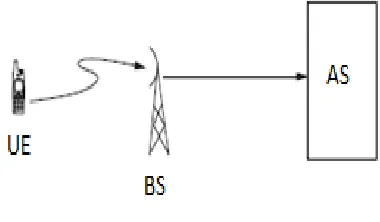
The transmission pathway from User Equipment (UE) to Application Server (AS) is shown in Fig.1.1.
Fig.1.1. System Diagram
A user request originates at the User Equipment. The requested message is transmitted to the Application Server through mid-network nodes. The processing of the user generated query is done at the base station, intermediate nodes and at the Application Server in order to stream the desired content. The video/audio files which have large size are stored in database at remote Application Server and the request must be transmitted upstream in order to be satisfied. The request message must be processed before the media stream can be transmitted downstream.
International Journal of Emerging Technology and Advanced Engineering
Website: www.ijetae.com (ISSN 2250-2459,ISO 9001:2008 Certified Journal, Volume 3, Issue 7, July 2013)
430 II. MID-NETWORK PROCESSING SYSTEM
In Mid-network processing, the processing power is leased from mid network nodes. This reduces the processing burden on User Equipment (UE). It can lower communication latency by reducing the message size.
Mid-Network Processing is useful in media applications such as Mobile Augmented Reality. Many mobile devices are equipped with a small camera. In Mobile Augmented Reality, a picture captured by a mobile device corresponds to a request, such as streaming a desired video or audio stream to the mobile device. A series of image processing techniques are used to do this. The final step requires matching the processed image to the requested content in a large database. It is often the case that this database is so large it cannot feasibly be stored on the limited memory of the mobile device. Therefore, a request must be transmitted uplink to the Application Server. Once the request has been fully processed, the desired content can be streamed downlink to the requesting handheld device. The focus is on the uplink transmission and processing of a single original request.
Fig2.1: Simple System Model
A request originates at the User Equipment (US) and is transmitted over one hop to the Base Station (BS) and finally to the Application Server (AS). Once the request has reached the AS and has been fully processed, it can be satisfied.
A. Objective
[image:2.612.327.562.123.342.2]The apartments within 20Km radius are listed and given ranking based on qualities and facilities. Ranking is based on the qualities and features of the apartments in their spatial neighborhood.
Fig 2.2: High Level Diagram
The system architecture explains the way by which the whole system is designed and the sequence of processes that are carried out in the system.
[image:2.612.70.260.387.498.2]International Journal of Emerging Technology and Advanced Engineering
Website: www.ijetae.com (ISSN 2250-2459,ISO 9001:2008 Certified Journal, Volume 3, Issue 7, July 2013)
[image:3.612.332.552.152.339.2]431 The search request from the user will contain a location and radius information. This is processed by the search engine which sends a query to the DB. The results from DB are shortlisted by the ranking system before they are displayed back to the user.
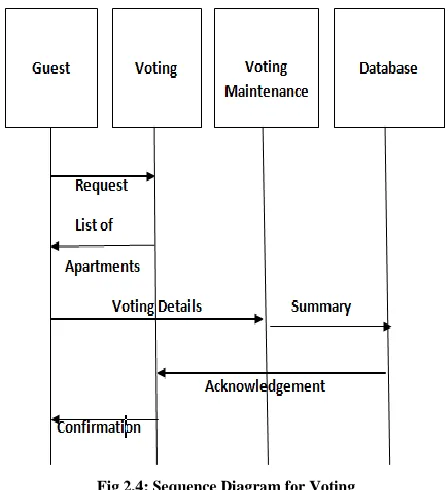
Fig 2.4: Sequence Diagram for Voting
The search requests from the user are handled by the search engine which provides the list of apartments as a result back to the user. The voting details are sent to the DB via a voting maintenance module.
The user communicates to Base station via an android device. The user uses Wireless Application Protocol (WAP) to communicate to the base station. Once connected to the base station, the base station performs the apartment filtering over the data stored in a database.
[image:3.612.55.279.183.428.2]The application server provides ranking of the apartments from the data retrieved from the database.
Fig 2.5: Context Diagram
The context diagram explains the privileges that each user has. The users are classified into various such as Admin User, Guest User and Android User. Each user has rights and privileges.
III. SESSIONS AND MODULES
A. Admin Session
International Journal of Emerging Technology and Advanced Engineering
Website: www.ijetae.com (ISSN 2250-2459,ISO 9001:2008 Certified Journal, Volume 3, Issue 7, July 2013)
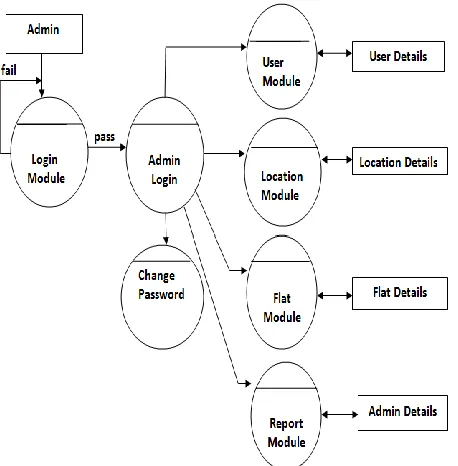
[image:4.612.58.287.122.355.2]432 Fig 3.1: Data Flow Diagram – Admin Session
Using the admin login module, admin can login to the home page. After a successful login, admin can access the User module, Location module and Flat module. Admin can also generate report or change the password.
B. Guest Session
A guest user’s access is limited to the home page of the application and is not provided with any login module. When the guest enters the home page of the application, all the flat details are displayed. Guest can select the review option and place his vote. This system has voting criteria in the form of Bus Facilities, Hospitals Nearby, Water Facilities and Other Facilities. Guest user can became member user by selecting register option. The Guest User has limited privileges including Flat Details Display, Voting system and Registration.
Fig 3.2: Data Flow Diagram – Guest Session
The guest user directly enters the home page, as no authentication is required for the guest. From the home page, guest can access either the feedback module to provide feedback on flats or view the list of flats.
C. Android user Session
[image:4.612.335.556.137.318.2]International Journal of Emerging Technology and Advanced Engineering
Website: www.ijetae.com (ISSN 2250-2459,ISO 9001:2008 Certified Journal, Volume 3, Issue 7, July 2013)
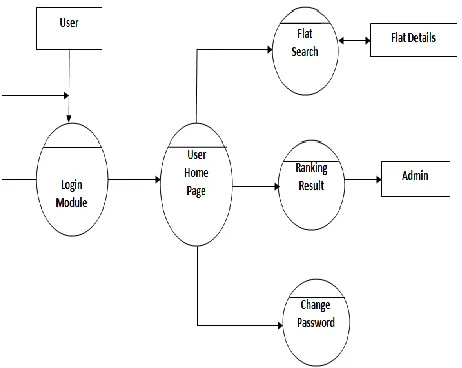
[image:5.612.56.287.132.316.2]433 Fig 3.3: Data Flow Diagram – Android User Session
Using the login module, android user can enter into home page, by providing valid username and password. Once logged in, user can perform flat search, change password and ranking of the flats.
IV. RESULTS
The system was tested in a 100Mbps LAN network using simulations and observed an improvement of 7 milliseconds. This corresponds to an improvement of approximately 28%. The change in performance will vary when the system is deployed on actual mobile networks that use different communication equipments.
V. CONCLUSION &FUTURE WORK
Communication bandwidth limitation is a main disadvantage that android mobile users are facing, especially while running complex multimedia applications. By leasing the processing power from mid-network nodes, the communication latency in such applications is reduced. Mid-network processing can help lighten the processing burden off the Mobile Station without increasing the service latency. The concept of mid-network processing is implemented in an online apartment search and ranking system.
The apartment search is performed using a device running on android operating system. A 28% reduction in the communication latency in the network is observed. This is achieved by making use of the processing power in the intermediate nodes in the network. The speed of the search is improved as well as the processing required at the user’s android device is reduced. By applying better query processing mechanisms in the mid-network nodes, the communication latency can be further reduced. The performance can be further enhanced by optimal selection of mid-network nodes.
REFERENCES
[1] T. Yeh, K. Tollmar, and T. Darrell, ―Searching the web with mobile images for location recognition,‖ in Proc. IEEE CVPR, vol. 2, pp. 76–81, July 2004.
[2] G. Fritz, C. Seifert, and L. Paletta, ―A mobile vision system for urban detection with informative local descriptors,‖ in Proc. IEEE ICVS, p. 30, Jan. 2006.
[3] H. Bay, B. Fasel, and L. V. Gool, ―Interactive museum guide: Fast and robust recognition of museum objects,‖ in Proc. IMV, May 2006.
[4] ―Amazon app for iphone and ipod
touch.‖http://www.amazon.com/gp/feature.html?ie=UTF8&docId=1 000291661.
[5] Carri W. Chan, Member, IEEE, Nicholas Bambos, Member, IEEE, and Jatinder Singh, Member, IEEE, ―Network Assisted Mobile Computing with Optimal Uplink Query Processing‖ IEEE 2012 Transactions on Mobile Computing,Volume:PP,Issue:99.
[6] D. Chen, S. Tsai, V. Chandrasekhar, G. Takacs, J. P. Singh, and B. Girod, ―Robust image retrieval using scalable vocabulary trees,‖ in Proc. VCIP,2009.
[7] D. Chen, S. Tsai, V. Chandrasekhar, G. Takacs, J. P. Singh, and B. Girod, ―Tree histogram coding for mobile image matching,‖ in Proc. IEEE DCC, pp. 143–152, 2009.
[8] V. Chandrasekhar, G. Takacs, D. Chen, J. P. Singh, and B. Girod, ―Transform coding of image feature descriptors,‖ in Proc. VCIP, 2009.
[9] S. Tsai, D. Chen, J. P. Singh, and B. Girod, ―Image-based retrieval with a camera-phone,‖ in Technical Demo, IEEE ICASSP, 2009. [10] S. Mohapatra and N. Venkatasubramanian, ―Para: power aware
reconfigurable middleware,‖ in Proc. IEEE Int. Conf. on Distributed Computing Systems, p. 312319, 2003.