Journal of Chemical and Pharmaceutical Research, 2016, 8(5):450-456
Review Article
ISSN : 0975-7384
CODEN(USA) : JCPRC5
Advancements in Layered Cathode Materials for Lithium ion Batteries
M. C. Rao
Department of Physics, Andhra Loyola College, Vijayawada – 520008, India
_____________________________________________________________________________________________
ABSTRACT
Improvements in the capacity of modern lithium batteries continue to be made possible by enhanced electronic conductivities and ionic diffusivities in anode and cathode materials. Lithium ion battery technology has been applied to both thin, light and flexible portable electronic devices and more recently, to batteries for transportation systems including hybrid and electric vehicles. LiCoO2 has been commercially used as a cathode material for
lithium-ion batteries due to its high capacity and excellent cycling stability. Layered LiNiO2, LiMnO2 and their
derivatives are promising cathode materials for lithium-ion batteries due to their high theoretical capacity and low cost. Lithium-excess layered oxides, Li[Li, Mn, Ni, Co]O2, such as (Li2MnO3)x(LiMO2(M=Ni, Co, Mn))1−x, offer a
working voltage much higher capacity values than those of LiCoO2 and LiMn1.5Ni0.5O4 and LiNi1−xCoxO2, where x ≤
0.4, is considered as a promising material based on its lower price, higher specific capacity and better cycleability.
Keywords: Lithium-ion Batteries, Cathode Materials, Advancements, Properties, Applications.
_____________________________________________________________________________________________
INTRODUCTION
IMPORTANCE OF LITHIUM BATTERIES
Lithium ion battery technology has been applied to both thin, light and flexible portable electronic devices and more recently, to batteries for transportation systems [3] including hybrid and electric vehicles. Though these markets present different challenges in battery cell design, the former requiring in general higher power density and the latter requiring higher energy density for greater degrees of vehicle electrification, the technical requirements of improved conductivity and diffusivity are common to both. Models of battery cells and materials [4–6] critically require the best available estimates for conductivity and diffusivity, in order to both predict response and design improved materials. One of the problems associated with the performance of Lithium ion batteries is the capacity decay in the cell with cycling. This capacity fade is caused by various mechanisms, which depend on the electrode materials and also on the protocol adopted to charge the cell. Capacity fade in Lithium ion cells can be attributed to unwanted side reactions that occur during overcharge or discharge, which causes electrolyte decomposition, passive film formation, active material dissolution and other phenomena. Overcharging the Lithium ion cells causes deposition of metallic Lithium on the negative electrode surface, which is a primary side reaction. Lithium deposition will take place in cells with excess cyclable Lithium due to either higher than desired initial mass ratio or lower than expected Lithium losses during the formation period.
Lithium ion batteries are light weight as compared to the other rechargeable batteries of the same weight. Lithium ion batteries have a very high energy density hence lot of energy can be stored in it and this is due to the fact that electrodes of lithium ion batteries are made of light weight lithium and carbon and lithium is highly reactive element. Batteries made by lead-acid which weighs 6 kilograms can store the same amount of energy which a 1 kilogram lithium ion battery can store. Charge lost by lithium ion batteries is as low as 5 percent per month as compared to NIMH batteries which has 20 percent charge loss per month. Lithium ion batteries do not need to be discharged completely, i.e. they do not have any memory effect which some other batteries have. Hundreds of charge and discharge cycle can be handled by lithium ion batteries. Lithium iron phosphate has the wide range of characteristics due to which variety of different sizes of batteries can be produced and they found major areas of application: big electric vehicles, light electric vehicles, power tools, remote control toys, wind energy storage and solar equipment, small medical equipment and portable instruments. Lithium ion batteries are made up of one or more generating compartments called cells. Each cell is composed of three components: a positive electrode, negative electrode and a chemical called an electrolyte in between them. The positive electrode is made from chemical compound named lithium cobalt oxide (LiCoO2) or lithium iron phosphate (LiFePO4). The negative electrode is made up of carbon (graphite) and the electrolyte varies from one type of battery to another. During charging the battery, lithium based positive electrode withdraws some of its lithium ions, which move through the electrolyte to reach to the negative electrode and remain there. The battery stores energy during this process. When the battery is discharging, the lithium ions move back across the electrolyte to the positive electrode, producing the energy that powers the battery.
CATHODE MATERIALS
In the past two decades, the layered oxide LiCoO2 cathode has been widely used in portable electronics [7]. The high cost, toxicity, chemical instability in the deep charged state, safety concern and limited capacity associated with LiCoO2, however, have prevented its large-scale applications in transportation and stationary storage. Having a
similar capacity as that of LiCoO2, but a relatively high working voltage LiMn1.5Ni0.5O4 is becoming an attractive
candidate for high energy applications. Furthermore, the cycle life and rate capability of doped LiMn1.5Ni0.5O4 (spinel structure) could be enhanced significantly by cationic substitutions (Co, Cr, Fe, Ga or Zn) [8] and surface modification (AlPO4, ZnO, Al2O3 and Bi2O3) [9]. In order to obtain a uniform surface modification and/or strong cationic coating, however, a complicated and high- cost post-chemical process is necessary [10]. To make the matter
even worse, the currently used standard electrolytes (LiFP6 in EC/DEC/DMC) are not appropriate for LiMn1.5Ni0.5O4
cathode, which requires the high working voltage. Lithium-excess layered oxides, Li[Li, Mn, Ni, Co]O2, such as
(Li2MnO3)x(LiMO2(M=Ni, Co, Mn))1−x, offer a working voltage much higher capacity values than those of LiCoO2
and LiMn1.5Ni0.5O4 [11]. However, there is often a huge irreversible capacity loss associated with the oxygen and
lithium loss from the host structure of the lithium-excess layered oxides (Li[Li, Mn, Ni, Co]O2) at the end of the first
charging process. Although the irreversible capacity loss can be significantly reduced by coating with insulating
materials (e.g., Al2O3, AlPO4, MgO, RuO2), the high surface area associated with the nanostructured lithium excess
Since 1980 when the LiCoO2 was demonstrated firstly as a possible cathode material for rechargeable lithium battery, the transition metal intercalation oxides have caught the major research interests as the LIB cathodes [12,
13]. Categorized by structure, the conventional cathode materials include layered compounds LiMO2 (M = Co, Ni,
Mn, etc.), spinel compounds LiM2O4 (M = Mn, etc.), and olivine compounds LiMPO4 (M = Fe, Mn, Ni, Co, etc.).
Most of the researches are performed on these materials and their derivatives. New structure intercalation materials such as silicates, borates and tavorites are also gaining increasing attentions in recent years. During the materials optimization and development, following designing criterions are often considered: energy density; rate capability; cycling performance; safety; cost. The energy density is determined by the material’s reversible capacity and operating voltage, which is mostly determined by the material intrinsic chemistry such as the effective redox couples and maximum lithium concentration in active materials. For rate capability and cycling performances, electronic and ionic motilities are key determining factors, though particle morphologies are also important factors due to the anisotropic nature of the structures and are even playing a crucial role in some cases. Therefore materials optimizations are usually made from two important aspects, to change the intrinsic chemistry and to modify the morphology (surface property, particle size, etc.) of the materials. The materials with promising theoretical properties have high potentials as the candidates of future generation LIB cathode, therefore are under intensive studies. For certain materials such as the LiFePO4 olivine, significant property improvements have been achieved during the past decade with assistance of newly developed technologies. The ideal structure of layered compound
LiMO2 is demonstrated in Figure 1. The oxygen anions form a close-packed fcc lattice with cations located in the
6-coordinated octahedral crystal site. The MO2 slabs and Li layers are stacked alternatively. Although the conventional
layered oxide LiCoO2 has been commercialized as the LIB cathode for twenty years; it can only deliver about 140
mAh/g capacity which is half of its theoretical capacity.
LAYERED CATHODES FOR LITHIUM BATTERIES
LiCoO2 has been commercially used as a cathode material for lithium-ion batteries due to its high capacity and excellent cycling stability. Nonetheless, cobalt has economic and environmental problems that leave the door open to exploit alternative cathode materials. For example, layered LiNiO2, LiMnO2 and their derivatives are promising cathode materials for lithium-ion batteries due to their high theoretical capacity and low cost. Unfortunately, these materials still have significant drawbacks. The major problems associated with LiNiO2 include the difficulty in preparing stoichiometric LiNiO2 powders without cation mixing, the structure degradation caused by irreversible phase transition during electrochemical cycling and thermal safety problems caused by oxygen release in the charged state. The main shortcoming of layered LiMnO2 is the crystallographic transformation to spinel structure
during electrochemical cycling [14]. Although layered LiMnO2 materials that do not convert to spinel during cycling
were reported by Paulsen et al. [15], the preparation of the materials involved a cost-adding, multistep process of ion exchange of Na+ with Li+. Various approaches such as partial replacement of nickel and manganese by transition metals and optimizing preparation methods and conditions were adopted to improve their performance. For example, LiNi1−xCoxO2, where x ≤ 0.4, is considered as a promising material based on its lower price, higher specific capacity and better cycleability. However, its thermal safety still cannot satisfy the requirements for practical applications. The most appropriate and successful approach is to introduce Ni, Co, and Mn ions
simultaneously in the layer structure. A solution of LiNixCoyMn1−x−yO2 may possess improved performances, such
as thermal stability, due to the synergistic effect of the three ions. Therefore, recently, intensive effort has been
directed towards the development of LiNixCoyMn1−x−yO2 as a possible replacement for LiCoO2. Similar to LiCoO2,
LiNixCoyMn1−x−yO2 generally exhibits a well defined α-NaFeO2 layered structure (Figure 2), which is hexagonal
crystalline and indexed as R-3m space group. This structure has Li+ at the 3a sites, the transition metal ions M (M =
Mn, Co and Ni) at the 3b sites, and O2− at the 6c sites in a MO6 octahedron. X-ray diffraction is an effective methodology to investigate the crystalline structure since it gives one a good picture of the long-range structural changes in the materials. The value of I (003)/I (104) is used as a standard to measure the degree of the cation mixing in the layered compounds. The smaller the I (003)/I (104) value, the higher the disordering. Generally, the undesirable cation mixing takes place when I (003)/I (104) < 1.2. Moreover, distinct splitting of the (108), (110), and (006), (102)
Figure 1: Crystal structure of layered LiMO2 (blue: transition metal ions; red: Li ions)
Figure 2: Layered structure of LiTiS2, LiVSe2, LiCoO2, LiNiO2 and LiNiyMnyCo1-2yO2, showing the lithium ions between the
transition-metal oxide/sulfide sheets
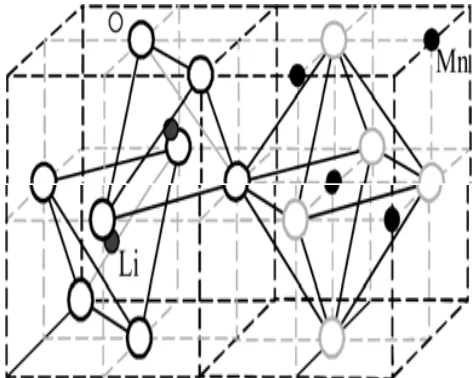
The structure of LiMn2O4 belongs to the face center cubic lattice and each lattice is made up of 2 lithium atoms, 4
manganese atoms and 8 oxygen atoms [16-22]. In contrast to the layered oxides (LixCoO2 or LixMyCoyO2, M = Ni,
Mg, Ti) presently used in commercial Lithium ion cells LiMn2O4 adopts a (3D) structure that can simply be
[image:4.595.178.414.527.716.2]However, this structure is complicated by possible cations mixing between the two types of sites. It is well documented that, within the spinel family, the degree of cations mixing and extent of cationic or anionic non stoichiometry affecting the spinel magnetic or optical properties is strongly dependent on the thermal story of the sample. Thus, it was important to first determine whether or not the Li intercalation/deintercalation process within
LiMn2O4 was sensitive to the sample history (precursors, heat-treatments) and subsequent cation mixing as the early
electrochemical data suggested. In the LiMn2O4 spinel structure (space-group: Fd3m), a ccp array of oxygen ions occupy the 32e position, Mn ions are located in the 16d site and Li in the 8a site. The Mn ions have an octahedral
coordination to the oxygens, and the MnO6 octahedra share edges in a three-dimensional host for the Li guest ions.
The 8a tetrahedral site is situated furthest away from the 16d site of all the interstitial tetrahedra (8a, 8b and 48f) and octahedra (16c). Each of the 8a-tetrahedron faces is shared with an adjacent, vacant 16c site. This combination of structural features in the stoichiometric spinel compound constitutes a very stable structure.
The growth of LiCoO2 thin films with preferred orientation is known to be crucial. Several thin film deposition techniques such as RF sputtering [23], pulsed laser deposition [24- 33], electrostatic spray deposition [34] and
chemical vapour deposition [35] were employed for the growth of LiCoO2 thin films. PLD has been widely
recognized as a very promising, versatile and efficient method for the deposition of metal oxide thin films [36]. In particular, it has been successfully employed for the deposition of simple and complex metal oxide materials with desired composition, structure, physical and chemical properties. When PLD is carried out in the atmosphere of a chemically reactive gas (a process known as Reactive Pulsed Laser Deposition (RPLD)), the flux of the laser ablated material interacts with the gas molecules all along the transit from the target to the collector surface. The resulting deposited layer was found to have a chemical composition substantially the same as the base or starting material.
LiCoO2, LiMn2O4 and LiNixCo1-xO2 thin films were grown by pulsed laser deposition technique and the systematic
characterization like structure, surface morphology, vibrational studies, optical properties, electrical properties, thermodynamic properties, gas sensing properties and electrochemical properties were studied [37-47] which are different from many transition metal oxides which have been exploited in many challenging fields of information science, nano and microelectronics, computer science, energy, transportation, safety engineering, military technologies, optoelectronic, electrochromic devices etc. These transition metal oxides are most interesting materials exhibiting a wide variety of novel properties particularly in thin film form useful for advanced technological applications. Sometimes they exhibit structural transformations and sub-stoichiometric phase transitions, which attracted the attention of researchers over the past few years to explore their potential scientific and technological
applications in the fields of display systems and microelectronics[48-51]. Besides these battery materials we have
studied other materials like CdTe, ZnSe and CdSe nanopolymers and glassy materials are of great industrial interest for developing photoluminescence based biomedical labeling reagents [52-70]. Quantum dots have applications in both organic and inorganic light emitter devices such as electroluminescence devices. They are dispersed within or between phosphor layers and emit a specific color of light [71-82].
CONCLUSION
Lithium ion batteries are light weight as compared to the other rechargeable batteries of the same weight. Lithium ion batteries have a very high energy density hence lot of energy can be stored in it and this is due to the fact that electrodes of lithium ion batteries are made of light weight lithium and carbon and lithium is highly reactive
element. LiMn1.5Ni0.5O4 is becoming an attractive candidate for high energy applications. Furthermore, the cycle life
and rate capability of doped LiMn1.5Ni0.5O4 (spinel structure) could be enhanced significantly by cationic substitutions (Co, Cr, Fe, Ga or Zn) and surface modification (AlPO4, ZnO, Al2O3 and Bi2O3). LiCoO2 has been commercially used as a cathode material for lithium-ion batteries due to its high capacity and excellent cycling stability. Layered LiNiO2, LiMnO2 and their derivatives are promising cathode materials for lithium-ion batteries due to their high theoretical capacity and low cost.
REFERENCES
[1] M Meinshausen; N Meinshausen; W Hare; SCB Raper; K Frieler; R Knutti; DJ Frame; MR Allen. Nature, 2009, 458, 1158–1162.
[2] O vanVliet; AS Brouwer; T Kuramochi; M vanden Broek; A Faaij. J. Power Sources, 2011, 196, 2298–2310. [3] S Moore; M Ehsani. Adv. Ele. Vehicle Tech., SAE, 1999, SP-1417, 1–8.
[6] CW Wang; AM Sastry. J. Electrochem.Soc., 2007, 154, A.1035–1047. [7] JB Goodenough; Y Kim. Chem. Mater., 2010, 22, 587- 603.
[8] Y Xie; MF Ye; LJ Jiang; RS Zhu. Ionics, 2011, 17, 383–389. [9] J Liu; A Manthiram. Chem. Mater., 2009, 21, 1695–1707.
[10] D Kovacheva; B Markovsky; G Salitra; Y Talyosef; M Gorova; E Levi; M Riboch; HJ Kim; D Aurbach.
Electrochim. Acta., 2005, 50, 5553–5560.
[11] Z. Lu, L.Y. Beaulieu, R.A. Donaberger, C.L. Thomas, J.R. Dahn, J. Electrochem. Soc., 2002, 149, A778– A791.
[12] MC Rao; OM Hussain. Research J. Chem. Sci., 2011, 1, 92-95. [13] MC Rao. J. Non-Oxide Glasses, 2013, 5, 1-8.
[14] YY Huang; HH Zhou; JT Chen. Prog. Inorg. Chem., 2005, 17. 406-412. [15] JM Paulsen; CL Thomas; JR Dahn. J. Electrochem. Soc., 1999, 146, 3560-3566. [16] YU Ze-min; ZHO Lian cheng. Trans. Nonferrous Met. Soc., 2007, 17, 659-664. [17] MC Rao. J. Optoelect. Biomedical Mater., 2013, 5(1), 9-16.
[18] MC Rao. Res. J. Chem. Sci., 2012, 2(3), 74-79. [19] MC Rao. Int. J. Sci. Res., 2014, SI, 11-13.
[20] MC Rao. Int. J. Adv. Phar. Bio. Chem., 2013, 2 (3), 498-500. [21] MC Rao. Int. J. Mod. Phys., Conf. Series, 2013, 22, 576-582. [22] MC Rao. J. Chem. Bio. Phy. Sci. Sec. C, 2013, 3 (2), 1412-1424.
[23] BJ Neudecker; NJ Dudney; JB Bates. J. Electrochem. Soc., 2000, 147, 517- 524. [24] Y Zhang; B. Chiyuen, M. Zhua, Rare Metals, 2008, 27, 266-272.
[25] MC Rao, OM Hussain. J. Alloys Comp. 2010, 491 (1), 503-506.
[26] MC Rao; OM Hussain. Eur. Phys. J. Appl. Phys., 2009, 48, 20503 (p.1-6).
[27] MC Rao; K Ravindranadh; Sk Muntaz Begum; G Nirmala. AIP Conf. Proc., 2011, 1349, 641-642. [28] MC Rao. Bull. Pure & Appl. Sci., 2011, 30D (2), 241-246.
[29] MC Rao. J. Crys. Growth, 2010, 312, 2799–2803.
[30] MC Rao. Optoelect. & Adv. Mater., (Rapid Commu.), 2011, 5, 85-88.
[31] MC Rao; OM Hussain. IOP Conf. Series: Mater. Sci. Eng., 2009, 2(1), 012037 (p.1-4). [32] MC Rao. Optoelect. & Adv. Mater., (Rapid Commu.), 2011, 5, 651-654.
[33] MC Rao. J. Optoelect. & Adv. Mater., 2011, 13, 428-431.
[34] CH Chen; AAJ Buysman; EM Kelder; J Schoonman. Solid State Ionics, 1995, 80, 1-9. [35] SJ Cho; SG Yoon. Appl. Phys. Lett., 2003, 82, 3345-3352.
[36] JC Miller; RF Haglmel. Laser Ablation and Deposition, Academic Press, New York, 1998. [37] MC Rao; OM Hussain. Optoelect. & Adv. Mater., 2011, 13, 1109-1113.
[38] MC Rao. J. Chem. Bio. Phy. Sci. Sec. C, 2014, 4 (2), 1502-1505. [39] MC Rao. J. Chem. Bio. Phy. Sci. Sec. C, 2013, 4(1), 496-500.
[40] MC Rao; OM Hussain. Optoele. Adv. Mater. (Rapid Commun., 2012, 6 (1-2), 245- 248. [41] MC Rao. J. Intense Pulsed Lasers & Appl. Adv. Phys., 2012, 2, 45-57.
[42] MC Rao. J. Intense Pulsed Lasers & Appl. Adv. Phys., 2012, 2, 35-38. [43] MC Rao. Optoelect. & Adv. Mater., (Rapid Commu.), 2012, 6, 511-515.
[44] MC Rao; SM Begum. Optoelect. & Adv. Mater., (Rapid Commu.), 2012, 6, 508-510. [45] MC Rao. J. Optoele. Adv. Mater., 2011, 13 (1-2), 72-75.
[46] MC Rao. Optoelect. & Adv. Mater., (Rapid Commu.), 2010, 4, 2088-2091. [47] MC Rao. J. Optoelect. & Adv. Mater., 2010, 12, 2433-2436.
[48] MC Rao. J. Optoelect. & Biomedical Mater., 2011, 3, 45-50. [49] MC Rao. Res. J. Rec. Sci., 2013, 2(3), 67-73.
[50] MC Rao; OM Hussain. Res. J. Chem. Sci., 2011, 1 (7), 76-80. [51] MC Rao. Int. J. ChemTech Res., 2014, 6 (3), 1904-1906.
[52] MC Rao; K Ramachandra Rao. Int. J. Chem Tech Res., 2014, 6(7), 3931-3934.
[53]K Ravindranadh; RVSSN Ravikumar; MC Rao.Int. J. Mod. Phys., Conf. Series, 2013, 22, 346-350.
[54] Sk Muntaz Begum; K Ravindranadh; MC Rao; RVSSN Ravikumar. AIP Conf. Proc., 2013, 1536, 27-28. [55] MC Rao; K Ravindranadh; MS Shekhawat. AIP Conf. Proc., 2013, 1536, 215-216.
[60] Sk Muntaz Begum; MC Rao; RVSSN Ravikumar. J. Mol. Struct., 2011, 1006(1), 344- 347.
[61] Sk Muntaz Begum; MC Rao; RVSSN Ravikumar. Spectrochim. Acta Part A: Mol. & Biomol. Spec., 2012, 98, 100-104.
[62] K Ravindranadh; RVSSN Ravikumar; MC Rao. Int. J. Mod. Phys., Conf. Series, 2013, 22, 346-350.
[63] Sk Muntaz Begum; RVSSN Ravikumar; MC Rao. Int. J. Sci. Res., 2014, SI, 76-77.
[64] MC Rao; K Ravindranadh; T Satyanarayana; Y Dasaradhudu. Der Phar. Che., 2016, 8(4), 243-250.
[65] K Ravindranadh; D Sridhar Kumar; K Durga Venkata Prasad; MC Rao. Int. J. ChemTech Res., 2016, 9(4) in
Press.
[66] Ch Srinivasa Rao; MC Rao; T Srikumar. Int. J. Chem Tech Res., 2014, 6(7), 3935-3938. [67] T Srikumar; Ch Srinivasa Rao; MC Rao. Int. J. Chem Tech Res., 2014, 6(11), 4697-4701. [68] Ch Srinivasa Rao; T Srikumar; MC Rao. Int. J. Chem Tech Res., 2014, 7(1), 420-425.
[69] Ch Srinivasa Rao; T Srikumar; S Shantkriti; MC Rao. Int. J. Tech Chem Res., 2015, 1(1) 66-69. [70] Ch Srinivasa Rao; MC Rao. Int. J. Chem Tech Res., 2015, 8(2), 524-527.
[71] K Ravindranadh; MC Rao; RVSSN Ravikumar. J. Mater. Sci: Mater. Elect., 2015, 26, 6667-6675. [72] K Ravindranadh; MC Rao; RVSSN Ravikumar. Appl. Mag. Reson., 2015, 46(1), 1-15.
[73] K Ravindranadh; MC Rao; RVSSN Ravikumar. J. Luminesce., 2015, 159, 119-127. [74] MC Rao; K Ravindranadh; MS Shekhawat. AIP Conf. Proc., 2016, 1728, 020077 (1-4).
[75] MC Rao; Sk Muntaz Begum; E Sivanagi Reddy; O.M.Hussain. AIP Conf. Proc., 2012, 1447, 613-614. [76] Sk Muntaz Begum; K Ravindranadh; MC Rao; RVSSN Ravikumar. AIP Conf. Proc., 2013, 1536, 27-28. [77] MC Rao. Int. J. Mod. Phys., Conf. Series, 2013, 22, 11-17
[78] MC Rao. Int. J. Mod. Phys., Conf. Series, 2013, 22, 355-360. [79] MC Rao. Int. J. Mod. Phys., Conf. Series, 2013, 22, 385-390.
[80] K Ravindranadh; RVSSN Ravikumar; MC Rao. AIP Conf. Proc., 2016, 1728, 020079 (1-4).
[81] T Samuel; K Sujatha; K Ramachandra Rao;MC Rao. AIP Conf. Proc., 2016, 1728, 020080 (1-4).