Proceedings of Engineering Teclrnology International Conference (ETIC2015) 10-11 August 2015, Knanfan, Palrang
Potential Use of Shredded Tyre as a Filter Medium in Subsurface
Drainage Layer
Agus Sulaemaq Rafidah Binti Hamdan, Mohd Aswad
Bin
Abdul Rahman
FTK,
UniversitiTun Hussein Onn Malaysia, Johor
Abstract
In line with the growth in road traffic, substantial quantities of used tyre are beimg discarded annually thTough0ut the world. The current techniques to dispose this giant stockpile of used tyre where it is deposited in landfills. Tyres occupy a great volume of the landfill space, as compaction of the tyres is not possible, and the disintegration is very slow. This result to environmental problems such as, the tytes may accumulate rainwater and in this way will establish insect breeding grounds for mosquitoes (health risk like dengue). In this research used tyres was thoroughly studied to find the potential use of shredded tyre as a filter medium in subsurface drainage layer. Hence, the permeability tests and dry sieve analysis were setup to find the permeability coefficient (k) to fit the filter design criteria. However, since the tyres contain several chemical and metal compositions, Toxicity Cbaracteristics Leaching Procedure (TCLP) tests were demonstrated to investigate the leaching level of recycle shredded tyre. The result shows, the data obtained from Dry Sieve Analysis and Permeability Test has passing the Filter Performance Criteria which is Permeability Criterion and Retention Criterion. Apart from that, the hazardow constituent or leaching level of shredded tyre has showed the level is below the regulatory limits. From the parameter and data obtained, a conclusion can be made, where the shredded fyre has a promising potential and suitable to be used as filter medium in subsurface drainage layer.
Keywords
:ShreddedTyre; filters in subsurface drainage layer; filters medium; filters perfom,~nce criteria; retention criterion; permeability criterion.
1.0 Introduction
Every year substantial quantities of used tyre being discarded throughout the world and this likely will increase with growth in traEc. This giant stockpile of used tyre established the environmental economic implications of this waste. Many regulating bodies worldwide are actively promoting policies aimed at recycling and reuse of the material for recovery as valuable resources. However, in many parts of the world, recycled is still in its infancy. Technical knowledge and research on the benefits of used tyres wastes therefore need to be disseminated to the latest development [I].
From the viewpoint of civil engineering practices, shredded rubber provide numerous advantages such as, shredded rubber have light weight, high vibration-absorption, high elastic compressibility, and high hydraulic conductivity. Therefore, the reuse of large amounts of shredded rubber is beneficial, and several researchers have devoted their attention to the use of shredded rubber for civil and environmental engineering applications [2].
Mainly, two types of shredded rubber materials are used for civil engineering applications with or without shredding or cutting into small pieces of several tens of centimeters or several centimeters diameter. The former is without shredding, and it is useful for infrastructural retaining walls and foundations [3].
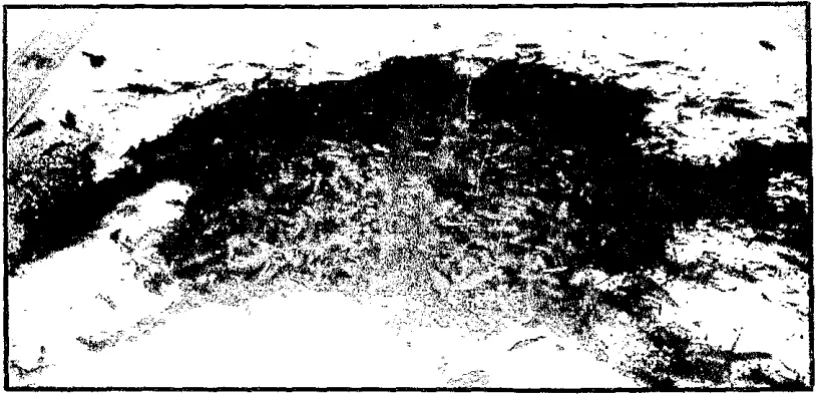
Thus, the most important engineering ropert ties of the use of shredded rubber as a filter medium is penneabiiity coefficient as shown in Figure 1. The permeability coefficient value must be higher to allow Water to draim easily and the porosity must be small enough to retain protected. The filter medium in subsurface drainage layer is typically constructed kom granular soil such sand and gravel. In this study, shredded rubber is thoroughly study to find the potential use if it possesses a higher hydraulic conductivity. These property values were helpful in evaluating the potential use of shredded rubber as the filter medium.
Figure 1: Shredded Tyre
2.0 Literature Review
In geotechnical engineering, fiter is a structural arrangement that is designed to protect soils 60m erosion due to seepage. As water flows through a soil, fine particles can be washed out, and this leading to internal erosion and eventually, the failure of the structure. Thus correctly designed filters retain loose soil particles may preventing erosion, while allowing seepage water to flow [4].
Filters are commonly used in embankment dams, agriculture drainage works, road pavements, retain'ig walls, canal linings, coastal protection works, and landfills in geotechnical structure. Granular and geotextile are the two types of filters in engineering practise. A granular filter is typically well-graded sand or sandy gravel. Granular filter has been in practice for almost a century now. In contrast, a geotextile is a synthetic textile material, a relatively recent technological development, and has been used in professional practice for the past t h i i years 141.
In 2010, U.SEPA in Scrap Tires; Handbook on Recycling Applications and Management for the U.S. and Mexico, stated the recycle shredded tyre can be used as a substitute for conventional drainage aggregate for a wide range of applications since this material is advantageous when conventional aggregate is more expensive. As shown in Figure 2, Potential draimage applications include as follows:
i. .. Drainage layers within landfill leachate collection and removal systems.
11. Permeable aggregate for landfill gas collection layers and trenches.
iii. Free draining aggregate for edge drains for roadways.
iv. Permeable backfill for exterior walls below the ground surfice. v. Septic systems drain fields.
Hightmy undsrdmin slope dininage. (Wignull a d Kendrick; 1982).
Figure 2: Typical application of filter drainage medium
2.1 Filters performance criteria
The principles performance criteria for filters is the filter should be permeable enough to allow liquid flow fieely. To ensure the particles behind the filter is retained, the opening s u e must be small enough [5] [l 11. It also stated the filter should include a large number of openings so the probability for clogging of them is small. However, for a material to satisfactorily replace a graded granular filter, it must perform the same function as a graded granular filter as follows [6] [ll]:
i. Prevent soil particles &om going into suspension ..
11. Allow soil particles already in suspensions to pass the filter @revent clogging)
iii. Have a sufficiently high permeability and flow rate.
Table 1: Filter Performance Criteria.
I
- .1
Theoretical Hazen's equation respective to particle sizes. [ p::=.-
.- $:.: z ~ ; , = .. A
mmI
CriteriaPrevention of excessive pore pressure.
Prevention of excessive reduction in flow rate.
I
Retention CriteriaRequirements
[i:: 1:. 110;:;: :] d s
[;:z::. . ... 2 ?5;::]m/s Permeabilitv Criterion
2.2 Recycled shredded tyre
Function of filters to retain soil or separate liquid behind the filter.
Tyre is made fiom natural rubher (latex) and synthetic rubber where it turns into composite product by addimg chemicals, fillers, and cords. They are designed to meet the mobility requirements of vehicles such as load canying capability, vehicle control, vehicle handling, ride smoothness, traction, and durability. The recycled shredded tyre can be obtained when the tyres are not being use anymore. The tyres then grind whether into a pieces or granulated material and dump into landfills [7].
[if.:; .::
3i:':=,]
-.. m m [image:3.602.68.523.395.540.2]Moreover the composition of tire contains, a vulcanized rubber, a rubberized fabric reinforced with textile cords, a mass of steel or fabric belts, and a mass of steel-wire reinforced rubber beads where the vulcanization is a chemical process for converting rubber or related polymers into more durable materials via the addition of additives
PI.
Hence the contaminant level of tyre should be determine whether it is harmful to environment. The levels of pollutants from recycle shredded tyre are compared to Toxicity Characteristic Leaching Procedure (TCLP) regulatory limits standards where Table 2 presents regulatoly limits for metals from United States, Environmental Protection Agency (EPA).
Arsenic
Barium 100.0
Cadmium Chromium
Merc
T earl 5 n
3.0 Materials and Methods
Selenium
1
1 .OThis research determines the physical properties of three samples which are; typical soil as the filter protected material, gravel as a filter original medium, and shredded tyre as a filter alternative medium. The intended physical properties in this study are, the permeability coefficient and the particle sizes distribution on those three sample which is typical soil, gravel and shredded rubber respectively. To determine those properties, the Dry Sieve Analysis and Permeability Test is investigated. While to ensure the alternative medium (shredded tyre) is not harmful to environment, the Toxicity Characteristics Leaching Procedure (TCLP) is observed to find the chemical properties level or hazardous contaminant.
Silver
3.1 Sample Preparation
5.0
The beginning of this study, it began with preparation of shredded rubber. Used tyres from the workshop were sent to the Recycling Centre. These used tyres were grinded into small pieces before it dump into landfill or stored in warehouse. The shredded tyre sample obtains eom the Recycling Centre come in various sizes from range 25 mm to 50 mm or in the smaller pieces particles fiom range 25 mm to 75 p. For typical soil as a protective material is obtained from the field while the gravel is obtained from lab storage.
3.2 Determination of Particle Sizes Distribution
A dry sieve analysis is a practice or procedure used to assess the particle size distribution of a granular material. The size distribution is often of critical importance to the way the material performs in use. Hence, in this study the all sample which is typical soil as protected material, gravel as original filter medium and shredded tyre as alternative medium were tested in dry sieve analysis. This data has been plotted in particle sizes distribution curve to determine the particle sizes at the percentage of percent finer required by the filter performance criteria.
3.3 Determination permeability coefficient
(k)
for fine grained soils that less permeable ones such as silts and clays and it is only allow a very small rate of flow through the soil. Hence, in this study for the fine grained material which is gravel shredded tyre were observed in constant head permeameter test. While for the fine grained soil which is typical soil is measured in falling bead permeameter test.
3.4 Toxicity Characteristics Leachiig Procedure (TCLP)
Leachiig is where the material is put into contact with a leachant and some constituents of the material are extracted. Therefore this process probably will compose metal and chemical kom its component. To determine hazardous constituent level, TCLP test will be demonstrated.
TCLP is designated to simulate leaching of shredded tyre will experience if disposed in landfill. The extraction fluid employed is a function of the alkalinity of the solid phase of the waste. The extract obtained fiom the shredded tyre is then analysed to determine if any of the thresholds established for the hazardous constituents. If the TCLP extract contains any one of the hazardous constituents in an amount equal to or exceeding the concentrations specified in the limits, the waste possesses the characteristic of toxicity and is a hazardous waste.
4.0
Results and Discussions
To achieve the research objective several experiment and test has been executed on shredded tyre, gravels and typical soil as stated in methodology to obtain a result. Selected parameter were determined kom three samples which were, shredded tyre, gravels and typical soil. There were two experiment executed in geotechnical laboratory which were Dry Sieve Analysis and Permeability Test (Constant Head and Fallimg Head) to determine the physical properties. While to determine the chemical properties, the Toxicity Characteristics Leaching Procedure (TCLP) was executed in Analytical Geo-Environmental Laboratory. All the experiments data were tabulated in tables and graphical approach to elaborate the results of this study. The experiment strictly based on the standards and practices stated in methodology.
4.1 Particle sizes distribution
Dry Sieve Analysis is executed to determine particle size distribution. There were three sample in this test which were shredded m e , gravels and typical soil. To determine the particle size distribution of soil, random sample of typical soil has been collected in the field to be tested in laboratory. The following Figure 3,4 and 5 showed the particle distribution data of the particle sample whereas Figure 6 showed the comparison between shredded t y e over gravel.
[image:5.602.113.495.504.694.2]c!,
---
:? C?'E2;-
-c+reriueci v*;e
---
G<6\.e!-- ~ -- I
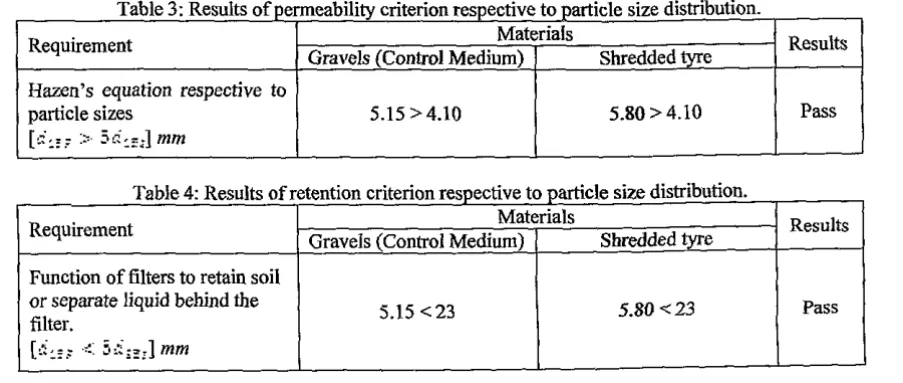
From the result it shows that, both the particle sizes of the control medium which was gravel and the alternative medium shredded tyre have passed the Filter Performance Criterion as mentioned in Table 3 and 4 [51 [I I]. The following Table 3 showed the measured and requirements for Permeability Criterion, while Table 4 shows for Retention Criterion.
I
Nazen's equation respective to [image:7.616.80.532.134.325.2]narticle sizes
I
5.15>4.10I
5.80>4.10Table 3: Results of permeahility criterion respective to particle size distribution.
4.2
Permeability
Coefficient, k.
Results Requirement
Table 4: Results of retention criterion respective to particle size distribution.
In this study permeability test was measured to determine the ~ermeability coefficient. There were three sample tested which were typical soil, gravels and shredded tyre. The typical soil was tested using the falling head apparatus while gavels and shredded tyre was tested using the constant head apparatus. Table 5 showed the summary results of hydraulic conductivity. r
Materials
[image:7.616.99.502.420.490.2] [image:7.616.91.519.565.695.2]Gravels (Control Medium)
1
Shredded tyreTable 5: Summary results of permeability test.
Sample Permeability Coefficient,
.::
Typical Soil 0.782 x 1 0 - ' ~ d s
~ -. . .
-
-9.
Results
Pass Requirement
Function of filters to retain soil or separate liquid behind the filter.
- .
.:: 3 ~m m ~ ~ ~ ]
I
Gravels 6.73 1 x iU~2m/sShredded lyre 7.554 x 10"ds
The results shows the permeability coefficient value of gravels and shredded tyre value fall in good drainage properties which is soil type as clean sand, sand and gavels mixture. However this p m e t e r is not enough evidence to claim it is suitable for filters. Hence the permeability criterion of the filters are recorded and analysed as the following Table 6:
Materials Gravels (Control Medium)
5.15 i 2 3
-
Shredded tyre
5.80 1 2 3
1
Prevention of excessive pore pressure
1;::
. :: 110,::::;I
m/sPrevention of excessive reduction in flow rate
[;:,, . . ....
,.
-. 23,::1] d sResults
Requirement Gravels (Control Medium)
(
Shredded lyreI I
Materials
6.731 x 10⁵>7.820 x lo-''
6.731 x 10-~>1.955 x
7.554 x 10-~>7.820 x
7.554 x 103>1.955 x
lo-9
Pass
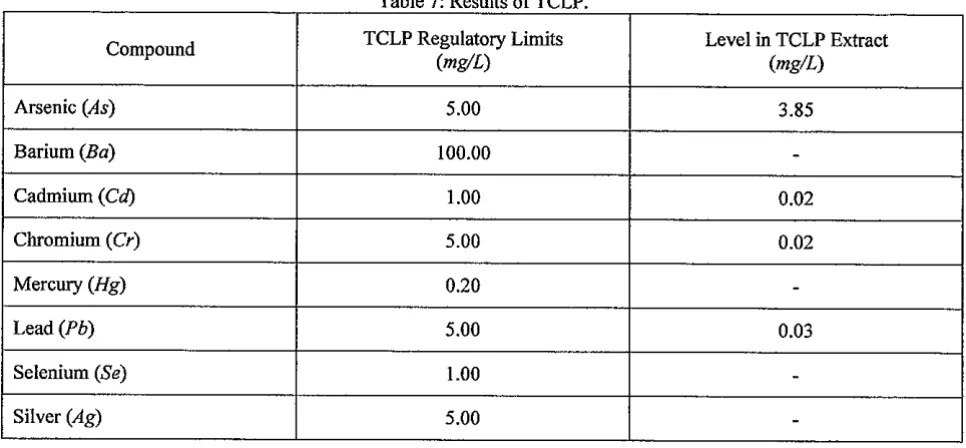
T o ensure a leachate from shredded tyre is not harmful to environment and human health, the TCLP test has been conducted to find the leaching level or hazardous constituent in shredded tyre. The extract fluid from the TCLP test then analysed for contaminants concentration using Atomic Absorption Spectroscopy (AAS). Results fiom AAS are provided in Table 7.
Table 7: Results of TCLP.
I I I I
I
CompoundI
TCLP Regulatory LimitsI
Level in TCLP Extract( 4 0
(mg/L)I
I
Arsenic (As)I
5.00I
3.85I
Barium (Ba)
Cadmium (Cd)
Chromium (Cr)
I
Selenium (Se) Mercuv (Hg)Lead (Pb)
100.00 1.00 5.00
Result fiom TCLP test show that the level of Arsenic, Cadmium, Chromium and Lead were below the TCLP regulatory limits. In conclusion, from this observation, shredded tyre is safe to be used as
a
filter medium in subsurface drainage layer as the leaching capability of the medium is considerably low when expose to the environment. In addition by recycling shredded tyre it also can reduce the environmental pollution.-
0.02 0.02 0.20
5.00
Silver (Ag)
5.0
Conclusions
-
0.03
5.00
From laboratory result and analysis indicated that, this study has obtained the general objectives. It can be summarizes that:
i. The parameter of permeability coefficient and particle size distribution for sample shredded tyre has shown the promising result.
ii. From the dry sieve analysis, the result has shown the particle size distribution of shredded tyre has passed or satisfied the permeability criterion in filter performance criteria.
iii. The results also shown, the particle size distribution of shredded tyre has passed or satisfied the second criteria which is retention criterion in filter performance criteria.
iv. From the conducted Permeability Test, the permeahility coefficient of shredded tyre slightly lower than the originals medium, gravel. However the permeahility coefficient of shredded tyre value still fall in a good drainage properties.
v. The permeability coefficient of shredded tyre also shows, the value has passed or satisfied the permeability criterion in fdter performance criteria
From this study, the conclusion can be made where the shredded tyre has shown the promising potential to be used as filter medium in subsurface drainage layer. From the particle distribution curve and permeability coefficient, it showed that the parameter has passed or satisfied the filter performance criteria requirements.
However, since the composition of rubber made from several chemical and metals, the chemical characteristics need to be considered to avoid any environmental risk. From the demonstrated test, it bas showed that the level of contaminant below the regulatory limits. And this parameter can be conclude that the shredded tyre is safe and not harmful to the environment.
As a shredded tyre is alternative approach to reduce solid waste and reduce pollutant, it can be claimed that the shredded tyre is suitable to be used as a filter medium in subsurface draimage layer. As an advantages of using this shredded tyre in filter medium in subsurface drainage layer, it is hope it will minimize the increasing of waste tyre dumped in landfill or in illegal ways.
6.0 Acknowledgement
The authors would l i e to express their gratitude to Recess and ORICC UTHM for financially supporting this project under the research grant Vot U260 (kontrak).
References
[l] Dhir, R.K, Limbachaya, M.C & Paine, K.A. (2001). Recycling and Reuse of Used Tyre. London, England: Thomas Telford Publishing.
[2] Reddy, K.R. and Saichek, R.E., (1998), Characterization and Performance Assessment of Shredded Scrap Tires as Leachate Drainage Material in Landfills. Fourteenth International Conference on Solid Waste Technology and Management. Philadelphia, US: Widener University School of Engineering and the University of Pennsylvania.
[3] Yasuhara, K. (2007). Recent Japanese experiences on scrapped tires for geotechnical applications. The International Workshop on Scrap Tire. Yokosuka, Japan: Taylor & Francis. pp19-42.
[4] Raut, A. K., Mathematical Modelling of Granular Filters and Constriction-based F i t Design Criteria. Ph.D. Thesis. University of Wollongong; 2006.
[51 Rowe, R.K (2001). Geotechnical &Geoenvironmental Engineering Handbook. Queen's University, Ontario, Canada: Kluwer Academics Publishers.
161 Chen, W.F &Richard Liew, J.Y (2003). The CivilEngineering Handbook. 2"d. Ed. U.S America: CRC Press. [71 Shulman, V.L., (2004). Tyre Recycling: Expert overviews covering the science & technology of rubber. Vol.
15. United Kingdom: Rapra Technology Ltd.
[81 Grimes, B. H., Steinbeck, S., and Amoozegar, A. (2003). Analysis of Tire Chips as a Substitute for Stone Aggregate in Nitrifcation Trenches of Onsite Septic Systems: Status and Notes on the Comparative Microbiology of Tire Chip versus tone Aggregate Trenches. Small Flows Quarterly, 4(4), pp. 18-23.
[9] Dodds, J., Domenico, W. P., Evans, D. R., Fish, L. W., Lusahn, P. L., and Toth, W. J. (1983). Scrap Tires: A Resource and Technology Evaluation of Tire Pyrolysis and Other Selected Alternative Technologies. Idaho: Idaho Falls.