Effect of 1×1, 2×1, 2×2, 3×1 and 3×3 Knit Structure on
Different Properties of Rib Knitted Fabric
Md. Reazuddin Repon1,2,*, Md. Nura Alam Shiddique1, Rajib Al Mamun1
1Department of Textile Engineering, Khwaja Yunus Ali University, Bangladesh
2Department of Production Engineering, Faculty of Mechanical Engineering and Design, Kaunas University of Technology, Lithuania
Copyright©2019 by authors, all rights reserved. Authors agree that this article remains permanently open access under the terms of the Creative Commons Attribution License 4.0 International License
Abstract
This study investigates the effect of different knit structure on various properties of rib knitted fabric. The acrylic yarns were used to make 1×1, 2×1, 2×2, 3×1 and 3×3 rib structured fabrics using manual V-bed knitting machine in this research work. The effects of knit structure were measured concerning drape co-efficient percentage, bending length, flexural rigidity and tightness factor. The results disclosed that the fabric properties are greatly influenced by knit structures. 1×1 rib knit fabric showed the lowest value for all tested properties and 3×3 rib knit fabric showed the highest value except drape co-efficient. The bending length and flexural rigidity was investigated in both wale and course direction. At the same time, surface and back sides bending length were also calculated. It has been identified from the test results that the effect of knit structure on flexural rigidity in both wale and course direction were influenced in a same chronological way.Keywords
Knitted Fabric, Drape Co-efficient, Bending Length, Flexural Rigidity, Tightness Factor1. Introdu.ction
Knit wear industry is rising at a faster rate over the globe and technological advancements contribute a lot in the success of industry. Knit wear fabrics are popular on account of their excellent properties of comfort, softness, sweat absorption, durability and softness. Quality of the fabric is of prime concern in placement of new ties between buyers and manufacturers. Consumers, now days, are becoming more and more concerned and aware of fabric quality and accept higher quality standards than any time in recent years [1-4]. Knit fabrics provide outstanding comfort qualities and have long been preferred as fabrics in many kinds of clothing. Knit fabrics are produced on different machines with different knit stitches and conditions to create different patterns and fabric types. The knitted fabrics have more stretchable property compared to
the woven fabrics [5-7]. The commercial design of knitted garments is a process that shares many important characteristics with other types of aesthetic design and engineering [8, 9]. Rib is a more costly and heavier structured fabric to produce than plain fabric [10]. The main utilization of knitted rib structures are in providing welts, cuffs, and collars for garments with plain-knitted bodies and sleeves. Moreover, the knitted rib structures are also widely used in body lengths for outerwear [11].
Fabric drape is defined as the ability of a fabric to deform when suspended under its own weight in specified conditions [12, 13]. Drape is a unique property that allows a fabric to be bent in more than one direction describing a sense of graceful appearance. Drape is a complex property and it is an essential parameter to decide both appearance and handle of fabrics [14]. The role of drape in a garment is an important aspect of aesthetics. It is also one of many factors that influence the aesthetic appearance of a fabric and has an outstanding effect on the formal beauty of the cloth [15-17]. The drape is characterized by drape coefficient (DC). The drape coefficient is the widely used parameter to describe fabric drape. A low drape coefficient indicates easy deformation of a fabric and a high drape coefficient indicates less deformation [18, 19]. The drape co-efficient of knitted fabric have been examined by many researchers [12, 20-26].
The bending length is very important factor which determines the flexibility of the fabric. The bending length in both the warp and weft direction of the fabric is important in calculating the flexibility of the fabric. Fabrics with high bending length are stiffer and these are not used as suitable aesthetic fabrics. The bending length of knit and woven fabric has been studied by some researchers [6, 27-29].
bending rigidity supports the positive impression of sensorial comfort, and is at the same time a feature of fabrics which are susceptible to the formation of pleats. The importance of bending rigidity are the estimating the technological usefulness and usability of fabrics. The bending rigidity or flexural rigidity of fabric has been observed by many researchers [27, 30-32].
Fabric tightness implies the looseness and tightness of knitted fabrics. When the stitch length is big, the fabrics become slack and when the loops are small, the fabric is tighter [33, 34]. Tightness factor of fabric has examined by several researchers [35-38]. Tightness factor significantly influences the properties of knitted fabrics.
The goals of this study were to disclose the effect of 1×1, 2×1, 2×2, 3×1 and 3×3 knit Structure on various properties of knitted fabric such as drape co-efficient percentage, bending length, flexural rigidity and tightness factor.
Figure 1. Rib knitted structure [1]
2. Experimental
2.1. Materials
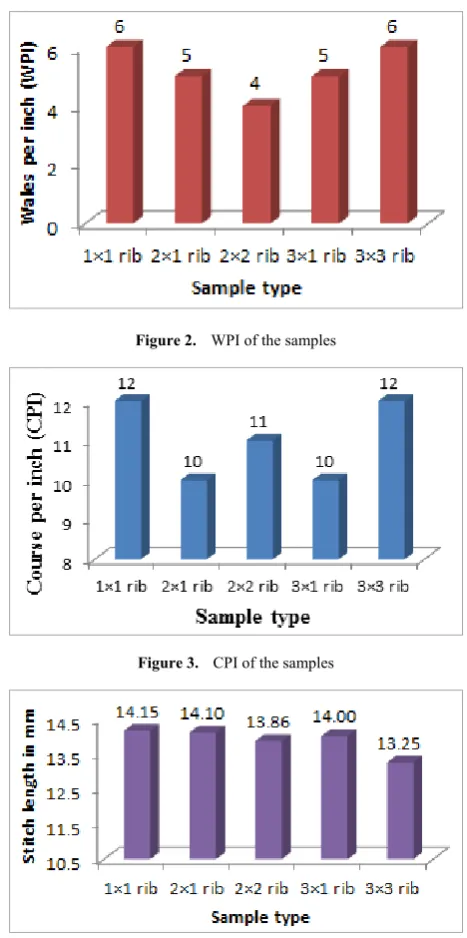
[image:2.595.303.537.75.545.2]The acrylic yarns were collected from local market of Dhaka, Bangladesh. Different rib structured fabrics like 1×1 rib, 2×1 rib, 2×2 rib, 3×1 rib and 3×3 rib were knitted with manual V-bed knitting machine using full needle bed length, 3.5 machine gauge and Single ended latch needle at fabric manufacturing and technology lab of Ahsanullah University of Science and Technology, Dhaka, Bangladesh. The wales per inch (WPI), course per inch (CPI) and stitch length of the samples are mentioned in the figures 2, 3 and 4 respectively.
Figure 2. WPI of the samples
Figure 3. CPI of the samples
Figure 4. Stitch length of the samples
2.2. Methods
2.2.1. Sampling
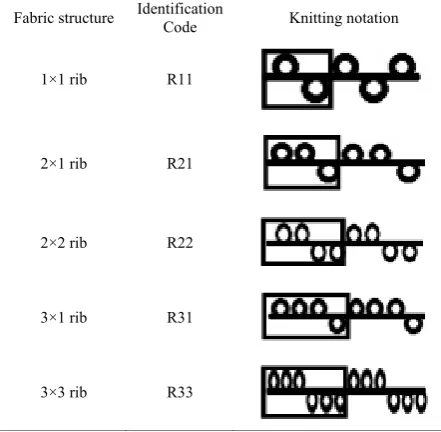
The samples are categorized as accordingly as stated table 1.
2.2.2. Sample Testing
[image:2.595.60.285.294.481.2]2.2.3. Measurement of WPI, CPI & Stitch Length
[image:3.595.60.281.171.387.2]The wales per inch (WPI) and course per inch (CPI) were measured by counting glass [40]. Stitch length was determined by HATRA Course Length Tester (SDL International Ltd., England).
Table 1. Fabric structures, identification code and knitting notation
Fabric structure Identification Code Knitting notation
1×1 rib R11
2×1 rib R21
2×2 rib R22
3×1 rib R31
3×3 rib R33
2.2.4. Measurement of Drape Co-efficient
The appropriate diameter of the template and corresponding size of paper ring was 30 cm. Firstly, the test sample was calendared and conditioned in standard atmosphere. The selected template (30 cm) was placed on the specimen and marked round it. Then a pin was pushed through the template center in order to make a small hole in the middle of specimen. After cutting the specimen it was placed on the disc (18 cm) of Cusick drape tester and the lid was covered. A paper ring was placed on the lid around the locating disc. After that the light of the drape tester was switched on. A shadow of the specimen was found on the paper. Then the shadow was drawn on the paper. Drape co-efficient of fabrics were calculated using the following formula (i) [22, 24].
DC = WS−Wd
WD−Wd×100% (1) Where,
DC= Drape Co-efficient.
WD= Weight of the paper whose area is equal to the area
of the specimen.
Wd= Weight of the paper whose area is equal to the area
of the supporting disc.
Ws= Weight of the paper whose area is equal to the
projected area of the specimen.
2.2.5. Determination of Bending Length
Fabric bending length for each direction (course and wale directions) was measured five times using the
cantilever method. Fabric bending length (c), a measure of the interaction between the fabric bending rigidity and weight, is defined as following formula (ii) [6, 28].
c= lf1(θ) (2)
Where, f1(θ) =
3 1
tan
8
2
1
cos
θ
θ
l= Cantilever length
θ
= Deflection angle2.2.6. Determination of Flexural Rigidity
Flexural rigidity (G) is identified as the force couple required to bend a non-rigid structure to a unit curvature. This is a measure of stiffness associated with handle. Any formula from (iii) and (iv) can be used to measure the fabric flexural rigidity.
G = 3.39 w1c3 mg.cm (3)
or G = w2c3 × 103 mg.cm (4)
Where, c = Bending length
w1 = Cloth weight in ounces per square yard
w2 = Cloth weight in gram per square centimeter
2.2.7. Determination of Tightness Factor
The tightness factor is the measurement of level of fabric density [36, 37]. The tightness factor was calculated by using formula (v).
T. F =√TL (5) Where, T.F = Tightness Factor
T = The linear density of yarn in Tex L = Stitch length or loop length in cm
3. Results and Discussion
3.1. Drape of Co-efficient
Figure 5. Effect of fabric structure on drape co-efficient
3.2. Bending Length
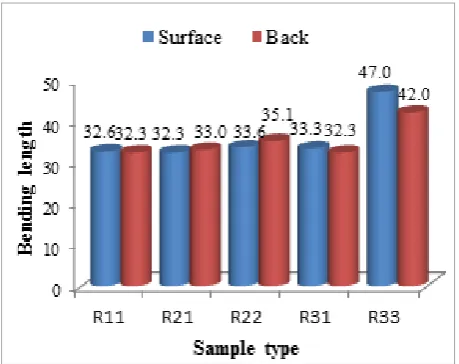
[image:4.595.60.289.80.200.2]The figures 6 and 7 demonstrate the effect of fabric structures on bending length of rib fabric. The figure 6 is responsible for bending length in wale direction and the figure 7 is responsible for bending length in course direction. The bending length in both sides (surface and back) of the fabric has calculated for both directions (wale and course) of the fabric. In wale direction, the highest bending length was recorded in surface side of 3×3 rib and lowest value was observed in back side of 3×1 rib. In the other hand, in course direction, the highest bending length was recorded in surface side of 3×3 rib and lowest value was observed in same side of 1×1 rib. It is also clearly evident from the figure 6, the bending length of back side showed lower than surface side except 2×1 and 2×2 rib and from the figure 7, the bending length of back side explained higher than surface side except 3×1 and 3×3 rib.
Figure 6. Effect of fabric structure on bending length in wale direction
Figure 7. Effect of fabric structure on bending length in course direction
3.3. Flexural Rigidity
[image:4.595.60.290.449.631.2]The figures 8 and 9 reveal the effect of fabric structures on flexural rigidity of tested specimen. The flexural rigidity in wale and course direction were measured and plotted in the figures 8 and 9. It is clearly evident from the figures 8 and 9 that the flexural rigidity in wale direction is higher than the flexural rigidity in course direction. The flexural rigidity among different structures, it is seen that 1×1 rib possesses the lowest value and 3×3 rib possesses the highest value both in wale and course direction. Regarding flexural rigidity in wale direction, the orders of the samples were found as R11> R21> R31> R22> R33. The flexural rigidity were 34.29%, 64.93%, 48.41% and 405.39% higher for the samples R21, R22, R31 and R33 respectively compared to the sample R11 in wale direction. Concerning flexural rigidity in course direction, the orders of the samples were found as R11> R21> R31> R22> R33 as like as wale direction. The flexural rigidity were 64.49%, 107.51%, 96.83% and 365.94% higher for the samples R21, R22, R31 and R33 respectively compared to the sample R11 in course direction.
[image:4.595.306.536.532.668.2]Figure 9. Effect of fabric structure on flexural rigidity in course direction
3.4. Tightness Factor
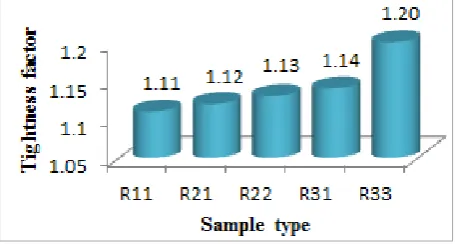
[image:5.595.59.289.79.232.2]The outcomes of tightness factor of different structures of rib fabric are shown in the figure 10. The orders of the samples were found as R11> R21> R22> R31> R33 depending on the value of tightness factor. The lowest value was identified for 1×1 rib and highest value for 3×3 rib. The tightness factor were 0.90%, 1.80%, 2.70% and 8.11% higher for the samples R21, R22, R31 and R33 respectively compared to the sample R11.
Figure 10. Effect of fabric structure on tightness factor
4. Conclusions
It has been established that properties of the knitted fabrics are related to the knitting structure. The effect of 1×1, 2×1, 2×2, 3×1 and 3×3 knit structure on different properties viz. drape co-efficient, bending length, flexural rigidity and tightness factor of rib knitted fabric has carried out in this work. The results disclosed that the fabric properties greatly influenced by knit structures. 1×1 rib knit structured fabric showed the lowest value for all tested properties and 3×3 rib knit structured fabric showed the highest value except drape co-efficient. 2×2 rib knit fabric possessed the highest drape co-efficient percentage. The bending length and flexural rigidity was investigated in both wale and course direction. At the same time, surface and back sides bending length were also calculated. From
the above mentioned data it has been identified that the effect of knit structure on flexural rigidity in both wale and course direction were influenced in a same chronological way (1×1 <2×1 <3×1 <2×2 <3×3). The tightness factor was observed as orderly as 1×1< 2×1 <2×2 <3×1 <3×3. The effects of other knit structures on the all other features of fabrics will be evaluated in further works. The variety of knitted fabrics with natural and synthetic fibre and/or blend of natural and synthetic fibre will also be used in future for characterizing the effects of knit structures.
Author Contributions
The objectives and methodology of this works were proposed by Md. Reazuddin Reponand Md. Nura Alam Shiddique. The specimen fabrication, characterization and data treatment also carried out by Md. Reazuddin Repon and Md. Nura Alam Shiddique. The article was written by Md. Reazuddin Reponand revised by all authors.
Funding
This research received no specific grant from any funding agency in the public, commercial, or not-for-profit sectors.
Acknowledgments
The authors would like to thank the authority of Textile Engineering Department of Ahsanullah University of Science and Technology, Dhaka, Bangladesh for providing the tools and characterization supports for carrying out the experiments.
Conflicts of Interest
The authors declare no conflict of interest.
REFERENCES
Spencer, D. J. “Knitting Technology: A comprehensive [1]
handbook and practical guide”, 3rd Edition, Woodhead Publishing, 2001.
Anbumani, N. “Knitting Fundamentals, Machines, [2]
Structures and Developments” New Age International, 2007.
Ray, S. C. “Fundamentals and advances in knitting [3]
technology”, WPI Publishing, 2012.
Jamshaid H. “Spirality in Knitted Fabric”, Journal of Textile [4]
[image:5.595.61.289.400.522.2]Das, S., Hossain, M., Rony, M.S.H., Hashan, M.M., Haque, [5]
A.U. and Majumder, M., “Analyzing Technical Relationships among GSM, Count and Stitch Length of (1x1) Rib and (1x1) Grey Interlock Fabric”, International Journal of Textile Science, Vol.6, No.2, pp.64-71, 2017. Oinuma, R., “Effect of stitch length on some properties of [6]
cotton 1× 1 rib knitted fabrics”, Journal of the Textile Machinery Society of Japan, Vol. 36, No.3, pp.91-95, 1990. Chen, P.L., Barker, R.L., Smith, G.W. and Scruggs, B., [7]
“Handle of weft knit fabrics”, Textile Research Journal, Vol.62, No.4, pp.200-211, 1992.
Eckert, C. and Stacey, M., “Sources of inspiration in [8]
industrial practice: The case of knitwear design”, Journal of Design Research, Vol. 3, No. 1, pp. 1-30, 2003.
Emirhanova, N. and Kavusturan, Y., “Effects of knit [9]
structure on the dimensional and physical properties of winter outerwear knitted fabrics”, Fibres & Textiles in Eastern Europe, Vol. 16, No.2(67), pp. 69-74, 2008. Kabir, S.M.M. and Zakaria, M., “Effect of Machine [10]
Parameters on Knit Fabric Specifications”, DUET Journal, Vol. 1, No.3, pp.12-16, 2012.
Repon M.R., Shiddique M.N.A., Paul D., Al Mamun R., [11]
Shahria S., Quayum M. “Effect of Yarn Count & Stitch Length on the Fabric Width, GSM, WPI and CPI of 1× 1 Rib Fabrics”, International Journal of Textile Science, Vol.7, No. 4, pp. 94-100, 2018.
[Kenkare, N. and May-Plumlee, T., “Evaluation of drape [12]
characteristics in fabrics”, International Journal of Clothing Science and Technology, Vol.17, No. 2, pp.109-123, 2005. Test method for nonwovens. “Determination of drape ability [13]
including drape coefficient” London: BSL, (2008). Sanad, R. and Cassidy, T., “Investigating garment drape [14]
behavior”, Journal of Fiber Bioengineering and Informatics, Vol.8, No.1, pp.47-56, 2015.
Itagi, A.A. and Basu, A., “Drape Behaviour of Silk Apparel [15]
Fabrics with Radial Seams”, International Journal of Engineering Research and Technology, Vol. 1, No. 8, pp. 1-11, 2012.
Behera, B.K. and Pattanayak, A.K., “Measurement and [16]
modeling of drape using digital image processing”, Indian Journal of Fiber & Textile Research, Vol.33, pp.230-238, 2008.
Behera, B.K. and Mishra, R. “Effect of Crease Behavior, [17]
Drape and Formability on Appearance of Light weight Worsted Suiting Fabrics”, Indian Journal of Fibre & Textile Research, Vol. 32, pp. 319-325, 2007.
Pattanayak, A.K., Luximon, A. and Khandual, A., [18]
“Prediction of drape profile of cotton woven fabrics using artificial neural network and multiple regression method”, Textile Research Journal, Vol. 81, No.6, pp.559-566, 2011. Masteikaite, V., Sacevičienė, V., Janulevičienė, D., [19]
Igembajeva, G. and Nurjasarova, M., “Drape analysis of fabrics used for outerwear”, Indian Journal of Fibre & Textile Research, Vol.39, No.4, pp.373-379, 2014. Emdadul Haque, Md Shamim Alam. “Effect of Stitch [20]
Lengths and Yarn Counts on Areal Density and Drape
Behaviour of Different Weft Knitted Single Jersey Structures” American Journal of Applied Scientific Research. Vol. 2, No. 6, pp. 33-37, 2016,
Ragab A, Fouda A, El-Deeb H and Hemdan AT, “A Simple [21]
Method for Measuring Fabric Drape Using Digital Image Processing”, Journal of Textile Science and Engineering, Vol.7, No.5, pp. 1-8, 2017.
Abdin, Y., Taha, I., El-Sabbagh, A. and Ebeid, S., [22]
“Description of draping behaviour of woven fabrics over single curvatures by image processing and simulation techniques”, Composites Part B: Engineering, Vol.45, No.1, pp.792-799, 2013.
Eryuruk, S.H. and Kalaoglu, F., “Analysis of the [23]
performance properties of knitted fabrics containing elastane”, International Journal of Clothing Science and Technology, Vol. 28, No. 4, pp.463-479, 2016.
Gaucher, M.L., King, M.W. and Johnston, B., “Predicting [24]
the drape coefficient of knitted fabrics”, Textile Research Journal, Vol. 53, No.5, pp.297-303, 1983.
Yücel, Ö., “Effect of seamed viscose fabrics on drape [25]
coefficient”, Tekstil, Vol.61, pp.101-106, 2012.
Kenkare, N. and May-Plumlee, T., “Fabric drape [26]
measurement: A modified method using digital image processing”, Journal of Textile and Apparel, Technology and Management, Vol.4, No.3, pp.1-8, 2005.
Goetzendorf-Grabowska, B., Karaszewska, A., Vlasenko, [27]
V.I. and Arabuli, A.T., “Bending stiffness of knitted fabrics–comparison of test methods”, Fibres & Textiles in Eastern Europe, Vol. 22, No. 1(103), pp. 43-50, 2014. Ghosh, T.K. and Zhou, N., “Characterization of fabric [28]
bending behavior: A review of measurement principles”, Indian Journal Fibre and Research, Vol. 28, pp. 471-476, 2003.
Mihailovic, T., Asanovic, K. and Mihajlidi, T., “Complex [29]
estimation of woven fabrics bending ability”, Indian Journal of Fibre & Textile Research, Vol. 32, pp. 453-458, 2007. Kim, K., Inui, S. and Takatera, M., “Prediction of bending [30]
rigidity for laminated weft knitted fabric with adhesive interlining”, Textile Research Journal, Vol.83, No.9, pp.937-946, 2013.
Jakubczyk, J., “Evaluating the bending rigidity of flat [31]
textiles with the use of an Instron tensile tester”, Fibres & Textiles in Eastern Europe, Vol.13, No.2 (50), pp. 31-34, 2005.
Tohidi, S.D., Jeddi, A.A. and Nosrati, H., “Analyzing of the [32]
woven fabric geometry on the bending rigidity properties”, International Journal of Textile Science, Vol.2, No.4, pp.73-80, 2013.
https://www.slideshare.net/KentishChintaram/2-the-effectso [33]
f-tightness-factor-on-spirality-and-seams-displacement-of-t ubular-sj-fabrics; accessed on 28 January 2019.
https://nptel.ac.in/courses/116102008/16; accessed on 28 [34]
January 2019.
Azim, A.Y.M.A., Islam, M.A., Morshed, M., Sarker, A.Y., [35]
Vol.10, No.36, 211-220, 2014.
Sitotaw, D.B. and Subramanian, K.S., “Study Effect of [36]
Twist Multipliers on Loop Length, Loop Shape, and Tightness Factors of Single Jersey and Rib Knitted Fabrics”, Advances in Materials Science and Engineering, Article ID 5628387, pp. 1-7, 2016.
elzaher Eltahan, E.A., Sultan, M. and Mito, A.B., [37]
“Determination of loop length, tightness factor and porosity of single jersey knitted fabric”, Alexandria Engineering Journal, Vol. 55, No.2, pp.851-856, 2016.
Shiddique, N.A., Repon, R., Al Mamun, R., Paul, D., Akte,r [38]
N., Shahria, S. and Islam, S. “Evaluation of Impact of Yarn Count and Stitch Length on Pilling, Abrasion, Shrinkage and Tightness Factor of 1 × 1 Rib Cotton Knitted Fabrics”, Journal of Textile Science and Engineering, Vol. 8, No. 5, pp. 1-6, 2018.
ISO 139:2005; Textiles – Standard Atmospheres for [39]
Conditioning and Testing.
IS 1963: 1982, Methods for determination of threads per unit [40]