Journal of Chemical and Pharmaceutical Research, 2016, 8(12):131-135
Research Article
CODEN(USA) : JCPRC5
ISSN : 0975-7384
131
Development of Colorimetric Method for Determination of Gabapentin
Using Ascorbic Acid as Chromogen
Adam ME, Shantier SW
*, Reem S, Mohamed MA and Gadkariem EA
Department of Pharmaceutical Chemistry, Faculty of Pharmacy, University of Khartoum, Sudan _______________________________________________________________________________________
ABSTRACT
A simple and accurate colorimetric method was developed for the quantification of Gabapentin (GP) in bulk and pharmaceutical formulations. The method was based on the coupling of GP with ascorbic acid to give a colored product having analytically useful maxima at 390 and 531 nm. Factors affecting the color development and stability were optimized and incorporated in the procedure. Regression analysis of Beer's plot showed good correlation (not less than 0.999) in a concentration range of 12-60 μg/mL. The detection and quantification limits were 0.73µg/ml and 1.69µg/ml, 2.43µg/ml and 5.65µg/ml at 390nm & 531nm, respectively. The average recovery for the commercial preparation (Gabapentin 400mg capsule) was 100.06 ±1.02% and 102.83±5.49%; n=3 at 390nm and 531nm, which reflected no interference by the capsules additives. Based on the molar ratio, the reaction stoichiometry was found to be 1:1.
Keywords: Gabapentin; Colorimetric method; Ascorbic acid
_______________________________________________________________________________________
INTRODUCTION
[image:1.595.217.380.540.619.2]Gabapentin (Figure 1) is a gamma amino butyric acid analogue drug. It is freely soluble in water and both basic and acidic aqueous solution. It was originally developed to treat epilepsy and currently is also used to relieve neuropathic pain [1]. The mechanism by which gabapentin exerts its analgesic action is unknown, but in animal models of analgesia, gabapentin prevent allodynia (pain-related behavior in response to a normally innocuous stimulus) and hyperalgesia (exaggerated response to painful stimuli). Also, it decreases pain related responses after peripheral inflammation [2].
Figure 1: Chemical structure of gabapentin
Literature review revealed different methods for the determination of gabapentin in bulk and pharmaceutical dosage forms. These methods include mainly spectrophotometric [3-6] and chromatographic methods [7-10]. The present work aims to develop simple, accurate and precise colorimetric method for the determination of gabapentin in bulk and pharmaceutical dosage form using ascorbic acid.
EXPERIMENTAL SECTION
Materials and instruments Preparation of stock solutions
132
Dimethyl Formamide (DMF), Merck K.G.A, Germany. Spectrophotometric studies were carried out on Shimadzu UV-1800ENG240V, Koyoto, Japan.
Standard stock solution
Stock solution was prepared by dissolving 0.03g gabapentin standard in 25ml distilled water to obtain (solution A; 1200μg/ml).
Stock solution of gabapentin capsules
An equivalent powdered sample to 0.03g of gabapentin was weighed and transferred into a volumetric flask. 5ml of distilled water was added and then the solution was shaken for 15minutes to ensure dissolution. The volume was completed to 25ml with the solvent (solution B; 1200μg/ml).
Ascorbic acid solution
0.02g of ascorbic acid was transferred into 10ml volumetric flask. 0.1ml of water plus 2ml DMSO were added and the solution was shaken for 5minutes. The volume was then completed to mark with DMSO (solution C; 0.2% w/v).
PROCEDURE
Optimization of reaction conditions Effect of ascorbic acid concentration
Into three stoppered glass tubes containing 0.1ml of solution A, 0.4ml of distilled water was added. 2ml of 0.1%, 0.2% or 0.3% w/v of freshly prepared ascorbic acid in DMSO were then added. 7.5ml of DMSO was added to each tube and the solutions were then heated in a boiling water bath for 30minutes. After cooling, the absorbance values were measured against blank reagent at 390nm and 531nm.
Effect of heating time
Into four stoppered glass tubes, 0.3ml of solution A was transferred. 0.2ml of distilled water followed by 2ml of solution C and 7.5ml of DMSO were added to each tube. The solutions were heated in a boiling water bath for different heating times (10-40 minutes). After cooling, the absorbance values were measured to determine the optimum heating time.
Linearity
Serial aliquots from solution A (0.1- 0.5ml) were transferred into five stoppered glass tubes. The volumes were adjusted to 0.5ml by addition of distilled water. 2ml of solution C followed by 7.5ml of DMSO were added to each tube. The solutions were heated for 30 minutes in a boiling water bath. After cooling, the absorbance was recorded at 390nm and 531nm.
Linearity was determined from the plotted calibration graph of absorbance values vs concentrations.
The capsule content was determined by treating solution B as under linearity and/or by direct sample/standard comparison.
Added recovery
Recovery studies were conducted to assess the accuracy of the developed method. The recovery percentage was calculated using the following formula [11]:
Percent Recovery = [(Amix–Asam)/Astd] × 100
Where Amix is the absorbance of mixture; Asam is the absorbance of sample; Astd is the absorbance of the
standard.
Molar ratio method for determination of the stoichiometry
Serial volumes (0.1 ˗ 0.5ml) of gabapentin standard solution (3x10⁻² M) were transferred into eight stoppered glass tubes. 0.40, 0.35, 0.30, 0.25, 0.20, 0.15, 0.10 and 0.0 ml of distilled water were then added, respectively. 0.3ml of freshly prepared ascorbic acid solution (3x10⁻² M) was added to each tube. The volumes were completed to 10ml with DMSO, heated for 30minutes and the absorbance values were then measured at 390nm and 531nm against blank.
133
RESULTS AND DISCUSSION
[image:3.595.208.424.153.288.2]Gabapentin exhibits weak UV absorption therefore, a suitable chromogen is needed to react with gabapentin to obtain a more UV light absorbing chromophore that can be useful for a sensitive spectrophotometric determination. Ascorbic acid reacts with gabapentin to give a purple colored product absorbing at 390 nm and 531nm (Figure 2).
Figure 2: UV/VIS spectrum of the colored product (48μg/ml)
Optimization of reaction conditions
The different experimental factors affecting the color development, intensity and stability were studied. These factors include solvent, the reagent concentration, reaction time and temperature.
Heating was found necessary for oxidation of ascorbic acid and then formation of a colored complex. Maximum colored product was developed after 40minutes; however more consistent results were obtained when heated for 30minutes in a boiling water bath which is selected as a fixed time of heating.
For faster and intense color development, DMSO was used as solvent. As reported by Pesez and Bartos [12], the sample should contain no more than 1% water in the final volume for high sensitivity and color stability. The suitable volume and concentration of ascorbic acid was found to be 2mL of 0.2%w/v which gave the highest intensity and stability of colored product.
Method validation
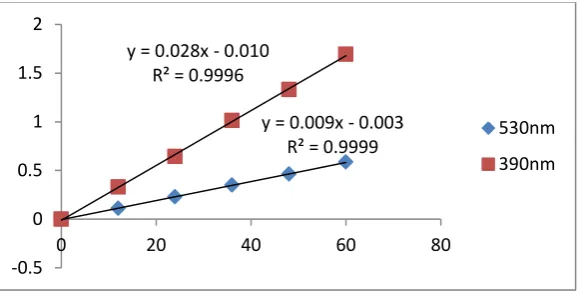
Linearity: Under the optimum conditions, Beer’s law was found to be valid over the concentration range
12-60µg/ml. The corresponding calibration equations are: A= ˗ 0.0219+0.0284C and A= ˗ 0.008+0.0098C at 390nm and 531nm, respectively with correlation coefficient not less than 0.9996 (Figure 3).
Figure 3: Calibration graph of gabapentin-ascorbic acid complex at 390nm & 531nm
The obtained results from regression equation indicate good linearity of the developed method. The linearity data was calculated at 95% confidence limit and summarized in Table 1.
y = 0.009x - 0.003 R² = 0.9999 y = 0.028x - 0.010
R² = 0.9996
-0.5 0 0.5 1 1.5 2
0 20 40 60 80
530nm
[image:3.595.153.444.519.667.2]134
Table 1: Linearity data of the developed method
Parameter Wave length
390nm 531nm
Slope ± tsb 2.8x10⁻²±1.34x10⁻³ 9.8x10⁻³±2.0x10⁻⁴
Intercept ± tsa 2.2x10⁻²±5.3x10⁻² 8.0x10⁻³±7.9x10⁻³
Correlation coefficient 0.9996 0.9999
Range 12-60 μg/ml 12-60 μg/ml
LOD 1.69μg/ml 0.73 μg/ml
LOQ 5.65 μg/ml 2.43 μg/ml
Assay
The developed method was successfully applied for analysis of drug sample (Gabapentin capsules). The results were found to be 101.20±2.86% and 102.00±1.73%; n=4 at 390nm and 531 nm, respectively.
Accuracy and precision
To assess the accuracy of the proposed method, an amount of reference gabapentin (24µg/ml) was added to gabapentin capsule (24µg/ml) and subsequently analyzed by the proposed method. The mean percentages of added recovery were 100.06±1.02% and 102.83±5.49%; n=3 at 390nm and 531nm, respectively. These results reflect the accuracy of the method and freedom from interference by the excipients.
Different concentrations within the linearity range were used to evaluate the within-day and between-days precision. RSD% values were found less than 2%, which indicates that the developed method is precise.
Proposed pathway for the reaction
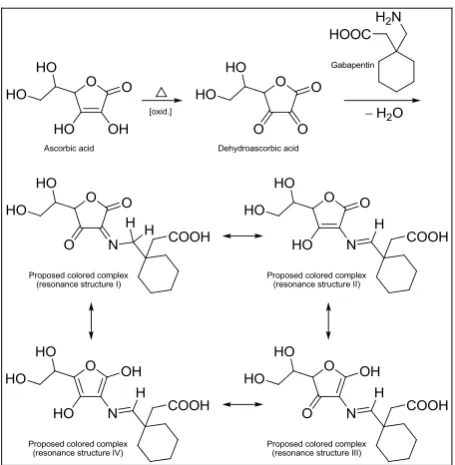
Based on the resultant 1:1 molar ratio for the coupling of GP and ascorbic acid, the course of the reaction was anticipated to proceed through 1,2-nucleaophilic addition followed by a series of tautomerization. Being a furan derivative, tautomer IV appears to be the most stable compared to others and hence responsible for the maximum absorption at at 390nm and 531 nm (Scheme 1).
Scheme 1: Proposed reaction pathway between ascorbic acid and GP
CONCLUSION
The developed method was proved to be simple, accurate and precise. Ascorbic acid was found to be a suitable reagent for the determination of gabapentin in pure form and its formulations without interference from excipients.
ACKNOWLEDGEMENT
135
REFERENCES
1] SS Vedula; RW Berol; K Dickersin. The New England J Med. 2009, 361(20),1963-1971. [2] RS Gujral; SM Haque; SH Perm. J Pharma Sci Tech. 2010, 2 (5), 222.
[3] S Dinda; RB Desireddy; P Jitendarkumar; P Narisireddy; K Srimannarayana; G Balaji. Int J Chem Pharm.
2012, 3(4).
[4] TA Vermeji; PM Edelbroek. J Chroma B, Biomed Appl. 2004, 810,297-303. [5] Z Zhu; L Neirinck. J Chroma B, Biomed Appl. 2004, 779(2), 307-312.
[6] NVS Ramkrishna; KN Vishwottam; M Koteshwara; Manoj; M Santosh; J Chidambara; B Sumatha. J Chroma B, Biomed Anal. 2002, 27, 253-260.
[7] EA Gadkariem; M Mutasim; KE Ibrahim; HA El-Obeid. J Biomed Sci. 2009, 5, 267-274. [8] SW Shantier; EA Gadkariem; KE Ibrahim. Int J Dru Form Res. 2012, 2(4), 260-272.
[9] FS El-Shafie; EA GadKariem; KA Al-Rashood; HA Al-Khamees; HA El-Obeid. Anal Lett. 1996, 29(3), 381-393.
[10] HA El-Obeid; EA Gad-Kariem; KA Alrashood; HA Al-Khamees; GAM Bawazeer. Anal Lett. 1999, 32, 2809-2823.
[11] SW Shantier; EA Gadkariem; KE Ibrahim. E-J Chem. 2011, 8 (3), 1314-22.