D e ci sio n s u p p o r t m e t h o d s i n
d i a b e ti c p a ti e n t m a n a g e m e n t b y
i n s uli n a d m i ni s t r a ti o n n e u r a l
n e t w o r k v s. i n d u c ti o n m e t h o d s
fo r k n o wl e d g e cl a s sific a tio n
Am b r o si a d o u , B, Vad e r a , S, S h a n k a r a r a m a n , V a n d G o uli s, D
T i t l e
D e ci sio n s u p p o r t m e t h o d s i n d i a b e ti c p a ti e n t m a n a g e m e n t
b y in s u li n a d m i ni s t r a tio n n e u r a l n e t w o r k v s. in d u c tio n
m e t h o d s fo r k n o wl e d g e cl a s sific a tio n
A u t h o r s
Am b r o si a d o u , B, Vad e r a , S, S h a n k a r a r a m a n , V a n d G o ulis,
D
Typ e
C o nf e r e n c e o r Wo r k s h o p I t e m
U RL
T hi s v e r si o n is a v ail a bl e a t :
h t t p :// u sir. s alfo r d . a c . u k /i d/ e p ri n t/ 9 4 0 3 /
P u b l i s h e d D a t e
2 0 0 0
U S IR is a d i gi t al c oll e c ti o n of t h e r e s e a r c h o u t p u t of t h e U n iv e r si ty of S alfo r d .
W h e r e c o p y ri g h t p e r m i t s , f ull t e x t m a t e r i al h el d i n t h e r e p o si t o r y is m a d e
f r e ely a v ail a bl e o nli n e a n d c a n b e r e a d , d o w nl o a d e d a n d c o pi e d fo r n o
n-c o m m e r n-ci al p r iv a t e s t u d y o r r e s e a r n-c h p u r p o s e s . Pl e a s e n-c h e n-c k t h e m a n u s n-c ri p t
fo r a n y f u r t h e r c o p y ri g h t r e s t r i c ti o n s .
From: B.V. Ambrosiadou, S. Vadera, V. Shankararaman, D. Goulis, and G. Gogou, Decision Support Methods in Diabetic Patient Management by Insulin Administration. Neural Networks vs Induction Methods for Knowledge Classification Proc. 2nd ICSC Symposium
on Neural Computation, Berlin, (2000).
Decision Support Methods in Diabetic Patient Management by Insulin
Administration
Neural Network vs. Induction Methods for Knowledge Classification
B.V.Ambrosiadou
1, S. Vadera
2, V.
Shankararaman
1, D. Goulis
3,
41
Department of Computer Science, University
of Hertfordshire, England
2
Department of Computer Science, University
of Salford, England
3
Clinical Research Fellow in Endocrinology
& Diabetes, Imperial College School of
Medicine, St. Mary's Hospital, London, UK
4Medical Informatics Laboratory, Aristotelion
University of Thessaloniki
Abstract
Diabetes mellitus is now recognised as a major world-wide public health problem. At present, about 100 million people are registered as diabetic patients. Many clinical, social and economic problems occur as a consequence of insulin-dependent diabetes. Treatment attempts to prevent or delay complications by applying ‘optimal’ glycaemic control. Therefore, there is a continuous need for effective monitoring of the patient. Given the popularity of decision tree learning algorithms as well as neural networks for knowledge classification which is further used for decision support, this paper examines their relative merits by applying one algorithm from each family on a medical problem; that of recommending a particular diabetes regime. For the purposes of this study, OC1 a descendant of Quinlan’s ID3 algorithm was chosen as decision tree learning algorithm and a generating shrinking algorithm for learning arbitrary classifications as a neural network algorithm. These systems were trained on 646 cases derived from two countries in Europe and were tested on 100 cases which were different from the original 646 cases.
1.0 Introduction
Diabetes is a chronic disease. The prevalence of diabetes mellitus is rising, especially in developing
countries as they adopt a Western lifestyle [1]. Long term complications involving the eyes, the kidneys, the central and peripheral nervous system may appear to those patients that do not achieve an ‘optimal’ glycaemic control. Diabetic patient management may be achieved by appropriate diet, exercise and insulin administration for glycaemic control of Type I or Type II insulin dependent diabetic patients. There is divergence of opinions regarding the issue of insulin administration among the experts, which mainly depends on ‘soft’ information such as their educational and social background as well as their experience and gut feel. An effort has been made to systematise the process of insulin administration by developing decision support tools, which facilitate a consistent and objective decision making among specialists [2,3]. The knowledge in this field has been mainly acquired from a number of sources across Europe in order to alleviate the differences due to lifestyles and diet habits. A DELPHI approach was followed in order to arrive at consensus opinion in those cases where there was divergence [4]. In this paper two methods are compared for knowledge classification in insulin administration which may later be used for decision support purposes. These are the decision tree learning and the neural network algorithmic approaches. The following sections describe the domain under consideration, the two methods as well as the results obtained.
1.1 The Domain: Insulin Regime
Prescription and Dose Adjustment
The most widely used insulin regimens are:
1. short-acting insulin mixed with intermediate-acting insulin, given twice daily before meals 2. short-acting insulin mixed with
intermediate-acting insulin, given before breakfast AND
short-acting insulin, given before evening meal AND intermediate-acting insulin, given at bedtime 3. short-acting insulin, given three times daily AND
intermediate-acting insulin, given at bedtime 4. intermediate-acting insulin, given once daily
Regimen No Pre-Breakfast Pre-Lunch Pre-Tea Pre-Bed
1 Medium acting - - -
2 Fast+Medium acting - Fast+Medium acting -
[image:3.595.49.500.273.486.2]3 Fast acting Fast acting Fast acting Medium acting 4 Fast acting Fast acting Fast acting Fast acting
Table 1. Most common regimens.
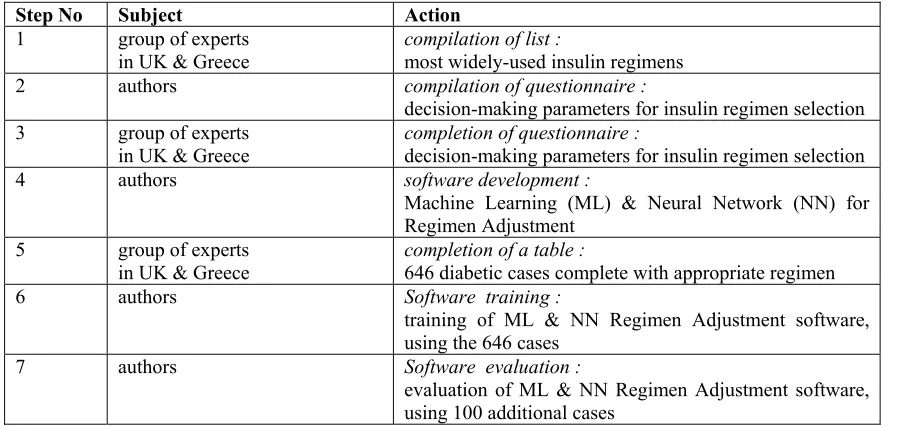
Step No Subject Action
1 group of experts
in UK & Greece compilation of list : most widely-used insulin regimens 2 authors compilation of questionnaire :
decision-making parameters for insulin regimen selection 3 group of experts
in UK & Greece
completion of questionnaire :
decision-making parameters for insulin regimen selection 4 authors software development :
Machine Learning (ML) & Neural Network (NN) for Regimen Adjustment
5 group of experts
in UK & Greece completion of a table : 646 diabetic cases complete with appropriate regimen 6 authors Software training :
training of ML & NN Regimen Adjustment software, using the 646 cases
7 authors Software evaluation :
evaluation of ML & NN Regimen Adjustment software, using 100 additional cases
Table 2. Study design. Generally, the regimens that contain long acting insulin
are not prescribed because they are considered outdated and they are used only out of necessity [6-8], especially in elderly patients. The intensive glucose control (regimen 3) gives the best results in terms of blood glucose control but, on the other hand, results in more hypoglycaemic episodes (low blood glucose) which is a, potentially, dangerous situation. The result of intensive glucose control is the most frequent appearance of hypoglycemia (low blood glucose) which is even more dangerous than hyperglycemia (high blood glucose values) [6], [7], [9].
Depending on special occasions other regimens can also be prescribed. These life circumstances include coexistence of another acute or chronic disease, short life expectancy, honeymoon period, psychosomatic problems due to injections, the environment and
inability of the patient to understand the demands of a particular regimen [6-8].
2.0 The Comparative Study – An
Overview
2.1 Study Design
The prototype systems described in this paper classify clinicians’ knowledge in the domain of insulin administration. In this way, they may further support decision making in this field. The whole study design is presented in Table 2.
2.2 System Knowledge
regimens was compiled by interviewing diabetes experts in the United Kingdom and Greece (Step 1). Subsequently, a questionnaire was prepared (Step 2) and was sent to three diabetic departments of UK and fourteen diabetological centres in Greece. The questionnaire was asking for the parameters that were necessary in order to decide for each specific insulin regimen (Step 3), among the ones that were proposed in Step 1.
The outcome of the above process was a choice of the main factors intuitively used by doctors for insulin regimen prescription. These are:
• Diabetes type (unknown, type I, type II)
• Patient age
• What the patient is used to taking (unknown, tablets, insulin)
• Special condition (pregnancy, surgery, infection)
• Dawn phenomenon (yes, no)
• Unstable ("brittle") diabetes (yes, no)
• Glucose profile (morning, afternoon, evening, night / unknown, normal, hyperglycemia, hypoglycemia)
• Physical activity (morning-noon, afternoon-evening, night / none-unknown, sedentary, light, heavy)
• Food intake (breakfast, lunch, tea, dinner)
• Desirable blood glucose control (fair, good, very good)
In the same way the main factors used by doctors for insulin dose adjustment are:
• Insulin regimen
• Current dose
• Glucose values
• Glucose profile (morning, afternoon, evening, night / unknown, normal, hyperglycemia, hypoglycemia).
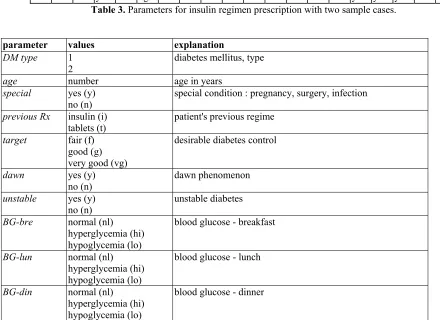
Cas e No
DM typ e
age spe cial Previo
us Rx
targ
et dawn unstabl e
BG-bre BG-lun BG-din BG-bedPA-morPA-aft PA-nig FI-breFI-lun FI-din FI-bedRegime n No
[image:4.595.54.494.423.743.2]1 1 n i vg n n n hi hi hi hi l - y y y y 4 2 1 40 y i vg n n hi nl nl nl s - - y y y n 4
Table 3. Parameters for insulin regimen prescription with two sample cases.
parameter values explanation
DM type 1
2 diabetes mellitus, type
age number age in years
special yes (y)
no (n)
special condition : pregnancy, surgery, infection
previous Rx insulin (i)
tablets (t) patient's previous regime
target fair (f)
good (g) very good (vg)
desirable diabetes control
dawn yes (y)
no (n)
dawn phenomenon
unstable yes (y)
no (n) unstable diabetes
BG-bre normal (nl)
hyperglycemia (hi) hypoglycemia (lo)
blood glucose - breakfast
BG-lun normal (nl)
hyperglycemia (hi) hypoglycemia (lo)
blood glucose - lunch
BG-din normal (nl)
hyperglycemia (hi) hypoglycemia (lo)
BG-bed normal (nl) hyperglycemia (hi) hypoglycemia (lo)
blood glucose - bed
PA-mor sedentary (s)
light (l) heavy (h)
physical activity - morning
PA-aft sedentary (s)
light (l) heavy (h)
physical activity - afternoon
PA-nig sedentary (s)
light (l) heavy (h)
physical activity - night
FI-bre yes (y)
no (n) food intake - breakfast
FI-lun yes (y)
no (n) food intake - lunch
FI-din yes (y)
no (n) food intake - dinner
FI-bed yes (y)
no (n)
food intake - bed
Legend for Table 3.
3.0 Methods
3.1 Machine Learning Algorithms
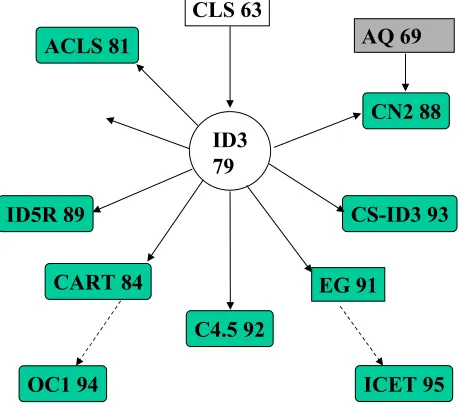
Since its initial development, the ID3 machine learning algorithm has provided the basis for several decision tree learning methods. Figure 1 shows some of the well known algorithms that have evolved to reduce deficiencies in ID3 and to tackle issues such as costs of carrying out tests.
CLS 63
ID3 79 ACLS 81
C4.5 92 ID5R 89
AQ 69
CART 84
CN2 88
OC1 94
CS-ID3 93
[image:5.595.58.288.492.694.2]ICET 95 EG 91
Figure 1: Some well known decision tree learning algorithms
These algorithms have been applied in various domains, and several experimental studies have evaluated their accuracy using benchmarking data From the set of available algorithms, Murthy’s OC1 [10] was chosen to represent the decision tree learning algorithms family, mainly because it constructs trees using a core algorithm that it inherits from ID3, and which is a characteristic of most decision tree learning algorithms. Section 3.1.1 gives an overview of the algorithm, and section 3.1.2 presents the results obtained.
3.1.1 Overview of the OC1 Algorithm
The main principle behind tree induction algorithms is to develop a tree that is consistent with the table of examples representing the training set. The core procedure to obtain such a tree can be summarised as follows:
If all the result values are the same, stop Otherwise
• Select the root from the available attributes
• Partition the table so that each sub-table's Root column has the same value.
• Apply the algorithm recursively to find a decision tree for each of the sub-tables, ignoring the Root attribute.
Numeric attributes are partitioned by considering all potentially useful axis parallel splits [12], or by adopting linear divisions [13]. The OC1 algorithm provides options for utilising a range of selection metrics, and allows the use of axis parallel splits, as well as a scheme for linear splits.
This type of process can produce deep trees that over trained, with terminal nodes based on only a few examples. There are various tree pruning methods that can be used to overcome this problem [14]. The central operation in post-pruning is to replace a subtree by a leaf node which takes the value of the majority class of the examples in the subtree provided it results in an improvement in accuracy.
OC1 adopts a techniques, known as the minimum cost-complexity pruning method [15]. This technique works in two stages. First it generates a series of pruned trees. This is done by considering the effect of replacing each subtree by a leaf and working out the reduction in error per leaf (α):
1
)
(
)
(
−
−
=
t t
N
T
R
t
R
α
where R(t)is the expected error rate if the subtree is pruned, R(Tt) is the expected error rate if the subtree is
not pruned, and Nt is the number of leaf nodes in the
subtree. The subtree with least value per leaf (smallest
α) is pruned by replacing the subtree by its majority
class, and the process repeated recursively to generate a series of increasingly pruned trees. Second, once a series of increasingly pruned trees have been generated, it uses an independent testing set to select a tree that is the most accurate (more precisely, it selects the smallest tree within one standard error of the most accurate tree)
3.1.2 Results
The OC1alogorithm was tested by applying it on the training dataset and testing it on the 100 additional cases. It was run with both an axis-parallel option set, when it is similar to C4.5, and with the use of linear divisions. The Information gain measure was used for the selection metric, and all other parameters were set to their default values (i.e., they were not tuned in any way).
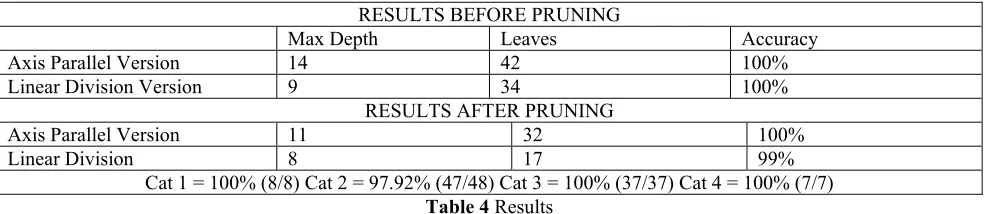
The following table summarises the results in terms of accuracy and size of trees for the different variations. In terms of comprehensibility, the simple splits adopted by utilising axis-parallel splits are easier to relate to the domain by an expert than the linear equations present when linear divisions are used. The use of linear divisions with pruning results in the smallest tree, although it is the only tree that is not 100% correct.
RESULTS BEFORE PRUNING
Max Depth Leaves Accuracy
Axis Parallel Version 14 42 100% Linear Division Version 9 34 100%
RESULTS AFTER PRUNING
Axis Parallel Version 11 32 100%
Linear Division 8 17 99%
[image:6.595.53.546.453.560.2]Cat 1 = 100% (8/8) Cat 2 = 97.92% (47/48) Cat 3 = 100% (37/37) Cat 4 = 100% (7/7)
Table 4 Results
3.2 Neural Network Algorithm
3.2.1. The Generating-Shrinking Algorithm
–System Architecture
The description here is based on [16. The algorithm uses a three layer feed-forward neural network. The first, input, layer (IL) contains linear neurons, the second, hidden, layer (HL) contains sigma-pi neurons, and the third, output, layer (OL) contains linear threshold neurons. The number of neurons in IL and HL equals the number of training patterns, and the number of neurons in OL equals the number of classes
(in our case insulin regimens) that the neural network has to distinguish.
The first layer has as input an n-dimensional pattern vector p
∈
Rn to be classified, along with a fixed reference number r∈
R. Together p and r they form an (n+1)-dimensional vector (p,r)∈
Rn+1. The neurons' outputs in the third layer are binary, so when the output of the ith neuron is 1, the input pattern belongs to theeach layer are described by the following three equations: Input Layer:
∑
+ =′
=
1 1 n j j IL ij ILi
w
p
o
,i
=
1
,
2
,...,n
IL (1)where
o
iIL is the output of the ith neuron in the input layer,w
ijIL is the weight of the connection between thejth input component and the ith neuron in the input layer,
n
IL is the number of neurons in the input layer and p'j is the jth component of p'.Hidden Layer:
(
)
∏
≠ =+
=
IL n i) (j j IL i HL ii IL j HL ij HLi
f
w
o
w
o
o
1
,
HL
,...,n
i
=
1
,
2
(2) where( )
0
0
0
1
≤
>
=
x
x
,
,
x
f
, HL io
is the output of the ith neuron in the hidden layer,HL ij
w
is the weight of the connection between the output of the jth neuron in the input layer and the ith neuron in the hidden layer andn
HL is the number of neurons in the hidden layer.Output Layer:
−
=
∑
= IL n j HL j OL ij OLi
f
w
o
.
o
1
5
0
,i
=
1
,
2
,
...,n
OL (3) whereo
iOL is the output of the ith neuron in the output layer,w
ijOL is the weight of the connection between the output of the jth neuron in the hidden layer and theith neuron in the output layer and
n
OL is the number of neurons in the output layer.3.2.4. Neural Network Results
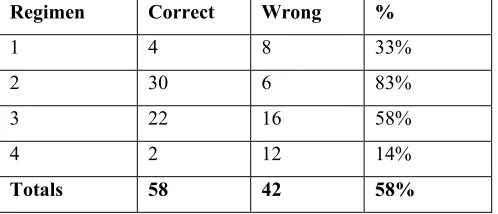
At first the Neural Network was not trained at all. The 646 cases were entered one by one as an input to the NN. If the Neural Network's output was the same answer as the expert's decision the next case was entered in the NN. If not, the case was used as a new training pattern for the NN before we go on to the next one. In this way the Neural Network had a little more "experience" before the processing of the next case. In this way after the 1st pass of the 646 cases, the correct answers were 452 and the Neural Network had 194 training patterns (the wrong answers). The above process was repeated with the cases that were correctly answered to check if the patters that were added would change the Neural Network's decision, until the Neural Network was able to give the correct answer for all cases.
1st pass 2nd pass 3rd pass 4th pass
Number of cases 646 452 412 409
Correct answers 452
(70,0 %) (91,1 %) 412 (99,2 %) 409 (100,0 %) 409
Wrong answers 194
(30,0 %) 40 (8,9 %) 3 (0,8 %) 0 (0,0 %)
[image:7.595.138.459.476.561.2]Training patterns 194 234 237 237
Table 5: Training results
Regimen Correct Wrong %
1 4 8 33%
2 30 6 83%
3 22 16 58%
4 2 12 14%
[image:7.595.175.424.595.702.2]5.
Conclusion
It was found that the decision tree learning algorithm out-performed the neural network in the evaluation phase. As a next step, the expert will comment on the outcome of the two algorithms, in order to determine why the neural network did not perform as expected.
Bibliography
1. Unger R, Foster D. (1992) Diabetes mellitus. In: Wilson J, Foster D (eds). Williams textbook of endocrinology, 8th ed. (Philadelphia, WB Saunders), 1255-1334.
2. Ambrosiadou V., Goulis D.G., Pappas C. (1996) "Clinical Evaluation of the DIABETES Expert System for Decision Support by Multiple Regimen Insulin Dose Adjustment". Computer Methods and Programs in Biomedicine, Vol. 49, 105-115. 3. Ambrosiadou V., Gogou G., Pappas C.,
Maglaveras N. (1996) "Decision Support for Insulin Regime Prescription Based on a Neural Network Approach". Journal of Medical
Informatics, Taylor & Francis, Vol. 21, No.1, 23-34.
4. Ambrosiadou V., Goulis D. (in press) "The DELPHI Method as a Consensus and Knowledge Acquisition Tool for the Evaluation of the DIABETES System for Insulin Administration". Journal of Medical Informatics.
5. Luger G.F., Stubblefield, W.A. (1998) Artificial Intelligence Structures and Strategies for Complex Problem Solving, Third Edition, Addison Wesley Longman.
6. Foster D.W. (1987) "Diabetes mellitus", in Harrison's Principles of Internal Medicine, 11th ed, Mc Graw-Hill, 1778-1797.
7. Garber A.J. (1994) "Diabetes mellitus", in Stein J.H. (editor), Internal Medicine, 4th ed, Mosby, 1391-1430.
8. Group of European Politics IDDM. (1993) "Instructions for the Treatment of Insulin-Dependent (type I) Diabetes- Consensus Guidelines ".
9. Miller AS, BH Blott, TK Hames (1992) "Review of neural network applications in medical imaging and signal processing", Med & Biol Eng & Comput, vol. 30, 449-464.
10. S. Murthy and S. Kasif and S. Salzberg (1994), A System for Induction of Oblique Decision Trees, Journal of Artificial Intelligence Research, 2, 1-32 11. Vadera, S. and Nechab, S. (1994), ID3, its
Children and their Safety }, BCS Specialist Group on Expert Systems Newsletter 31,11-21
12. Quinlan, J.R. (1992), C4.5 : A Program for Machine Learning, California:Morgan Kauffman 13. Vadera, S. and Nechab, S. (1996), Inducing Safer
Trees, Proceedings of the International Conference on Knowledge Based Computing Systems, Narosa Publishing, pp205-216.
14. Breslow, L.A. and Aha, D.W. (1997), Simplifying decision trees: A survey, Knowledge Engineering Review, 12,1-40.
15. L. Breiman, L. and Friedman, J.H. and Olsen, R.A. and Stone, C. J. (1984), Classification and
Regression Trees, Belmont: Wadsworth 16. Yan Qiu Chen, David W., Thomas, and Mark S.