Influence of Fertilizer, Aspect, and Harvest
Date on Chemical Constituents and In Vitro
Digestibility of Tall Fescue
G.E. PROBASCO AND A.J. BJUGSTAD
Abstract
The nutritional benefits of fertilization on Ozark forest range for the late spring and summer period are questionable. Fertilizer application did not enhance either protein or calcium content, but did increase phosphorus. Acid detergent fiber (ADF) increased on fertilized plots while in vitro dry matter digestibility (IVDMD) decreased. An interaction between harvest date and fertilizer treat- ment revealed higher IVDMD for fertilized plots in May, but the relation then reversed for the remainder of the study. Harvest date proved to be the most influential treatment in the study. The changes associated with harvest date reflect the normal phenologi- cal development of tall fescue. The forage becomes less nutritious and less digestible as it approaches maturity and dormancy in July and August. Aspect significantly influenced ADF content and IVDMD. ADF content was lower and IVDMD higher on south- facing slopes.
Fertilization of tall fescue (Festuca arundinacea Schreb.) on Ozark forest range increases production (Ehrenreich and Buttery 1960; Halls and Crawford 1963; and Crawford and Bjugstad 1967); but the influence on forage quality and digestibility is unknown. Pasture research on the same spe- cies or similar species in different areas has yielded consider- able information on these factors. For example, Blaser (1964) noted increased carrying capacity under fertilization; however, individual animal output generally did not improve. He concluded that fertilization caused no appreci- able difference in total digestible nutrients. Raymond (1969), in reviewing several papers on fertilizer and forage digestibility, drew a similar conclusion. Martz, et al. ( 1967), working on orchardgrass in central Missouri, found results comparable to those of Blaser and Raymond. Kaiser (197 l), during a 2-year study in southern Indiana, found no signifi- cant relationship between fertilizer application and in vitro dry matter digestibility in the first year of his study. During the second year, he found that fertilizer significantly increased IVDMD. Similar information is not available, but it is needed for large areas of the Ozarks in southern Mis- souri which are being converted to tall fescue grassland. This study was designed to measure the influence of fertilizer on the chemical constituents and digestibility of tall fescue. The effects of harvest date and aspect were also determined.
Methods
This study was conducted in the Ozark Plateau region of south-
Authors are, respectively, research wildlife biologist, North Central Forest Experi- ment Station, Forest Service, U.S. Department of Agriculture, Columbia, Missouri, and supervisory range scientist, Rocky Mountain Forest and Range Experiment Station, Forest Service, U.S. Department of Agriculture, Rapid City, South Dakota.
Manuscript received September 5, 1978.
244
ern Missouri. Over geologic time, the plateau has been eroded into numerous narrow winding valleys. Ridgetops range from 30 to 200 meters above valley bottoms. Soils are derived from dolomitic limestone and contain high percentages of cherty rock. Mineral nutrients and organic matter are low. Major soils are Clarksville (typic paleudult-loamy-skeletal, siliceous, mesic); Lebanon (typic fragiudalf-fine, mixed, mesic); and Nixa (glossic fragudults- loamy-skeletal, siliceous, mesic). The Ozarks receive about 90 to 100 cm annual precipitation, and have a growing season of approx- imately 180-200 days.
The dominant vegetation is oak-hickory forest. Shortleaf pine occurs in the eastern Ozarks in either pure stands or mixed with oak, while redcedar becomes an important associated species in the western Ozarks. Hardwood quality is much better in the eastern Ozarks than in the western Ozarks. The lower quality hardwoods in the western Ozarks are the focal point for grassland conversion; primarily to pure stands of tall fescue. Some conversion does occur throughout the rest of the area.
Paired 0.2-ha plots were used for this study. One plot in each pair was topdressed in March with 54 kg/ ha each of NPK granulated fertilizer, while the other plot in each pair received no fertilizer. Plots were located on upper north- and south-facing slopes. For- age samples were collected during the first week of each month from May through November.
Leaves and stems were clipped to a 5-cm stubble, oven-dried, and ground, using a 2-mm screen to provide samples for chemical analysis and in vitro digestibility trials. Chemical analysis by the Agriculture Experiment Station Chemical Laboratories, Univer- sity of Missouri, Columbia, Missouri, provided data on crude protein, calcium, phosphorus, and acid-detergent fiber. In vitro digestibility trials with cattle were determined by the Science and Education Administration, University of Missouri, using the two- stage technique of Tilley and Terry (1963).
The experimental design was a three-factor factorial with two levels of application for each nutrient (0 and 54 kg/ha N, P205, K20), two aspects (north and south), two plots on each aspect, and seven harvest dates (May, June, July, August, September, October, and November). Statements of significance are based on standard analysis of variance (P < .lO) with significant effects being further subjected to Duncan’s New Multiple Range Test (P< .lO).
Results
Crude Protein
Crude protein content was significantly related to harvest date. Crude protein contents decreased from 16.2% in May, a period of active spring growth, to only 8.1% in August, an inactive growth period (Table 1). By October growing con- ditions had improved and crude protein increased to 11 .a%. In November the plant material matured and crude protein content declined to 9.5%.
Table 1. Average protein, Ca, P, Ca:P, ADF, and IVDMD as affected by north-facing slopes than for south-facing slopes. The respec-
harvest date. tive values were 34.7 and 33.6 (Table 2).
In Vitro Dry Matter Digestibility
Item Harvest date IVDMD responded significantly to harvest date, fertilizer
measured Mav June July Aug. Sept. Oct. Nov. treatment, aspect, and interaction between harvest date and
Crude fertilizer treatment. IVDMD decreased from 68.2% in May
Protein % 16.2ar 10.4bc 9.lcd 8.ld 9.3cd 11.4b 9.5cd to 56.6% in September; then increased to 66.2% for the
Ca % .31d .37bc .43a .41ad .36c .35c .29d November regrowth (Table 1).
P% .29a .19cd .2lbcd .17d .26ab .23bc .25ab
Ca:P 1.13d 2.07bc 2.3 1 b 2.91a 1.53cd 1.68cd 1.28d The response of fertilizer treatment showed significantly ADF* % 30.7d 34.8bc 35.2bc 35.8b 37.5a 34.oc 3 1 .Od higher IVDMD values for unfertilized plots over the fertil- 1VDMD %68.2a 59.6~ 58.4cd 57.0d 56.6d 62.2b 66.6a ized plots. The respective IVDMD values were 62.7% and ‘Means with the same letter on the same line are not significantly different-Duncan’s 59.7% (Table 2).
Multiple Range Test (P < .lO). The harvest date-fertilizer treatment interaction occurred
2ADF q Acid-detergent fiber; IVDMD = In vitro dry matter digestibility. during the interval between May and June harvest dates. IVDMD values for fertilized and unfertilized plots were Crude protein content was also significantly related to 69.1% and 67.2a/o, respectively, in May; but the relation aspect, although the differences were small; crude protein changed to 58.5% and 60.8%, respectively, in June and content for north- and south-facing slopes was 10.2 and remained in that position throughout the rest of the growing
10.970, respectively (Table 2). season.
The response to aspect revealed significantly higher IVDMD values for south-facing slopes than for north- facing slopes. The IVDMD values were 61.8 and 60.6, respectively.
Calcium
Calcium content was significantly related to harvest date. Calcium content increased from .3 1% in May to .41?& in August, and decreased to .29% by November (Table 1).
Calcium increased as plant material matured, then
decreased as plants renewed growth in the fall. Discussion
Our results show that tall fescue grown on Ozark forest- range provides higher quality forage both early and late in the growing season, with a significant drop in quality during the summer when tall fescue is dormant or nearly so. Harv- est date proved to be the most influential variable in this study. Fertilizer treatment proved not to be the influential factor that we had anticipated it might be, or at least not in the manner that we had expected. Aspect is generally consi- dered important because of the rough Ozark topography; however, significant differences in crude protein, ADF, and IVDMD due to aspect are probably inconsequential from a
management standpoint and do not merit further
discussion. Phosphorus
Phosphorus content was significantly related to both harvest date and fertilizer treatment. Harvest date effects exhibited a variable trend, increasing one month and decreasing the next (Table 1). Fertilizer treatment increased phosphorus content. Phosphorus content values were. 18% on unfertilized plots and .28% on fertilized plots (Table 2). Calcium:phosphorus Ratio
The Ca:P ratio was also significantly related to both harvest date and fertilizer treatment. Harvest date effects show Ca:P increasing from 1.13 in May to 2.91 in August, then decreasing to 1.28 by November (Table 1). Fertilizer effects show the Ca:P decreasing in response to fertilizer application. The respective values were 2.33 for unfertilized plots and 1.35 for fertilized plots (Table 2).
Table 2. Protein, P, Ca:P, ADF*, and IVDMDl as affected by fertilizer treatment or aspect.
ltem measured
Fertilizer treatment
(kg/ ha) Aspect
0 55 North South
Crude protein % 10.5 10.6 NS’ 10.2 10.9
Ca % .37 .35 NS .36 .36 NS
Phosphorus % .18 .28 .23 .23 NS
Ca:P 2.33 1.35 1.9 1.8 NS
ADF % 33.7 34.6 34.7 33.6
1VDMD % 62.7 59.7 60.6 61.8
‘ADF q Acid-detergent fiber; IVDMD = In vitro dry matter digestibility; NS q Nonsignificant.
Acid-detergent Fiber
ADF was significantly related to harvest date, fertilizer treatment and aspect. ADF varied over the harvest period from 30.7 in May to 37.5% in September, and back to 31% by November (Table 1). Fertilizer treatment increased ADF from 33.7% on unfertilized plots to 34.6% on fertilized plots (Table 2). Aspect effects showed ADF to be higher for
The influence of harvest date is manifest through the normal seasonal growth cycle of cool-season grasses such as tall fescue. As the grass approaches maturity at the end of the spring growing season, quality drops considerably; how- ever, it will begin to improve once fall regrowth begins. It was anticipated that fertilizer might overcome some of this quality loss; however, this was not the case, and in some instances fertilizer apparently depressed the forage quality. Fertilizer may be important in keeping the Ca:P ratio within the optimum range of .5 to 2.0. While phosphorus content and Ca:P ratio responses were expected with phosphorus being added in the fertilizer, ADF and IVDMD responses were not.
It appears that the main response to fertilizer is increased fiber production. Although we realize that portions of ADF are digestible, this is usually not a large amount and we feel that the increase in ADF indicates lessened digestibility. Our IVDMD data lend support for this assumption, as it decreased on fertilized plots. What this means is that the increased production from fertilization must be weighed against the lowered digestibility when evaluating the bene- fits of fertilizer. If production increases are substantial enough to offset decreased digestibility so that there is actu- ally an increase in digestible forage, then fertilization may pay. The harvest date-fertilizer treatment interaction that
occurred in the IVDMD data suggests that the additional fiber is produced during the time toward the end of the spring growing period.
Literature Cited
Blaser, R.E. 1964. Symposium on forage utilization: Effects of fertility levels and stages of maturity on forage nutritive value. J. Anim. Sci. 23: 246-253.
Crawford, H.S., and A.J. Bjugstad. 1967. Establishing grass range in the southwest Missouri Ozarks. U.S. Dep. Agr., Forest Serv., Res. Note NC- 22, 4 p. North Cen. Forest Exp. Sta., Columbia, MO.
Ehrenrekh, J.H., and R.F. Buttery. 1960. Increasing forage on Qzark wooded ranges. U.S. Dep. Agr., Forest Serv., Tech. Pap. CS-177, 10 p., Cen. States Forest Exp. Sta.
Halls, L.K., and H.S. Crawford. 1963. Vegetation response to an Ozark woodland spraying. J. Range Manage., 18: 338-340.
Kaiser, C.J. 1971. Isolation of factors influencing the utilization of (Festuca arundinacea Schreb.) by ruminants during the grazing season. Ph.D.
Diss., Univ. Missouri, Columbia, 260 p.
Martz, F.A., J.R. Brown, B.K. Dar, and D.D. Pagitt. 1967. Effect of topdressed nitrogen and potassium in the feeding values of orchardgrass hay for lactating dairy cows. Agron. J., 59: 599-602.
Effects of Increased Rainfall on Native
Forage Production in Eastern Montana
JOHN J. NEWBAUER, III, LARRY M. WHITE, RICHARD M. MOY, AND DAVID A. PERRY
Abstract
Basal area data, collected from five sites in 1963 and 1976, were compared to determine the effects of 13 years of above-average rainfall in the growing season (April through September) on native range vegetation of the northern Great Plains. Changes in basal area, composition, and forage production were analyzed for five major grass and grass-like species. During the 13-year above- average rainfall period, western wheatgrass (Agropyron smithii),
needleandthread (Stipa comata), and prairie junegrass (Koeleria cristutu) established or increased on all sites. Threadleaf sedge
(Carex filifoliu) increased on the silty thin hilly range sites but decreased on the sandy range sites. Blue grama (Boutelouagracilis)
decreased on all sites. Calculated forage yield of these five species more than doubled on the silty (110%) and thin hilly (109%) range sites and increased 61% on the sandy range sites. The increase in forage yield decreased the amount of land needed for grazing by 1.6, 0.7, and 2.4 ha/cow-month for the silty, sandy, and thin hilly range sites, respectively.
It is well known that changes in precipitation will alter the floristic composition of short and midgrass prairies in the northern High Plains (Perry 1976). Many investigators have discussed the effects of droughts upon rangeland vegetation but, as Coupland (1959) and Perry (1976) have stated, little information has been published correlating the effects of many years of near-normal or above-normal precipitation upon this vegetation.
The authors are range biologist, Montana Department of Natural Resources and Conservation. High Plains Experiment. P.O. Box 1350, Miles Citv. Mon. 59301: range scientist, U.S. Dep. Agr. Agricultural Research Service, Sidney, Mon. 59270; and program manager, Montana Department 01 Natural Kesources and Conservation, High Plains Experiment, Helena, Mon. 59601;and assistant Professor, Department of Forest Science, Oregon State University, Corvalhs 57331.
I ne autnors wlsn to tnank Ann Losmski tar her unttrmgetforts in pfanimetering the basal area maps. We also thank Drs. D.N. Hyder, R.T. Coupland. R.S. White, and A.B. Super for reading and commenting on the manuscript.
This study was partially funded through Contract No. 14-06-D-7577 from the Office of Atmospheric Resources Management, Bureau of Reclamation to the Montana Department of Natural Resources and Conservation as part of the High Plains Experiment.
Manuscript received November 29, 1978.
246
The short and midgrass prairies are continually changing, with climatic variables determining the degree of dominance of each species. Generally, during extended dry periods, total basal area decreases and species composition shifts toward domination by the short grasses. During the drought of the 1930’s, blue grama (Bouteloua gracilis), western wheatgrass (Agropyron smithii), and needleandthread (Stipa comata) were reduced approximately 90% in eastern
Montana (Ellison and Woolfolk 1937; Hurtt 1951; Reed and Peterson 1961). This drought reduced threadleaf sedge (Carex filzfolia) only 12 to 55%. In southern Alberta, Clarke et al. (1947) reported that total basal cover was reduced from 26% in 1929 to 21% in 1936 and then to 14% by 1939. In eastern Montana, needleandthread and prairie junegrass (Koeleria cristata) appear to be the least drought-tolerant species, whereas blue grama and threadleaf sedge seem to be the most drought-tolerant species (White et al. 1978).
During extended periods of above-normal precipitation, total ground cover may increase, and range vegetation may shift toward a more mesic type in which the midgrasses play the more dominant role (Coupland 1958). Coupland (1959) reported that precipitation averaged about 20T0 above nor- mal and temperature 1.7 to 2.8 C below average between
1950 and 1954 in Alberta and Saskatchewan, Canada, and that total basal area of grasses on ungrazed to moderately grazed sites in the mixed grass prairie doubled between 1944 and 1954 and the calculated forage yield increased by 137%. The two principal species in this region, porcupine needlegrass (Stipa spartea var. curiseta) and thickspike wheatgrass (Agropyron dashystachyum), increased from 15 to 3 1% in total composition and forage yield increased from 29% to 50%. In contrast, the two principal species of drier situation, needleandthread and blue grama, declined from 62% to 44% in total composition and the calculated forage yield declined from 54 to 38%.
Five permanent sites, representing the native range vege-
tation near Mildred, in southeastern Montana, were
mapped by basal area in 1936, 1938, and 1963. These sites provided us an excellent opportunity to document changes in range composition because the growing season precipita- tion (April-September) in this area between 1963 and 1976 averaged 23% higher than the mean of the previous 13 years (1949-1962). We believed that changes in vegetation occur- ring under natural conditions might be a good predictor of the possible long term consequences of many years of successful spring-early summer cloud seeding. Evidence to date indicates that cloud seeding may result in precipitation increases of lo-70% (Cleveland et al. 1978). Therefore, the objective of this study is to document changes in basal area between 1963 and 1976 after 13 years of above-average rainfall and relate this to changes in forage yield.
tistically to the previous 13 and 35 year averages (one-tailed Stu- dent’s t-test). Since we are interested in major effects of above-average precipitation, data obtained in 1963 were compared with the data from 1976, after 13 years of above-average precipitation.
Site Descriptions
The vegetation was charted using a 30 X 152-cm frame strung with wire forming 5 X 5-cm grids. Basal area of plant species, ant hills, cow chips, and other materials occupying area within the frame were mapped on graph paper at ‘/2 scale and then planimetered at least twice to assure accuracy. The basal area data were used in determining composition changes during the study period of all grasses, shrubs, half shrubs, and forbs. A one-tailed paired comparison t-test was used to statistically compare basal area changes on the range sites. Because western wheatgrass, blue grama, needleandthread, prairie junegrass, and threadleaf sedge are the important grasses or grass-like species for forage production in this region, the data for these species were analyzed further for changes in percent total ground cover between 1963 and
1976.
Within each of the five permanent sites, five 30 X 152-cm (1 X 5 ft) permanently marked plots were originally located about 130 m (426 ft) apart. All plots have a north-south orientation and location
was restricted to similar type range. Some plots were lost over the years, leaving five plots each at sites 1 through 4 and three plots at site 5 in 1976.
The soils at these sites were classified by the Soil Conservation Service (Table 1). Sites 1 and 2 were classed as silty, site 3 as sandy, and sites 4 and 5 as thin hilly range sites. To minimize the effects of different soils, the basal area data on similar range sites were combined.
Grazing was heavy on all sites until allotments were formed in the late 1940’s. Since then, the Bureau of Land Management records in Miles City show that the grazing pressure at each site between the two periods ( 1949- 1962 and 1963- 1975) was relatively constant. Sites 1 and 3 have been grazed lightly to moderately by cattle from April to October. Site 2 has been grazed only occasion- ally although heavily by cattle and sheep. Site 4 has received only moderate grazing by cattle and sheep during the winter and early spring since 1940. Grazing on site 5 has varied from moderate to heavy from April to October.
To obtain a relative estimate of forage yield, percent basal area for these five species was converted to Stipa equivalents (Brown
1954; Clarke et al. 1947). Forage yield is first converted in terms of needleandthread cover by multiplying the figure for relative yield- ing capacity (relative production) of each species by its percentage basal area. A stand of needleandthread (the standard) with 100% cover yields 2,268 kg of air-dry forage per acre in southeastern Alberta (Clarke et al. 1947). This standard was used in calculating forage yield. These values were then used to calculate an estimate of grazing capacity for cattle, assuming that a 453.5 kg (I ,000 lb) grazing beef cow: (1) may graze 55% of the available forage and (2) will use 299 kg (660 lb) of forage per month on a dry-weight basis (Brown 1954). Since the relative yielding capacity figures used were those developed for the Canadian grasslands, the actual yield of various species under the conditions encountered in eastern Mon- tana may be different. However, for a comparative study (1963 production vs. 1976 production) use of the Canadian relative yielding capacity figures is quite justified.
Results
Methods
Precipitation and temperature from 48 years of records at the National Weather Service Cooperative Station located near the study sites in Mildred, Montana, were analyzed. Growing season rainfall (April through September), water-year precipitation (October through September), and monthly precipitation and temperature averages between 1963 and 1976 were compared sta-
Weather Conditions during the Study
Growing season precipitation and the water-year precipi- tation during the recent 13-year period averaged 23% and 21% higher, respectively, than that of the earlier 13-year
Table 1. Characteristics of study sites.
Soil Site Range site Soil depth Slope
No. classification texture (cm) (%) Physiography
I Silty Loam 90 1 Terrace along
upland creek
2 Silty Loam 80-100 5 Slope of rolling
upland
3 Sandy Fine sandy 90 4 Slope of rolling
upland
4 Thin hilly Loam & fine 30-70 7 Slope of steeply
sandy loam rolling upland
5 Thin hilly Loam & clay 13-70 1 Ridge crest of
loam steeply rolling
upland
Fig. 1. Growing season (April-September)precipitation for 13 consecutive years (1963-197.5) at Mildred, Mon. (histograms). Two rectangular blocks Cfar righorepresent the 1950-1962and 1963-1975growingseasons (average, standard error of the mean, standard deviation, and range). Solid and dashed horizontal lines represent the 1963-1975and 19.50-1962 means, respectively.
period. The months of April and June accounted for most of the difference.
Figure 1 illustrates the variation in growing season precip- itation at Mildred, Montana, for the 13 years between 1963 and 1975. Eleven of these exceeded the average value of 23.5 cm calculated from the prior 13 growing seasons (1950- 1962), which was not significantly different from the 24.4 cm average for the 1928 (beginning of record) to 1962 period. The average of 30.5 cm determined from the recent 13 growing seasons was significantly higher (KO.0 1) than that of both these earlier periods.
The water-year precipitation between 1929 and 1962 and between 1949 and 1962 averaged 31.4 cm and 29.7 cm, respectively, and was significantly less (P<O.O5) than that of the 1962-1975 period (37.5 cm). Water-years, rather than annual years, were analyzed because fall-winter precipita-
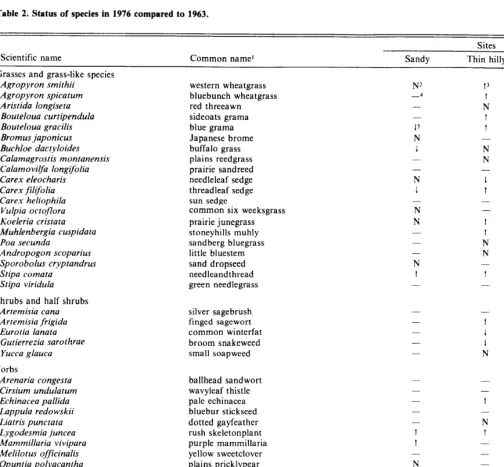
Table 2. Status of species in 1976 compared to 1963.
tion can affect forage production the following summer. April and June had significantly more rainfall (P<O.Ol) during the 1962-1975 period than during the earlier period (1949-1962), with June showing the greatest increase (3.86 cm) (Fig. 2). Precipitation in the remaining months did not differ significantly (DO.0 1).
Average monthly temperatures for the two 13-year peri- ods (1949-1962 and 1962-1975) did not differ significantly (DO.01).
Changes in Basal Area
Total basal area at all range sites increased 61% between 1963 and 1976 with the silty, sandy, and thin hilly range sites increasing 58, 34, and 10 170, respectively. Basal area at the silty and thin hilly range sites increased significantly (P<O.O5). The sample size at the sandy site was too small for
Sites
Scientific name Common name’ Sandy Thin hilly Silty
Grasses and grass-like species
Agropyron smithii western wheatgrass N* f3 1
Agropyron spicatum bluebunch wheatgrass -4 1
Aristida longiseta red threeawn - N
Bouteloua curtipendula sideoats grama t -
Bouteloua gracilis blue grama 15 t t
Bromus japonicus Japanese brome N -
Buchloe dactyloides buffalo grass 1 N t
Calamagrostis montanensis plains reedgrass N N
Calamovilfa longifolia prairie sandreed - - 1
Carex eleocharis needleleaf sedge N I
Carex filifolia threadleaf sedge I t t
Carex heliophila sun sedge - N
Vulpia octojlora common six weeksgrass N - N
Koeleria cristata prairie junegrass N t f
Muhlenbergia cuspidata stoneyhills muhly I
Poa secunda sandberg bluegrass N t
Andropogon scoparius little bluestem - N
Sporobolus cryptandrus sand dropseed N
Stipa comata needleandthread r 1 r
Stipa viridula green needlegrass - - 1
Shrubs and half shrubs
Artemisia cana silver sagebrush - 1
Artemisia frigida finged sagewort - r 1
Eurotia lanata common winterfat 1 -
Gutierrezia sarothrae broom snakeweed - 1 -
Yucca glauca small soapweed N
Forbs
Arenaria congesta ballhead sandwort - 1
Cirsium undulatum wavyleaf thistle - 1
Echinacea pallida pale echinacea r t
Luppula redowskii bluebur stickseed N
Liatris punctata dotted gayfeather N -
Lygodesmia juncea rush skeletonplant r t N
Mammillaria vivipara purple mammillaria r t
Melilotus officinalis yellow sweetclover N
Opuntia polyacantha plains pricklypear N 1
Petalostemon purpureum purple prairieclover - - N
Phlox hoodii Hoods phlox - t
Plantago purshii woolly plantain N t -
Polygala alba white polygala N
Psoralea argophylla silverleaf scurfpea N
Ratibida columnifera prairie coneflower - N t
Solidago missouriensis Missouri goldenrod - N
Sphaeralcea coccinea scarlet globemallow N r r
Taraxacum officinale common dandelion - - N
Tragopogon dubius yellow salsify N N N
‘Plant names follow those recommended by Beetle (1970). %pecies not present in 1963 and 1976 *N = species present in 1976 but not in 1963. 5t =Decreases in y0 composition by basal area. 3t = increase in $7’ composition by basal area
I J
OCT NOV DEC JAN FE8 MAR APR+ MAY JUN. JUL AUG SEP MONTH
Fig. 2. Average monthly precipitation at Mildred, Mon. Solid line repre- sents 1962-197.5 average (open circle f2 standard error of the mean) and dashed line represents 1949-1962 average (dark circle average f2 standard error of the mean). Months of signl$cant differences e< 0.01) are indicated by *.
statistical comparison because some of the plots were lost over the past 40 years. The status of all species present in 1976 compared to 1963 are summarized in Table 2.
The following five species comprised approximately 85% of the basal area at the range sites: western wheatgrass, blue grama, prairie junegrass, needleandthread, and threadleaf sedge (Table 3). By 1976, western wheatgrass, needleand- thread and prairie junegrass had increased on all range sites, whereas, blue grama and threadleaf sedge increased on the silty and thin hilly range sites but decreased on the sandy site. These five species increased the most on the thin hilly
range (97%), followed by the silty range sites (64%) and lastly, the sandy range site (34%).
Table 3. Percent basal area at the three range sites in 1963 and 1976.
Range Site
Silty Sandy Thin hilly
Plant species 1963 1976 1963 1976 1963 1976
Western wheatgrass Blue grama Needleandthread Prairie junegrass Threadleaf sedge
Subtotal
All other grasses and sedges All forbs All shrubs
Percent total basal area
0.1 0.2 0.0 0.1 0.0 0.1
5.4 6.6 4.8 4.2 1.8 3.5
o.- 2.1 2.4 5.7 0.3 1.3
0.0 0.5 0.0 0.3 0.0 0.4
0.7 2.1 1.4 1.3 1.4 2.0
6.2 11.5 8.6 11.6 3.5 7.3
0.5 1.2 0.2 0.3 0.5 1.1
0.4 0.3 0.0 0.1 0.2 0.5
0.4 0.2 0.0 0.0 0.0 0.1
7.5 13.2 8.8 12.0 4.2 9.0
All other grasses and sedges accounted for less than 6,3, and 12% of the total basal area on the silty, sandy, and thin hilly range sites, respectively, in 1963 (Table 3). Basal area of these species had more than doubled on the silty and thin hilly range sites but increased only 23% on the sandy site by
1976.
Forbs and shrubs (representing less than 1% of the total basal area on all sites) increased on the sandy and thin hilly range sites and decreased on the silty range site (Table 3).
Percentage of bare ground decreased at all sites; from 92
to 87% at the silty range sites, from 93 to 90% at the sandy site and from 95 to 90% at the thin hilly sites (Table 3). Since basal area is an estimate of the ground area actually occu- pied by plants rather than the area covered by the combined aerial parts of plants and litter (as in foliage cover), the amount of bare ground estimated by basal area will be higher than that estimated by foliage cover.
Changes in Percent Composition Based on Basal Area In 1963 the dominant plant was the low growing, peren- nial blue grama, but in 1976 the trend appeared to be chang-
ing slightly toward more midgrass species such as
needleandthread and prairie junegrass (Fig. 3). Dominant in this case refers to the area occupied by the various species. In terms of forage yield, blue grama was never a dominant grass with the exception of the silty sites in 1963 (Fig. 4).
SILTY
m MDGRASSES
WESTERN WHEATGRASS NEEDLEANDTHREAD PRAIRIE JUNEGRASS
ISHORT GRASSES AND SEDGES BLUE GRAMA
THREADLEAF SEDGE
Ll
1963 I976 196SANDY THIN HILLY
RANGE SITES
Fig. 3. Change in percent of total composition by basal area of the five major grasses in 1963 and 1976.
The percentage of total composition comprising the five grass or grass-like species discussed above changed very little at the three range sites between 1963 and 1976 (Fig. 3). Blue grama decreased at all sites: from 66 to 5 1% on the silty range sites, from 54 to 35% on the sandy range site and from 42 to 39% on the thin hilly range sites. Needleandthread and prairie junegrass increased at all range sites with needleand- thread becoming the dominant grass on the sandy range sites by 1976 (27 to 47%). Threadleaf sedge increased at the silty site (9 to 16%), but decreased at the sandy (16 to 11%) and thin hilly range sites (32 to 22%).
The percent total composition of all other grasses and
367 kg
‘////r THREADLEAF SEDGE - PRAIRIE JUNEGRASS :$:I NEEDLEANDTHREAD 0 BLUE GRAMA
@B WESTERN WHEATGRASS
480 kg
SILTY SANDY THIN HILLY
RANGE SITES
Fig. 4. ~~~c~~ated forage yield for the five species indicated at the three range sites in 1963 and 1976.
sedges did not change significantly on sandy (2 to 2%) or thin hilly range sites (12 to 13%), but did show a slight increase on the silty range sites (6 to 9%). This increase was principally due to increases in red threeawn (Aristida Zon- giseta) and sandberg bluegrass (Poa secunda).
In 1963, forbs and shrubs comprised less than 5% of the total composition on the silty and thin hilly ranges and less than 1% on the sandy range site. These species decreased at all sites by 1976, except for a slight increase of shrubs (< 1%) at the thin hilly site and the establishment of forbs (< 1%) at the sandy site.
Changes in Relative Production
The calculated forage yield of the five important grass or grasslike species described above increased 192 (1 lo%), 183 (109%), and 130 kg/ ha (61%) on the silty, thin hilly, and sandy range sites, respectively, between 1962 and 1976 (Fig. 4). Needleandthread comprised the major increase at these range sites. Forage yield would be somewhat larger if all species on these sites were analyzed.
The increase in forage yield of these species increased the calculated grazing capacity for cattle from 3.1 to 1.5 hectares per cow-month on the silty range sites, from 1.8 to 1.1 on the sandy range site and from 4.6 to 2.2 on the thin hilly range sites.
Conclusions
The higher April and June precipitation between 1963 and 1976 increased basal area considerably on the silty, sandy, and thin hilly range sites. Species composition changed from a dominant blue grama grassland toward a
more mid-grass community. Needleandthread, western
wheatgrass, and prairie junegrass became established or increased on all sites. Threadleaf sedge increased on the silty and thin hilly range sites, but decreased on the sandy range site. Concurrently, the calculated forage yield of these spe- cies more than doubled on the silty and thin hilly range sites and increased 61% on the sandy range site. The latter range site, however, was more productive than the other two sites. The increase in forage yield of these five grasses decreased the hectares needed per cow-month for grazing by 1.6 (48%), 0.7 (24%), and 2.4 (48%) on the silty, sandy, and thin hilly range sites, respectively.
These results indicate that additional spring-early summer precipitation on moderately grazed rangeland in eastern Montana has benefits for the stockman. The number of cattle that may be properly grazed could almost double with a 23% increase in precipitation, similar to the findings of Coupland (1959) in southern Alberta and Saskatchewan. Whether an increase of this magnitude is consistently obtainable with purposeful cloud seeding remains to be seen.
Literature Cited
Beetle, A.A. 1970. Recommended plant names. Wyo. Agr. Exp. Sta. Res. J. 31. 124 p.
Brown, D. 1954. Methods of Surveying and Measuring Vegetation. Commonwealth Agricultural Bureau, England.
Clark, S.E., E.W. Tisdale, and N.A. Skoglund. 1947. The effects of climate and grazing practices on short-grass prairie vegetation. Canada Dep. Agr. Tech. Bull. 46. 54 p.
Cleveland, H. (Chairman). 1978. The management of weather resources, Vol. I - Proposals for a National Policy and Program. U.S. Dep. Comm., Washington, D.C. 229 p.
Coupland, R.T. 1958. The effects of fluctuations in weather upon grasslands of the Great Plains. Bot. Rev. 24: 273-317.
Coupland, R.T. 1959. Effects of changes in weather conditions upon grasslands in the northern Great Plains. Grasslands in Our National Lives. (H.B. Sprague, ed.) AAAS Symposium Pub. 53. p. 291-306. Ellison, L., and E.J. Woolfolk. 1937. Effects of drought on vegetation near
Miles City, Montana. Ecology 18: 329-336.
Hurtt, L.D. 1951. Managing northern Great Plains cattle ranges to minimize effects of drought. U.S. Dep. Agr. Circ. 865. 24 p. Perry, D.A. 1976. The effects of weather modification on the northern
Great Plains grasslands: A preliminary assessment. J. Range Manage. 29: 272-278.
Reed, M.J., and R.A. Peterson. 1961. Vegetation, soil, and cattle responses to grazing on northern Great Plains range. U.S. Dep. Agr. Tech. Bull.
1252. 79 p.
Sarvls, J.T. 1941. Grazmg investigations on the northern Great Plains. No. Dak. Agr. Exp. Sta. Bull. 308. 110 p.
White, L.M. J.J. Newbauer, III, and J.R. Wight. 1978. Vegetational differences on native range during 38 years in eastern Montana. Proc. of
1st Internat. Rangeland Congress 260-262.
Whitman, W., H.C. Hanson, and R. Peterson. 1943. Relation of drought and grazing to North Dakota rangelands. No. Dak. Agr. Exp. Sta. Bull. 320. 29 p.
Effects of Season and Frequency of Burning
on a Phryganic Rangeland in Greece
VASILIOS P. PAPANASTASIS
Abstract
Pbrygank rnngehnds dominated by Sarcopoterium spinosum, a thorny and unpalatable dwarf shrub, are a cummun vegetation type over the eastern Mediterraneancountries. In sucbarangeland of northern Greece, the effect of early spring and fall burning, applied once, twice, and three times in a 3-year period, was studied. Season of burning did nut have any significant effect on the dominant shrub. Frequency of burning, however, significantly reduced the plant yields but altered species composition only slightly and bad no effect on soil organic matter and acidity. Burning has only temporary effects on pbryganic rangelands due to the high regeneration capacity of the component species. If prescribed, tire can be used a a tool to suppress the shrub and increase the availability of herbage for the benefit of the grazing animals.
Plant communities dominated by Sarcopoterium
spinosum (L.) Spach., a thorny and flammable dwarf shrub of less than 50 cm tall, are a common vegetation type in the eastern Mediterrannean countries (Litav and Orshan 1971). In Greece, such communities are known as “phrygana”and they are widespread in areas with long, dry, and hot summers and mild and rainy winters, normally found in the southern part of the country. They usualy grow on dry, rocky, and friable soils without active calcium (Debazac and
Mavrommatis 1969).
Phrygana are more open communities than are
mediterranean maquis or chaparral and they have an important herbaceous element. Physiognomically, they can compare with the coastal sage scrub, the vegetation type which lies below chaparral and extends to the South Coast Ranges of California (Munr and Keck 1968).
Phryganic communities are important grazing lands for livestock, mainly sheep, in the winter time. Sarcopoterium spinosum, however, is unpalatable to these animals, while its spines injure them. In places where it gets dense, free movement of sheep becomes impossible and considerable area of valuable grazing land is thus lost.
To control this troublesome species and to, consequently, increase the grazing capacity of the phryganic rangelands, shepherds have been using fire for a long time. However, the fires set by those people are uncontrolled and usually have more harmful than desirable effects (Papanastasis 1977).
If fire is to be used rationally in management of phryganic rangelands, a full knowledge of its ecological role in those ecosystems is needed. Furthermore, precise information is required on the effects of prescribed burning if it is going to be applied for improvement of these grazing areas.
The effects of fire on range communities have received considerable attention and some excellent reviews are
available (Biswell 1974; Daubenmire 1968; Naveh 1974; Wright 1974; Mueggler 1976). Nevertheless, information on fire ecology and management on the phryganic communities is scanty (Papanastasis 1977).
The objective of this paper was to study the effects of season and frequency of burning on the phryganic rangelands for a better understanding of the ecological role of fire as well as its use for rational management of those areas for the benefit of livestock and the wild animals.
Study Area
A phryganic rangeland located in the hills of the city of Thessaloniki, Northern Greece, was selected as a study site. The community had not been burned for more than 20 years and it was commonly grazed by sheep. The area had a south exposure and about 20% slope.
Besides Sarcoporerium spinosum, covering about 30% of the ground, herbaceous species were also a significant part of the vegetation cover (Fig. 1). Soil was a shallow sandy loam. Parent rock, made up of basic intrusive (peridotite, serpentine, gabbre, d&base) was often exposed at the surface. Annual rainfall of the area amounts to 500 mm and average annual temperature to I .5O C.
Methods
1974, or for two consecutive years, i.e. in 1974 and 1975, or every year, i.e. in 1974, 1975, and 1976. Hereafter frequencies will be referred to as once, twice, and thrice.
The six treatment combinations along with a control (no burning) were randomly established on an area 0.14 ha in sire. Each plot was 200 m2 By erecting a barb wire fence, no livestock grazing was allowed during the course of the experiment.
Spring burning was done in early March when S’arcoporerium spinosum had started to flower. Fall burning, on the other hand, was done in late September, when most of its mature seeds had fallen off. To secure uniform burning of the vegetation a gasoline- motored flame thrower was used to set the fire. Approximate weather conditions during burning were 8” C and 15’ C air temperature, 55% and 75% relative humidity, and 7 km/h and 5 km/h wind speed, respectively, for the spring and the fall seasons.
Measurements were taken one growing season after the last fall fire, in June 1977, which was considered the end of the 3.year burning period. Vegetative cover was measured with the loop method (Joint Committee 1962). Five transects of IO m long were randomly taken in each plot and 20 readings with the 2 cm wide loop were made in each transect. Meanwhile, two square quadrats of 0.12 m2 were randomly placed under each transect and theplant material (live and dead) was clipped to the ground level. Plant biomass was also measured at the end of the two previous growing seasons (1975 and 1976) but only in the once-burned plots.
In the meantime, permanent quadrats of 0.25 X 0.25 ml were established after the first fall fire, one in each plot, and regular cwnts of theSarcopoterium spinosum seedlings were taken.
In June 1977, three samples of the top 8 cm soil were taken from the control and each fall burned plot. Soil samples were analysed for organic matter content and acidity.
In the laboratory living and dead plant material was separated by hand for both Sarcoporerium spinosum and herbaceous species, and it was weighed after oven-drying at 70° C.
Yield data (live parts) were subjected to analysis of variance as a 2 X 3 factorial design. Moreover, frequency levels were campared to the control for each season with a one-way analysis of variance. When needed, the studentized range test was used (Hicks 1973). All tests were made at the 0.05 level of significance.
Results Cover and Species Composition
Table 1 shows the most common species encountered in the plots. It appears that the fall-burned plots had relatively less Sarcopoterium spinosum and grass coveras well as litter than the spring-burned plots at the end of the 3.year burning
period. On the contrary, forb cover and bare soil were most prevalent on the fall-burned plots. However, no particular species seemed to be favored by burning at any season.
Sarcopoterium spinosum was mostly affected by frequency of burning. At the end of the 3-year period, the cover of this species was reduced 40%, SO%, and 90% in the once, twice, and thrice burned plots, respectively.
Other species were affected only slightly by frequency of burning. Dominant perennial grass Chrysopogon gryilus tended to decrease due to repeated burning, while another quite abundant perennial grass Hyparrhenia hirta tended to increase (Fig. 2).
Among the forbs, Pumana thymifdio appeared to be favored by repeated fires, while Thymus vulgaris was harmed. Annual legumes were more abundant in the plots burned repeatedly. Also, burning created more room for other forb species.
Finally, high burning frequency, at any season resulted in sharp increases of bare soil in the community while the amount of litter was at the same time decreased.
Species reproduction
Sarcopoterium spinosum recovered after burning by Table 1. Vegetative wver (%) of the phryganic rangeland at the end of the 3.year burning period.
Spring-burned Fall-burned
Species Once Twice Thrice Once Twice Thrice ““burned
Half-shrubs
sareoporerium spin0sum (L) Spach. 18 8 I 14 3 2 28
Grasses
Chrysopogon gryNius grin. 32 23
Hyporrhenia hirro (L.) Staph. I II 21 23 26 20
Other grass& 16
28 2
3 2 _ 3 6 2 9 2 5 I
F0rbs
Fumona rhymifolio (L.) Spach. 3 5
heavy sprouting. It was estimated that 95% of the burned plants sprouted from the root crown after each burn. Only the plants which were exposed to a very hot fire, as judged by the absence of any standing stem, died after burning.
Sprouts attained about one third of the original plant height at the end of the first growing season after burning.
However, they produced seeds only in the second growing season since they were burned.
Although no single seedling was noticed in the unburned plots during the course of the experiment, a high population of such seedlings was established under the burned mother plants. I counted 1900 seedlings per square meter in early February under plants burned in the spring and fall of the year before. The population decreased 73% in late June of the same year. By June of the following year, the population had decreased 99%. Only 8 seedlings remained in June of the third year. No seedlings were found away from the mother plants, where grass was growing, except in the bare spaces.
The surprising thing was that even spring burning resulted in seedling establishment. It was not clear whether the seeds germinated had come from the seed pool in the soil or from the plant crowns which retained some mature seeds from the previous growing season.
As far as the herbaceous species are concerned, the dominant perennials, either grasses or forbs, reproduced vegetatively after burning (Fig. 2).
Yields
Statistical analyses showed that season of burning did not have any significant effect on the yields (live plant parts) of both Sarcopoterium spinosum and herbaceous species. On
the contrary, frequency of burning affected them
significantly. Table 2 summarizes the yield results.
For Sarcopoterium spinosum specifically, the means of the twice and thrice burned plots did not differ significantly from each other but both reduced yields more than the once- burned plots. Moreover, all frequency levels of both seasons had significantly lower yields than the unburned plots.
Herbage yields, on the other hand, were affected less by frequency of burning. Only the thrice-burned plots of both seasons had significantly lower yield compared to the
control. The other two frequencies did not differ
significantly from each other nor from the control.
The effect of burning frequency on the total yield was a combination of the effects on the two components already described (Table 2).
Table 2. Means of plant yields (kg/ha) for the three burning frequencies over both (spring and fall) seasons and for the unburned plots at the end of the 3-year burning period.
Burned
Species Once Twice Thrice Unburned
Sarcopoterium spinosum
Herbaceous vegetation Total
11 120” 52” 8&P
I244 1074 529” 1167
1755” 1194 581” 2031b
Significantly (a) lower than other burned and unburned, (b) higher than burned, and (c) higher than other burned treatments of the same species or groups of species at 0.05 level of significance.
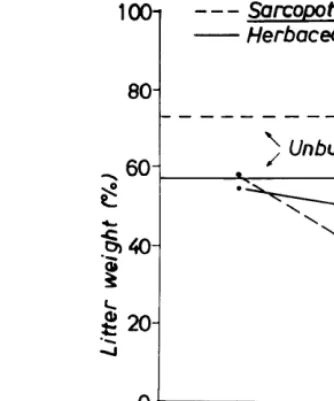
A tendency for accumulation of litter (standing and lying dead) of both Sarcopoterium spinosum and herbaceous species was found in the less frequently burned and in the unburned plots. The percentages of dry weight of litter in the
100
:
- - - Sorcopoterium sknosum - Herbaceous species
80
,__---__---__
> Unburned levels c
‘b.
‘ll*,\. \
\ \
\
g20
1
\ \
2
01
1 2 3
Burning frequency
Fig. 3. Percentages of litter (standing and lying dead) in the biomass (live and dead) for the three burning frequencies over both (spring andfall) seasons as compared to the levels in the unburned plots.
biomass (live and dead) are graphed in Figure 3, which showed that the plots left unburned for three consecutive growing seasons tended to accumulate almost as much dead material as the unburned plots. This material consisted of dry twigs for the shrub and of dry leaves and stems for the herbs.
Sarcopoterrum sprnosum Herbacous vegetution T&al biomass ---Sprrng burned -Fall burned
4ooo-1
i
1
I
----
1975 GTz77I
/
IL-
1975 1976 1977 1975 19iS 147 T/me fyeufs)
Fig. 4. Rate of biomass build up in the once-burnedplots of thephryganic rangeland in 3 years after burning.
Biomass Build-up after Burning
For the once-burned plots in the spring and in the fall, the rate of biomass build up in 3 years is shown in Figure 4. It is apparent that the original differences between the two seasons tended to disappear towards the end of the 3-year period.
Sarcopoterium spinosum recovered faster when burned in the spring then in the fall. Regardless of the season, there was a rapid biomas build up from the first year to the second (106%) and a slower one from the second to the third year (22%).
By contrast, herbaceous vegetation recovered faster in the fall than in the spring. Over both seasons, there was a 92% increase in biomass from the first to the second and a 59% increase from the second to the third year.
Overall, total biomass built up faster when burned in the fall than in the spring. Averaging over both seasons, rates of
biomass build up were 97% and 45% respectively from the first to the second and from the second to the third year. In actual data, 1,346.2 kg/ ha of biomass was added in the second year and 1,238.2 kg/ha, in the third. Since the biomass of the first year was 1,388.4 kg/ ha, an average of I ,324.2 kg/ ha was added from the one year to the next after burning.
Effect on Soil
Burning did not seem to have had any appreciable effect on soil based on the two soil properties measured, organic matter content and acidity. At the end of the 3-year burning period, the fall burned plots had 1.715% and 6.5 in the once burned, 1.409% and 6.2 in the twice and 1.965% and 6.5 in the thrice burned plots, respectively, for organic matter and pH. The corresponding figures for the unburned plots were 1.712 and 6.3.
Although not measured, no soil erosion in the burned plots was observed.
Discussion and Conclusions
The capacity of both Sarcopoterium spinosum and the herbaceous species to regenerate vigorously after burning may explain the lack of any significantly different effect between the two seasons on their yields.
However, the cover data indicated a tendency for both the shrub and the grasses to increase with spring burning at the expense of forbs, which in turn tended to increase with the fall burning. Taking into account that both dominant perennial grasses, Chrysopogon gryllus and Hyparrhenia hirta, are warm-season plants (Papanastasis, unpublished data), these results are reasonable, since spring burning normally favors the warm-season over the cool-season grasses (Wright 1974). On the other hand, fall burning usually favors forbs over grasses in natural grasslands
(Daubenmire 1968). Moreoever, an increase of the
herbaceous species (grasses and forbs) at the expense of the woody plants in the fall-burned plots as compared to the spring-burned ones was also found in a Quercus coccifera L. garrique in southern France (Trabaud 1974).
Of the two components of vegetation, Sarcopoterium spinosum was affected more by frequent burning than herbaceous species. This explains why the shrub yields were significantly lower in the once- and twice-burned plots as compared to the control while the herbage yields were not reduced. Suppression of woody plants in favor of the herbaceous species by frequent fires has been found in other plant communities, too (Wright 1972, 1974; Trabaud 1977).
Shrubs usually regenerate after fire either vegetatively or by seeds (Wright 1972). However, several chaparral species possess both these capacities. An example is chamise (Adenostema fasciculatum), which produces both strump- sprouts and seedlings after burning (Biswell 1974).
Sarcopoterium spinosum belongs to this latter group of species. In addition to sprouting, it regenerates readily by seeds, the germination capacity of which is enhanced by high temperatures (Papanastasis and Romanas 1977). Therefore, it can be considered as a highly adaptive species to recurring fires.
Its seedlings, though, are sensitive to competition from annual grasses (Litav and Orsham 197 1). This is why no seedlings were observed in places covered by grasses in the community studied. It follows that burned phryganic rangelands deteriorate over time when overgrazed, because
competition to Sarcopoterium spinosum seedlings from grasses is lessened and the shrub eventually gets denser.
Among the grasses, Hyparrhenia hirta seems to be favored by frequent burning, which suggests that it is well adapted to recurring fires. The same was also observed in Israel by Naveh (1974).
It is apparent that fire has only temporary effects on the phryganic rangelands. This can be illustrated by the relatively high speed that aerial biomass is built up after burning. Since the average rate of this build up was about 1,320 kg/ ha per year in the once-burned plots, it follows that they will reach the unburned levels (5,936 kg/ ha) in about 4.5 years. Sarcopoterium spinosum, however, would need a longer time to build up its biomass to the original level, about 7.5 years. Herbaceous vegetation needs only 2.0 years for full recovery. More advanced communities require more time to recover after burning; for example, Q. cocczjkra gariques need 6 years (Trabaud 1977), while chaparral communities need about 20 to 25 years (Biswell 1974).
On the other hand, the phryganic ecosystem has a tendency to accumulate dead material and become decadent if unburned. About 2,200 kg/ha of such material was accumulated in the once-burned plots in a 3-year period, whereas the unburned plots had about 3,900 kg/ha. Meanwhile, Wright (1974) states that build up of litter in excess of 2,240 kg/ ha may have adverse effects on nutrient cycling in stagnated grassland communities and he suggests the use of fire to stimulate forage production.
Hence, it appears that phryganic communities are rejuvenated by frequent fires. However, if burning is too
frequent, Sarcopoterium spinosum is significantly
supressed but herbage production is decreased; if too infrequent, the shrub grows up, large amounts of the production goes to the detritus form and the herbage
produced becomes rather unavailable. Therefore, the
optimum fire frequency should lie between these two extremes.
The results of this study suggest that prescribed burning every 3 to 4 years, preferably in early fall, should be applied for rational fire management of the phryganic rangelands.
Such burning will keep Sarcopoterium spinosum
reasonably suppressed while securing at the same time a high availability of the herbage produced. However, further research is needed to verify these findings over the entire phrygana zone and under actual grazing conditions.
Literature Cited
Biswell, H.H. 1974. Effects of fire on chaparral. p. 321-360. In: T.T. Kozlowski and C.E. Ahlgren (Eds) Fire and Ecosystems. Academic Press Inc. N.Y.
Daubenmire, R. 1968. Ecology of fire in grasslands. In: Adv. in Ecol. Res. 5: 209-266.
Debazac, E.P. and G. Mavrommatis. 1969. Note sur les formations fo- rest&es “a feuilles persistantes” en G&e. Inst. Rech. Forest., Athenes. 23 p.
Hicks, C.R. 1973. Fundamental Concepts in the Design of Experiments. 2nd Ed. Holt, Rinehart and Winston Inc., N.Y. 349 p.
Joint Committee. 1962. Basic Problems and Techniques in Range Research. National Academy of Sciences, Nat. Res. Council Pub. 890. 341 p.
Litav, M., and G. Orshan. 1971. Biological Flora of Israel. 1. Surcopoterium spinosum (L.) SP. Israel J. Bot. 20: 48-64.
Mueggler, W.F. 1976. Ecological role of fire in western woodland and range ecosystems. p. 1-9. In: Use of Prescribed Burning in Western Woodland and Range Ecosystems, a Symposium. Utah State Univ., Logan.
Munz, P.A., and D.D. Keck. 1968. A California Flora. University Calif. Press. 1,681 p.
Naveh, Z. 1974. Effects of fire in the Mediterranean region. p. 401-434. In: T.T. Kozlowski and C.E. Ahlgren (Eds) Fire and Ecosystems. Academic Press Inc., N.Y.
Papanastasis, V.P. 1977. Fire ecology and management of phrygana communities in Greece. p. 476-482. In: H.A. Mooney and C.E. Conrad (Techn. Coords), Proc. Symp. on Environmental Consequences of Fire and Fuel Manage. in the Med. Ecosystems. U.S. Dep. Agr. Forest Serv. General Tech. Rep. WO-3.
Papanastasis, V.P., and L.C. Romanas. 1977. Effect of high temperatures on seed germination of certain Mediterranean half-shrubs. Forest Res. Inst., Bull. 86.30 p. (In Greek with English summary).
~-~-~---I
I
!
I
I
I
I
I
I
I
I
I
I
I
I
I
I
I
I
I
I
I
I
I
I II
I
I
I
I
I
I
I
I
I
I
1
II
I
ITrabaud, L. 1974. Experimental study on the effects of prescribed burning on a Quercus cocczfera L. garrique. Early results. Proc. 13th Ann. Tall Timbers Fire Ecology Conf., 97-129.
Trabaud, L. 1977. Comparison between the effect of prescribed fires and wildfires on the global quantitative evolution of the kermes scrub oak (Quercus coccifera L.) garriques. p. 271-282. In: H.A. Mooney and C.E. Conrad (Techn. Coords.), Proc. Symp. on Environmental Consequences of Fire and Fuel Manage. in the Med. ecosystems. U.S. Dep. Agr. Forest Serv. General Tech. Rep. WO-3.
Wright, H.A. 1972. Shrub response to fire. p. 204-217. In: C.M. McKell et al. (eds) Wildland Shrubs-Their Biology and Utilization. U.S. Dep. Agr. Forest Serv., General Tech. Rep. INT-1.
Wright, H.A. 1974. Range burning. J. Range Manage. 27: 5-l 1. I---,--,
1
SRM Publications
Rangeland Entomology @ $2.75 . . . ._
Quotable Range Quotes @ $.75 . . . ._
Proceedings: First International Range/and Con- gress @$72.00 . . . ._
Range/and Reference Areas @$2.00 . . ._
Glossary of Terms @$7.50 . . . .-.---- Jornada Experimental Range @$2.50 . .-
Proceedings of U.S./Australia Workshops: Arid Shrublands @$3.50 . . . ._
Range/and Ecosystem Evaluation and Manage- ment @$&IO0 . . . , . . . .-
Symposium on Resources for Beef Cattle Produc- tion @$3.50 . . . ~
Range/and Plant Physiology @$14.50 . .- Special Management Needs of Alpine Ecosystems @$4.50.. . . . .-
Index for JRM Vol. 1-10 @$l.OO . . . .-
Index for JRM Vol. 70-20 @ $7.00 . . . ._
Set of both Indices @ $2.00 . . . ..--- Abstract of Papers Presented at the First In terna- tional Range/and Congress @ $3.00 . . .-
Back issues JRM (if available): Used copies @ $1.50---; New @ $3.00-- . . . .-
JRM Vol. 31 to current @$4.66 . . . .-
Abstracts of papers presented at SRM Annual Meetings available for the years shown; please indicate the number of copies wanted of each issue.
1969@$1.00...---
7970@ $7.00..._-___- 1971 @$l.OO...
1976@$1.00..._
1977 @$1.50.. . . . ._ 1978 @$1.50.. . . . ._
1979 @$3.00.. . . . ._ 1980 @$3.00.. . . . .-
Total cost of all books $_
(U.S. currency only)
Name
Address
City State- Zip_
I
I
I
I
I
I
II
I
II
I
I
I
I
I
I
I
I
I
I
I
I
I
I
I _
I
I
I
I
I
II . .
I
I
I
I
I
II
-
JOURNAL OF RANGE MANAGEMENT 33(4), July 1980