Journal of Chemical and Pharmaceutical Research, 2016, 8(11):113-118
Research Article
CODEN(USA) : JCPRC5
ISSN : 0975-7384
113
Characterization of Pt- Au Core –Shell System for the Fuel Cell Applications
Hind I Murad
Department of Physics, College of Science, Baghdad University, Baghdad, Iraq
___________________________________________________________________________________
ABSTRACT
The development of new catalysts system for fuel cell is an important for the clean environment point of view. The rising cost of platinum, the most commonly used metal for catalysis, has also driven research for more efficient catalyst use. Recent findings have supported the suggestions that either alloying or layering Pt with Au can decrease both the rate of catalyst poisoning by species such as the amount of Pt loading necessary in the catalyst. Specifically, “core/shell” catalysts utilize monolayers of Pt for the surface shell and other metallic components or alloys for the core structure. The reduction of the Platinum (Pt) layers deposited on Gold (Au) thin film decrease the rate of catalysts poisoning and the amount of Pt loading necessary in the catalysts. We demonstrate here a careful characterization of the surface alloyed nanostructure for the Pt-Au core-shell system using X-ray Photoelectron Spectroscopy (XPS) methods.
Keywords: Carbon fiber paper; Fuel cell; Pt Monolayer; X-ray photoelectron spectroscopy; Core/shell system ___________________________________________________________________________________
INTRODUCTION
The reduction of platinum loadings are required for electro catalytic applications in varied fields related to energy and clean environment [1]. For example, direct methanol fuel cells (DMFC) are efficient. In the polymer electrolyte (or proton exchange) membrane fuel cells (PEMFC), and electrochemical energy devices. The platinum nanoparticles are used to deposit on Au-carbon fiber paper (CFP) substrate through Au thin film.
Direct methanol fuel cells (DMFCs) are currently the subject of extensive interest due to their promise as high efficiency power sources free of the problems of hydrogen storage and transport [2-4]. Moreover, the rate of methanol oxidation reaction (MOR) at the anode isone of the locating factors for DMFCs currently developed. Currently the catalyst of choice for MOR in acidic media is Pt, although the two primary obstacle of platinum, its high cost and low poisoning resistance, have yet to be completely attenuated. Therefore, one of the main goals of catalyst development for DMFCs is to modify the Pt catalyst in order to decrease its cost while increasing its poisoning resistance and efficiency [5-7].
Finally, attempts to develop bimetallic Pt compounds in order to reduce Pt loading While increasing poisoning resistance have been reported for systems such as Pt_Ru [8,9]and Pt_Au [2,10-12]. So, to decrease the amount of Pt required through the use of monolayer/sub monolayer Pt catalyst films [13, 14].
Deposition of Pt on nanoparticles of comparatively exuberant metals is among themost efficient strategies to save Pt in catalysts. Moreover, surface Pt atoms deposited on properly chosen core metals could have enhanced intrinsic catalytic activity over those on the pure Pt surface, due to the so-called strain and ligand effects [15]. Pt monolayer-modified Au single crystal surfaces.
114
catalyst films and determining how changes in these properties effect the electrochemical performance and durability of the catalyst architecture as a whole.
The ultrathin platinum over layers were prepared on the Au structures which grown on CFP by using potentiostatic deposition (PSD). Layer-by-layer Pt growth on the Au_CFP surface was conducted by surface limited redox replacement (SLRR), by which Pt replacement of an under potentially deposited (UPD) Cu adlayer resulted in a sub monolayer-equivalent of deposited Pt [16].
SLRR is a very versatile technique in that it can be performed with a variety of different metals as sacrificial layers, including UPD Pb or over potentially grown Ni [13, 17, and 18]. In this work, we are carried out the work to use Cu UPD to make the nearest layer, as it is less toxic than another materials like Pb and has also more widely used by other researchers for Pt SLRR fabrication.
EXPERIMENTAL SECTION
Layer-by-layer Pt growth on the Au surface was conducted using surface limited redox replacement (SLRR), by which Pt replacement of an under potentially deposited (UPD) Cu ad layer results in a sub monolayer-equivalent of deposited Pt [19, 20-23]. Surface limited redox replacement (SLRR) involves the repeated process of electrodeposition of one sacrificial atomic monolayer, oftentimes via under potential deposition (UPD) [24-26] and its replacement by a second element via redox galvanic replacement.
In this work, we use Cu UPD to make the sacrificial layer, as it is less toxic than other materials like Pb and has also been more widely used for Pt SLRR fabrication [27-29]. By stopping a voltage sweep at a potential between the bulk removal and the UPD removal potentials for Cu, the surface coverage of the Cu UPD layer is self-limiting. This repeated deposition of well-wetted Pt over layers allows the surface shell to be grown with a high level of precision at the monolayer scale.
When replaced by Pt, each iteration of the SLRR process is expected to result in a one-third monolayer of Pt on the surface [20]. CFP was used because of its high surface area. Using CFP also excludes organic agents and other nonconductive materials while also preventing nanoparticle aggregation [30,31].
All electrochemical synthesis was done at room temperature in a three electrode glass cell set up using a hanging meniscus arrangement. All solutions used were deaerated prior to use by bubbling with ultra-high purity nitrogen. All electrochemical measurements were obtained with a Pine WN50 potentiostat system, and any potentials are reported relative to homemade Ag/AgCl reference electrodes. Pt wires were used for the counter electrodes. The solution used for Cu UPD was 10 mM CuSO4 + 50 mM H2SO4 and Pt galvanic replacement of the Cu utilized 1 mM
H2PtCl6.
RESULTS AND DISCUSSIONS
Synchrotron X-ray photoelectron spectroscopy
In this study, the Pt layers are prepared by deposited the Au on CFP via surface limited redox replacement. The over layer of Pt atoms and the Au substrate was examined by using x-ray photoelectron spectroscopy (XPS) which used a tunable light source. This technique offer a depth profile study to be performed on the core-shell structured catalyst samples. The tunable XPS system with low energy incident photons, can be used to examine the chemical states of the Pt and Au at different ‘information depths’ of the core-shell structure. This technique is good for examine the surface of core-shell structure leading to the analysis of thickness- dependent structure for both Pt over layer and Au support. Also this study appears the changes in the core-shell structure of SLRR developed samples due to metal inter diffusion as a result of elevated temperatures. The XPS analysis chamber via a thermocouple connection was completed when heating on the sample stage in 15 minute intervals up to 400 °C.
XPS values were obtained based on inelastic mean free path modeling functions by Cumpson and Seah [32]. Overall set of spectra were obtained by different energies of the incident photon between 400 and 650 ev on a variety of samples, regarding the chemical state of Pt and Au for core-shell style samples besides alloyed surfaces. The precise examination of the over layer shell can’t be achieved with laboratory XPS, so allows using low energy photons which available from synchrotron radiation.
115
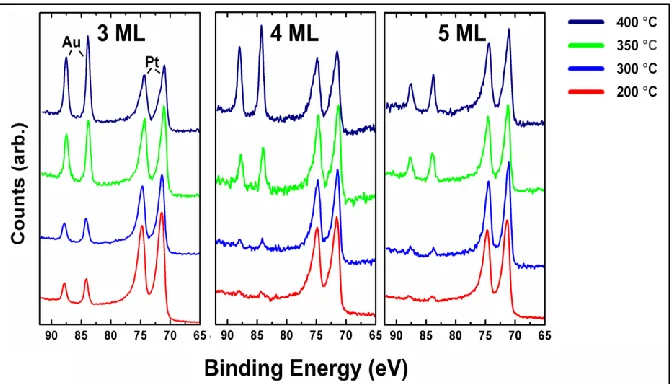
[image:3.612.139.475.117.309.2]and 5 ML sample were heated to increasing temperatures with an XPS spectra taken after each heating step, each of which examine the state of the Pt overlayer. This annealing was performed under vacuum conditions.
Figure 1: Synchrotron XPS spectra for three samples after each heating step with incident photon energy 400 eV at temperatures of 200 °C, 300 °C, 350 °C, and 400 °C in vacuum. a) 3 ML sample b) 4 ML sample c) 5 ML sample
Figure 1 shows the XPS spectra for a 3, 4, and 5 ML samples on CFP taken after each individual heating step with incident photon energy of 400 eV. With regards to Au and Pt matrices, 400 eV corresponds to slightly more than a half-nanometer of information depth, so the spectra are representative of the top half-nanometer of the sample. Pt is characterized as a 4f electron doublet (4f7/2,5/2) at ~71 and ~74 eV, while the Au 4f doublet is seen at ∼84 and ~88
eV [33].
The first notable feature is that the Au photoemission is clearly visible for the 3 ML sample at lower annealing temperatures, whereas the 4 and 5 ML samples’ Au photoemission is only marginally visible beyond the noise. This means, at 3 monolayers, selected incident photon energy of 400 eV is still able to penetrate past the deposited Pt over layer into the Au substrate. However, for the 4 and 5 ML samples, photon energies is low and it can only provide information of the Pt over layer. The electrons from the underlying Au do not have enough energy to eject from the sample.
For the 4 and 5 ML samples, all Au detected at any temperature must be Au that has diffused into the half-nanometer region where the Pt over layer resided before significant alteration by heating. However, for the 3 ML sample, we cannot easily distinguish bulk Au from Au that has moved towards the surface, as the information depth proceeds through the Pt shell. However it is still clear by the increase in the Au photoemission that more Au has moved into the top few nanometers as the temperature is increased.
To better understand the Au diffusion, further XPS spectra were taken after the individual annealing steps at slightly higher incident photon energies to alter the information depths of the spectra. By altering the photon energy, it becomes possible to further determine the state of the top surface of these samples without altering the sample structure. It cannot be assumed that the Pt/Au alloy formed at the surface by the in-situ heating is homogenous. Thus, lower energy photon energies can be used to determine the chemical state of the top-most layer of the alloyed surface while higher photon energies will probe chemical information slightly deeper into the over layer.
116
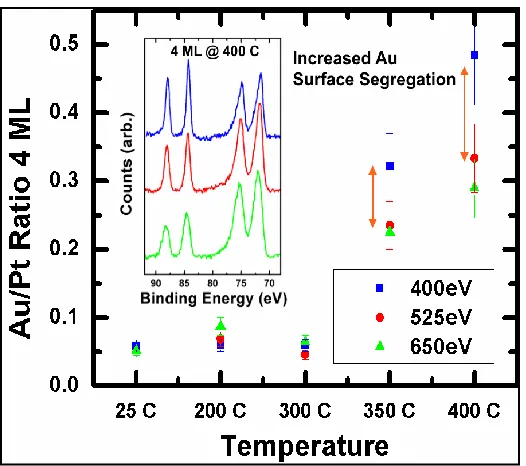
Figure 2: The ratio of the Au photoemission to the Pt XPS photoemission for a 4 ML sample, at 400, 525, and 650 eV. Inset: The XPS photoemission spectra of the 4 ML sample after heating to 400 °C in vacuum
This is consistent with inelastic mean free path calculations. Up to a temperature of 300 °C, these ratio values do not change significantly, showing that the layer-substrate structure of these samples are relatively unaffected after 15 minutes of heating. The Au/Pt ratio is largely unaffected by higher photon energies in this temperature, as the Au signal is still only barely noticeable even with increased information depths. However, once the samples are heated to 350 °C, the spectra exhibit a significant increase in the Au photoemission, leading to an increased Au/Pt ratio. This shows that the sample now has more Au near the XPS-sensitive surface region. Heating to 400 °C further substantiates this trend, as the surface becomes even more Au rich. By also examining energies of 525 eV and 650 eV, we see that after heating past 300 °C, these ratios are significantly affected for the 4 ML sample. The incident photon energy is inversely proportional to the amount of Au at the surface at elevated temperatures; 400eV reveals the highest amount of Au at 350 °C and 400 °C while 600 eV shows the lowest amount of Au at the same temperatures.
As incident photons of 400 eV are the most surface sensitive, this indicates that the Au is now at least partially sitting close to the top of the sample with the former Pt shell now sitting underneath it. Since higher photon energy results in higher inelastic mean free paths for the emitted electrons, these data show that relatively less Au is being detected at deeper information depths, or inversely, that the surface is especially Au rich.. These results warrant further investigation as now the once fully Pt surface has been replaced by a surface of Au at elevated temperatures. One important note regarding the synchrotron experiments is that the temperature control and temperature measurement were performed only via a thermocouple connection on the sample stage in the beamline sample chamber. While the temperatures listed in Figures 1 and 2 represent the temperatures measured on the stage, they may not accurately reflect the actual temperature the CFP samples experienced inside the vacuum environment. In order to investigate this temperature and atmosphere dependence on these effects more closely, further experiments were performed in non-synchrotron environments using laboratory XPS and electrochemical characterization.
X-ray Spectroscopic and electrochemical characterization
117
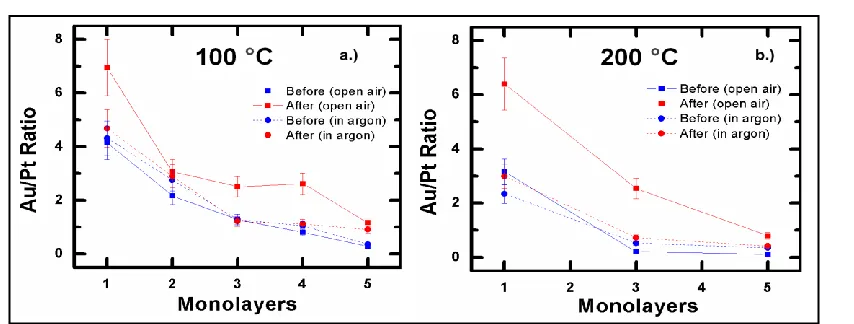
Figure 3: The ratio of Au to Pt of XPS photoemissions of Pt-Au-CFP samples before and after heating for 15 minutes in open air and under Ar at temperatures: A.) 1, 2, 3, 4, and 5 ML at 100 °C B.) 1,3, and 5 ML at 200 °C
Figure 3 shows the Au/Pt photoemission ratios for CFP based samples heated to 100 °C and 200 °C in both open atmosphere and under Ar for 15 minutes. A higher Au/Pt ratio indicates a higher presence of Au seen in the XPS spectra along the surface of the Pt monolayer catalyst. Figure 3a shows how in an open environment, the presence of Au in the monolayer shell notably increases even when only heated to 100 °C. The presence of Au in the monolayer shell was not seen in the vacuum studies in Figures 1 and 2 until 350 °C.
Removing oxygen from the annealing atmosphere by heating under Ar shows that the Au/Pt ratio remains more intact. At 200 °C, as seen in Figure 3b, the Au/Pt ratio is further increased, revealing that samples heated in Ar show diffusion of substrate Au into the Pt over layer.
CONCLUSION
We present careful characterization of surface alloyed nanostructures with respect to the relative core/shell (Pt-Au) compositions and activity using electrochemical and x-ray spectroscopic methods. At operating temperatures of 100°C and above, there is potential for interdiffusion to occur between the primary and support metals of bimetallic core-shell catalyst systems. The presence of Au in the monolayer shell was not seen in the temperature raising between (100-350) °C whereas the Pt is characterized at 71ev and 74ev. Then more than 350°C the Au diffusion into Pt over layer is observed, at 84 ev and 88 ev. This result was checked by using x-ray photoelectron spectroscopy (XPS) technique.
REFERENCES
[1]. Paddison, S.; Gasteiger, H., PEM Fuel Cells, Materials and Design Development Challenges. In Fuel Cells SE - 11; Kreuer, K.-D., Ed.; Springer: New York, 2013; pp 341−367.
[2]. Selvarani, G.; Selvaganesh, S. V.; Krishnamurthy, S.; Kiruthika, G. V. M.; Sridhar, P.; Pitchumani, S.; Shukla, A. K. J. Phys. Chem. C 2009, 113, 7461.
[3].Ge, X.; Wang, R.; Liu, P.; Ding, Y. Chem. Mater. 2007, 19, 5827.
[4]. Goodenough, J. B.; Hamnett, A.; Kennedy, B. J.; Manoharan, R.; Weeks, S. A. J. Electroanal. Chem. 1988, 240, 133.
[5]. Martin, S.; Garcia-Ybarra, P. L.; Castillo, J. L. Int. J. Hydrogen Energy 2010, 35, 10446.
[6]. Mougenot, M.; Caillard, A.; Brault, P.; Baranton, S.; Coutanceau, C. Int. J. Hydrogen Energy, in press. [7]. Tsiouvaras, N.; Pe~na, M. A.; Fierro, J. L. G.; Pastor, E.; Martínez- Huerta, M. V. Catal. Today 2010, 158, 12. [8]. Li, X. W.; Liu, J. Y.; Huang, Q. H.; Vogel, W.; Akins, D. L.; Yang, H. Electrochim. Acta 2010, 56, 278. [9]. Gavrilov, A. N.; Petrii, O. A.; Mukovnin, A. A.; Smirnova, N. V.; Levchenko, T. V.; Tsirlina, G. A. Electrochim. Acta 2007, 52, 2775.
[10]. Zhao, D.; Wang, Y.-H.; Xu, B.-Q. J. Phys. Chem. C 2009, 113, 20903. [11]. Zhao, D.; Xu, B. Q. Angew. Chem., Int. Ed. 2006, 45, 4955.
[12]. Cao, L.; Tong, L.; Diao, P.; Zhu, T.; Liu, Z. Chem. Mater. 2004, 16, 3239.
118
[14]. Podlovchenko, B.; Gladysheva, T.; Filatov, A.; Yashina, L. Russ. J. Electrochem. 2010, 46, 1189.
[15]. Stamenkovic, V.; Mun, B. S.; Mayrhofer, K. J. J.; Ross, P. N.; Markovic, N. M.; Rossmeisl, J.; Greeley, J.; Norskov, J. K. Changing the Activity of Electrocatalysts for Oxygen Reduction by Tuning the Surface Electronic Structure. Angew. Chem., Int. Ed. 2006, 45, 2897−2901.
[16]. Zhang, G.; Kuang, Y.; Liu, J.; Cui, Y.; Chen, J.; Zhou, H. Electrochem. Commun. 2010, 12, 1233. [17]. Fayette, M.; Liu, Y.; Bertrand, D.; Nutariya, J.; Vasiljevic, N.; Dimitrov, N. Langmuir 2011, 27, 5650. [18]. Zhang, J.; Mo, Y.; Vukmirovic, M. B.; Klie, R.; Sasaki, K.; Adzic, R. R. J. Phys. Chem. B 2004, 108, 10955. [19]. Shao, M. H.; Peles, A.; Shoemaker, K.; Gummalla, M.; Njoki, P. N.; Luo, J.; Zhong, C. J., Enhanced Oxygen Reduction Activity of Platinum Monolayer on Gold Nanoparticles. Journal of Physical Chemistry Letters 2011,2
(2), 67-72.
[20]. Cheng, S.; Rettew, R. E.; Sauerbrey, M.; Alamgir, F. M., Architecture-Dependent Surface Chemistry for Pt Monolayers on Carbon-Supported Au. ACS Appl. Mater. Interfaces 2011,3 (10), 3948-3956.
[21]. Zhang, G.; Kuang, Y.; Liu, J.; Cui, Y.; Chen, J.; Zhou, H., Fabrication of Ag/Au bimetallic nanoparticles by UPD-redox replacement: Application in the electrochemical reduction of benzyl chloride. Electrochemistry Communications 2010,12 (9), 1233-1236.
[22]. Hartl, K.; Mayrhofer, K. J. J.; Lopez, M.; Goia, D.; Arenz, M., AuPt core-shell nanocatalysts with bulk Pt activity. Electrochemistry Communications 2010,12 (11), 1487-1489.
[23]. Fennell, J.; He, D. S.; Tanyi, A. M.; Logsdail, A. J.; Johnston, R. L.; Li, Z. Y.; Horswell, S. L., A Selective Blocking Method To Control the Overgrowth of Pt on Au Nanorods. Journal of the American Chemical Society
2013,135 (17), 6554-6561.
[24]. Leiva, E., Recent developments in the theory of metal upd. Electrochimica Acta 1996,41 (14), 2185-2206. [25]. Herrero, E.; Buller, L. J.; Abruna, H. D., Underpotential deposition at single crystal surfaces of Au, Pt, Ag and other materials. Chem. Rev. 2001,101 (7), 1897-1930.
[26]. Gewirth, A. A.; Niece, B. K., Electrochemical applications of in situ scanning probe microscopy. Chem. Rev. 1997,97 (4), 1129-1162.
[27]. Zhang, J. L.; Vukmirovic, M. B.; Sasaki, K.; Nilekar, A. U.; Mavrikakis, M.; Adzic, R. R., Mixed-metal Pt monolayer electrocatalysts for enhanced oxygen reduction kinetics. Journal of the American Chemical Society 2005,
127 (36), 12480-12481.
[28]. Shao, M.; Sasaki, K.; Marinkovic, N. S.; Zhang, L.; Adzic, R. R., Synthesis and characterization of platinum monolayer oxygen-reduction electrocatalysts with Co-Pd core-shell nanoparticle supports.
Electrochemistry Communications 2007,9 (12), 2848-2853.
[29]. Adzic, R. R.; Zhang, J.; Sasaki, K.; Vukmirovic, M. B.; Shao, M.; Wang, J. X.; Nilekar, A. U.; Mavrikakis, M.; Valerio, J. A.; Uribe, F., Platinum monolayer fuel cell electrocatalysts. Topics in Catalysis 2007,46 (3-4), 249-262.
[30]. Onoe, T.; Iwamoto, S.; Inoue, M., Synthesis and activity of the Pt catalyst supported on CNT. Catalysis Communications 2007,8 (4), 701-706.
[31]. Sen, S.; Sen, F.; Gokagac, G., Preparation and characterization of nano-sized Pt-Ru/C catalysts and their superior catalytic activities for methanol and ethanol oxidation. Physical Chemistry Chemical Physics 2011,13 (15), 6784-6792.
[32]. Cumpson, P. J.; Seah, M. P., Elastic scattering corrections in AES and XPS .2. Estimating attenuation lengths and conditions required for their valid use in overlayer/substrate experiments. Surface and Interface Analysis 1997,
25 (6), 430-446.
[33]. Ge, X.; Wang, R.; Liu, P.; Ding, Y., Platinum-decorated nanoporous gold leaf for methanol electrooxidation.
Chemistry of Materials 2007,19 (24), 5827-5829.