N A N O E X P R E S S
Open Access
Excitonic effects on the second-order nonlinear
optical properties of semi-spherical quantum dots
Jefferson Flórez
*and Ángela Camacho
Abstract
We study the excitonic effects on the second-order nonlinear optical properties of semi-spherical quantum dots considering, on the same footing, the confinement potential of the electron-hole pair and the Coulomb interaction between them. The exciton is confined in a spherical geometry by means of a three-dimensional semi-parabolic potential. We calculate the optical rectification and second harmonic generation coefficients for two different values of the confinement frequency based on the numerically computed energies and wavefunctions of the exciton. We present the results as a function of the incident photon energy for GaAs/AlGaAs quantum dots ranging from few nanometers to tens of nanometers. We find that the second-order nonlinear coefficients exhibit not only a blue-shift of the order of meV but also a change of intensity compared with the results obtained ignoring the Coulomb interaction in the so-called strong-confinement limit.
Introduction
Nonlinear optical properties of semiconductor quantum dots have attracted considerable interest due to their several potential applications [1-4]. In particular, sec-ond-order nonlinear optical properties, such as non-linear optical rectification (OR) and second harmonic generation (SHG), have received special theoretical [5-8] and experimental [9,10] attention due to their magni-tudes being stronger than those of high-order ones, making them the first nonlinear optical effects experi-mentally observed.
The confinement of carriers provided by a quantum dot is well described by a parabolic potential when only the lowest excited states of the carriers are considered. However, self-assembled quantum dots growth in the laboratory usually exhibit asymmetrical shapes that ensure the generation of nonlinear optical effects. In order to model these asymmetries, an asymmetrical potential is required.
Recently, several authors [5,6,8] studied the effects of an exciton on the second-order nonlinear properties in one-dimensional semi-parabolic quantum dots. Using analytical approximate results, they showed that the excitonic effects enhance significantly the OR and SHG coefficients. They used the so-called strong-confinement
limit, ignoring in this way the Coulomb interaction between electron and hole because of the quantum dot dimensions are smaller than the effective Bohr radius, and finding that the excitonic effect reduces itself to an effective-mass model in one particle scheme.
In this study we find eigenenergies and eigenstates of an exciton in a semi-spherical quantum dot solving the corresponding three-dimensional Schrödinger equation using a finite elements method and taking into account both the confinement and Coulomb potentials of the electron-hole pair. We present the OR and SHG coeffi-cients as a function of the incident photon energy with and without Coulomb potential. Our results show that energy and intensity of the peaks in the second-order nonlinear optical coefficients change when Coulomb interaction is introduced.
This article is organized as follows. In “Theory” sec-tion, we present the characteristic quantities of the har-monic and Coulomb potentials, and the definitions of the weak- and strong-confinement limits in terms of these parameters. In addition, we present the analytical expressions for the optical nonlinearities, such as OR and SHG, obtained by the density matrix formalism. In “Results” section, we show the OR and SHG coefficients with and without Coulomb interaction as a function of the incident photon energy for two quantum dot sizes. We also give account of the changes presented by the * Correspondence: [email protected]
Departamento de Física, Universidad de los Andes, A.A. 4976, Bogotá, DC, Colombia
second-order nonlinear coefficients focusing in the role played by the Coulomb interaction. Conclusions are summarized in final section.
Theory
The effective-mass Hamiltonian for the electron-hole pair in the three-dimensional quantum dot reads [11]
H= p
2 e
2m∗e +V(re)+ p2
h
2m∗h +V(rh)− e2
4πε|re−rh|
, (1)
wherem∗eandm∗hare the effective masses of the
elec-tron and the hole, respectively, εis the background
dielectric constant andV (ri) is the three-dimensional semi-parabolic potential that we define as
V(ri)=
⎧ ⎨ ⎩ 1 2m ∗
iω20r2i, 0≤θ <
π
2,
∞, π
2 ≤θ ≤π,
(i= e, h) . (2)
The angleθis the usual polar angle in spherical coor-dinates, andω0 the oscillator frequency considered in
this study the same for the electron and the hole. The potential defined in Equation 2 confines the exciton in the upper half of a sphere, i.e., the quantum dot has a semi-spherical shape.
Hamiltonian (1) can be separated in terms of center-of-mass and relative coordinates, respectively,
H= P
2
2M+
1 2Mω
2 0R2+
p2
2μ+ 1 2μω
2 0r2−
e2
4πε|r|, (3)
where M=m∗e+m∗h is the total mass, and
μ=m∗em∗h/Mis the reduced mass. The center-of-mass and relative position coordinates are defined as usual,
R= m
∗
ere+m∗hrh
M , r=re−rh, (4)
with the corresponding momentaP = -iħ∇R andp= -iħ∇rin terms ofpeandph,
P=pe+ph, p= μ
m∗epe+ μ
m∗hph. (5)
The explicit separability of the center-of-mass and rela-tive coordinates in Equation 3 lead to the following total envelope wave function and total energy for the system:
Ψ (re,rh)=Φ (R) φ (r), (6)
E=ER+Er. (7)
The center-of-mass part of Hamiltonian (3) is a three-dimensional semi-parabolic oscillator that can be solved analytically. Therefore, the problem is now reduced to solve the relative motion Hamiltonian:
Hr=
p2
2μ+ 1 2μω
2 0r2−
e2
4πε|r|. (8)
Hamiltonian (8) has been solved analytically in two limiting cases (strong and weak confinement) for one-dimensional quantum dots. The eigenfunctions and eigenvalues are presented in references [5] and [8]. In one-dimensional case, the confinement potential also imposes constraints to spatial coordinates, resulting in a hydrogen-like (asymmetric-harmonic) reduced particle Hamiltonian for weak (strong) limit.
The harmonic potential in Equation 8 defines both the sizeLof the quantum dot,
L= ¯ h μω0 , (9)
and the energy quantaħω0 due to confinement, which
is related toLby
¯ hω0= ¯
h2
μL2. (10)
On the other hand, the Coulomb potential defines the effective Bohr radiusa∗0and the effective Rydberg energy
R∗of the electron-hole interaction,
a∗0= 4πεh¯
2
μe2 , (11)
R∗= e2
4πεa∗0 =
μe4
¯
h2(4πε)2. (12)
The strong-confinement limit is established when
La∗0, or equivalently hω¯ 0R∗, and the
weak-confinement limit when La∗0, orh¯ω0R∗.
The second-order nonlinear optical coefficients can be obtained by density matrix approach and perturbation expansion method [12,13]. The expression for the OR coefficient, within a two-level system approach, is given by [5,6]
χ(2)
0 = 4
e3σ
s
ε0h¯2
μ2 01δ01
×
ω2 01
1 +T1 T2
+
ω2+ 1
T2 2 T1 T2 −1
(ω01−ω)2+ 1 T2 2
(ω01+ω)2+ 1 T2
2 ,
(13)
where e is the electron charge, ss is the density of
electrons in the quantum dot, T1 is the longitudinal
relaxation time,T2is the transverse relaxation time, and
δ01=| ψ1|r|ψ1 − ψ0|r|ψ0 |, (15)
ω01=
E1−E0
¯
h . (16)
For the resonance condition
¯
hω≈E1−E0, (17)
there is a peak intensity given by (1/T1 ≪ 1/T2 ≪ ω01)
χ(2) 0,max= 2
e3σsT1T2
ε0h¯2
μ2
01δ01. (18)
The SHG coefficient in a three level system is [8]
χ(2) 2ω =
e3N
ε0
× μ01μ12μ20
(h¯ω−E10−ih¯Γ10) (2h¯ω−E20−ih¯Γ20)
. (19)
whereNis the density of carriers in the quantum dot,
Eij=Ei-Ej,Γ10=Γ20=Γ0are the relaxtion rates, and μij=|
ψi|r|ψj
|, (20)
Under the double resonance condition, i.e.,ħω≈ E10≈ E20/2, the intensity of the peak is given by
|χ(2) 2ω,max|=
e3N
ε0
μ01μ12μ20
¯ h2Γ2
0
. (21)
and its energy by
¯
hω≈ E20+ 2E10
4 . (22)
Results
In this study, the results are presented for a GaAs/ AlGaAs structure. We have used the following para-meters in the calculations: m∗e= 0.067m0,m∗h= 0.09m0
(m0 is the mass of a free electron) [4], T1 = 1 ps, T2 =
0.2 ps [12], ss = 5 × 1024 m -3 [5], ε= 12.53, Γ0 = 1/
0.14ps-1,N= 3 × 1016cm-3[8].
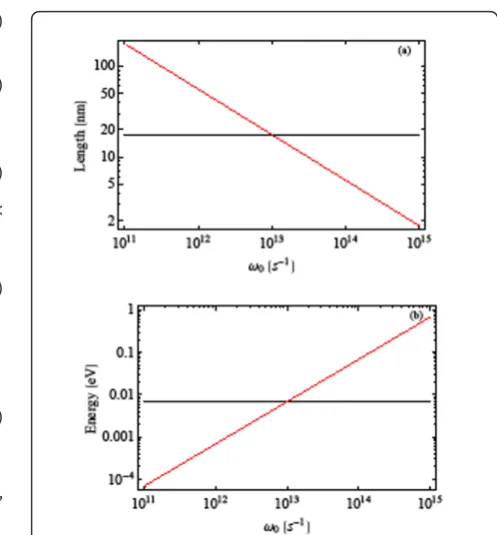
In Figure 1, we plot the characteristic lengths and energies for the confined particle in a GaAs/AlGaAs quantum dot as a function of the confinement frequency ω0. a∗0and R∗are independent on ω0 because they are
related to the Coulomb potential. In Figure 1a, we can see that the lengths Land a∗0are of the same order of magnitude for a confinement frequency aroundω0= 1 ×
1013 s-1. In Figure 1b, we observe that also ħω0 and R∗ show similar values around ω0 = 1 × 10¹³
s-1. For this reason, we conclude that, in this frequency range, neither the strong-confinement limit nor the weak limit
can be assumed because both interactions, harmonic and Coulomb, are important. Therefore, we propose a numerical technique to calculate eigenenergies and eigenstates of Hamiltonian (8), considering the harmo-nic and Coulomb potentials.
With the aim of exploring the nonlinear behavior at higher frequencies, i.e., when the quantum dot size is smaller than in the previous case, we choose ω0 = 2 ×
1014 s-1, in which the quantityL is less thana∗0, orħω0
is greater thanR∗, differing in both cases by one order of magnitude as can be seen in Figure 1. Because of this difference, several authors [5,6,8] used the strong-con-finement limit as a satisfactory approximation in the case of small quantum dots. Accordingly with Equation 9, the frequencies ω0 = 1 × 10¹³ s-1andω0 = 2 × 10¹⁴
s-1 define a quantum dot size ofL = 17.4 nm and L=
3.9 nm, respectively. This means that our results are sui-table for the current quantum dot sizes that range from few nanometers to tens of nanometers.
[image:3.595.59.302.82.319.2]We find numerically eigenenergies and eigenstates of Hamiltonian (8) by a finite elements method for the two frequencies mentioned above. We have used the soft-ware COM-SOL Multiphysics, which offers the possibi-lity of defining a geometry, in this case the upper half of a sphere, and to solve the time-independent Schrödinger equation with appropriate boundary conditions.
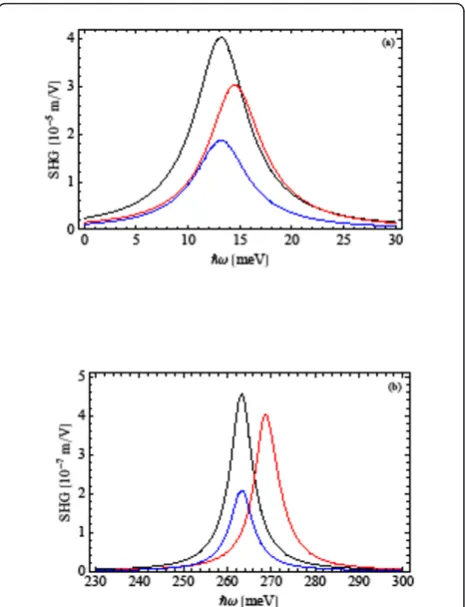
[image:3.595.289.538.84.352.2]The terms involving quantum states and energies in Equations 13 and 19 are found using the eigenstates and eigenenergies previously calculated. The OR and SHG coefficients are shown in Figures 2 and 3, respectively. Figures 2a and 3a correspond to ω0 = 1 × 10¹³ s-1, and
Figures 2b and 3b toω0 = 2 × 10¹⁴ s-1. In each figure,
we present the corresponding nonlinear optical coeffi-cient considering excitonic effects with and without Coulomb interaction. For comparative purposes, we also present the case without excitonic effects, i.e., when only one electron exists in the quantum dot.
Figures 2 and 3 reproduce the reported results quite well [5,8] regarding the enhancement of the nonlinear optical coefficients due to the quantum confinement of the exciton. However, the same figures show addition-ally a significant blue-shift of the OR and SHG peaks when both the harmonic and Coulomb potentials are taken into account. In Tables 1 and 2, we present the eigenenergies of the exciton and peak energies of the OR and SHG coefficients with and without Coulomb interaction for the two frequencies under study. The peak energies are estimated by Equations 17 and 22 for the OR and SHG coefficients, respectively.
We can see from Tables 1 and 2 that the eigenener-gies obtained with Coulomb inter-action are smaller than those obtained without that interaction. The expla-nation to this fact is that there is an attractive Coulomb potential between the electron-hole pair that implies a reduction of the eigenenergies for the exciton. However, the eigenenergies are affected in different ways depend-ing on the quantum state. For example, for the ground stateω0= 1 × 10¹³ s-1, Table 1, we have an energy
[image:4.595.306.539.88.392.2]dif-ference of 5.237 meV, while for the first and second excited states the differences are of 3.472 and 2.784
Figure 2 The OR coefficient as a functions of the incident
photon energyħωfor (a)ω0= 1 × 10¹³s-1and (b)ω0= 2 ×
1014s-1, considering excitonic effects with (red line) and
without Coulomb (black line)interaction. The blue line corresponds to the case without excitonic effects.
Figure 3The SHG coefficient as a functions of the incident
photon energyħωfor (a)ω0= 1 × 10
13
s-1and (b)ω0= 2 ×
1014s-1, considering excitonic effects with (red line) and
[image:4.595.57.292.396.671.2]without Coulomb (black line)interaction. The blue line corresponds to the case without excitonic effects.
Table 1 Eigenenergies of the exciton and peak energies of the OR and SHG coefficients with and without Coulomb interaction forω0= 1 × 10¹³s-1
Energy (meV) With Coulomb Without Coulomb Diff.
E0 11.218 16.455 5.237
E1 26.147 29.619 3.472
E2 40.000 42.784 2.784
OR peak energy 14.929 13.164 1.765
[image:4.595.304.539.654.731.2]meV, respectively. We have a similar situation forω0=
2 × 10¹⁴ s-1, Table 2. This is because the mean spatial separation between the electron and the hole increases, and therefore the Coulomb interaction decreases, as the energy of the quantum state increases. The final result is a blue-shift of the OR and SHG peaks of the order of meV for bothω0= 1 × 10¹³s-1andω0= 2 × 10¹⁴s-1.
In addition, the OR and SHG coefficients exhibit dif-ferent peak intensities depending on the consideration of the Coulomb interaction, as it can be seen in Figures 2 and 3. This fact originates from the modification of the dipole matrix elements defined in Equations14, 15, and 20 when the Coulomb interaction is considered. According to Equation 18, the peak intensity of OR
coefficient depends essentially on the productμ2
01δ01,
while for SHG coefficient, Equation 21, the peak
inten-sity depends onμ01 μ12 μ20. Tables 3 and 4 show the
values of these dipole matrix element products with and without Coulomb interaction for the two frequencies considered. As one can see, the productμ2
01δ01is greater
with Coulomb interaction than without it for both con-finement frequencies. Therefore, in Figure 2a, b, the OR intensity is higher in the former case than in the later one. In the case of SHG coefficient, the productμ01 μ12
μ20 is smaller with Coulomb than without that interac-tion. This fact makes the SHG intensity smaller in the former case as can be seen in Figure 3a, b.
Conclusions
Contrary to the assumption that Coulomb interaction can be neglected when the quantum dot dimensions are smaller than the effective Bohr radius, we show that this interaction affects the excitonic effects of the second-order nonlinear optical properties of semi-spherical quantum dots. We find that Coulomb interaction
manifests itself in a blue-shift of the energy peaks of the order of several meV in the studied spectra. These results were found for two quantum dot sizes, in the first one the characteristic quantities of the harmonic and Cou-lomb potentials are equals, and in the second one they differ by one order of magnitude. This means that the Coulomb interaction plays an important role even when the quantum dot sizes are smaller than the effective Bohr radius.
Therefore, we encourage experimentalists to carry out measurements of second-order optical nonlinearities in asymmetrical quantum dots with the aim of to detect the magnitude of this effect.
Abbreviations
OR: optical rectification; SHG: second harmonic generation.
Acknowledgements
This work was partially supported by Facultad de Ciencias of Universidad de los Andes.
Authors’contributions
JF: carried out the numerical calculations and drafted the manuscript. AC: performed ananalys and interpretation of results, and gave final approval of the version to be published. All authors read and approved the final manuscript.
Competing interests
The authors declare that they have no competing interests.
Received: 25 August 2010 Accepted: 29 March 2011 Published: 29 March 2011
References
1. Fu Y, Hellström S, Ågren H:Nonlinear optical properties of quantum dots: excitons in nanostructures.J Nonlinear Opt Phys Mater2009,18:195. 2. Gotoh H, Kamada H:Coherent nonlinear optical properties in quantum
dots.NTT Tech Rev2005,3:19.
3. Bimberg D, Meuer C, Lämmlin M, Liebich S, Kim J, Kovsh A, Krestnikov I, Eisenstein G:Nonlinear properties of quantum dot semiconductor optical amplifiers at 1.3μm.Chin Opt Lett2008,6:724.
4. Rosencher E, Vinter B:OptoelectronicsCambridge: Cambridge University Press; 2003.
5. Yu Y-B, Zhu S-N, Guo K-X:Exciton effects on the nonlinear optical rectification in one-dimesional quantum dots.Phys Lett A2005,335:175. 6. Baskoutas S, Paspalakis E, Terzis AF:Effects of excitons in nonlinear optical
rectification in semi-parabolic quantum dots.Phys Rev B2006,74:153306. 7. Zhang C-J, Guo K-X, Lu Z-E:Exciton effects on the optical absorptions in
one-dimensional quantum dots.Phys E2007,36:92.
8. Karabulutİ,Şafak H, Tomak M:Excitonic effects on the nonlinear optical properties of small quantum dots.J Phys D: Appl Phys2008,41:155104. 9. Brunhes T, Boucaud P, Sauvage S, Lemaître A, Gérard J-M, Glotin F,
[image:5.595.56.294.122.199.2]Prazeres R, Ortega J-M:Infrared second-order optical susceptibility in InAs/GaAs self-assembled quantum dots.Phys Rev B2000,61:5662. Table 2 Eigenenergies of the exciton and peak energies
of the OR and SHG coefficients with and without Coulomb interaction forω0= 2 × 10¹⁴s-1
Energy (meV) With Coulomb Without Coulomb Diff.
E0 306.59 329.10 22.51
E1 577.06 592.39 15.33
E2 843.31 855.67 12.36
OR peak energy 270.47 263.28 7.19
[image:5.595.304.539.123.162.2]SHG peak energy 269.41 263.28 6.13
Table 3 Dipole matrix element products of the OR and SHG coefficients with and without Coulomb interaction forω0= 1 × 10¹³s-1
Coefficient [nm3] With Coulomb Without Coulomb
OR μ201δ01 1365 1222
SHG M01M12M20 1237 1635
Table 4 Dipole matrix element products of the OR and SHG coefficients with and without Coulomb interaction forω0= 2 × 10¹⁴s-1
Coefficient [nm3] With Coulomb Without Coulomb
OR μ201δ01 16.95 14.03
[image:5.595.54.290.691.730.2]10. Sauvage S, Boucaud P, Brunhes T, Glotin F, Prazeres R, Ortega M, Gérard J-M:Second-harmonic generation resonant with s-p transition in InAs/ GaAs self-assembled quantum dots.Phys Rev B2001,63:113312. 11. Que W:Excitons in quantum dots with parabolic confinement.Phys Rev B
1992,45:11036.
12. Rosencher E, Bois P:Model System for optical nonlinearities: Asymmetric quantum wells.Phys Rev B1991,44:11315.
13. Boyd R:Nonlinear Optics.3 edition. New York: Elsevier; 2008.
doi:10.1186/1556-276X-6-268
Cite this article as:Flórez and Camacho:Excitonic effects on the second-order nonlinear optical properties of semi-spherical quantum dots.Nanoscale Research Letters20116:268.
Submit your manuscript to a
journal and benefi t from:
7 Convenient online submission
7 Rigorous peer review
7 Immediate publication on acceptance
7 Open access: articles freely available online 7 High visibility within the fi eld
7 Retaining the copyright to your article