Number 6003
Konkoly Observatory Budapest
10 November 2011 HU ISSN 0374 – 0676
IMPLICATIONS OF THE NON-DETECTION OF X-RAY EMISSION
FROM HD 149427
STUTE, M.1
; LUNA, G.J.M.2,3
1
Institute for Astronomy and Astrophysics, Section Computational Physics, Eberhard Karls University T¨ubingen, Auf der Morgenstelle 10, 72076 T¨ubingen, Germany
2
Instituto de Ciencias Astronomicas, de la Tierra y del Espacio (ICATE), Av. Espana Sur 1512, J5402DSP, San Juan, Argentina
3
Harvard-Smithsonian Center for Astrophysics, 60 Garden St. MS 15, Cambridge, MA, 02138, USA
1
Introduction
HD 149427 (PC 11 = IRAS 16336-5536 = PN G 331.1-05.7) was first noticed to be a peculiar object by Webster (1966). Its exact nature is not known, several scenarios exist in the literature.
The object is listed in the Planetary Nebula (PN) catalogue of Peimbert & Costero (1961) as PC 11, in the catalogue of Southern PNe of Henize (1967) as Hen 2-172 and in the catalogue of Henize (1976) as Hen 3-1223 based on its Hα emission. Henize (1976) noted that the emission-line spectrum is that of a PN but with a continuum of an F star. Gutierrez-Moreno et al. (1987) systematically investigated HD 149427 using optical photographic, spectrophotometric and spectroscopic observations. They suggested that it is indeed a young peculiar PN. Gutierrez-Moreno et al. (1995) confirmed this with a diagram using the ratios of [OIII]λ4363/Hγ and [OIII]λ5007/Hβ. Parthasarathy et al. (2000) suggested that the central star is a close binary system with an early-F dwarf companion based on UV variations. Webster (1966) classified the object as a symbiotic star (SyS) based on its spectrum. Using NIR observations, Glass & Webster (1973) classified HD 149427 as SyS with a yellow supergiant as cool component, however, their NIR observations could not reliably identify its nature. Allen & Glass (1974) confirmed this result with new NIR observation, but pointed out the high density and high excitation in the nebulosity. Allen (1982) listed it as a D’-type SyS.
distance of 420 pc assuming a luminosity class V. Assuming that the cool component is, however, a giant of luminosity class III, this estimated distance had to be increased to 850 pc (Gutierrez-Moreno & Moreno 1998). Tajitsu & Tamura (1998) derived a distance of 9 kpc using IRAS four-band fluxes. Phillips (2001) used the observed radial velocities of PNe and the galactic rotation curve for measuring the distance to 3.27 kpc. Pereira et al. (2010) analized high-resolution spectra of the late-type companion and found logg
and T values implying a distance of 9.94 kpc. However, using the luminosity of the white dwarf in the system, the distance of about 10 kpc would result in a extremely large white dwarf radius of 0.14 R⊙ (Pereira et al. 2010).
HD 149427 received our attention since it is a member of the list of symbiotic stars with possible jet detections compiled by Brocksopp et al. (2004). Brocksopp et al. (2003) found three peaks and extended emission in HST WFPC2 snapshot images taken in July 1999 with F502N and F656N filters corresponding to the central source and knots at distances of about 2′′
and 12′′
. Radio observations show extended emission in the same direction as the peaks in the HST images (Brocksopp et al. 2003). Gutierrez-Moreno & Moreno (1998) found evidence for jet-like [OIII] emission moving away from the central nebula with a velocity of 120 km s−1
.
X-ray observations provide a direct probe of the two most important components of jet-driving systems: the bow and internal shocks of the jet emitting soft X-rays and the central parts of the jet engine, where gas is being accreted to power the jet, leading to hard X-ray emission. Currently R Aqr (Kellogg et al. 2001, 2007) and CH Cyg (Galloway & Sokoloski 2004; Karovska et al. 2007, 2010) are the only two jets from symbiotic stars that have been resolved in X-rays. All objects with jets, detected in other wavelength, when observed in X-rays, show soft components (< 2 keV; R Aqr, CH Cyg, MWC 560, RS Oph, AG Dra, Z And, V1329 Cyg). The three objects CH Cyg, R Aqr, MWC 560 also emit hard components (Mukai et al. 2007; Nichols et al. 2007; Stute & Sahai 2009). Z And showed hard emission in one of three observations only (Sokoloski et al. 2006).
2
Observation and analysis
We observed the field of HD 149427 withXMM-Newtonin 2009 (Table 2) using the EPIC instrument operated in full window mode and with the medium thickness filter. Simul-taneously, we used the Optical Monitor OM. All the data reduction was performed using the Science Analysis Software (SAS) software package version 8.0. We removed events at periods with high background levels from the pipeline products selecting events with pattern 0–4 (only single and double events) for the pn and pattern 0–12 for the MOS, respectively, and applying the filter FLAG=0. The resulting exposure time after these steps is 33.5 ks.
Instrument Filter Duration UT Start UT Stop
pn Medium 68430 19:05:32 14:06:02
MOS1 Medium 69504 18:43:12 14:01:36
MOS2 Medium 69515 18:43:11 14:01:46
OM U 10× ∼1500 18:51:36 23:49:51
UVW1 10× ∼1500 00:40:11 06:08:27 UVM2 15× ∼1500 06:13:48 15:02:12
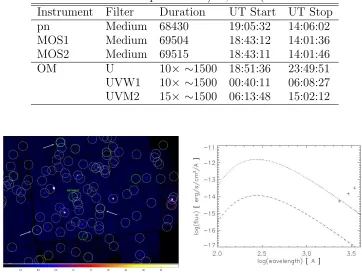
Figure 2. Left: Mosaic of EPIC images of the region around HD 149427 including our detected X-ray sources (white circles), the reference objects fromSIMBAD(green circles) and also the closest source
from theROSATfaint source all-sky survey (red circle). We can clearly identify three objects, for which
theSIMBAD position agrees perfectly with the position found in our source detection run (white
arrows) and thus can exclude any pointing error and indeed report the non-detection of HD 149427 in X-rays. Right: Spectral energy distribution in the optical filtersU,U V W1 andU V M2. Also plotted is
blackbody emission representing a white dwarf with a temperature of 105000 K and radius of 8×10⁸
cm at distances of 850 pc (dotted line) and 9.96 kpc (dashed line). The slope and flux level of the spectral energy distribution indicates that the optical flux is dominated by nebular emission.
3
Results
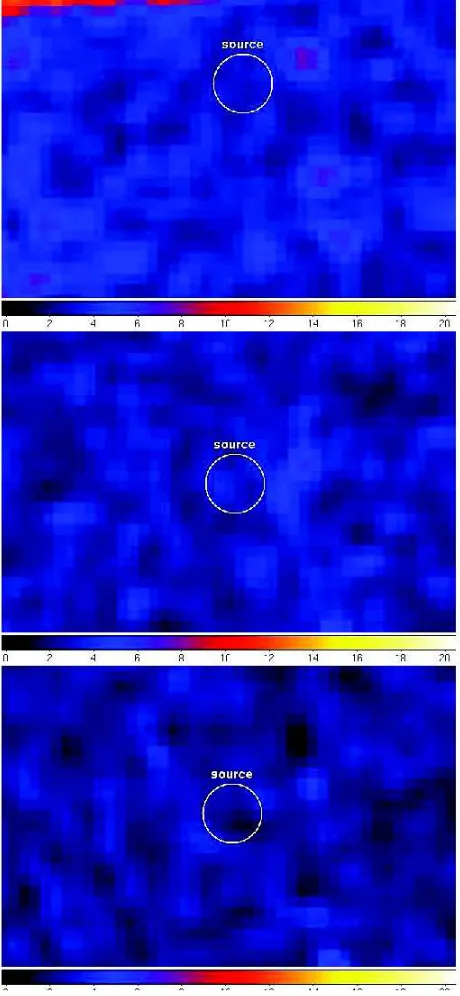
All three X-ray images with the EPIC pn, MOS1 and MOS2 cameras show no detection of emission above background levels centered on HD 149427 using the coordinates from SIMBAD (Fig. 1, white circles). In all bands, however, a faint source is visible, which is about 26′′
[image:4.595.114.476.90.369.2]Contrary to the X-ray band, HD 149427 has been detected in the three optical bands used. The average magnitudes in the optical filters U, UV W1 and UV M2 are 12m. 7,
13m.5 and 14m. 8, respectively. The slope of the spectral energy distribution indicates that the optical flux is dominated by nebular emission (Fig. 2). The flux levels of blackbody emission corresponding to a white dwarf with a radius of 8×108 cm and with an effective temperature of 105000 K at a distance of 850 pc (Gutierrez-Moreno & Moreno 1998) are lower than the measured fluxes.
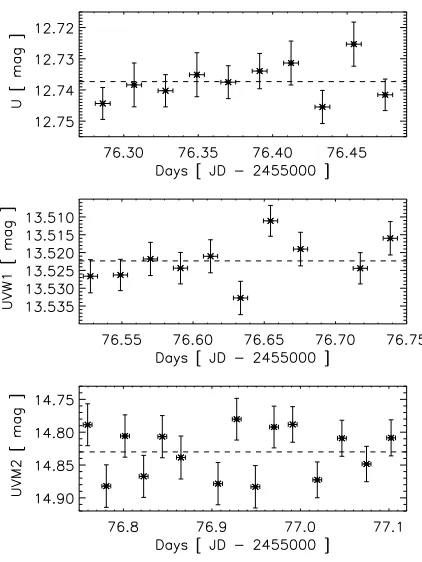
[image:5.595.103.496.319.377.2]We examined the OM photometry (Fig. 3). The optical light curves are consistent with a constant flux. The measured rms variations, those expected from Poisson statistics, and the ratios of these two quantities are listed in Table 3. s and sexp are given in percentage of the mean value. The optical light curves in filters UVW1 and UVM2 where the ratio of measured to expected rms s/sexp is 1.27 and 1.21, respectively, may indicate weak variability, however, the presence of systematic and/or unknown errors is more likely. Since the optical flux is dominated by nebular emission, we do not expect variability in these bands.
Table 2. Measured and expected variations and their ratio
optical filter measured variations expected variationsexp ratio s/sexp
U 0.044 % 0.045 % 0.96
UVW1 0.045 % 0.046 % 1.27
UVM2 0.288 % 0.237 % 1.21
Figure 3. Light curves of the OM exposures for filters U (left, 3440 ˚A),U V W1 (middle, 2910 ˚A) and
[image:5.595.189.400.438.719.2]Using the effective exposure time of 33.5 ks in all instruments, the sensitivity of XMM-Newton (Watson et al. 2001) gives an upper limit of about 10−15
erg s−1
cm−2
in the soft band (<2 keV) and of about 10−14 erg s−1 cm−2 in the hard band (>2 keV).
We can identify several different scenarios for the nature of HD 149427 in the literature: a planetary nebula or a symbiotic star, both either close to us or very distant.
Pereira et al. (2010) favor the idea of HD 149427 being a distant PN at about 10 kpc away from us. From the position of HD 149427 in the [OIII]λ5007/Hβ – [OIII]λ4363/Hγ
diagram, they claim it is neither consistent with that of PNe nor that of symbiotic stars. They argue that the electron density observed in HD 149427 is higher than typical electron densities in PNe, but not as high as observed in D- and D’-type symbiotics. However, the closest object to HD 149427 in this diagram is another D’-type symbiotic. Or is HD 149427 a symbiotic star whose companion just turns into a PN?
In case of HD 149427 being a central star of a PN, we simply expect X-ray emission from a blackbody with a temperature of about 105 K (Gutierrez-Moreno & Moreno 1998) as given in Fig. 2. The emission at 0.2 keV (= 62 ˚A) would be fainter than our upper limits, so our non-detection would have no significant implications.
However, if HD 149427 were a symbiotic star and accretion was present in this object, we would be able to test the accretion rate with important implications (see below).
For deriving the distance to HD 149427, Pereira et al. (2010) used their fits to high resolution spectra, namely their derived values of log g and log T. They estimated the luminosity of the star and calculated the distance to it using a measured V magnitude. They finally derived a distance of 9.94±0.6 kpc. However, using the luminosity of the white dwarf in the system, the distance would result in a extremely large white dwarf radius of 0.14 R⊙ (Pereira et al. 2010). Turning this argument around and using radius
determinations of 0.01–0.02 R⊙ (e.g. Gutierrez-Moreno & Moreno 1998), we would get
a distance of about 0.7–1.5 kpc. A second point of criticism is that the error estimate mentioned above bases only on the error of log g and log T, but not on the error of the
V magnitude. The V magnitudes in the literature vary between 11m.2 and 12m. 7 – the latter value has been used by Pereira et al. (2010). The former value, however, would imply a distance of only about 5 kpc, thus the distance based only on their own data is still highly uncertain. The smallest estimated distance to HD 149427 is only 850 pc (Gutierrez-Moreno & Moreno 1998), therefore we adopt two extremal distances of 850 pc and 10 kpc.
With a distance of 850 pc, the flux upper limits give an upper limit for the soft X-ray luminosity of about 8.6×1028 erg s−1 and for the hard X-ray luminosity of about 8.6×1029 erg s−1; with the highest claimed distance of 9.96 kpc, these limits increase to 1.2×1031 erg s−1
and 1.2×1032 erg s−1
, respectively.
Since accretion should be the main source of hard X-ray emission in this objects, we can convert these upper limits of luminosities into upper limits for the accretion rates. From the definition
Lacc <∼ 1 2
G MM˙
R = 3×10
32erg s−1 M 0.6 M⊙
!
˙
M
10−10M
⊙yr−1
!
8×108cm
R
!
(1)
follows that, after assuming the largest distance, the white dwarf accretes with a rate below 10−10M
⊙ yr
and the surface of the white dwarf is optically thin (Pringle & Savonije 1979; Popham & Narayan 1995) and thus emitting hard X-rays withLacc. In case, the low distance of 850 pc is correct, the upper limit on the accretion rate reduces even to 10−13
M⊙ yr −1
. Gutierrez-Moreno & Moreno (1998) found an electron density of the potential jet knot of 105 cm−3, an electron temperature of 20000 K and a velocity of this knot of 120 km s−1. With a typical ionization fraction at this temperature and a typical compression factor – we assume that the observed values correspond to those of shocked jet material – we derive an (un-shocked) jet density in the same order of magnitude as the measured electron density.
The jet velocity is connected to the velocity of the contact discontinuity or knot via
vknot =vjet √η
1 +√η (2)
with η being the ratio of jet to ambient density. Therefore the jet velocity is always higher than the knot propagation velocity (e.g. a factor 4.2 forη= 0.1 or 1.3 forη= 10). The presence of a jet with a velocity of about 120 km s−1 naturally leads to shocks with temperatures of the order of 0.02 keV, which contribute only marginally to the bands observed with XMM-Newton or Chandra. Higher velocities above 300 km s−1
, however, should lead to soft X-ray emission. Assuming a cylindrical jet with a radius of about 1 AU, the mass-loss rate in the jet is
˙
Mjet =π R2jetnjetmHvjet >2.3×10⁻¹¹M⊙yr
−1. (3)
Since the mass-loss rate through the jet is at most a few percent of the mass accretion rate (depending on the underlying jet formation model), the latter must have been of the order of 10−10 – 10−8 M
⊙ yr
−1 at the time when the jet was formed.
The kinetic luminosity of the jet would be
Lkin = 1 2M˙jetv
2
jet >2×1029erg s
−1
. (4)
Only a fraction of this kinetic luminosity (∼ 1–20 %, Stute & Sahai 2007) would be radiated away in soft X-rays, thus the presence of an X-ray emitting jet cannot be ruled out by our non-detection, independent of adopting the small or large distance. Furthermore we can argue that if a larger fraction of the proposed observation time had not been affected by high background, we might have detected soft emission from the jet.
Another source of soft X-ray emission might be the presence of colliding winds as inβ
systems classified by M¨urset et al. (1991, 1997). Their typical luminosity may also be of the order of 1031 erg s−1.
5
Conclusion
We reported the non-detection of X-ray emission from the enigmatic object HD 149427. This result poses upper limits on the mass accretion rate of the white dwarf. Such low accretion rates are untypical of symbiotic stars and may favor the picture of HD 149427 being a young PN, even if we adopt the larger values of its distance. Unfortunately, the distance to HD 149427 is still highly uncertain.
exciting results for this enigmatic object.
ACKNOWLEDGMENTS: This work is based on observations obtained with XMM-Newton, an ESA science mission with instruments and contributions directly funded by ESA Member States and the USA (NASA). GJML thanks NASA for funding this work by XMM-Newton AO-8 award NNX09AP88G.
References:
Allen, D.A., Glass, I.S. 1974, MNRAS, 167, 337 Allen, D.A. 1982,ASSL, 95, 27
Brocksopp, C., Bode, M. F., Eyres, S. P. S. 2003, MNRAS, 344, 1264 Brocksopp, C., Sokoloski, J. L., Kaiser, C., et al. 2004, MNRAS, 347, 430 Galloway, D. K., Sokoloski, J. L. 2004, ApJ, 613, L61
Glass, I.S., Webster, B.L. 1973, MNRAS, 165, 77
Gutierrez-Moreno, A., Moreno, H. 1998,PASP,110, 458
Gutierrez-Moreno, A., Moreno, H., Cortes, G. 1987,Rev. Mex. A. A., 14, 344 Gutierrez-Moreno, A., Moreno, H., Cortes, G. 1995,PASP, 107, 462
Henize, K.G. 1967, ApJS, 14, 125 Henize, K.G. 1976, ApJS, 30, 491
Karovska, M., Carilli, C. L., Raymond, J. C., Mattei, J. A. 2007,ApJ,661, 1048
Karovska, M., Gaetz, T. J., Carilli, C. L., Hack, W., Raymond, J. C., Lee, N. P. 2010,
ApJ,710, L132
Kellogg, E., Pedelty, J. A., Lyon, R. G. 2001, ApJ, 563, L151 Kellogg, E., Anderson, C., Korreck, K., et al. 2007, ApJ, 664, 1079 Kenny, H.T. 1995, PhD Thesis, University of Calgary
Kerber, F., Mignani, R. P., Smart, R. L., Wicenec, A. 2008, A&A, 479, 155 Maciel, W. J. 1984,A&AS,55, 253
Milne, D.K. 1979, A&AS, 36, 227
Milne, D.K., Aller, L.H. 1975, A&A, 38, 183
Mukai, K., Ishida, M., Kilbourne, C., et al. 2007, PASJ,59, S177
M¨urset, U., Nussbaumer, H., Schmid, H. M., Vogel, M. 1991, A&A, 248, 458 M¨urset, U., Wolff, B., Jordan, S. 1997, A&A, 319, 201
Nichols, J. S., DePasquale, J., Kellogg, E., et al. 2007,ApJ, 660, 651
Parthasarathy, M., Garcia-Lario, P., Pottasch, S. R., et al. 2000, A&A, 355, 720 Peimbert, M., Costero, R. 1961,BOTT, 3, 33
Pereira, C. B., Baella, N. O., Daflon, S., Miranda, L. F. 2010, A&A, 509, A13 Phillips, J.P. 2001, A&A, 367, 967
Popham, R., Narayan, R. 1995, ApJ, 442, 337
Pringle, J. E., Savonije, G. J. 1979,MNRAS, 187, 777
Sokoloski, J. L., Kenyon, S. J., Espey, B. R., et al. 2006, ApJ,636, 1002 Stute, M., Sahai, R. 2007, ApJ, 665, 698
Stute, M., Sahai, R. 2009, A&A, 498, 209 Tajitsu, A., Tamura, S. 1998, AJ, 115, 1989
Watson, M. G., Augueres, J.-L., Ballet, J., et al. 2001, A&A, 365, L51 Webster, L. B. 1966, PASP, 78, 136