- e405. ISSN 0905-7188 DOI: https://doi.org/10.1111/sms.12148 Link to Leeds Beckett Repository record:
http://eprints.leedsbeckett.ac.uk/14/
Document Version: Article
The aim of the Leeds Beckett Repository is to provide open access to our research, as required by funder policies and permitted by publishers and copyright law.
The Leeds Beckett repository holds a wide range of publications, each of which has been checked for copyright and the relevant embargo period has been applied by the Research Services team.
We operate on a standard take-down policy. If you are the author or publisher of an output and you would like it removed from the repository, please contact us and we will investigate on a case-by-case basis.
Using the prototype willingness model to predict doping in sport
L. Whitaker a, J. Long a, A. Petróczi b, S.H. Backhouse a a
Carnegie Research Institute, Leeds Metropolitan University, Leeds, UK; b School of Life
Sciences, Kingston University, Kingston Upon Thames, UK
Author Note
Correspondence concerning this article should be addressed to Lisa Whitaker,
Carnegie Research Institute, Leeds Metropolitan University, Headingley Campus, Leeds, LS6 3QS, UK.
Telephone number: +44 (0)113 812 4684
Abstract
To enable preventive measures to be designed, it is important to identify modifiable distal and proximal factors underlying doping behaviour. This study investigated aspects of the
prototype willingness model in relation to doping. A cross-sectional study was conducted involving 729 competitive athletes. Following ethical approval, athletes (mean age= 28.8 ±
10.1 years; 63% male) completed an online questionnaire which assessed doping-related attitudes, norms, prototype perceptions, outcome expectancies and behavioural willingness. Using hierarchical multiple regression analysis, 54.4% of the total variance in willingness to
dope was explained. Specifically, past doping, attitudes and favourability of performance enhancing substance user prototypes were the strongest unique predictors of willingness to
dope. Athletes appeared most willing to dope if they were to suffer an injury, a dip in performance or think others are doping and getting away with it. National level athletes
displayed significantly greater willingness to dope (Kruskal-Wallis 2= 35.9,
p < .001) and perceived themselves as significantly more similar to a doper (Kruskal-Wallis 2 = 13.4,
p = .004) than athletes competing at any other level. The findings highlight the importance of extending anti-doping provision beyond elite level sport and the need to target athletes’ doping-related perceptions.
Key words: Performance enhancing substances; possible selves; prevention; anti-doping
Introduction
Recurring doping headlines illustrate that an appetite for using performance enhancing substances (PES) remains despite a greater emphasis on preventative education
and increased efforts to detect such use through drug testing. However, testing programmes typically target those competing at the elite/professional level and this is problematic because
research has shown that PES use is ubiquitous across the sporting landscape (Pitsch & Emrich 2011). Equally, the costs and logistics associated with carrying out drug testing are also inherent limitations of detection-based deterrence. In light of these limitations, the World
Anti-Doping Agency (WADA) emphasises the importance of preventative education (Fahey 2009), which aims to inhibit the initiation of doping behaviours.
To prevent doping in sport, an understanding of the psychosocial mechanisms involved in the decision making processes which shape athletes’ chosen performance enhancement methods is necessary (Petróczi & Aidman 2008). Thus far, Ajzen's theory of
planned behaviour (TPB; Ajzen 1985) has been the dominant framework applied to examine doping behaviour in sport (e.g., Goulet et al. 2010; Lucidi et al. 2008). Research utilising the TPB or elements of the TPB within integrated social cognition models have found attitudes
and social norms to emerge as predictors of doping behaviour through the mediator intentions (e.g., Lucidi et al. 2008; Wiefferink et al. 2008). However, intentions do not account for
behaviours which may occur in response to a risk-conducive circumstance (Gibbons et al. 2006). Therefore, it is important to acknowledge the possibility that an athlete may use PES if a certain situation arises, even though they may have no prior intention to dope.
The prototype willingness model (PWM; Gibbons et al. 2003) is a dual-processing model that considers personal, social and environmental factors. Previous research utilising
behaviours (e.g., condom use, exercise, healthy eating; Blanton et al. 2001; Rivis & Sheeran 2003). The PWM comprises two pathways – the reasoned and the reactive. The reasoned pathway consists of intentions and the antecedent’s attitudes and perceived norms as
previously explored through the TPB. In contrast to the TPB, the PWM incorporates
descriptive norms (i.e., what significant others actually do) rather than injunctive norms (i.e.,
what significant others think the person ought to do). This is pertinent because the predictive validity of the TPB following the inclusion of descriptive norms has been enhanced (Rivis & Sheeran 2003). As such, descriptive norms have been examined within doping-related studies
utilising the TPB (Lazuras et al. 2010; Wiefferink et al. 2008). In addition, athletes who use PES tend to overestimate doping behaviour among other athletes (Uvacsek et al. 2009).
Therefore, athletes who perceive others in their sport to be using PES may be more willing to dope themselves, warranting the inclusion of descriptive norms in this study.
In contrast to the reasoned pathway, the social reaction pathway focuses on
willingness to perform a behaviour and acknowledges that risk behaviours can occur in response to a risk-conducive circumstance despite an individual previously having no intentions of performing the behaviour. An athlete may be willing to dope in response to a
request from a team mate or coach. Similarly, athletes may be willing to dope to fit in with others in their training group (Kirby et al. 2011). It is proposed that this momentary
temptation may give rise to more planned and assisted doping behaviours in the future. Consequently, applying the PWM to doping will allow for athletes’ openness to the opportunity of using PES to be examined, which so far has not been possible through the
application of the TPB. The PWM also suggests that willingness to perform a given
behaviour is influenced by attitudes, social norms and risk prototype perceptions, which refer
more willing they are to engage in the behaviour (Zimmermann & Sieverding 2010). At present, prototype perceptions in relation to willingness to dope have yet to be investigated. Finally, previous research has suggested that expectancies can influence behaviour even
though they may not be a true reflection of actual behavioural outcomes (Hasking & Oei 2008). Therefore, various outcome expectancies may provide insight into why athletes
initially start to use PES and subsequently may complement the PWM in predicting athletes’ willingness to dope.
In sum, the present study is based on the assumption that willingness to dope is the
outcome of the interplay between athletes’ attitudes, norms, prototype perceptions and outcome expectancies. Therefore, the key aim is to use the PWM to investigate gender and
level of competition differences in athletes’ willingness to dope. In turn this will inform anti-doping education by highlighting which athletes are most willing to dope and when athletes are most willing to dope.
Methods
Participants
The study involved 729 competitive athletes with a mean age of 28.8 ± 10.1 years.
The highest proportions of participants were from cycling (14%), athletics (12.3%), badminton (8.5%), football (7.5%) and hockey (7%), with 63% of the athletes being male.
The sample included a spectrum of competitive levels with 31% of athletes competing at club/university level, 19% county, 20% national and 29% international level. Athletes were recruited using a convenience sampling method via a number of gatekeepers. National
governing bodies, local clubs, coaches and known athletes were approached to help with recruitment. Furthermore, social networking sites were used to increase the reach of the
study. Ethical approval was gained from the University research ethics committee.
nature of participation and that submission of the questionnaire implied consent, was emphasised.
Measures
The online questionnaire consisted of several parts including demographics, PES user and non-user prototype perceptions, willingness to dope, PES norms, PES outcome
expectancies, PES use, the performance enhancement attitude scale (PEAS; Petróczi & Aidman 2009) and the Impression Management (IM) subscale of Paulhus' Balanced Inventory of Desirable Responding (1988). Participants were provided with the WADA
Code’s definition of PES (WADA 2009) along with examples of PES to assist them with the completion of the questionnaire.
Prototype perceptions. Four questions were used to assess athletes’ prototype
perceptions relating to PES users and non-users. Participants were asked to identify how favourable they perceived a PES user/non-user to be from highly unfavourable (0) to highly
favourable (100). Then, participants reported whether or not the characteristics they perceived to describe a PES user/non-user also described them on a five-point scale from definitely not (0) to definitely yes (4).
Willingness to dope. Participants were provided with 10 scenarios1 relating to times when an athlete may be willing to use a banned substance (e.g., you suffer a dip in
performance and your contract/funding is under threat, you are approaching the end of your career and are struggling to keep up with the younger athletes). Scenarios were designed in relation to the findings from a previous study (Whitaker 2013) as well as the findings from
previously published literature which identified possible reasons for athletes to dope. After the scenarios were presented, participants were asked to rate how willing they would be to
use a banned substance in that situation from not at all willing (0) to extremely willing (6). All 10 item scores were added up to calculate athletes’ total willingness (between 0 and 60), with a high score indicating greater willingness to dope.
Norms. Participants’ social projection of doping in their sport was assessed through
the two questions “of the athletes you know in your sport, how many use banned
substances?” and “of the four athletes you know best, how many use banned substances?” Participants’ rated their responses on a four-point scale from none (0) to all (3). Descriptive norms were calculated by adding the two items together. In addition, subjective norms were
examined through the use of four questions. Participants were asked to indicate whether they believed their coach/doctor/fellow athletes/family would approve of them using banned
substances on a six-point scale from definitely no (0) to definitely yes (5). PES norms were calculated by adding up the scores on the four items relating to subjective norms. Scores range from 0-20 with high scores representing greater approval from significant others to use
PES.
Outcome expectancies. Participants were asked to indicate from strongly disagree (1)
to strongly agree (6), how much they agreed with 14 items that related to potential positive
and negative outcomes associated with the use of PES. For example, participants were asked to indicate how much they agreed that a banned substance could result in financial gain,
achieve optimal muscle size and result in a ban. Negative items were reversed so that a total outcome expectancies score could be calculated. Total outcome expectancies scores above the hypothetical mean (49) indicated more positive outcome expectancies.
Performance enhancement use. This section was designed to gain information on
athletes’ use of PES. Participants were asked to report whether they currently use a banned
performance and whether they intended to use a banned substance at least once within the next 12 months.
Attitudes. Participants’ attitudes towards doping were measured using the PEAS, which is a 17-item questionnaire where responses range from strongly disagree to strongly agree on a six-point Likert-type scale (see Petróczi & Aidman 2009 for further detail).
Social desirability. The IM subscale of Paulhus' Balanced Inventory of Desirable Responding (1988) which includes 20 items measured on a five-point Likert-type scale (from not true to very true) was used to measure social desirability. For each question, certain
responses (4 and 5 for the negatively worded items and 1 and 2 for the other items) were identified as 'hits' and scored one point every time they were chosen. Total number of hits
were calculated with scores > 12 indicating a tendency to appear in a favourable light ('faking good') thus the presence of an image enhancing bias in other self-reported variables.
Statistical analysis
SPSS 20.0 for Windows was used to conduct data analysis. The Kolmogorov Smirnov test, along with skewness and kurtosis values, indicated that the data were not normally
distributed. Therefore, data were analysed using nonparametric statistics (Mann-Whitney U
and Kruskal-Wallis 2) to compare the differences in variables between groups of
participants. The level of significance was set at p= .05. Finally, hierarchical regressions were used to identify the predictors of athletes’ willingness to dope.
Results
Performance enhancement use
Of the athletes who responded, 2.3% of athletes admitted currently using PES, whilst 4.5% reported previous use (1.2% had used once and never since, 1.8% occasionally used
Doping attitudes
Examination of athletes’ attitudes highlighted that some groups of athletes have significantly more positive attitudes towards doping than others as indicated by the total
PEAS score (M = 32.2, SD = 11.6). International level athletes (M = 30.1, SD = 9.5) displayed the most negative attitudes towards doping compared to athletes competing at
club/university (M = 33.6, SD = 12.4), county (M = 32.0, SD = 11.8) and national level (M =
33.3, SD = 11.7; 2 = 9.6, p = .022). In contrast, current self-declared users (M = 56.3, SD =
21.3) reported significantly more positive attitudes towards doping than non-users (M = 31.7,
SD = 10.6; U = 1598.5, p < .001). Males (M = 33.8, SD = 12.6) also held significantly more positive attitudes towards doping than females (M = 29.9, SD = 9.3; U = 36908.5, p < .001).
Prototype perceptions
National level athletes (M = 0.7, SD = 0.9) perceived themselves as significantly more similar to PES users compared to athletes competing at club/university (M = 0.5, SD = 0.9),
county (M = 0.5, SD = 0.9) and international level (M = 0.5, SD = 0.9; 2 = 13.4, p = .004).
Similarly, males (M = 0.6, SD = 1.0) reported that they were significantly more similar to PES users compared to females (M = 0.4, SD = 0.8; U = 48190, p =.028). In addition, males (M = 16.6, SD = 25.6) reported PES users as significantly more favourable than females (M =
10.1, SD = 19.4; U = 45016.5, p < .001). In contrast, females (M = 90.9, SD = 16.5) were significantly more favourable of non-users compared to males (M = 87.3, SD = 18.7; U = 43452, p = .001). Furthermore, a significant difference was observed between current PES
users’ and non-users’ favourability of PES users (U = 2579, p < .001) and non-users (U = 3644.5, p = .019). More specifically, current PES users perceived PES users as more
favourable and non-users as less favourable than those athletes who did not report current PES use.
Athletes competing at international level (M = 2.7, SD = 7.4) were portrayed as least willing to use PES when compared to club/university (M = 7.7, SD = 13.1), county (M = 7.1,
SD = 12.5) and national level athletes (M = 8.3, SD = 13.1; 2= 35.9, p < .001). In contrast, males (M = 7.8, SD = 13.6) were significantly more willing to dope than females (M = 3.8,
SD = 8.3; U = 42629, p < .001). Athletes appeared to be most willing to use PES if they were to suffer a dip in performance and their funding was under threat (M = 0.8, SD = 1.5), if they
were to suffer an injury before a major competition (M = 0.8, SD = 1.4) or if they thought everyone they were competing against was using PES and getting away with it (M = 0.8, SD = 1.5).
Norms
Fellow athletes and coaches were perceived by more athletes (7% and 6%
respectively) to approve of them using banned substances compared to doctors and family (1% each). Club/university athletes (M = 1.6, SD = 2.8) believed PES use would be approved of by significant others more than county (M = 1.1, SD = 2.0), national (M = 1.2, SD = 2.5)
and international athletes (M = 0.6, SD = 1.4; 2= 28.4, p <.001). Similarly, males (M = 1.4,
SD = 2.6) perceived significant others to approve of PES use more than females (M = 0.6, SD = 1.5; U = 39558.5, p <.001). In addition, males (M = 0.4, SD = 0.7) perceived more athletes
in their sport to use PES than females (M = 0.2, SD = 0.5; U = 43507, p < .001). Equally, athletes from individual sports (M = 0.7, SD = 1.3) perceived more athletes in their sport to use PES than athletes from team sports (M = 0.4, SD = 0.9; U = 45831.5, p = .001). Club/
university athletes (M = 0.6, SD = 1.2) also perceived more athletes in their sport to use PES than county (M = 0.4, SD = 1.1), national (M = 0.5, SD = 1.1) and international athletes (M =
0.5, SD = 0.9; 2= 9.6, p = .022).
Male athletes (M = 44.2, SD = 8.7) demonstrated significantly more positive outcome expectancies than females (M = 39.5, SD = 10.5; U = 4220.5, p < .001). However, there was no significant difference in the total outcome expectancies scores between club (M = 43.26,
SD = 8.9), county (M = 41.9, SD = 9.5), national (M = 43.4, SD = 8.7) and international level
athletes (M = 41.4, SD = 10.8; 2= 6.1, p = .106).
Hierarchical regression
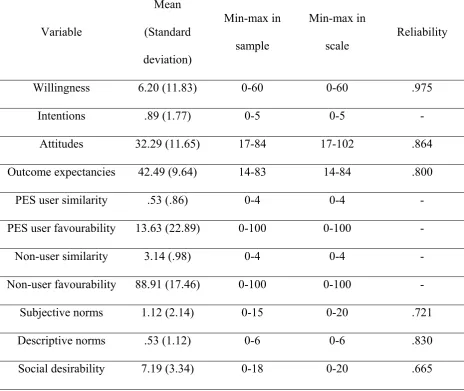
The means, standard deviations and reliability scores were calculated for each scale (Table 1). The PEAS, outcome expectancies, subjective norms and willingness scales all demonstrated good internal reliability (α > .70) whilst the social desirability scale
demonstrated adequate reliability (KR-21 > .60). Correlation coefficients between each of the measured variables are shown in Table 2. All correlations were below .70 therefore,
multicollinearity was not evident (Tabachnick & Fidell 1996). Correlations between social desirability and the other variables were in the expected direction. Correlations with social desirability were also < .20 suggesting that the PWM variables were not strongly influenced
by social desirability. However, it is important to monitor social desirability even when social desirability bias is not concerning among individual variables, as the accumulated effect may
be significant (Petróczi & Nepusz 2011). In the present study, 36 participants (4.9%) scored >12 hits on the IM subscale. Therefore when conducting the hierarchical regressions, social desirability was controlled for rather than removing participants. Along with social
Table 1. Descriptive and reliability statistics
Variable
Mean (Standard deviation)
Min-max in
sample
Min-max in
scale
Reliability
Willingness 6.20 (11.83) 0-60 0-60 .975
Intentions .89 (1.77) 0-5 0-5 -
Attitudes 32.29 (11.65) 17-84 17-102 .864
Outcome expectancies 42.49 (9.64) 14-83 14-84 .800
PES user similarity .53 (.86) 0-4 0-4 -
PES user favourability 13.63 (22.89) 0-100 0-100 -
Non-user similarity 3.14 (.98) 0-4 0-4 -
Non-user favourability 88.91 (17.46) 0-100 0-100 -
Subjective norms 1.12 (2.14) 0-15 0-20 .721
Descriptive norms .53 (1.12) 0-6 0-6 .830
Social desirability 7.19 (3.34) 0-18 0-20 .665
Table 2. Correlations between all variables
1 2 3 4 5 6 7 8 9 10 11 12 13
1. Willingness -.160** -.149** .535** -.194** .501** .490** -.220** -.304** .591** .502** .342** .433**
2. Gender .167** -.121* .059 -.132** -.091* .094* .027 -.163** -.172** -.234** -.145**
3. Level of competition -.037 .015 -.061 .005 .027 .046 -.108* -.177** -.056 -.030
4. PES use -.030 .319** .401** -.179** -.260** .453** .378** .290** .532**
5. Social desirability -.080* -.100* .048 .078** -.147** -.129** -.145** -.043
6. PES user favourability .402** -.282** -.237** .469** .367** .268** .342**
7. PES user similarity -.219** -.334** .451** .387** .296** .361**
8. Non-user favourability .410** -.294** -.144** -.114* -.188**
9. Non-user similarity -.281** -.165** -.172** -.209**
10.Attitudes .484** .381** .462**
11.Subjectivenorms .265** .454**
12.Outcome expectancies .292**
13.Descriptive PES norms
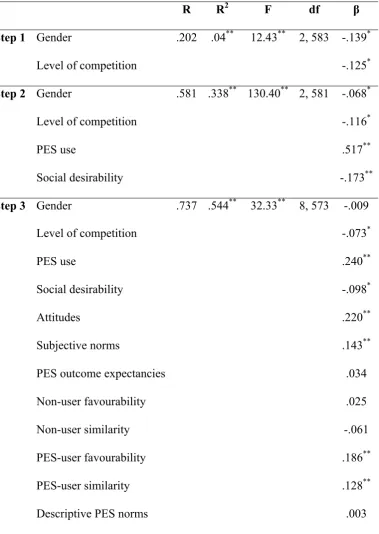
Gender and level of competition were entered in step 1, explaining 4% of the variance in willingness to dope, F (2, 583) = 12.43, p < .001. PES use and social desirability were then entered in step 2, explaining an additional 29.7% of the variance in willingness to dope, F (2,
581) = 130.40, p < .001; Table 3). After entry of PES attitudes, outcome expectancies, social norms, descriptive norms and PES user and non-user prototype perceptions an additional
20.6% of the variance in willingness to use PES was explained (R squared change = .206, F change (8,573) = 32.33, p < .001). The significant predictors of willingness to dope in order of magnitude were previous PES use, PES attitudes, PES user favourability, social norms,
PES user similarity, social desirability hits and level of competition. In step 3, PES outcome expectancies, non-user similarity, non-user favourability, descriptive norms and gender did
Table 3: Hierarchical multiple regression analyses
R R2 F df β
Step 1 Gender .202 .04** 12.43** 2, 583 -.139*
Level of competition -.125*
Step 2 Gender .581 .338** 130.40** 2, 581 -.068*
Level of competition -.116*
PES use .517**
Social desirability -.173**
Step 3 Gender .737 .544** 32.33** 8, 573 -.009
Level of competition -.073*
PES use .240**
Social desirability -.098*
Attitudes .220**
Subjective norms .143**
PES outcome expectancies .034
Non-user favourability .025
Non-user similarity -.061
PES-user favourability .186**
PES-user similarity .128**
Descriptive PES norms .003
Discussion
Applying the PWM to doping in sport, the purpose of this study was to determine self-reported PES use, athletes’ willingness to dope and predictors of willingness to dope
from a range of psychosocial variables. In terms of self-reported use, 2.3% of athletes
declared that they were currently using PES and 4.5% indicated that they had previously used
PES. Our findings highlight the need for a shift in focus of anti-doping policy so that prevention-deterrence programmes are not limited to elite/professional sport. Whilst they need to reach across the sporting landscape, this study highlights a specific need to target
national level athletes in the first instance.
Anti-doping education needs to reach national level athletes and move beyond its current
compliance focus
A key finding of the present study was that national level athletes may be particularly at risk of doping in comparison to athletes competing at any other level. These findings
provide support for previous work carried out by Pitsch and Emrich (2011) who suggest that doping is a greater problem among sub-elite athletes than those competing at international level. Owing to financial constraints, a very small proportion of competing sportsmen and
women are part of the national registered testing pool. Thus, national level athletes are not likely to be deterred from using PES by drug testing because the focus of current anti-doping
policy is skewed towards the elite level athlete. This study has highlighted that more emphasis should be placed on targeting preventative education at national level athletes so that the WADA and UNESCO can fulfil their aim of ensuring all athletes have the right to
compete in clean honest sport (UNESCO 2006; WADA 2009).
One factor differentiating the current study from previous research investigating
to dope. This suggests that athletes who perceive PES users favourably or similar to themselves will theoretically be more likely to dope. As a result, distorted doping-related perceptions could be damaging to athletes by encouraging doping through future possible
selves (Whitaker et al. 2012). For example, if athletes evaluate a PES user favourably, they may aspire to that as a possible self and behave accordingly (e.g., if offered PES when
struggling with performance). Prototype perceptions influence behavioural willingness and as a result, changes in prototype perceptions could lead to changes in risk behaviour (Thornton et al. 2002). Owing to this, the impact of PES user prototype perceptions on doping behaviour
warrants further investigation. Moreover, prototype perceptions have been identified as a target for prevention programmes aimed at smoking and drinking among adolescents
(Andrews et al. 2008) following their success in reducing risky behaviours. Therefore, targeting athletes’ doping-related perceptions offers a new approach to anti-doping by extending the focus beyond doping control compliance. This shift may serve to increase the
effectiveness of doping prevention.
As well as the prototype perceptions, findings suggest that descriptive norms may warrant further investigation. Males, athletes from individual sports and those competing at
club/university level believed significantly more athletes in their sport were using PES compared to females, athletes from team sports and athletes competing at any other
performance level. Athletes may be vulnerable to doping if they believe that others are using PES (Kondric et al. 2011), particularly without sanction. Supporting this idea is the finding that athletes were most willing to use PES if they thought others were using in their sport and
getting away with it. Therefore, anti-doping education programmes need to find a way of addressing this factor by continuing to promote anti-doping role models and attempting to
doping-related perceptions. Instead, interventions which place emphasis on responsibility and
ownership of a behaviour (i.e., focus on the individual rather than the situation) may be more appropriate (Pomery et al. 2009).
Increased willingness to dope- be vigilant if an athlete suffers an injury, dip in performance
or funding cut threat
In the present study, athletes were most willing to use PES if they were to suffer a dip in performance and their funding was under threat or if they were to suffer an injury before a major competition. These findings corroborate previous research which suggests that doping
may be a dynamical response, which is more likely to occur if athletes suffer a period of distress or instability (Hauw & Bilard 2011). More specifically, the findings replicate
previous research suggesting athletes may be willing to dope to help maintain current living standards or following injury (Bloodworth & McNamee 2010), particularly if the timing of the injury coincided with a major competition (Mazanov & Huybers 2010).
Anti-doping agencies need to work with key partners to develop interventions which help athletes deal with periods of instability. Athletes need to be supported in developing key life skills such as effective decision making and resilience (Backhouse et al. 2012; Kondric et
al. 2011) to ensure that they are able to cope when a negative situation arises. One suggestion that is currently being investigated is to include moral and ethical decision-making in
anti-doping education, which encourages athletes to confront ethical dilemmas and resolve them spontaneously before being provided with training to provoke moral evaluations of their decision (Melzer et al. 2010). Anti-doping education needs to become more than a provision
which equips athletes to confidently undergo urine sample provision, complete whereabouts and be knowledgeable about the prohibited substance list (Backhouse et al., 2012). However,
Limitations and future directions
One of the limitations of using an online questionnaire - combined with convenience sampling via recruitment from gatekeepers - is the inability to include a response rate.
Equally, we are unable to make any conclusions about the exact population from which the sample was drawn. As with any questionnaire, there is likely to be some sample bias which
needs to be acknowledged and the views expressed by those who responded may be different from those who chose not to respond (Nulty 2008). Nonetheless, the size of the sample gives confidence that a suitable range of perceptions was captured. In addition, although this study
identifies doping-related perceptions as a key target for anti-doping interventions, it is important to acknowledge that the results of this study were based upon information athletes
were consciously willing to disclose. Therefore, there may be other risk factors which influence an athlete’s decision to dope which were not revealed. There is also the possibility that participants may have provided socially desirable responses. However, responses to the
survey did not demonstrate any compunction to give socially desirable replies. Further, research suggests that online questionnaires increase the accuracy and reporting of sensitive information compared to other modes of data collection (Kreuter et al. 2008). Future research
could consider taking a longitudinal approach, which would enable athletes to be tracked over a period of time. This would permit potential risk factors to be monitored and targeted
through intervention. Furthermore, a longitudinal approach would allow the efficacy and effectiveness of anti-doping programmes to be assessed with a view to determining the best methods for preventing doping at different stages of an athlete’s career. Moreover, future
research should delve further into athletes’ willingness to dope to determine what makes an athlete become willing to use PES when faced with a particular situation. In addition, it is
insight into how doping-related perceptions are formed. In turn, this knowledge may enhance the ability of policymakers to design effective anti-doping programmes to change
perceptions.
In sum, current anti-doping policy and the WADA Code does not encourage a life skills approach to doping prevention. Furthermore, although the current anti-doping message suggests there is no place for doping in elite sport, the message to sub-elite level athletes is
less clear. The gap between sub-elite athletes and the registered testing pool needs to be addressed to reduce the mismatch in targeted prevention and detection programmes (Kondric
et al. 2011) to heighten the anti-doping message. At present, the availability of funds prevents drug testing from becoming an integrated part of sub-elite sport. Subsequently, it is
paramount that prevention is targeted at the sub-elite level and more specifically at national
level athletes. Anti-doping programmes need to consider the influence of athletes’ doping-related perceptions and future possible selves on doping behaviour. In addition, we need to
increase the relevance of anti-doping to the wider sports society in order to instil anti-doping morals and values and encourage responsibility for this issue across the entire sporting community. The adoption of anti-doping values combined with the development of life skills
may help athletes to deal with risk-conducive situations that promote doping and in turn reduce athletes’ willingness to dope.
Perspectives
An appetite for using performance enhancing substances (PES) still remains despite increased efforts to detect such use through drug testing and sanctioning. Limited resourcing also
means that anti-doping education is compliance driven. A focus on the prohibited substance list, doping control procedures and athletes’ rights and responsibilities does not promote the
Understanding the factors which influence willingness to dope could help to inform anti-doping education and in turn prevent anti-doping behaviour before it begins. Through this
research, the prototype willingness model has demonstrated its potential for predicting doping
behaviour through behavioural willingness. Willingness to dope appears to be influenced by athletes’ attitudes towards doping and their perceptions of PES users. Furthermore, national
level athletes may be particularly vulnerable to doping and there is a pressing need for anti-doping provision to extend beyond elite sport. Targeting anti-doping related perceptions and equipping athletes with the necessary skills to confidently deal with situations which could
References
Ajzen I. From intentions to actions: A theory of planned behaviour. In: Kuhl J, Beckmann J, eds. Action control: From cognitions to behaviour New York: Springer, 1985:11-39.
Andrews JA, Hampson S, Barckley M. The effect of subjective normative social images of smokers on children's intentions to smoke. Nicotine Tob Res. 2008: 10: 589-597.
Backhouse SH, Patterson L, McKenna J. Achieving the Olympic ideal: Preventing doping in sport. Performance Enhancement & Health. 2012: 1: 83-85.
Blanton H, Vanden den Eijnden RJJM, Buunk BP, Gibbons FX, Gerrard M, Bakker A. Accentuate the negative: Social images in the prediction and promotion of condom use. J Appl Soc Psychol. 2001: 31: 274-295.
Bloodworth A, McNamee M. Clean Olympians? Doping and anti-doping: The views of talented young British athletes. Int J Drug Policy. 2010: 21: 276-282.
Fahey J. Are we winning the fight? Play True: World Anti-Doping Agency, 2009:1.
Gibbons FX, Gerrard M, Lane DJ. A social reaction model of adolescent health risk. In: Suls JM, Wallston KA, eds. Social Psychological Foundations of Health and Illness. Oxford: Blackwell, 2003:107-136.
Gibbons FX, Gerrard M, Reimer RA, Pomery EA. Unintentional behavior: A subrational approach to health risk. In: de Ridder D, de Wit J, eds. New perspectives on health behavior: The role of self-regulation. Chichester, UK: John Wiley & Sons Ltd, 2006:45-70.
Goulet C, Valois P, Buist A, Côté M. Predictors of the use of performance-enhancing substances by young athletes. Clin J Sport Med. 2010: 20: 243-248
Hasking PA, Oei TPS. Incorporating coping into an expectancy framework for explaining drinking behaviour. Curr Drug Abuse Rev. 2008: 1: 20-35.
Hauw D, Bilard J. Situated activity analysis of elite track and field athletes' use of prohibited performance-enhancing substances. J Subst Use. 2011: 17: 183-197.
Kondric M, Sekulic D, Petroczi A, Ostojic L, Rodek J, Ostojic Z. Is there a danger for myopia in anti-doping education? Comparative analysis of substance use and misuse in Olympic racket sports calls for a broader approach. Subst Abuse Treat Prev Policy. 2011: 6: 27.
Kreuter F, Presser S, Tourangeau R. Social desirability bias in CATI, IVR and web surveys. Public Opin Q. 2008: 72: 847.
Lazuras L, Barkoukis V, Rodafinos A, Tsorbatzoudis H. Predictors of doping intentions in elite-level athletes: A social cognitive approach. J Sport Exerc Psychol. 2010: 32: 694-710.
Lentillon-Kaestner V, Hagger MS, Hardcastle S. Health and doping in elite-level cycling. Scand J Med Sci Sports. 2011: 22: 596-606.
Lucidi F, Zelli A, Mallia L, Grano C, Russo PM, Violani C. The social-cognitive mechanisms regulating adolescents' use of doping substances. J Sports Sci. 2008: 26: 447-456.
Mazanov J, Huybers T. An empirical model of athlete decisions to use performance-enhancing drugs: qualitative evidence. Qual Res Sport Exerc Health. 2010: 2: 385 - 402.
Melzer M, Elbe A-M, Brand R. Moral and ethical decision-making: A chance for doping prevention in sports? Nord J Appl Ethics. 2010: 4: 69-85.
Nulty DD. The adequacy of response rates to online and paper surveys: what can be done? Assessment & Evaluation in Higher Educ. 2008: 33: 301-314.
Paulhus DL. Manual for the balanced inventory of desirable responding: Version 6. Unpublished manual, University of British Columbia, 1988.
Petróczi A, Aidman E. Psychological drivers in doping: The life-cycle model of performance enhancement. Subst Abuse Treat Prev Policy. 2008: 3:7.
Petróczi A, Aidman E. Measuring explicit attitude toward doping: Review of the
psychometric properties of the Performance Enhancement Attitude Scale. Psychol Sport Exerc. 2009: 10: 390-396.
Pitsch W, Emrich E. The frequency of doping in elite sport: Results of a replication study. Int Rev Sociol Sport. 2011: 45: 559-580.
Pomery EA, Gibbons FX, Reis-Bergan M, Gerrard M. From willingness to intention: Experience moderates the shift from reactive to reasoned behavior. Pers Soc Psychol Bull. 2009: 35: 894-908.
Rivis A, Sheeran P. Social influences and the theory of planned behaviour: Evidence for a direct relationship between prototypes and young people's exercise behaviour. Psychol Health. 2003: 18: 567-583.
Tabachnick BG, Fidell LS. Using multivariate statistics. 3rd ed. New York: Harper Collins 1996.
Thornton B, Gibbons FX, Gerrard M. Risk perception and prototype perception: Independent processes predicting risk behavior. Pers Soc Psychol Bull. 2002: 28: 986-999.
UNESCO. Doping education brochure. Paris: United Nations Educational Scientific and Cultural Organization, 2006.
Uvacsek M, Nepusz T, Naughton DP, Mazanov J, Rànky MZ, Petróczi A. Self-admitted behavior and perceived use of performance-enhancing vs psychoactive drugs among competitive athletes. Scand J Med Sci Sports. 2009: 21: 224-234.
WADA. World Anti-Doping Code. Montreal: World Anti-Doping Agency, 2009.
Whitaker L. Applying the prototype willingness model to doping in sport [PhD]. Leeds: Leeds Metropolitan University, 2013.
Whitaker L, Long J, Petróczi A, Backhouse SH. Athletes’ perceptions of performance enhancing substance user and non-user prototypes. Perform Enhancement Health. 2012: 1: 28-34.
Wiefferink CH, Detmar SB, Coumans B, Vogels T, Paulussen TG. Social psychological determinants of the use of performance-enhancing drugs by gym users. Health Educ Res. 2008: 23: 70-80.