A Monthly Double-Blind Peer Reviewed Refereed Open Access International e-Journal - Included in the International Serial Directories.
GE-International Journal of Engineering Research (GE-IJER) ISSN: (2321-1717)
70 | P a g e
GE-International Journal of Engineering Research
Vol. 4, Issue 8, August 2016 IF- 4.721 ISSN: (2321-1717)
© Associated Asia Research Foundation (AARF) Publication
Website: www.aarf.asiaEmail : [email protected] , [email protected]
PREDICTING SEISMIC BUMPS BY USING CLASSIFIER ENSEMBLES
Sami Halawani
Faculty of Computing and Information Technology, King Abdulaziz University, Jeddah,
Saudi Arabia.
ABSTRACT
Predicting seismic bums is an important research area in mining. As correct prediction
save many human lives, attempts are being made for the correct prediction of seismic bums.
In this paper, we use many machine learning techniques to predict seismic bums. Results
suggest that classifier ensembles generally do not perform well than single classifiers. As the
dataset is imbalanced machine learning techniques developed for imbalanced datasets may be
more useful for seismic mass predictions.
KEYWORDS - Seismic mass, Classifiers, Ensembles, Imbalanced dataset.
1. INTRODUCTION
Mining activity is an important part of our life. However, mining activities have their
hazards effects. Early prediction of the seismic activities may reduce the dangerous effects of
seismic activities and can save the human lives [1]. However, it is not simple to predict these
activities. The task is to predict whether a notable seismic activity will take place or not.
Machine learning techniques are powerful tools to analyze the data [2]. These
techniques are also used to predict the future events. Classification is an important machine
learning technique. In this technique first a model is trained on a given dataset and then a
model is used to predict whether an outcome will take place or not. This problem is called
binary classification. Decision trees, neural networks, support vector machines etc. are
A Monthly Double-Blind Peer Reviewed Refereed Open Access International e-Journal - Included in the International Serial Directories.
GE-International Journal of Engineering Research (GE-IJER) ISSN: (2321-1717)
71 | P a g e
Classifier ensembles are mixture of many classifiers. Each classifier contributes to
the final result of an ensemble. These ensembles have shown better classification accuracy
than single classifiers [3].
In this paper we will use the ensembles of various classifiers to predict the notable
seismic activity. The paper is organized in following way. Section 2 has discussion about the
data set and machine learning techniques used in this paper. Section 3 has results and
discussion. Section 4 has conclusion and future work.
2.MATERIAL AND METHODS
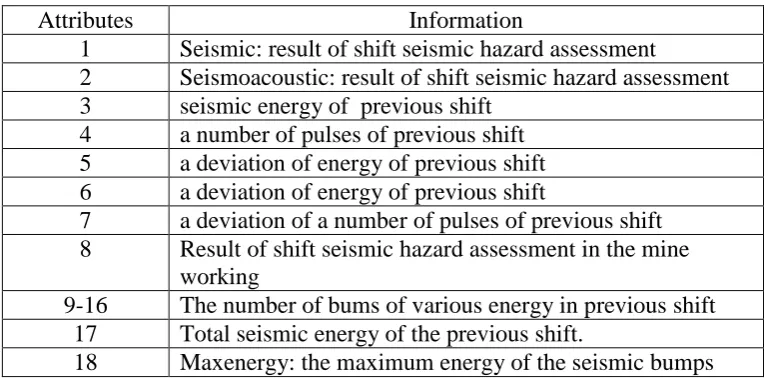
This dataset is collected from Polish mines [1]. The dataset has 2584 data points and
18 attributes. Most of these attribute have the information about the previous shift. The output
has two classes. The dataset has only 170 positive data points. The task is to predict whether
the next day there will be seismic bumps or not. High energy (higher than 104 J) is defined as
[image:2.595.106.491.383.572.2]the targeted seismic bumps. The information about the attributes is given in Table 1.
Table 1- Information about dataset attributes
2.1 Machine Learning Tools
Following machine learning techniques (classification methods) are used for the prediction.
2.1.1 Decision Trees - Decision trees are very popular classifier [4, 5]. It is a rule based
method. It is very popular because of its low computational complexity and good
interpretability. The rules are easily understandable to human beings. While growing a
Attributes Information
1 Seismic: result of shift seismic hazard assessment
2 Seismoacoustic: result of shift seismic hazard assessment
3 seismic energy of previous shift
4 a number of pulses of previous shift
5 a deviation of energy of previous shift
6 a deviation of energy of previous shift
7 a deviation of a number of pulses of previous shift
8 Result of shift seismic hazard assessment in the mine
working
9-16 The number of bums of various energy in previous shift
17 Total seismic energy of the previous shift.
A Monthly Double-Blind Peer Reviewed Refereed Open Access International e-Journal - Included in the International Serial Directories.
GE-International Journal of Engineering Research (GE-IJER) ISSN: (2321-1717)
72 | P a g e
decision tree at each node available data points are divided into two subsets depending upon
the importance of attributes.
2.1.2 Naïve Bayes – Naïve Bayes classifier is a probabilistic classifier [2]. The assumption is
that all attributes are independent. However, these classifiers are very accurate.
2.1.3- Neural networks - These neural networks mimic the human brains [2]. These consist
of interconnected nodes. These neural networks can approximate nonlinear decision
boundaries.
2.1.4- Support vector machines – Support vector machines are very popular classifiers [2].
With proper kernel functions they can easily represent nonlinear decision boundaries.
However, if proper kernel functions are not selected it can give inaccurate results.
2.1.5 Classifier Ensembles – Classifier ensembles are combination of many classifiers [3,
6-9]. Each classifier contributes to the final result. The result of an ensemble is generally more
accurate than a member classifier. The condition for an accurate ensemble is that member
classifiers of the ensemble are accurate and diverse. There are many methods to create
accurate and diverse classifiers. Bagging and Boosting are the two most popular ensemble
methods. We will use these two methods in this paper. These two methods will be discussed
in detail.
2.1.5.1 Bagging – In bagging diverse datasets are created [6]. These datasets are created by
random sampling with replacement. Many datasets are created by using the same method. As
these datasets have different data points these datasets are diverse. Classifiers trained on these
diverse datasets are diverse so they create an ensemble.
2.1.5.2- Boosting - In boosting, classifier are trained one by one [7]. Each data points have
equal weights. One classifier is trained on this dataset. The weights of the points which are
wrongly classified by the classifier are increased so in the next round these points have more
probability to be selected. All classifiers are trained by using this method. In subsequent
round classifiers concentrate more on hard to predict points. The boosting gives accurate
results however when datasets have noisy points it can produce poor results as in subsequent
rounds classifiers will concentrate more on noisy data points.
3.RESULTS AND DISCUSSION
We used WEKA software for our experiments [10]. J48 decision trees were used in
A Monthly Double-Blind Peer Reviewed Refereed Open Access International e-Journal - Included in the International Serial Directories.
GE-International Journal of Engineering Research (GE-IJER) ISSN: (2321-1717)
73 | P a g e
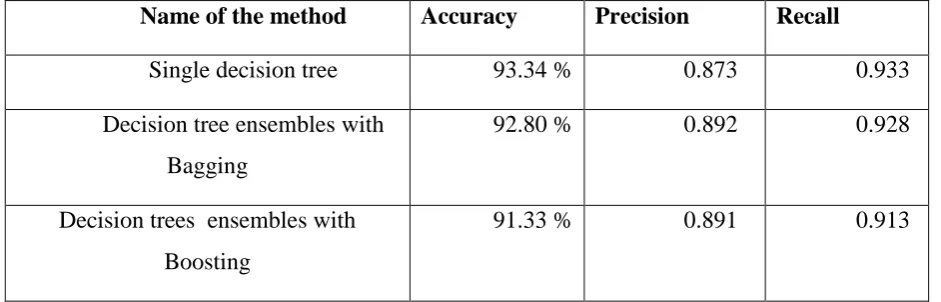
ensemble was 10 for all ensembles. Ten folds cross validation was used. The results are
[image:4.595.64.535.110.261.2]presented in Table 2 – Table 5.
Table 2- Results With Decision Trees
Name of the method Accuracy Precision Recall
Single decision tree 93.34 % 0.873 0.933
Decision tree ensembles with
Bagging
92.80 % 0.892 0.928
Decision trees ensembles with
Boosting
91.33 % 0.891 0.913
Table 3- Results With Naïve Bayes Classifier
Table 4- Results with Neural Networks
Name of the method Accuracy Precision Recall
Single Neural Network 92.45 % 0.891 0.925
Neural Network ensembles with
Bagging
93.29 % 0.913 0.928
Neural Network ensembles with
Boosting
93.24 % 0.925 0.932
Name of the method Accuracy Precision Recall
Single Naïve Bayes 86.27 % 0.907 0.867
Naïve Bayes ensembles with
Bagging
89.99 % 0.907 0.866
Naive Bayes ensembles with
Boosting
A Monthly Double-Blind Peer Reviewed Refereed Open Access International e-Journal - Included in the International Serial Directories.
GE-International Journal of Engineering Research (GE-IJER) ISSN: (2321-1717)
74 | P a g e
Table 5- Results with Support Vector Machines
Name of the method Accuracy Precision Recall
Single Support Vector Machine 93.42 % 0.873 0.934
Support Vector Machine ensembles with
Bagging
93.42 % 0.873 0.934
Support Vector Machine ensembles with
Boosting
93.42 % 0.873 0.934
The results suggest that the ensemble methods do not improve a lot against single
classifier. For example the accuracy of single decision tree is better than ensemble of decision
trees whereas ensemble of decision trees have better precision than single decision tree. For
naïve Bayes classifier the ensembles of Naive Bayes classifiers have better accuracy than
single Naïve Bayes classifiers. However, ensembles of Naïve Bayes classifiers do not show
any improvement in precision. For neural networks ensembles there is a small improvement
in accuracy and precision over single neural networks. For support vector machines
classifiers, ensembles and single classifier perform exactly the same. The reason for this is
that all the data appoints are classified in one class. This shows that support vector machine is
not a good classifier for this problem.
The dataset is an unbalanced dataset in which points of one class is very small. This
could be a reason for poor performance of support vector machines.
4. CONCLUSION
In this paper, we studied predicting seismic bumps by using various machine learning
techniques. Single classifier and ensembles of classifiers were used for this purpose.
Accuracy, precision and recall performance measures were used in our experiments. Results
suggest that ensembles are not very useful for this application. Support vector machines also
did not give good results as it put all the data points in one class.
As this data in unbalanced dataset, in future we will use the methods that have been
A Monthly Double-Blind Peer Reviewed Refereed Open Access International e-Journal - Included in the International Serial Directories.
GE-International Journal of Engineering Research (GE-IJER) ISSN: (2321-1717)
75 | P a g e REFERENCES
1. Sikora M., Wrobel L.: Application of rule induction algorithms for analysis of data
collected by seismic hazard monitoring systems in coal mines. Archives of Mining
Sciences, 55(1), 2010, 91-114.
2. Han, J; Kamber, M;, Pei, J; Data Mining: Concepts and Techniques, Morgan
Kaufmann, 2011.
3. Kuncheva, L. I., Combining pattern classifiers: methods and algorithms. Wiley-IEEE
Press, New York, 2004.
4. Quinlan, J. R., C4.5: Programs for machine learning. CA: Morgan Kaufmann, San
Mateo, 1993.
5. Breiman, L., J. Friedman, R. Olshen and C. Stone, Classification and Regression
Trees. 1st Edn., Chapman and Hall, London, ISBN- 10: 0412048418, 1984.
6. Breiman, L., Bagging predictors. Mach. Learn. 24(2):123–140, 1996.
7. Freund, Y. and R.E. Schapire; A decision theoretic generalization of on-line learning
and an application to boosting. J. Comput. Syst. Sci., 1997, 55: 119-139. DOI:
10.1006/jcss.1997.1504
8. Ho, T. K.; The Random Subspace Method for Constructing Decision Forests, IEEE
Transactions on Pattern Analysis and Machine Intelligence, 1998, 20, no. 8, 832–844.
DOI:10.1109/34.709601
9. Breiman, L., Random Forests, Machine Learning, 2001, 45, no. 1, 5–32.
DOI:10.1023/A:1010933404324.
10. Witten, I. H., and Frank, E., Data mining: practical machine learning tools with java