
GAS TURBINE PERFORMENCE BASED CREEP LIFE ESTIMATION USING SOFT COMPUTING TECHNIQUE
ALMEHDI MOHAMED ZARTI
A thesis submitted in
fulfillment of the requirement for the award of the Degree of Master of Mechanical
Engineering
Faculty of Mechanical and Manufacturing Engineering University Tun Hussein Onn Malaysia
iv
ABSTRACT
CONTENTS
TITLE i
DEDICATION ii
ACKNOWLEDGEMENT iii
ABSTRACT iv
CONTENTS v
LIST OF TABLES viii
LIST OF FIGURES ix
LIST OF SYMBOLS AND ABBREVIATIONS xii
CHAPTER 1 INTRODUCTION 1
1.1 Introduction to Gas Turbines 1.2 Problem Statement
vi
CHAPTER 2 LITERATURE REVIEW 8
2.1 Common Failure in the Gas Turbine Hot Section 2.1.1 Fatigue
2.1.2 High Temperature Corrosion/Oxidation 2.1.3 Creep Deformation
2.2 Creep Life Estimation Approaches 2.1.1 Model-Based Approach
2.1.2 Service-Based Approach
2.1.3 Statistical / Probabilistic Approach 2.1.4 Soft Computing Approach
2.3 Artificial Neural Network
2.3.1 Introduction to Artificial Neural Network 2.3.2 Advantages of Neural Networks
2.3.3 Neuron Model
2.3.4 Multilayer Perceptron Network Architectures 2.4 Some Previous Works
CHAPTER 3 METHODOLOGY 35
3.1 Research Methodology Diagram 3.2 Research Methodology Diagram 3.3 Proposal Model
3.4 Work Setup
CHAPTER 4 DATA ANALYSIS AND DISCUSSION 49 4.1 Result and Discussion
4.2 Effect of Engine Operation and Health Condition on the Blade‟s Creep Life
4.2.1 Effect of Altitude
4.2.2 Effect of Engine Rotational Speed 4.2.3 Effect of Ambient Temperature 4.2.4 Effect of Mach Number 4.3 Train Network
4.3.1 The Performance of the Network Using Unseen Test Samples
4.4 Compare results
viii
LIST OF TABLES
2.1 Finalized parameter(s) for each cluster 32
3.1 Test range of selected parameter 42
3.2 Step size for each parameter 43
3.3 Sample parameter 44
3.4 Training parameter 45
3.5 Error ranges used to assess the performance of the trained
Approximates 48
4.1 Summary of the impact analysis 61
4.2 Percentage of samples within the specified range for all
the Tests 62 4.3 Percentage of samples within the specified range for all
the Tests 64 4.4 Percentage of Samples Encompassed Within the
LIST OF FIGURES
1.1 Schematic for a) an Aircraft Jet Engine; and
b) A land-Based Gas Turbine 2
1.2 Cutaway View of the Rolls-Royce Trent
900 Turbofan Engine 3
1.3 Increase of Firing Temperature With Respect
to Turbine Blade Alloys Development 5
2.1 Deformed Turbine Blades under Creep Attack 11
2.2 Life Span of Hot Section Component Due
to Creep Deformation 12
2.3 Single Input Neuron 18
2.4 Some Common Transfer Functions 19
2.5 Multiple-Input Neuron 20
2.6 A Multiple-Input Neuron Using Abbreviated Notation 20
2.7 A Single-Layer Network of S Neurons 21
2.8 Layer of S Neurons, Abbreviated Notation 22
2.9 Three Layer Network 23
2.10 Abbreviated Notation of Multilayer Network 24
2.11 Back Propagation of Error 25
2.12 Weights and Bias Update 25
2.13 SRT Specimen (a) and Its Location in Blades (b) 27
2.14 Failed Stator Blades 28
2.15 Fracture on the Studied Blade 30
x
2.18 Functional-Based Architecture Based on Mapping2 34 2.19 FB Architecture with Degradation Levels and
Operation 35
3.1 Illustration of Research Idea 36
3.2 Research Methodology Diagram 38
3.3 Mappings 4 39
3.4 Simplified Sensor-Based Architecture for Clean Engine
Case 39
3.5 Engine for Helicopter 40
3.6 Engine Model Configuration 41
3.7 The Neural Network Training 45
3.8 Training, Validation and Test Samples During Network
Training 46
3.9 Training, Validation and Test Samples During Network
Training 47
4.1 Plot of TET Against Altitude 50
4.2 Plot of Tm Against Altitude 51
4.3 Plot of Max Stress Against Altitude 51
4.4 Plot of Mass Flow Against Altitude 52
4.5 Plot of Mach No Against Altitude 52
4.6 Plot of PCN Against Altitude 53
4.7 Plot of Creep Life Against Altitude 53
4.8 Plot of TET Against PCN 54
4.9 Plot of Rotor Temp Against PCN 55
4.10 Plot of Max Stress Against PCN 55
4.11 Plot of Mass Flow Against PCN 56
4.12 Plot of Altitude Against PCN 56
4.13 Plot of Mach No Against PCN 57
4.14 Plot of Creep Life Against PCN 57
4.15 Plot of TET Against Ambient Temperature 58
4.16 Plot of TET Against Rotor Temp 58
4.18 Plot of TET Against Mass Flow 59
4.19 Plot of TET Against Creep Life 60
4.20 Enforcement of SLB Neural Creep Life Estimation Architecture 62
4.21 Percentage of Samples Encompassed Within the Specified Error
Range for Test 1 64
4.22 Percentage of Samples Encompassed Within the Specified Error
Range for Test 2 65
4.23 Percentage of Samples Encompassed within the Specified Error
Range for Test 3 65
4.24 Percentage of Samples Encompassed within the Specified Error
Range for Test 4 66
xii
LIST OF SYMBOLS AND ABBREVIATIONS
ANN - Artificial Neural Network
b - Bias
CL - Creep Life
CFD - Computational Fluid Dynamic CT - Combustion Turbine
DT - Destructive Test
EAbs, - Absolute Prediction Error Percentage
f - Function
FB - Functional-Based
FF - Fuel Flow
HP - High Pressure
HCF - High Cycle Fatigue
LCF - Low Cycle Fatigue
LCMin - Minimum Creep Life
LP - Low Pressure
MSE - Mean Squared Errors MLP - Multilayer Perceptron NDT - Non-Destructive Test
P3 - Compressor Outlet Total Pressure P15 - Power Turbine Outlet Total Pressure PCN - Relative Compressor Rotational Speed R - Regressions
RB - Range-Based
SB - Sensor-Based
SP - Shaft Power Tm - Metal Temperature
T3 - Compressor Outlet Total Temperature T12 - Power Turbine Inlet Temperature T15 - Power Turbine Outlet Total Temp TET - Turbine Entry Temperature TMF - Thermal-Mechanical Fatigue
W - Weight
Z - Targeted parameter
z^ - Output Parameter
σ - Applied Stress
Chapter 1
Introduction
1.1 Introduction to Gas Turbines
In the history of energy conversion, however, the gas turbine is relatively new. The first practical gas turbine used to generate electricity ran at Neuchatel, Switzerland in 1939, and was developed by the Brown Boveri Company. The first gas turbine powered airplane flight also took place in 1939 in Germany, using the gas turbine developed by Hans P. von Ohain. In England, the 1930s‟ invention and development of the aircraft gas turbine by Frank Whittle resulted in a similar British flight in 1941[1].
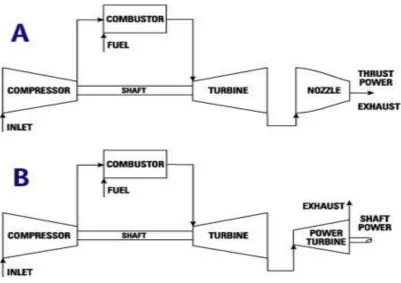
Figure 1.1: Schematic for a) an Aircraft Jet Engine; and b) a Land-Based Gas
Turbine.[1]
Because the 1939 origin of the gas turbine lies simultaneously in the electric power field and in aviation, there have been a profusion of "other names" for the gas turbine. For electrical power generation and marine applications it is generally called a gas turbine, also a combustion turbine (CT), a turbo shaft engine, and sometimes a gas turbine engine. For aviation applications it is usually called a jet engine, and various other names depending on the particular engine configuration or application, such as: jet turbine engine; turbojet; turbofan; fanjet; and turboprop or prop jet (if it is used to drive a propeller). The compressor combustor- turbine part of the gas turbine is commonly termed the gas generator [1].
3 fretting, hot corrosion/oxidation, creep, and thermo mechanical fatigue will be induced to the components ranging from fan/compressor sections up front to high pressure (HP) and low pressure (LP) turbine sections at the rear.
Figure1.2: Cutaway view of the Rolls-Royce Trent 900 Turbofan Engine. [2]
The increases in bucket alloy temperature capability accounted for the majority of the firing temperature increase until the 1970s, when air cooling was introduced, which decoupled firing temperature from bucket metal temperature. Also, as the metal temperatures approached the 1600°F/870°C range, hot corrosion of buckets became more life-limiting than strength until the introduction of protective coatings. During the 1980s, emphasis turned toward two major areas: improved processing to achieve greater bucket alloy capability without sacrificing alloy corrosion resistance; and advanced highly sophisticated air-cooling technology to achieve the firing temperature capability required for the new F generation of gas turbine.The use of steam cooling to further increase combined-cycle efficiencies will be realized in the 1990s [3].
5
Figure1.3: Increase of Firing Temperature with Respect to Turbine Blade Alloys
Development. [3]
Therefore, the potential failure mechanisms and lifetimes of gas turbine materials are of great concern to the designers, and the hot-section components are mostly considered to be critical components from either safety or maintenance points of view. Because of its importance, the methodology of life prediction has been under development for many decades. [3]
As the firing temperatures are increased and the operating cycles become more complicated, the traditional approaches are too costly and time-consuming to keep up with the fast pace of product turn-around for commercial competition. The challenges in life prediction for gas turbine components indeed arise due to their severe operating conditions:
High mechanical loads and temperatures in a high-speed corrosive
Erosive gaseous environment.
Gas turbine designers need analytical methods to extrapolate the limited material.[2].
The attempt to signified the traditional process have been done by Abdul Ghafir[4] via soft computing technique to develop an alternative performance-based creep life estimation method that is able to provide a quick solution to creep life prediction while at the same time maintaining the achieved accuracy and reliability as that of the model-based method. Using an artificial neural network, the existing creep life prediction sub processes and secondary inputs are „absorbed‟ into simple parallel computing units that are able to create direct mapping between various gas turbine operating and health conditions or gas path sensors and creep life. As his work has shown promising outcomes, it is the intention of this project to complete his work and look for any opportunity to improvement.
1.2 Problem Statement
In depth blade life estimation takes place in the design stage, current model-based creep life estimation methods have become more and more complicated and therefore demand huge amounts of work and significant amount of computational time [10, 11, 12,13]. For this reason, there are used to find an alternative solution that can reduce complexity of the estimation creep life, to be able to perform rapid computation and more accurate, also reduce the cost of design.
1.3 Project Objectives
Its measurable objectives are as follows:
7 b) To construct an alternative neural-based creep life estimation model that enables a direct link between the gas turbine operating conditions and the components‟ corresponding life.
1.4 Project Scope
This project is primarily concerned with the creep life estimation, the scopes of this project are:
a) Creep deformation is only considered in the research component of the life assessment.
b) The component that‟s they studied is high pressure turbine blade.
c) ANN is used to construct the alternative creep life estimation model where the reduction of the complexity will be done at a macro level.
Chapter 2
LITERATURE REVIEW
2.1 Common Failure in the Gas Turbine Hot Section
The failure of metal parts is a complex phenomenon that depends on material, temperature, deformation, and the rate at which strain is applied. When a metal component breaks, two major questions need to be answered; what are the modes of the failure and what is the origin of the damage; hence examination of the „how‟ is essential to understand the deterioration phenomena [4].
9
2.1.1 Fatigue
Fatigue, broadly speaking, is caused by repetitive loads that produce fluctuations in the components‟ stress, hence if large enough, will cause the component to fail even though the . Is much lower than that required for failure on single load application. Consequently, it will lead to crack initiation and propagation which ends with a fracture.
2.1.2 High Temperature Corrosion/Oxidation
Both turbine and compressor are exposed to aggressive corrosive and oxidizing conditions that may be caused by several factors [14]:
a. Ingested air which contains sodium and chloride in the form of salt from the sea or from runaway de-icing treatment or marine environments.
b. Atmospheric contaminants resulting from pollutions from industry or forest fires which usually contain sulphur and sodium.
c. Volcanic activity which can generate significant levels of pollutants particularly sulphur.Gaseous combustion products which contain elements such as sulphur, vanadium or even lead and bromine from fuel at higher temperatures.
Although the blades have a protective coating, corrosive and oxidation attacks are unavoidable, especially when the blades are exposed to sufficiently contaminated surroundings or too much harmful fuel element [4].
2.1.3 Creep Deformation
11
Figure 2.1: Deformed Turbine Blades Under Creep Attack. [4]
Although different materials have different strengths to resist creep deformation, it can generally be said that creep becomes significant when the homologous temperature (ratio between the material temperature and its melting temperature) is more than 0.5 but it can be in the range of 0.4 to 0.6.
2.2 CREEP LIFE ESTIMATION APPROACHES
As the material degrades progressively, micro-cracks will start to initiate on the surface and will propagate. According to Betten et al., the influence of micro-cracks on creep behavior begins even at the primary stage and the micro-cracks become visible at the tertiary creep stage when the linkage of blunted micro-cracks into macro-crack occurs. The macro-cracks will propagate before the final creep fracture takes place [4].
Figure 2.2: Life span of hot section component due to creep deformation. [4]
There are several methods for estimating creep life. In general, these methods can be classified into four broad approaches [4]:
a. Model-Based approach b. Service-Based approach,
c. Statistical/Probabilistic-Based approach. d. Soft Computing approach
13 2.2.1 Model-Based Approach
The model-based approach involves empirical, analytical or numerical model creation in order to calculate the component‟s creep life. Depending on how the model is created, external sources are needed to accompany the estimation such as the component‟s geometrical, material data, and engine operating and health conditions [4]. According to Wood [15], non-destructive test (NDT) and destructive test (DT) should be carried out using conventional techniques when the life fraction is greater than 0.5 (50%).
The model-based approach can further be classified into two sub-approaches which are the total life approach and the damage tolerance approach. In the total life approach, the life span of the component is predicted prior to the failure of the component or at the time failure occurs. On the other hand, the damage tolerance approach focuses on modeling the crack initiation and propagation processes. It is important to note that in this section; only the total life approach will be discussed since the development of the author‟s integrated creep life prediction model is based on this approach [4].
Creep life estimation using the total life approach can be done by using either a life-based model, a strain-based model, or a damage-based model.
2.2.2 Service-Based Approach
The main methods of assessing the remaining life will involve both nondestructive tests (NDTs) and destructive tests (DTs).
2.2.3 Statistical / Probabilistic Approach
Although a statistical approach has been partially used in some of the approaches, most of the approaches used statistics in order to assist the model development which in general is deterministic in nature.
In a statistical/probabilistic approach, statistical/probabilistic theory is used as the main lifing method. This approach is used either as a means to substitute the existing model, or as a means to account for uncertainties in the influencing parameters or variables that will affect the creep life behavior, or to provide the basis of performing failure risk analysis [4]
2.2.4 Soft Computing Approach
15 2.3 Artificial Neural Network
2.3.1 Introduction to Artificial Neural Network
In recent years, neural computing has emerged as a practical technology with successful applications in many field [17] such as in image processing and computer vision, signal processing, medicine, military systems, financial systems, power systems [18], material science etc. ANN has evolved from a biologically inspired layer network connected by neurons into various categories of computational models with different algorithms and a large variety of architectural design [19].
A Neural Network is a powerful data-modelling tool that is able to capture and represent complex input/output relationships. The motivation for the development of neural network technology stemmed from the desire to develop an artificial system that could perform "intelligent" tasks similar to those performed by the human brain. Neural networks resemble the human brain in the following two ways:
A neural network acquires knowledge through learning.
A neural network's knowledge is stored within inter-neuron connection strengths known as synaptic weights [16].
2.3.2 Advantages of Neural Networks
Adaptive learning: An ability to learn how to do tasks based on the data given for training or initial experience.
Self-Organization: An ANN can create its own organization or representation of the information it receives during learning time.
Real Time Operation: ANN computations may be carried out in parallel, and special hardware devices are being designed and manufactured which take advantage of this capability.
Fault Tolerance via Redundant Information Coding: Partial destruction of a network leads to the corresponding degradation of performance. However, some network capabilities may be retained even with major network damage
The procedure used to perform the learning process is called a learning algorithm, the function of which is to modify the synaptic weights of the network in an orderly fashion to attain a desired design objective.
Each neuron is a simple processing unit which receives some weighted data, sums them with a bias and calculates an output to be passed on the function that the neuron uses to calculate the output is called the activation function. Typically, activation functions are generally non-linear having a "squashing" effect. Linear functions are limited because the output is simply proportional to the input.
17 perceptron in one layer is connected to every perceptron on the next layer; hence information is constantly "fed forward" from one layer to the next.
By varying the number of nodes in the hidden layer, the number of layers, and the number of input and output nodes, one can classify points in arbitrary dimensional space into an arbitrary number of groups.
2.3.3 Neuron Model
The multilayer perception neural network is designed from simple components. Initially, we will describe a single input neuron which is then extended to include multiple inputs. Next, these neurons will be stack together to produce a layer [16]. Finally, a number of layers are cascaded together thus forming a multilayer network.
Figure 2.3: Single Input Neuron. [16]
19
Figure 2.4: Some Common Transfer Functions.[16]
Multiple-input neuron: Typically, a neuron has more than one input. A neuron with R inputs is shown in figure 2.5. The individual inputs p , p1 2p g are each weighted by corresponding elements W 1,1 燱1,2,.W 1,R of the weight matrix "W". The neuron has a bias "b", which is summed with the weight inputs to form the net input "n":
1,1 1 1,2 2 1,R R
This expression can be written in matrix form as:
[image:31.595.229.399.129.279.2]n = Wp + b (2.2)
Figure 2.5: Multiple-Input Neuron. [16]
A particular convention in assigning the indices of the elements of the weight matrix has been adopted [16]. The first index indicates the particular neuron destination for the weight. The second index indicates the source of the signal fed to the neuron. Thus, the indices in "W1,1" say that this weight represents the connection to the first (and only) neuron from the second source [16]. A multiple-input neuron using abbreviated notation is shown in Figure 2.5.
Multiple input neurons
[image:31.595.222.453.536.711.2]21 As shown in Figure 2.6, the input vector "p" is represented by the solid vertical bar at left. The dimensions of "p" are displayed below the variable as "Rx1", indicating that the input is a single vector of "R" elements. These inputs go to the weight matrix "W", which has "R" columns but only one row in this single neuron case.
A constant "1" enters the neuron as an input and is multiplied by a scalar bias "b". The net input to the transfer function “f” is "n", which is the sum of the bias "b" and the product "Wp". The neuron's output is a scalar in this case. If there exit more than one neuron, the network output would be a vector [16].
2.3.4 Multilayer Perceptron Network Architectures
Generally in the most application one neuron, even with many inputs, may not be sufficient. We might need five or ten, operating parallel, in what we will call a “layer". This concept of a layer is discussed below.
[image:32.595.237.428.602.722.2]A layer of neurons: A single-layer network of "S" neurons is shown in Figure 2.7. Note that each of the "R" inputs is connected to each of the neurons and that the weight matrix now has s rows.
The layer includes the weight matrix, the summers, the bias vector
"
b"
, the transfer function boxes and the output vector"
a". Each element of the input vector "p" is connected to each neuron through the weight matrix "W". Each neuron has a bias b , a summer, a transfer function f and an output "i ai". Taken together, the outputs form the output vector "a
"
. It is common for the number of inputs to a layer to be different from the number of neurons (i.e. RS). The input vector elements enter the network through the weight matrix "W":1,1 1,
,1 ,
R
S S R
w w w w w (2.3)
[image:33.595.227.446.471.628.2]The row indices of the elements of matrix "W" indicate the destination neuron associated with that weight, while the column indices indicate the source of the input for that weight. Thus, the indices in "W3,2" say that this weight represents the connection to the third neuron from the second source. The S-neuron, R-input, one-layer network also can be drawn in abbreviated notation as shown in Figure 2.8.
Figure 2.8: Layer of S Neurons, Abbreviated Notation. [16]
23 multiplication operations, the bias vector
"
b"
, the transfer function boxes and the output vector.Multilayer perceptron (MLP): Considering a network with several layers, each layer has its own weight matrix "W", its own bias vector "b", a net input vector "n" and an output vector "a2". Some additional notation should be introduced to distinguish between these layers. Superscripts are used to identify these layers. The number of the layer as a superscript is appended to the names for each of these variables. Thus, the weight matrix for the second layer is written as w 2. This notation is used in the two-layer network shown in Figure 2.9.
There are "R" inputs, "S1" neurons in the first layer, "S2" neurons in the second layer, etc. The output of layers one and two are the inputs for layers two and three. Thus layer 2 can be viewed as a one-layer network with R=S1 inputs, S= S2
neurons and an S1*S2 weight matrixW2. The input to layer 2 is a1 and the output is 2
[image:34.595.135.521.511.721.2]a . A layer whose output is the network output is called an output layer. The other layers are called hidden layers [16].
The network shown in Figure 2.9 has an output layer (layer3) and two hidden layers (layers 1 and 2). Figure 2.10 shows abbreviated notation of multilayer network.
Figure 2.10: Abbreviated Notation of Multilayer Network. [16]
The network learns about the input through an interactive process of adjusting the weights and the bias. This process is called supervised learning and the algorithm used is the learning algorithm. One of the most common is the error back propagation algorithm. This algorithm is based on the error-correction learning rule, based on gradient descent in the error surface.
71
REFERENCES
1. Lee S. Langston, University of Connecticut and George Opdyke, Jr., Dykewood Enterprises “Introduction to Gas Turbines for Non- Engineers,” Published in the Global Gas Turbine News, Volume 37: No. 2, 1997.
2. Xijia Wu, Institute for Aerospace Research, National Research Council Canada “Life Prediction of Gas Turbine Materials,” Published in the 2009.
3. P.W. Schilke, GE Energy Schenectady, NY. “Life Advanced Gas Turbine Materials and Coatings Materials,” 2004.
4. M. F. Abdul Ghafir , Scholl of Engineering Gas Turbine” Performance Based Creep Estimation For Gas Turbines Application” 2011.
5. J. Bolton, A “Characteristic-Strain” Model for Creep ECCC Creep Conference, 12–14 September 2005, London.
7. Mehdi Tofighi Naeem, Seyed Ali Jazayeri, Nesa Rezamahdi, K. N. Toosi University of Technology “Failure Analysis of Gas Turbine Blades” 2008.
8. Yasmina Assoul, Samira Benbelaid, Vera Sijacki-Zeravcic, Gordana Bakic, Milos Dukic, Faculty of Engineering, University Saad Dahleb Blida, Algeria “Life Estimation of First Stage High Pressure Gas Turbine” 2008.
.
9. Muhammad Naeem, College of Aeronautical Engineering (CAE), National University of Sciences & Technology (NUST) “Implications of day temperature variation for an aero-engine‟s HP turbine-blade‟s creep life-consumption” 2009.
10. B. Meherwan P., “9-Axial-Flow Turbines,” in Gas Turbine Engineering Handbook (Third Edition), Burlington: Gulf Professional Publishing, 2006.
11. D.M Knowles, “Gas Turbine Assist Management Research”Gas Today, 2008.
12. F. J. Cunha, M. T. Dahmer, and M. K. Chyu, “Thermal-mechanical life prediction system for anisotropic turbine components,” Journal of Turbomachinery, vol. 128, pp. 240-250, 2006
13. E. Marcus, “A Parametric Physics Based Creep Life Prediction Approach to a Gas Turbine Blade Conceptual Design” Georgia Institute of Technology, Atlanta, Georgia 2008.
14. T.J.Carter “Common Failures in Gas Turbine Blades” Engineering Failure Analysis, 2005.
15. M. Wood, “Gas Turbine Hot Section Life Assessment and Extension Status and Issues” OMMI, 2004.
73 17. C.M Bishop, Neural Networks for Pattern Recognition, 1st ed. Oxford
University Press, USA, 1996.
18. H.K.H Bhadeshia, “Neural Network in Materials Science,” ISIJ Internationall, vol. 39, no. 10, pp. 966-979, 1999.
![Figure 2.1: Deformed Turbine Blades Under Creep Attack. [4]](https://thumb-us.123doks.com/thumbv2/123dok_us/8777123.902077/22.595.147.491.71.307/figure-deformed-turbine-blades-creep-attack.webp)
![Figure 2.2: Life span of hot section component due to creep deformation. [4]](https://thumb-us.123doks.com/thumbv2/123dok_us/8777123.902077/23.595.124.521.238.409/figure-life-span-hot-section-component-creep-deformation.webp)
![Figure 2.3: Single Input Neuron. [16]](https://thumb-us.123doks.com/thumbv2/123dok_us/8777123.902077/29.595.215.417.79.267/figure-single-input-neuron.webp)
![Figure 2.4: Some Common Transfer Functions.[16]](https://thumb-us.123doks.com/thumbv2/123dok_us/8777123.902077/30.595.155.508.69.512/figure-some-common-transfer-functions.webp)
![Figure 2.6: A Multiple-Input Neuron Using Abbreviated Notation. [16]](https://thumb-us.123doks.com/thumbv2/123dok_us/8777123.902077/31.595.229.399.129.279/figure-multiple-input-neuron-using-abbreviated-notation.webp)
![Figure 2.7: A Single-Layer Network of S Neurons. [16]](https://thumb-us.123doks.com/thumbv2/123dok_us/8777123.902077/32.595.237.428.602.722/figure-a-single-layer-network-of-s-neurons.webp)
![Figure 2.8: Layer of S Neurons, Abbreviated Notation. [16]](https://thumb-us.123doks.com/thumbv2/123dok_us/8777123.902077/33.595.227.446.471.628/figure-layer-of-neurons-abbreviated-notation.webp)
![Figure 2.9: Three Layer Network. [16]](https://thumb-us.123doks.com/thumbv2/123dok_us/8777123.902077/34.595.135.521.511.721/figure-three-layer-network.webp)
![Figure 2.10: Abbreviated Notation of Multilayer Network. [16]](https://thumb-us.123doks.com/thumbv2/123dok_us/8777123.902077/35.595.108.552.181.334/figure-abbreviated-notation-multilayer-network.webp)
