No d'ordre : 4420 ANNEE 2012
%
gbn
U N I V E R S I T E D E
fi
RENNES
I
u e h
w
THESE I
UNIVERSITE DE RENNES 1
sous le sceau de I'Universite Europeenne de Bretagne
pour le grade de
DOCTEUR DE L'UNIVERSITE DE RENNES
1
Mention : ~raitement du Signal et Telecommunications
Ecole doctorale Matisse
presentee par
Samsul Haimi DAHLAN
Preparee a I'unite de recherche (UMR CNRS 6164, IETR)
lnstitut dlElectronique et de Telecommunications de Rennes Universite
de Rennes 1
Contribution to the body of
revolution finite-difference
time domain (BoR-FDTD)
method
-
Implementations
of hybrid and multi-
resolution approaches for
fast simulation of
electrically large axis-
symmetrical antenna
structures.
These soutenue a I'Universite de Rennes 1 le 13 Janvier 2012
devant le jury compose de :
Mme Elodie RICHALOT
Professeur des Universites, Univenite de Paris-Est /
rappoHeur
M. Michel NEY
Professeur, Telecom Bretagne I rapporieur
M. Alain RElNElX
Directeur de Recherche au CNRS, Universite de Limoges 1 examinateur
M. Renaud LOISON
Professeurdes Universites, INSA de Rennes 1 examinateur
M. Anthony ROLLAND
Docteur de I'Univenite de Rennes 1 I examinateur
M. Ronan SAULEAU
Professeur des Universites, Univenite de Rennes 1
Chapter 1
-
General IntroductionChapter 1
General Introduction
1.1
History and collaboration
This Ph.D thesis on the Body-of-Revolution Finite-Difference Time-Domain (BoR-
FDTD) was conducted at IETR (Inititute of Electronics and Telecommunications of Rennes).
It was supervised by Ronan SAULEAU (Professor at University Rennes 1). This work was
supported in part by the "Universit6 Europeenne de Bretagne" and the "Conseil Regional de
Bretagne" (project acronyms: OPTIMISE, CREATEICONFOCAL and GRAPPAS) and
UTHM (Universiti Tun Hussien Onn Malaysia) for the Ph.D scholarship.
The development of the BoR-FDTD simulator at IETR started in 2006 by Dr. Ming-
Sze Tong. He contributed in the development of the kernel programs of the simulator and
used it for electromagnetic study focusing on the electromagnetic band-gap structures (EBGs)
in BoR environment [I], [2].
This work was then continued by Anthony Rolland, who defended his Ph.D in 2009.
His thesis entitled "Conception d'antennes me'tallo-diklectriques par optimisation globule
base'e ssu le couplage entre la mkthode FDTD et les algorithmes gkne'tiques" combines the
BoR-FDTD simulator with an optimization technique which is based on the Genetic
Algorithms (GA) for the synthesis and the development of dielectric and lens antennas with
axis-symmetrical structure [3].
The BoR-FDTD is well known for fast and efficient method compared with the h l l y
three-dimensional (3D) FDTD simulator. In this present work, we explore and introduce
techniques to further reduce the computational effort especially for the simulation of large
Chapter 1 - General Introduction
References
[I] Ming Sze Tong, "Final report on body-of-revolution FDTD," (Unpublished)
[2] M. -S. Tong, R. Sauleau, A. Rolland, and T.-G. Chang, "Analysis of Electromagnetic
Band-Gap (EBG) waveguide structures using body-of-revolution finite difference time
domain method," Microwave and Optical Technology Letters, vol. 49, no. 9, pp. 467 -
469, Sept. 2007.
[3] A. Rolland, "Conception d'antennes me'tallo-di6lectriquespar optimisation globule base'e
sur le couplage entre la me'thode FDTD et les algorithmes ge'ne'tiques," These de
Doctorat, Universite de Rennes 1, Jan. 2009.
[4] Yee, K. S., "Numerical solution of initial boundary value problems involving Maxwell's
equations
in
isotropic media," IEEE Trans. Antennas and Propagation, vol. 14, 1966, pp. 302-307.[5] M. Celuch and W. K. Gwarek, "Industrial design of axis-symmetrical devices using a
customized solver from RF to optical frequency bands," IEEE Microwave Mag., vol. 9,
no. 6, pp. 150 - 159, Dec. 2008.
[6] A. Taflove and S. C. Hagness, Computational Electrodynamics: the Finite-Difference
Time-Domain Method, 2nd ed., Artech House, Inc., 2000.
[7] S. H. Dahlan, A. Rolland, R. Sauleau, "Application of the dual-grid scheme in BoR
FDTD for the simulation of dual reflector antennas", European Con$ on Antennas and
Propagation, EuCAP 2011, pp. 1345-1348, Rome, Italy, 11-15 Apr. 201 1.
[8] S. H. Dahlan, A. Rolland, R. Sauleau, "Schkmas d'analyse rapide de problemes
axisymitriques par la mkthode FDTD b symitrie de rkvolution (BoR-FDTD)", Dix-
septidmes Journe'es Nationales Micro-ondes, Brest, 4 pages, 18-20 May 201 1.
[9] S. A. Muhammad, A. Rolland, S. H. Dahlan, R. Sauleau and H. Legay, "Comparison
between Scrimp horns and stacked Fabry-Perot cavity antennas with small apertures,'"
European Con$ on Antennas and Propagation, EuCAP 2012, (Submitted).
[lo] Romain Pascaud, "Nouveaux schdmas rapides pour la mdthode des Diffirences Finies dans le Domaine Temporel (FDTD). Application b la simulation d'antennes environnkes,"
Chaoter 2 - The Finite Difference Time Domain Method - General Overview
effect however could be reduced by implementation of some extension technique
called the Mur superabsorbation [6] which is much less sensitive to variation of an
incident angle. The major property of the Mur ABC is that it can accurately
matched incoming wave at a particular direction, by changing the effective
permittivity of the Mur absorption. This property will deteriorates to some extent
for incoming wave at angles different compared to the matched one.
2. The total field-scattered field (TF-SF) decomposition
This technique is very useful in antenna and radar analysis. The FDTD problem
space is divided into two separate regions by virtual TF-SF boundaries which then
known as the total field (TF) region and the scattered field (SF) region [3]. An
incident plane wave is excited inside the total field region. It can be a direct or an
oblique plane wave depending on the problem analysis. Whenever there is no
scatterer or obstacle in the TF region, the applied incident plane wave will not
radiate outside the TF region into the SF region. On the other hand, with the
present of obstacle inside the TF region, only the scattered part of the
electromagnetic wave will be radiated outside the region into the SF region.
3. Near-field to far-field transformation (NTFF)
An important technique for calculating the far field characteristics of a radiating
source based on the near field information without having to extend the radiation
space to the far field region. The near-to-far field transformation is performed
around a surrounding transformation surface enclosing the radiating source in the
near field region. It is a post-processing technique that calculates the contributions
of the radiated fields over time for gaining the far field information either in time
or frequency domain. It is widely applied in antenna design [7].
4. Media
Media such as losslessflossy, linearlnonlinear, isotropic/nonisotropic and
dispersivelnondispersive can be treated using the FDTD method. Nonlinear media
can be treated naturally in FDTD since it is a time-domain approach. For
dispersive media, special model such as the Debye, Drude and Lorentz models [3]
are commonly applied to represent the characteristic. A single FDTD run could
provide results for the whole spectrum range.
Cha~ter 2 - The Finite Difference Time Domain Method - General Overview
could handle this eficiently in FDTD such as by applying the multi-resolution
approach. In this thesis a new multi-resolution approach based on the dual grid
method is introduced in the subsequent chapter for handling such issue in the
bodies of revolutions FDTD (BoR-FDTD) environment. The explanation about
BoR-FDTD is detailed in the next chapter.
2. Long computation of high-Q structures
Performing simulation for a high-Q structure using the time domain approach
might require very long computation time. This is due to the slow field
dissipations. The problem can be more challenging when involving finer
resolution in time and space. This issue however is not only restricted to FDTD
alone but other analysis methods are also face similar problem.
2.3 Conclusion
In summary, a brief discussion of the general FDTD method has been presented.
Some of its major properties as well as its inherent limitations have been pointed out. Next
chapter will present the bodies of revolution (BoR) FDTD, a FDTD approach based on
cylindrical coordinate system to handle axis-symmetrical electromagnetic problems. The
Chavter 3 -Bodies of Revolution Finite Difference Time Domain (BoR-FDTD) Simulator
3.2 Specification and presentation of BoR-FDTD method
3.2.1
The governing equations
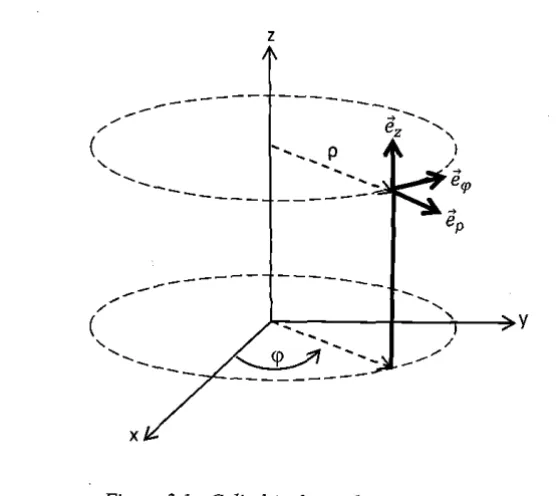
The BoR structures are symmetric about the axis and this leads to the natural use of
the cylindrical coordinates @,y,z) as illustrated in Figure 3.1.
[image:25.624.174.452.214.462.2]xd
Figure 3.1
-
Cylindrical coordinate systemTo derive the governing equations for the BoR-FDTD we should go back to the
Maxwell curl equations given in (2.1) to (2.2) from the previous chapter. In cylindrical
Chapter 3 -Bodies of Revolution Finite Difference Time Domain (BoR-FDTD) Simulator
From equation (3.3) to (3.8) it can be noted that the cylindrical space is discretized in
three dimensional manners along the p, p, and z directions. However, thanks to the rotationally symmetric structures where fields variations in the azimuthal ( p ) directions can be solved analytically. In order to do that, we first expand the electric and magnetic fields in
the rotationally symmetric geometries using the infinite Fourier series expansion [6], [8]. It is
written as:
where m is the azimuthal mode number. The subscript even and odd denotes the Fourier coefficients for the cosinusoidal or sinusoidal dependence respectively. Originally the
electric and magnetic fields are a function of p, p and z at all time. However, once expanded in Fourier series, the fields are now dependent only on p and z components but varied with
cos(myl) and sin(myl).
Without losing generality, we can now assume that the angular variation of the
Chanter 3 -Bodies of Revolution Finite Difference Time Domain (BoR-FDTD) Simulator
govern the electromagnetic fields in bodies of revolution (BoR) structure in its normal FDTD
computational space.
3.2.2 Discretization of the governing equations
3.2.2.1 Gridding scheme in three dimensional cylindrical coordinate
The governing equations need to be discretized for used in the FDTD scheme and the
update equations must be derived based on the grid definition. In the FDTD method the
electric field and the magnetic fields are located at offset position from one another in the
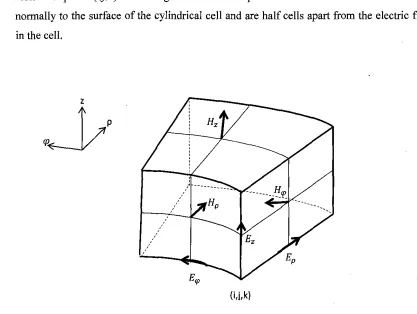
designated space. For reference, the general three dimensional FDTD cell in cylindrical
coordinate system is as illustrated in Figure 3.2. The positions of all electric field components
are at the cell borders tangential to each other and effectively located half cells apart from the
reference point (i,j,k). The magnetic fields components on the other hand are defined
normally to the surface of the cylindrical cell and are half cells apart from the electric fields
in the cell.
[image:29.621.93.510.344.658.2](i,i,k)
Figure 3.2 - The three dimensional FDTD cell in cylindrical coordinates.
Chavter 3 -Bodies of Revolution Finite Difference Time Domain @OR-FDTD) Simulator
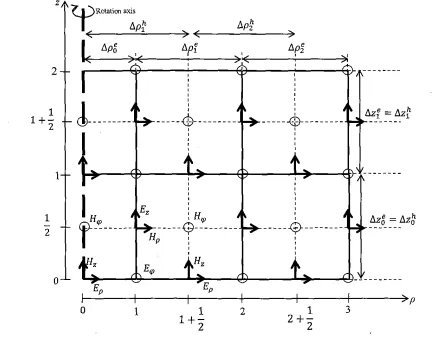
Figure 3.4 - Cell definitions on the BoR-FDTD grid system
From Figure 3.4, we show some cells and field components on the BoR-FDTD grid
system. The definitions of the cell sizes and the half cells are given. Note that BoR-FDTD
lattice has uniform size in z direction but distributed non-uniformly in p direction. The following defines the cell sizes and half cells coordinate for both directions:
Apf = pi+l - p i for i = 0-Np - 1
P i + ~ / z = pi