Leachability and strength of kaolin stabilized with
cement and rubber
Meei-Hoan Ho1, Ahmad Tarmizi2, Chee-Ming Chan3 & Ismail Bakar4
Research Centre for Soft Soil (RECESS)1,2,3&4 Faculty of Civil and Environmental Engineering
Universiti Tun Hussein Onn Malaysia, 86400 Parit Raja, Batu Pahat, Johor, Malaysia
* Corresponding author, e-mail: [email protected]
ABSTRACT
Yearly, the disposal of used tyres is a major environmental problem for countries all over the world. This causes environmental hazards such as uncontrolled fire, consume landfill space, breeding ground for mosquitoes and contaminating the soil and vegetation. Hence, urgent steps were identified to produce new methods of recycling the waste tyres to solve this hazard. This study reviews the feasibility of using waste tyres in the form of rubber chips with cement to stabilize soft clay and the effect to the environment. The focus of this study was mainly the strength and leachability characteristics of kaolin as base clay, admixed with cement as the binder and rubber chips as an additive. Leaching test is used to evaluate the performance of cementitious materials for stabilization and solidification (S & S) of hazardous materials such as waste or contaminated soil. In this study, cylindrical stabilized clay specimens were prepared with various rubber chips contents and cement, and then aged for 28 days. Cylindrical specimens were then subjected to unconfined compressive strength test (using Geocomp LoadTrac II) and the specimens were later dried in oven at 105° before tested for leaching tests. These leaching methods are Acid Neutralization Capacity Test (ANC) and Synthetic Precipitation Leaching Procedure (SPLP). The solidified samples were checked on six different heavy metals, namely copper, chromium, cadmium, arsenic, zinc and plumbum. Analysis was carried out by relating the effects of 0, 2 or 4 % cement as well as 0, 5, 10 and 15 % rubber chips addition to the base clay and its leachability. As observed, the curing of specimen for 28 days was in a range of 66.24 to 249.4 kPa. Specimen with 4 % cement is able to produce ANC9 of about 0.13 meq HNO3/g specimen. However specimen with 0 % and 2 % cement for different rubberchips content shows that the specimen do not have the capacity to neutralize acid at pH 9. Therefore, more cement (> 4 %) is needed to achieve ANC9. SPLP results showed that all six different heavy metals tested do not exceed the approved limit for drinking water by World Health Organization (WHO), United States Environmental Protection Agency (USEPA) and Ministry of Health in Malaysia.
1.0 INTRODUCTION
Malaysia is one of the largest producers of rubber and as a result produces million tonnes of rubber waste from the rubber-based industries each year. According to Summary of Monthly Rubber Statistics Malaysia November 2010, production of natural rubber (NR) is 73,100 tonnes. The domestic consumption was recorded as 35,003 tonnes. Comparing year-on-year, domestic consumption had declined to about 12.9 %. The largest NR consuming industry was the rubber gloves (66.5 %) followed by rubber thread (14.8 %) and tyre and tubes (6.8 %). The total consumption for these three industries combined was 30,862 tonnes or 88.1 % of total NR consumption in the country. These numbers keep on increasing every year with the increase of vehicles, as do the future problems relating to waste tyres [1].
Cement-based solidification/stabilization (S/S) is an established technique utilized in treatment of wastes in developed countries. In fact S/S-related processes such as chemical stabilization has been identified as the best demonstrated available technology (BDAT) for a variety of Resource Conservation and Recovery Act (RCRA) non-wastewater wastes [2]. Solidification techniques by using cement, lime, or other agents are sometimes used to stabilize the soft soil to attain the suitable properties for the geotechnical applications. Chemical stabilization is generally defined as a chemical alteration technique of reducing the mobility as well as solubility of contaminants present in soil in order to convert that particular soil into chemically inert form [3].
[4] reported that the ordinary Portland cement normally contains chromium (Cr) in the range of 30 to 100 mg/kg. The chromium is originally included in raw materials of cement. When these raw materials are sintered in the cement, they are oxidized to hexavalent chromium. From the leaching tests, a considerable mass of Cr+6 was detected from the cements supplied by several Japanese cement manufacturers. This means that careful attention must be taken to prevent the environmental risk when cement is used. The Japanese environmental standard of the Cr+6 leachate is below 0.05 mg/L, and hexavalent chromium leaching from cement itself may have a high risk to contaminate the surrounding environment, i.e. groundwater. Leaching tests for the cement-stabilized soils were also conducted to determine the level of contamination risk by cement stabilized materials. Cr+6 leachate from the cement-stabilized soil were significant, and it depends on the type of soils to be treated. The additive content of cement, of course, affected the leachate volume.
Arsenic (As) is known to be dangerous to human’s health. Hence, USEPA had reduced the maximum As contamination level in drinking water from 0.05 mg/L to 0.01 mg/L starting from 2006 [5-6]. In Malaysia, [7] stated that Standard A for As in domestic waste effluent at 0.05 mg/L.
S/S research on copper (Cu) with cement or lime was done by a few researchers [10-11]. For example, [10] reported that Cu can bind the cement using agglomerate agent, natrium methasilicate, Na2SiO3.9H2O.
Lead (Pb) concentration in precipitation solution after S/S of cement was influenced by the pH of the solution [9; 12]. Generally the concentration of Pb in the leaching solution will reduced with the increment of pH. It is difficult to detect when the pH is in between 9 to 11 due to the formation of insoluble hydroxide, however it can be detected at pH 12 because the formation of complex amphoteric hydroxide.
[8] research using cement and binders; it was found that the concentration of zinc (Zn) in leaching solution at larger pH range is similar to the estimation done from calculation of dilution of ion hydroxide.
In this study, the synthetic precipitation leaching procedure (SPLP), EPA Method 1312, is used to evaluate the potential for leaching of metals into ground and surface waters, and provides an assessment of metal mobility under actual field conditions, i.e. what happens when it rains (or snows) [13]. While acid neutralization capacity (ANC) test is used to determine the buffering capacity of S/S waste forms [14].
2.0 MATERIALS
2.1 Kaolin
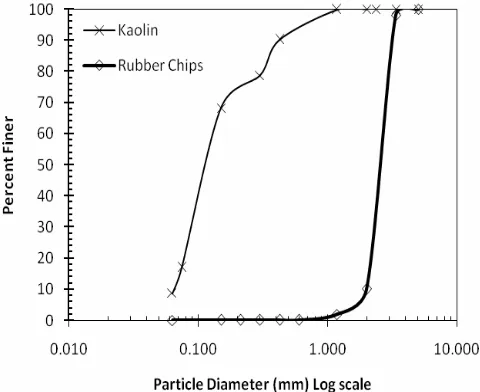
Kaolin was used in this project which formed the base clay having controlled homogeneous properties. It was used to ensure that the moisture content and density were controlled as it has a consistent size range. It is whitish in colour, soft and fine grained. The kaolin used was obtained from Kaolin Malaysia Sdn. Bhd. The particle size distribution of kaolin used is shown in Figure 1. Its uniformity coefficient, Cu is 2 and
coefficient of gradation, Cc is 0.96.
2.2 Rubber chips (RC)
Figure 1. Grain size distribution of kaolin and rubberchips
2.3 Ordinary Portland cement
Ordinary Portland cement is a widely used stabilizer whether on its own or admixed with other additives [16]. The cement was first oven-dried at 105˚C for 24 hours before being stored in airtight containers to maintain the consistency of cement used in the preparation of specimens.
3.0 TEST PROGRAMME
2.3 Specimen preparation
The test specimens were prepared by varying the proportion of ordinary Portland cement and then a known proportion of rubber chips were added to kaolin paste of known water content (i.e. w = 50 %). Analysis was carried out for geotechnical properties by relating the effects of 0, 2 and 4 % cement and 0, 5, 10 and 15 % rubber chips additions, and after a 28 days curing period. These aforementioned percentages of additives were calculated based on dry mass of the kaolin.
The mixture was mixed thoroughly in a mechanical mixer and then compacted in a split mould to form specimens of 38 mm in diameter and 76 mm in height. A specially designed miniature hand compacting tool was used to compact the mixture in 4 layers, 50 blows each [17]. The extruded specimens were then wrapped in cling film and stored for 28 days prior to testing. Each specimen mix was prepared in pairs to ensure uniformity of the specimen preparation method and test procedures.
2.3 Laboratory Testing
(a) Oxide element analysis
kaolin is SiO2 and Al2O3 with 51.91 and 41.83 % respectively. While for cement and
rubber chips, the main oxide elements were CaO, SiO2 and Al2O3. Rubber chips alone
contained ZnO and PbO which is 6.96 and 0.87 % respectively.
Table 1: Oxide Concentration of Materials Used
Concentration (%)
Oxide Elements Kaolin Rubberchips Cement
Al2O3 41.83 16.20 4.68
CaO 0.21 44.87 66.80
Fe2O3 1.65 1.28 2.32
PbO 0.02 0.87 -
SiO2 51.91 20.50 18.30
SO3 0.13 6.89 5.03
ZnO - 6.96 -
Table 2 shows the maximum concentration of the six contaminants studied in this paper according to standards regulated by USEPA, World Health Organization (WHO) and Ministry of Health Malaysia.
Table 2: Maximum Concentration of Contaminants According to Standards
Contaminant WHO Standard for clean water (mg/l) USEPA Maximum Contaminant Level (MCL) (mg/l) Water Quality Standards (Malaysia) (mg/l)
Arsenic (As) 0.05 0.01 0.01
Cadmium (Cd) 0.01 0.005 0.003
Chromium (Cr) 0.05 0.1 0.05
Copper (Cu) 1.0 1.3 1.0
Lead (Pb) 0.05 0.015 0.01
Zinc (Zn) 5.0 5.0 3.0
Maximum Contaminant Level (MCL) which is the highest level of a contaminant that is allowed in drinking water. MCLs are enforceable standards by USEPA.
(b) Unconfined Compression Test
The unconfined compressive strength (UCS) test was conducted according to BS1377-7:1990 [18]. The specimens were extruded from the moulds, levelled, measured for length and diameter, weighed and subjected to uniaxial compression test (UCT) at a constant rate of strain of 1% per minute. Care was taken to ensure that both ends of the specimen were as flat as possible to minimize bedding error during tests, especially with the stiffer specimens. Deformation was measured by a frame-mounted displacement transducer (LVDT) and the load measured by a frame-mounted load transducer.
(c) Acid Neutralization Capacity (ANC)
The applied ANC (WTC B11 1991) is inspired from the European pre-standard ‘Influence of pH on leaching with initial acid/base addition’. The aim of this test is to study the influence of pH on the leacheability of inorganic constituents from a waste material by addition of predetermined amounts of acid or base to reach desired end pH values in apparent steady state condition [19].
The pH-dependent solubilization of the various polluting species has an important effect on the leaching behavior of the material. The specimen solubility according to the pH is carried out on finely crushed materials in order to rapidly reach solid/liquid steady state conditions. 5 g of finely crushed material (grain size less than 150 μm (ASTM No. 100) is in contact with a leachant volume at a determined pH. In this study, tests were done according to Schedule 1 (from 0 to 4 meq/g) [20]. The extraction is performed in bottle containers and liquid-solid separation is accomplished by centrifuging. Cement-rubberchips specimens were divided into 11 sub-specimens each, which were placed in containers with an increased amount of nitric acid 2 N and deionized water-to-solid ratio 6:1. The tubes were then rotated end over end for 48 hours before centrifuging (6000 rpm for 10 minutes) and measured the extract pH using a pH meter.
(d) Synthetic precipitation leaching procedure (SPLP)
Scientists and engineers often rely on results from the synthetic precipitation leaching procedure (SPLP) to assess the risk of groundwater contamination posed by the land application of granular solid wastes. The concentrations of pollutants in SPLP leachate can be measured and compared to groundwater quality criteria to determine if groundwater contamination is likely. These results are applied, however, inconsistently among regulatory agencies because of uncertainty over whether the SPLP leachate concentrations represent the actual pore water concentrations expected in the waste, or whether they represent diluted concentrations as might be expected in an underlying aquifer. Depending on the waste in question, the SPLP results can represent either condition [21]. In this study, research was conducted to examine the use of the SPLP for assessing risk to groundwater.
The application of a dilution factor to the SPLP concentrations was found to underestimate possible risk in most cases. Comparing the SPLP directly to water quality limits was found to be conservative in most situations; several observations were made, however, where the SPLP underestimated pore water concentrations. The use of a total pollutant concentration (mg/kg) in conjunction with a SPLP concentration (mg/L) to estimate a pore water concentration was found unreliable; this method underestimated the measured pore water concentrations [21].
For SPLP test, 1 g of crushed specimens which passed a 1 mm sieve was placed in a bottle container prior to addition of leaching solution nitric/sulfuric acid (pH 4.20) to provide a ratio of 20:1 mass ratio of leachant to solidified specimens. The containers were then agitated using a rotating extractor at 30 rpm for 18 hours. Leachate pH was measured at the end of the extraction period. The filtrate was then acidified with nitric acid to pH < 2 and stored under refrigeration (< 4˚C) prior to heavy metal analysis by using the ELAN 9000 Perkin Elmer Inductively Coupled Plasma Mass Spectrometry (ICP-MS).
4.0 DISCUSSION OF RESULTS
2.3 Oxide content
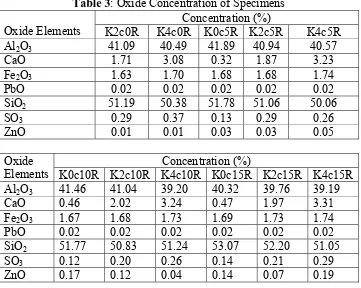
The results of the XRF were summarized in Table 3 with 0, 2 and 4 % cement content and 0, 5, 10 and 15 % rubber chips. It shows that the material contains a large amount of silicates and aluminates. The content of CaO, Fe2O3 and SO3 increased significantly when
[image:7.595.128.489.324.612.2]more cement is added. ZnO also have a slight increment when more rubber chips were added.
Table 3: Oxide Concentration of Specimens
Concentration (%)
Oxide Elements K2c0R K4c0R K0c5R K2c5R K4c5R
Al2O3 41.09 40.49 41.89 40.94 40.57
CaO 1.71 3.08 0.32 1.87 3.23
Fe2O3 1.63 1.70 1.68 1.68 1.74
PbO 0.02 0.02 0.02 0.02 0.02
SiO2 51.19 50.38 51.78 51.06 50.06
SO3 0.29 0.37 0.13 0.29 0.26
ZnO 0.01 0.01 0.03 0.03 0.05
Concentration (%) Oxide
Elements K0c10R K2c10R K4c10R K0c15R K2c15R K4c15R
Al2O3 41.46 41.04 39.20 40.32 39.76 39.19
CaO 0.46 2.02 3.24 0.47 1.97 3.31
Fe2O3 1.67 1.68 1.73 1.69 1.73 1.74
PbO 0.02 0.02 0.02 0.02 0.02 0.02
SiO2 51.77 50.83 51.24 53.07 52.20 51.05
SO3 0.12 0.20 0.26 0.14 0.21 0.29
ZnO 0.17 0.12 0.04 0.14 0.07 0.19
2.3 Strength development of cement-rubberchip
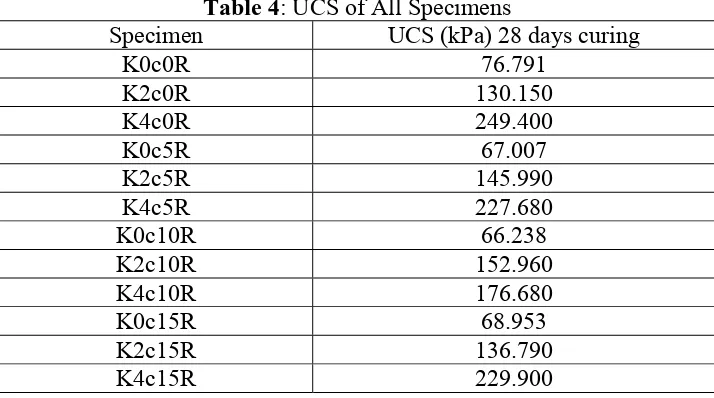
The UCS values for the cement-rubberchips specimen shows the rate at which hydration reactions took place with different cement and rubberchips content.
(predominant elements in cement) increased in the stabilized soil enabling more production of tobermorite gel or calcium-silicate-hydrate (CSH) [23].
Table 4: UCS of All Specimens
Specimen UCS (kPa) 28 days curing
K0c0R 76.791 K2c0R 130.150 K4c0R 249.400 K0c5R 67.007 K2c5R 145.990 K4c5R 227.680 K0c10R 66.238 K2c10R 152.960 K4c10R 176.680 K0c15R 68.953 K2c15R 136.790 K4c15R 229.900
2.3 Leachability of the metals
Leaching of heavy metals is the main reason why the waste or S/S products should be managed as a hazardous waste. The results show that the concentrations of the heavy metals are much lower than the pollution limits stipulated by WHO, USEPA and Ministry of Health Malaysia. This justifies the acceptability of cement-rubberchip stabilized kaolin for reuse in stabilization works, where leaching of the heavy metals is likely to be substantially reduced by the binding effects of the cementitious reaction.
(a) ANC analysis
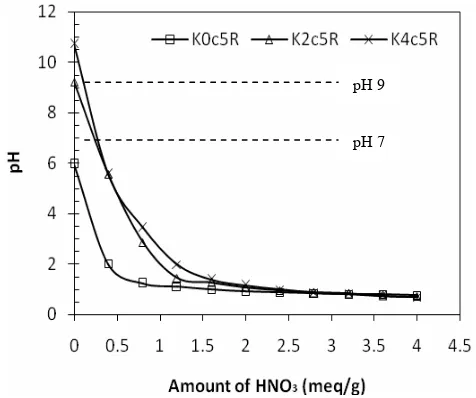
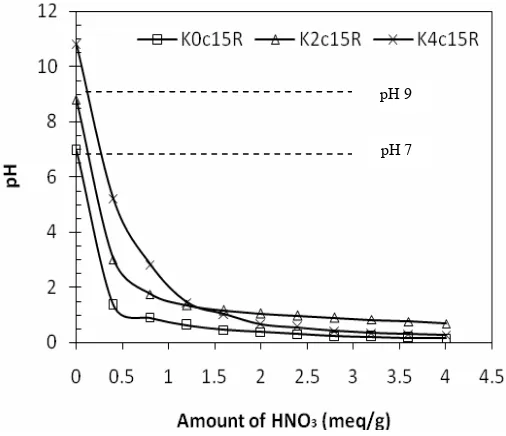
ANC test was done to study the capacity of cement- rubberchips to stabilize kaolin and to assess pH decline when the specimen was titrated with nitric acid. The capacity of acid to neutralize for each specimen can be observed by plotting pH against the quantity of acid added to the specimen in miliequivalent acid per 1 g of dried specimen as shown in (Fig. 2-5).
The ANC test is used to determine the buffering capacity of the S/S products. The higher buffering capacity of the specimen increases the possibility of maintaining alkaline conditions and minimizing leaching [14]. [24] proposed that the S/S product should have an acid neutralization capacity greater than 1 eq/kg, before reaching pH 9 in order to be landfilled at a segregated landfill. They also proposed the ANC to be greater than 3 eq/kg for a sanitary landfill, since the S/S product would be exposed to more acidic conditions in a sanitary landfill.
Specimen with 4 % cement is able to produce ANC9 of about 0.13 meq HNO3/g
[image:9.595.187.414.161.360.2]specimen. While for specimen with 0 % and 2 % cement for different rubberchips content shows that the specimen do not have the capacity to neutralize acid at pH 9. These figures can be observed having the same pattern showing that cement is more dominant than rubberchips to neutralize acid to pH 9. Therefore, more cement (> 4 %) is needed to achieve ANC9.
Figure 2. Acid neutralization capacity of specimen at different cement content
and 0 % RC
Figure 3. Acid neutralization capacity of specimen at different cement content
and 5 % RC
pH 7 pH 9
pH 9
[image:9.595.181.419.419.618.2]Figure 4. Acid neutralization capacity of specimen at different cement content
and 10 % RC
Figure 5. Acid neutralization capacity of specimen at different cement content
and 15 % RC
(b) SPLP analysis
Synthetic rain was obtained using sulfuric acid and nitric acid with ratio of 60/40 (weight percentage) until the pH of the dilution reached is between 4.15 to 4.25. In this study, the average pH used to make synthetic rain is 4.20. According to [21], diluted SPLP will be compared with the standard for drinking water as shown in Table 2. Also, SPLP test was established by USEPA to filter dangerous waste.
SPLP contains inorganic acids (60% sulfuric and 40% nitric) simulating acid rain with pH = 4.2. This test would be appropriate for assessing metal loss from cement-rubberchips stabilized kaolin used in foundation or areas subject to acid rain. However, the stormwater precipitates into the material on the ground, where most soils buffer the pH - and bind many metals, or it falls into water with a natural buffering capacity that
pH 9 pH 9
[image:10.595.173.426.295.513.2]reduces the pH. In order to evaluate aquatic risks, one must consider the transport and fate of contaminants [25].
SPLP extract liquid contained sulfate ion and nitric ion. According to [26], if a material contained sulfate and nitrate element, the concentration in the SPLP extract liquid will be reduced. This explains that when a minimum separation that will happen as a consequence of the same ions effect. Same ions effect means that the increasing of the same ions to a solution containing that particular ion and in a saturated state will caused the ion to precipitate to keep solubility product in the same extent [27].
Chemical reaction of nitrite acid and sulfuric acid with cement is also different. According to [28] the mechanism of corrosion of hardened paste of geopolymer cements at relatively high concentrations of sulfuric acid (pH≈1) consists of two subsequent steps. The first step starts by an ion exchange reaction between the charge compensating cations of the framework, i.e. sodium and calcium, and H+ or H3O+ ions from the solution along
with an electrophilic attack by acid protons on polymeric Si–O–Al bonds. The electrophilic attack of acid protons results in the ejection of tetrahedral aluminum from the aluminosilicate framework. In the second step, the exchanged calcium ions diffusing toward the acid solution react with counter-diffusing sulfate anions resulting in the formation and deposition of gypsum crystals inside corroding layer. Deposition of gypsum crystals inside corroding matrix provides a protective effect inhibiting the total process of deterioration.
According to [29], SPLP is the method of choice when evaluating fate and transport of metals in a properly engineered waste land disposal facility from which municipal solid waste is excluded.
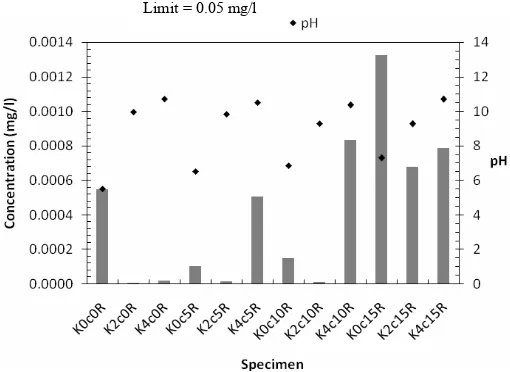
The relationship between the leachate pH and the heavy metals leached can be seen in Fig. 6-11. It can be inferred that the leachability of the metals largely depends on the pH of the extract solution. It may be considered that the S/S products may be disposed of at a segregated landfill without being exposed to the more acidic conditions of a municipal waste landfill.
[image:11.595.206.411.577.737.2]However, the long-term leachability of contaminants should be considered before making such a decision. All the precipitation for the 6 elements tested does not exceed the approved limit for drinking water.
Figure 6. Chromium leaching (mg/l) compared to specimens and pH
Figure 6 shows the Cr leaching for all specimen concentration with leaching solution of SPLP were lower than 0.05 mg/L, the standards for drinking water for element Cr. pH shows a range from 5 to 13 which does not affect the leaching of Cr. An obvious trend for all specimens can be seen when cement content increases, Cr concentration also increases. This is due to cement containing Cr6+ as stated in [4].
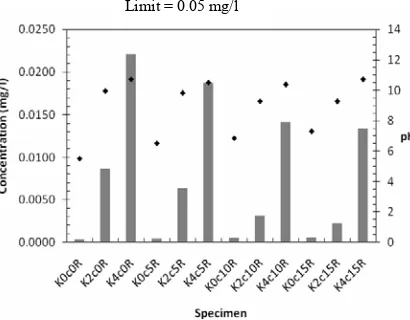
Figure 7. Arsenic leaching (mg/l) compared to specimens and pH
[image:12.595.180.441.480.665.2]Arsenic leaching compared to pH for each specimen can be seen in Figure 7. Specimen with 2 % cement gave higher As concentration compared to 0 % and 4 % cement. For 4 % cement with different rubber chips content, the concenration of As also increases significantly. This could be the leaching of As, at the formation of Ca–As precipitation [30]. Hence, Ca-As precipitration increases with Ca from cement. Arsenic is also a product mainly available in rubber chips.
Figure 8. Copper leaching (mg/l) compared to specimens and pH
Cu leaching from Figure 8 can be seen having the similar pattern as Cr leaching. For all specimen concentration with extract liquid of SPLP were lower than 1.0 mg/L, the standards for drinking water for element Cu. pH shows a range from 5 to 13 which does
Limit = 0.05 mg/l
not affect the leaching of Cu. [31] stated that Cu precipitation happened in the range of pH 5.4 to 12.0.
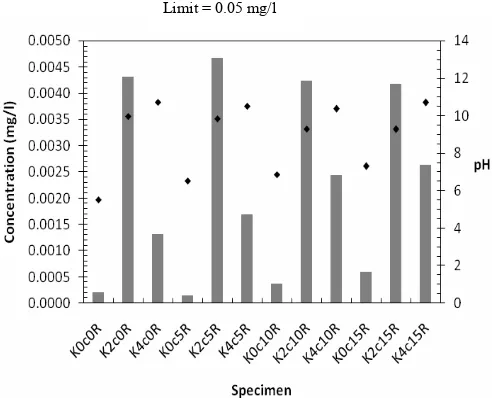
Figure 9. Cadmium leaching (mg/l) compared to specimens and pH
[image:13.595.183.437.426.619.2]Cd leaching for all the specimens were shown in Figure 9. The Cd concentration was quite scattered and does not show any obvious pattern. This could be because Cd concentration is found in all the three materials (kaolin, cement and RC). According to [9], cadmiun hydroxide will have low solubility at pH 11. In a short time of solidification, pH extract is between 10 to 12 for two mix design showing the low solubility for cadmium hydroxide.
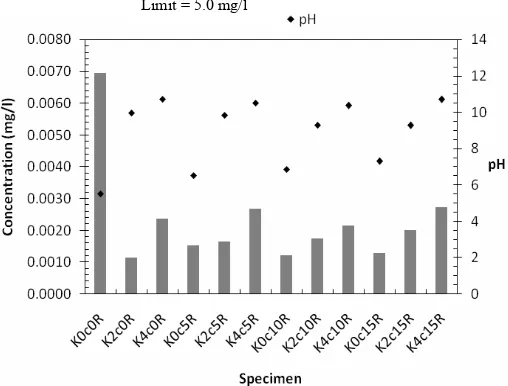
Figure 10. Zinc leaching (mg/l) compared to specimens and pH
Figure 10 shows that precipitation of Zn is influenced by pH. [31] stated that precipitation of Zn is between 5.3 to 9, while from the above figure the pH range is from 5 to 11. This shows that Zn fixation in cement matrics is very strong to be leached out by SPLP liquid extractor.
Limit = 0.01 mg/l
Figure 11. Lead leaching (mg/l) compared to specimens and pH
Figure 11 shows the Pb leaching for the all the specimen. When more rubber chips were added, an increased of Pb concentration was seen. The pH effects the precipitation of Pb from 9 to 10 [32] or pH 6 to 9 [31]. As for this study, the pH ranges from 5 to 13 for all specimens.
4.0 CONCLUSIONS
The following conclusions may be drawn from this study:
The UCS for specimens after curing 28 days was in a range of 66.24 to 249.4 kPa. Overall, higher UCS values were obtained when higher amount of cement was used for stabilization process.
Using the SPLP test method, all 6 heavy metals tested (Cr, As, Cu, Cd, Zn and Pb) does not exceed the approved limit for drinking water by WHO, USEPA and Ministry of Health in Malaysia. pH for SPLP ranges from 5 to 11.
Specimen 4 % cement for different rubberchips content is able to produce ANC9 of about 0.13 meq HNO3/g specimen. While specimen with 0 % and 2
% cement shows that the specimen do not have the capacity to neutralize acid at pH 9. Therefore, more cement (> 4 %) is needed to achieve ANC9 of greater
than 1 eq/kg, in order to be landfilled at a segregated landfill.
It can be concluded from the results of this study that kaolin stabilization by using Portland cement and rubber chips would not be harmful for the environment and soil.
5.0 ACKNOWLEDGEMENTS
The authors would like to thank Universiti Tun Hussein Onn Malaysia for supporting this research under the Postgraduate Incentive Research Grant.
6.0 REFERENCES
[1] Summary of Monthly Rubber Statistics Malaysia (2006). [Online]. (28th Jan 2011). Available: http://www.statistics.gov.my/portal/index.php?option=com_content&view=article&id=480&Itemid=5 3&lang=en
[2] United States Environmental Protection Agency (1993). Technical resource document: solidification/stabilization and its application to waste materials, EPA/530/R-93/012.
[3] Yin, C.Y. Shaaban, M.G. & Mahmud, H. (2007). Chemical stabilization of scrap metal yard contaminated soil using ordinary Portland cement: Strength and leachability aspects, Building and Environment, 42, 794-802.
[4] Kamon, M., Katsumi, T. & Watanabe, K. (2000) Heavy-metal leaching from the cement-stabilized waste sludge, Geotechnics of High Water Content Materials, ASTM STP 1374, T.B. Edil and P.J. Fox (eds.), ASTM, 123-136.
[5] U.S. EPA. (2002). Arsenic Treatment Technologies for Soil, Waste and Water. EPA-542-R02-004. Office of Solid Waste and Emergency Response, Washington D.C.
[6] Nikolaidis N. P., Dobbs G. M. & Lackovic J. A. (2003). Arsenic removal by zero –valent iron: field, laboratory and modeling studies, Water Research, 37, 1417– 1425.
[7] Environmental Quality Act (1974). EQ Act 1974, Dept. DOE / JAS.
[8] Coz, A., Andrés, A. Soriano, S. & Irabien, Á. (2004). Environmental behaviour of stabilised foundry sludge. Journal of Hazardous Material. B109, 95 – 104.
[9] Fuessle, R. W., & Taylor, M. A. (2004b). Long term solidification/stabilization and toxicity characteristic leaching procedure for an electric arc furnace dust. Journal of Environmental Engineering. 130, 492 – 498.
[10] Polettini, A., Pomi, R. & Valente, M. (2004). Remediation of a heavy metalcontaminated soil by means of agglomeration, Journal of Environmental Science Health, A39, 999 – 1010.
[11] Balkan, M., & Kocasoy, G. (2004). Industrial sludge solidification by using clinoptilolite. Journal of Environmental Science Health. A39, 951 – 960.
[12] Lee, D. (2007). Formation of leadhillite and calcium lead silicate hydroxide (C-Pb-S-H) in the solidification/stabilization of lead contaminants. Chemosphere, 66, 1727– 1733.
[13] Salihoglu, G., Pinarli, V., Salihoglu, N.K. & Karaca, G. (2007). Properties of steel foundry electric arc furnace dust solidified/stabilized with Portland cement, Journal of Environmental Management, 85, 190–197.
[14] United States Environmental Protection Agency (1989). Health and environmental effects document for 4-Aminopyridine, Cincinnati, OH.
[15] Mitarai, Y., Yasuhara, K., Kikuchi, Y. & Karmor, A.K. (2006). Application of the cement treated clay with added tire chips to the sealing materials of coastal waste disposal site, 5th ICEG Environmental Geotechnics, Thomas Thelford, London, 757-764.
[16] Ho, M.H. & Chan, C.M. (2009). Chemical effects of cement-stabilised columns on the surrounding soils, The 3rd International Geotechnical Symposium (IGS2009) on Geotechnical Engineering for Disaster Prevention and Reduction, 22-25 July 2009, Harbin, China.
[17] Chan, C.M. (2006). A laboratory investigation of shear wave velocity in stabilized soft soils, PhD. Thesis, University of Sheffield.
[18] BS 1377-7 (1990). Methods of Tests for Soils for Civil Engineering purposes. London: British Standards Institution (BSI).
[19] Tiruta-Barna, L., Imyim, A. & Barna R. (2004). Long term prediction of the leaching behavior of pollutants from solidified wastes. Advances in Environmental Research, 8, 697 – 711.
[20] Stegemann, J. A. & Cote , P. L. (1991). Investigation of test methods for solidified waste evaluation – A Cooperative Program. Appendix B: Test Methods for solidified waste evaluation (Methods B1 – B15). Environment Canada Manuscript Series. Doc TS-15, Burlington, Ontario, Canada.
[21] Townsend, T., Jang, Y. C. & Tolaymat, T. (2003). A guide to the use of leaching tests in solid waste management decision making. Report No. 99-4. Florida Center for Solid and Hazardous Waste management, University of Florida.
[22] U.S. EPA. (1994). Method 1312: Synthetic Precipitation Leaching Procedure in EPA SW-846: Test Methods for Evaluating Solid Wastes: Physical and Chemical Methods. Office of Solid Waste, Washington D.C.
[23] Neville, A.M. (1996). Properties of concrete, 4th Ed. London: Addison Wesley Longman Limited. [24] Stegemann, J. A. & Cote, P. T. (1996). A proposed protocol for evaluation of solidified wates.
Science of the Total Environment 178, 103-110.
[25] Townsend, T. and Solo-Gabriele, H. (2001). A critical review on Leaching and Toxicity of CCA-Treated and Alternative-CCA-Treated Wood Products. Aquatic Environmental Sciences, Port Townsend, WA.
[27] Sawyer, C. N., McCarty, P. L. & Parkin, G. F. (1994). Chemistry for Environmental Engineering. 4th Ed. New York: McGraw Hill Inc.
[28] Allahverdi, A. & Skvara, F. (2005). Sulfuric Acid attack on hardened paste of geopolymer cements Part 1: Mechanisms of corrosion at relatively high concentrations. Ceramics-Silikaty, 49, 225 – 229. [29] Salihoglu, G., Pinarli, V., Salihoglu, N.K. and Karaca, G. (2006). Properties of steel foundry electric
arc furnace dust solidified/stabilized with Portland cement. Journal of Environmental Management, 85, 190-197.
[30] Leist, M., Casey, R. J., & Caridi, D. (2002). The fixation and leaching of cement stabilized arsenic, Waste Management, 23, 353 – 359.
[31] Yilmaz, O., Ünlü, K., & Cokca, E. (2003). Solidification/stabilization of hazardous wastes containing metals and organic contaminants. Journal of Environmental Engineering, 129, 366 – 376.