http://dx.doi.org/10.4236/am.2013.411206
Algorithms for Computing Some Invariants for Discrete
Knots
Gabriela Hinojosa, David Torres, Rogelio Valdez
Facultad de Ciencias, Universidad Autónoma del Estado de Morelos, Cuernavaca, México Email: [email protected], [email protected], [email protected]
Received April 18,2013; revised May 18, 2013; accepted May 25, 2013
Copyright © 2013 Gabriela Hinojosa etal. This is an open access article distributed under the Creative Commons Attribution Li-cense, which permits unrestricted use, distribution, and reproduction in any medium, provided the original work is properly cited.
ABSTRACT
Given a cubic knot K, there exists a projection of the Euclidean space onto a suitable plane
such that p(K) is a knot diagram and it can be described in a discrete way as a cycle permutation. Using this fact, we develop an algorithm for computing some invariants for K: its fundamental group, the genus of its Seifert surface and its Jones polynomial.
3
:
p P 3 P3
Keywords: Cubic Knots; Discrete Knots; Algorithms
1. Introduction
Considering the set consists of the lattice and all the straight lines parallel to the coordinate axis and passing through points in , we say that a knot
3
S 3
3
3
K is a cubicknot if it is contained in . In [1] it was shown that any classical knot is isotopic to a cubic knot and by [2] we know that there exists a generic pro-jection p of any cubic knot into a suitable plane. If we combine these two results, we have that p(K) is a dia-gram of K and it can be described in a discrete way as a cyclic permutation of points
S
w w1, 2, , wn
(with some restrictions). This allows us to develop an algorithm for computing the fundamental group of K, the genus of its Seifert surface and its Jones polynomial.2. Discrete Knots and Some Invariants
Consider an oriented cubic knot K. In [2] it was proved that we can associate to K a unique sequence of points
such that , i j,
v v 1, ,2 v, n
3
i
v v v 1i j n, , i is joined to i 1 by a unit edge, vn is likewise joined to 1 by a unit edge, and the numbering of the i’s is compatible with the orientation of K. Henceforth, we will assume that all the coordinates of the points in K are positive.
v
v v
v
An advantage of cubic knots is that there exists a ca-nonical generic projection p (for details see [2]). In fact, let , where is the well-known tran-scendental number. Let P be the plane through the origin
in orthogonal to N and consider the orthogonal pro-jection . Then
1,π,π2N
P
π
3
3
:
p p3 is injective. Let
ˆ
K p K be its projection into the plane P. Thus Kˆ
is a polygonal curve contained in P with some self-in- tersections called inessential vertices or crossings. The crossings are not contained in
3 :
P
p p K and
are transverse, hence p is regular. The projections of the vertices of K are contained in P, and are called verti-ces. Hence we can write Kˆ as a cyclicpermutation of points
w w1, 2, , w
n n
where wi P, wiwj, 1i j, and wi is joined to i 1 by a straight line segment whose preimage is a unit edge and in the same way is likewise joined to (for details see [2]).
w
w
n 1
Definition 2.1. A discrete knot K̂ is the equivalence
class of the n cyclic permutations of n points w
w w1, 2, , wn
in P P such that the ’s satisfy the above assumptions. wiˆ
Next we will describe the crossings of K. Consider an orthonormal basis β of the plane P3, given by
π2,π3, 1 π2
1 1
0 ,
A π, 1, B
where A π21 and B 2π2 2π4 π6 1
w
4 ˆ i
w K . Con-sider four points i1, i2, i3 and whose coordinates with respect to the basis β are
w w
,y
ji j j .
The following lemma gives us a criteria to know when the line segment
w x
1 2
i i intersects the line segment
w w
3 4
i i . Notice that for the computing algorithm purpose, we just need to consider only the quadruples of points
where 2 1 and 4 3 (see [2]).
Lemma 2.2. Let i3 and , whose
coordinates are ij j . Let r s and consider the 2 × 2 matrices, ,
1
i i
1,3 u4,3
1
i i
1
i , wi2, w
, j
w x y
3,1 2,1 C u u
w
4 ˆ i
w K
i
u w
4,3
u
D u ,
r s wi
3 2,
A u
B u , and 4,1 u2,1. Then the line segment i1 i2 intersects the line seg-ment
w w 3 4
i i
w w if and only if det
A det B 0 and .
C det
det D 0
Algorithm 1. Projection and crossings
Require: List of points at 3, L v v
1, , ,2 vn
, where, list of points at P,
, ,i i i i
v a b c
L w w1 1, 2,,wn
, anempty set I, the constant numbers A and B given above. for all vsL do
2 3 2
π π π π
,
s s s s s s s
a b a b c c
w A B
for all 1 do
Create matrices w wi, k L
M
wi1wk
wk1wk , N
wkwj
wk1wk
,O
wkwi
wi1wk , P
wk1wk
wi1wk where ws
x ys, s and ws wr
xsx yr, syr
if
det
M det N
0
and
det O det
P 0
then
if
i j, I and
j i, I then add
i j, to ISuppose that the line segment li wi1 i intersects
the line segment
w
1
k k k. We will determine which
crosses “over” the other. Since, the line segments i and k are the image under the projection p of two segments whose endpoints are i1, i and k 1, k, respec-tively, we have that these both segments are parallel to two different canonical coordinate vectors. Let
y k k 1 k k k k .
If i
l w w
l
,y ,l
v
zi
v v
v
v
x
1 , ,
i i i i i
u v v x y
k
u v z
x x
, ,i i
v a b
a
, then we compare the first coordinate of the vectors i i and , i.e., we
compare and ak. Thus, c
vk
ak, ,bk
ck
i
If ai < ak we say that lk crosses over li (over crossing).
If ak < ai we say that lk crosses under li (under crossing).
If i k, then we compare the second coordinate of the vectors i y k, and we have the same criteria of the previous case changing a by b. The last case zi = zk is analogous to the previous one.
y y
v v
Let c be a crossing point of the segment over the segment . Consider the vectors i i1 i,
and construct the 2 × 2-matrix k l w i l 1
u w
k k
u w w
k i
kM u u . Thus we have two possible configurations: If det(M) > 0, we say that c is a positive crossing; If det(M) < 0, then c is a negativecrossing.
Algorithm 2. Crossing criteria
Require: The list of indexes of intersection points
1, 1
, 2, 2
, ,
r, r
I i k i k i k 3
L v v
1, , ,2 vn
, where v and the list of points in i
a b ci, ,i i
and
1 1, 2, , n
L w w w .
for all
i j, I dowhere s s1 vs
x y zs, ,s s
u v v
u v
i i1 i uk vk1vk if xixk then if ai < ak then
print w wi1 i crosses under
else
print w wk1 k crosses under
if yi yk then if bi < bk then
print w wi1 i crosses under
else
print w wk1 k crosses under
if zizk then if ci < ck then
print w wi1 i crosses under
else
print w wk1 k crosses under
2.1. Fundamental Group
Let Kˆ
w w1, 2, , wn
, , , crbe an oriented discrete knot and 1 2 be its crossings. We will compute the fun-damental group K denoted by
c c
1 K
P , using the Wirt-inger presentation (see [3,4]). We will start describing the set of generators of P1
K (see [2]).Suppose that cj is the crossing point of the linear segment lkj wkj1wkj over the linear segment
1 j j j
i i i
ings
l w w . Now we are going to rearrange the cross- j
c in such a way that 1 2 r. Let i be the segment of
i i i g
ˆ
K whose endpoints are and ci ci1 (where cr1c1). Thus g1
i11,i12, , i2
,
i
,
2 2 2 3 1 ,
where each index
1, 2
i i , , , ,
g gr ir1,ir2, i j
i is considered mod n. We know by Wirtinger presentation that there exists a bijection be-tween the set of segments and the set of generators of
, 1, , i i r g
1 K
P , so the set of generators of
1 K
P is
a1, , ar
Again, by the Wirtinger presentation we know that for each
.
j j j i k
c l l
l
a l corresponds a relation among the generators , a1 and as, where the indexes s and l satisfy that kjgs and ijgl. So
If det
wij1 w ij
wkj1 wkj
0
, then we have
the relation Rl given by a al sa as l1.
Therefore P1
K
a1, , ar R1, , Rr
.Algorithm 3. Fundamental group
Require: The list of indexes of intersection points
1, 1
, 2, 2
, ,
r, r
I i k i k i k . Create lists
1 1 1 2
2 2 2 3
1
1, 2, ,
1, 2, ,
1, 2, ,
r r r
i i i
i i i
i i i
g
g
g
for all i kj, jL do
Search r and l such that kjgs and ijgl. Create a matrix,
A
wij1wij
wkj1wkj
if det
A 0 thenprint a as l a al1 s else
print a al s a as l1
2.2. Seifert Surface
Given a knot K there exists an algorithm to construct its Seifert surface via an oriented diagram of it (for details see [3,4]). Roughly speaking, suppose that the corre-sponding diagram has r crossings, then the crossings are replaced by two disjoint arcs respecting the orientation. At the end, we obtain a collection of s simple closed curves called Seifert curves. We construct a Seifert sur-faceF for K considering each Seifert curve as the bound-ary of a disk. The disks are connected at each crossing by a twisted band (so we need r bands). The genus of F is
1 2
s r
. The Seifertgenus of a knot is the minimal ge- nus possible for a Seifert surface of that knot.
Next, we apply the above algorithm to our case. As in the previous section, Kˆ
w w1, 2, , wn
1, , ,2 r
c c c
denotes an oriented discrete knot and are its crossings, where cj is as above. Let A
i1, ,ir
1, 2, ,
n w w wn
A l B
and
. In [2] it was defined the bijective map , given by
if and ,
1, ,1 2
: w w,
l l
r
B k k
, ,
s
w w1s
w
l
1s l k
w w
s if
s
l i , or s
wl wis1 if l k s.This permutation can be expressed as a product of s disjoint cycles, where each cycle represents a Seifert curve. Hence we can compute the Seifert genus g.
Algorithm 4. Seifert surface
Require: The set or indexes A
i1, , ir
andsuch that
1, , rB k k
1j wij
i
w crosses under 1
j j
k k . The empty sets , and
w w L L1, , ,2 Ln r1 and the genus of the knot g0.
Create a function where l is an index s
wl wl1 if lA and l BIf l A lis so that s
wl wks1If l B l ks so that s
wl wis1 Now we will form cyclesfor isLrLr1L1 do Add is to Lr and mis while is
m doAdd
m to Lr and m
m r++
L1 L2 Lr
2 s r 1 g
printg
2.3. Jones Polynomial
The Jones polynomial is a very important invariant of an oriented knot K. We compute the Jones polynomial of a cubic knot K using the method described on “The knot atlas website” ([5]) applied to our case.
Let Kˆ
w w1, 2, , wn
be as above. Let
i kj, j
be pairs of indexes such that lkj crosses over lij,1,
j ,r. Consider the sequence
1 1,i 1, ,k k1 1 1, ,ir,ir 1, ,k kr r 1
c i and up to re-arrangement, we can assume that
1 1,l 1, ,l l2 2 1, ,l2k,l2k 1
C l is an increasing se-quence. Consider the segments of curves
1 1 1,1 2, ,2
C l l l , C2
l21,l22, ,l3
,···,
2k 2k 1,2k 2, ,
C l l l1 , where the index n + 1 is equal to 1.
For each pair
i ks, s
, consider the segments as, , cs and ds such that is Ccs, is + 1 Cas, ks Cds and ks + 1 Cbs. Now we take the following expres-sions
C bs
C C C
If det
wis1wis
wks1wks
0, then we con- sider A as ds bs cs
,
,
A1
as bs cs ds,
,
, if det
wis1wis
wks1wks
0, then we con- sider A as ds cs ds
,
,
A1
as ds bs cs,
,
,as formal sums, where A denotes a variable and s = 1, ···, r. Notice that in the above expressions the order does not matter; for instance, the expressions [as, ds] and [ds, as] are equal. Now, we compute the formal product of all the above expressions to obtain a new expression Q.
We calculate theKauffmanbracket, denoted by t A
from Q replacing first
as bs bs cs,
,
by
as cs,
and afterward replace
as as,
by A2A2. Next we com-pute thewrithenumber denoted by w, which is equal to the number of positive crossings minus the number of negative crossings.Finally, the Jones polynomial J q
is equal to
1 3 1
4 4
1 1
2 2
w
q t
J
q q q
q
where q denotes a variable, 1 4 t q
is the Kauffman
bracket evaluated at 1 4
q and w is the writhe number.
Algorithm 5. Jones polynomial
Require: The list of indexes of intersection points
1, 1
, 2, 2
, ,
r, r
I i k i k i k
, bracketKauffman, poly-nomJones and writhe← 0.
Create array
c
i i1 1, 1, ,k k1 11, , , i ir r1, ,k kr r1
Sort C and produces C l l1, , ,2 ln
where 1 2 nTake curve segments l l l
1 1 1 2
2 2 2 3
1 1, 2, ,
1, 2, ,
1, 2, , n n n
C l l l
C l l l
C l l l
for all i ks, sL do
Take isCl, ksCm, is1Cn, s1 p such that l, m, n, p are the labels of the edges around
k C
that crossing, starting from the incoming lower edge l and proceeding counterclockwise direction. Example:
l m n p, , ,
such that m is next to l in counterclockwi- se direction, n is next to m in counterclockwise direc tion, etc.Save
l m n p, , ,
Replace each
l m, ,n p,
A l p m n
, , A l m n p1
, , bracketKauffman← Multiply all replacementsbracketKauffman←Replace
as bs bs cs,
,
as cs,
and
as bs,
2
as as,
bracketKauffman Replace and simplify
as as,
A2A2printt(A) = bracketKauffman for all i ks, sL do
Create matrix U
wis1wis
wks1wks
if det
U 0 then writhe++ else
writhe--
PolynomJones←
32 2
writhe
A t A
A A
PolynomJones← replace and simplify
1 4 Aq
print J q
= PolynomJones3. Examples
3.1. Left-Handed Trefoil Knot
Considering the left-handed trefoil knot as a cubic knot, see Figure 1, where you can see the corresponding
vec-tors vi’s; i1, , 24 .
Now, we apply our program to compute its fundamen-tal group, genus Seifert and Jones polynomial. See Fig-ure 2. In this case, its fundamental group has 3
genera-tors a1, a2, a3; and relations: a3a2 = a2a1, a1a3 = a3a2, a2a1 = a1a3. Its genus surface is one and its Jones poly-nomial is J q
q4 q3q.3.2. Figure Eight Knot
Considering the figure eight knot as a cubic knot, in this case, we have 40 vertices. See Figure 3.
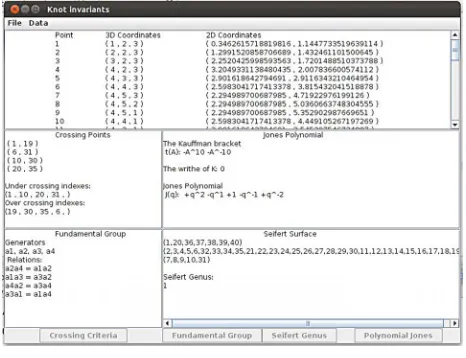
We now compute its fundamental group, its genus sur-face and its Jones polynomial. Thus, its fundamental group has 4 generators a1, a2, a3, a4; and relations: a2a4 = a1a2, a1a3 = a3a2, a4a2 = a3a4, a3a1 = a1a4. Its genus surface is one and its Jones polynomial is
q2 q 1 q1 q J q 2. See [image:4.595.348.499.294.387.2]Figure 4.
[image:4.595.309.539.412.600.2]Figure 1. Cubic left-handed trefoil knot.
Figure 2. Left-handed trefoil knot invariants.
REFERENCES
[1] M. Boege, G. Hinojosa and A. Verjovsky, “Any Smooth Knot Sn ℝn+2 Is Isotopic to a Cubic Knot Contained in the Canonical Scaffolding of n+2,” Revista Matemática
Complutense, Vol. 24, No. 1, 2011, pp. 1-13. http://dx.doi.org/10.1007/s13163-010-0037-4
[2] G. Hinojosa, A. Verjovsky and C. V. Marcotte, “Cubu-lated Moves and Discrete Knots,” 2013, pp. 1-40. http://arxiv.org/abs/1302.2133
[3] D. Rolfsen, “Knots and Links,” AMS Chelsea Publishing, American Mathematical Society, Providence Rhode Is-land, 2003.
[4] R. H. Fox, “A Quick Trip through Knot Theory. Topol-ogy of 3-Manifolds and Related Topics,” Prentice-Hall, Inc., Upper Saddle River, 1962.
[image:5.595.56.289.86.265.2][5] “The Knot Atlas,” 2013. http://katlas.math.toronto.edu Figure 4. Figure eight knot invariants.