Munich Personal RePEc Archive
Explaining ECB and Fed interest rate
correlation: Economic interdependence
and optimal monetary policy
Mandler, Martin
Justus-Liebig-Universität Giessen
October 2010
Online at
https://mpra.ub.uni-muenchen.de/25929/
Explaining ECB and Fed interest rate correlation:
Economic interdependence and optimal monetary
policy
Martin Mandler∗
(University of Giessen, Germany)
Abstract
This paper studies whether the observed high correlation between monetary policy in the U.S. and
the Euro area can be explained by economic fundamentals, i.e. by macroeconomic interdependence
between the two regions. We show that an optimal monetary policy reaction function for the ECB that
accounts explicitly for economic interrelationships between the two economies reproduces substantial
parts of the observed patterns of interest rate correlation and represents a good approximation to the
actually observed monetary policy of the ECB. It implies strong reactions to shocks to US variables,
particularly to shocks to the Federal Funds Rate.
Keywords: optimal monetary policy, monetary policy reaction function, vector autoregressions
JEL Classification: E47, E52, E58
Martin Mandler
University of Giessen
Department of Economics and Business
Licher Str. 66, 35394 Giessen
Germany
phone: +49(0)641–9922173, fax.: +49(0)641–9922179
email: [email protected]–giessen.de
1
Introduction
This paper studies whether the observed high correlation between monetary policy
in the U.S. and the Euro area can be explained by economic fundamentals, i.e. by
macroeconomic interdependence between the two regions. Using a vector
autoregres-sion (VAR) framework we derive an optimal monetary policy reaction for the European
Central Bank (ECB) that accounts explicitly for the effects of U.S. macroeconomic
vari-ables on the Euro area economy. We show that this optimal reaction function implies
for the ECB a response to shocks both within the Euro area and in the U.S. The
optimal reaction to shocks to the U.S. economy often turns out to be even stronger
than actually estimated and this applies to the reaction to the Federal Funds Rate,
in particular. This optimal reaction function for the ECB not only fits the actually
observed path of monetary policy in the Euro area remarkably well but succeeds also
in replicating the observed correlation patterns between short-run interest rates in the
Euro area and in the U.S. for leads and lags up to one year.
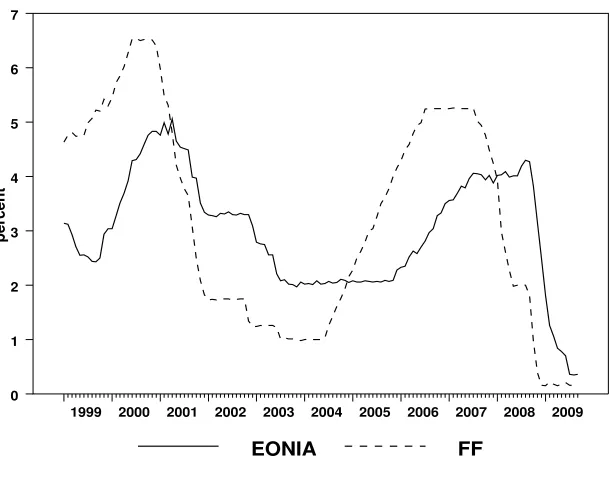
Figure 1 displays the U.S. Federal Funds Rate – the overnight interest rate closely
con-trolled by the Federal Reserve – and its counterpart in the Euro area the EONIA. Both
time series are monthly averages of daily data. The figure suggests that monetary
pol-icy in the Euro area follows that of the U.S. with a lag. The cross correlation coefficient
peaks at a lag of seven months for the Federal Funds Rate. This relationship between
policy interest rates in the Euro area and the U.S. has been studied empirically by Belke
and Gros (2003, 2005, 2006). They investigate the dynamic interrelationship between
Euro area and U.S. short-term interest rates using Granger causality tests with daily
and weekly observations. For the time period before September 2001 they find a
sym-metric relationship with either bi-directional Granger causality or no Granger causality
at all depending on the chosen lag length. Using observations from after September
2001 only, they present evidence for an asymmetric relationship with Granger causality
running from the Federal Funds Rate to the Euro area interest rate. The analysis of
the short-run interest-rate interactions between the Euro and the U.S. is extended in
Belke and Cui (2010) to simultaneously account for a possible long-run relationship.
Using a vector-error-correction model (VECM) and monthly data they estimate a
EONIA FF
percent
1999 2000 2001 2002 2003 2004 2005 2006 2007 2008 2009 0
[image:4.612.128.433.82.321.2]1 2 3 4 5 6 7
Figure 1: EONIA and Federal Funds Rate
the existence of a long-run equilibrium relation between both interest rates. For the
short-run interest-rate dynamics their estimates indicate for both interest rates similar
speeds of adjustment to deviations from this long-run equilibrium.
One possible explanation for the lead-lag pattern in Figure 1 is that both central banks
change their interest rates according to movements in the business cycle and that the
Euro area business cycle lags that of the U.S. (e.g. Begg et al., 2002). This effect can be
accounted for by estimating interest rate reaction functions for the central banks that
include macroeconomic variables and control for the stage of the business cycle. Breuss
(2002) and Ullrich (2005) estimate Taylor rules for the ECB augmented by the lagged
Federal Funds Rate and show that the U.S. interest rate enters the Euro area
mone-tary policy reaction function in a statistically significant way. Belke and Cui (2010)
augment their VECM by Euro area and U.S. inflation rates and output gaps. Their
results still indicate a cointegrating relationship between the EONIA and the Federal
Funds Rate. However, the U.S. interest rate is estimated to be weakly exogenous to
the VECM indicating an asymmetry in the relationship between the ECB and the Fed
by which only the ECB and not the Fed responds to deviations from the
cointegrat-ing relation. Scotti (2006) analyses the interdependence of the timcointegrat-ing of interest-rate
changes by the ECB and the Fed and controls for the effects of output and inflation
on the interest-rate decisions. She estimates a bivariate conditional hazard model on
weekly data and finds evidence for contemporaneous interdependence in the timing of
interest rates changes by the two central banks.
The patterns found empirically in the time-series of policy interest rates are the result
of the monetary policy reaction functions of the Fed and the ECB. These reaction
functions link the setting of the short-term interest rate by the central banks to other
macroeconomic variables. Correlation between the interest rates set by both central
banks can be caused by one or both central banks reacting directly to the
interest-rate chosen by the other one or by both central banks reacting to the same or similar
macroeconomic variables, perhaps with different time lags and intensities. Theoretical
analyses of monetary policy reaction functions (e.g. Clarida et al., 1999; Galí, 2008;
Svensson, 1997; Woodford, 2003a) show that an optimal reaction function makes the
central bank respond to all variables and shocks that help in forecasting the central
bank’s goal variables. This implies, that it will be optimal for the ECB to react to
U.S. macroeconomic variables if these have predictive power for Euro area inflation
and economic activity, either because these variables directly or indirectly affect the
Euro area economy or because they convey information about shocks that are relevant
to the Euro area.
In this paper, we study how far this explanation takes us in reproducing the observed
correlations of short-term interest rates in the U.S. and the Euro area. From an
em-pirically estimated VAR model of the U.S. and Euro area we construct an optimal
monetary policy reaction function for the ECB and investigate how important the
op-timal responses to U.S. variables and shocks are in determining the time path of the
EONIA. By means of simulations we show that the optimal reaction function can
re-produce the observed interest-rate correlation pattern to a large extent and that its
reactions to the various shocks in the model are close to those for the reaction function
estimated on the observed data. Our results suggest that the observed interest-rate
correlation between the U.S. and the Euro area results from the optimal reaction of
the ECB to U.S. variables and U.S. shocks.
The main results of the paper are as follows: (1) It is shown that the observed monetary
policy function of the ECB can be approximated by an optimal reaction function
policy implies strong reactions to shocks to U.S. variables, particularly to the Federal
Funds Rate and induces a high correlation between the interest rates set by the ECB
and the Fed. (3) These results are robust with respect to changes in the identification
assumptions of the VAR and to the introduction of uncertainty about the monetary
transmission mechanism.
The next section derives an optimal monetary policy reaction function for the ECB
from an estimated structural VAR (Section 2.1) and presents results for the importance
of U.S. variables in the optimal reaction function and for its ability in reproducing the
observed time series of the EONIA and its correlation with the Federal Funds Rate
(Section 2.2). Section 3 investigates the robustness of these results by considering
alternative identification schemes for the structural VAR. Section 4 presents results
for a model which introduces uncertainty about the structural relationships in the
economy. The results from the accordingly adjusted optimal monetary policy reaction
function resemble closely those from Section 2. Section 5 summarizes the results and
concludes.
2
Optimal policy with additive uncertainty
We construct the optimal monetary policy reaction function for the ECB from an
esti-mated structural VAR model of the Euro area and the U.S. economies using a
method-ology proposed in Sack (2000). The VAR framework is a natural way to model the
implications of macroeconomic interdependence on the monetary policy of both central
banks. A VAR that includes both policy interest rates together with macroeconomic
variables that are important determinants of monetary policy such as unemployment,
output and inflation is a flexible and relatively unrestricted framework that can account
for both the systematic responses of the central banks to the macroeconomy and for
the macroeconomic interdependence of the U.S. and the Euro area. It allows to
esti-mate the monetary policy reaction functions of the ECB and the Fed and to study the
central banks’ reaction functions by means of impulse response analyses and variance
decompositions. Furthermore, VAR models have already been successfully applied to
studies of monetary policy interdependence, although mostly for small open economies.
The interrelation between the U.S. Federal Funds Rate and interest rates in other
countries has been studied with structural vector autoregressions by Grilli and Roubini
(1995). They estimate structural VARs for non-U.S. G-7 countries either individually
or as a group and add an indicator of U.S. monetary policy to this model. They show
that unexpected innovations in the Federal Funds Rate lead to significant changes in
the short-term interest rates of non-U.S. G-7 countries. The transmission channels of
U.S. monetary policy shocks to the other G-7 countries are studied in more detail by
Kim (2001) using a sample period from 1974 to 1996. He augments a VAR model for
the U.S. with individual variables for the other G-7 countries. Although output and
production in the other countries increase significantly after an expansionary monetary
policy shock in the U.S. he finds these shocks to have little effect on the other countries’
trade balances and short-term interest rates. He concludes that expansionary monetary
policy impulses are transmitted from the U.S. to the other economies via their effects
on world interest rates. Neri and Nobili (2010) build structural VAR models of the
Euro area and the U.S. combined to study the effects of U.S. monetary policy shocks
on the Euro area. They estimate a significantly positive response of the Euro area
short-term nominal interest rate to an exogenous increase in the Federal Funds Rate.
Other authors have not focussed explicitly on the effects of U.S. monetary policy shocks
on other countries’ interest rates. Nevertheless, they have incorporated in their VAR
models the assumption of a dependence of the country of interest’s monetary policy
on the U.S. For example, Cushman and Zha (1997) study the effects of monetary
policy shocks on the Canadian economy and account explicitly for the dependence
of Canadian monetary policy on the U.S. Federal Funds Rate. Kim and Roubini
(2000) investigate the effects of monetary policy shocks on exchange rates for small
open economies and use the Federal Funds Rate to control for the effects of foreign
monetary policy. Brischetto and Voss (1999) adapt the structural VAR model of Kim
and Roubini (2000) to estimate the effects of monetary policy shocks on the Australian
economy and, again, include the Federal Funds Rate as an indicator of foreign monetary
policy.
This VAR literature does, however, only shed limited light on the question of
interest-rate correlation. Its focus is mostly on the unsystematic part of monetary policy, i.e.
is driven by the systematic reactions of monetary policy to the whole range of shocks.
Hence, in this paper we will focus on how monetary policy responds to a variety
of shocks as opposed to how the other variables respond to monetary policy shocks.
Furthermore, our approach enables us to consider optimal interest rate reactions and
to use these to evaluate the actually observed behavior of the central banks.
2.1
The optimal monetary policy reaction function of the ECB
The starting point of the analysis is an estimated structural vector autoregression
(VAR)
Zt = kZ+ q
i=0
AiZt−i+
q
i=0
biRt−i+ℓZt+ν
Z
t (1)
Rt = kR+ q
i=0
c′
iZt−i+ q
i=1
diRt−i+ℓRt+νtR. (2)
Zt is an (n×1)-vector of non-policy variables, Rt is the ECB policy interest rate, q is
the number of lags in the VAR,νZ
t is a(n×1)-vector of uncorrelated structural shocks
that is also uncorrelated with the structural policy disturbance νR
t . kZ is a vector
of constants, ℓZ a vector of coefficients on time trends and kR and ℓR the constant
and time trend in the estimated monetary policy reaction function. Ai are (n ×n)
coefficient matrices and bi and ci are (n × 1) coefficient vectors. A0 describes the
contemporaneous interactions of the non-policy variables whileb0 gives the immediate
(if any) reactions of the variables in Zt to the monetary policy instrument Rt.
Non-zero elements in c0 indicate to which of the variables in Zt monetary policy responds
to within the same period.
In this paper’s application the variables in Zt are the deviations of the U.S. and Euro
area unemployment rates from their natural levels (U N U S, U N EM U), the growth
rates of industrial production in the U.S. and in the Euro Area (IP U S,IP EM U), rates
of consumer price inflation in the U.S. and in the Euro Area (IN F LU S,IN F LEM U),
a smoothed rate of commodity price inflation P COM, the Federal Funds Rate (F F)
and the nominal U.S.-Dollar/Euro exchange rate (EXCHR). The monetary policy
indicatorRt is approximated by the EONIA rate, the average overnight interest rate in
the Euro area interbank market. As shown in (1) the VAR includes constants and time
trends. The specification in inflation rates and growth rates is chosen in accordance
with the variables included in the central bank’s loss function below.1
Equation (2) represents a backward-looking monetary policy reaction function (MPRF)
of the ECB. Its estimate can be obtained from the estimated structural VAR that
results from stacking the non-policy variablesZtand the monetary policy indicatorRt.
Equations (1) of the structural VAR can be rewritten in state-space form as a transition
equation for the state vectorXt
Xt+1 =FXt+HRt+J+µt+1, (3)
where the coefficients inF,H,J can be derived from the coefficients in (1). The state
vector Xt contains current and lagged values of the variables in Zt and lags of the
EONIA. The immediate effects of monetary policy on the state variables are captured
by the vector H.
The state-space representation of the structural model of the economy (3) can be used
to derive an optimal monetary policy reaction function (e.g. Mandler, 2009; Sack,
2000): The ECB is assumed to maximize a quadratic objective function
−1
2Et
∞
i=1 βi
(πt+i−π
∗
)2+λu(ut+i−u
∗
)2+λR(Rt+i−1−Rt+i−2)
2
. (4)
This is a standard objective function used in monetary policy analysis that penalizes
the central bank for deviations of unemployment and inflation from their target values
u∗
and π∗
(e.g. Walsh, 2010). The presence of the squared change in the interest
rate Rt+i−1 − Rt+i−2 represents an aversion to interest rates changes and leads to
interest-rate smoothing by the central bank (e.g. Woodford, 2003b).2
λu and λR are
the weights attached to the employment and interest-rate objectives relative to the
inflation objective and β is a discount factor. Since the unemployment variables inZt
are already defined as deviations of unemployment rates from their natural levels, u∗
is equal to zero, i.e. the ECB is assumed to target the natural rate of unemployment.
The part of the objective function in square brackets can be written in a notation
1
Detailed information on the data is given in the appendix.
2
Empirically, interest rate smoothing manifests in a statistically significant and quantitatively
compatible with (3)
(Xt+i −X
∗
)′
G(Xt+i−X∗
). (5)
G has as non-zero entries only the elements corresponding to the weights attached to
the relevant variables inXt+i in the objective function. X∗ is the vector of target values
for the state variables. In this model the only non-zero element in X∗
corresponds to
the inflation target π∗
. 3
The optimal policy reaction function determines the policy instrumentRtas a function
of the state variables Xt and maximizes (4) subject to (3). This linear-quadratic
dynamic programming problem can be solved using standard methods (e.g. Ljunquist
and Sargent, 2004, Ch. 4; Sack, 2000). The optimal monetary policy reaction function
solves the Bellman equation
V(Xt) = max Rt
−(Xt−X
∗
)′
G(Xt−X∗
) +βEt[V(Xt+1)]
, (6)
subject to (3). For a linear quadratic dynamic programming problem like this the value
function has the form
V(X) =X′
tΛXt+ 2X
′
tω+ρ, (7)
with constants Λ,ω and ρ. The solution for the optimal policy reaction function is
R∗
t =−(H
′ΛH
)−1
(H′ΛF
Xt+H
′ΛJ
+H′
ω), (8)
where the symmetric matrixΛ is defined implicitly by the Riccati equation
Λ=−G+βF′
ΛF−βF′
ΛH(H′
ΛH)−1H′
ΛF. (9)
The vector ω is given by
ω = I−βF′
I−ΛH(H′
ΛH)−1H
−1
× GX∗
+βF′
Λ I−H(H′
ΛH)−1H′
ΛJ. (10)
3
A slight departure from the standard specification is the use ofRt+i−1−Rt+i−2instead ofRt+i−
Rt+i−1 in (4). Through this modification, the objective function can be written in terms of the state
variables as given in (5). The difference of (4) to the standard specification caused by this modification
is twofold: First, in the infinite sum in equation (4) the term Rt+i−Rt+i−1 is multiplied by β
i+1
instead ofβi
as in the standard formulation and, second, the objective function (4) includes the term
−(1/2)β(Rt−1−Rt−2)which would not be present when using the standard specification. β is close to one andRt−1−Rt−2 does not depend on the setting of the interest rate in periodt. Hence, these
two differences will have a negligible effect on the optimal monetary policy reaction function.
Under the optimal monetary policy reaction function the dynamics of the economy are
given by (3) and (8). (8) shows how the value of the monetary policy instrumentRt is
determined by the current state of the economy Xt. Xt and Rt in turn determine the
state vector in the next period Xt+1 according to (3). The only sources of uncertainty
are the shocks µt+1 to the transition equation (3). The optimal monetary policy
reac-tion funcreac-tion (8) is much less restrictive than a Taylor-type rule and allows the policy
rate to react to current and lagged values of all of the non-policy variables and to lags
of the policy interest rate.
In deriving the optimal ECB reaction function (8) we treat (3) as a structural
represen-tation of the economy, i.e. we assume the coefficients in (3) that are derived from the
estimated structural VAR to be invariant with respect to changes in the ECB reaction
function. This assumption can be questioned in the light of the Lucas (1976) critique.
Since the parameters in lagged representations of an economic model as in (1) and (2)
depend on agents’ expectations of monetary policy they will change when the central
bank is assumed to follow a monetary policy different from that in the estimation
pe-riod.
However, the empirical relevance of the critique depends on the size and on the
eco-nomic significance of the changes in the reduced form parameters that are caused by
alternative policies. For example, even though much evidence has been presented for
pronounced changes in the Fed’s monetary policy reaction function, empirical VAR and
backward-looking non-VAR models appear to be stable, see, for example Rudebusch
and Svensson (1999), Bernanke and Mihov (1998), and Estrella and Fuhrer (2003).4
Rudebusch (2005) conducts a thorough investigation into the empirical relevance of
the Lucas critique. He simulates structural economic models that contain
expecta-tional variables and finds only very modest changes in the reduced form coefficients.
In most cases, he is unable to reject the null hypothesis of stability in the reduced
form parameters after having changed the policy rule. That structural invariance in
face of plausible policy changes often cannot be rejected is argued as well by Estrella
and Fuhrer (2003). In the following section we will show that the optimal monetary
policy reaction function is actually a good approximation to the actual one and that
4
In the context of estimated Taylor rules see, for example, Boivin (2006), Clarida, Galí, and Gertler
the behavior of the economy model under the optimal ECB reaction function is close
to that of the estimated VAR. Hence, the possible effect of the Lucas critique will be
very limited.
The first step in the construction of the optimal monetary policy reaction function for
the ECB is the estimation of the structural VAR (1) and (2) and its transformation into
the state space model (3). Structural identification of the VAR is achieved by imposing
zero restrictions in the matrix A0 of contemporaneous interactions of the non-policy
variables in (1), in the vectorb0 in (1) indicating the immediate reactions of the
non-policy variables to the monetary non-policy instrument, and in the vector c0 in (2) which
represents the within-period response of monetary policy to the non-policy variables.
Of special importance are the restrictions imposed on c0 since these restrict to which
non-policy variables monetary policy can respond immediately, i.e. of which non-policy
variables the current observations are in the central bank’s information set. This has
implications for the construction of the state vector Xt in (3) since comparisons of
the optimal and the estimated monetary policy reaction functions must be based on
identical information sets: The current observations of all of the variables with non-zero
elements in c0 must be included in Xt.
In our model the identification of the structural VAR is based on the following
as-sumptions:5
For both the EMU and the U.S. variables we assume recursive orderings
in which the unemployment rate is ordered first, followed by the growth rate of
indus-trial production and by the inflation rate. There is no contemporaneous interaction
of these variables across country blocks which is a reasonable assumption for monthly
data. As in Kim and Roubini (2000) we include an indicator of commodity price
infla-tion to capture global inflainfla-tionary shocks. Commodity price inflainfla-tion reacts to all other
variables with a lag. The nominal exchange rate is affected within the same period by
all other variables including the interest rates in the Euro Area and in the U.S.
Of particular importance are the identification assumptions concerning monetary
pol-icy in the U.S. and in the Euro Area. In the first version of the model we assume
5
These identifying assumptions are in part derived from the standard standard recursive
identifi-cation scheme common in the literature (e.g. Christiano et al., 1999). This structure for variables
within one economy is also used in Kim (2001).
that U.S. monetary policy reacts within the same period to unemployment, industrial
production and inflation in both regions and to commodity price inflation but not to
the ECB’s monetary policy and to the exchange rate. The ECB is assumed to react
within the same period to all variables except for the exchange rate, i.e. the ECB is
allowed to respond immediately to U.S. monetary policy. Since this implies an
asym-metry in the treatment of both central banks we will also present results in Section 3
for slightly different identification schemes and show that our results are robust with
respect to these changes. In particular, we also consider a model in which the ECB
does not react to U.S. monetary policy within the current period while the Federal
Reserve immediately reacts to changes in Euro area interest rates.6
The structural VAR is estimated on monthly data from 1995:7 to 2007:12.7
Since a
VAR with ten variables is fitted to a relatively short sample period the VAR is
esti-mated with only six lags.
2.2
Results
The optimal monetary policy reaction function (8) contains four free parameters: the
discount factor β, the relative weights of unemployment and interest-volatility in the
central bank’s objective function,λu andλR, and the inflation targetπ∗. As suggested
by Sack (2000) we impose β = 0.996 and estimate λu, λR and π
∗
by minimizing the
sum of squared deviations of the interest rate implied by (8) from the actually observed
interest rate.8
For any combination ofλu,λRandπ
∗
on a grid we compute the optimal
monetary policy reaction function (8) and use it to obtain a time series of optimal
interest rates based on the historically observed values for the state variables in Xt.
The particular combination of λu, λR and π∗ selected is the one which minimizes the
sum of squared deviations of the optimal from the observed EONIA rate for 1999M1
6
Kim (2001) considers various structural and recursive identification schemes in his VAR study on
the international transmission of monetary policy shocks and shows his results to be very robust with
respect to these changes.
7
Including observations up to the collapse of Lehman Brothers in September 2008 resulted in a
large increase in the imprecision of the estimates indicating the possibility of a structural break.
8
The estimation of structural parameters in an optimal monetary policy rule by fitting it to observed
EONIA EONIA(opt)
percent
1999 2000 2001 2002 2003 2004 2005 2006 2007 0
[image:14.612.127.431.82.321.2]1 2 3 4 5 6
Figure 2: Actual and fitted optimal EONIA
to 2007M12.9
The results of this search procedure showed a tendency for λR to
be-come excessively large while the estimates for the other two parameters were mostly
independent of λR. Hence, we fixed λR = 2.5 at a value which provided a reasonably
good approximation to the observed time series of the EONIA and searched over λu
andπ∗
only. Higher values forλR led to only very small improvements in the fit of the
model. The resulting estimate for the weight on unemployment isλu = 0.0575and the
estimate for the inflation target is π∗
= 2.20 percent which is only slightly above the ECB’s official inflation target of two percent. The estimated weight on the
unemploy-ment objective is relatively low but in line with other results in the literature. Using
quarterly data for the period 1980:3-1998:3 Favero and Rovelli (2003) find a weight of
0.00125 on the output gap in the loss function of the Federal Reserve. Also for the
Federal Reserve, Dennis (2001, 2004) reports statistically insignificant estimates of the
weight on the output gap while Collins and Siklos (2004) estimate a weight of 0.001.
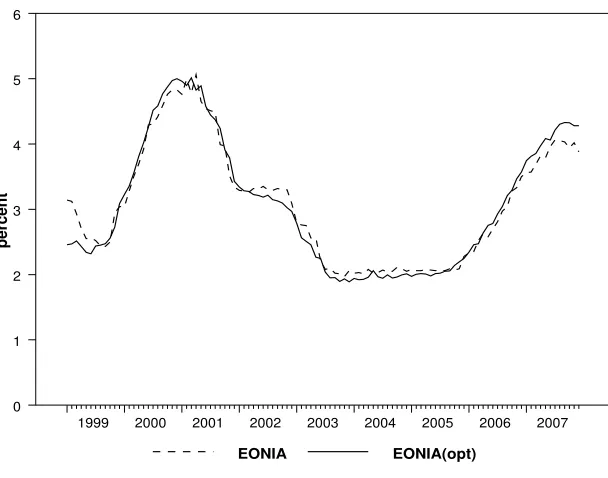
Figure 2 shows the observed time series for the EONIA together with the one
con-structed from the optimal monetary policy reaction function. Except for the first and
last few months the optimal interest rate path tracks the observed one very closely
9
Since no explicit solution for the matrixΛin (9) exists this search procedure is employed. As a
consequence information on the precision of the estimates is not available.
EONIA(opt)_t,FF_t-i EONIA_t,FF_t-i
lag for FF (months)
correlation coefficient
-26 -22 -18 -14 -10 -6 -2 2 6 10 14 18 22 26 -0.6
[image:15.612.124.437.84.317.2]-0.4 -0.2 0.0 0.2 0.4 0.6 0.8 1.0
Figure 3: Correlation of actual and fitted optimal EONIA with observed
Fed-eral Funds Rate
with a sum of squared deviations of 3.50. The volatility of the optimal interest rate is
slightly above the volatility of the observed EONIA (standard deviations of 0.98 and
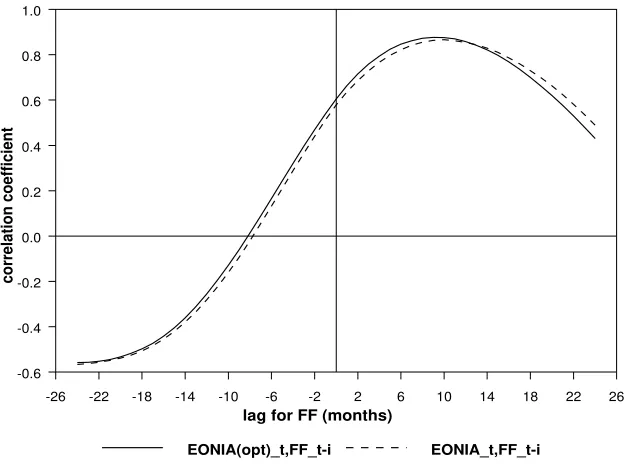
0.90, respectively). The optimal monetary policy reaction function is able to reproduce
the cross correlation structure of the EONIA and the observed Federal Funds Rate at
leads and lags up to two years as presented in Figure 3.
Figure 4 compares impulse responses of the EONIA for the estimated monetary policy
reaction function to those for the optimal one. The impulse responses for the optimal
monetary policy reaction functions (MPRF) (solid lines) are obtained from simulating
the structural equations for the non-policy variables in (3) together with the optimal
monetary policy reaction function (8). The identification assumption concerning the
ECB’s information set used to compute the optimal reaction function is identical to the
one imposed in the estimation of the structural VAR. Therefore, the impulse responses
for the system with the optimal reaction function are simulated with the same
struc-tural shocks as used for the estimated impulse responses.10
For the structural shocks
10
This assumes the estimated structural shocks from the VAR as the ’true’ shock series and simulates
the effects on the dynamical adjustment of the economy of exchanging the estimated for the optimal
impulse responses for EONIA: with optimal MPRF (solid), with estimated MPRF (dashed)
response to UNUS
months
0 10 20 30 40 50 -0.10 -0.05 0.00 0.05 0.10 0.15
response to UNEMU
months
0 10 20 30 40 50 -0.15 -0.10 -0.05 0.00 0.05 0.10 0.15 0.20
response to IPUS
months
0 10 20 30 40 50 -0.15 -0.10 -0.05 0.00 0.05 0.10 0.15 0.20
response to IPEMU
months
0 10 20 30 40 50 -0.25
-0.15 -0.05 0.05 0.15
response to INFLUS
months
0 10 20 30 40 50 -0.20
-0.10 -0.00 0.10 0.20
response to INFLEMU
months
0 10 20 30 40 50 -0.20
-0.10 -0.00 0.10 0.20
response to PCOM
months
0 10 20 30 40 50 -0.15 -0.10 -0.05 0.00 0.05 0.10 0.15 0.20
response to FF
months
0 10 20 30 40 50 -0.15 -0.10 -0.05 0.00 0.05 0.10 0.15
response to EONIA
months
0 10 20 30 40 50 -0.15 -0.10 -0.05 0.00 0.05 0.10 0.15
response to EXCHR
months
[image:16.612.155.726.111.467.2]to the EONIA itself we use the estimate from the policy equation in the structural
VAR (2). The dashed lines are the impulse responses for the EONIA in the estimated
structural VAR ((1) and (2)) and the dotted lines represent 90% probability bands
around the estimated impulse responses and were constructed by Monte Carlo
simu-lation.11
For many of the shocks the impulse responses of the model with the optimal
reaction function imposed are close to the estimated impulse responses and follow very
similar trajectories. The optimal impulse responses match the estimated ones very
suc-cessfully in the first year after shocks to the EMU unemployment rate, U.S. industrial
production and to the EONIA itself. The optimal reaction function leads to a quicker
but shortly lived negative (positive) interest rate response to shocks to U.S. (EMU)
inflation compared to the estimated reaction of the EONIA. The response of the
EO-NIA to Federal Funds Rate shocks within the first few months is more pronounced for
the optimal reaction function but less persistent. Both the optimal reaction function
and the estimated one imply a hump-shaped response to Federal Funds Rate shocks
similar to the result in Neri and Nobili (2010). Strong changes can be observed for
the response to U.S. unemployment, Euro area industrial production and to
commod-ity price inflation. Overall, the impulse responses from the optimal monetary policy
reaction function provide a reasonably good approximation to the estimated responses
of the ECB. Figures 5 and 6 offer the same comparisons for the impulse responses of
the EMU unemployment and inflation rates. Again, the impulse responses from the
VAR with the optimal monetary policy reaction function imposed are very close to the
estimated ones.
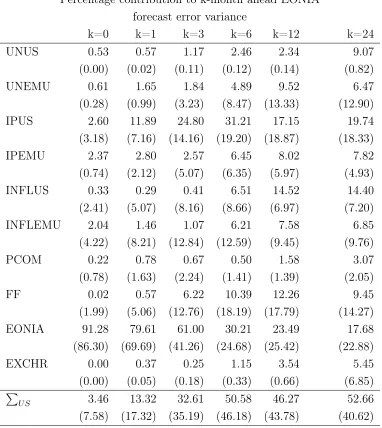
Table 1 presents decompositions of the EONIA forecast variance for the model with,
first, the estimated and then the optimal ECB reaction functions imposed. Again,
because of the identical identification assumptions we use the VAR estimates of the
structural shocks to construct the variance decompositions for the system including
the optimal reaction function.
A few interesting facts emerge: The contribution of inflation shocks both in the U.S.
and in the EMU is higher under the optimal ECB reaction function than that under
11
The dynamical stability of the model obtained from combining (3) and (8) was checked by
com-puting the largest absolute eigenvalue of the system as 0.996. The largest absolute eigenvalue of the
impulse responses for INFLEMU: with optimal MPRF (solid), with estimated MPRF (dashed)
response to UNUS
months
0 10 20 30 40 50 -0.15 -0.10 -0.05 0.00 0.05 0.10 0.15
response to UNEMU
months
0 10 20 30 40 50 -0.15 -0.10 -0.05 0.00 0.05 0.10 0.15 0.20
response to IPUS
months
0 10 20 30 40 50 -0.15 -0.10 -0.05 0.00 0.05 0.10 0.15
response to IPEMU
months
0 10 20 30 40 50 -0.20 -0.15 -0.10 -0.05 -0.00 0.05 0.10 0.15
response to INFLUS
months
0 10 20 30 40 50 -0.20
-0.10 -0.00 0.10 0.20
response to INFLEMU
months
0 10 20 30 40 50 -0.20
-0.10 -0.00 0.10 0.20
response to PCOM
months
0 10 20 30 40 50 -0.20 -0.15 -0.10 -0.05 -0.00 0.05 0.10 0.15
response to FF
months
0 10 20 30 40 50 -0.15 -0.10 -0.05 0.00 0.05 0.10 0.15
response to EONIA
months
0 10 20 30 40 50 -0.15 -0.10 -0.05 0.00 0.05 0.10 0.15
response to EXCHR
months
[image:18.612.147.721.110.468.2]impulse responses for UNEMU: with optimal MPRF (solid), with estimated MPRF (dashed)
response to UNUS
months
0 10 20 30 40 50 -0.050
-0.025 0.000 0.025 0.050
response to UNEMU
months
0 10 20 30 40 50 -0.06 -0.04 -0.02 0.00 0.02 0.04 0.06
response to IPUS
months
0 10 20 30 40 50 -0.050 -0.025 0.000 0.025 0.050 0.075
response to IPEMU
months
0 10 20 30 40 50 -0.04 -0.02 0.00 0.02 0.04 0.06 0.08
response to INFLUS
months
0 10 20 30 40 50 -0.08 -0.06 -0.04 -0.02 0.00 0.02 0.04 0.06
response to INFLEMU
months
0 10 20 30 40 50 -0.050 -0.025 0.000 0.025 0.050 0.075 0.100 0.125
response to PCOM
months
0 10 20 30 40 50 -0.100 -0.075 -0.050 -0.025 -0.000 0.025 0.050
response to FF
months
0 10 20 30 40 50 -0.04 -0.02 0.00 0.02 0.04 0.06
response to EONIA
months
0 10 20 30 40 50 -0.05
-0.03 -0.01 0.01 0.03
response to EXCHR
months
[image:19.612.153.718.109.469.2]Table 1: Comparison of variance decompositions under estimated and
opti-mal MPRF
Percentage contribution to k-month ahead EONIA forecast error variance
k=0 k=1 k=3 k=6 k=12 k=24
UNUS 0.53 0.57 1.17 2.46 2.34 9.07
(0.00) (0.02) (0.11) (0.12) (0.14) (0.82)
UNEMU 0.61 1.65 1.84 4.89 9.52 6.47
(0.28) (0.99) (3.23) (8.47) (13.33) (12.90)
IPUS 2.60 11.89 24.80 31.21 17.15 19.74
(3.18) (7.16) (14.16) (19.20) (18.87) (18.33)
IPEMU 2.37 2.80 2.57 6.45 8.02 7.82
(0.74) (2.12) (5.07) (6.35) (5.97) (4.93)
INFLUS 0.33 0.29 0.41 6.51 14.52 14.40
(2.41) (5.07) (8.16) (8.66) (6.97) (7.20)
INFLEMU 2.04 1.46 1.07 6.21 7.58 6.85
(4.22) (8.21) (12.84) (12.59) (9.45) (9.76)
PCOM 0.22 0.78 0.67 0.50 1.58 3.07
(0.78) (1.63) (2.24) (1.41) (1.39) (2.05)
FF 0.02 0.57 6.22 10.39 12.26 9.45
(1.99) (5.06) (12.76) (18.19) (17.79) (14.27)
EONIA 91.28 79.61 61.00 30.21 23.49 17.68
(86.30) (69.69) (41.26) (24.68) (25.42) (22.88)
EXCHR 0.00 0.37 0.25 1.15 3.54 5.45
(0.00) (0.05) (0.18) (0.33) (0.66) (6.85)
U S 3.46 13.32 32.61 50.58 46.27 52.66
(7.58) (17.32) (35.19) (46.18) (43.78) (40.62)
NOTES: Sample period is 1995:7-2007:12. Numbers in brackets apply to the model including the optimal MPRF, number without brackets to the estimated VAR.
Actual and simulated optimal EONIA - historical shocks
EONIA(opt) EONIA
percent
1999 2000 2001 2002 2003 2004 2005 2006 2007 0
1 2 3 4 5 6
Actual and simulated Federal Funds Rate - historical shocks
FF(sim) FF
percent
1999 2000 2001 2002 2003 2004 2005 2006 2007 0
[image:21.612.126.439.96.308.2]1 2 3 4 5 6 7 8
Figure 7: Simulation of EONIA and Federal Funds Rate with historical
shocks
the estimated one for forecast horizons up to six months. The importance of shocks to
industrial production in explaining unexpected EONIA changes declines. U.S.
unem-ployment shocks explain less variation in the EONIA under the optimal ECB reaction
function than under the estimated one while the explanatory power of EMU
unem-ployment shocks increases for forecast horizons of three months and more. In addition,
the contribution of Federal Funds Rate innovations to the EONIA forecast variance
in-creases strongly while that of the EONIA’s own shocks declines in the short run. The
last two rows show the aggregate variance contribution of all U.S. variables together.
For forecast horizons up to three months the optimal monetary policy reaction
func-tion recommends assigning a greater importance to U.S. shocks than actually observed.
After three months the aggregate contribution of U.S. shocks to the EONIA is similar
for the optimal and for the estimated reaction function.
The time series for the optimal EONIA in Figure 1 was derived by computing the
optimal EONIA rate for the actually observed values of the state variables in Xt at
EONIA(opt)_t,FF(sim)_t-i EONIA_t,FF_t-i
lag for FF (months)
correlation coefficient
-26 -22 -18 -14 -10 -6 -2 2 6 10 14 18 22 26 -0.6
[image:22.612.124.437.83.317.2]-0.4 -0.2 0.0 0.2 0.4 0.6 0.8 1.0
Figure 8: Correlation of simulated EONIA and simulated Federal Funds Rate
that result from simulating (3) with the optimal monetary policy reaction function (8).
For each model the historical time series of the structural shocks were constructed from
the reduced form VAR residuals using the identification assumptions given in Section
2.1. Beginning at the historically observed values for the state vector Xt in 1999:1
each model is simulated subject to the estimated time series of structural shocks. This
assumes all variables in the model to evolve according to their dynamics in (3) and (8)
and does not reset them to their observed values in each period. In Figure 7 the model
is still able to capture broadly the evolution of the policy interest rates in the U.S. and
in the EMU.12
Figure 8 displays the correlation coefficients between the simulated EONIA and Federal
Funds Rates series in Figure 7 at various leads and lags and shows the correlation
patterns to be very close to those of the observed time series for leads and lags of the
Federal Funds Rate of up to about a year. However, the model has some problems in
replicating the long-run correlations between the two interest rate series which are too
weak compared to the observed ones.
12
Note that only for the ECB an optimal monetary policy reaction function is used. For the Fed
the model still includes the estimated reaction function.
All these results indicate that shocks to U.S. macroeconomic variables are important
driving forces behind the dynamic behavior of the EONIA even though the U.S.
vari-ables enter the optimal monetary policy reaction function only because of their
pre-dictive power for inflation and unemployment in the Euro area. In fact, the optimal
monetary policy reaction assigns an even greater importance to short-run reactions
to U.S. variables than estimated. Compared to the estimated ECB reaction function
the optimal one implies a stronger reaction to unexpected Federal Funds Rate changes
within the first months and emphasizes the importance of U.S. monetary policy shocks
for the EONIA. The correlation pattern between the EONIA and the Federal Funds
Rate is thus caused by the direct response of each central bank to the other’s policy
interest rate and by the two central banks reacting to changes in the macroeconomic
variables in both the U.S. and the Euro area. In the context of the model presented in
this paper, this behavior of the ECB is close to optimal.
3
Robustness
The results in the preceding model were derived from a structural VAR in which the
Federal Reserve reacts to U.S. and Euro area unemployment, industrial production and
inflation and to commodity price inflation within a given month. The Federal Reserve
was assumed to respond to the EONIA with a lag of month. In contrast, the ECB was
allowed to react immediately to unemployment, industrial production and inflation in
both the Euro area and the U.S. and to commodity price inflation as well as to the
Federal Funds Rate. This identification assumption was important in deriving the
state equation for the economy (3) and the structural shocks used to construct impulse
responses, variance decompositions and the simulated interest rate series in Figure 7.
In order to investigate how strongly our results depend on this assumption we derived
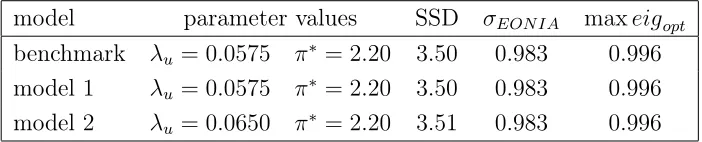
results as in Section 2 for different identification schemes. The difference in model 1 to
the benchmark model in Section 2 is that it restricts the set of variables the Federal
Reserve is assumed to react to within the month to only U.S. unemployment, industrial
production and inflation and to commodity price inflation. It retains the assumption
Table 2: Estimation results for various identification schemes
model parameter values SSD σEON IA maxeigopt
benchmark λu = 0.0575 π
∗
= 2.20 3.50 0.983 0.996
model 1 λu = 0.0575 π
∗
= 2.20 3.50 0.983 0.996
model 2 λu = 0.0650 π
∗
= 2.20 3.51 0.983 0.996
SSD: Sum of squared deviations of optimal from observed EONIA.
σEON IA: Standard deviation of fitted EONIA (standard deviation of
observed EONIA is 0.900). maxeigopt is the largest absolute Eigen-value of the model with the optimal MPRF imposed. The largest absolute eigenvalue of the estimated VAR is 0.998.
Model 2 switches the information assumptions of the benchmark model between the
Federal Reserve and the ECB around and assumes that the Federal Reserve reacts
immediately to U.S. and Euro area unemployment, industrial production and inflation
and to commodity price inflation as well as to the EONIA while the ECB does not
react to the Federal Funds Rate within the month.13
The estimates for the parameters in the central bank’s loss function (4) are almost
the same across models.14
The fit of the optimally set EONIA to the observed one is
almost identical for for the benchmark model and models 1 and 2 as shown in Figure
9. For all models, the correlation between the fitted EONIA and the Federal Funds
Rate comes close to the one of the observed EONIA (Figure 10).
Figure 11 presents for all models the impulse responses of the EONIA if each optimal
monetary policy reaction function is combined with the appropriate version of the
state equation (3) for the model. The structural shocks used in this simulation are
that from the structural VAR with identification assumptions consistent with those
used to construct the optimal monetary policy reaction function. The dashed lines
13
We estimated also a third model which assumed that both central banks react to each other’s
in-terest rate changes immediately but to ensure identification, restricted the Federal Reserve to respond
to the other Euro area variables except for the EONIA with a lag of one month. Unfortunately, there
were difficulties in estimating the contemporaneous interaction coefficients inA0, b0 and c0 between
the variables not only for this specification but also for slightly different models with the assumption
of immediate interaction between the ECB and the Fed. Furthermore the impulse responses indicated
that the interest rate shocks were not identified appropriately. These problems could be avoided by
replacing the U.S.-Dollar/Euro nominal exchange rate by a real effective exchange rate for the Euro
area. The evidence from this model supports the general robustness of our results.
14
For the weight on interest-rate smoothingλR a uniform value of 2.5 was imposed for all models.
benchmark model
EONIA EONIA(opt)
percent
1999 2000 2001 2002 2003 2004 2005 2006 2007 0
1 2 3 4 5 6
model 1
EONIA EONIA(opt1)
percent
1999 2000 2001 2002 2003 2004 2005 2006 2007 0
1 2 3 4 5 6
model 2
EONIA EONIA(opt2)
percent
1999 2000 2001 2002 2003 2004 2005 2006 2007 0
[image:25.612.85.482.205.598.2]1 2 3 4 5 6
benchmark model
CCorr(EONIA(opt)_t,FF_t-i) CCorr(EONIA_t,FF_t-i)
lag for FF (months)
correlation coefficient
-26 -20 -14 -8 -2 4 10 16 22 -0.6
-0.4 -0.2 0.0 0.2 0.4 0.6 0.8 1.0
model 1
CCorr(EONIA(opt1)_t,FF_t-i) CCorr(EONIA_t,FF_t-i)
lag for FF (months)
correlation coefficient
-26 -20 -14 -8 -2 4 10 16 22 -0.6
-0.4 -0.2 0.0 0.2 0.4 0.6 0.8 1.0
model 2
CCorr(EONIA(opt2)_t,FF_t-i) CCorr(EONIA_t,FF_t-i)
lag for FF (months)
correlation coefficient
-26 -20 -14 -8 -2 4 10 16 22 -0.6
[image:26.612.83.479.205.595.2]-0.4 -0.2 0.0 0.2 0.4 0.6 0.8 1.0
Figure 10: Correlation of actual and fitted optimal EONIA with observed
Federal Funds Rate (all models)
impulse responses for EONIA: with optimal MPRF (solid), with estimated MPRF (dashed)
benchmark model model 1 model 2
response to UNUS
months
0 10 20 30 40 50 -0.15
-0.05 0.05 0.15
response to UNUS
months
0 10 20 30 40 50 -0.15
-0.05 0.05 0.15
response to UNUS
months
0 10 20 30 40 50 -0.15
-0.05 0.05 0.15
response to UNEMU
months
0 10 20 30 40 50 -0.15
-0.05 0.05
0.15 response to UNEMU
months
0 10 20 30 40 50 -0.15
-0.05 0.05
0.15 response to UNEMU
months
0 10 20 30 40 50 -0.15
-0.05 0.05 0.15
response to INFLUS
months
0 10 20 30 40 50 -0.15
-0.05 0.05 0.15
response to INFLUS
months
0 10 20 30 40 50 -0.15
-0.05 0.05 0.15
response to INFLUS
months
0 10 20 30 40 50 -0.15
-0.05 0.05 0.15
response to INFLEMU
months
0 10 20 30 40 50 -0.15
-0.05 0.05 0.15
response to INFLEMU
months
0 10 20 30 40 50 -0.15
-0.05 0.05 0.15
response to INFLEMU
months
0 10 20 30 40 50 -0.15
-0.05 0.05 0.15
response to FF
months
0 10 20 30 40 50 -0.15
-0.05 0.05
0.15 response to FF
months
0 10 20 30 40 50 -0.15
-0.05 0.05
0.15 response to FF
months
[image:27.612.155.718.107.475.2]impulse responses for EONIA: with optimal MPRF (solid), with estimated MPRF (dashed)
benchmark model model 1 model 2
response to IPUS
months
0 10 20 30 40 50 -0.15
-0.05 0.05 0.15
response to IPUS
months
0 10 20 30 40 50 -0.15
-0.05 0.05 0.15
response to IPUS
months
0 10 20 30 40 50 -0.15
-0.05 0.05 0.15
response to IPEMU
months
0 10 20 30 40 50 -0.15
-0.05 0.05
0.15 response to IPEMU
months
0 10 20 30 40 50 -0.15
-0.05 0.05
0.15 response to IPEMU
months
0 10 20 30 40 50 -0.15
-0.05 0.05 0.15
response to PCOM
months
0 10 20 30 40 50 -0.15
-0.05 0.05 0.15
response to PCOM
months
0 10 20 30 40 50 -0.15
-0.05 0.05 0.15
response to PCOM
months
0 10 20 30 40 50 -0.15
-0.05 0.05 0.15
response to EONIA
months
0 10 20 30 40 50 -0.15
-0.05 0.05 0.15
response to EONIA
months
0 10 20 30 40 50 -0.15
-0.05 0.05 0.15
response to EONIA
months
0 10 20 30 40 50 -0.15
-0.05 0.05 0.15
response to EXCHR
months
0 10 20 30 40 50 -0.15
-0.05 0.05
0.15 response to EXCHR
months
0 10 20 30 40 50 -0.15
-0.05 0.05
0.15 response to EXCHR
months
[image:28.612.131.722.109.473.2]Table 3: Comparison of variance decompositions for different models
Percentage contribution of U.S.-Variables to k-month ahead EONIA forecast error variance
k=0 k=1 k=3 k=6 k=12 k=24
benchmark (/FF) 3.46 12.75 26.38 40.19 34.01 43.21
(5.59) (12.26) (22.43) (27.99) (25.98) (26.36)
benchmark (FF) 0.02 0.57 6.22 10.39 12.26 9.45
(1.99) (5.06) (12.76) (18.19) (17.79) (14.27)
benchmark (all) 3.48 13.32 32.60 50.58 46.27 52.66
(7.58) (17.32) (35.19) (46.18) (43.78) (40.62)
model 1 (/FF) 3.44 12.68 25.77 39.49 33.97 43.41
(5.46) (11.91) (21.63) (27.48) (26.01) (26.47)
model 1 (FF) 0.03 0.65 7.16 12.08 14.48 10.97
(2.28) (5.81) (14.62) (21.30) (21.31) (16.99)
model 1 (all) 3.47 13.33 32.92 51.57 48.44 54.38
(7.75) (17.72) (36.26) (48.78) (47.32) (43.47)
model 2 (/FF) 3.46 12.75 26.38 40.19 34.01 43.21
(5.23) (11.68) (21.60) (26.72) (24.67) (24.46)
model 2 (FF) 0.00 0.46 5.95 10.29 12.59 9.71
(0.00) (1.87) (10.57) (19.07) (20.64) (17.27)
model 2 (all) 3.46 13.21 32.33 50.48 46.60 52.92
(5.23) (13.55) (32.17) (45.79) (45.31) (41.73)
NOTES: Sample period is 1995:7-2007:12. Numbers in brackets apply to the model including the optimal MPRF, number without brackets to the esti-mated VAR. (/FF) denotes the sum of the contributions of U N U S, IP U S
andIN F LU S to the EONIA forecast variance. (All) denotes the sum of these contributions plus the contribution of FF.
represent the estimated impulse responses and the dotted lines 90% probability bands
around these. The impulse responses of the optimal EONIA differ only very slightly
across models and are for many shocks very close to the estimated ones.15
Table 3 compares the results of variance decompositions for the EONIA across the
different models. As in Table 2 the structural shocks used are identified consistently
within each model using the same timing assumptions for the estimated and for the
optimal reaction function. For each model the sum of the contributions to the EONIA
forecast variance of shocks to all U.S. variables except for the Federal Funds Rate is
15
This applies as well to the impulse responses of Euro area unemployment and inflation which are
shown in the (/F F) line of each panel for the estimated VAR and in the second line for
the model with the optimal monetary policy reaction function imposed for the ECB.
The third and fourth lines show the contribution of Federal Funds Rate innovations
while the last two lines give the sum of the contribution of all U.S. variables including
the Federal Funds Rate.16
The table provides very similar results concerning the cumulative importance of shocks
to U.S. unemployment, industrial production and inflation across models for both the
estimated and the optimal ECB reaction function. The optimal reaction function in
all models assigns a greater importance to these U.S. shocks in the impact period
but a lower one afterwards relative to the estimated ECB reaction function. In turn,
Federal Funds Rate shocks contribute stronger to unexpected EONIA movements under
the optimal ECB reaction functions than under the estimated ones. The aggregate
contributions of all U.S. shocks to the EONIA forecast variance under the assumption
of the optimal monetary policy reaction function for the ECB are very close to their
estimated counterparts apart from forecast over 24 months when it is considerably
lower. This mirrors the difficulties of the optimally derived monetary policy reaction
functions to capture the correlation between EONIA and Federal Funds Rate at longer
leads and lags.
Figure 12 repeats the simulations from Figure 7 for each model. It shows the time
series for the EONIA that result from simulating the model’s version of (3) with the
relevant optimal monetary policy reaction function (8) and the estimated structural
shock series from the VAR imposed. The simulated EONIA series are almost identical
across the different models. As in Figure 7 the models are quite capable in reproducing
the general pattern of interest rate policy in the Euro area.
The correlation of the simulated times series of the EONIA and the Federal Funds
Rate at various leads and lags are shown in Figure 13 for the different models. All
models succeed in reproducing the correlations between the EONIA and the Federal
Funds Rate for leads and lags up to about one year but imply weaker than observed
correlations for longer leads and lags.
16
While values in the first row of the top and bottom panels are identical, the individual
contribu-tions of the different U.S. shocks that enter these sums differ between the two models.
benchmark model
EONIA EONIA(sim)
percent
1999 2000 2001 2002 2003 2004 2005 2006 2007 0
1 2 3 4 5 6
model 1
EONIA EONIA(sim1)
percent
1999 2000 2001 2002 2003 2004 2005 2006 2007 0
1 2 3 4 5 6
model 2
EONIA EONIA(sim2)
percent
1999 2000 2001 2002 2003 2004 2005 2006 2007 0
[image:31.612.85.480.214.608.2]1 2 3 4 5 6
benchmark model
CCorr(EONIA(sim)_t,FF(sim)_t-i) CCorr(EONIA_t,FF_t-i)
lag for FF (months)
correlation coefficient
-26 -20 -14 -8 -2 4 10 16 22 -0.6
-0.4 -0.2 0.0 0.2 0.4 0.6 0.8 1.0
model 1
CCorr(EONIA(sim1)_t,FF(sim1)_t-i) CCorr(EONIA_t,FF_t-i)
lag for FF (months)
correlation coefficient
-26 -20 -14 -8 -2 4 10 16 22 -0.6
-0.4 -0.2 0.0 0.2 0.4 0.6 0.8 1.0
model 2
CCorr(EONIA(sim2)_t,FF(sim2)_t-i) CCorr(EONIA_t,FF_t-i)
lag for FF (months)
correlation coefficient
-26 -20 -14 -8 -2 4 10 16 22 -0.6
[image:32.612.84.482.203.590.2]-0.4 -0.2 0.0 0.2 0.4 0.6 0.8 1.0
Figure 13: Correlation of simulated EONIA and simulated Federal Funds
Rate (all models)
4
Optimal policy with model uncertainty
The following section derives an optimal monetary policy reaction function for the ECB
which explicitly accounts for uncertainty about the monetary transmission mechanism.
The results from this optimal reaction function are then compared to the results from
section 2.
In the last section we assumed that the central bank knew the true dynamic structure
of the economy as represented in (3) and that all uncertainty was due to the stochastic
disturbances µ. Since the loss function (4) is quadratic and the constraints in (3) are
linear, certainty equivalence holds and uncertainty about the shocks µdoes not affect
the shape and structure of the optimal monetary policy reaction function. In reality,
however, central banks rely on estimated and, therefore, necessarily uncertain models of
the structural relations within the economy. Brainard (1967) showed that uncertainty
about the economic model’s coefficients implies a less aggressive optimal policy reaction
function compared to that under certainty equivalence. However, other studies have
concluded that parameter uncertainty does not necessarily lead to monetary policy
becoming more cautious (e.g. Söderström, 2002).
4.1
The ECB’s optimal reaction function with parameter
un-certainty
Sack (2000) proposes an approximate solution to the optimal policy problem under
uncertainty. First (3) is replaced by
ˆ
Xt+1 =FXˆt+HRt+J+µt+1, (11)
whereXˆt=Et−1Xˆt is the forecast ofXt based on timet−1information. The optimal policy sets the interest rate as a function of Xˆt. This implies that the central bank reacts to shocks to the elements of Xt with a lag of one period.
function subject to (11) is given by the Bellman equation
V( ˆXt) = max it
− Xˆt−X
∗
′
G Xˆt−X∗
− Xˆ′
tKXˆt+ 2 ˆXtL
+βEt
V( ˆXt+1)
(12)
together with (11). This transformation of the optimization problem leaves the
dy-namic structure of equation (3) unchanged and incorporates the effects of parameter
uncertainty into the loss function. The matrixK and the vector L are weighted sums
of the variance-covariance matrices of the parameters describing the dynamic behavior
of the variables in the central bank’s loss function. K = Σβ(π)+λuΣβ(u)+λRΣβ(R),
where Σβ(n), n =u, π, R, is the covariance matrix of the coefficients within the
equa-tion of current unemployment, inflaequa-tion and the lagged EONIA in (11). Lcontains the
covariances of the n-th equation’s elements in F with the n-th element of the vector
J.17
As explained in Sack (2000, pp. 247) the approximation in (11) and (12) implies that
the variances of the shocks µincrease through time due to accumulation effects.18
He
shows that the optimal solution for the policy instrument can be retrieved by assigning
different weights to the first and the second terms in (12), that is by replacingG with
ˆ
G= (1−ρ)G,K with Kˆ =ρK, andL with Lˆ =ρL, 0≤ρ≤1.19
The optimal policy reaction function under model uncertainty has the same structure
17K
andLare derived from the variance-covariance matrix of the VAR coefficient estimates over the
complete sample period. This probably leads to an underestimation of the actual degree of uncertainty
the central bank is facing.
18
The forecast of the state vector Xˆt+1 = FXt+Hit+J results from Xt and not from Xˆt as
suggested in (11). Hence, the shocks in µt+1 in (11) pick up terms related to Xt−Xˆt. Despite
this fact, the shock vector µ remains uncorrelated with Xˆt and the dynamics in (11) are unbiased
representations of the true dynamics of Xˆ. However, the accumulation of the effects of Xt−Xˆt
through time leads to an increasing variance ofµ. Since the Bellman equation (12) does not account
for this fact it underestimates the true extent of model uncertainty. See Sack (2000), pp. 247.
19
ρ is chosen to minimize the central bank loss function. The exact procedure is given in Sack
(2000), p. 248 and Table 1. Since the VAR used in the present paper is much larger than his the
required simulations for estimatingρturn out to be excessively lengthy. Results from a limited number
of simulations indicate an estimate ofρ= 0.2. We experimented with different parameter values and
found the results in this section to be very robust.
as before with Xt being replaced by Xˆt
R∗
t =−(H
′
ΛH)−1 H′
ΛFXˆt+H′
ΛJ+H′
ω. (13)
The Riccati equation becomes
Λ=−Gˆ −Kˆ +βF′ΛF
−βF′ΛH
(H′ΛH
)−1
H′ΛF
, (14)
and
ω = I−βF′
I−ΛH(H′
ΛH)−1H
−1
× GˆX∗
−Lˆ+βF′
Λ I−H(H′
ΛH)−1H′
ΛJ. (15)
4.2
Results
As shown in the optimal monetary policy reaction function (13) the EONIA is
deter-mined by the expectation of the state vectorXˆt=Et−1Xt. As a consequence the ECB does not react to any serially uncorrelated structural shock within the same period.
Translated into the VAR model (1) and (2) this implies an identification assumption in
which all of the entries inc0 are equal to zero, i.e. the ECB does not react
contempora-neously to any other variable. To keep the assumptions underlying the optimal reaction
function consistent with the estimated VAR the results that follow are derived from an
estimated structural VAR that imposes this identification assumption but otherwise is
identified as in the benchmark model.
After imposing the estimates from Section 2 for the parameters in the central bank’s
loss function (λu = 0.0575, λR = 2.5, π∗ = 2.2) the optimal monetary policy reaction function under uncertainty results in a fit almost identical to the benchmark model
in section 3 with a sum of squared deviations of the optimal from the actual EONIA
of 3.55 compared to 3.50. Figure 14 shows that the fitted time series for the EONIA
and their correlation with the observed Federal Funds Rate is almost undistinguishable
[image:35.612.68.508.88.348.2]from that in the benchmark model.
Figure 15 compares impulse responses of the EONIA if the optimal monetary policy
reaction function from the benchmark model is simulated with (3) to those that result
benchmark model
EONIA EONIA(opt)
percent
1999 2000 2001 2002 2003 2004 2005 2006 2007 0
1 2 3 4 5 6
model unc
EONIA EONIA(opt_unc)
percent
1999 2000 2001 2002 2003 2004 2005 2006 2007 0
1 2 3 4 5 6
benchmark model
CCorr(EONIA(opt),FF) CCorr(EONIA,FF) lag for FF (months)
correlation coefficient
-26 -20 -14 -8 -2 4 10 16 22 -0.6
-0.4 -0.2 0.0 0.2 0.4 0.6 0.8 1.0
model unc
CCorr(EONIA(opt_unc),FF) CCorr(EONIA,FF) lag for FF (months)
correlation coefficient
-26 -20 -14 -8 -2 4 10 16 22 -0.6
[image:36.612.85.481.207.585.2]-0.4 -0.2 0.0 0.2 0.4 0.6 0.8 1.0
Figure 14: Actual and fitted optimal EONIA and correlation with Federal
Funds Rate for additive and coefficient uncertainty