Munich Personal RePEc Archive
Can Denmark’s Flexicurity System Be
Replicated In Developing Countries?
The Case Of Turkey
Gundogan, Naci
Anadolu University
2009
Online at
https://mpra.ub.uni-muenchen.de/17470/
∗ ∗∗ ∗
!
! "
# ! !
$ % & #
%
' ( '
) # *
+
! , #
!-, ,
!"#$ "
Globalisation, rapid progress in new technologies, increasing international competition, high unemployment rates and demographic changes force enterprises to react quickly to a rapidly changing environment. This has a number of implications for labor markets: new jobs, new forms of contract, such as temporary work and labor agencies. As a consequence, there is a widespread perception of unstable jobs, uncertain income, and poor career prospects, especially among young people.
Over the last two decades, flexibility has been one of the major labor market issues. Flexible working patterns have been seen as important elements in improving competitiveness of a company or an economy and regarded as part of a global strategy on deregulating the labor markets (Standing 1999). At the same time, concerns over the economic and social impacts of flexibility in the labor markets have increased. “The flexibilisation of the labor market has led to a significant erosion of workers’ rights in fundementally important areas which concern their employment and income security and the (relative) stability of their working and living conditions. Regarding the trade-offs arising from flexibility bargaining, there has not been an attempt to drastically change the present paradigms of economic and social policy” (Ozaki 1999).
Two different relationships between work security and flexibility have been conjectured, the first supporting the “trade off” theory and the second the “flexicurity” thesis (Muffels and Luijkx 2005). According to the first hypothesis, a negative relationship between flexibility and security exists: flexible employment patterns are in conflict with work security, especially for the weakest workers’ groups such as low skilled workers, and a high level of
∗ Dr. Naci Gundogan, Faculty of Economics and Administrative Sciences, Anadolu University, Turkey
work security can be obtained only at the cost of low flexibility. An opposite view is at the basis of the “flexicurity” hypothesis, according to which %&'( ) & * # +' $! * !' "
" ! # " +, )$ )' -$ $ &&* +$.."! /' 0 1+ " ..!".! ' 2"!1.& ' .! '+ # & )"! - !1' + $ " + (Madsen 2002). In this hypothesis, flexicurity is seen as a means to create more and better jobs, modernise labor markets and promote good work through new forms of flexibility and security to increase adaptability, employment and social cohesion.
3
'%
4 &'( $! *
Flexicurity -the contraction of the English words; flexibility and security- is currently the most popular concept for labor markets in developed countries. There is no agreed universal definition of flexicurity. For many researchers, flexicurity is best refined into three main understandings: flexicurity as a policy strategy, as a state of affairs of the labor market and as an analytical concept.
The most widely used definition of flexicurity comes from Ton Wilthagen and his colleagues. Wilthagen defines the concept as a : .
! !
$
$ ! !
"(Wilthagen and Tros 2004).
A second and broader understanding of flexicurity addresses it as a + ' "! " # " "% 0' & )"! - !1' as opposed to a specific policy strategy. In this manner, Wilthagen & Tros have defined flexicurity as: “(1) a degree of job, employment, income and combination security that facilitates the labor market careers and biographies of workers with a relatively weak position and allows for enduring and high quality labor market participation and social inclusion, while at the same time providing (2) a degree of numerical (both external and internal), functional and wage flexibility that allows for labor markets’ (and individual companies’) timely and adequate adjustment to changing conditions in order to maintain and enhance competitiveness and productivity” (Wilthagen & Tros 2004). This definition is among other things inspired by the Danish case, where it is difficult to speak of any deliberate policy strategy. As pointed out by Madsen (2006), “in some cases a state of flexicurity has over the years not been reached through implementing a deliberate strategy, but through a gradual process of political struggles and compromises with a strong element of path dependency”.
The third understanding of flexicurity is as an that can be used to analyse developments in flexibility and security and to compare national labor market systems. Wilthagen and Tros have developed a matrix identifying four forms of flexibility and four forms of security: (1) Numerical flexibility (adaptation of the number of employees), (2) functional flexibility (between different work tasks), (3) working time flexibility and (4) wage flexibility. The innovative aspect of the flexicurity concept is to link this with different forms of security: (1) Job security: security enabling the worker to remain in the same job. (2) Employment security: security to remain in employment, but not necessarily in the same job or with the same employer. (3) Income/ social security: security which maintains one’s income under conditions of unemployment, illness and accident. And (4) combination security: the possibility to combine working life with private life (e.g. child-care leave).
continued benefit support, individuals must look actively for a job or take steps to improve their employability" (OECD 2004).
A recent contribution is the communication from the European Commission published in June 2007 aiming to “explore the development of a set of common principles on flexicurity” (EC 2007). The focus on flexicurity is motivated by “the need to achieve the objectives of the renewed Lisbon Strategy, in particular more and better jobs, and at the same time to modernise the European social models”. The communication defines flexicurity “as an integrated strategy to enhance, at the same time, flexibility and security in the labor market”.
According to the communication from the Commission, there is an agreement within the EU that flexicurity policy should include the following components (EC 2007):
• Flexible and reliable " ! $ & !! 4'-' + through modern labor laws, collective agreements and work organisation.
• Comprehensive & %'&" 4 &' ! 4 strategies to ensure the continual adaptability and employability of workers, particularly the most vulnerable ones.
• Effective /' & )"! - !1' ."& '+ that help people cope with rapid change, reduce unemployment spells and ease transitions to new jobs.
• Modern +" & +' $! * systems that provide adequate income support, encourage employment and facilitate labor market mobility.
5
0'
+0
"#'& "% &'( $! *
# 0' 6 "&#'
!
4&'7
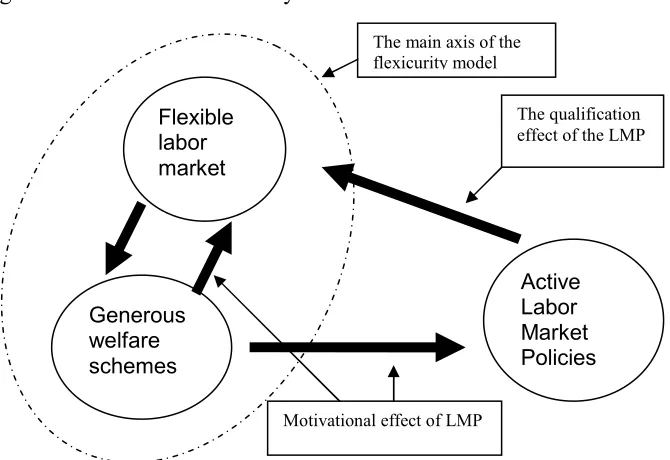
There are different models of flexibility/security possible in Europe, with each of them depending on certain characteristics of industrial relations systems at national level. In recent years, Denmark has become the prime example of a real-life flexicurity labor market. The Danish case of flexicurity is a combination a flexible labor market with liberal hiring-and firing procedures on the one hand, and relatively generous social security and active labor market policies on the other hand. In general terms, Denmark has succeeded in combining a universal, generous and redistributive welfare state with a competitive labor market and productive labor force. The recent international academic and political interest in this “happy marriage” of flexibility and security coincides with relatively good macro-economic and labor market performance. The most important implication of Danish flexicurity is a shift from job security towards employment security, i.e. protecting transitions on the labor market rather than protecting jobs (Bredgaard, Larsen 2007). Sapir (2005) argues that “protecting jobs with employment legislation is definitely detrimental to employment, whereas protecting workers with unemployment insurance is potentially useful for employment”. The underlying idea is that low employment protection makes employers more willing to hire, at the same time as generous unemployment insurance reduces employee resistance to structural change.
Figure 1. The Danish Flexicurity Model
Source: Thomas Bredgaard, Flemming Larsen, Per Kongshøj Madsen (2005),
6 0' &'( )&' +0 )"! !1' 8 '/ '27, /0 , Aalborg University.
9
'&'/
' "%
' - !1 + &'( $! * %"!
'/'&". 4
"$ ! '+
The concept of flexicurity was originally used for developed countries and applied to them. A key question is whether the concept is relevant to developing countries. Can developing countries apply the Denmark’s flexicurity for solving their labor market problems? First of all, we need to remember the main elements of Denmark’s flexicurity to decide whether it’s relevant for developing countries or not.
The Danish flexicurity-model consists of three elements: • Flexible labor market (Flexible rules on dismissal), • Generous welfare schemes (Unemployment insurance), • Active labor market policies (Training).
The Danish labor market is characterized by a high level of flexibility. Compared to other European countries, it is relatively easy to hire and fire. The employers have a flexible workforce to draw on. They are able to adjust the workforce to changes in production without incurring great costs. The employees have the opportunity to quit their jobs with a relatively short notice. A large group of skilled and unskilled Danish employees have eight days’ notice when they’ve found themselves a better job (LO 2008).
In contrast to developed countries’ labor markets which are mainly formal and characterised by waged employment, many developing countries are characterised by dual labor markets in which the absence of protection in the informal economy contrasts with a high level of employment security in the smaller formal economy. In developing countries, the labor market is characterized by large proportions of unpaid family work and self-employment and a very low share of waged self-employment. Since regulation does not affect much employment with similar features, labor markets tend to be rather flexible and workers’ protection is often neglected. Hence, the notion of “flexicurity” needs to be adapted from the one used for advanced economies which mainly focuses on regulated waged employment. In other words, the situation of the labor markets in poor countries presents opposite characteristics compared to those of industrialized economies. A largely prevailing informal economy, a predominating agricultural sector employing most of the labor force,
self-The main axis of the flexicurity model
Motivational effect of LMP
subsistence activities and a very small State budget are among the principal features of poor economies. In particular, the large size of the informal economy and of agricultural labor determines a high level of flexibility through the provision of occasional work and irregular incomes, which is not compensated by measures targeting workers’ protection (De Gobbi 2006).
The second leg of the Denmark’s flexicurity is generous unemployment insurance system. The Danish unemployment insurance system is characterized by relatively moderate admission demands and eligibility rules for claiming benefits as well as long duration (at present 4 years). The unemployment benefits system is a contribution financed supplementary insurance in relation to the social security system (cash benefits), but the system is publicly subsidized (marginal costs are publicly financed). The unemployment benefits are determined partly by a replacement rate of 90% of the previous salary and partly by an absolute maximum for unemployment benefits. This combination means that the rate of income compensation is high (90%) for low-income groups, but falling in income (beyond a certain minimum). The average replacement rate is approximately 60% (Andersen, 2006). Unemployment insurance (UI) provides temporary income security for the unemployed. “Without UI, job loss forces people to take whatever work is available or engage in self-employment, both of which can lead to under-employment. Those who are underemployed or are employed full-time but for low wages are often referred to as the working poor” (Vandenberg 2008).
Some developing countries have limited unemployment insurance and some others have no insurance at all. Even if they have UI, the program may be less efficient than those in developed countries due to the existence of a large informal sector, different nature of unemployment, weak administrative capacity and limited access to capital markets.
Active labor market policy (ALMP) is a crucial element of the Denmark’s system. ALMPs have two main aims: to upgrade the skills of the unemployed, and to encourage the unemployed to remain active and search for job. Denmark has the highest expenditure on ALMPs and spends about 4.4% of its GDP/year on supporting and retraining the jobless, making it one of the most expensive labor market policies in the world.
While ALMPs are common in developed countries, they tend to be weak, inefficient and often uncoordinated in developing countries, because of the small state budget available to finance them.
One of the main characteristics of the Danish Labor Market is the high level of unionisation. In Denmark, 82% of the workforce is unionised. “High level of unionisation, tight social partnership and reciprocal recognition by the opposing parties in Denmark are seen as a precondition for a working and effective flexicurity model. The collective agreements cover around 85 per cent of all employees and include regulation on wages, pensions, working time, redundancies and various pay arrangements for employees when ill, on maternity/paternity leave etc. Social partners in Denmark have decentralised the bargaining process with the aim of increasing flexibility - especially with regard to wage setting and working hours” (Bosman 2007). The Danish system is based on close cooperation between two social partners (DA and LO). Trust between the social partners is very important for a well functioning labor market.
In many developing countries, unionization rates are relatively low and because of this, social dialogue is still underdeveloped.
the emerging standards of flexicurity but, quite pragmatically, they should look for the forms of worker security that are compatible with sustainable development. A priori, many different configurations might coexist in response to economic specialization, social values and political choices (Bredgaard and Larsen 2007).
:
0'
$!1 +0
+'
Turkey has both a flexible (informal) segment and a secure (formal) segment in its labor market. However, they do not overlap. There are demographic and institutional reasons for these particular circumstances. Clearly, this is not the idea behind the concept of flexicurity (Ercan 2006). First of all, we need to know the Turkish labor market situation to understand the Turkish case.
The main characteristics of Turkish labor markets can be summarized as follows:
; Labor supply has been increasing due to relatively high population growth rate (1.01% in 2008).
; Turkey has a large informal economy. Approximately one in three workers in urban areas and three in four in rural areas are not registered with the social security institutions.
; One-third of total employment in Turkey is in agriculture. Workers in this sector tend to be uneducated and unskilled.
; Women participation in the labor market is very low level (27% in 2008). Half of all women are unpaid family workers and 59% of women work in agriculture.
; Another point for labor market in Turkey is characteristics of employment status. In developed countries, employees are about 80%, but in Turkey is just 50%. The employment problem created by unpaid family workers is very serious.
; Unemployment insurance system did not exist in Turkey until very recently. This new insurance is in operation at present, but it covers only 5 million workers, less than one out of four in the workforce and it offers very little compensation when applied.
; The migration flow from rural to urban areas against the limited employment creation capability of Turkish economy has generated an increase in unemployment rates in urban areas.
:
&'( ) & *
# ' $! *
0'
$!1 +0
)"!
2
In Turkey, as in other developing countries, the informal labor market is a major issue with an impact on economic efficiency, overall labor market performance, income distribution and poverty, as well as on fiscal and budgetary performance. Turkey has a large informal labor market and it is indeed very flexible. Traditionally, flexibility is a characteristic of informal labor market. Workers in the informal market tend to have little legal protection. Since much of Turkey’s formal social protection system (pensions, health insurance, and unemployment insurance) is based on membership in the social security institutions, this means that workers are not receiving these protections. While few receive pensions, health insurance, and unemployment insurance, even fewer receive the full severance pay and other protections stipulated in the employment protection legislation. (WB 2006).
In 2003 greater flexibility was introduced into the Turkish Labor Act despite resistance from trade unions. The 2003 Labor Act has regulated atypical types of work, including part time work, on call work, temporary employment contracts. This is the most welcome aspects of the new law by employers.
establishments employing less than 30 workers (the law No. 4773 excluded only those employing less than 10 workers). Therefore, the new law has legally provided extensive flexibility to small establishments (Taymaz 2004).
Severance pay regulation is an important tool of labor market rigidity in Turkey. Severance pay in Turkey is much higher than the OECD or European average. A worker with 20 years of service in Turkey is entitled to 20 months compensation, compared to 6 months for OECD countries, 4 months for Europe and Central Asia countries, and 10 months for middle-income countries (WB, 2006). But informal workers are unlikely to get severance pay benefits. Moreover, social security membership is no guarantee of receiving severance. Workers who work at large firms or belong to a trade union are more likely to receive severance payments, but only 30 percent of workers work in firms with 10 or more employees, and at most 12 percent of workers belong to unions.
: 3
/'
)"!
!1' "&
'+
$!1'*
Compared to other OECD countries and many middle-income countries, Turkey has a very limited experience and capacity in the area of active labor market programs (ALMPs). Starting in the mid-1990s, some initiatives were introduced, funded largely by the World Bank. An important institutional development took place in 2000 with the establishment of ISKUR, the national employment agency (WB 2006). ISKUR’s most significant project aimed at capacity building and funding some small local projects. The EU provided EUR 40 million, and the Turkish Government another EUR 10 million. Capacity building constituted training ISKUR personnel (1,600 trained so far out of approximately 2,300) and constructing eight pilot offices as model offices to be replicated later in other locations. Twenty provincial ISKUR offices have now been built in this way. The project finished at the end of 2005. Another component of the project was the selection and financing of about 300 small local projects, which helped participants to acquire skills and find employment within a year. The impact of this initiative was small. After a few years of gaining experience, ISKUR managed to train 11,400 participants in its ALMPs in 2005. This is slow going, despite much enthusiasm and goodwill on ISKUR’s part. Its institutional capacity must go up by about tenfold, at least. The political climate is suitable for an unemployment drive. Turkish gross domestic product has been growing steadily since 2002, yet employment growth only started to recover slowly after 2004. This episode of jobless growth propelled Turkey’s unemployment problem to top place in public opinion polls (Ercan 2006).
: 5
'-.&"*-'
+$!
'
Unemployment Insurance Act was enacted in 1999 and was put into effect as of June 2000. The system covers workers registered with Social Insurance Institution and does not include civil servants or the self-employed. Funds are collected by SSK and transferred to ISKUR, which implements the program. It is mandatory and covers all industries and occupations. Benefit levels depend on earnings. Contribution rate of the unemployment insurance is 4 % of the gross monthly earnings. Employer’s share is 2 %, worker’s share is 1 % and State’s share is 1 % of the gross monthly earnings of the insured. Unemployment benefits are not subject to any taxes or deductions other than stamp tax whose percentage rate is 0,6.
A major issue is the limited access of Turkey’s workers to formal protection, including labor laws, collective bargaining, and social security. In part, this low coverage reflects the nature of the economy, which has a large agricultural sector and a high (and growing) degree of informalization. It also reflects low compliance, both in terms of enforcing labor laws and registration in social security plans. The coverage problems are due, at least in part, to the high costs of complying with social security and labor. Payroll taxes are high by international standards, especially for low-wage earners and workers in families with children. The employment protection rules are costly as well (WB 2006).
In comparison with Denmark’s labor market, it can be said that Turkey has a low labor market flexibility, a very limited experience and capacity in the area of active labor market programs and inadequate unemployment insurance system. Also lack of social dialogue is a big challenge in the policy development on flexicurity. “The problem is that workers’ unions represent less than 10% of the employed in Turkey. A flexicurity debate which takes place only between the usual social partners (employee and employer unions) is thus severely limited and flawed. Excluded from the debate are current and former agricultural workers, almost all service sector employees, and almost all women workers” (Ercan 2006).
< =0
'++" +
)'
' ! '# %!"- 0'
+0
&'( $! * %"!
'/'&". 4
"$ ! '+
1. For many developing countries, flexicurity may be more problematic because of obvious reasons. Labor markets in these countries are essentially flexible (informal) and unsecure. Therefore, flexicurity should promote and provide a better job security and social security of flexible (informal) workers in developing countries.
2. Social dialogue is essential for effective flexicurity. The Denmark case shows that sustainable and successful flexicurity strategies are dependant on broad support from social partners. In developing countries, social dialogue is weak because of low level of unionization and collective labor relations. Whereas, collective bargaining is the most widespread form of social dialogue. So, unionization and collective bargaining have to be promoted.
3. Developing countries have large informal economy. Large informality means that a substantial portion of labor is not effected by legislation. As a result of this, workers in this sector have no basic labor rights, including employment security. “Social security system in developing countries must encourage the taking on of work within the formal labor market while also protecting flexible workers. This will require a major reorganisation of the system, involving creativity on the part of all the relevant stakeholders” (Süral and Pennings, 2006).
4. Active labor market policies (ALMPs) are crucial element of the Denmark’s system. They tend to be weak, inefficient and often uncoordinated in developing countries, because of the small state budget available to finance them. Developing countries need more and effective labor market policies, particularly skill training, employment subsidies and employment services. So, developing countries have to spend more of their GDP/year on supporting and retraining the jobless.
5. Unemploymet insurance is one of the most important components of flexicurity. Developing countries either have no unemployment insurance or have limited. Unemployment insurance programs must be adapted to suit the needs of developing countries.
7. Additionally, in developing countries, the most flexible workers are women because they mostly work in agriculture as unpaid family workers without income and security. So, women’s position in the labor market has to be improved.
Andersen Søren Kaj, Mikkel Mailand (2005), “ 0' +0 &'( $! * "#'&7, 1', University of Copenhagen.
Andersen Torben M., Michael Svarer (2006), &'( $! *8 0' +0 )"! !1' "#'&.
Barbier Jean-Claude (2005), 6 ' ! 4 !"- ' - !1 '%&' " " 0' 6 +0 ! &'7 !"- !' 0 4&'7, European Policy Centre Working Paper, September.
Bosman Marije at.al (2007), > &'( ) & * ' $! *,IP Flexem, Finland.
Bredgaard Thomas, Flemming Larsen, Per Kongshøj Madsen (2005), 6 0' &'( )&' +0 )"! !1' 8 '/ '27, /0 , Aalborg University.
Bredgaard Thomas, Flemming Larsen (2007), "-. ! 4 &'( $! * ' - !1 # ? . , /0 , Aalborg University.
De Gobbi Maria Sabrina (2006), )"! !1' &'( ) & * # -.&"*-' # "-' ' $! * 0 ". @ & '! /' " + #'! " +, International Labor Office Employment Policy Unit Employment Strategy Department,2006/1.
EC (2006), &'( $! *, EMCO Working Group on Flexicurity, Brussels, 19 May 2006.
EC (2007), "2 !#+ "--" ! .&'+ "% &'( $! *@ "!' # ' '! ?")+ 0!"$40 &'( ) & * # ' $! *,Communication from the Commission to the Council.
Ercan Hakan (2006), " ! )$ " " 0' $ $- '/ '2 3AA< B &'( $! * $!1'*,European Employment Observatory.
Ercan Hakan (2008), 6 &'( $! * 0' "$ 0'! -@ $!1'* "-. ! /' '!+.' /'7,Prepared for the Flexicurity Conference Bucharest, Romania.
Gehrmann Tyler (2007) 0' '/'&".-' "% +0 &'( $! * # "++ )&' '++" + %"! -'! ,Norges Handelshøyskole, Bergen.
Gundogan Naci (2007), “ !) C " # )"! !1' !")&'-+ '/'&". 4 "$ ! '+@ 0' +' "% $!1'*7, The Ninth Asian Urbanization Conference, Kangwon National University, 18-23 August 2007, Republic of Korea.
Hansen Peder Munch (2007), +0 -.&"*-' "& *8 "#'& %"! 0' ,
http://www.lo.dk/Englishversion/Flexicurity/DanishemploymentpolicyamodelfortheEU.aspx
Leschke Janine, Günther Schmid, Dorit Griga (2006), 6 0' !! 4' "% &'( ) & * # ' $! *@ '++" + %!"- 0' ! C;!'%"!-+ '!- *7, Social Science Research Center Discussion Paper, Berlin.
LO (2008) &'( )&' )"! !1' ''#+ !" 4 " & ! '!+, Copenhagen.
Madsen Per Kongshøj (2004), 0' +0 " # " 6 &'( $! *7, =0'!' !' =' # "2 # =' ' 0'!' Quality in Labor Market Transitions: A European Challenge A TLM.NET Conference, Royal Netherlands Academy of Arts and Sciences, Amsterdam.
Madsen Per Kongshøj (2006), 6 "2 "++ )&* &* 0' ! #"( "% * -)"! !1' # / ='&% !' '7, 2 ) 3
+ & # !, edited by John L. Campbell, John A. Hall and Ove K. Pedersen. Montreal: McGill University Press.
Muffels RJA, Luijkx R. Job (2005), + 0'!' B ! #';"%% "! B "$)&' # ' 2'' &'( ) & * # ' $! * TLM.NET 2005 Working Paper No.2005-13, Amsterdam, SISWO/Social Policy Research.
OECD (2004), -.&"*-' $ &""1 3AA9.
Ozaki, M., ed. (1999), '4" 4 &'( ) & * 0' "&' "% 0' " & ! '!+ # 0' ', Geneva: International Labor Office.
Sapir Andre (2005), 6 &") & C " # 0' '%"!- "% $!".' " & "#'&+7, Bruegel Policy Brief, Issue 2005/01.
Standing, G. (1999), &") & )"! &'( ) & * London: Macmillan.
Stokes Bruce (2006), 6?")&'++, 0' +0 = *7, National Journal, Vol. 38, Issue 9.
Süral Nurhan, Frans Pennings (2006), &'( ) & + " # "#'! + " "% $!1 +0 )"! !1' , (Edited by Roger Blanpain), Kluwer Law International.
Tangian Andranik S. (2004), 6 '% 4 0' &'( $! * #'( ..& " " $!".' "$ ! '+7,WSI in der Hans Böckler Stiftung, Discussion Paper2 . 122.
Tangian Andranik S. (2005), 6 " "! 4 &'( $! * "& '+ 0' 2 0 '# '# "-."+ ' # "!+7,4') 5 67 ! ' Dusseldorf.
http://invicta.socsci.aau.dk/-leo/iera/papers/Workshopno6/AndranikTangianno6.pdf .
Taymaz Erol, Şule Özler (2004), 6 )"! !1' "& '+ # 0' '++ " @ !")&'-+ # !"+.' + %"! $!1'*7, Erc Working Paper.
Wilthagen Ton, Frank Tros (2004), 6 0' " '. "% &'( $! *@ '2 ..!" 0 " '4$& 4 -.&"*-' # )"! !1' +7, Transfer – European Review of Labor and Research, 10(2).
Wilthagen Ton (2004), 6 & 4 &'( ) & * # ' $! * $!".' )"! !1' +7,
/ # ) / , The Hague, 7-8