Research on An Improved PMF-FFT Fast PN Code
Acquisition Algorithm
Ning-qing Liu, Bin Sun, Chun-meng Guan
Communication Research Center Harbin Institute of Technology Harbin, China Email: [email protected], [email protected]
Received July, 2013
ABSTRACT
To solve the problem of the large Doppler frequency offset in the LEO communication system, this paper studies a rapid PN code acquisition method based on the PMF-FFT architecture, which searches the phase and frequency offset and at the same time reduces the acquisition time. It presents an improved method equivalent to windowing function and uses windowing process to overcome the attenuation of related peak envelope caused by partial matched filters.
Keywords: Doppler Frequency Offset; Rapid PN Code Acquisition Algorithm; PMF-FFT; Windowing
1. Introduction
Doppler frequency offset, which makes it very difficult for the receiver to seize the signals. Ordinary one-di- mensional search cannot meet the requirements of the rapid PN code acquisition, and thus two-dimensional search method is being gotten more attention. M. Sust has proposed a fast acquisition concept in the audio CDMA system [1]. In the paper, he analyzed the method of using FFT compensation method to solve the problem of large offset acquisition in the system, and the capture structure he used was the prototype of PMF-FFT algo- rithm. G.J.Povey, who first proposed this kind of algo- rithm which was based on [1] and made an efficient study and analysis [2-4], has gotten significant conclu- sions, making great contributions to the later develop- ment of the algorithm.
Reference [3] describes a non-coherent rapid acquisi- tion system under the Doppler frequency offset. For the first time, it gives the PMF-FFT acquisition model and analyzes the probability of false alarm and detection probability characteristic in the Gaussian channel. S. M. Spangenherg proposed the windowing process of the FFT input to reduce the Scalloping Loss. This paper fo- cuses on windowing approaches and then improves the structure of windows, improving the acquisition per- formance of the algorithm. It also presents a structure equivalent to windowing function, simplifying the im- plementation. For some low-pass attenuation of the matched filters, the window approach is also introduced.
2. Acquisition Algorithm Models Based on
the PMF-FFT Structures
2.1. Acquisition Theory
M. Sust etal first used the FFT compensation, increasing the search range greatly in the frequency fields, which is equal to the parallel searches. Then G.J.Povey developed this method, systematically analyzed the acquisition al- gorithm of the FFT auxiliary digital matched filters, and showed the model based on both the digital part of the matcher filters and the FFT, shown in Figure 1. Here MX = KN, N is the length of PN code, while K is the sampling factor.
Supposing the sampling interval Ts=Tc/K, the initial
phase is, the sampling signal after the down-conver- sion is
d s
(2π )
d s s
d s
sin(π )
( ) ( )
π
j f nT
f T
x n PT c n L e
f T
(1)
When PN code obtains full synchronization,
d s d s
d s
d s d s
sin(π ) sin[π ( / )] ( , )
π sin[π( / )]
j
f XT M f XT k M
Y k f PMXT e
f XT M f XT k M
(2)
0
PMF PMF1 PMF2 PMFM2 PMFM1
[image:1.595.317.534.544.713.2]2 2 2 2 2
Normalize (2), the normalized frequency response of the FFT output of the k-th point
d
( , )
d s d s
PMF-FFT d
d s d s
sin(π ) sin[π ( / )] ( , )
π sin[π( / )]
j k f
f XT M f XT k M
G k f e
f XT M f XT k M
(3) d
It is shown in Figure 1 that the input which is com-pared with the preset threshold is the maximum output value of the k-th FFT point. That is, for a fixed variable
fd, comparing these values of ( , )k f
is the phase characteristic of the PMF-FFT.
PMF-FFT( , )d
G k f , then we
can get the related gains in the acquisition system.
d PMF-FFT d
PMF-FFT c d d d
c
( ) max ( , ) ( 0,1, 2 1)
1 , (0
2
A f G k f k M
) M
G NT f f f
NT (4)
means to get the integral results downward.
2.2. FFT Compensation Characteristic
Equation (4) can be divided into two parts, and the nor- malized contribution of the partial matched filter of (4) is
d s
( 1)
d s 2
PMF d
d s
sin( / 2)
( )
/ 2
j X f T
Xf T
G f e
Xf T
(5)
And the contribution that the FFT makes to the related normalized is
FFT d
j ( , FFT( , )d FFT( , )d
k f
G k f A k f e ) (6)
FFT( , )d
A k f is the amplitude response, and FFT( , )k fd
is the phase response.
For the moment, partial influence of the matched fil-ters is not considered, and the following properties can be deprived from (6):
1) Panning features
Change the form of (6), then
FFT d FFT d
c 1
( 1, ) ( , )
G k f G k f
NT
(7)
Equation (7) indicates that the frequency response of the kth FFT point is actually a 1/NTc units right shift of
the (k-1)th FFT point’s frequency response.
So the synchronization system based on the PMF-FFT structure in Figure 1, can be extended M times in fre-
quency searching range, which is [0, M/(NTc)]. Therefore
the simultaneous capture algorithm based on the PMF- FFT structure is not sensitive to the Doppler frequency offset, and the system is still able to complete the simul- taneous capture successfully.
2) Period feature
Because the FFT compensation factor km M
W is a rota-
tion factor with a period of M, and is reflected as a peri-
odic function in frequency domain in (6), with the period of M/(NTc). According to (6), it can be obtained:
FFT d FFT d
c
( , M ) ( , )
G k f G k f
NT
(8)
3) Ax symmetric feature
It can be found that GFFT( , )k fd is an ax symmetric
function of fd, and on the axis of k/(NTc). Make simple
algebraic simplification to (6), then
FFT d FFT d
c c
( , k ) ( , k )
G k f G k f
NT NT
(9)
That is
FFT d FFT d
c c
( , k ) ( , k )
G k f G k f
NT NT
(10)
4) Dual feature
Now consider the negative frequency, there is
FFT( , d) FFT ( , )d
G k f G M k f (11)
When d
c c 1 [ , 2 2 k k f NT NT
], the capture system can
still work effectively, and produces the maximum related output on the (M-k) FFT.
3. Scalloping Loss
The associated gain of each FFT point is similar to sinc(x) function. At the crossover point, the associated gain out- put appears on the trough, presenting the phenomenon of the Scalloping Loss. Reference[4] proposes two solu- tions, storage zeros and windowing, and makes a thor- ough analysis to the former one. This paper focuses on the study and improvement of the windowing method. The main idea of this method is to increase the width of the main lobe and increase the FFT peak output intersect- tion of the two adjacent points, in order to reduce the loss.
Now the window function is adapted to the united form
11 1 cos 2π , 0 0m
m M
w m M
others
1
(12)
The related gain is
FFT d
FFT d FFT d FFT d FFT d
c c
( , )
1 1
( , ) ( , ) ( , ) ( , )
2 2
j k f
G k f A k f A k f A k f
[image:2.595.315.540.205.366.2]FFT d FFT d FFT d
FFT d
( , ) ( , ) ( 1, )
2 ( 1, )
2
G k f G k f G k f
G k f
(14)
Thus the weighted sum of three consecutive FFT points according to (14) can get the same effect as win- dowing and the structure is simpler. In Figure 2, there is the comparison of the realization between windowing and equivalent windowing. It can be seen that the weighted sum of the FFT output is equal to the window- ing process of the FFT input. They share the same im- proving properties.
4. The Low-pass Decay of PMF
As to the discussion about the FFT compensation fea- tures before, it is supposed to be all-pass without the in- fluence of FFT. But actually PMF is a limited FIR with the length of X and all the coefficients are one.
In fact, GFFT (k,fd) is the related gain envelop of the
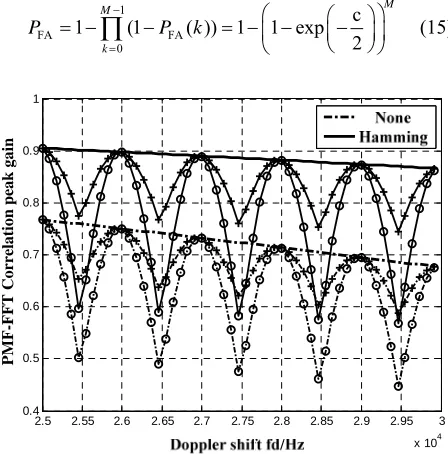
PMF-FFT. When there is a large Doppler frequency off- set, the attenuation of the PMF greatly influences the peak of related gain. This paper uses the same method as the windowed FFT input to perform the windowing process to the sampled data entering the FFT, increasing the width of the main lobe envelop in order to improve the decay when the frequency is large, shown in Figure 3.
5. The Improved Structure of the Algorithm
Thus, this paper makes a detailed analysis of the acquisi- tion structure based on PMF-FFT, and discusses two methods to overcome the Scalloping Loss. After com- parison, adding zeros by windowing turns to be easier and more effective. Therefore, this paper introduces windowing and its equivalent method into the acquisition system. For the influence on the related gain in the sys- tem which is made by the low-pass characteristic of some0 500 1000 1500 2000 2500 3000 3500 4000 4500 5000
0.8 0.82 0.84 0.86 0.88 0.9 0.92 0.94 0.96 0.98 1
多普勒频偏fd/Hz
PMF-FFT输出
峰
值
增
益
[image:3.595.312.536.290.517.2]对FFT的输入做加窗处理 对FFT的输出做加权叠加
Figure 2. Simulation of equivalent window function method.
matched filters, this paper presents two effective solu-tions, which are adaptive threshold method and window-ing. These two methods can be combined in order to im-prove the ability of acquiring PN code in large frequency offset.
The improved PMF-FFT structure is shown in Figure 4.
6. Algorithm Evaluation
Considering the non-coherent detection system, the am-plitude statistical variables of M-point FFT output are identically distributed.
In the acquisition system in Figure 4, the statistical variables R that is compared with the threshold is the
maximum value of M-point FFT output. Now the false
probability is
1
FA FA
0
c
1 (1 ( )) 1 1 exp
2
M M
k
P P k
(15)2.5 2.55 2.6 2.65 2.7 2.75 2.8 2.85 2.9 2.95 3
x 104 0.4
0.5 0.6 0.7 0.8 0.9 1
PM
F-FFT
相关峰值增
益
多普勒频偏f
d/Hz
未加窗 加汉宁窗
[image:3.595.310.538.553.709.2]PMF-FFT Correlation peak gain
Figure 3. Effect of Amplitude-frequency response of PMF.
...
2
1
FFTk
FFTk
1
FFTk
FFTk
2
2
2 R
[image:3.595.65.277.563.719.2]From (15), not only the threshold, but the number of FFT points has connection with false alarm probability. And the probability increases with the increasing values of M. Therefore, the number of the chosen FFT points in
actual system is limited, and the false probability and the searching range of the frequency offset are in contradict- tion.
For the PMF-FFT capture system the detecting prob- ability [4, 5] is
D( ) 2 in PMF-FFT( , ) ,
P k Q N SNR G k fd c (16)
Suppose the preset threshold c=30, at this time PFA =
3.92
10-5, the information rateRb=1kpbs, the period of
the PN code N=10240, the input SNR SNRin = -25 dB.
The relation between the detecting probability and the Doppler offset before and after the improvement is shown in Figure 5.
From Figure 5, the PMF-FFT algorithm expands the right detecting probability in the frequency domain. And the probability is bigger after windowing process than before. So the windowing method improves the detecting probability of the PN code acquisition.
This paper uses the single stay acquisition decision, so the average acquisition time is
D
Acq d
D
2 (2 )( 1)(1 )
2
P q kP
T
P
FA
(17)
Here q is the number of code offset units to be
searched, q=KN; d is single stay time. The stay time
will be Ts by using parallel matched filters, but it is at the
cost of huge hardware resource. So it is the serial way that is chosen in this design and the stay time is XTs; k is
the number of decisions approving the happening of false alarm. So false alarm penalty time is kd. If k = 10, the
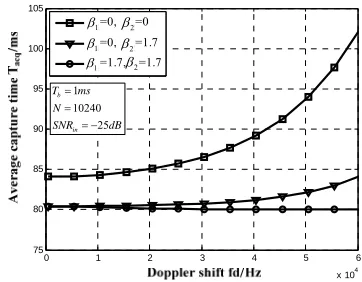
relation between PMF-FFT algorithm and the Doppler frequency offset before and after the improvement is shown in Figure 6. Figure 7 shows the connection of algorithm and the input SNR before and after improve- ment.
0 500 1000 1500 2000 2500 3000 3500 4000 4500 5000
0.8 0.82 0.84 0.86 0.88 0.9 0.92 0.94 0.96 0.98 1
多普勒频偏fd/Hz
检测概率P
D
K
2=0, 未加窗
K
2=1, 汉宁窗
K
2=1.7,改进窗 in 1ms 10240 25dB b T N SNR 2 2 2
Figure 5. Relationships between probability of detection of improved algorithm and Doppler shift.
0 1 2 3 4 5 6
x 104 75 80 85 90 95 100 105
多普勒频偏fd/Hz
平均
捕获
时间
TAcq
/m
s
K1=0, K2=0 K1=0, K2=1.7 K1=1.7,K2=1.7
[image:4.595.330.511.86.227.2]1 10240 25 b in T ms N SNR dB 1 1 1 2 2 2
Figure 6. Average capture time of original and improved algorithm under Doppler shift.
-40 -35 -30 -25 -20 -15 -10 -5 0 5
101
102
103
104
105
输入信噪比SNRin/dB
平均
捕获
时间
TAc
q
/m
s
K1=0, K2=0 K1=0, K2=1.7 K1=1.7,K2=1.7
[image:4.595.327.518.270.410.2]1 1 1 2 2 2 b d 1ms, 10240 30, 59.5kHz T N c f
Figure 7. Average capture time of original and improved algorithm under different SNR.
7. Conclusions
This paper analyses basic theory of the PMF-FFT PN code acquisition algorithm. For the Scalloping Loss, it focuses on the windowing function method and improves the structure, reducing the influence of the Scalloping Loss. What is more, it proposes an equivalent method equipped with easier structure. For the loss brought by PMF fixed low-pass properties, it chooses the windowing process to the received data. Theoretical analysis results show that, after windowing twice, the algorithm im- proves detecting probability and reduces average acquisi- tion time compared with the original one, improving the capacity of resisting disturbance.
REFERENCES
[1] M. Sust, R. Kaufman, F. Molitor and A. Bjornstor, “Rapid Acquisition Concepts for Voice Activated CDMA Communication,” IEEE Globecom’ 90, 1990, pp.
1820-1828.
[image:4.595.85.259.570.707.2]and Navigation. 1996, pp. 16-19.
doi:10.1049/cp:19960398
[3] R. A. Stirling-Gallacher, A. P. Hulbert and G. J. R. Povey, “A Fast Acquisition Technique for a Direct Sequence Spread Specrum Signal in the Presence of a Large Dop-pler Shift,” Proceedings of ISSSTA’96, Mainz, Germany.
1996, pp. 156-160.
[4] S. M. Spangenberg, I. Scott, S. Mclaughlin and G. J. R. Povey, “An FFT-Based Approach for Fast Acquisition in
Spread Spectrum Communication Systems,” Wireless Personal Communications, Vol. 13, No. 1-2, 2000, pp. 27-55.doi:10.1023/A:1008848916834
[5] A. Polydoros and C. L. Weber, “A Unified Approach to Serial Search Spread-Spectrum Code Acquisition—Part II: A Matched Filter Receiver,” IEEE Transactions Commu-nications, 1984, Vol. 32, No. 5, pp. 550-560.
![Figure 1. Capture model based on PMF-FFT[1].](https://thumb-us.123doks.com/thumbv2/123dok_us/7910750.745578/1.595.317.534.544.713/figure-capture-model-based-on-pmf-fft.webp)
![Figure 1Mquency searching range, which is [0, M/(NTc)]. Therefore](https://thumb-us.123doks.com/thumbv2/123dok_us/7910750.745578/2.595.315.540.205.366/figure-mquency-searching-range-m-ntc.webp)