i l l i i s « ^ EFFICIENCY OF DIFFUSION BARRIERS
A Í I I I I I M I Í F O R ALUMINIUM-CANNEri»
f i
JÊL
This document was prepared under the sponsorship of the Commission of the European
Atomic Energy Community ( E U R A T O M ) . ,
Neither the EURATOM Commission, its contractors nor any person acting on their behalf:
Make any warranty or representation, express or implied, with respect t o t h e accuracy,
completeness, or usefulness of the information contained in this document, or t h a t the use
of any information, apparatus, method, or process disclosed in this document may not
infringe privately owned rights; or
per
2° — Assume any liability with respect to the use of, or for damages resulting from the use of
any information, apparatus, method or process disclosed in this document
The authors' names are listed in alphabetical order.
Uirr Viv.
'·.
Mm
mm
¡tøall
This reprint is intended for restricted distribuitoli only. It reproduces,
by kind permission of the publisher, an article from the Proceedings of
the Symposium
"NEW NUCLEAR
MATERIALS
INCLUDING
NON-METALLIC
FUELS",
Prague July 15, 1963 Vol. II
-511-534. For further copies please apply to The International
Atomic
Energy Agency - I.A.E.A.
- Publications Sales Services
—
Vienna 1,
Kartner Ring 11-13
(Austria).
»IP
Dieser Sonderbruck ist für eine beschrankte Verteilung bestimmt. Die
Wiedergabe des vorliegenden in dem Tagungsbericht des
Symposium
NEW NUCLEAR
MATERIALS
INCLUDING
NON-METALLIC
;:
FUELS",
Prague - July 1-5, 1963 - Vol. II - 511-534 erschienenen
Aufsatzes
erfolgt mit freundlicher
Geenehmigung des Herausgebers.
Bestellungen weiterer Exemplare sind an The International
Atomic
Energy Agency -
I.A.E.A.
Kartner Ring 11-13 (Austria),
zu richten.
Vienna 1,
Publications Sales Service
mm
Ce tiré-à-part est exclusivement destiné à une diffusion restreinte. Il
reprend, avec l'aimable autorisation de l'éditeur, un article publié dans
les comptes rendus du Symposium «NEW NUCLEAR
MATERIALS
INCLUDING
NON-METALLIC
FUELS»,
Prague - July 1-5,
1963 - Vol. II - 511-534. Tout autre exemplaire de cet article doit être
demandé à The International
Atomic Energy Agency - I.A.E.A.
-Publications Sales Service — Vienna 1, Kartner Ring 11-13
(Austria).
Questo estratto è destinato esclusivamente ad una diffusione
Umitata.
Esso è stato riprodotto, per gentile concessione dell'Editore, dagli Alti
del Simposio
«NEW
NUCLEAR
MATERIALS
INCLUDING
NON-METALLIC
FUELS»,
Prague - July 1-5,
1963 Vol. II
-511-534. Ulteriori copie dell'articolo debbono essere richieste a The
International Atomic Energy Agency - I.A.E.A.
- Publications
Sales
Service ■
—■
Vienna 1, Kartner Ring 11-13
(Austria).
Deze overdruk is slechts voor beperkte verspreiding bestemd. Het artikel
is met welwillende toestemming van de uitgever overgenomen uit de
verslagen van het Symposium
,,NEW NUCLEAR
MATERIALS
INCLUDING
NON-METALLIC
FUELS",
Prague - July 1-5,
1963 - Vol. II - 511-534. Meer exemplaren kunnen besteld worden bij
The International
Atomic Energy Agency - I.A.E.A.
- Publications
f-
Rr
!^P?if^à;r iki.
Γ-ίΜϊΦ*
Sales Service
—
Vienna 1, Kartner
lati'iìisiiisi
íner Ring 11-13 (Austria).
EUR
5 1
5 . e R E P R I N TE F F I C I E N C Y O F DIFFUSION B A R R I E R S F O R ALUMINIUM-CANNED URANIUM F U E L ELEMENTS b y F . BROSSA, H.W. SCHLEICHER R. T H E I S E N .
European Atomic Energy Community - EURATOM ORGEL Program
Joint Nuclear Research Centre Ispra Establishment (Italy) Materials Department
Metallurgy and Ceramics Division
Reprinted from the Proceedings of the Symposium "New Nuclear Materials Including Non-Metallic Fuels - Prague - July 1-5 - 1963
Vol. I I - 1963 - 511-534 pages - edited by I.A.E.A.
The use of aluminium-canned metallic uranium fuel elements is limited to relatively low temperatures if no special means are provided to inhibit the intermetallic diffusion between fuel and can. Intermediate layers should be
EUR
5 1
5 . e R E P R I N TEFFICIENCY O F DIFFUSION B A R R I E R S F O R ALUMINIUM-CANNED URANIUM F U E L ELEMENTS by F . BROSSA, H.W. SCHLEICHER, R. T H E I S E N .
European Atomic Energy Community - EURATOM ORGEL Program
Joint Nuclear Research Centre Ispra Establishment (Italy) Materials Department
Metallurgy and Ceramics Division
Reprinted from the Proceedings of the Symposium "New Nuclear Materials Including Non-Metallic Fuels - Prague - July 1-5 - 1963
Vol. II - 1963 - 511-534 pages - edited by I.A.E.A.
The use of aluminium-canned metallic uranium fuel elements is limited to relatively low temperatures if no special means are provided to inhibit the intermetallic diffusion between fuel and can. Intermediate layers should be
EUR
5 1
5 . e R E P R I N TE F F I C I E N C Y OF D I F F U S I O N B A R R I E R S FOR ALUMINIUM-CANNED URANIUM F U E L ELEMENTS by F. BROSSA, H.W. SCHLEICHER, R. T H E I S E N .
European Atomic Energy Community - EURATOM ORGEL Program
Joint Nuclear Research Centre Ispra Establishment (Italy) Materials Department
Metallurgy and Ceramics Division
Reprinted from the Proceedings of the Symposium "New Nuclear Materials Including Non-Metallic Fuels - Prague - July 1-5 - 1963
Vol. I I - 1963 - 511-534 pages - edited by I.A.E.A.
efficient diffusion barriers b u t should, a t the same time, effect a good bonding and exhibit a good thermal conductivity. This restricts these barriers practically to metallic layers.
In the frame of the Orgel project, different barriers have been studied. Depo-sition methods have been developed and the diffusion behaviour of the respec-tive couples and triplets has been evaluated by metallographic, micro-hardness and electron microprobe analyses. Ni, Cr, V, Nb and multiple barriers such as Si-V and Si-Cr seem up to now to show the greatest promise for practical applications.
The paper describes the results obtained thus far and compares the different barriers with respect to deposition procedures, diffusion rates, formation of intermetallic compounds and uranium concentration gradients. On the basis of these phenomena, the thickness of the diffusion barrier needed under specific reactor conditions (pressure, temperature and lifetime of fuel element) can be determined.
efficient diffusion barriers but should, at the same time, effect a good bonding and exhibit a good thermal conductivity. This restricts these barriers practically to metallic layers.
In the frame of the Orgel project, different barriers have been studied. Depo-sition methods have been developed and the diffusion behaviour of the respec-tive couples and triplets has been evaluated by metallographic, micro-hardness and electron microprobe analyses. Ni, Cr, V, Nb and multiple barriers such as Si-V and Si-Cr seem up to now to show the greatest promise for practical applications.
The paper describes the results obtained thus far and compares the different barriers with respect to deposition procedures, diffusion rates, formation of intermetallic compounds and uranium concentration gradients. On the basis of these phenomena, the thickness of the diffusion barrier needed under specific reactor conditions (pressure, temperature and lifetime of fuel element) can be determined.
efficient diffusion barriers b u t should, at the same time, effect a good bonding and exhibit a good thermal conductivity. This restricts these barriers practically to metallic layers.
In the frame of the Orgel project, different barriers have been studied. Depo-sition methods have been developed and the diffusion behaviour of the respec-tive couples and triplets has been evaluated by metallographic, micro-hardness and electron microprobe analyses. Ni, Cr, V, Nb and multiple barriers such as Si-V and Si-Cr seem up to now to show the greatest promise for practical applications.
Reprint from
"NEW NUCLEAR MATERIALS
INCLUDING NON-METALLIC F U E L S "
Vol. II
E F F I C I E N C Y O F DIFFUSION BARRIERS FOR
ALUMINIUMCANNED URANIUM
F U E L E L E M E N T S
F. BROSSA, H.W. SCHLEICHER AND R. THEISEN CENTRE COMMUN DE RECHERCHE NUCLÉAIRE D'EURATOM
ISPRA, ITALY
Abstract — Résumé — ΛΗΗΟ I aunsi — Resumen
EFFICIENCY OF DIFFUSION BARRIERS FOR A L U M I N I U M C A N N E D URANIUM FUEL E L E M E N T S . T h e
u s e o f a l u m i n i u m c a n n e d m e t a l l i c u r a n i u m fuel e l e m e n t s is l i m i t e d t o r e l a t i v e l y l o w t e m p e r a t u r e s if n o
s p e c i a l m e a n s a r e p r o v i d e d to i n h i b i t t h e i n t e r m e t a l l i c diffusion b e t w e e n fuel and c a n . I n t e r m e d i a t e l a y e r s
s h o u l d b e e f f i c i e n t diffusion b a r r i e r s b u t s h o u l d , a t t h e s a m e t i m e , e f f e c t a g o o d b o n d i n g and e x h i b i t a good
t h e r m a l c o n d u c t i v i t y . T h i s r e s t r i c t s t h e s e b a r r i e r s p r a c t i c a l l y t o m e t a l l i c l a y e r s .
In t h e f r a m e of t h e O r g e l p r o j e c t , d i f f e r e n t b a r r i e r s h a v e b e e n s t u d i e d . D e p o s i t i o n m e t h o d s h a v e b e e n
d e v e l o p e d and t h e diffusion b e h a v i o u r of t h e r e s p e c t i v e c o u p l e s a n d t r i p l e t s h a s b e e n e v a l u a t e d b y m e t a l l o
g r a p h i c , m i c r o h a r d n e s s a n d e l e c t r o n m i c r o p r o b e a n a l y s e s . N i , C r , V , Nb a n d m u l t i p l e b a r r i e r s s u c h as
S i V a n d S i C r s e e m u p t o n o w t o s h o w t h e g r e a t e s t p r o m i s e for p r a c t i c a l a p p l i c a t i o n s .
T h e p a p e r d e s c r i b e s t h e r e s u l t s o b t a i n e d t h u s far a n d c o m p a r e s t h e d i f f e r e n t b a r r i e r s w i t h r e s p e c t t o
d e p o s i t i o n p r o c e d u r e s , diffusion r a t e s , formation of i n t e r m e t a l l i c c o m p o u n d s and u r a n i u m c o n c e n t r a t i o n g r a d i e n t s .
O n t h e basis of t h e s e p h e n o m e n a , t h e thickness of t h e diffusion b a r r i e r n e e d e d under s p e c i f i c r e a c t o r conditions
( p r e s s u r e , t e m p e r a t u r e and l i f e t i m e of fuel e l e m e n t ) c a n b e d e t e r m i n e d .
EFFICACITÉ DES BARRIÈRES CONTRE LA DIFFUSION DANS LES ÉLÉMENTS COMBUSTIBLES D'URANIUM
GAINÉS D ' A L U M D N ' I U M . On ne peut utiliser des é l é m e n t s c o m b u s t i b l e s d ' u r a n i u m m é t a l l i q u e g a i n é s d ' a l u m i n i u m
q u ' à des t e m p é r a t u r e s r e l a t i v e m e n t basses, si l'on ne prend pas des p r é c a u t i o n s spéciales pour inhiber la diffusion
i n t e r m é t a l l i q u e c o m b u s t i b l e g a i n e . Les c o u c h e s i n t e r m é d i a i r e s d e v r a i e n t c o n s t i t u e r des b a r r i è r e s e f f i c a c e s
c o n t r e l a diffusion, m a i s aussi assurer u n e b o n n e l i a i s o n e t p r é s e n t e r u n e b o n n e c o n d u c t i v i t é t h e r m i q u e . P r a t i
q u e m e n t d e t e l l e s b a r r i è r e s n e p e u v e n t Être q u e m é t a l l i q u e s .
Dans l e c a d r e du p r o j e t O r g e l , les a u t e u r s o n t é t u d i é d i v e r s types d e b a r r i è r e s . Ils o n t m i s au p o i n t des
p r o c é d é s d e d é p o s i t i o n e t é t u d i é l e c o m p o r t e m e n t d e s d i f f é r e n t s d o u b l e t s e t t r i p l e t s a u p o i n t d e v u e d e l a
diffusion e n p r o c é d a n t à u n e a n a l y s e m é t a l l o g r a p h i q u e , à u n e a n a l y s e d e la m i c r o d u r e t é e t à u n e a n a l y s e p a r
m i c r o s o n d e é l e c t r o n i q u e . Des b a r r i è r e s d e N i , C r , V , Nb a i n s i q u e d e s b a r r i è r e s m u l t i p l e s t e l l e s q u e S i / V ,
S i / C r s e m b l e n t offrir l e s m e i l l e u r e s p e r s p e c t i v e s d ' a p p l i c a t i o n p r a t i q u e .
Les a u t e u r s e x p o s e n t les r é s u l t a t s o b t e n u s j u s q u ' i c i e t c o m p a r e n t les d i f f é r e n t e s b a r r i è r e s q u a n t aux p r o
c é d é s d e d é p o s i t i o n , a u x vitesses d e d i f f u s i o n , à la f o r m a t i o n d e c o m p o s é s i n t e r m é t a l l i q u e s e t a u x g r a d i e n t s
d e c o n c e n t r a t i o n d e l ' u r a n i u m . En t e n a n t c o m p t e d e ces p h é n o m è n e s , on p e u t d é t e r m i n e r l ' é p a i s s e u r d e l a
b a r r i è r e n é c e s s a i r e pour e m p Ê c h e r l a diffusion dans les c o n d i t i o n s p a r t i c u l i è r e s d ' u n r é a c t e u r d o n n é ( p r e s s i o n ,
t e m p é r a t u r e e t d u r é e d e v i e d e l ' é l é m e n t c o m b u s t i b l e ) .
3ΦΦΕΚΤΜΒΗ00Τί> £ΜΦΦΥ3Μ0ΗΗΜΧ EAPbEPOB ßJIfl TErUI0BbUlEJWKWI4X 3JIEMEHT0B H3 YPAHA C AJD0MMHMEBOÍÍ
0E0J10HK0ÍÍ. ΠΡΗΜΘΗΘΗΜΘ TenjioBbiÄeJiHEmHX 3JieMeHTOB H3 MerajijumecKoro ypaHa c ajruMHHueBoíí oöoJiottKOR
jiHMMTHpyeTCfl cpaBHHTejibHO HM3KMMH TeMnepaTypHHMH peanMaMM, ecjiH He npeaycMOTpeHU cneunajibHiie
Mepu, npenHTCTByiomne ΑΜΦΦΥΒΗΗ Me*,ny ΤΟΠΛΜΒΟΜ H oöojiomcott. npoMeiyTOUHbie npocnoiÌKH ÄOJETHH öuTb
3φφθΚΤΗΒΗΗΜΗ ΑΗφφγ 3HOHHHMM ÖapbepaMH, ΟΛΗΟΒρθΜΘΗΗΟ ROJTKHU OCec ÜCJHBaTb npOMHyE CBH3b H HMeib XOpCmyE
TenJionpoBO/iHOCTb. 3 τ ο npattTMMecKH orpaHHWBaeT BUöop TBKHX ö a p b e p o s MeTajijiimecKHMM npocJioíÍKaMn.
Β paMKax npoeKTa OpreJib ÕUJW HsyyeHU paajumHtie öapbepti n paapaöoTaHu MX HaHeceHHH. nyre»!
MeTajiJiorpaijHMecKoro M DJietcTpoHHoro MHKpoaHajiH3a H onpeaeJieHMH ΜΜκροτΒβρΑοοτκ ÖHJIM oueHeHU Λ « Φ
ttiy3H0HHHe cBottcTBa cooTBeTCTByromHX nap n ΤΡΜΠΛΘΤΟΒ.
Β HacTOHiuee BpeMH N i , C r , V, Nb n MHorocjioiÎHîJe ö a p b e p u Bpofle S i / V , S i / C r ABJIHDTCH ΟΘΜΗΜΜ
nepcneKTHBHbttui RJia ΠΡΜΜΘΗΘΗΗΗ Ha npaitTHKe.
512 F. BROSSA et al.
flaeTCfl onHcaHHe pe3yjn>TaT0B, ΛΟΟΤΜΓΗΥΤΜΧ ΛΟ CMX nop, n cpaBHHBauTCH pasjumHUe öapbepu c TOMKH 3pemin TexHOJiorHH Hx HaHeoeHMa, OKopooTM ÄHifcSya™, oSpa30BaHHfl MeiMeTajuMMecKHX ooeaMKeHHi H rpa^HeHTOB KOHueHTpamiH ypaHa . Ha ocHOBe TaicHx aaHHUx MOXKO onpeaejrHTb TOJimHHy amWiysMOHHOrc Oaptepa, HeoöxoanMym tipu onpeaejieHHiix ycJioBMflx peaKTopHOro pexHMa (jraBJleHHe, TeMnepaTypa H cpoi cjiyxöH TenjioBUfleJiJiBmero ajieMeHTa).
EFICACIA DE LAS BARRERAS DE DIFUSIÓN PARA ELEMENTOS COMBUSTIBLES DE URANIO ENVAINAD! EN ALUMINIO. Si no se recune a medios especiales tendientes a evitar la difusión intermetálica combustible vaina, los elementos combustibles de uranio metálico revestidos de aluminio sólo pueden utilizarse a tempera turas relativamente bajas. Esas barreras intermedias deberían inhibir eficazmente la difusión y, al mismi tiempo, constituir una unión resistente y buena conductora del calor. Por tales motivos, la elecciónse limit, en la práctica a los metales.
En el marco del proyecto Orgel, los autores han estudiado diversos inhibidores. Perfeccionaron proce dimientos de depósito y evaluaron las propiedades de difusión de los pares o tripletes respectivos por medio d determinaciones metalográficas y de la microdureza, así como por análisis electrónico de micromuestras. A parecer, los mejores resultados se obtienen con Ni, Cr, V y Nb, así como con barreras múltiples del tipi Si/V y Si/Cr.
La memoria describe los resultados obtenido's hasta el presente, y compara los diversos inhibidores er cuanto a los procedimientos de depósito, velocidades de difusión, formación de compuestos intermetai.'cos ) gradientes de concentración del uranio. Sobre la base de estos datos, puede determinarse el espesor de 1; barrera de difusión que se requiere para condiciones determinadas de funcionamiento del reactor (presión temperatura y vida útil de los elementos combustibles).
1.
INTRODUCTION
In the development of a nuclear fuel element, special attention has tc
be paid to the compatibility between fuel and can. In the ORGEL reactor
(organiccooled, heavywatermoderated natural uranium reactor), one pos
sible fuel type could consist of a metallic uranium rod canned with aluminium,
Fuel surface t e m p e r a t u r e s will be around 430°C. At this t e m p e r a t u r e a
direct contact between uranium and aluminium would result in excessivt
interdiffusion between the metals and limit the lifetime of an element to a
very short period. It is thus clear that a diffusion b a r r i e r is required be
tween the two metals.
Such a diffusion b a r r i e r has to fulfil certain conditions:,
1. It must prevent the penetration of uranium to the outer surface of
the can.
2. It must establish a good bonding between fuel and can.
3. It should have a good thermal conductivity.
4. Neutron absorption must be kept as low as possible.
On the basis of these considerations several types of barriers have been
studied in detail with the aim of evaluating a conveniently applicable barrier
which would work for at least one year at 450°C. This paper describes th<s
results obtained and compares the different b a r r i e r types. The results o:
the diffusion studies on binary systems with the barrier metal and uranium
or aluminium, respectively, which preceeded normally the study of the com
bined systems, are however only briefly cited and reference is made to the
respective reports describing this work in detail.
EFFICIENCY OF DIFFUSION BARRIERS 513
l a b o r a t o r i e s of CERCA (Compagnie pour l'étude et la r é a l i s a t i o n de c o m -b u s t i -b l e s a t o m i q u e s ) , Bonneuil, which -both worked u n d e r c o n t r a c t . T h e preparation of the diffusion layers was made at the above l a b o r a t o r i e s . E l e c -tron microprobe analyses were made at I s p r a .
2. MATERIALS, PREPARATION AND EVALUATION
2 . 1 . Materials
After p r e l i m i n a r y t e s t s with a n u m b e r of different m e t a l s , Ni, C r , V and Nb w e r e s e l e c t e d for a detailed study. To t h e s e have been added r e -cently multiple b a r r i e r s composed of V-Si and C r - S i , Si being in both c a s e s situated on the aluminium s i d e . T h e s e combinations have been chosen, as t h e r e is only a very s m a l l solubility of Si in Al and of V or Cr in U [1] . The uranium was r e a c t o r - g r a d e m a t e r i a l , containing 120 ppm (Fe + Si); the alu-minium was 99.5% p u r e , with 0.5% (Fe + Si) as main i m p u r i t i e s .
2 . 2 . P r e p a r a t i o n and t r e a t m e n t of the s a m p l e s
In the case of the nickel and chromium b a r r i e r s , which were deposited e l e c t r o l y t i c a l l y , c y l i n d r i c a l s a m p l e s of 8 - m m d i a m . w e r e u s e d . F o r the study of the b a r r i e r s consisting of V, Nb or multiple l a y e r s , however, the evaporation unit, which was used for t h e i r p r e p a r a t i o n , was not equipped with the n e c e s s a r y rotating device, so that flat sandwich-type s a m p l e s had to be used.
Details of the deposition p r o c e d u r e s a r e mentioned in the sections dealing with the special b a r r i e r s . The cylindrical samples were autoclaved to achieve a good contact between the different m e t a l s . The sandwich-type s a m p l e s w e r e n o r m a l l y c l a m p e d t o g e t h e r by s t a i n l e s s s t e e l s c r e w s , the c r e e p of the aluminium at high t e m p e r a t u r e s l i m i t e d the p r e s s u r e during the diffusion t r e a t m e n t , which was done in an argon a t m o s p h e r e in quartz c a p s u l e s . Other s a m p l e s w e r e p r e p a r e d by r o l l - m i l l i n g .
2 . 3 . Examination
Diffused s a m p l e s were examined by metallography, by electron m i c r o -probe analysis and by m i c r o h a r d n e s s testing. In the case of the chromium b a r r i e r s a l s o X r a y r a d i o g r a p h y was done and t h e r m a l cycling was e m -ployed to d e t e r m i n e the m e c h a n i c a l r i g i d i t y of the bond.
514 F. BROSSA et al.
All t h e s e p r o b l e m s m a y h a v e c o n t r i b u t e d t o t h e c o n t r a d i c t i o n s found in e a r l i e r work. In such c a s e s the electron m i c r o p r o b e a n a l y s e r is the most powerful tool to get p r e c i s e information.
In our work a C a m e c a m i c r o p r o b e a n a l y s e r w a s u s e d , on s a m p l e s p o lished on diamond ( 1 / 4 μηι) without or with only a very slight chemical attack. As t h e n o r m a l l y u s e d c o r r e c t i o n c a l c u l a t i o n s [2] a r e i n s u f f i c i e n t for t h e a n a l y s i s of p h a s e s containing e l e m e n t s with X r a y a b s o r p t i o n coefficients a s different a s t h o s e of the s y s t e m U N i A l , new c o r r e c t i o n f o r m u l a s have been developed [3] and used for the c a l c u l a t i o n s . As the d e t e r m i n e d values of the a l u m i n i u m c o n c e n t r a t i o n depend s t r o n g l y on t h e a c c e l e r a t i o n of the e x c i t e d e l e c t r o n s , t h e a n a l y s i s of a l u m i n i u m in t h e d i f f e r e n t p h a s e s h a s b e e n a c c o m p l i s h e d by m e a s u r e m e n t s of t h e A i Και l i n e i n t e n s i t i e s at dif f e r e n t a c c e l e r a t i o n v o l t a g e s b e t w e e n 5 and 10 kV and e x t r a p o l a t i o n of the o b t a i n e d v a l u e s (after c o r r e c t i o n for t h e m a s s a b s o r p t i o n ) to t h e c r i t i c a l a c c e l e r a t i o n of the AlKoj line (where no retrodiffusion of e l e c t r o n s o c c u r s ) . The c o n c e n t r a t i o n v a l u e s t h u s obtained a r e quoted in the f i g u r e s and t a b l e s of t h i s p a p e r .
2 . 4 . E v a l u a t i o n of the quality of the b a r r i e r s
Up to now, the l i f e t i m e of the diffusion b a r r i e r s w a s n o r m a l l y c o n s i d e r e d to be the t i m e d u r i n g which u n d e c o m p o s e d , p u r e b a r r i e r m e t a l i s s t i l l p r e sent in the bond. Our e x a m i n a t i o n showed, h o w e v e r , that t h e diffusion of u r a n i u m in t h e a l u m i n i u m p h a s e of t h e c a n i s v e r y r e s t r i c t e d , e v e n if t h e b a r r i e r m e t a l i s t o t a l l y t r a n s f o r m e d to i n t e r m e t a l l i c c o m p o u n d s . That m e a n s that t h e r e is s t i l l a b a r r i e r effect after consumption of the p u r e b a r r i e r m e t a l and t h i s p e r m i t s an i n c r e a s e in the life of the b a r r i e r . T h e c r i t e r i o n for the efficiency of a s p e c i a l type of diffusion b a r r i e r can t h e r e fore not be quoted a s ' l i f e t i m e " of p u r e m e t a l a s a function of the t e m p e r a t u r e , but h a s to take into account the t h i c k n e s s of the p e n e t r a t i o n z o n e . In view of the s p e c i a l conditions of the ÜRGEL project, where the canning thick n e s s m a y be about 1 m m of aluminium, we c o n s i d e r as lifetime of a b a r r i e r the t i m e a f t e r which a diffusion zone of about 7 50 μτη will be v i s i b l e u n d e r the m i c r o s c o p e .
M i c r o p r o b e a n a l y s i s h a s shown that the u r a n i u m c o n c e n t r a t i o n in t h e aluminium phase conies down to undetectable' low values within a few m i c r o n s of d i s t a n c e from the visible phase boundary.
3. THE DIFFUSION BEHAVIOUR OF E L E M E N T S WITH DIFFERENT BARRIER SYSTEMS
3 . 1 . Study of the diffusion in e l e m e n t s UNiAl
EFFICIENCY OF DIFFUSION BARRIERS 515
The study d e s c r i b e d h e r e has been c a r r i e d out in close collaboration with the Nuclear R e s e a r c h Centre of Belgium at Mol, and much of the data c o m m u n i c a t e d h e r e was taken from the r e p o r t i s s u e d on t h i s work [12] .
As a knowledge of the binary s y s t e m is the only s a t i s f a c t o r y basis for the study of the t e r n a r y s y s t e m , t h e s e binary s y s t e m s a r e t r e a t e d briefly before p r o c e e d i n g to the t e r n a r y . The p r e p a r a t i o n m e t h o d s , which a r e l a r g e l y the s a m e for both studies, a r e d e s c r i b e d together with the binary s y s t e m s .
3 . 1 . 1 . The study of the couples U-Ni-and Ni-Al
3 . 1 . 1 . 1 . U-Ni
The t e s t s have been l i m i t e d as it was found that the diffusion r a t e in the t e r n a r y s y s t e m is d e t e r m i n e d r a t h e r by the interdiffusion A l - N i than by the interdiffusion U - N i . The t e s t s showed that the methods of etching and nickel deposition have a s t r o n g influence on the diffusion r a t e and the homogeneity of the diffusion l a y e r s . Among a number of methods, the s u b sequently described p r o c e d u r e gave the best r e s u l t s [13] .
(a) Anodic etching of the u r a n i u m in an aqueous solution, containing 10% n i t r i c acid.
(b) Nickel deposition in an aqueous solution containing: Nickel sulphate 200 g / l
Sodium c i t r a t e 40 g / l A m m o n i u m chloride 5 g / l Wetting agent ("Lissapol1') 2 c m3/ l
pll 4-5 T e m p e r a t u r e 25°C
C u r r e n t density 1,5 A / d m2
(c) Degassing in vacuum (slow temperature r i s e (100°C/h) up to 350°C,main taining the final t e m p e r a t u r e for about 1 h).
After a treatment of 1 h at 500°C, no diffusion was found} at 540°C, how ever, a diffusion layer of about 3-μηι thickness had appeared after the same t i m e . No detailed study has been done on e i t h e r the d e t e r m i n a t i o n of the phases formed or the kinetics of the p r o c e s s . The r e s u l t s induced us, how ever, to specify a p r e - t r e a t m e n t of 1 h, 57 5°C for all t e r n a r y U-Ni-Al s a m p l e s .
3 . 1 . 1 . 2 . Ni-Al
The study of this binary system was limited to solid samples of the sandwich-type, clamped together by a titanium s c r e w . The nickel, as well as the aluminium, had been etched in a solution after JACQUET [14] (HCIO4 and CH3COOH).
516 F. BROSSA et a l .
T h e diffusion follows t h e e x p r e s s i o n
Xn = kt, (X = t h i c k n e s s of diffusion l a y e r in cm) (1)
(t = t i m e in s)
w h e r e n i s a p p r o x i m a t e l y 2 . T h e t e m p e r a t u r e i n f l u e n c e i s d e s c r i b e d by
k =k0eQ/RTí (2)
with
k0= 7 . 3
Q = 38 500 c a l / M .
3 . 1 . 2 . M u l t i p h a s e diffusion s t u d i e s in U N i A l e l e m e n t s
T h e following p r o c e d u r e w a s e m p l o y e d for t h e p r e p a r a t i o n and t r e a t m e n t of t h e t e r n a r y U N i A l e l e m e n t s , c o n s i s t i n g of a u r a n i u m r o d ( 8 m m d i a m . ) , a n i c k e l l a y e r ( t h i c k n e s s b e t w e e n 9 and 37μπι) and an a l u m i n i u m can ( 1 m m t h i c k n e s s ) :
(a) Nickel d e p o s i t i o n by the d e s c r i b e d p r o c e d u r e .
(b) V a c u u m d e g a s s i n g with t e m p e r a t u r e r i s e t o a b o u t 350°C ( s e e 3 . 1 . 1 . 1 ) . .
(c) P r e d i f f u s i o n f o r 1 h at 575°C.
(d) C a n n i n g , e l e c t r o n b o m b a r d m e n t w e l d i n g .
(e) A u t o c l a v i n g at different t e m p e r a t u r e s (475600°C) and p r e s s u r e s ( 5 0 1 0 0 0 a t m ) , n o r m a l l y 525°C, 700 a t m .
(f) S e a l i n g in q u a r t z c a p s u l e s .
(g) Diffusion t r e a t m e n t b e t w e e n 400 and 520°C.
T h e a i m of the different a u t o c l a v i n g t r e a t m e n t s (mentioned a s (e)) was to d e t e r m i n e the b e s t c o n d i t i o n s for an i n t i m a t e c o n t a c t of can and b a r r i e r and for a r e g u l a r d e v e l o p m e n t of the diffusion b e t w e e n t h e n i c k e l and both i t s adjacent m e t a l s . It was found that at l e a s t 525°C and 350 a t m a r e n e c e s s a r y t o h a v e an efficient bonding, but b e s t r e s u l t s w e r e o b t a i n e d at 535°C with 500 a t m .
Depending on t i m e and t e m p e r a t u r e of the diffusion t r e a t m e n t , m i c r o s c o p i c a l and X r a y m i c r o p r o b e a n a l y s i s s h o w e d a d i f f e r e n t c o m p o s i t i o n of t h e s a m p l e s . T h r e e m a i n s t a g e s m a y be d i s t i n g u i s h e d , a s f o l l o w s :
(i) T h e r e i s s t i l l a p u r e , u n d e c o m p o s e d n i c k e l b a r r i e r ( F i g . 1 ( a ) ) .
Diffusion p r o c e e d s a s d e s c r i b e d for both binary s y s t e m s UNi and NiAl, with p a r a b o l i c r a t e l a w s and f o r m a t i o n of v e r y b r i t t l e i n t e r m e t a l l i c c o m pounds ( e s p e c i a l l y on t h e U N i s i d e ) .
EFFICIENCY OF DIFFUSION BARRIERS 517
__!"ia
ÖT 0 10 Î 0 30 A0 SO 60
* ' — P e n e t r a t i o n in microns
U N g A I n NIAJ3
MjAl;
0 l Õ I O 4 Û 60 80 TOO 120 Al „ . . .
P e n e t r a t i o n in microns
U
( b )
Fig.l
Multiphase diffusion in uraniumnickelaluminium samples (a) Diffusion of UNiAl, 10s s at 520'C (25μΓΠ Ni) (b) Diffusion of UNiAl, 3X10⁵s at 520'C (28um Ni)
The aluminium c o m e s into contact with the UN15 and f o r m s with it a t e r n a r y l a y e r of v a r i a b l e c o m p o s i t i o n (two p h a s e s in one diffusion l a y e r a r e t h e r m o d y n a m i c a l l y p o s s i b l e i n a s y s t e m of t h r e e c o m p o n e n t s .
(iii) F o r m a t i o n of a t e r n a r y l a y e r of a c o m p o s i t i o n of n e a r l y UM7AI13 and a p p e a r a n c e of the b i n a r y compound UAI3 ( F i g . 1(b)).
Stages (i) and (ii) a r e r e l a t i v e l y r a p i d . The formation of UAI3 then b e c o m e s the m o s t a p p a r e n t f e a t u r e of the p r o c e s s . T h i s p h a s e grows r a p i d l y , p r e f e r e n t i a l l y in the f o r m of t e n d r i l s e n t e r i n g in the g r a i n b o u n d a r i e s of the u r a n i u m and then expanding l a t e r a l l y . T h e t h i c k n e s s of t h i s p h a s e e x c e e d s in a r e l a t i v e l y s h o r t t i m e the t h i c k n e s s of all other diffusion l a y e r s t o g e t h e r . The concentration of the t h i r d element has been m e a s u r e d in s o m e of the b i n a r y p h a s e s . In the UAI3 the Ni content d r o p s f r o m 0.4% at the i n t e r f a c e with t h e t e r n a r y p h a s e t o p r a c t i c a l l y z e r o within about 80 μπι. T h e p h a s e s adjacent t o the a l u m i n i u m , Ni AI3 and N12AI3 contain about 0.3 and 0 . 4 % u r a n i u m , r e s p e c t i v e l y . U r a n i u m i s d e t e c t a b l e i n t h e Al w i t h i n about 50 μπι f r o m t h e AIAI3N1 i n t e r f a c e .
A t e r n a r y compound c o r r e s p o n d i n g approximately to the formula UNi7 Al13
518 F. BROSSA et al.
at low t e m p e r a t u r e by diffusion p r o c e s s e s and that it d e c o m p o s e s at higher t e m p e r a t u r e s by the m e c h a n i s m
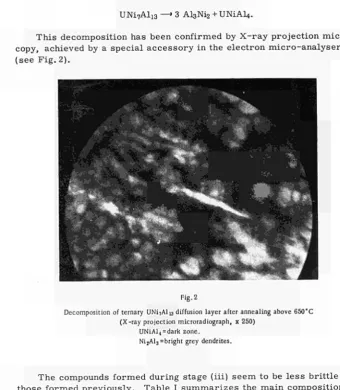
UNi7Al13 —» 3 AI3M2 + UN1AI4.
T h i s decomposition has been confirmed by X - r a y p r o j e c t i o n m i c r o s copy, achieved by a s p e c i a l a c c e s s o r y in the e l e c t r o n m i c r o - a n a l y s e r [15] (see F i g . 2).
[image:14.425.37.378.94.485.2]Fig. 2
Decomposition of ternary UN17AI13 diffusion layer after annealing above 650"C (X-ray projection microradiograph, χ 250)
UNiAl4 = dark zone.
Ni2Al3=bright grey dendrites.
The compounds formed during s t a g e (iii) s e e m to be l e s s b r i t t l e than t h o s e formed p r e v i o u s l y . T a b l e I s u m m a r i z e s the m a i n c o m p o s i t i o n s of the diffusion l a y e r s .
The e x p e r i m e n t a l r e s u l t s show that the l o g a r i t h m of the total diffusion l a y e r t h i c k n e s s is a l i n e a r function of the l o g a r i t h m of the t i m e for given t e m p e r a t u r e and initial nickel l a y e r t h i c k n e s s , so that
Xn = kt;
k depends on t e m p e r a t u r e by the equation
k =k0e-Q/RT,
and k0and Q have been found to be
(1)
EFFICIENCY OF DIFFUSION BARRIERS
TABLE 1
MEAN COMPOSITION O F DIFFUSION LAYERS IN THE SYSTEM Al-Ni-U
(Corrected values, adjusted to 100%)
519
Al
(wt.%)
0.2 0.4
34.8
Ni
(wt. %
41.7 58.8 40.7
U
(wt.^ 58.1 40.8 24.5
Phase
N1AI3 Ni2Al3
UNÌ, Al u
k
0=2.75X IO"
2Q = 23 500 cal/M
when t is measured in seconds and X in centimetres.
As it has been found that for given times and temperatures the logarithm
of the total thickness X is a linear function of the initial barrier thickness E
(cm) X may be expressed by the formula
X = Cit
c2e
c3/
Te
c4E
(3)for which the following values have been determined by the method of least
squares, using all measured values:
Ci = 0.32
C
2=0.716
C
3=-8350
C
4=-740
3.2. Study of the diffusion in elements U-Cr-Al
The study concerning the chromium as a diffusion barrier was carried
out in collaboration with CERCA, Bonneuil. The final report on this work
under contract is in p r e s s [16] . Again, the binary systems a r e shortly
treated at first.
3. 2 . 1 . The study of the couples U-Cr and Cr-Al
3 . 2 . 1 . 1 . U-Cr
520 F. BROSSA, et al.
becomes quite rough in this t r e a t m e n t . F o r the electrolytic c h r o m i u m d e position two solutions have been applied:
(a) Solution of P a s s a l [17] C r 03 300 g
SrS04 15 g K2SiF6 40 g
H20 1000 g
(b) Solution of BORNHAUSER [18] C r 0 3 330 g / l
NaOH 48 g / l Cr2Os 6 g / l
The a d h e r e n c e of both deposits is good, however c o r r o s i o n t e s t s show the existence of c r a c k s . T e s t s a r e underway to prevent them by multistage deposition.
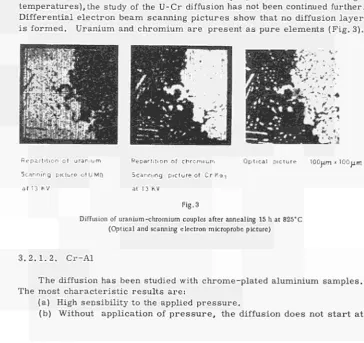
Diffusion experiments h a v e been run with solid sandwich-type s a m p l e s . No diffusion has been found with α-uranium, i . e . a t t e m p e r a t u r e s up to 600°C, even after v e r y long t i m e s . At higher t e m p e r a t u r e s (β- and 7 - u r a n i u m ) the diffusion b e c o m e s quite i m p o r t a n t . Differences have been found in the dif fusion r a t e u s i n g different t y p e s of c h r o m i u m ( P a s s a l or B o r n h a u s e r d e p o s i t s or solid s a m p l e s ) . However, as the diffusion with β - or 7 - u r a n i u m is not of p r a c t i c a l i n t e r e s t for the ORGEL project (because of too high t e m p e r a t u r e s ) , the study of the U-Cr diffusion has not been continued further. Differential e l e c t r o n b e a m scanning p i c t u r e s show that no diffusion l a y e r i s formed. Uranium and c h r o m i u m a r e p r e s e n t as pure e l e m e n t s (Fig. 3).
R e p a r t i t i o n of u r a n i u m
Scanning picture ο ί ϋ Μ β
at 13 KV
Repartition of c h r o m i u m
S c a n n i n g p i c t u r e of C r K a ^
[image:16.425.33.398.304.647.2]at 13 KV
Fig. 3
Diffusion of uranium-chromium couples after annealing 15 h at 825°C (Optical and scanning electron microprobe picture)
3 . 2 . 1 . 2 . C r - A l
The diffusion has been studied with c h r o m e - p l a t e d aluminium s a m p l e s . The most c h a r a c t e r i s t i c r e s u l t s a r e ;
(a) High sensibility to the applied p r e s s u r e .
EFFICIENCY OF DIFFUSION BARRIERS 521
t e m p e r a t u r e s beyond 430°C, but is highly a c c e l e r a t e d when passing from 450 to 500°C.
(c) Only two of the i n t e r m e t a l l i c phases given by the phase diagram (1) appear as diffusion l a y e r s . The compound adjacent to the chromium f o r m s a r e l a t i v e l y flat l a y e r ( V i c k e r s h a r d n e s s 650 k g / m m 2 ) , the other one shows a toothed band (Vickers hardness 350 kg/mm2). The junction between aluminium and t h i s compound i s the m o s t b r i t t l e interface in the s y s t e m .
A c o m p a r i s o n of the s y s t e m s C r A l and N i A l shows that the i n t e r -diffusion of c h r o m i u m and aluminium is initially m o r e i m p o r t a n t than that of nickel and a l u m i n i u m , but continues at a s m a l l e r r a t e . At 450oC, for i n s t a n c e , the foUowing r a t e l a w s have been found:
χ = 1.64 t0·3 2 for C r - A l , and x = 0 . 2 6 t0·5 9 for N i - A l .
The Vickers h a r d n e s s (V.H. ) of the h a r d e s t compounds forming during the diffusion in both s y s t e m s is
650 V . H . for C r2A ln, and 860 V . H . for Ni2Al3.
3 . 2 . 2 . Multiphase diffusion studies in U - C r - A l elements
As the deposition of c h r o m i u m b a r r i e r s i s m o r e difficult than that of nickel b a r r i e r s and as the r e s u l t s of the t e r n a r y diffusion examinations show a m u c h bigger s c a t t e r , the p r e p a r a t i o n and t r e a t m e n t p a t t e r n was s o m e t i m e s changed during the c o u r s e of the study. However, the g e n e r a l line m a y be d e s c r i b e d s i m i l a r l y to that of the n i c k e l b a r r i e r s .
(a) Deposition of the chromium in the solution after P a s s a i (cf. 3 . 2 . 1 ) . (b) Degassing for 3 h at 200°C and 10"5torr.
(c) Canning, electron bombardment welding.
(d) Autoclaving, generally at 450°C and 200 atm, however also for some t e s t s at higher t e m p e r a t u r e s and p r e s s u r e s .
(e) Diffusion t r e a t m e n t at t e m p e r a t u r e s between 450 and 600°C, either in vacuum or under argon p r e s s u r e in autoclaves.
As d e s c r i b e d above, the c h r o m i u m d e p o s i t s a r e g e n e r a l l y sound and a d h e r e n t after the vacuum t r e a t m e n t . However, they do not look briUiant and exhibit a slightly rough, c o a r s e s u r f a c e .
Diffusion at 450°C
No diffusion could be detected, either after t r e a t m e n t s without p r e s s u r e , or after 200 h at 40 a t m . Even a p r e v i o u s autoclaving of 1 h at 535°C and' 650 a t m did not p r o d u c e diffusion after annealing during 360 h.
522 F. BROSSA et a l .
Diffusion at õOO"C
The tests demonstrate a considerable influence of the p r e s s u r e . After
15 h, a diffusion layer of 10 urn was observed when the treatment was done
in vacuum and a layer of 25 um, when a pressure of 40 atm was maintained.
In this latter case diffusion peaks reached nearly the uranium (initial
chromium thickness 30 μπα). After 60 h under 40 atm, chromium l a y e r s
of 3050 Mm had reacted almost completely with the aluminium.
0 20 50 100 200
Penetration in microns Al
[image:18.425.29.398.31.585.2]Cr
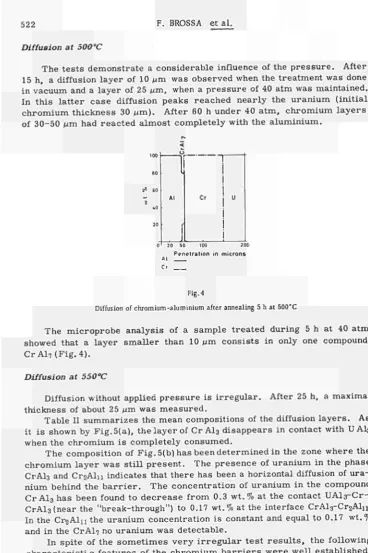
Fig. 4
Diffusion of chromiumaluminium after annealing 5 h at 500°C
The microprobe analysis of a sample treated during 5 h at 40 atm
showed that a layer smaller than 10
μπι
consists in only one compound,
C r A l
7( F i g . 4 ) .
Diffusion at 550°C
Diffusion without applied pressure is irregular. After 25 h, a maximal
thickness of about 25
μτη
was measured.
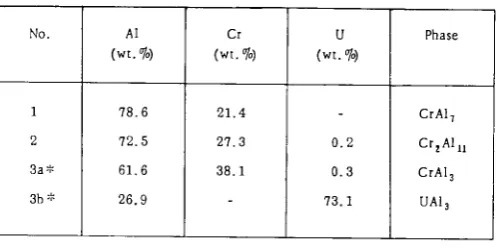
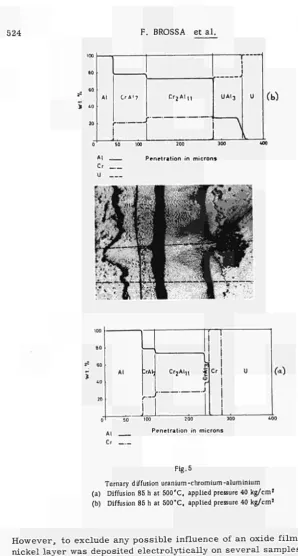
Table II summarizes the mean compositions of the diffusion layers. As
it is shown by Fig.5(a), the layer of Cr Al
3disappears in contact with UAI3
when the chromium is completely consumed.
The composition of Fig. 5(b) has been determined in the zone where the
chromium layer was still present. The presence of uranium in the phase
CrAl
3and C r ^ l n indicates that there has been a horizontal diffusion of u r a
nium behind the b a r r i e r . The concentration of uranium in the compound
Cr A l
3h a s been found to d e c r e a s e from 0.3 wt.% at the contact UAlsrCr
CrAl
3(near the "breakthrough") to 0.17 wt.% at the interface CrAl
3Cr
2Al
u.
In the Cr
2Aln the uranium concentration is constant and equal to 0.17 wt.%
and in the CrAl7 no uranium was detectable.
EFFICIENCY OF DIFFUSION BARRIERS 523
TABLE II
MEAN COMPOSITION OF DIFFUSION
LAYERS IN THE SYSTEM Al-Cr-U
(Corrected values, adjusted to 100%).
No.
1
2
3a*
3 b *
Al (wt.%) 78.6 72.5 61.6 26.9 Cr (wt.%) 21.4 27.3 38.1
-U (wt. %)
-0.2 0.3 73.1 Phase CrAl,
C r , A lu
CrAl3
UAI3
v Layers 3a or 3b are formed when chromium is still present or consumed,
respectively.
(b) The diffusion of the uranium most probably does not penetrate the
last layer of CrAl7 and does not reach the aluminium can.
(c) The mechanical behaviour of miniature fuel elements which were
prepared by canning threaded uranium rods with an aluminium can
using an intermediate chromium layer of 30 um has been acceptable,
even after a strong thermal cycling treatment (100 rapid cycles be
tween 15 and 350°C).
3. 3. Study of the diffusion in sandwiches U-V-Al
As already mentioned, the study of the vanadium barrier has been
limited to flat samples, as it was up to now not possible in the apparatus
employed by C.E.N.,Mol, to evaporate the vanadium on cylindrical
samples. As for the preceding barriers, the main deposition procedures
are described in the section dealing with the binary systems.
3. 3. 1. Study of the couples U-V and V-Al
3 . 3 . 1 . 1 . U-V
524 F. BROSSA, e t a l .
βο
. 60
ï ¿ο
20
C r A i 7 r2A i , ,
Γ
U A 13
50 100
(b)
Al
Cr _ . .
100 200 300
[image:20.425.41.340.24.581.2]Penetration in microns
Fig. 5
Ternary diffusion uraniumchromiumaluminium (a) Diffusion 85 h at 500'C, applied pressure 40 kg/cm* (b) Diffusion 85 h at 500'C, applied pressure 40 kg/cm2
EFFICIENCY OF DIFFUSION BARRIERS 525
3 . 3 . 1 . 2 . V-Al
Different p r o c e d u r e s w e r e used to p r e p a r e the diffusion c o u p l e s : e v a poration of vanadium onto aluminium, r o l l - m i l l i n g of units consisting of an aluminium r o d s u r r o u n d e d by a vanadium tube, combining a l u m i n i u m and vanadium d i s k s by t i t a n i u m s c r e w s and s p o t - w e l d i n g . Both m e t a l s w e r e etched anodically, the aluminium in a m i x t u r e of HCIO4 and CH3COOH, the vanadium in a solution containing H F , CH3COOH and H3PO4.
Diffusion t e s t s w e r e r u n at t e m p e r a t u r e s b e t w e e n 460 and 610°C and d u r a t i o n s between 3 h and 3 m o n t h s .
T h e coefficients of the equation
Xn= k t = k0e-Q/R T t, (4)
where
X = total thickness of diffusion l a y e r s (cm) Τ = t e m p e r a t u r e (°K)
t = t i m e (s),
have been calculated by the method of l e a s t s q u a r e s .
T h e following v a l u e s have been found for the s a m p l e s with evaporated vanadium :
η =1.42 k0 = 270
Q =43 000 c a l / M
F o r the rolled s a m p l e s the diffusion is m o r e rapid and it has been found
η =1.48 k0=7.7
Q = 36 600 c a l / M
The m i c r o p r o b e a n a l y s e s c a r r i e d out on s a m p l e s t r e a t e d for 5X 10⁵ s at 610°C revealed the p r e s e n c e of four intermetallic compounds: V5Alg, VAI3, VAI« and VAI7 (Fig. 6).
3. 3. 2. Multiphase diffusion studies in the U-V-Al system
Vanadium l a y e r s of 10-to 22-μτη thickness were evaporated onto uranium d i s k s by the p r e v i o u s l y d e s c r i b e d p r o c e d u r e . T h e coated s a m p l e s w e r e clamped with titanium s c r e w s to aluminium disks and heat treated in argon-filled quartz capsules at t e m p e r a t u r e s between 460 and 610°C and t i m e s b e tween 3X 10⁴ and i#2X 10⁷ s.
526 F. BROSSA, et al.
Experimental values Theoretic concentration
[image:22.425.34.396.27.453.2]Fig. 6
Diffusion of vanadium-aluminium for 5X10⁵s at 610"C
(t> 106 s) this layer disappears completely, but it may probably be - together with the limited solubility of the vanadium in the u r a n i u m - the r e a s o n for deviations in the diffusion law, when the aluminium begins to p e n e t r a t e into the u r a n i u m . S a m p l e s which had r e c e i v e d a faint n i c k e l l a y e r b e f o r e the vanadium evaporation (see 3 . 3 . 1 . 1 ) showed a m o r e r e g u l a r and a slightly enhanced diffusion, which h o w e v e r does not influence r e m a r k a b l y the g e -n e r a l r e s u l t s .
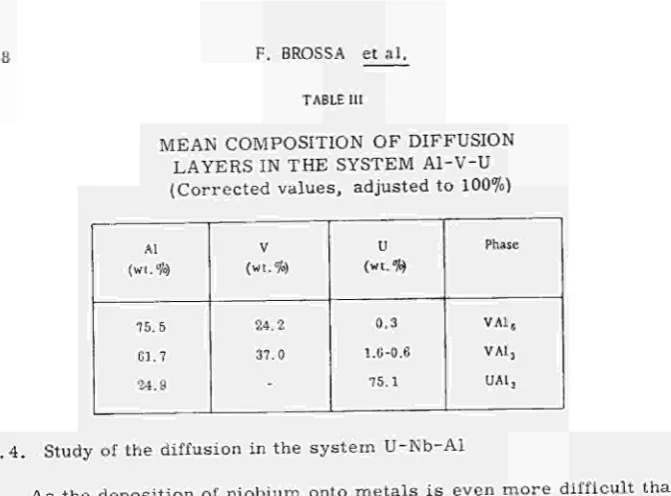
T h e p e n e t r a t i o n of the aluminium t h r o u g h the b a r r i e r p r o d u c e s , a s in the c a s e of the other b a r r i e r s , the compound U Al3. The penetration of the u r a n i u m t o w a r d s the aluminium is p r a c t i c a l l y stopped before it r e a c h e s the canning m e t a l , even when both the vanadium and the U 02 a r e totally consumed. As shown by F i g . 7, t h e r e e x i s t s , after a t r e a t m e n t of 3X lO^s at580°C, a g r a d i e n t of the u r a n i u m c o n c e n t r a t i o n in t h e VA13 p h a s e , r a n g i n g from
1.6 wt.% at the interface UAI3/VAI3 to 0.6 wt.% at the interface VA13/VA16;
0.3 wt.% u r a n i u m was d e t e r m i n e d in the VAle.
EFFICIENCY OF DIFFUSION BARRIERS 527
ο 'o so 100 0 200 250 300 350
Fig. 7
Ternary diffusion of uranium-vanadium-aluminium (a) Diffusion U-V-Al, 3X10⁶s at 580°C
(b) Diffusion V-Al, 5X10⁵s at 610°C
The coefficients of the expression
X = C i tc2 ec3 / Tec4Ej (3)
where
X = total diffusion thickness (cm)
t = time (s)
T = temperature (°K)
E = initial V thickness (cm),
were calculated by the method of least squares. Using the experimental
results obtained for the later stage of the diffusion process and neglecting
those for shorter times, the following values were determined·
Ci = 0.88
C
2= 0.40
C
3= -6600
C
4= - 260.
528 F. BROSSA et al.
TABLE III
MEAN COMPOSITION OF DIFFUSION
LAYERS IN THE SYSTEM Al-V-U
(Corrected values, adjusted to 100%)
Al (wt.%)
75.5
61.7
24.9
V (wt.%)
24.2
37.0
-U ( w t . %
0.3
1.6-0.6
75.1
Phase
VA16
VA13
UA13
3.4. Study of the diffusion in the system U-Nb-Al
As the deposition of niobium onto metals is even more difficult than
that of vanadium, the study of the niobium barrier has been very much
de-layed and no definite test results can be given at present.
The deposition was done byC.E.N., Mol, using evaporation by means of
electron bombardment heating. The procedure was similar to that employed
for the evaporation of vanadium. Very careful degassing was necessary and,
because of the higher temperature of the evaporation source, the distance
between this and the uranium had to be raised to 160 mm. After a thermal
treatment of the covered samples for 3 h at 600°C the niobium deposits show
a good adherence.
Preliminary binary diffusion tests have been run with samples prepared
by roll-milling. No reaction has been detected between uranium and
nio-bium below 600°C. Between nionio-bium and aluminium a eutectic alloy is
formed, mostly in the giain boundaries of the aluminium at temperatures
above 610°C. At 640°C NbAl
3appears and grows quite rapidly in thickness.
3.5. Study of the diffusion in U-V-Si-Al system
A somewhat different possibility for the solution of the diffusion barrier
problem consists in the application of double layer barriers, in which both
components show a good resistance to their adjacent metals respectively
and a low solubility for uranium and aluminium of the intermetallics formet
between them. Several tests run up to now with the system U-V-Si-Al have
given quite encouraging results. Samples were prepared by evaporation
as described for V and Nb. V and Si were deposited successively. Much
care had to be taken to avoid cracking of the Si during the outgassing
procedure.
EFFICIENCY OF DIFFUSION BARRIERS 529
e q u i v a l e n t t o t h e s t a t e m e n t t h a t t h e diffusion follows t h e c o n c e n t r a t i o n g r a d i e n t . T h i s i s , h o w e v e r , not a n e c e s s a r y c o n c l u s i o n and it i s t h e r m o d y n a m i c a l l y q u i t e p o s s i b l e t h a t diffusion o c c u r s a g a i n s t a c o n c e n t r a t i o n g r a d i e n t ( " u p h i l l diffusion"), for i n s t a n c e when t h e diffusion c r o s s e s t h e i n t e r f a c e of two p h a s e s with a v e r y l i m i t e d m i s c i b i l i t y [20] . Such a c a s e e x i s t s a p p a r e n t l y for the s y s t e m in q u e s t i o n .
By m i c r o p r o b e a n a l y s i s of s a m p l e s t r e a t e d at different t e m p e r a t u r e s for different d u r a t i o n s , the p h a s e s indicated in Table IV have been identified (UAI3ÌS formed only after quite heavy t h e r m a l t r e a t m e n t s ) .
TABLE IV
MEAN COMPOSITION O F DIFFUSION LAYERS IN THE SYSTEM AlSiVU ( C o r r e c t e d v a l u e s , adjusted to 100%)
Al (wt.%)
< 0 . 4
44.2 59.8 -25.0 Si (wt.%) 38.3
8 . 7
0.4 -V (wt. %) 61.7
4 7 . 1
40.2 99.4 -U (wt.%) -0.6 83.8 75.0 Phase
(VSi2 +V)
VSij+VAlj VAI, V U 02
UA13
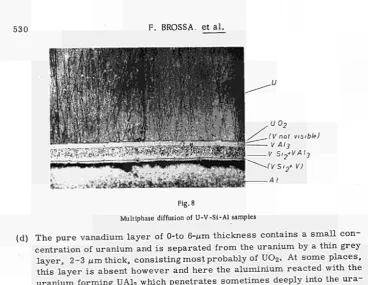
R e f e r r i n g to the data of T a b l e IV and to F i g s . 8 and 9, the following r e m a r k s can be m a d e :
(a) T h e p h a s e (VSi2+V) i s only v i s i b l e after a s t r o n g etching t r e a t m e n t
(5% H F ) . T h e l a y e r , which i s p a r t i a l l y p e n e t r a t e d , i s 2 3 μπι t h i c k . The p h a s e d i a g r a m (1) i n d i c a t e s that the e x i s t e n c e of a p h a s e VSi2 c o n
t a i n i n g v a n a d i u m in solid solution i s p r o b a b l e .
(b) The adjacent l a y e r (visible h e r e and t h e r e on F i g . 8)has a metallographic a s p e c t c o r r e s p o n d i n g to a m i x t u r e of two p h a s e s (VSi2 and VAI3). In
spite of its p l a c e m e n t between the aluminium and the foregoing l a y e r , which i s n e a r e r to the a l u m i n i u m , t h i s l a y e r contains m o r e a l u m i n i u m and l e s s v a n a d i u m than the foregoing one, and a l s o l e s s a l u m i n i u m and m o r e v a n a d i u m than the following one. Its c o n c e n t r a t i o n of s i l i c o n v a r i e s s t r o n g l y and the i n d i c a t e d value h a s t o be c o n s i d e r e d a s a m e a n v a l u e . T h e s t r o n g v a r i a t i o n of the Si c o n c e n t r a t i o n s u p p o r t s , t o g e t h e r with i t s a s p e c t , the h y p o t h e s i s that the l a y e r contains two p h a s e s (VSi2
(+V) and VAI3).
|c) T h e low c o n c e n t r a t i o n of s i l i c o n in t h e following l a y e r (VAI3) m a y be due t o t h e p r e s e n c e of p a r t i c l e s of VSi2. T h e a s p e c t of t h e l a y e r a
b r o w n c o l o u r a f t e r the HF etch c o r r e s p o n d s t o that found for VA13 in
530 F. BROSSA, et al.
uo
2(V nol visible) V Al3
V Si2+VA13
[image:26.425.30.399.31.316.2](V S12* V)
Fig. 8
Multiphase diffusion of U-V-Si-Al samples
(d) The pure vanadium layer of 0-to 6-μπι thickness contains a smaU con
centration of uranium and is separated from the uranium by a thin grey
layer, 2-3 μπι thick, consisting most probably of U0
2. At some places,
this layer is absent however and here the aluminium reacted with the
uranium forming UA1
3which penetrates sometimes deeply into the ura
[image:26.425.29.401.41.601.2]nium (Fig. 9).
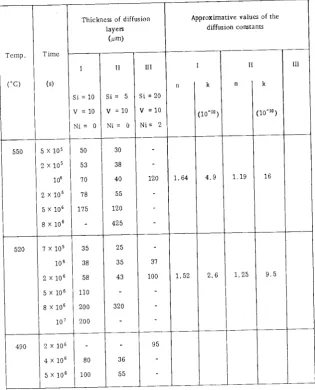
Table V summarizes the results obtained up to now with diffusion treat
ments at 550, 520 and 490°C.
As can be seen, approximate values for η and k have been calculated
for special cases. The number of experimental results is however still
too small to draw more general conclusions, as to the dependence on
temperature or relative thickness of initially deposited layers. It seems,
however, that the multiple layer barriers in question produce much smaller
diffusion zones than the previously studied barriers.
4. DISCUSSION
As shown above, the characteristics of the b a r r i e r types studied are
quite different. A final decision for practical application in a special case
has to take account of a large number of factors of which only a few are
known up to now with certainty. Knowledge of the behaviour of the barriers
under thermal gradients and under irradiation are completely missing. How
ever, the results obtained up to now give a very strong basis for the final
evaluation, as they allow comparison of the most important characteristics
such as temperature limits, mechanical stability and diffusion rate. The
study of the deposition procedures has been up to now only a means to pro
duce good, sound samples and was not influenced by questions of practical
interest. Other possible deposition procedures may produce improvements,
as, for instance, in the case of silicon, which may perhaps be deposited
much easier by a gas phase decomposition than by evaporation.
EFFICIENCY OF DIFFUSION BARRIERS 531
UO
VSi2+VAI3
(VSi2+ V)
■ Al
* Ι * Μ Μ · £ Κ , v o d f e í u * « U-t?
Fig. 9
Multiphase diffusion of UVSiAl samples Presence of UAI3 tendrils.
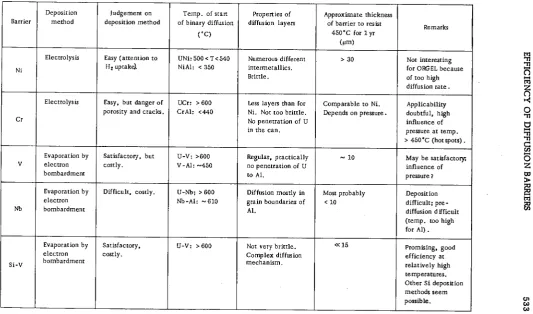
As may be seen, the nickel b a r r i e r is the most convenient one from
the point of view of the deposition. However, its relatively high diffusion
rate makes it unsuitable for applications at about 450°C when low neutron
absorption is required. The applicability of the chromium, barrier is doubt
ful, owing to the high influence of the p r e s s u r e on the diffusion r a t e ,
which may lead to dangerous consequences in the case of hot spots and owing
to failures in the deposited Cr layer. All the following b a r r i e r s could be
deposited up to now only by vacuum evaporation, which means that they are
costly. The evaporation of niobium is very difficult, and as there are, for
the time being, no other procedures of deposition working at relatively low
temperatures of the substrate, this barrier shows an important disadvantage
from the technical point of view. As its efficiency seems to be outstandingly
good, application in solid form (foils) may be advantageous in special cases
[21] . Vanadium may work satisfactorily; its evaporation is easier than that
of niobium. The influence of pressure on diffusion has still to be examined.
The SiV double barrier shows great promise judging from the still limited
experimental r e s u l t s . Diffusion rates are low, neutron absorption acceptable
and mechanical bonding properties probably satisfactory. Experiments are
continuing for further information on this barrier type.
5. CONCLUSION
532 F. BROSSA, et al.
TABLE ν
THICKNESS OF DIFFUSION LAYERS AND DIFFUSION
CONSTANTS IN THE SYSTEM Al-Si-V-U
Temp. CO 550 520 490 Time (s)
5X 10s
2 X 10⁵
106
2 X 10⁶
5 X 10⁶
8 X 10⁶
7 X 10⁵
106
2 X 10⁶
5 X 10⁶
8 X 10⁶
107
2 X 10⁶
4 X 10⁶
5 X 10⁶
Thickness of diffusion layers
(um)
I
Si = 10
V = 10
Ni = 0
50 53 70 78 175
-35 38 58 110 200 200 80 100 II
Si = 5
V = 10
Ni = 0
30 38 40 55 120 425 25 35 43
-320
-36 55 ΠΙ
Si =20
V =10
Ni = 2
-120
-37 100
-95
Approximative values of the diffusion constants
I η 1.64 1.52 k (10"") 4.9 2.6 II n 1.19 1.25
I
k(IO"10)
16
9.5 III
A C K N O W L E D G E M E N T S
[image:28.425.62.378.139.530.2]TABLE VI
COMPARISON OF DIFFERENT BARRIER TYPES
Barrier Ni Cr V Nb Si-V Deposition method Electrolysis Electrolysis Evaporation by electron bombardment Evaporation by electron bombardment Evaporation by electron bombardment Judgement on deposition method
Easy (attention to H2 uptake).
Easy, but danger of porosity and cracks.
Satisfactory, but costly.
Difficult, costly.
Satisfactory, costly.
Temp, of start of binary diffusion
(eC)
UNi: 500 <T< 540 NiAl: <350 UCr: >600 CrAl: <440 U-V: >600 V-Al: ~450 U-Nb; >600 Nb-Al: - 6 1 0
U-V: >600
Properties of diffusion layers
Numerous· different intermet all ics. Brittle.
Less layers than for Ni. Not too brittle. No penetration of U in the can.
Regular, practically no penetration of U to Al.
Diffusion mostly in grain boundaries of Al.
Not very brittle. Complex diffusion mechanism.
Approximate thickness of barrier to resist
450eC for l y r
(Mm)
> 30
Comparable to Ni. Depends on pressure.
- 10
Most probably <10
« 1 5
Remarks
Not interesting for ORGEL because of too high diffusion rate.
Applicability doubtful, high influence of pressure at temp. > 450"C (hotspots).
May be satisfactory; influence of pressure?
Deposition difficult; pre-diffusion difficult (temp, too high for Al).
534 F· BROSSA, et a l .
R E F E R E N C E S
[I] HANSEN, M. and ANDERKO. K., Constitution of Binary Alloys, 2nd e d . , Mc GrawHill Book C o . ,
New York (1958).
[2] CASTAING, R., Pub. ONERA No. 5 5 ( 1 9 5 2 ) .
[3] THEISEN, R., « Analyse d' une méthode de calculs de correction du microanalyseur électronique».
EUR 3 f (1961).
[4] ANGERMAN, C L . . "Electron metallography of the UNi diffusion zones", Nucl. Engng and Sci. Conf.. Preprint 63, Session IX. Chicago ( Π 2 1 March 1958).
[5] CASTELMAN, L. and SEIGLE, L., Fundamentals of diffusional bonding, US A EC Rep. SEP227 (1956). [6] STEINEGGER, A.E. and AAS, S., Private communication. (1960).
[7] ADDA, Y. et a l . , « Influence de la pression sur la diffusion dans les systèmes UAl, UCu, U N i » , Us MemoirêTs^ientifiques de la Revue de Métallurgie 57 6 (1960) 42334.
[8] MÜLLER, Ν., "Untersuchung über die Diffusion in den Systemen UranZirkon und UranNickel", Z. Metall kunde 50 11 (1959) 65260.
[9] GREEN, D.R.. Preliminary data on U/Ni/x8001 aluminium alloy diffusion, USAEC Rep. HW56513
[10] STORCHEIM, S. et a l . , "Solid state bonding of aluminium to nickel". Trans. AIME 200 (1954) 26974. [ I I ] KIDSON, G. V. . l ^ k i n e t i c s of layer formation by the interdiffusion of Al and Ni in extrusion clad
nickel plated uranium flats, Rep. AECL421 (1957).
[12] BROSSA, F., HUET, J.J., THEISEN. R. et TYTGAT, D., « Etude du nickel comme barriere de diffusion entre l'uranium et l'aluminium», EUR 17 f (1962).
[13] BROSSA, F. et AIROLA, M.. « Perfectionnements aux procédés de dépôt électrolytique sur des métaux, en particulier des barreaux d'uranium pour éléments combustibles de réacteurs nucléaires», Belgian
Pat. No. 600262(1961).
IACQUET, P . A . , « Polissage électrolytique des surfaces métalliques», Edition Métaux, St.Germain
en Laye (S &0 ) (1948).
THEISEN, R. and LEMAITRE, J., in: Proc. Xth Intern. Colloquium Spectroscopicum, International Spartan Books, Washington (1962) 391.
FOURE, M., MONTI, H. et THEISEN, R.. « Etude du chrome comme barrière antidiffusante entre
uranium et a l u m i n i u m » , EUR Rep. (in press).
[17] COLLOT, M . , «Thèse de l'école technique supérieure du laboratoire»(1958).. [18] BORNHAUSER, O . , French Pat. No. 7 5 4 . 2 9 9 ( 1 9 3 2 ) .
[19] HUET, I J . , MUSSO. G . . BROSSA, F. et THEISEN, R., « Etude du vanalium comme barrière de dif fusion entre l'aluminium et l'uranium», EUR Rep. (in press).
[20] JOST, W., "Diffusion in Solids, Liquids, Gases" Academic Press Inc., N. Y. (1952). [21] ALFILLE, L., BROSSA, F. et THEISEN, R., Belgian Pat. No. 499.649(1962). [14]
[15]