http://dx.doi.org/10.4236/cs.2016.78154
Wireless Sensor Network Lifetime
Enhancement Using Modified Clustering and
Scheduling Algorithm
K. Ramesh
1, K. Somasundaram
21Department of IT, Nandha Engineering College, Erode, India
2Department of CSE, Vel Tech High Tech Dr.Rangarajan Dr.Sakunthala Engineering College, Chennai, India
Received 7 April 2016; accepted 1 May 2016; published 20 June 2016
Copyright © 2016 by authors and Scientific Research Publishing Inc.
This work is licensed under the Creative Commons Attribution International License (CC BY). http://creativecommons.org/licenses/by/4.0/
Abstract
Random distribution of sensor nodes in large scale network leads redundant nodes in the applica-tion field. Sensor nodes are with irreplaceable battery in nature, which drains the energy due to repeated collection of data and decreases network lifetime. Scheduling algorithms are the one way of addressing this issue. In proposed method, an optimized sleep scheduling used to enhance the network lifetime. While using the scheduling algorithm, the target coverage and data collection must be maintained throughout the network. In-network, aggregation method also used to re-move the unwanted information in the collected data in level. Modified clustering algorithm high-lights three cluster heads in each cluster which are separated by minimum distance between them. The simulation results show the 20% improvement in network lifetime, 25% improvement in throughput and 30% improvement in end to end delay.
Keywords
Clustering Algorithm, Wireless Sensor Networks, Scheduling Algorithm, Network Lifetime
1. Introduction
The network lifetime is the crucial factor for network design and it is directly depends on the nodes lifespan. Clustering Algorithms proposed in [1] [2] are first level for energy efficient network design. The redundant nodes may collect and transfer the repeated data and drain its energy. A scheduling algorithm is used to address this issue by considering a part of the nodes alive and others in sleep for predefined duration. Energy wastage in ideal listening of node is reduced with considerable control overhead and minimum energy loss in mode transac-tion (active to sleep and vice versa). A sleep scheduling algorithm without proper tuning may lead the packet loss and the network brake in the field. This degrades the network performance and also the lifetime.
In this proposal, proper tuning in scheduling algorithm is the primary goal and it considers the part of nodes as the standby nodes to provide brake free network and also to improve the packet delivery ratio. The proposed work focused on reducing energy consumption at all stages, starting from cluster formation. An optimized sleep scheduling algorithm is proposed to reduce the redundant and unwanted data transmission. Modified in-network aggregation method is used for further reduction of data transfer and its communication cast.
The rest of this paper is organized as follows. Section 2 introduces the related work for clustering, scheduling and lifetime enhancement in WSNs. Section 3 introduces the proposed system model used in this work. Section 4 is simulation results and discussion. Finally, we conclude this paper with a discussion about future research in Section 5.
2. Related Work
Communication cast in direct transmission between base and nodes high and it’s overcome by forming the clus-ters. Clusters are the group of nodes in which one of the member node is elected as leader i.e., Cluster Head (CH) [1]. CHs are elected for frequent interval in rotation manner to provide a balance network. A CH node collects the information from member nodes and sends it to sink and drain its energy quickly. So CH node elected for every round and it should be in rotation. Energy-efficient sensor target coverage problem was discussed in [2] for lifetime improvement.
Scheduling method is used in [3], introduces concept of sensors should power off when they are not in use for collection of information and to save energy. Energy wastages in simple ideal listening are reduced by consi-derable control overhead.
An approximation algorithm was developed for maximum data collection in the application field was investi-gated in [4]. Collected data’s to reach the sink either in single hop or a multihop model based on energy level and distance between node and base. If it choose multihop to reach base, then it needs a proper routing protocol to find a path towards sink. A linear programming algorithm developed to find a shortest path to transmit data in WSNs for prolonging network lifetime in [5]. Searching tree methods used for finding the multiple path between two nodes and to select one best path to reach the base.
An energy aware organization is proposed in [6] improves the performance of the network lifetime. Maximal lifetime scheduling introduced in [7] to focus a target coverage with multiple nodes. Energy efficient target- oriented scheduling algorithm developed in [8] used for directional sensor networks and improved the perfor-mance of the network.
A comparative study of clusterhead selection algorithms in wireless sensor networks in [9] provides detailed comparison of different algorithms and its performance. Several characteristics of active/sleep models are dis-cussed in [10] create a chain of nodes for communication hops and all sequenced nodes tend to sleep in same time to avoid the packet loss. Usually the base station is far away from the network and the nodes send the data to base using CDMA slots. Base station placement method proposed in [11] prolongs the lifetime by placing the base in Centre of the field to make a short reach to all nodes in the field.
Uneven clustering introduced in [12] improved the lifetime by avoiding overloading the nodes nearby base station. Uneven clustering concepts also prevents the hidden area called far-zone which far away from base sta-tion. Prevention of Far-zone discussed in [13] improves the network lifetime by uneven clustering and modified sleep scheduling algorithm. The proposed system optimizes the sleep scheduling and modifies the clustering al-gorithm to improve the network lifetime.
3. Proposed System
3.1. Initialization Phase
Initialization of sensor nodes is more complex than the system design. A proper network model required the less energy consumption. Figure 1 shows the transmitter and receiver section of a node with their energy levels.
elec
E , refers to energy required to transmit or receive one bit of data. And energy required to transmit n bits of information for d distance with threshold d0 is given by,
(
,)
( )
(
,)
Txn TxElec TxAmp
E n d =E n +E n d (1)
(
)
2 04 0
, ,
, Elec fs Txn
Elec mp
nE n d d d
E n d
nE n d d d
+ ∈ <
= + ∈ ≥
. (2) Free space (fs) model or multipath (mp) model is used based on the threshold and the distance between trans-mitter and receiver. To receive the above message (n bits), the receiver has to spend:
( )
Rxn Elec
E n =nE (3) Cluster head selection threshold for node k, as follows,
( )
( )
max 1
1 mod
0 others
re x rE
T x r p E
r
n G
= −
∈
(4)
where, r is the current round, Ere x( ) is the residual energy of the node in current round and Emax is the maxi-mum energy of the a node at initial. Emax is common for all nodes in a homogeneous network and p is the probability for that node to be a cluster head.
The following pseudo-code shows initialization phase. Initially all nodes are with equal initial energy level and the threshold values. Sensor nodes are inbuilt with self-configuration and self-organizing capabilities. With this property, the nodes are initialized with the base station and update their information with neighbours. The given pseudo-code initializes all m nodes with their threshold value and finds their coordinate’s values to base. A message broadcasts these information to all neighboring nodes.
Pseudo-Code for Initialization Phase 1: if (Eint(m)>0 &rmod(1/p)≠0) then
2: r ←random(0,1) and compute T(m); 3: if (r < T(m)) then
4: CCH{m}=TRUE; node n be a nominate for CH 5: else
6: CCH{m}=FALSE; node n not be a candidate CH 7: end if
8: end if
9: SendToBS(IDi, (xi,yi), CCH(i)) ←All nodes send messages to BS; 10: Eres(n) ←All nodes remaining energy updated;
11: BTN(p) ←BS broadcasts a message back to all nodes;
3.2. Cluster Formation Phase
Dynamic cluster formation and Cluster Head (CH) election is based on new threshold values (x). To make a common prototype, network model follows the threshold for node x, as in Equation (4). If a node is eligible to act as a CH based on residual energy level, then its threshold value is calculated and compared with other nodes value. A node with maximum threshold value is elected as a CH and that node sends advertisement message to other node to join as a member of that cluster. Other nodes that receive the advertisement and are willing to join that CH is sent a request message to join. In this proposal three CH are elected within a cluster with minimum separation distance d0. The eligible nodes before elected them self as CH, the need to communicate to other CH nodes for minimum separation. If the distance is less than d0, the system goes for an alternate, otherwise the node elected as CH. The following pseudo-code gives the detailed CH election.
Pseudo-Code for CH selection 1: do { ; repeat for all m rounds 2: compute Eres(m) and distance from base 3: if (Eres(m)>Eth&rmod(1/p)≠0) then 4: r ←random(0,1) and compute T(n) 5: if (r < T(m)) then
6: CH{n}=TRUE; node n be a nominate for CH 7: else
8: CH{m}=FALSE; node s not be a candidate for CH 9: end if
10: end if
11: if (CH{m}=TRUE) then
12: Accept ‘m’ value 0,1,2 with minimum distance d0
13: BM (ADV) ←broadcast an advertisement message with in the coverage 14: Join(IDi); non-cluster head node i join into the nearby CH
15: CH (j); maximum join message received nominee elected CH of that round 16: Clstr( k) ; form a cluster with TDMA slot to member nodes;
17: end if
18: }
3.3. Data Relay Phase
In data relay phase CHs receive the data from members and aggregate it. Based on the distance from the base CH node selects the path with single hop or multiple hops to base. After selecting the path, the aggregated data with cluster head ID is transferred to next hop and maintains the hop count. If the node is a gateway node then it collects data from CH node and do the in-network aggregation and forward it to next hop. Member nodes are sent the sensed data in their respective time slot to base and activate sleep state.
Pseudo-Code for Data Relay
1: If (CH(j)=TRUE) then; repeat for all CH nodes
2: Receive(IDi, DataPkt) ; receive data from member nodes of that cluster j 3: Aggregate(IDj, DataPkt)
4: Synchronize datas within Cluster’s CHs.
5: TransToNh(IDj, AgDataPkt); transmit aggregated data to next hop towards base; 6: else
7: If (GWN(m)=TRUE) then ; gateway nodes 8: Receive(IDj, AgDataPkt)
9: InNetworkAggregation (IDj, AgDataPkt) ; In-network aggregation to remove the redundant message 10: TransToNh(IDj, AgDataPkt); transmit aggregated data to next hop towards base;
11: else
12: If (MyTimeSlot=TRUE) then; for non-CH nodes
13: TransToCH(IDi, DataPkt) ; transmit sensed data to CH within their time slot; 14: else
15: SleepMode(i)=TRUE ; node i at a sleep state 16: end if
17: end if
4. Performance Analysis
In this section, simulation results are compared with cluster based LEACH protocol, Energy efficient target- oriented Scheduling (EETS) protocol and proposed model. The simulation parameters are 100 number of nodes with 500 × 500 m2 area. 1 Mbps channel bandwidth, 500 bytes packet size with 1J initial nodal energy are the other parameters. Performance analysis is based focused for lifetime enhancement of network with three para-meters Control overhead, Packet loss, Throughput and Average Delay.
4.1. Control Overhead
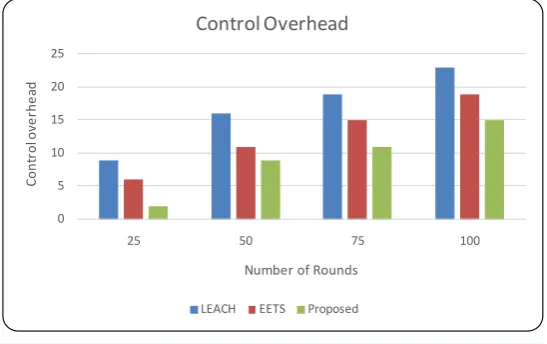
Control overhead is the control message transaction count in specific duration. Control messages are used for having minimum bandwidth and to be reduced in overall count to avoid collision and also overall delay. Figure 2 shows the comparison of proposed protocol with other two protocols and it is considerably reduced in pro-posed line in number of rounds or time duration. Due to modified clustering algorithm the control overhead val-ue reduced considerably at the later round when compared with early rounds. 20% reduction at the last round shows the improvement when compared with others.
4.2. Packet Loss
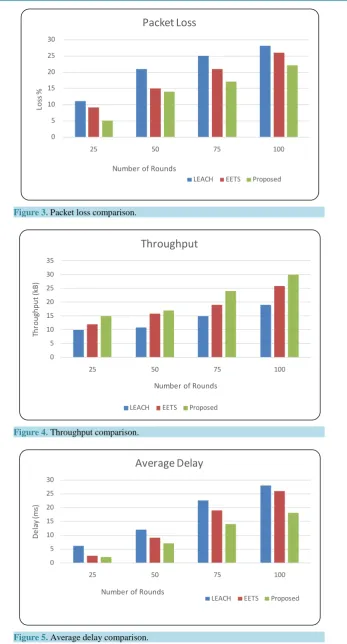
Packet loss and Packet delivery ratio are interrelated parameters. Packet loss is defined as the ratio between number of packets received at the end and total number of packet transmitted in specific time duration. Due to optimized sleep scheduling algorithm used in proposed method reduces the packet loss by compared with others and tends to increases the PDR value. Figure 3 shows the comparison graph and its highlights the reduced amount of packet loss in proposed method when compared with other two methods. The values are calculated in the simulation result for all the three protocols. 20% reduction at the last round shows the improvement when compared with others.
4.3. Throughput
Throughput is the measure of number of packets received at receiver end in a specific time duration. Proper tuning in scheduling algorithm and reduced packet loss are helped to reach high throughput value when com-pared with other protocols. Comparative graph in Figure 4 shows the 25% improvement in proposed model.
4.4. Average End to End Delay
[image:5.595.176.450.536.708.2]The Average end to end delay is the measure of packets delayed at the receiver due to transmission in the net-work hop. Optimized scheduling algorithm and routing methods used in relay phase are provides reduced over-all delay when compared with other protocols. Figure 5 gives comparative analysis for average delay in pro-posed protocol and highlights 30% improvement in last round.
Figure 2. Control overhead comparison. 0
5 10 15 20 25
25 50 75 100
Con
tr
ol
ov
er
he
ad
Number of Rounds
Control Overhead
Figure 3. Packet loss comparison.
[image:6.595.143.491.77.722.2]Figure 4. Throughput comparison.
Figure 5. Average delay comparison.
0 5 10 15 20 25 30
25 50 75 100
Lo
ss %
Number of Rounds
Packet Loss
LEACH EETS Proposed
0 5 10 15 20 25 30 35
25 50 75 100
Thr
oug
hput
(k
B)
Number of Rounds
Throughput
LEACH EETS Proposed
0 5 10 15 20 25 30
25 50 75 100
De
la
y (
ms
)
Number of Rounds
Average Delay
5. Conclusion
Prolonging wireless sensor network (WSN) lifetime is mainly by considering clustering approach and schedul-ing methods. The proposed protocol modifies both clusterschedul-ing method and sleep schedulschedul-ing algorithms used in previous methods. In modified clustering, three CHs are elected within the cluster and provide load sharing be-tween them to reduce the energy consumption for data collection and relay. In optimized Sleep scheduling mod-el, less number of nodes in each round kept alive while others in sleep to enhance the lifetime of nodes and also the lifetime of network. 30% improvements in overall delay and 20% improvements in network lifetime high-light the proposed system. A modified routing protocol with minimum communication cast may enhance net-work lifetime as feature net-work.
References
[1] Heinzelman, W.R., Chandrakasan, A. and Balakrishnan, H. (2000) Energy-Efficient Communication Protocol for Wireless Sensor Networks. Proceedings of the 33rd Hawaii International Conference on System Sciences, Maui, Ha-waii, 4-7 January 2000, 1-10. http://dx.doi.org/10.1109/HICSS.2000.926982
[2] Slijepcevic, S. and Potkonjak, M. (2001) Power Efficient Organization of Wireless Sensor Networks. ICC 2001 IEEE International Conference on Communication, Helsinki, 2001, 472-476. http://dx.doi.org/10.1109/icc.2001.936985
[3] Raghunathan, V., Schurgers, C., Park, S., Srivastava, M. and Shaw, B. (2002)Energy-Aware Wireless Microsensor Networks. IEEE Signal Processing Magazine, 19, 40-50. http://dx.doi.org/10.1109/79.985679
[4] Sadagopan, N. and Krishnamachari, B. (2004) Maximizing Data Extraction in Energy-Limited Sensor Networks. Twenty-Third Annual Joint Conference of the IEEE Computer and Communications Societies,Hong Kong, 7-11 March 2004, 1717-1727. http://dx.doi.org/10.1109/infcom.2004.1354583
[5] Chang, J.H. and Tassiulas, L. (2004) Maximum Lifetime Routing in Wireless Sensor Networks. IEEE/ACM Transac-tions on Networking, 12, 609-619. http://dx.doi.org/10.1109/TNET.2004.833122
[6] Cardei, M. and Du, D. (2005) Improving Wireless Sensor Network Lifetime through Power Aware Organization. Wireless Network, 11, 333-340. http://dx.doi.org/10.1007/s11276-005-6615-6
[7] Liu, H., Wan, P.J. and Jia, X. (2006) Maximal Lifetime Scheduling for Sensor Surveillance Systems with k Sensors to 1 Target. IEEE Transactions on Parallel and Distributed Systems, 17, 1526-1536.
http://dx.doi.org/10.1109/TPDS.2006.175
[8] Cai, Y., Lou, W., Li, M. and Li, X. (2009) Energy Efficient Target-Oriented Scheduling in Directional Sensor Net-works. IEEE Transactions on Computers, 58, 1259-1274. http://dx.doi.org/10.1109/TC.2009.40
[9] Ramesh, K. and Somasundaram, K. (2011) A Comparative Study of Clusterhead Selection Algorithms in Wireless Sensor Networks. International Journal of Computer Science & Engineering Survey (IJCSES), 2, 153-164.
http://dx.doi.org/10.5121/ijcses.2011.2411
[10] Li, W. (2011) Several Characteristics of Active/Sleep Model in Wireless Sensor Networks. 2011 4th IFIP International Conference on New Technologies, Mobility and Security (NTMS),Paris, 7-10 February 2011, 1-5.
http://dx.doi.org/10.1109/ntms.2011.5721073
[11] Gu, Y., Pan, M. and Li, W. (2013) Prolonging the Lifetime of Large Scale Wireless Sensor Networks via Base Station Placement. 2013 IEEE 78th Vehicular Technology Conference (VTC Fall),Las Vegas, NV, 2-5 September 2013, 1-5. http://dx.doi.org/10.1109/vtcfall.2013.6692379
[12] Ramesh, K. and Somasundaram, K. (2014) Improved Energy Efficient Method for WSN to Prevent Far-Zone. Ad-vances in Natural and Applied Sciences, 8, 1-6.