© 2018, IRJET | Impact Factor value: 6.171 | ISO 9001:2008 Certified Journal | Page 4317
A Study on Risk Analysis in Construction
Project
V. Rathna Devi
M.E. Student, Department of civil engineering, Velammal Engineering College, Tamil Nadu, India
---***---Abstract –
Risk management is the systematic process ofidentifying, analyzing, and responding to project risk. The process of risk analysis includes qualitative and quantitative analysis. The qualitative risk analysis is done by prioritizing the identified risk factors based on their probability and impact. The quantitative risk analysis is expressed in terms of monetary value and schedule. The aim of this study is to use earned value management as a quantitative method to risk analysis. The earned value analysis can be used to predict the cost at completion and percentage of completion with reference to the baseline estimate and schedule. This method of quantitative analysis considers financial risk and schedule risk as major factor in the execution of project. When the difference between planned value and earned value is observed the risk factors involved can be identified using work break down structure. Similarly, the quantification for risk can be made by the performance indicators obtained in the earned value analysis. In this way progress of the project can be analyzed and also proactive risk analysis can be done for further completion of the project. Thus earned value management and risk management can be integrated to prevent delay and improve performance of the project.
Key Words: Earned Value Management, Quantitative Risk Analysis, Risk Analysis, Work Breakdown Structure.
1.
INTRODUCTION
Risk analysis is regarded as the procedure involving the critical evaluation of prospective risks, arranging them according to importance, and allowing the management team to select the important ones. Risk analysis is the most tasking procedure in managing risk. This is due to the fact that it involves assessing the chances of the event of a risk and their outcomes on a project’s objectives. Its main aim is to evaluate risk by separating the unnecessary events, the chances of the unwanted event happening, and the size of such events. Risk analysis includes uncertainty in a qualitative and quantitative manner to evaluate the potential effects of risk. The evaluation should largely focus on risks that have high chances or effects.
In risk analysis, two main approaches are broadly used. They are: qualitative risk analysis and quantitative risk analysis and sub-category semi-quantitative. The choice of method depends on the following: the type and magnitude of the intended project, available information,
the financial implication and time available, the experience of the analysts, the extent of innovation and the ultimate purpose of the results. Quantitative approach is primarily based on probability spreading of risks. However, if sufficient data are available it can provide objective results. Qualitative method on the other hand, is subject to personal experience, intuition and judgment. The outcomes can therefore significantly vary from one analyst to another. Consequently, the quantitative approach remains the preferred option by most practitioners.
1.1 Qualitative Risk Analysis
Qualitative Risk Analysis at its simplest involves only a description of the obvious project risks; in some circumstances risk identification may be all the risk analysis that is required, in other cases more in-depth analysis will be warranted. Qualitative Risk Analysis comprises qualifying and prioritizing the risks that have been identified in terms of likelihood and impact on the construction project undertaking. Qualitative risk analysis is one process of assessing the impact and likelihood on the identified risks. This process prioritizes the risks according to their potential effect on the project objectives and is one way to determine the importance of addressing specific risks and guiding appropriate risk responses. An evaluation of the available information on a regular basis can also help to modify the assessment of the risk.
Qualitative risk analysis requires that the probability and consequences of the risks be evaluated using established qualitative analysis methods and tools. When qualitative analysis is repeated any trends in the results can indicate the need for more or less risk management action. Qualitative risk analysis should be reviewed during the project’s lifecycle to remain current with any change in the project risks. This process can itself lead to quantitative risk evaluation.
1.2 Quantitative Risk Analysis
© 2018, IRJET | Impact Factor value: 6.171 | ISO 9001:2008 Certified Journal | Page 4318 determine the probability of achieving a specific
project objective:
quantify the risk exposure for the project and determine the size of cost and schedule contingency reserves that may be needed;
identify the risks which require the most attention by quantifying their relative contributions to project risk;
identify realistic and achievable costs, schedule, or scope of work targets.
Quantitative risk analysis requires risk identification after which both qualitative and quantitative risk analysis processes can be used separately or together. Considerations of time and budget availability and the need for both types of analysis statements about risk and impacts will determine which method(s) to use. Trends on the results when quantitative analysis is repeated can indicate the need for more or less management action.
2.
LITERATURE REVIEW
The relevant literature related to risk management techniques in general, risk factors, methods used for risk analysis, earned value analysis and the use of earned value analysis in risk analysis were reviewed.
Altaher Mohamed Eida et Al (2015), seeks to identify the risk factors that affect the performance of construction projects, using appropriate tools and technique and to develop a risk management framework. This study investigates, categorizes and evaluates the risk and develops a risk management policies and guidelines to the company contractor which can be adopted at the construction projects site for better and risk free construction work. The questionnaire prepared for the survey was formulated by seeing the relevant literatures in the area of construction management. The responses were analyzed by bar chart, standard variance & mean using the software of SPSS.
Ashish Ram et Al (2015), articulates to study about the delay causes and factors that contribute to the construction sequence delay for the road infrastructure projects and how one can predict the future completion date for the delayed project using earned value management. The data about the causes and quantification of delay factors is gathered through questionnaire survey. The gathered data are analyzed through Relative Importance Index (RII) and the delay causes are ranked as per their significance. To validate the findings of questionnaire survey, a case study on road construction was considered and analyzed based on earned value management (EVM). The formulae used for calculating RII is:
RII = Σ W ⁄ (A × N)
where, 0 ≤ RII ≤ 1
Here, W = Weight given by respondent ranges from 1 to 5;
A = Highest weight i.e. 5 (in this case); and N = Total number of respondent.
Svetlana Boyadzhieva (2014), provides a methodology that will assist the selection of one of the key figures in the theory of Earned Value Management - the basic project plan. This methodology is based on historical data from completed projects, as well as on simulation methods that generate possible project outcomes. The research is based on the three Steps to a Successful Schedule Risk Analysis.
It includes:
Step 1: A Critical Path Method Schedule Step 2: The Activity Duration Ranges Step 3: Simulate the Project Schedule
The practical application suggested above shows that together Earned Value and Risk Management offer a powerful management approach, assessing not only past performance, but also the uncertainty of the future for making informed decisions.
S. M. Renuka et Al (2014), mainly discusses the critical risk factors and its assessment techniques through comparative study of various international construction projects. About 50 relevant articles published over the last 25 years have been reviewed. The review resulted that a simple analytical tool will be developed for each project task to assess the risk easily and quickly, which will encourage the practitioners to do the risk analysis in their project. This review concluded that the earlier risk identification in the project and assessment during the bidding stage of the construction project will lead to the better estimation of the escalation on cost and time overrun.
Vikas Pawar et al (2014), emphasizes the identification and assessment of various risks in case of fast track projects. The evaluation of risks can help in prioritizing risks for effective risk management and successful completion of a project. A risk factor RF or combined risk measure is then calculated for each category.
RF = P + C – (P * C) Where,
RF = Risk Factor
P = Probability (occurrences) measure on a Scale 1 to 5
© 2018, IRJET | Impact Factor value: 6.171 | ISO 9001:2008 Certified Journal | Page 4319 The risk factor RF, from 1(Low) or 5(high) reflects
the probability of a risk arising and the severity of its impact. The risk factor will be high if the probability P is high, or the consequence C is high or both.
Oleg Kaplinski (2013) describes the method of defining the utility function as the decision maker is faced with a choice between a certitude of a given result and a lottery was to extreme results. The two contrasting cases of function of utility, that is characteristic of a decision maker with an aversion to risk, and decision maker with a predilection to risk, are then analyzed in detail. The suggested procedure of analyzing and identifying attitudes towards risk is based on the new criterion of maximization, namely the criterion of maximization of the expected result which has been replaced by the criterion of maximization of expected utility. It significantly changes the approach to analyzing risk, especially in construction industry.
3. METHODOLOGY
The assessment of time and cost related risk is made through the application of Earned Value Management. Earned value management (EVM) and risk management (RM) processes share a common aim of providing decision makers with the best information available when setting objectives and considering management strategies. However, they take differing approaches. The Earned Value Management can be used for forecasting the time schedule and cost estimation and hence can be integrating to predict the unexpected occurrence of risk in the project. EVM establishes project performance status and extrapolates that information to gain an understanding of future trends and the allocation of resource needed to successfully meet these objectives. RM looks to the unknown future to identify risks (threat and opportunity) and recommend early action to be taken to limit the impact and probability of threat occurrence or maximize the exploitation of opportunities. Both EVM and RM are, in their own way, informing project baseline estimates by using both objective and subjective data. Estimating uncertainty can be reduced by comparison of data outputs from both disciplines, providing a better understanding of project progress and predicted future trends.
Earned Value Management index (CPI, SPI) shows advanced deviations from the program and can show the effectiveness of risk process in the assessment of uncertainty.
1. If CPI or SPI is less than 1, project progress is further back to program, and one of its reasons is risk process failure in keeping project on the primary base. And when these risks are turned into problems, there will
be delay or additional cost in project. In this case, the manager should consider risk management and evaluate its efficiency.
2. If CPI or SPI is higher than 1, the development project has been more than the program and the risk process must focus on the use of available opportunities, it examines the best risk management process and the opportunity together and seeks to minimize risk and maximize opportunity. When the Earned Value Management represents opportunities in the project, the risk process identifies these opportunities.
3. It should be noted, being too high CPI or SPI (much greater than 1) does not represent an opportunity for project but also show there are other problems in the project. Usually, if real progress is so much more expected program, it can be concluded that in determining the initial baseline, a poor planning has been done or areas have been marked by mistake.
4. Similarly, if the CPI or SPI is so much less than 1, it is not only the result of not managed risks, it can also be the result of problems in the program or scope baseline.
4. DATA COLLECTION
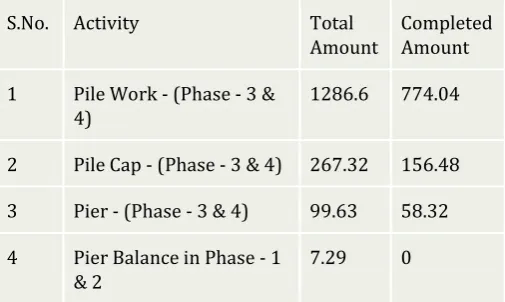
[image:3.595.305.558.602.753.2]The data for the study is collected from the project involving the construction of grade separator at the junction of Kaliamman Koil Street and CMBT city Bus Entrance at Koyambedu. The financial schedule was obtained from client for the project. The project involves four phases including the midspan and obligatory span. The contract value was 129.29 crores and the planned duration for the project was 33 months. The project commenced on 29.09.15 and the completion period was planned to be 28.06.18. Only 29.09% of work is accomplished in the contract period.
Table - 1: Total Amount and Completed Amount of the Project Cost
S.No. Activity Total
Amount Completed Amount
1 Pile Work - (Phase - 3 &
4) 1286.6 774.04
2 Pile Cap - (Phase - 3 & 4) 267.32 156.48
3 Pier - (Phase - 3 & 4) 99.63 58.32
4 Pier Balance in Phase - 1
© 2018, IRJET | Impact Factor value: 6.171 | ISO 9001:2008 Certified Journal | Page 4320 5 Pier Cap 252.97 55.53
6 Pedestal & Bearing
Fixing 97.98 0
7 Girder & Deck Slab 1560.00 0
8 Obligatory Span 150.00 0
9 R E Panel Casting 160.45 0
10 Approach Formation Works
209.08 0
11 Expansion Joint Fixing 64.88 0
12 Drain Works in Service Road
183.95 0
13 Crash Barrier, Centre
Median & Wearing Coat 244.14 0
14 Service Road 891.13 0
15 Painting & Miscellaneous 1104.00 0
5. RESULTS AND ANALYSIS
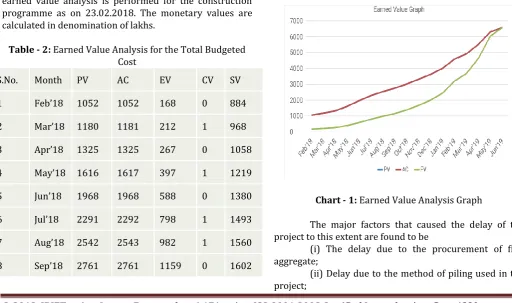
[image:4.595.34.547.482.785.2]The Actual Sanction Amount for the project is 40 crores and the Revised Sanction Amount is 93.5 crores. The Total Sanction Amount for the project is 93.5 crores and the probable date for completion is 30.06.2019. The earned value analysis is performed for the construction programme as on 23.02.2018. The monetary values are calculated in denomination of lakhs.
Table - 2: Earned Value Analysis for the Total Budgeted Cost
S.No. Month PV AC EV CV SV
1 Feb’18 1052 1052 168 0 884
2 Mar’18 1180 1181 212 1 968
3 Apr’18 1325 1325 267 0 1058
4 May’18 1616 1617 397 1 1219
5 Jun’18 1968 1968 588 0 1380
6 Jul’18 2291 2292 798 1 1493
7 Aug’18 2542 2543 982 1 1560
8 Sep’18 2761 2761 1159 0 1602
9 Oct’18 3020 3020 1386 0 1634
10 Nov’18 3322 3322 1677 0 1645
11 Dec’18 3631 3631 2003 0 1628
12 Jan’19 4014 4015 2449 1 1565
13 Feb’19 4592 4593 3204 1 1388
14 Mar’19 4924 4925 3684 1 1240
15 Apr’19 5521 5522 4632 1 889
16 May’19 6304 6305 6039 1 265
17 Jun’19 6580 6581 6580 1 0
Total 56643 56653 36225 10 20418
CPI = EV / AC = 36225/56653 = 0.639 SPI = EV / PV = 36225/56643 = 0.640 PV = 56443
SV = 20418
SV% = (SV/PV) * 100 = (20418/56443) * 100 SV% = 36.17%
The Cost Performance Indicator and Schedule Performance Index is less than 1 which indicates that the activities under the schedule are prone to risk in the area where the difference between the planned value and the earned value is high.
Chart - 1: Earned Value Analysis Graph
The major factors that caused the delay of the project to this extent are found to be
(i) The delay due to the procurement of fine aggregate;
© 2018, IRJET | Impact Factor value: 6.171 | ISO 9001:2008 Certified Journal | Page 4321 (iii) Delay in land acquisition process for the
obligatory span;
(iv) Delay due to the observed soil stratum resulting in the pile driving process and
(v) Delay caused due to technical issues caused by human errors.
5. CONCLUSION
Risk Analysis is carried out to mitigate the consequences of a negative event such as risk. The probability and impact are obtained through qualitative risk analysis whereas the quantification for risk is obtained in the quantitative risk analysis. The study conducted in the initial stages was aimed at identifying the risk analysis method and risk factors through review of literature. Though quantitative risk analysis is carried out after the identifying the risk factors through qualitative risk analysis, this study aimed at considering the cost and time factors and carrying out quantitative risk analysis. This study is aimed at identifying the factors affecting the progress of construction projects. The study investigates the variances and performance indicators through earned value analysis. The cost and schedule data collected are subjected to analysis and the results obtained are related to the critical activities in the project where the probability of risk is high. The basic idea of the study is to obtain quantification to risk in terms of monetary value in construction project.
REFERENCES
[1] Altaher Mohamed Eida and R.K. Pandey (2015), ‘Risk Management in Small Construction Project’, International Journal of Scientific Engineering and Technology Research, Vol. 4, Issue 13, Pages: 2472-2474, ISSN 2319-8885.
[2] Asish Ram and Pratheeba Paul (2015), ‘Study on Construction Sequence Delay for Road Infrastructure Projects’, IOSR Journal of Mechanical and Civil Engineering (IOSR-JMCE), ISSN: 2320-334X, Volume 12, Issue 2, PP 15-21.
[3] Oleg Kaplinski (2013), ‘Risk Management of Construction Works by Means of the Utility Theory: A Case Study’, Procedia Engineering, 57, 533 – 539.
[4] S. M. Renuka, C. Umarani and S. Kamal (2014), ‘A Review on Critical Risk Factors in the Life Cycle of Construction Projects’, Journal of Civil Engineering Research, 4(2A): 31-36.
[5] Svetlana Boyadzhieva (2014), ‘A Method for Choosing a Project's Planned Value Curve by Integrating
Earned Value and Risk Management’, Economic Alternatives, Issue 2, pp. 89-97.