© 2017, IRJET | Impact Factor value: 5.181 | ISO 9001:2008 Certified Journal
| Page 2970
A TRUSTWORTHY MODEL IN E-COMMERCE BY MINING FEEDBACK
COMMENTS
Gigi Mol
1, Sincy John
21
PG Student, Department of Computer Science and Engineering, A.P.J Abdul Kalam University, Kerala, India
2
Professor, Department of Computer Science and Engineering, A.P.J Abdul Kalam University, Kerala, India
Abstract - A crucial factor for the success of e-commerce
systems is accurate trust evaluation. Reputation trust models are mostly used in the e-commerce systems, where the ratings are used to calculate this trust score. There is, however, no guarantee of the trustworthiness of a reputation. The “all good reputation” problem, however, is predominant in current reputation systems, because the trust score is very high for most of the sellers. So, it becomes very difficult for the users to identify the potential sellers for them to transact with. CommTrust is one such system used for trust evaluation by mining feedback comments, because the users feel free to express their opinions in the free text feedback comments. This helps to resolve the “all good reputation” problem and rank the sellers effectively. The objective of this paper is to resolve the problem of false reputation i.e. the problem of being manipulated by unfair ratings. For this, a true-reputation based algorithm is proposed based on the confidence of the customer. This system helps to identify the malicious users and reduces their impact on computing the trust score either to increase their own reputation or to decrease the reputation of the competitors. It also helps in finding the individual dimensional score for each product which in turn helps in self-improvement of the areas where the product is lagging.Key Words – Reputation system, trust score, feedback, e-commerce, data mining
1. INTRODUCTION
The most important factors to be considered in an e-commerce system are trust and reputation. Reputation based trust models are used in e-commerce applications to help the users or customers to choose the best seller by letting them rate each other.
Nowadays e-commerce applications are gaining unprecedented popularity, where buyers and sellers are doing all the transactions through the web. Online shopping users are influenced by the feedback given by the other buyers on their purchase experience, more than the product details given in the website, either product related or seller related. All the websites related to the product are encouraging all their users to give the feedback based on the ratings and textual comments to facilitate the potential transactions. Reputation reporting systems [1] have been implemented in eBay and Amazon (for third-party sellers), where the aggregated feedback ratings is used to compute the reputation for the sellers.
© 2017, IRJET | Impact Factor value: 5.181 | ISO 9001:2008 Certified Journal
| Page 2971
express their real opinion about the transaction in open text feedback comments.
Some of the shopping websites allows the sellers to rate the buyers to find the malicious buyers. To defend their business, the sellers will rate the buyers, which will help them to defend their business, who had given the low rating for the good product while purchasing. This mechanism will help the product rate to become high, whatever comment is coming from the buyer. According to the buyer’s point of view, the average rate products are not a good one to buy. More comments will irritate the users to get to know about the product and time consuming. The buyers are expecting to know rating instead of comments that is very difficult to digest the information correctly. This will help to represent the reputation of the seller in a way so that they can be measured accurately by the buyer.
The reputation will give the trust of sellers to the buyers while buying products. While analyzing the information in feedback the sellers will uncover the buyers towards different aspects. This will help the sellers to maintain a comprehensive reputation profile. For identifying positive and negative opinions towards different dimensional aspects of transactions, a Multi-dimensional trust (CommTrust) [3], a fine-grained multi-dimension trust evaluation model for e-commerce applications is used. The trustworthiness of the comments depends on the reliability of the user. So, while computing the trust score the role of user is also important. This will helps to calculate the reputation in a more effective manner so that the buyers can select the most trusted seller to do transactions. Checking user reliability is an important step to solve the problem of false reputation, the reputation being manipulated by unfair ratings of the user.
It aims to provide a comprehensive trust profiles for sellers that assist buyers in conducting their online shopping based on the past experiences. The main aim is on extracting individual rating for dimensions from feedback comments of the user and further combining these dimension ratings to calculate the overall trust reputation scores for the sellers. The motivation is that online feedback comments contain distinct information for users to put the rating on sellers, therefore content of comments can be used to reliably evaluate the trustworthiness of sellers. The reliability of user also plays an important role in computing the reputation score to solve the false reputation problem which depends on the activity, consistency and objectivity of the user providing the feedback comments about the transaction. There are different scenarios in which the false reputation occurs either to increase the reputation of their own company or to decrease the reputation of competitor’s company.
The contribution of this system are:
• The Comment-based Multi-dimensional trust (CommTrust), a fine grained multi-dimension evaluation model, to calculate the trust and reputation of the e-commerce applications. While the model is potentially extensible to target item-specific trust, it is capable of computing comprehensive trust profile for sellers.
• The feedback comments is to identify dimension rating expresses by applying lexicon-based opinion mining techniques and natural language processing (NLP) for dependency relation analysis.
© 2017, IRJET | Impact Factor value: 5.181 | ISO 9001:2008 Certified Journal
| Page 2972
reducing the influence of malicious users in computing the trust score of various products.
2. RELATED WORKS
Reputation systems can be classified according to four main areas:
1. Trust computation approaches. 2. Analysis of e-commerce comments. 3. Summarization and opinion extraction. 4. Matrix Factorization technique applications.
2.1 Trust Computation Approaches
Positivebiasing system [4] is used for trust computation in eBay reputation system. It is a simple system in which the individual reputation score is computed for each seller. A positive feedback percentage is calculated based on the average number of positive and negative feedback in a specified period of time for a particular transaction. All good repute problem occurs in this system as it cannot express the negative aspect towards a transaction [5].
PeerTrust system [6] is used in peer to peer online communities. It calculates reputation score based on trust parameters and general trust metric. Trust parameter includes feedback scope, transaction context factor, community context factor and credibility factor. The trust metric evaluates these parameters to calculate the reputation score.
EigenTrust system [7] is a reputation management system for peer to peer network. In this, a unique global trust value is computed for each peer by local trust value assigned to them by other peers weighted by their global trust value. Those having high value will be having high reputation score.
CommTrust system [3] is a multidimensional trust model in which the reputation score is computed based on the feedback comments from the user. It is based on the idea that users feel free to express their opinions about different aspects of transaction in the free text feedback comments. The dimensional score is calculate based on the number of positive and negative ratings towards a particular dimension. The advantages of this system includes self-improvement, more accurate and effectively rank the sellers for assisting the potential buyers to choose the most trustworthy seller for doing transactions.
2.2 Feedback Comment Analysis
The user interaction is one of the main reason for the success of e-commerce applications. A seller having high reputation score will attract a large number of users for doing transactions with them and may leave comments. For identifying the service quality of a seller, the potential buyers may check their reputation score. Most of the reputation system does not provide any provision for considering the negative aspects of the user [8]. So, they feel free to express their actual opinion about a transaction in an open text feedback comments. Therefore, by analyzing the wealth of information in the feedback comments one can generate the actual trusted reputation score for a seller.
© 2017, IRJET | Impact Factor value: 5.181 | ISO 9001:2008 Certified Journal
| Page 2973
performs comparison between the feedback comments by a particular buyer on the target seller to the feedback comments by the same buyer for the sellers other than the target seller. . By extracting the descriptions of those two, one can obtain a summary about the transaction. By this method, the courtesy descriptions can be eliminated without deleting the descriptions that actually express their real feelings. Rated aspect summarization of short comments can also be used for analyzing the feedback comments which aims to identify the various aspects towards the aggregated ratings [9].
The CommTrust (Comment base Multi-dimensional Trust model) not only simply classifies the comments from the user into positive and negative but also identifies the dimension in them by mining it and determines the orientation hidden in the text of associated feedbacks. So, it is able to solve the all good reputation problem which is prevalent in most of the reputation systems. Rather than making a summary of the comments, it aims at calculating the individual dimension scores and their corresponding weights. It improves the computation efficiency compared to all other reputation models.
2.3 Aspect Opinion Extraction and Summarization
Opinion mining and sentiment analysis are mostly used to analyze the comments given by the users on the free text documents. According to the extracted features, by selecting and reorganizing sentences, summaries of comments are generated. Sentiment summary can be produced by proper mining of the reviewed comments, which is mainly used for summarizing the user’s opinion about a particular transaction. While summarizing the opinions, it also determines whether the opinion about a transactional dimension is positive or negative which
makes it different from the traditional summarization of text comments given by the user.
To find all the commonly used item sets i.e. the set of words or phrases that occur together, association rule mining is used. It identifies the relationship between the words in the text feedback comments. It provides minimum threshold support and minimum constraints in confidence while finding the frequent item pairs. These opinion word are adjectives in a sentence that describes the nouns which represents the transactional aspects for a particular product.
To extract nouns and noun phrases from the review towards a transaction, OPINE is used [10]. It retains all those phrases having frequency higher than the threshold set experimentally. The assessor of OPINE computes a Point-wise Mutual Information score between the noun phrases and discriminators associated with a particular product and then makes an evaluation on it. Syntactic information uses dependency analysis to extract the various aspects of products and its associated opinions.
A multi-knowledge based approach is used for opinion extraction which combines WordNet, statistical analysis and previous knowledge obtained for that product. In order to find opinion and the corresponding aspect of a product, a keyword is generated depending on the WordNet and the labeled training data [11]. To identify this pair, analyze the grammatical relationship between each and every words or phrases in the sentence by using some natural language processing tools. For this, it is assumed that the aspect and opinion description for that aspect will occur within a certain distance.
© 2017, IRJET | Impact Factor value: 5.181 | ISO 9001:2008 Certified Journal
| Page 2974
numeric score to indicate whether it is positive or negative. It can be considered as the most important resource for automatic sentiment classification [13]. CommTrust uses both Lexical-LDA and DR- mining approaches for identifying the dependency relation between each and every phrases and to identify the dimension ratings for each aspect from the feedback comments of the user.
2.4 Matrix Factorization
Matrix factorization is an analytic technique mainly used in the areas of retrieval of information and recommender systems [14]. Latent Semantic Indexing (LSI) is an information retrieval method which is mainly used for indexing and retrieving the required information by applying a singular value decomposition (SVD) to split the document matrix into terms by using a set of factors through which the original matrix can be approximately reproduced using linear combinations. Matrix algebra is used to represent the similarity between the documents, its terms and the queries.
For recommender systems, the commonly used technique is collaborative filtering (CF) which uses matrix factorization algorithm. It will recommend items to the user depending on the preferences of other user having a similar taste with the user. So, there will be having a higher probability for that user to choose that item. Vector representation is used for representing the user and product interactions. If there is a high correspondence between the item and the user, then it will be chosen for recommendation to other users. For effective prediction of ratings in collaborative filtering, standard SVD is used.
3. TRUST EVALUATION MODEL
3.1 Reputation Trust Framework
In eBay they are not using feedback ratings (positive or negative) to compute overall trust for the seller. Instead of that they are using the positive negative comments from the buyer and take overall trust scores from the feedback given. The dimension ratings are computed by their weight of feedback ratings based on trust scores. From the feedback comments they are mining dimension ratings to do the dimension trust evaluation and computing dimension weights, then the weighted average of overall trust evaluation to define the seller profile.
In the feedback comments the buyers feel free to express their opinion about each and every transactions. They provide a detailed description including both positive and negative opinion on each dimensional aspects of transactions..
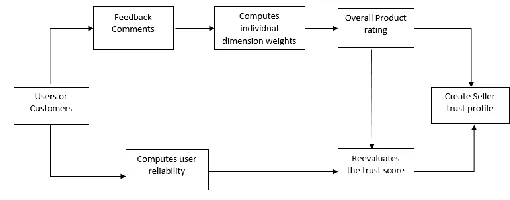
Fig 1: Reputation Trust Framework
The reputation trust framework is as shown in Fig 1. The main focus is on identifying the sentiments in the comments given by the user. The main challenging task is to correctly classify the comments into positive and negative as the comments provided by the users are noisy.
[image:5.612.328.583.386.486.2]© 2017, IRJET | Impact Factor value: 5.181 | ISO 9001:2008 Certified Journal
| Page 2975
good has a rating higher than average which in turn has a rating higher than poor. By using these dimensional rating values, sellers can identify the areas in which they are lacking, so self-improvement is possible
After evaluating the dimensional ratings, the overall rating for a particular comment can be obtained by aggregating the dimensional values. This will also be included in the seller profile which in turn helps the buyer to choose the most trustworthy seller for them to do the transactions. Enumerating dimensional weights is the process of adding all the weights of individual dimensions and aspects for obtaining overall rating for the comment. It is very important as it gives very clear picture of what the customer is actually trying to convey about a particular transaction.
The next step is to calculate the reputation of users by checking the confidence of the user depending on his activity, consistency and objectivity [15]. The activity of a user is defined by the number of products that he rates. The consistency of a user refers to how constant a user is in rating a product. The objectivity of a user refers to how close the rating provided by him is to the public evaluation. The overall trust score value is adjusted based on the user’s reputation and moves to a stable state. It helps to identify the malicious users and reduce its impact on the trust score for the seller.
3.2 Lexical-LDA
Here the focus is on the feedback comments, to extract the ratings from feedback comments and aggregating the trust scores with the use of CommTrust Lexical-LDA. In the CommTrust Lexical-LDA, first we need to define dependency analysis to find the dimension expression and identify the associated ratings given by the buyer comments. There is one type of approach called Topic
modelling [16] which takes terms of same topic segregated as one group, then applying the algorithm to find dimension weights with the help of Dirichlet Allocation (LDA) [17]. This algorithm is a very popular for topic modelling method to get the overall trust scores. It is more transparent to the user to find the stable performance across domains.
3.2.1 Extracting Aspect Expressions and Ratings by Typed Dependency Analysis
Here the user feedback comments in e-commerce sites like eBay and Amazon are mostly short comments (eg. Nice) provided by the user. In some cases, they are only providing phrases or short sentences. From these short sentences or phrases we can accurately identify dependency relations [18] through natural language parsing. By the way of dependency relations, based on parsing results, it can produce the results of associated ratings of dimensions with the help of dimension rating patterns.
3.2.2 Grouping Dimension Expressions into Dimensions
Topic modelling will automatically discover the topics and produce the results (ratings). Lexical LDA is different from the topic modelling approach as it takes the document as an input and produce the result. The Lexical-LDA algorithm will produce the results to achieve more effective clustering with the help of topic modelling lexical knowledge.
There are two types of lexical knowledge to produce meaningful clusters to supervise grouping dimension expressions into dimensions.
© 2017, IRJET | Impact Factor value: 5.181 | ISO 9001:2008 Certified Journal
| Page 2976
dimension expressions will help us to provide more meaningful comments with the help of the same modifier across all comments to get the dimension expression.
(2) In the e-commerce transaction, a very rare scenario may happen, like same feedback comments are repeating more than once. In other words one can say that the same dimension expression cannot repeat in the same topic. It’s a very rare scenario that one can find these type of comments in the e-commerce applications.
3.3 DR-Mining
A Dimension Rating mining algorithm will calculate based on domain knowledge, meta-data [19] and general grammatical patterns, to identify the dimension rating accurately from the e-commerce feedback comments. This approach will collect all the feedback comments based on the grammatical pattern and domain knowledge and mines the data to produce the results. It will help to find the associated ratings by the way of dimension expression opinion. This dimensional approach helps to correctly identify the areas in which they are lacking for self-improvement.
3.4. True Reputation
The next step is to calculate the reputation of users by checking the confidence of the user depending on his activity, consistency and objectivity [13]. The activity of a user is defined by the number of products that he rates. The consistency of a user refers to how constant a user is in rating a product. The objectivity of a user refers to how close the rating provided by him is to the public evaluation. The overall trust score value is adjusted based on the user’s reputation and moves to a stable state. It helps to identify the malicious users and reduce its impact on the trust score for the seller.
There are two different types of users who provide the unfair ratings. They are:
Planned Attacker: They provide the unfair comments for the products purposefully to increase or decrease the reputation of them. These type of users are usually hired by the company themselves for increasing their own reputation or to decrease the competitive company’s reputation.
Unplanned Attackers: They provide unfair feedback comments for the products without any purpose or intension. For example, in the case of book, they give good comments for the authors whom they like or prefer rather than considering the quality of the book.
4. EXPERIMENTS
As mentioned, this system is based on the research to improve the accuracy of ratings given by users. The first step in calculating the accurate rating is to identify the dimensions relevant to the product as well as the shopping process. Next step is to identify the feedback relevant to those dimensions from the comments entered by the users. Special care has to be taken for detecting negative keywords which otherwise might be considered as a positive remark. For eg: “Product not good” is a negative comment due to the presence of keyword “not”. Without negative keyword detection, it will be considered as a positive comment due to presence of keyword “good”.
The dimensions along with their contribution to the total rating (value 5.0) are also mentioned.
1. Product Description - Maximum 1.0 point
© 2017, IRJET | Impact Factor value: 5.181 | ISO 9001:2008 Certified Journal
| Page 2977
3. Price - Maximum 1.0 point
4. Shipping Charges - Maximum 1.0 point
5. Shipping Quality - Maximum 1.0 point
For the test scenario, an E-Commerce portal of a plywood manufacturer is considered. There are fourteen different types of plywood products available for online sale. The product description, price, specifications etc are mentioned. A customer will have to sign-up before performing any transactions. He/ She can make a purchase decision based on the product description and price. A suitable shipping method is also selected.
Upon the receipt of the product, he / she could write a feedback to express his/her personal experiences as a comment or feedback. Also, it will help other customers with their decisions. In old systems, the customer used to enter the feedback and manually select a rating of his choice (out of 5.0). Such ratings can’t be trusted since they are based on the customer’s current state of mind and no criteria are involved in making that decision. With the use of this feedback system with Trust Evaluation Model, accuracy of the ratings are improved.
The process starts with the feedback input of the customer. After logging into the system, the customer could enter his feedback in the product page. The feedback is entered in normal English with special emphasis to areas of importance. It could be positive as well as negative. Also, there is a possibility that not all dimensions will be mentioned. Those mentioned will be evaluated according to the keyword. Each sentences in the comment are separated and words are separated. Dimension keywords and feedback keywords are parsed and corresponding values are assigned. If keyword for a specific dimension is not available, then an average rating
is automatically assigned. Individual dimension ratings are added to get a total value.
The whole feedback from the text area are fed into a character array. Sentences are separated by detecting the “.” character. Also, words are separated by detecting the “white space” in the array. The sentences are first parsed to identify the negative keywords like “not” etc. If such a keyword is found, then the next word is identified which usually will be a feedback rating keyword like “good”, “bad”, “great”, “worse” etc. All keywords have specific rating value. A “good” will fetch 75% of maximum points, an “excellent” will contribute 100% of maximum marks. Whereas, an “OK” is rated at 50%, “poor” at 25% and “worse” or “worst” will fetch 0 points.
A trust based rating is always dependent on the reliability of the customer. Hence it is also necessary to determine the customer reliability. In the current project, since the number of products are less, we decided to use the median value of all the ratings done by a customer as his trust rating. Hence, the rating engine also calculates the median value of all ratings given by a particular customer. The customer rating engine scans for all the feedback ratings generated by the customer. All those ratings are fed into an array which is sorted and the median value is calculated.
The final rating is calculated by providing necessary compensations for the calculated rating using the trust rating of the customer. If a customer with good trust rating has entered a good feedback, then it is considered as genuine.
© 2017, IRJET | Impact Factor value: 5.181 | ISO 9001:2008 Certified Journal
| Page 2978
compensating. A customer with rating 2.5 and above but less than 3.5 is considered as slightly less reliable and a positive compensation of 0.5 points are made for a low product rating (0.0 - 2.5) and a negative compensation of 0.5 points are made to a very high rating (4.0 - 5.0). Similarly, for a customer with a very low rating (0.0 - 2.5), the compensation made is 1.0 points.
5. RESULTS AND DISCUSSIONS
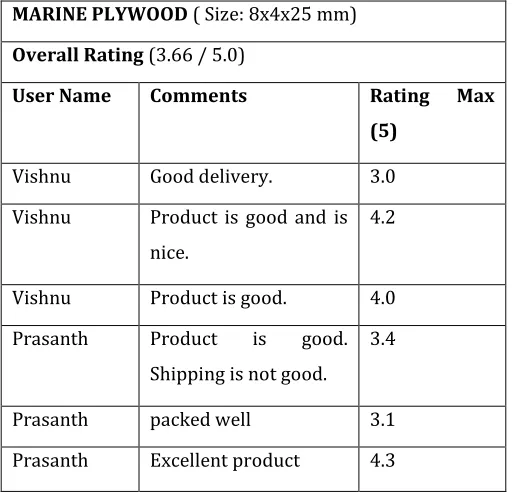
[image:9.612.313.571.268.528.2]The following tables show the differences between the ratings of a product before and after the implementation of the feedback analysis system. As evident from Table 1, the ratings entered by the customers are not based on any criteria. Usually, the customers enter a random rating of their choice. The overall rating is the mean value of the individual ratings.
Table -1: Initial rating given by the user (comments are not parsed)
MARINE PLYWOOD ( Size: 8x4x25 mm)
Overall Rating (3.66 / 5.0)
User Name Comments Rating Max
(5)
Vishnu Good delivery. 3.0
Vishnu Product is good and is nice.
4.2
Vishnu Product is good. 4.0
Prasanth Product is good. Shipping is not good.
3.4
Prasanth packed well 3.1
Prasanth Excellent product 4.3
[image:9.612.30.286.433.681.2]With the use of a Trust based feedback model, the comments are parsed and ratings for individual dimensions are calculated. That rating value is further processed based on the value of individual rating of the customer. If a customer with a history of bad ratings try to diminish the rating of the product, our rating engine will decrease the impact of the bad rating by compensating it as shown in Table 2. This system increase the accuracy.
Table-2: Processed rating by comment parsing.
MARINE PLYWOOD ( Size: 8x4x25 mm)
Overall Rating (3.66 / 5.0)
User Name
Comments Rating Max
(5) Vishnu Good delivery. 3.8
Vishnu Product is good and is nice.
3
Vishnu Product is good. 3
Prasanth Product is good. Shipping is not good.
2.25
Prasanth packed well 2.5
Prasanth Excellent product 3.5
6. CONCLUSION
© 2017, IRJET | Impact Factor value: 5.181 | ISO 9001:2008 Certified Journal
| Page 2979
the users to identify the potential sellers for them to transact with. CommTrust is a one system used for trust evaluation by mining feedback comments, because the users feel free to express their opinions in the free text feedback comments. A multidimensional trust evaluation model is proposed for computing reputation trust scores from feedback comments. For mining the feedback comments for dimension rating and weights, an algorithm is used which combines the techniques such as natural language processing, and opinion mining. This helps to resolve the “all good reputation” problem and rank the sellers effectively. The objective of this is to resolve the problem of false reputation i.e. the problem of being manipulated by unfair ratings. For this, a true-reputation based algorithm is proposed based on the confidence of the customer. The confidence of the user depends on his activity, consistency and objectivity. Thus the influence of malicious feedback can be reduced to a certain extend.
7. ADVANTAGES AND FUTURE SCOPE
The advantages of this system include:
Reduces the false reputation problem that is the problem of reputation being manipulated by the unfair ratings given by the malicious users.
Self-improvement is possible as the individual dimensional score is calculated from the feedback comments.
More accurate reputation score as it considers both the user reliability and the comments provided by them.
This system can be extended in future by including many factors to increase the accuracy of the trust model.
Some of these factors include:
i. The normal language is commonly used by the users for expressing their opinion about the
transaction in open free text feedback comment. But now users also use some short notations while writing texts. For example “good” can also be written as “gud”. But in this there is no provision to identify both refers to same word “good”. ii. This model considers only positive and negative
opinion from the feedback provided by the user. Future work can also be extended to identify the neutral opinion from the feedback comments provided by the user.
iii. This model considers only the feedback comments to compute the reputation score. The rating is also trusted to certain level. So by using these both values in computing the trust score a new trust reputation model with higher accuracy can be obtained in future.
REFERENCES
[1] P. Resnick, K. Kuwabara, R. Zeckhauser, and E. Friedman, “Reputation Systems: Facilitating Trust in Internet Interactions” Communications of the ACM, 43:45 48, 2000.
[2] Oleena Thomas, Sumy Joseph, “Literature Analysis on Reputation Models for Feedback in E-commerce”, International Journal of Advanced Research in Computer and Communication Engineering Vol. 4, Issue 1, January 2015.
[3] Xiu Zhen Zhang, Lishan Cui and Yan Wang, “Computing multidimensional trust by mining e-commerce feedback comments”, IEEE transactions on knowledge and data engineering, Vol 26, no 7, 2014.
© 2017, IRJET | Impact Factor value: 5.181 | ISO 9001:2008 Certified Journal
| Page 2980
reputation system, The Economics of the Internet and E-commerce, 2002.
[5] J. ODonovan, B. Smyth, V. Evrim, and D. McLeod, Extracting and visualizing trust relationships from online auction feedback comments, In Proc. IJCAI07, pages 2826:2831, 2007.
[6] Li Xiong and Ling Liu, “PeerTrust: Supporting Reputation-Based Trust for Peer-to-Peer Electronic Communities”, IEEE transactions on knowledge and data engineering, Vol.16, No.7, July2004
[7] Sepandar D. Kamvar Mario T. Schlosser and Hector Garcia Molina, “ The EigenTrust Algorithm for Reputation Management in P2P Networks”
[8] Y. Hijikata, H. Ohno, Y. Kusumura, and S. Nishida, Social summarization of text feedback for online auctions and interactive presentation of the summary, Knowledge-Based Systems, 20(6):527541, 2007.
[9] Y. Lu, C. Zhai, and N. Sundaresan, Rated aspect summarization of short comments, In 18 th Int. Conf. on WWW, 2009.
[10] Ana Maria Popescu and Oreb Etzioni, “Extracting product features and opinions from reviews”.
[11] M. Stark and R. Riesenfeld. Wordnet, “An electronic lexical database”, In Proceedings of 11 th Eurographics Workshop on Rendering, 1998.
[12] A. Esuli and F. Sebastiani. Sentiwordnet, A publicly available lexical resource for opinion mining, In Proceedings of LREC, volume 6, pages 417422, 2006.
[13] B. Ohana and B. Tierney, “Sentiment classication of reviews using SentiWordNet”, 9th. IT/T Conference, 2009.
[14] Y. Koren, Collaborative ltering with temporal dynamics, Communications of the ACM, 53 (4):8997, 2010
[15] Hyun-Kyo Oh, Sang-Wook Kim, Member, IEEE, and Ming Zhou, “Can You Trust Online Ratings? A Mutual Reinforcement Model for Trustworthy Online Rating Systems” IEEE Transactions On Systems, Man, And Cybernetics: Systems, Year 2015
[16] H. Wang, Y. Lu, and C. Zhai, “Latent aspect rating analysis without aspect keyword supervision” In Proc. the 17th ACMSIGKDD international conference on Knowledge discovery and data mining, pages 618{626}, 2011.
[17] D. Blei, A. Ng, and M. Jordan, “Latent Dirichlet allocation” the Journal of machine Learning research, 3:993{1022}, 2003.
[18] M. De Marnee and C. Manning, “The Stanford typed dependencies representation”, In Proc. the workshop on Cross Framework and Cross Domain Parser Evaluation, 2008.