http://dx.doi.org/10.4236/ojab.2014.33003
Culture Age on Evaluation of Electrically
Active Magnetic Nanoparticles as Accurate
and Efficient Microbial Extraction Tools
Barbara C. Cloutier1,2, Ashley K. Cloutier2, Lorele Trinidad2,3, Evangelyn C. Alocilja2 1Large Animal Clinical Sciences, College of Veterinary Medicine, Michigan State University, East Lansing, USA 2Department of Biosystems and Agricultural Engineering, Michigan State University, East Lansing, USA 3BIOTECH, University of the Philppines Los Baños College, Los Baños, The Philippines
Email: [email protected], [email protected], [email protected]
Received 26 June 2014; revised 23 July 2014; accepted 3 August 2014
Copyright © 2014 by authors and Scientific Research Publishing Inc.
This work is licensed under the Creative Commons Attribution International License (CC BY).
http://creativecommons.org/licenses/by/4.0/
Abstract
A potential confounding factor in the development and evaluation of biosensors is the diverse na-ture of the disciplines involved. Biosensor technology involves electrochemistry, microbiology, chemical synthesis, and engineering, among many other disciplines. Biological systems, due to non-homogeneous distribution, are already imprecise compared with other systems, especially food based systems. Inadequate knowledge of the techniques to moderate this leads to ineffective evaluation strategies and potentially halting the pursuit of excellent technology that was merely poorly evaluated. This research was undertaken to evaluate the effect culture age had on the cap-ture efficiency of the electrically active magnetic nanoparticles (EAMNP) using culcap-ture as the evaluation tool. The age of culture used for immunomagnetic separation (IMS) over all the expe-riments was 6 to 18 hours. Ideal culture age range for evaluating biosensors is 4 to 10 hours ac-cording to the growth curve for E. coli O157: H7 in trypticase soy broth. This is supported by the statistically significant difference among organisms in groups from 3 to 10 hours old compared with those grouped from 11 to 18 and >19 hours old (α = 0.05, p = 0.001 and p = 0.014 respectively). The two older categories were not different from each other. The capture efficiency in all biosen-sor analysis will vary less than when culture of only viable cells is the diagnostic tool. This allows a true evaluation of the consistency and accuracy of the method, less hindered by the variation in the ability to culture the organism.
Keywords
1. Introduction
Immunomagnetic separation (IMS) is a rapid method for extracting and concentrating a target analyte from its sample matrix. This is imperative due to the high level of interference the matrix of a food has on any diagnostic test [1]. IMS has been paired with a wide variety of biosensors for rapid detection of bacterial pathogens [2]-[13]. In IMS, micro- or nano-meter scale magnetic particles are immuno-functionalized with antibody, incubated with the sample to bind target cells, and separated from the sample matrix through application of a magnetic field. The magnetic particle-bound target can then be washed and concentrated removing the matrix interference. The possibility of concentrating target cells prior to detection can eliminate the need for time-consuming pre-enrich- ment steps with a greater real time analytical sensitivity. In comparison with centrifugation, filtration, or capture of target on an immuno-functionalized surface, the IMS is simpler, and generally results in higher capture effi-ciency due to the greater surface area available for target binding [2] [14]. This is especially true of nano-sized particles. The surface chemistry of nano-sized particles such as surface tension, magnetization and sheer volume of surface area improves the amount of functionalized space for reaction to occur and thus improves the capture ability and longevity of the resultant IMS particles [2] [14].
The development and evaluation of biosensors are affected by the myriad of disciplines involved in their pro-duction. This technology involves components from electrochemistry to engineering [15] [16]. There are few people who are well versed in multiple disciplines. This creates difficulties, for example, when an electrical en-gineer attempts to produce and challenge a microbiological based biosensor, especially a food based biosensor. Biological systems are imprecise compared with other systems [17]. Although techniques to combat this exist, widespread knowledge of them throughout the diverse disciplines involved in biosensor development is inadequate. This leads to ineffective evaluation and potential rejection of new technologies in the development phase. Theavnot [18] points out that the rapid growth of biosensors has led to “lack of rigor” (p. 2335) in their published perfor-mance criteria. Concepts like the log10 conversion of colony forming units per milliliter (CFU/mL) [19], plate
counting [20], and most probable number (MPN) calculations [21] are not used consistently in the biosensors li-terature. International standards for microbiological tests in food exist from the International Standards Organi-zation (ISO) [22]. OrganiOrgani-zations like the American Association of Occupational Chemists (AOAC) produce de-tailed recommendations on analytical expectations of microbiological testing requirements [23]. The field of biosensor technology is improving and expanding every year [16]. Addition of these concepts may allow better evaluation of the existing technology and prevent the discard of valuable diagnostic tools because of lack of ri-gor in their evaluation.
order to facilitate this, the following hypothesis was developed and tested.
2. Experimental Design
Hypothesis
The concentration and percentage of non-viable bacterial cells in the start culture results in decreased biosensor capture efficiency estimates as a result of non-growth of non-viable cells on culture media. To test the above hypothesis, detailed growth curves of the chosen strain of E. coli O157:H7, 2006 Japanese Sakai outbreak (Sa-kai), were developed by recording the time and volume of transfer and an OD600 on each culture. Some of the resultant cultures were IMS extracted with EAMNPs and cultured. Capture efficiencies were calculated to com-pare categories of culture ages. Matching experiments were performed on the control organisms used in the la-boratory.
3. Materials and Methods
E. coli O157:H7 strains, E. coli non-H7 strains and non-E. coli bacterial strains were obtained from the STEC Center collection at Michigan State University (MSU) (Shannon Manning, MPH, PhD), the Nano-Biosensors Laboratory at MSU (Evangelyn Alocilja, PhD), Neogen Inc. Research and Development, Lansing, Michigan (Jennifer Rice, DVM, PhD) and the University of Georgia, Center for Food Safety (Dr. Michael Doyle, PhD). From frozen purified culture stocks (stored at −80˚C), colonies were isolated by streak-plate method on trypti-case soy agar (BD Biosciences, MD) plates. A single colony was used to inoculate a vial of tryptic soy broth (BD Biosciences, MD) and grown overnight at 37˚C. A 1 mL aliquot of the liquid culture was transferred to a new vial of broth and stored at 37˚C for up to 6 days. This culture was used to inoculate a new vial of broth with 1 mL of inoculum 10 to 24 h before each experiment to produce fresh bacterial cells which were serially diluted in 0.1% (w/v) peptone water (Fluka-Biochemika, Switzerland) prior to their use in the IMS procedure. Varying volumes of stationary broth cultures, colony to broth and freezer stock to broth were inoculated into TSB for the growth curve analysis. Viable cells were enumerated by microbial plating on MacConkey agar with sorbitol (SMAC) (BD Biosciences, MD or Neogen Inc., MI), according to standard rules for plate counting [20]. Optical Density at 600 nanometers (OD600) spectrophotometer readings (BIO-RAD Smartspec 3000, Hercules, CA) were taken from each culture before use as compared to blank Trypticase Soy Broth (TSB). Three readings were taken and averaged together.
3.1. EAMNP Production
Ferric chloride hexahydrate (EMD Chemicals, Bedford, MA), sodium acetate (CCI Chemicals, Vernon, CA ), sodium acrylate, sodium chloride (NaCl), ethylene glycol, ethylenediamine, hydrochloric acid, aniline, iron (III) oxide nanopowder, ammonium persulfate, methanol, and diethyl ether were used as received from Sigma Al-drich (St. Louis, MO) in the synthesis of the EAMNPs. EAMNPs were synthesized by polymerization and acid doping of aniline monomer around gamma iron (III) oxide (γ-Fe2O3) nano-particles, using a slightly modified
published procedure [29]. Briefly, 0.650 g of iron (III) oxide nanopowder were dispersed in 50 mL of 1 M HCl, 10 mL of deionized water and 0.4 mL of aniline monomer by sonication in an ice bath for 1 hour. A volume of 20 mL of 0.2 M ammonium persulfate (as oxidant) was added drop-wise to the above solution under continuous magnetic stirring. Color change from rust brown to dark green indicated formation of electrically-active (green) polyaniline over the smaller (brown) γ-Fe2O3 nano-particles. The solution was stirred for 2 hours in an ice bath
and was filtered through a qualitative grade filter (2.5 µm pore size, Ahlstrom, grade 601). The supernatant thus obtained was successively filtered through a nitrocellulose membrane filter (1.2 µm pore size, Millipore) fol-lowed by washings with 10 mL each of 1M HCl, 10% (v/v) methanol, and diethyl ether. The particles were dried overnight at room temperature under vacuum. The particles ranged in size from 1.2 to 2.5 µm, and dis-played a room temperature saturation magnetization of 30 emu/g.
3.2. EAMNP Antibody Conjugation
Meridian Life Science, Inc. (Saco, ME). Polysorbate-20 (Tween-20), Triton X-100, phosphate buffered saline (PBS), Trizma base, casein, and sodium phosphate (dibasic and monobasic) were used in the IMS procedure. All of the above reagents, unless otherwise noted, were purchased from Sigma-Aldrich (St. Louis, MO). All solu-tions and buffers used in this study were prepared in de-ionized (DI) water (from Millipore Direct-Q system) as follows: PBS buffer (10 mM PBS, pH 7.4), wash buffer (10 mM PBS, pH 7.4, with 0.05% Tween-20 or 0.05% Triton-X100), phosphate buffer (100 mM sodium phosphate, pH 7.4), blocking buffer (100 mM Tris-HCl buffer, pH 7.6, with 0.01% w/v casein). Magnetic separations were performed with a commercial magnetic separator (Promega Corporation, Madison, WI). Hybridization of biological materials was carried out at room temperature with rotation on a tube rotisserie (Labquake, Thermo Scientific, MA). Scanning electron micrographs were ac-quired using field-emission scanning electron microscopy (JOEL 7500F, acceleration voltage of 5 kV). A su-perconducting quantum interference device magnetometer (Quantum design MPMS SQUID) was used for mag-netic characterization of EAMNPs.
Mab-conjugation of the EAMNPs was carried out by physical adsorption of antibodies onto the polyaniline surface. Electrostatic interactions between the negatively charged constant (Fc) portion of the antibodies and the positively charged polyaniline surface are thought to play a role in adsorption and orientation of the biomole-cules onto the EAMNPs [30]. Successful conjugation of antibodies onto EAMNPs was confirmed by measuring the quantity of antibody in the post-hybridization supernatant with a commercial fluorescence-based protein quantification kit. The measured protein concentration in the supernatant was significantly lower than the con-centration of antibodies initially added to the MNPs (data not shown), indicating that antibodies were retained on the MNPs during hybridization. EAMNPs were conjugated with monoclonal antibodies at an initial EAMNP concentration of 10 mg/mL (1% solid). A 100 µL aliquot of monoclonal, anti-E. coli O157:H7 antibody (sus-pended in 0.1 M phosphate buffer) was added to EAMNPs sus(sus-pended in PBS, yielding a final antibody concen-tration of 1.0 mg/mL. The mixture was hybridized on a rotisserie-style rotator for 1 hour at room temperature, with 25 µL of 10X PBS being added after the first 5 min of hybridization, to increase the sodium chloride con-tent of the suspension to approximately 0.14 M. Following hybridization, the EAMNP-antibody conjugate was magnetically separated, the supernatant removed, and the conjugate re-suspended in 250 µL of blocking buffer (0.1 M tris buffer with 0.01% casein) for 5 min. Again the conjugate was magnetically separated, the superna-tant removed, and the conjugate re-suspended in 250 µL of blocking buffer, this time for 1 hour with rotation. Finally, the EAMNP-antibody conjugate was magnetically separated, the supernatant removed, and the conju-gate re-suspended in 2.5 mL of 0.1 M phosphate buffered saline (PBS). The final concentration of EAMNPs in each solution was 1.0 mg/mL. Immuno-conjugated EAMNPs (Mab-EAMNPs) were stored at 4˚C. Prior to ex-perimental use, Mab-EAMNPs were or further diluted in 0.1 M PBS, in order to obtain solutions at 0.5 mg/mL EAMNPs.Avoid combining SI and CGS units, such as current in amperes and magnetic field in oersteds. This often leads to confusion because equations do not balance dimensionally. If you must use mixed units, clearly state the units for each quantity that you use in an equation.
3.3. Immuno-Magnetic Separation (IMS) and Plating of Bacteria
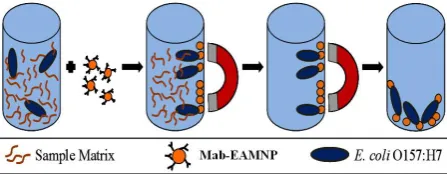
Figure 1. Immuno-magnetic separation procedure (IMS): sam- ple plus Mab-EAMNPs magnetic separation of target cells removal of sample matrix purified E. coli O157:H7-Mab- EAMNP complexes.
A 100-mL aliquot was placed on SMAC and incubated at 37˚C overnight. The number of colony-forming units (CFU) in the 100-mL aliquot was determined by manually counting the colonies on each plate. For every experimental case (i.e., particular combination of Mab-EAMNP concentration, and bacteria), a minimum of two bacterial dilutions underwent IMS and were plated. In most cases a full spectrum of dilutions from 10−1 to 10−9
were run as independent units. For the lower dilutions from 10−1 to 10−5 the final IMS solution was diluted from
5 to 1 time respectively to obtain countable plates. For dilutions from the 10−8 and 10−9 series, all 500 µL present
were plated.
Calculation of bacterial cell concentrations in both pure and IMS separated samples were carried out accord-ing to rules provided by the United States Food and Drug Administration’s Bacteriological Analytical Manual [20]. In addition, separate runs were performed where the final IMS solution was all plated to determine if any cells were collected at all, instead of the standard 100 µL. The CFU/mL calculations were adjusted accordingly to accommodate the change in plated dilution factor.
Capture efficiency as defined by the amount captured divided by the amount present in the original sample was calculated for each sample at each concentration for E. coli O157:H7, and each negative and positive con-trol. Capture efficiency was calculated by conversion of CFU/mL to log10 CFU/mL when above 10 CFU/mL.
The log10 conversion also normalizes the distribution [19]. When calculating capture efficiency at the lower
concentrations the log transformation is not performed since with a base 10 the result would be zero. Actual CFU/mL was used in this range to calculate capture efficiency.
3.4. Statistical Analysis
Statistical analysis was performed using SPSS software (Armonk, NY).Data was collected by hour and the re-sultant capture efficiencies grouped into categories of 3 - 10 hours, 11 - 18 hours and 19 - 24 hours. Subsequent analysis was performed using one way anova evaluation with a post hoc comparison using dunnet’s t-tests using the 3 - 10 hour category as the control to evaluate the effect of age on Mab-EAMNP extraction. All analyses were calculated with 95% confidence intervals (α= 0.05).
4. Results
Accurate growth curves for the bacterial strains we were using were developed under our laboratory conditions and equipment. Cumulative data from all extraction runs done over an 8 month period were tabulated and sepa-rated by time in hours and by inoculation volume. Figure 2 shows the resultant growth curve for E. coli O157:H7 Sakai strain, for a 1 mL transfer aliquot. Identical curves forother inoculums of E. coli O157:H7 and all growth curves for E. coli O55:H7 and Shigella boydii are available in supplementary data or on request.
5. Discussion
Figure 2. E. coli O157:H7 Sakai strain growth by hour of a 1 mL inoculum into 10 mL TSB.
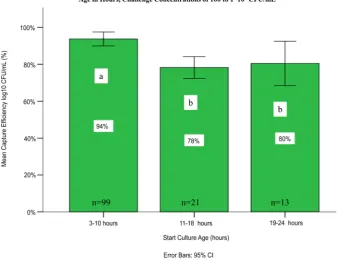
inoculums. This is supported by the increase in capture efficiency by the same biosensor with different ages of cultures shown in Figure 3.This is supported by the statistically significant difference between organisms blocked from 3 - 10 hours old and those blocked from 11 to 18 and >19 hours old, shown in Figure 4. The two older categories were no different from each other. The capture efficiency in all biosensor analysis will vary less then when known challenge concentrations lead to inaccurate classification on the electrochemical platform and a perceived variability of results by concentration of bacterial cells. Since one of the goals of effective biosensor evaluation is to evaluate the range and differentiation of the linear range results by cell concentrations, this could make a difference in the decision to move a biosensor from concept to validation studies [18]. Inaccurate known challenge concentrations add to the variability we see in the data for biosensors we create in the author’s labora-tory. The OD600 spectrophotometer evaluations as compared to the cultured CFU/mL and the age of the inocu-lums assist in both explaining early data variation and facilitate decisions on logistics for future data collection.
6. Conclusions and Limitations
This cumulative total of 323 repetitive broth challenges yielded statistically significant extraction and culture detection by capture efficiency. Monitoring the age of the inoculating culture during initial challenges of the EAMNP IMS methodology will allow future studies to better control the unintentional error not related to tech-nology under evaluation. When culture is used as the gold standard, test sensitivity calculations will be depressed due to increasing the false negative fractions on those with non-viable or viable and non-culturable bacteria in the system. Test sensitivity calculations are already a problem in the range of bacterial concentrations that are below the culture limit of detection, around 100 CFU/mL [23]. This is mostly due to the non-homogenous nature of bacteria in solution. The probability of pipeting the exact fraction the few bacteria reside in decreases as the culture becomes more dilute, increasing the degree of error.
Limitations of this extraction method include the fact that both viable and non-viable cells are extracted with this methodology. Further studies are designed and being implemented to evaluate the Mab-EAMNP to deter-mine the reaction kinetics of non-viable verses viable cells on the antibody target region in broth cultures. Limits of detection, inclusivity and exclusivity of microbial families and biosensor platform experiments are necessary before validation trials of the whole biosensor can proceed. The ultimate goal of this culture age evaluation is to be able to capture only viable cells when the diagnostic evaluation is by culture. This allows a trueevaluation of the consistency and accuracy of the method, less hindered by the variation in the ability to culture the organism. This also has ramifications on the electrochemistry results of a biosensor. Future multiplexing with multiple EAMNP and multiple bacterial targets could have interactions between the EAMNPs or between the mixed an-tibodies. Certain matrices may remove the Mab from the surface of the EAMNPs and make their use in that ma-trix impossible. For field based diagnostics, the largest drawback of this method is the need for refrigeration of the Mab-EAMNPs. When field based technologies are discussed, shelf stable reagents are an advantage.
Acknowledgements
Figure 3. E. coli O157:H7, Sakai strain, capture efficiency comparison by age of start culture. Statistical comparisons were made between groups and are shown inFigure 4.
[image:7.595.146.485.413.676.2]Food Protection and Defense under Grant R9106007101, and in part by the US Environmental Protection Agency through award number RD83300501. These funding sources had no involvement in the actual research or writ-ing of this report. The contents of this publication do not necessarily reflect the position or policy of the Federal Government.
The authors would like to thank Dr. Stanley Flegler and Carol Flegler for assistance with SEM studies, Dr. Reza Loloee for assistance with magnetism measurements, Dr. Paul Bartlett and the MSU Center for Statistical Training and Consulting (CSTAT) for assistance with statistical analyses, Dr. Julie Funk and Dr. Shannon Man-ning for providing bacterial cultures and for advice on microbiological methods, and Dr. John Linz and Dr. El-liot Ryser for offering information on best practices in food microbiology.
References
[1] Ge, B. and Meng, J. (2009) Advanced Technologies for Pathogen and Toxin Detection in Foods: Current Applications and Future Directions. Journal of the Association for Laboratory Automation, 14, 235-241.
http://dx.doi.org/10.1016/j.jala.2008.12.012
[2] Cheng, Y., Liu, Y., Huang, J., Li, K., Zhang, W., Xian, Y. and Jin, L. (2009) Nanoscale Assembly of Amine-Func- tionalized Colloidal Iron Oxide. Journal of Magnetism and Magnetic Materials, 321, 1529-1532.
http://dx.doi.org/10.1016/j.jmmm.2009.02.080
[3] Gehring, A.G. and Tu, S.I. (2005) Enzyme-Linked Immune-Magnetic Electrochemical Detection of Live Escherichia coli O157:H7 in Apple Juice. Journal of Food Protection, 68, 146-149.
[4] Gehring, A.G., Brewster, J.D., Irwin, P.L., Tu, S.I. and VanHouten, L.J. (1999) 1-Naphthylphosphate as an Enzymatic Substrate for Enzyme-Linked Immune-Magnetic Electrochemistry. Journal of Electroanalytical Chemistry, 469, 27-33. http://dx.doi.org/10.1016/S0022-0728(99)00183-7
[5] Jaffrezic-Renault, N., Martelett, C., Chevolot, Y. and Cloarec, J.P. (2007) Biosensors and Biobarcode Assays Based on Biofunctionalized Magnetic Microbeads. Sensors, 7, 589-614. http://dx.doi.org/10.3390/s7040589
[6] Maalouf, R., Hassen, W., Fournier-Wirth, C., Coste, J. and Jaffrezic-Renault, N. (2008) Comparison of Two Innovatives Approaches for Bacterial Detection: Paramagnetic Nanoparticles and Self-Assembled Multilayer Processes. Microchimica Acta, 163, 157-161. http://dx.doi.org/10.1007/s00604-008-0008-3
[7] Perez, F.G., Mascini, M., Tothill, I.E. and Turner, A.P.F. (1998) Immuno-Magnetic Separation with Mediated Flow Injection Analysis Amperometric Detection of Viable Escherichia coli O157. Analytical Chemistry, 70, 2380-2386. http://dx.doi.org/10.1021/ac970715t
[8] Ruan, C., Wang, H. and Li, Y. (2002) A Bioenzyme Electrochemical Biosensor Coupled with Immuno-Magnetic Se-paration for Rapid Detection of Escherichia coli O157:H7 in Food Samples. Transactions of the ASAE, 45, 249-255. http://dx.doi.org/10.13031/2013.7853
[9] Tu, S.I., Golden, M., Cooke, P., Paoli, G. and Gehring, A. (2005) Detection of Escherichia coli O157:H7 through the Formation of Sandwiched Complexes with Immuno-Magnetic and Fluorescent Beads. Journal of Rapid Methods & Automation in Microbiology, 13, 269-282. http://dx.doi.org/10.1111/j.1745-4581.2005.00026.x
[10] Varshney, M. and Li, Y. (2007) Interdigitated Array Microelectrode Based Impedance Biosensor Coupled with Mag-netic Nanoparticles-Antibody Conjugates for Detection of Escherichia coli O157:H7 in Food Samples. Biosensors and Bioelectronics, 22, 2408-2414. http://dx.doi.org/10.1016/j.bios.2006.08.030
[11] Varshney, M., Li, Y., Srinivasan, B. and Tung, S. (2007) A Label-Free, Microfluidics and Interdigitated Array Micro-electrode-Based Impedance Biosensor in Combination with Nanoparticles Immunoseparation for Detection of Esche-richia coli O157:H7 in Food Samples. Sensors and Actuators B: Chemical, 128, 99-107.
http://dx.doi.org/10.1016/j.snb.2007.03.045
[12] Varshney, M., Yang, L., Su, X.L. and Li, Y. (2005) Magnetic Nanoparticles-Antibody Conjugates for the Separation of Escherichia coli O157:H7 in Ground Beef. Journal of Food Protection, 68, 1804-1811.
[13] Yang, L. and Li, Y. (2006) Detection of Viable Salmonella Using Microelectrode-Based Capacitance Measurement Coupled with Immunomagnetic Separation. Journal of Microbiological Methods, 64, 9-16.
http://dx.doi.org/10.1016/j.mimet.2005.04.022
[14] Jiang, X., Wang, R., Wang, Y., Su, X., Ying, Y., Wang, J. and Li, Y. (2011) Evaluation of Different Micro/Nanobeads Used as Amplifiers in QCM Immunosensor for More Sensitive Detection of E. coli O157:H7. Biosensors and Bioelec-tronics, 29, 23-28. http://dx.doi.org/10.1016/j.bios.2011.07.059
[15] Nayak, M., Kotian, A., Marathe, S. and Chakravortty, D. (2009) Detection of Microorganisms Using Biosensors: A Smarter Way towards Detection Techniques. Biosensors and Bioelectronics, 25, 661-667.
[16] Lazcka, O., Del Campo, F.J. and Muñoz, F.X. (2007) Pathogen Detection: A Perspective of Traditional Methods and Biosensors. Biosensors and Bioelectronics, 22, 1205-1217. http://dx.doi.org/10.1016/j.bios.2006.06.036
[17] Adams, M.R. and Moss, M.O. (2008) Food Microbiology. 3rd Edition, RSC Publishing, Cambridge.
[18] Theavnot, D.R., Toth, K., Durst, R.A. and Wilson, G.S. (1999) Electrochemical Biosensors: Recommended Definitions and Classification. Pure Applied Chemistry, 71, 2333-2348.
[19] Mettler, D. and Tholen, D. (2007) G108—Guidelines for Estimating Uncertainty for Microbiological Counting Me-thods. http://www.a2la.org/guidance/MU_for_Micro_Labs.pdf
[20] FDA (2009) Bacteriological Analytical Manual (BAM). US Food & Drug Administration, Silver Springs, MD, USA. [21] USDA FSIS (2010) Microbiology Laboratory Guidebook.
http://www.fsis.usda.gov/science/microbiological_lab_guidebook/ [22] ISO Website (2011) http://www.iso.org/iso/home.html
[23] AOAC (2006) Final Report and Executive Summaries from the AOAC International Presidential Task Force on Best Practices in Microbiological Methodology. AOAC International, Rockville.
[24] Blackburn, C. and McCarthy, J.D. (2000) Modifications to Methods for the Enumeration and Detection of Injured Escherichia coli O157:H7 in Foods. International Journal of Food Microbiology, 55, 285-290.
http://dx.doi.org/10.1016/S0168-1605(00)00205-1
[25] Durso, L.M. and Keen, J.E. (2007) Shiga-Toxigenic Escherichia coli O157 and Non-Shiga-Toxigenic E. coli O157 Respond Differently to Culture and Isolation from Naturally Contaminated Bovine Faeces. Journal of Applied Micro-biology, 103, 2457-2464. http://dx.doi.org/10.1111/j.1365-2672.2007.03473.x
[26] Fitzmaurice, J., Duffy, G., Kilbride, B., Sheridan, J.J., Carroll, C. and Maher, M. (2004) Comparison of a Membrane Surface Adhesion Recovery Method with an IMS Method for Use in a Polymerase Chain Reaction Method to Detect Escherichia coli O157:H7 in Minced Beef. Journal of Microbiological Methods, 59, 243-252.
http://dx.doi.org/10.1016/j.mimet.2004.07.007
[27] Fung, D. (2008) Rapid Methods and Automation in Food Microbiology: 25 Years of Development and Predictions. In: Barbosa-Cánovas, G.V., Mortimer, A., Lineback, D., Spiess, W. and Buckle, K., Eds., IUFoST World Congress Book: Global Issues in Food Science and Technology, Academic Press, Waltham.
[28] Setterington, E., Cloutier, B., Ochoa, J., Cloutier, A. and Alocilja, E. (2011) Rapid, Sensitive, and Specific Immuno-magnetic Separation of Food Borne Pathogens. International Journal of Food Safety, Nutrition and Public Health, 4, 83-100. http://dx.doi.org/10.1504/IJFSNPH.2011.042576
[29] Pal, S., Setterington, E.B. and Alocilja, E.C. (2008) Electrically Active Magnetic Nanoparticles for Concentrating and Detecting Bacillus anthracis Spores in a Direct-Charge Transfer Biosensor. IEEE Sensors Journal, 8, 647-654. http://dx.doi.org/10.1109/JSEN.2008.922687
[30] Pal, S. and Alocilja, E.C. (2009) Electrically Active Polyaniline Coated Magnetic (EAPM) Nanoparticles as Novel Transducer in Biosensor for Detection of Bacillus anthracis Spores in Food Samples. Biosensors and Bioelectronics,