International Research Journal of Engineering and Technology (IRJET)
e-ISSN: 2395 -0056 p-ISSN: 2395-0072 Volume: 04 Issue: 03 | Mar -2017 www.irjet.netEXPERIMENTAL STUDY ON SELF- CURING CONCRETE
K.Nithya
1, K.Ranjitha
2, P.Kumar
31, 2
PG Student, Department of Civil Engineering, PSR Engineering College, Sivakasi, Tamilnadu, India
3
Assistant Professor, Department of Civil Engineering, PSR Engineering College, Sivakasi, Tamilnadu, India
---***---
Abstract -
Today concrete is most extensively usedconstruction material due to its good compressive strength and durability. It is expected that the present consumption of concrete in the world is of the order of 10 billion tones every year. The strength and durability of concrete will be fully industrial only if it is cured. Due to the curing of concrete large amount of water is required. To overcome the high consumption of water it is neededto study self-curing concrete. Self-curing is also referred as Internal- Curing. Self-curing concrete is one of the particular concretes in extenuating insufficient curing due to human disregard and also due to scarcity of water in arid areas, inaccessibility of structures in hard terrains and in areas where the presence of fluorides in water will badly affect the characteristics of concrete. The current study involves the use of shrinkage reducing admixtures in concrete which helps in self-curing and helps in better hydration and hence strength.
Key Words: Self-Curing concrete, Shrinkage Reducing Admixtures, Hydration, Mechanical properties.
1. INTRODUCTION
Self-curing or domestic curing is a technique that can be used to supply additional moisture in concrete for added effective hydration of cement and reduced self-desiccation. It was found that water soluble alcohols can be used as self- curing agent in concrete. The use of self-curing admixtures is very important from the point of vision that water resources are receiving valuable every day. New developments in curing of concrete are on the prospect as well. In the next century, mechanization of the placement, preservation, and removal of curing mats and covers will advance as performance-based provision compute curing for receiving and payment. In addition, effective sealants and compounds that prevent the loss of water and promote moist curing conditions will be in high demand. Self-curing concrete should become existing in the not-too-distant future.
Self-curing concrete is provide to absorb water from wetness from air to realize well hydration of strengthen in concrete. It solve the problem when the quantity of cement hydration is lower due to no curing or inappropriate curing by using a self-curing agent like poly-acrylic acid which has strong ability of fascinating moisture from the thought and providing water essential for curing concrete. M.V.Jagannadha Kumar et al, studied that the optimum dosage of PEG400 for maximum strengths (compressive, tensile and modulus of rupture) was create to be 1% for M20
and 0.5% for M40 grades of concrete. As proportion of PEG400 enhanced slump increased for both M20 and M40 grades of concrete. Strength of self- curing concrete is on par with conventional concrete. Self-curing concrete is response to many problems faced due to lack of proper curing. A. Aielstein Rozario et al, said that the permeability of concrete decreases with an increase in the replacement of fly ash with cement and in addition of P.E.G dosage. So the penetration of chemicals is decreased with the adding up of PEG and the concrete is safe beside sulphates. The proportion of weight loss of the concrete specimens is also decrease for every grade of concrete. From the results, we know that the self- curing concrete has the capability to resist the sulphates at hand in the soils and in the sea waters. It can be economical, so it can be adoptable for construction. Stella Evangeline et al, have investigated the Strength Variations in Concrete by Using super absorbent polymer and polyvinyl alcohol as shrinkage reducing admixtures. Polyvinyl alcohol is added in various proportions are 0.03%, 0.06%, 0.12%, 0.24%, 0.48%. It was establish the compressive strength, flexural strength, tensile strength. The maximum compressive strength, flexural strength and tensile strength is establish respectively 33.7 N/mm2, 8.0 N/mm2,4.945N/mm2 for 28 days.
This paper presents the results of compressive and flexural strength on concrete containing pond ash as partial replacement of cement and then addition of super absorbent polymer and polyvinyl alcohol. For this work, M30 grade concrete was used and the tests were conducted for various proportions of pond ash of 0-30%. And adding S.A.P of 0- 0.6% and PVA of 0-0.50% in concrete. The results obtained were compared with conventional concrete.
Objectives of the Study
:
The objective of this study is to experimentally investigate the mechanical properties of self-curing concrete with the addition of shrinkage reducing admixtures.
To reduce water quantity in curing periods.
To increase the compressive strength of concrete in self-curing method.
The scope of the paper is to study the effect of Polyvinyl alcohol on strength characteristics of Self-curing concrete.
International Research Journal of Engineering and Technology (IRJET)
e-ISSN: 2395 -0056 p-ISSN: 2395-0072 Volume: 04 Issue: 03 | Mar -2017 www.irjet.net2 EXPERIMENTAL STUDY
Materials:
A.Cement- Ordinary Portland cement (grade) conforming to IS: 12269: 1987.
SI.no Properties Test Results
1 Specific Gravity 3.15
[image:2.596.28.284.150.231.2]2 Initial Setting Time 45 min 3 Final Setting Time 185 min
Table 1: Results on test of Cement
B.Fine aggregate conforming to IS: 383-1970
SI.no Property Test Results
1 Specific Gravity 2.60
2 Size 4.75mm
Table 2: Results on test of fine Aggregate C.Coarse aggregate
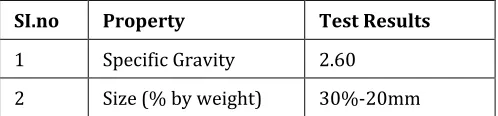
SI.no Property Test Results 1 Specific Gravity 2.60
[image:2.596.29.278.408.466.2]2 Size (% by weight) 30%-20mm Table 3: Results on test of Course Aggregate
D.Water- Water is necessary for the cement to hydrate and harden. It consists of hydrogen and oxygen. It is a significant component of concrete as it chemically participate in the reactions with cement to form hydration product C – S – H gel. The water use for concrete should be free from the unwanted salts that may react with cement and reduce their effectiveness. Silts and suspended particles are undesirable as they obstruct with setting, hardening and bond characteristics. Algae in mixingwater may reason a marked reduction in strength of concrete either by combine with cement to reduce the bond or by causing huge amount of air entrainment in concrete
E.Chemical admixtures Super absorbent polymer:
The common SAPs are further at rate of 0–0.6 wt of cement. The SAPs are covalently cross-linked.
One type of SAPs are deferment polymerized,
variety of 125–250 mm.
The size of the distended SAP particles in the cement pastes and mortars is regarding three times better due to pore fluid absorption.
The swelling time depends particularly on the particle size allotment of the SAP.
It is seen that more than 50% enlargement occurs within the first 5 min after water adding together. Polyvinyl alcohol:
Polyvinyl alcohol is formed commercially frompolyvinyl acetate, regularly by a continuous process.
The acetate groups are hydrolyzed by ester transaction with methanol in the presence of anhydrous sodium methylate or aqueous sodium hydroxide.
Polyvinyl alcohol is an neutral and flavorless translucent, white or cream colored granular powder.
Polyvinyl alcohol contains two OH groups. It helps to retain water from concrete.
It is soluble in stream, slightly soluble in ethanol, but insoluble in other natural solvents.
Typically a 5% solution of polyvinyl alcohol exhibits a pH in the range of 5.0 to 6.5. Polyvinyl alcohol has a melting point of 180 to 190°C.
F.Mineral admixtures- Mineral admixtures are suitable more popular in current decades. The use of recycled materials as concrete ingredients has been in advance popularity because of increasingly inflexible environmental legislation, and the discovery that such materials oftenhave complementaryand expensive property the most obvious of these are pond ash, a by-product of coal-fired power plants. The use of these materials in concrete reduces the amount of Resources necessary as the pond ash act as cement alternate. This displaces energetically expensive sand and ecological harms, while reducing the amount of industrial waste that must be liable off.
Mix details of
Self-Curing Concrete:
MIX DESIGNFOR M30 GRADE CONCRETE Cement
= 472.5Kg
Fine Aggregate = 525Kg/m3
Coarse Aggregate = 1141.6Kg/m3
Water = 189litre
International Research Journal of Engineering and Technology (IRJET)
e-ISSN: 2395 -0056 p-ISSN: 2395-0072 Volume: 04 Issue: 03 | Mar -2017 www.irjet.net3. RESULTS AND DISCUSSIONS
Workability Tests: (Slump value):
[image:3.596.35.272.236.415.2]The measured slump values of ordinary and pond ash replaced concrete with water cement ratio 0.5such as pond ash 0-30% (5,10,15,20,25,30 replacement).The variations of slump value with pond ash percentage are shown in fig.1. It is denoted that the slump value increases with increase in Percentage replacement of cement of pond ash for the same water cement ratio. Concrete does not give adequate workability with increase of pond ash.
Table 4: Replacement of pond Ash Compressive strength
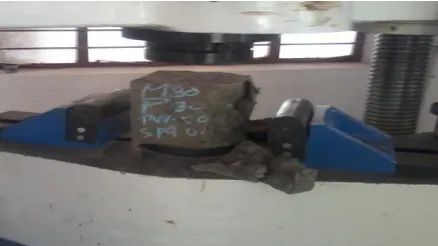
The compressive strength, as one of the most important properties of concrete. 28 days cube compressive strength is tested on cubes of size 150 x 150 x 150 mm. Three cube samples each for various percentage of SAP,PVA,POND ASH replaced by weight of cement were tested to determine the 7 days,14DAYS, and 28 days compressive strength using a 1000 KN compression testing machine.
[image:3.596.324.541.417.547.2]Fig -1: Cube Specimen under Compression Test
Table 5: Compressive strength of S.A.P. and PVA, Pond ash replaced specimen at 7, 14, 28 days
Chart -1: Avg.Compressive Strength for 7, 14 and 28days
Split tensile strength:
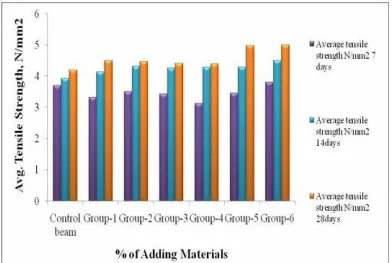
Tests are carried out on 150 X 300 mm cylinders confirming to ASTM-C 496 to attain the splitting tensile strength at the age of 7 days, 14 days and 28 days. In the split tensile test, the cylinder is located with its axis horizontal, between plates of the testing machine and the load is increased until the failure occurred by splitting in the plane containing the vertical diameter of the cylinder sample The experimental results, the split tensile strength of self -curing concrete was higher than conventional real.
SI.no
% of SAP by the weigh t of ceme
nt
% of PVA by the weigh t of ceme
nt
% of Pond Ash by the weigh t of Ceme
nt
Average compressive strength N/mm2
day s
14 s
28 days
Contro
l beam 22 24
Group-
1 0.1 0.25 19.3 24.8
Group-
2 0.2 0.30 10 20 25
Group-
3 0.3 0.35 15 21.2 25.2
Group-
4 0.4 0.40 20 22 25.8
Group-
5 0.5 0.45 25 23.5 26
Group-
6 0.6 0.50 30 24 26.8
S.No Percentage of replacement Slump value (mm)
Pond ash- 0% 2.9
Pond ash-5% 2.5
Pond ash-10% 2.2
Pond ash-15% 2.0
Pond ash-20% 1.7
Pond ash-25% 1.5
[image:3.596.38.257.519.642.2]International Research Journal of Engineering and Technology (IRJET)
e-ISSN: 2395 -0056 p-ISSN: 2395-0072 Volume: 04 Issue: 03 | Mar -2017 www.irjet.netFig -2: Cylinder Specimen under split tensile strength
S.No. % of SAP
by the weig ht of ceme nt
% of PVA by the weigh t of cemen
t
% of Pond Ash by
the weight
of Cemen
t
Average tensile strength N/mm2
7 day
s
14
Days Day 28 s
Contro
l beam 0 0 0 3.7 3.92 4.2
Group-
1 0.1 0.25 5 3.32 4.13 4.5
Group-
2 0.2 0.30 10 3.5 4.32 4.47
Group-
3 0.3 0.35 15 3.42 4.26 4.4
Group-
4 0.4 0.40 20 3.12 4.28 4.39
Group-
5 0.5 0.45 25 3.45 4.29 4.98
Group-
[image:4.596.313.563.137.601.2]6 0.6 0.50 30 3.8 4.50 5.0
Table 6: Split tensile strength of S.A.P. and PVA, Pond ash replaced specimen at 7,14,28 days
Flexural strength
Tests are carried out on700 X 150 X 150 mm beam to attain the flexural strength at the age of 7 days, 14 days and 28 days.
Fig -3: Prism Specimen under Flexure test S.No. % of
SAP by the weigh t of cemen
t
% of PVA by the weigh t of cemen
t
% of Pond Ash by
the weigh
t of Ceme
nt
Average flexural strength N/mm2
7 D 14 D 28 D
Control
beam 0 0 0 5.1 2 5.5 5.93
Group-1 0.1 0.25 5 4.9
4 5.4 5.69
Group-2 0.2 0.30 10 4.8
7 5.4 5.89
Group-3 0.3 0.35 15 4.9
5 5.5 5.96 Group-4 0.4 0.40 20 5.0
5.6 5.98
Group-5 0.5 0.45 25 5.1
2 5.7 8 6.34 Group-6 0.6 0.50 30 5.2
[image:4.596.17.272.264.580.2] [image:4.596.64.260.580.712.2]International Research Journal of Engineering and Technology (IRJET)
e-ISSN: 2395 -0056 p-ISSN: 2395-0072 Volume: 04 Issue: 03 | Mar -2017 www.irjet.netChart -3: Avg. Flextural Strengt h for 7, 14 and 28 Days
4. CONCLUSION
Based on the experimental work reported in this study, the following conclusions are drawn:
The optimum dosage of PVA for maximum Compressive strength was start to be 0.5% for grades of concrete.
As percentage of PVA increased slump increased For M30 grade of concrete.
Strength of self-curing concrete is on par with Predictable concrete.
Self-curing concrete is the answer to many Problems faced due to lack of proper curing.
Wrapped curing is less capable than Membrane Curing and Self-Curing it can be applied to simple as well as complex shapes.
REFERENCES
[1] Parhizkar.T, Najimi.M and Pourkhorshidi.A.R, “Application of pumice aggregate in structural lightweight concrete”, Asian Journal of Civil Engineering (2012), vol. 13, pp. 43-54. [2] Vinayakvijapur, Mohammed noorulla“An
experimental investigation on the behaviour of self-curing concrete under acidic attack”. Vol.1., Issue.3., 2013.
[3] Sathanandham.T, Gobinath.R, Naveen Prabhu.M “Preliminary Studies of Self Curing Concrete with the Addition Of Polyethylene” Vol. 2 Issue 11, November – 2013.
[4] K.Vedhasakthi, M. Saravanan “Development of normal strength and high strength self-curing concrete using super absorbing polymers (sap) and comparison of strength characteristics”. Vol.1., Issue.3., 2013.
[5] M. V. Jagannadha Kumar, M. Srikanth, Dr. K. Jagannadha Rao “Strength Characteristics Of Self- Curing Concrete” Ijret | Sep 2012.