© 2017, IRJET | Impact Factor value: 5.181 | ISO 9001:2008 Certified Journal | Page 2834
Performance Analysis of Energy Efficient Cross Layer Load Balancing in
Tactical Multi-gateway Wireless Sensor Network
Md. Sarfaraz Munawwar
1, Prof. Sunil Kuntawar
2, Prof. Vijay Roy
31
PG Student, Department of Electronics & Communication, Ballarpur Institute of technology, Maharashtra, India
2,3Professor, Department of Electronics & Communication, Ballarpur Institute of technology, Maharashtra, India
---***---Abstract -
In a recent time owing to the expansion inMicro-Electro-Mechanical-System (MEMS) technology, the popularity of wireless sensor network has enhanced enormously. A tactical wireless sensor network (WSN) is a distributed network that collects data from the sensor among the region of interest. Since the sensor nodes are battery operated device, as a result of which it impact the service lifetime of the network. Power saving is a sensitive issue in WSNs as the sensor nodes are deployed with limited battery life. In multi-gateway communication, selection of nodes and account for node movement and communication within the confined network is extremely necessary that indirectly decides the lifetime of network. To boost the lifetime of the network, load balancing technique using efficient routing mechanism in such a way that traffic is distributed between sensor nodes, Cluster head and gateway. In our analysis we are majorly focusing on Ad hoc On Demand Vector Algorithm, Load balancing and compression algorithm i.e. RLE (Run Length Encoding) for reducing the network delay, which can facilitate the system to communicate data from the source to the destination in a very less time and thus improve the speed and throughput of the network. We have Evaluate the performance of the ad hoc on-demand distance vector routing protocol in between two clusters with the help of the network simulator NS2. We will study the performance parameter such as Delay, Energy fairness, packet Loss Rate and Routing Overhead
Key Words: AODV, Load Balancing, Run Length Encoding WSN.
1.INTRODUCTION
In the previous work, the researchers have solved the issue of multi-gateway communication effectively, but the main focus is on how to select nodes and account for node movement and communication in the network. This has lead to increased delay in communication of the network, which is why our research is significant. In our research, we are majorly focusing on Load balancing and compression algorithm at source for reducing the network delay, which will help the system to communicate data from the source to the destination in a lower time and hence improve the speed and throughput of the network. In long term, this can even help in reducing the energy consumed by the network for communication
A wireless sensing element network consist of little sensor element nodes act among themselves utilizing radio signals, monitor and perceive the physical word [1].A WSN are often typically delineated as a network of sensing element nodes that cooperatively sense and should manage the surrounding enabling interaction between person or computer and also encompassing surrounding [2].
Due to the feature of easy placing of sensor element nodes, wireless sensing element networks (WSNs) have a massive vary of applications like observance of surrounding and rescue missions. Wireless sensing element network is consists of enormous variety of sensing elements nodes. The event is detected by the low power sensing element node deployed in neighborhood and therefore the detected data is transmitted to a distant process unit or base station [3]. Wireless sensing element networks are utilized in numerous forms of applications like unstable sensing, military applications, health applications, home applications and environmental applications. There are two main applications of wireless sensor networks which can be categorized as: monitoring and tracking and other commercial applications. [4]
In general the two varieties of wireless sensor elements are: unstructured and structured. The structured wireless sensing element networks which are those within which the sensing element nodes placed in according with planning whereas unstructured wireless sensing element networks are the one during which sensing element nodes are placed in an ad-hoc manner. As there is no mounted infrastructure between wireless sensing element network for communication routing becomes problem in sizable amount of sensing element nodes deployed in conjunction with different challenges of producing design and managing those networks.
2.
ROUTING PROTOCOLS:
There are two types of routing protocols i.e. PROACTIVE and REACTIVE Protocols.
© 2017, IRJET | Impact Factor value: 5.181 | ISO 9001:2008 Certified Journal | Page 2835 In reactive routing paths are found on demand by flooding
the network with route request packets. Here the source initiates the data transfer process by issuing a route request to the most relevant immediate neighbor issues a route reply to this request and takes forward the data transfer process. This happens till the destination is reached and the data packet received [5].
2.1
AD HOC ON DEMAND DISTANCE VECTOR
ROUTING PROTOCOL (AODV):
Being a reactive routing protocol AODV uses ancient routing tables, one entry per destination and sequence numbers are used to examine whether routing data is up-to-date and to prevent routing loops. It helps in both multicasting and unicasting. [6]
AODV makes use of <RREQ, RREP> pair to find the route. The source node broadcast the RREQ i.e. Route Request message to its neighbors to find the route to destination. The RREQ message contains the destination and source address, sequence numbers of destination, lifespan of message and source and request unique identification (ID). Destination Sequence number is that the most recent sequence number received within the past by the source for any route towards the destination and Source Sequence Number is that the current sequence number to be utilized in the route entry pointing towards the source of the route request [7]. If any node from an inventory of neighbors is destination or is aware of the route to destination, it will send RREP message to source.
3.
EXISTING METHOD:
In [8]is introduced the Minimum Energy Dynamic Source Routing (MEDSR) protocol for MANET and WSNs in which the route discovery has been suggested both in low and high power levels. In this protocol, a higher power level is sought if three attempts of route request from one node to the next for the route discovery fail at a lower power level. However, in MEDSR protocol, the energy is conserved and the overall lifetime of the network is increased at the cost of the delay per data packet since the travel of data packets to the destination node involves a large number of hops. Thus, there is a scope for the improvement in the delay in this protocol.
Narayanaswamy et al. [9]proposed Common Power (COMPOW) control in MANET. It is based on the following observation. Excessively high powers cannot be used to transmit the data packets from the source node to the destination node because of the shared medium, which also causes lot of interferences. This affects the traffic carrying capacity of the network and reduces the battery life. On the contrary if the network chooses low powers for establishing the routes then it leads to the route failure calling for the route maintenance and route discovery process to activate very frequently, which causes a loss of significant amount of energy. Therefore, the network power level must be chosen
neither too high to cause excessive interference which results in a reduced ability to carry traffic, nor too low to result in a disconnected network. For the table driven routing protocols, the method of COMPOW control has been designed and tested. The method is suitable for the network where the number of participating mobile nodes are in a very large amount and the covering area is small.
Hiremath and Joshi [10] proposed a fuzzy adaptive transmission range and fuzzy based threshold energy for the location aided routing protocol, namely Fuzzy Adaptive Transmission Range Based Power Aware Location Aided Routing (FTRPALAR). In this protocol proposed by them, the energy of a mobile node is conserved by employing a fuzzy adaptive transmission power control depending on the minimum number of neighboring nodes to maintain the network connectivity and power aware routing based on fuzzy threshold energy. Further, the experimental results on FTRPALAR obtained by them performs better in terms of the average energy consumption and network lifetime as compared to the conventional location aided routing (LAR) protocol and the variable transmission range power aware location aided routing (VTRPALAR) protocols. The proposed FTRPALAR is able to achieve 18% more lifetimes than VTRPALAR.
Tarique and Tape [11]proposed Minimum Energy Dynamic Source Routing (MEDSR) and Hierarchical Minimum Energy Dynamic Source Routing (HMEDSR) protocols. The MEDSR protocol uses two completely different power levels throughout the route discovery method to spot low-energy paths. Once finding the trail, the transmitted power levels of the nodes on the routes is adjusted link by link to the minimum needed level. However, the MEDSR protocol uses the flooding throughout route discovery method leading to increased overhead in giant networks thereby moving the routing performance severely. Although the overhead packets are not in large numbers yet they consume significant amount of energy. This drawback of the MEDSR protocol is alleviated in the HMEDSR protocol which is basically the combination of the protocols MEDSR and Hierarchical Dynamic Source Routing (HDSR), the latter reducing the overhead while the former saving energy in the transmission of data packets [11].
© 2017, IRJET | Impact Factor value: 5.181 | ISO 9001:2008 Certified Journal | Page 2836 routing table entry is expired if not utilized recently. A set of
predecessor nodes is maintained for each routing table entry, indicating the set of neighboring nodes which use that entry to route data packets. These nodes are notified with route error (RERR) packets once the next hop link breaks. Each forerunner node, in turn, forwards the RERR to its own set of predecessors, so effectively erasing all routes utilizing the broken link. Route error propagation in AODV are often envisioned conceptually as a tree whose root is that the node at the purpose of failure & all sources utilizing the unsuccessful link [14].
4.
PROPOSED METHODOLOGY:
In this paper we will study parameter such as Delay, Energy fairness, packet Loss Rate and Routing Overhead using NS2 sofware. Keeping scattered sensors stationary, we have divided the sensor area into 3 clusters. In each cluster there are 10 nodes. We will study these parameter separately for each Mode by transmitting the data packets from source to destination.
When Compression (algorithm) =0 and Load balance (algorithm) =0, the transmission will be in Normal Mode. In Normal Mode AODV algorithm is used to transmit data.
When Compression=0 and Load balancing=1, the transmission take place in Optimal Mode. In Optimal Mode, Load balancing with score mechanism is used to transmit data.
When Compression=1 and Load balancing=0, the transmission take place in Compressed Mode. In Compressed Mode, AODV with Run Length Encoding is used to transmit data.
When Compression=1 and Load balancing=1, the transmission take place in Optimal_Compressed Mode. In this mode, Load Balancing with Run Length Encoding is used to transmit data.
5.
PERFORMANCE METRICS:
(1) Delay:- Delay is refer to the amount of time it takes a bit to be transmitted from source to destination.
(2) Energy fairness: How much amount of energy is utilized by each node of the network.
(3) Packet loss rate: The fraction of the total transmitted packets that did not arrive at the destination. It is typically caused by network congestion
(4) Routing overhead: To keep up-to-date information about network routes, routing algorithms generate small sized packets, called routing packets. One example of such packets is a HELLO packet, which is used to check whether the neighbor node is active. Note that routing packets dont carries any application content, like data packets do. Both, routing and data packets have to share the same network bandwidth most of the times, and hence, routing packets are considered to be an overhead in the network. This overhead is called routing overhead. A good routing protocol should incur lesser routing overhead.
6. RESULTS:
We have analyzed the parameter such as Delay, Energy fairness, Pocket loss rate, Routing overhead in a graphical form.
1.
Delay
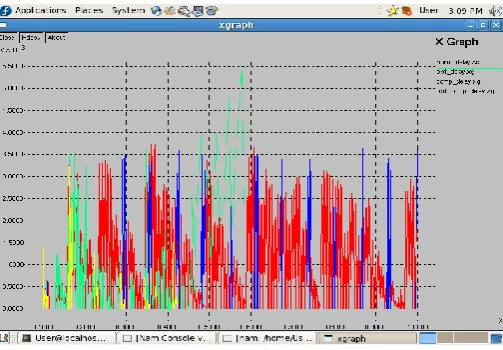
[image:3.595.311.563.179.354.2]Fig1. Delay Vs Time
Fig 1. Shows the Delay Vs Time graph. For normal network Delay must be very less or minimum. Analyzing individually all the modes we find that Mean Delay is more in normal mode which is 0.000992 sec. Optimal mode give bit less delay than normal mode which is 0.000564 sec. Compression mode gives delay of 0.000350 sec and optimal_compression mode gives mean delay of 0.000182 sec, which is the least. The Optimal_compressed mode gives very less delay.
2.
Energy fairness:
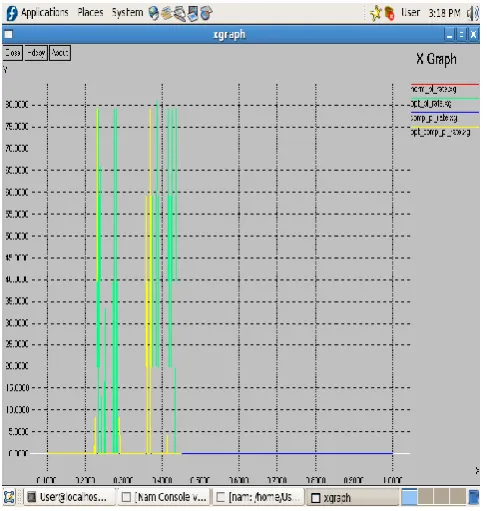
© 2017, IRJET | Impact Factor value: 5.181 | ISO 9001:2008 Certified Journal | Page 2837 The Energy fairness must be high for any network. The
Energy fairness of optimal_compression mode is very high which is 33mj/sec. while other Modes has low energy fairness.
[image:4.595.35.279.169.425.2]3.
Packet loss rate:
Fig 3. Packet loss rate Vs Time
The packet loss rate for any network must very minimum. Here The Optimal_compression mode has low packet loss rate as compared to other modes. Here normal mode graph is not shown because it is not shown instantaneous value and is over lapping with other modes.
4.
Routing overhead:
Fig 4. Routing Overhead Vs Time
The Routing Overhead of any network must be minimum. The routing overhead of optical_compression modes has very less routing overhead as compared with other modes.
7. CONCLUSIONS
The data packets were transmitted from source to destination using Ad-hoc On Demand Vector algorithm, Load balancing with and without compression. Four modes were made at the source i.e. Normal, Optimal, Compressed and Optimal compression. We have stimulated and investigated four parameter namely Delay, Energy fairness, Packet loss rate and routing overhead. Out of the four mode Normal compression mode makes the best choice for data transmission with having less delay, good energy fairness, less packet loss rate and less routing overhead.
REFERENCES
[1] S. john, “Wireless Sensor Networks,” Department Of Computer Science, University Of Virginia, June 19, 2006. [2] T. P.Lambrou and C. G. Pamayiotou, “Collaborative Area Monitoring Using Wireless Sensor Networks with Stationary and
Mobile Nodes,” Department of Electrical and Computer Engineering, University of Cyprus, Cyprus, Vol. 2009, Mar. 2009.
[3] I. F. Akyldiz, S. Weillian, S. Yogesh and C. Erdal, “A Survey on Sensor Networks”, Vol: 40, Aug 2002, pp. 102-114. [4] Rajashree.V.Biradar,V.C.Patil, Dr. S.R. Sawant, Dr. R.R. Mudholkar,Classification and Comparison of Routing Protocols in Wireless Sensor Networks, Special Issue on Ubiquitous Computng Security Systems.
[5] V. Ramesh, Dr. P. Subbaiah, N. Koteswar Rao and M. Janardhana Raju, “Performance comparison and analysis of DSDV and AODV for MANET,” International Journal on Computer Science and Engineering, vol. 02, pp. 183-188, 2010
[6]. Georgy Sklyarenko, “AODV Routing Protocol”, Seminar Technische Informatik, http://cst.imp.fu-berlin.de [6] www.ietf.org/rfc/rfc3561.txt
[7] http://moment.cs.ucsb.edu/AODV/aodv.html.
[8] Tarique, M. and Islam, R. (2007) Minimum Energy Dynamic Source Routing Protocols for Mobile Ad Hoc Networks. International Journal of Computer Science and Network Security, 7, 304-311.
[image:4.595.38.316.553.754.2]© 2017, IRJET | Impact Factor value: 5.181 | ISO 9001:2008 Certified Journal | Page 2838 Routing. International Conference on Information and
Communication Technologies, Shivamogga, 5-6 May 2014, 296-301.
[11] Tarique, M. and Tape, K.E. (2009) Minimum Energy Hierarchical Dynamic Source Routing for Mobile Ad Hoc Networks. Ad Hoc Networks, 7, 1125-1135. http://dx.doi.org/10.1016/j.adhoc.2008.10.002
[12] Perkins CE, Royer EM, Das SR. Ad Hoc on Demand Distance Vector (AODV) routing. Available from: http://www.ietf.org/ internetdrafts/draft-ietfmanet-aodv-06.txt, IETF Internet Draft, work in progress, 2000.
[13] Gallissot M. Routing on ad hoc networks, Project, Supervisor, Maurice Mitchell Date, 2007.