© 2017, IRJET | Impact Factor value: 5.181 | ISO 9001:2008 Certified Journal | Page 2531
A Study of Training and Blind Equalization Algorithms for Quadrature
Amplitude Modulation
Jaswant
1and Dr. Sanjeev Dhull
21
Research Scholar, Electronics and Communication, GJUS & T, Hisar, Haryana, India
2Associate Professor, Electronics and Communication GJUS & T, Hisar, Haryana, India.
---***---Abstract -In this paper a profound analysis of Training basedand Blind equalization algorithms have been demonstrated. Performance analysis and simulation results have been added to make it more general and specific as well. All the simulation results have been performed on Quadrature Amplitude Modulation (QAM). The comparative demonstration has been depicted through graphs and simulation results.
Key Words: Equalization, Training Equalization Algorithm,
Blind Equalization Algorithm, LMS, RLS, MMA, SCA.
1. INTRODUCTION
Nowadays, mode of wireless communication has taken over mode of wired communication. As world is moving from 3G to 4G to 5G, there is more and more need for bandwidth i.e. data rates. In bandwidth-efficient digital transmission, the training of a receiver requires a up process. This start-up includes three steps of setting the automatic gain control, recovering timing and converging the adaptive filters. For many applications, some predefined set of bits are sent to the receiver periodically known as training sequence which can be used as an ideal reference by the receiver because it is already known to receiving side. Such system is called supervised or trained. However, sometimes the use of training sequence is not feasible or not desirable. In such case, blind equalization is used which is invariably adaptive in nature. Blind equalization requires less channel bandwidth, but it poses some challenges and also increases system complexity. The most challenging aspect of blind equalization is the convergence of the adaptive equalizer. Without ideal reference, the receiver has to make decisions about what data have been transmitted. Generally, we use a decision device to make assumptions on the input signal. This decision device is called slicer. The decisions are highly unreliable because the received data are corrupted by Intersymbol Interference (ISI) due to distortion introduced by communication channel.
In training based data aided equalization technique, a chunk of data called as training/pilot signal is introduced to the receiver which helps the receiver learns the channel values and then use that data for channel estimation and ISI elimination. The training based equalization method has a quick conversion rate, better efficiency and has simple application. This method is considered best for environment where fast fading is required with high Doppler spread and
little coherence time. The downside to these equalizers; however, is that they constantly need pilot signals. The constant transmission of the training sequence consumes a lot of bandwidth which is a significant downside. In GSM around 18% of the bandwidth is consumed by the training sequences that are periodically sent to the receiver [5]. There are multiple training algorithms that can be used in a training-based adaptive equalizer e.g. LMS [6] and RLS [7].
The other equalization method is blind channel equalization. This technique is very handy when it comes to a system with one transmission point and multiple receiving nodes. If we send a training signal to each of the receiving node periodically, we will be consuming a lot of bandwidth. In order to solve this issue, we use blind equalization method so we do not have to send any training signal. The equalizer only needs to know about the mapping technique of the signal and then estimate channel effects accordingly. There are multiple algorithms including, CMA, MMA and SCA [16].
2. Training Equalization Algorithms
2.1 LMS Equalization
LMS [6] is the most common form of adaptive equalization. The LMS uses stochastic gradient descent for updating the equalizer weights during its operation. For any complex channel gain, the complex version of LMS equalizer is utilized and is given by
𝑧(𝑘)=𝜔𝜏(𝑘)𝑥(𝑘) (1)
z(k) represents the output of the given adaptive equalizer and is equal to the product of received signal and weight of the given equalizer.
𝑒(𝑘) = 𝑠(𝑘) − 𝑧(𝑘) (2)
Error estimation is represented in eq. 2 by e(k), while s(k) shows the desired signal. Subtracting the equalizer gain z(k) from the desired signal s(k) would give us the error estimation of the system. The weight update of the system can be calculated using the following
© 2017, IRJET | Impact Factor value: 5.181 | ISO 9001:2008 Certified Journal | Page 2532 Eq. 3 include * as the complex conjugate while μ represents
the step size which is related to the convergence rate of the equalizer. The process of finding the perfect μ value for efficient convergence is a tedious process and several numeral values are tried in this research in order to come up with the optimal convergence. The equation update the tap which then further changes the weight of the filter until the LMS equalizer is able to give an optimal convergence rate.
2.2 Recursive Least Square
Recursive Least Square (RLS) algorithm is another type of adaptive algorithm which has a higher computational complexity than its counterpart LMS. The working of an RLS equalizer can be calculated through the following formula
𝑢(𝑘) = 𝜓𝜆−1(𝑘 − 1)𝑥(𝑘) (4)
Ψ is used in equation 4 for reducing computational complexity. Ψ show a diagonal matrix with diagonal entries with value of 1, λ, λ2… Matrix inversion lemma is used in order to create a recursion in 𝜓𝜆−1. Input vector is shown by
x(k)
𝑥(𝑘)=(1/[𝜆 + 𝑥𝐻(𝑘)𝑢(𝑘)])𝑢(𝑘) (5)
Gain computed in the equation 5 depends on the value of λ. While both equations 4 and 5 are jointly used to calculate K(k) the gain vector. The λ which stands for the forgetting factor has a value near 1. λ, the weighting factor, provide less weightage to earlier samples and more to new ones and ignore the earlier ones.
ẑ𝑘−1(𝑘) = ŵ𝐻(𝑘 − 1)𝑥(𝑘) (6)
Equation 6 shows the input signal filtering in RLS equalizer. The ẑ𝑘−1(𝑘) is the output of the equalizer while ŵ(𝑘) show the updated weights. Just like the LMS, the error estimation in RLS equalizer is computed through the following
ê𝑘−1(k) = s∗(k) − ẑ𝑘−1(𝑘) (7)
ê𝑘−1(k) represents error which is calculated using the s∗(k) that represents the desired signal and the ẑ𝑘−1(𝑘) which is the output of the equalizer.
ŵ(𝑘) = ŵ(𝑘 − 1) + 𝐾(𝑘)ê𝑘−1(𝑘) (8)
Equation 8 is the tap update equation for the RLS equalizer. Gain K(k) and e(k) is multiplied in order to find the tap change for Kth iteration of the equalizer.
𝜓𝜆−1(𝑘)=λ−1(𝜓𝜆−1(𝑘−1)−𝐾(𝑘)[𝑥𝐻(𝑘)𝜓𝜆−1(𝑘−1)] (9)
Equation 9 is used for updating 𝜓𝜆−1.
3. Blind Equalization Algorithms
3.1Multi-Modulus Algorithm
Multi-Modulus Algorithm (MMA)[12][18] is the advanced form of the old CMA algorithm. In the old fashioned CMA, the real and imaginary parts of an equalizer’s output had to be separated. In MMA as well, both the real and imaginary parts are separated in order to get the cost function, which can be mathematically presented as
𝐽𝑀𝑀𝐴=𝑬{(| 𝑧𝑘𝑟 |𝑝 −𝑅𝑀𝑀𝐴𝑝)2+(| 𝑧𝑘𝑖 |𝑝−𝑅𝑀𝑀𝐴𝑝 )2} (10)
In equation 10 E denotes expectation operator, 𝑧𝑘𝑟 denotes
the real part and 𝑧𝑘𝑖 denotes the imaginary part of the output
of equalizer for kth value. ‘p’ mentioned in the equation denotes an integer necessary for the calculation.
𝑅𝑀𝑀𝐴𝑝= 𝐸 | 𝑠𝑘𝑟 |2𝑝 /𝐸 {| 𝑠𝑘𝑟 |𝑝}= 𝐸 | 𝑠𝑘𝑖 |2𝑝 /𝐸 | 𝑠𝑘𝑖 |p (11)
𝑅𝑀𝑀𝐴𝑝 is known as Goddard’s statistical constant. While Skr is the real part of the equation while Ski is the imaginary part of the equation. In a complex constellation, the equalizer dispersion is visible around 4 pints for MMS cost function (±RMMA ± jRMMA) and can be denoted as the addition of two cost functions. We can increase the performance of the MMA equalizer by increasing the value of p at the cost increase complexity. For the sake of simplification and practicality, we choose 2 as the value of p. In order to update the weight of the MMA based equalizer, we use the following formulae
𝑒𝑘= 𝑧𝑘𝑟 | 𝑧𝑘𝑟 |𝑝−2 (| 𝑧𝑘𝑟 |𝑝−𝑅𝑀𝑀𝐴𝑝)+𝑗𝑧𝑘𝑖 | 𝑧𝑘𝑖 |𝑝−2(| 𝑧𝑘𝑖 |𝑝−𝑅𝑀𝑀𝐴𝑝)
(12)
MMA equalizer is known for recover the distortion in the phase of the signal much efficiently.
3.2 Square Contour Algorithm
The Square Contour Algorithm (SCA) is based on the constellation of the received signal. The traditional CMA minimizes the dispersion of the output of the equalizer considering a circular constellation. The SCA, on the other hand minimizes the equalizer output using a square constellation and also recover the entire phase shift incurred during the transmission of the signal. The cost function for SCA based equalizer can be written as
𝐽𝑆𝐶𝐴 = 𝐸 {(|𝑧𝑘𝑟 + 𝑧𝑘𝑖 | + |𝑧𝑘𝑟 − 𝑧𝑘𝑖 |)𝑝 − 𝑅𝑆𝐶𝐴𝑝 )2} (13)
© 2017, IRJET | Impact Factor value: 5.181 | ISO 9001:2008 Certified Journal | Page 2533 depends on the type of constellation used in the wireless
communication system. As we have
| z𝑘𝑟 + z𝑘𝑖 | + | z𝑘𝑟− z𝑘𝑖|= 2max {| z𝑘𝑟|,| z𝑘𝑖|} (14)
The zero-error contour for the SCA equalization based system can be written as
max {|z𝑘𝑟|,|z𝑘𝑖|= 𝑅𝑆𝐶𝐴/2 (15)
Equation 15 represents a square with center as its origin. The error ek,SCA can be mathematically written as
ek,SCA = ((| zkr + zki | + | zkr − zki |)𝑝 − Rp𝑆𝐶𝐴 ) (| zkr + zki | + | zkr − zki |)p−1 ×(signum [zkr + zki] (1 + j) + signum [zkr − zki] (1 − j)) (16)
Where the Rp
𝑆𝐶𝐴 represents the constant as per the
constellation an can be mathematically showed as
Rp
𝑆𝐶𝐴= E {(| skr + ski | + | skr − ski |)𝑝 .Q}/𝐸(𝑄 ) (17)
Q in the given equation can be mathematically explained as
Q = (| skr+ ski| + | skr− ski|)p−1(sgn [skr+ ski] (1 + j) + signum [skr− ski] (1 − j)) s*𝑘 (18)
Where * represents a conjugate while the skr and ski stand for real and imaginary parts, respectively.
4. Simulation Results and Conclusion
4.1 Constellation Diagrams for different algorithms
Fig-4.1: LMS Equalization algorithm in 64 QAM constellation
Fig- 4.2: RLS Equalization algorithm in 64 QAM constellation
Fig-4.3: MMA Equalization algorithm in 64 QAM constellation
Fig-4.4: SCA Equalization algorithm in 64 QAM constellation
In the plots above, the left side represents the original transmitted signal to the receiver, the central figure represents the distorted and phase shifted signal due to the channel values and the AWGN present in the medium. This results in a distorted and shifted signal at the receiver with ISI. Now in order to extract the original signal, we applied each of the algorithms and the figure at right in each of the plots is the equalized signal.
4.2 BER Comparison of Equalization Algorithms for 64-QAM
Fig-4.5: BER comparison of LMS and RLS Algorithm for a 64-QAM constellation
© 2017, IRJET | Impact Factor value: 5.181 | ISO 9001:2008 Certified Journal | Page 2534 and if we go beyond that the performance of RLS will get
[image:4.595.41.292.171.312.2]even better. Hence we can safely conclude that for low intensity signal, both LMS and RLS have the same BER performance, however, for higher intensity signal, RLS is preferred for its better performance in terms of BER.
Fig-4.6: BER comparison of MMA and SCA Algorithms for a 64 QAM constellation
The plot above depicts the comparison of MMA and SCA for 64 QAM constellation and we can see the very significant difference in the performance of the two blind equalization Algorithms. For any given value of SNR, the BER of MMA is much better than that of SCA. However, there is a constant difference between the values of the two, at 25db the value of the MMA start getting even better. At 30db, we can witness a significant improvement. Hence it can be concluded that the performance of MMA is comparatively better than the SCA for 64 QAM constellations.
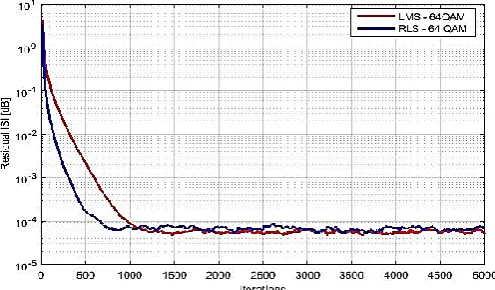
4.3 ISI Residual Comparison of LMS and RLS for 64-QAM
Fig. 4.7: ISI residual comparison of LMS and RLS Algorithms for a 64 QAM constellation
In plot above, we can see the ISI residual comparison of the two training based algorithms for 64 QAM constellations. The RLS in the plot above has a better convergence rate than the LMS and at around 700 iterations; the RLS can be see stabilizing. While the LMS takes long in convergence and
[image:4.595.314.569.172.300.2]needs around 1000 iterations to stabilize. Hence it can be concluded that utilization of LMS for communication between two fast moving nodes will result in a delay. However use of RLS can eliminate that problem, but it will cost more hardware and complex calculation to achieve this.
Fig. 4.8: ISI residual comparison of MMA and SCA Algorithms for a 64 QAM constellation
The plot above represents the comparison between MMA and SCA for ISI residual in a 64 QAM constellation. As we can see, the SCA has a quick convergence and requires only 400 iterations to retain a constant and stable residual ISI value. While in comparison the MMA requires around 7000 iterations to stabilize. However, the performance of MMA is pointedly better than that of the SCA but it comes at the cost of delay in the signal. If the system of communication can bear the delay then MMA is the best option to go for. However, if quick convergence is of utmost priority and no compromise can be made on delay then SCA is the first choice to be used.
4.4 MSE Comparison of LMS and RLS for 64 QAM
Fig-4.9: MSE comparison of LMS and RLS Algorithms for a 64 QAM constellation
[image:4.595.40.288.518.663.2] [image:4.595.311.574.522.685.2]© 2017, IRJET | Impact Factor value: 5.181 | ISO 9001:2008 Certified Journal | Page 2535 algorithms lies in its convergence rate. The LMS algorithm
takes a while in stabilizing and requires around 750 iterations to stabilize while the RLS requires 600 iterations. Hence RLS has better convergence rate and similar MSE performance at static conditions.
Fig-6.10: MSE comparison of MMA and SCA Algorithms for a 64 QAM constellation
The plot above represents the comparison of MMA and SCA blind algorithms for a 64 QAM constellation. The convergence rate of MMA is very high than that of SCA, however; the performance of SCA in terms of MSE is far better than the MMA. It takes around 200 iterations for MSE to stabilize while SCA takes around 8000 iterations before stabilizing. Hence for a static system using 64 QAM, SCA should be the first priority. It will initially take a while to stabilize, however; once stabilized the MSE of the signal will remain very little and almost negligible hence resulting in smooth transfer of signal.
In training based equalization algorithms, the LMS is comparatively simple and provide quick convergence, the RLS on the other hand has better performance when it comes to BER, MSE and residual ISI, however; due to the complexity involved and slow convergence, the RLS can be preferred for wireless systems with relatively static nodes. In blind equalization algorithm, the MMA general has a better performance than the SCA, however; like RLS the SCA needs complex calculations and at times provide better results in terms of ISI but is more costly. To sum it up, the equalization algorithms should be used in cases to case basis or a dynamic wireless communication system needs to be utilized which can switch between these algorithms rapidly based on the environment in order to ensure smooth flow of communication.
REFERENCES
[1] J.R. Treichler, M.G. Larimore and J.C. Harp, “Practical Blind Demodulators for High- order QAM signals", Proceedings of the IEEE special issue on Blind System
Identification and Estimation, vol. 86, pp. 1907-1926, Oct. 1998.
[2] Zhang, Haijun, Yang Shi, and A. Saadat Mehr. "Robust equalisation for inter symbol interference communication channels." Signal Processing, IET 6, no. 2 (2012): 73-78.
[3] Chung, G. C., S. S. Thwin, and Mohamad Yusoff Alias. "Statistical distribution of UWB signals in the presence of inter-symbol interference." InSustainable Utilization and Development in Engineering and Technology (CSUDET), 2013 IEEE Conference on, pp. 60-62. IEEE, 2013.
[4] Jalali, Sammuel. "Wireless Channel Equalization in Digital Communication Systems." (2012).
[5] Kavitha, Veeraruna, and Vinod Sharma. "Comparison of training, blind and semi blind equalizers in MIMO fading systems using capacity as measure." In Acoustics, Speech, and Signal Processing, 2005. Proceedings.(ICASSP'05). IEEE International Conference on, vol. 3, pp. iii-589. IEEE, 2005.
[6] Sharma, Prachi, Piush Gupta, and Pradeep Kumar Singh. "Performance Comparison of ZF, LMS and RLS Algorithms for Linear Adaptive Equalizer." International Journal of Advanced Computer Science and Applications 2, no. 3 (2016).
[7] Malik, Garima, and Amandeep Singh Sappal. "Adaptive equalization algorithms: an overview." International Journal of Advanced Computer Science and Applications 2, no. 3 (2011).
[8] Qureshi, Shahid UH. "Adaptive equalization." Proceedings of the IEEE 73, no. 9 (1985): 1349-1387.
[9] Moshirian, Sanaz, Soheil Ghadami, and Mohammad Havaei. "Blind Channel Equalization." arXiv preprint arXiv:1208.2205 (2012).
[10] Ding, Yanwu, Timothy N. Davidson, Zhi-Quan Luo, and Kon Max Wong. "Minimum BER block precoders for zero-forcing equalization." Signal Processing, IEEE Transactions on 51, no. 9 (2003): 2410-2423.
[11] Vanka, Ram Nishanth, S. Balarama Murty, and B. Chandra Mouli. "Adaptive Blind Equalization of QAM Transmitted Constellations across Linear Band-Limited Channel."
© 2017, IRJET | Impact Factor value: 5.181 | ISO 9001:2008 Certified Journal | Page 2536 Computer and Communication Engineering 3, no. 3
(March 2015): 2301-2305.
[13] Kavitha, Veeraruna, and Vinod Sharma. "Comparison of training, blind and semi blind equalizers in MIMO fading systems using capacity as measure." In Acoustics, Speech, and Signal Processing, 2005. Proceedings. (ICASSP'05). IEEE International Conference on, vol. 3, pp. iii-589. IEEE, 2005.
[14] Li, Honglei, Xiongbin Chen, Beiju Huang, Danying Tang, and Hongda Chen. "High bandwidth visible light communications based on a post-equalization circuit." Photonics Technology Letters, IEEE 26, no. 2 (2014): 119-122.
[15] Wang, Yuanquan, Rongling Li, Yiguang Wang, and Ziran Zhang. "3.25-Gbps visible light communication system based on single carrier frequency domain equalization utilizing an RGB LED." In Optical Fiber Communication Conference, pp. Th1F-1. Optical Society of America, 2014.
[16] Vanka, Ram Nishanth, S. Balarama Murty, and B. Chandra Mouli. "Adaptive Blind Equalization of QAM Transmitted Constellations across Linear Band-Limited Channel."
[17] Wei si yuan,”Blind Equalization for Qam signal based on the dual mode algorithm,science direct,pp34-37.