© 2016, IRJET | Impact Factor value: 4.45 | ISO 9001:2008 Certified Journal | Page 511
Biodiesel from Thumba Oil Characterization and Performance Testing
In Internal Combustion Engine
Akash Sase
1, Dr. P. M. Ardhapurkar
2, Supriya N Bobade
31
M.E. Student, Dept. of Mechanical Engineering, SSGMCE, Shegaon, Maharashtra, India
E-mail: [email protected]
2
Professor & Head, Dept. of Mechanical Engineering, SSGMCE, Shegaon, Maharashtra, India
E-mail: [email protected]
3
Indian Biodiesel Corporation, Baramati, Pune, Maharashtra, India E-mail: [email protected]
---***---Abstract -
The world pollution causing global warming andenergy demands has increased tremendously since last two decades. These energy demands are not fulfilled by the depleting fossil fuel sources. So as to meet the current needs of energy demand and minimize pollution researchers are working on finding alternative fuels for internal combustion engine.These concerns have increased the interest in developing second generation biofuels produced from non-food feedstocks such as nonedible oils which potentially offer greatest opportunities in the longer term. A large variety of plants that produce non-edible oils can be considered for biodiesel production such as Madhuca Indica (Mahua) ,Jatropha curcas(Ratan Jyot), Pongamia pinnata (Karanja), Soapnut (Sapindus mukorossi) and Melia azadirachta (Neem) etc., are easily available in developing countries and are very economical comparable to edible oils.In the present research an experimental work is conducted to obtain the performance and emission characteristics of Thumba Oil Biodiesel on Variable Compression Ratio (VCR) engine run on various blends of biodiesel, compression ratios and load conditions. From the comparison of results, it is inferred that the engine performance is improved with significant reduction in emissions for the chosen oils without any engine modification.
Key Words
:
Biodiesel, Citrullus Colosynthis Oil,Transesterification, Fuel Blends, Compression Ratio, Engine Load, Performance and Emissions, VCR CI Engine.
1. INTRODUCTION
The world energy demand has increased for the last two decades. The price of conventional fossil fuel is too high that has added burden on the economy of the importing nations and combustion of fossil fuels is the main cause in increasing the global carbon dioxide (CO2) level, a consequence of global warming. The scarcity and depletion of conventional sources are also cases of concern and have prompted research world-wide into alternative energy sources for internal combustion engines. Biofuels are one of the best potential alternative energy substitutes for fossil fuels. It is renewable and available throughout the world. The idea of using vegetable oils as fuel for diesel engines is not new. Rudolph diesel used peanut oil to fuel one of his engines at the Paris Exposition of 1900.
The problem of using neat vegetable oils in diesel engines relates to their high viscosity. The high viscosity will lead to blockage of fuel lines, filters, high nozzle valve opening pressures and poor atomization. One hundred percent vegetable oils cannot be used safely in DI diesel engines. The problems of high fuel viscosity can be overcome by using esters, blending and heating. Vegetable oils exhibit longer combustion duration with moderate rates of pressure rise, unlike petroleum derived fuels. The use of vegetable oils, such as palm, soya bean, sunflower, peanut, and olive oil, as alternative fuels for diesel is being promoted in many countries. Diesel engines provide important fuel economy and durability advantages for large heavy-duty trucks, buses, and non-road equipment and passenger cars. They are often the power plant of choice for heavy-duty applications. While they have many advantages, they also have the disadvantage of emitting significant amounts of particulate matter (PM) and oxides of nitrogen (NOx) and, to a lesser amount, hydrocarbon (HC), carbon monoxide (CO), and toxic air pollutants. Although several oil bearing trees like Karanja, Mahua, Polang, Kusum, Neem, Simarauba, Sal, Linseed, Castor, Baigaba, Jatropha Curcas etc. are native to India, systematic propagation and processing of these seeds is very important in view of large scale commercial production of bio-fuels.
1.1 Thumba
© 2016, IRJET | Impact Factor value: 4.45 | ISO 9001:2008 Certified Journal | Page 512
India and reaches also the north coast of the Mediterraneanand the Caspian seas. It can tolerate annual precipitation of 250 to 1500 mm and an annual temperature of 14.8 to 27.8 °C. It grows from sea level up to 1500 meter above sea level on sandy loam, sub-desert soils, and sandy sea costs with a pH range between 5.0 and 7.8 and the annual temperature required for growing these plants should ideally range between 14.8°C and 27.8°C.
The main objective of present work is to analyse the engine Performance and Emission characteristics of diesel engines fuelled with biodiesel produced from Thumba oil and its blends with diesel fuel, which will help in both the direction of reducing emission problems and search of alternative fuel for CI engines.
2. MATERIAL AND METHOD
2.1 Seed Material
The fresh seeds are collected from wild region of Jodhpur and Jaipur of Rajasthan state, India. The seeds are selected according to their conditions where damaged seeds are discarded and the good conditioned seeds are cleaned. De-shelled and dried at higher temperature at 100-105oC for 30min in oven. Then seeds are processed for oil extraction through mechanical expeller at room temperature.
2.2 Pre-treatment
Filtered Thumba oil is first taken to remove moisture. As water content of the feedstock is major parameter and should be kept below 0.06% w/w for better conversion of oil to esters. Hence the raw oil is kept in an oven at 1050 C for 2-3hrs to remove the water content from the oil. After de-moisture, the oil was filtered to remove suspended particles. The parameters present in trace quantity like carbon residue, un-saponificable material and fibre etc. are removed. The free fatty acid content of raw oil and products after reactions were determined by standard titrimetric methods (ASTM-664). To determine exact molecular weight of Thumba oil, it was analysed by Gas chromatography that gives available fatty acid. As the acid value of Thumba oil was found to be 2.30 mg KOH/gm. So there was no need to go for esterification process. We directly carry out base catalysed transesterification reaction.
2.3 Transesterification reaction
Transesterification or alcoholysis is the displacement of alcohol from an ester by another in a process similar to hydrolysis, except an alcohol is used instead of water. This process has been widely used to reduce the high viscosity of triglycerides. The major components of vegetable oils and animal fats are Triglycerides. To obtain biodiesel, the vegetable oil or animal fat is subjected to a chemical reaction termed transesterification.
CH2OCOR”’ CH2OH R”’COOR Catalyst
CH2OCOR” + 3ROH CH2OH + R”COOR
CH2OCOR’ CH2OH R’COOR
Oil or Fat Alcohol Glycerine Biodiesel Fig -1: Transesterification Reaction
Some feedstock must be pre-treated before they can go through the transesterification process. Feedstock with less than 5 % Free Fatty Acid, may not require pre-treatment. When an alkali catalyst is added to the feedstock’s (With FFA > 5 %), the Free Fatty Acid react with the catalyst to form soap and water. If methane is used in this process it is called methanolysis.
3. EXPERIMENTAL SET UP
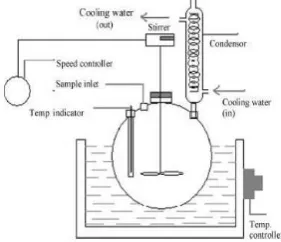
A 2000 ml three necked round –bottom flask was used as a reactor. The flask was placed in heating mantle whose temperature could be controlled within +20C. One of the two side necks was equipped with a condenser and the other was used as a thermos-well. A thermometer was placed in the thermos-well containing little glycerol for temperature measurement inside the reactor. A blade stirrer was passed through the central neck, which was connected to a motor along with speed regulator for adjusting and controlling the stirrer speed. [2]
The experimental set up is shown in figure3.1 1000 ml of Thumba oil was measured and poured into a 2000 ml three necked round bottom flask. This oil was heated up to 600C. In 250ml beaker a solution of potassium methoxide was prepared using 0.5, 0.75 and 1.25 wt. % potassium hydroxide pellets with the molar ratio 1:6, 1:8 and 1:10 of oil to methanol were studied. The solution was stirred until the potassium hydroxide pellet was completely dissolved (the mixture was called potassium methoxide solution). The solution was then heated up to 600C and slowly poured into preheated oil. The mixture was stirred (650rpm) vigorously for 10, 20, 30, 40, 50, 60, 70, 80 and 90 min. Finally FFA was checked and mixture was allowed to settle for 24 hours in a separating funnel. Thereafter, upper layer biodiesel was decanted into a separate beaker while the lower layer which comprised glycerol and soap was collected from the bottom of separating funnel. To remove any excess glycerol and soap from the biodiesel, hot water was used to wash it then allowed it to remain in separating funnel until clear water was seen below the biodiesel in the separating funnel. The PH of biodiesel was then tested. The washed biodiesel sample was then dried by placing it on a hot plate and excess water still in the biodiesel removed. These batches were taken to achieve highest yield and to study the effect of these parameters on yield of methyl ester.
[image:2.595.340.481.614.735.2]© 2016, IRJET | Impact Factor value: 4.45 | ISO 9001:2008 Certified Journal | Page 513
4
.
METHODOLOGY
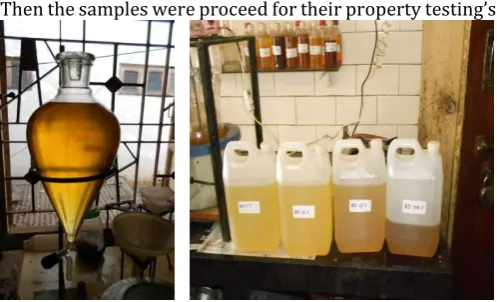
At present the amount of biodiesel available is less than that of diesel. The biodiesel blended with diesel by volume as B10 (10% thumba oil biodiesel & 90% diesel fuel), B20 (20% thumba oil biodiesel & 80% diesel fuel), B30 (30% thumba oil biodiesel & 70% diesel fuel), B40 (40% thumba veg oil biodiesel & 60% diesel fuel), B50 (50% thumba oil biodiesel & 50% diesel fuel), B100 (100% thumba oil biodiesel & 00% diesel fuel).
Then the samples were proceed for their property testing’s.
[image:3.595.36.285.215.366.2]Fig -3: Pure biodiesel & Blends of Biodiesel
4.1 Seed characterization
Fresh seeds contain 8-10% of moisture.
4.2 Oil Percentage
The available oil percentage in Thumba seeds is 12-20%. As per our practical trial, we recorded 14% of oil.
4.3 Physicochemical Properties
The fresh extracted crude oil is yellowish brown in colour & it gets darkened during the storage. The oil having slightly sweet odour & bitter taste. All properties were carried out as per American Standards’ For Testing & Material (ASTM)- 6751.The compressibility effect of the vegetable oil causes an earlier injection of fuel into the engine cylinder as compared to diesel fuel. This earlier injection does not play an important role, as the injection advance difference is at maximum 100C even for the neat vegetable oil. The major difference occurs in atomization process, i.e. the mean droplet size of vegetable oil is much higher than diesel fuel. This is because high viscosity (38.17Cst) and low volatility of vegetable oils lead to difficulty in atomizing the fuel and in mixing it with air.
Table -1: Properties of Thumba biodiesel blend
Test Description Density Calorific value Moisture
Reference Std.
ASTM 6751 D1448 D6751 D2709
Reference Unit gm/cc MJ/kg %
Limit .800-.900 34-45 0.05%
B00 0.830 42.50 NA
B05 0.832 42.36 NA
B10 .835 42.09 NA
B15 0.837 42.00 NA
B20 0.840 41.50 NA
B25 0.842 41.10 NA
B50 0.856 40.25 NA
B100 0.872 39.00 NA
A single cylinder, four strokes, water cooled, constant speed, computer controlled, variable compression ratio engine was selected for the tests. Technical specifications of the test engine are given below.
Engine Details:
IC Engine set up under test is Kirloskar TV1 having power 5.20 kW @ 1500 rpm which is 1 Cylinder, Four stroke , Constant Speed, Water Cooled, Diesel Engine, with Cylinder Bore 87.50(mm), Stroke Length 110.00(mm), Connecting Rod length 234.00(mm), Compression Ratio 18.00, Swept volume 661.45 (cc)
Combustion Parameters:
Specific Gas Const (kJ/kgK): 1.00, Air Density (kg/m^3) : 1.17, Adiabatic Index : 1.41, Polytrophic Index : 1.26, Number Of Cycles : 10, Cylinder Pressure Reference : 7, Smoothing 2, TDC Reference : 0
Performance Parameters:
Orifice Diameter (mm): 20.00, Orifice Coeff. Of Discharge: 0.60, Dynamometer Arm Legnth (mm): 185, Fuel Pipe dia (mm): 12.40, Ambient Temp. (oC) : 27, Pulses Per
revolution : 360, Fuel Type : Diesel, Fuel Density (Kg/m3) : 830, Calorific Value Of Fuel (kJ/kg) : 42000
RESULT AND DISCUSSION –
Performance parameters
© 2016, IRJET | Impact Factor value: 4.45 | ISO 9001:2008 Certified Journal | Page 514
Chart-2: Load vs BP at CR 16From the above graph plotted load vs BP at CR 16 we get that B00 i.e. pure diesel shows lowest BP. All other blends of Thumba biodiesel compared with diesel shows higher BP.BP increases with increase in load.Considering above graph at various loads we can select B50 as principle blend for replacing diesel fuel at CR 18 and 16.
Chart- 3: Load vs BTE at CR 18
Chart- 4: Load vs BTE at CR 16
From the above graph plotted load vs BTE at CR 16 we get that B00 i.e. pure diesel shows lowest BTE. All other blends of Thumba biodiesel compared with diesel shows higher BTE.BTE increases with increase in load. Considering above graph at various loads we can select B25 as principle blend replacing diesel fuel at CR 18 and16
.
Chart- 5:Load vs SFC at CR 18
Chart- 6: Load vs SFC at CR 16
From the above graph plotted load vs SFC at CR 16 we get that B00 i.e. pure diesel shows highest SFC. All other blends of Thumba biodiesel compared with diesel shows lower SFC. SFC decreases with increase in load. Considering above graph at various loads we can select B70 as principle blend replacing diesel fuel at CR 18 and 16.
© 2016, IRJET | Impact Factor value: 4.45 | ISO 9001:2008 Certified Journal | Page 515
Chart- 7: Load vs CO at CR 18Chart- 8: Load vs CO at CR 16
From the above graph plotted load vs CO at CR 18 we get that B00 i.e. pure diesel shows lowest emissions. All other blends of Thumba biodiesel compared with diesel shows higher emissions of CO. CO emissions increase with increase in load. Considering above graph at various loads we can select B25 as principle blend replacing diesel fuel at CR 18 and 16.
Chart- 9: Load vs HC at CR 18
Chart- 10: Load vs HC at CR 16
From the above graph plotted load vs HC at CR 18 we get that B10 shows highest emissions. All other blends of Thumba biodiesel compared with B10 shows lower emissions of HC. HC emissions increase with increase in load. Considering above graph at various loads we can select B70 as principle blend replacing diesel fuel at CR 18 and 16.
Chart- 11: Load vs CO2 at CR 18
© 2016, IRJET | Impact Factor value: 4.45 | ISO 9001:2008 Certified Journal | Page 516
From the above graph plotted load vs CO2 at CR 18 we getthat B50 shows highest emissions. All other blends of Thumba biodiesel compared with B50 shows lower emissions of CO2. CO2 emissions increase with increase in
load. Considering above graph at various loads we can select B70 as principle blend replacing diesel fuel at CR 18 and 16.
Chart- 13: Load vs O2 at CR 18
Chart- 14: Load vs O2 at CR 16
From the above graph plotted load vs O2 at CR 18 we get that
B50 shows lowest emissions. All other blends of Thumba biodiesel compared with B50 shows higher emissions of O2.
O2 emissions decrease with increase in load. Considering
above graph at various loads we can select B50 as principle blend and for replacing diesel fuel at CR 18 and 16.
Chart- 15: Load vs NOx at CR 18
Chart- 16: Load vs NOx at CR 16
From the above graph plotted load vs NOx at CR 18 we get that B25 shows highest emissions. All other blends of Thumba biodiesel compared with B25 shows lower emissions of NOx. NOx emissions increase with increase in load. Considering above graph at various loads we can select B70 as principle blend for replacing diesel fuel at CR 18 and 16.
3. CONCLUSIONS
Performance
The biodiesel blends of B50% (combination of Diesel 50% by volume, biodiesel 50% by volume) gave better brake power at all CR. Hence we would suggest B50 as alternate fuel to diesel for better brake power compared to diesel and CR 18 as fundamental CR for optimum output.
© 2016, IRJET | Impact Factor value: 4.45 | ISO 9001:2008 Certified Journal | Page 517
The biodiesel blends of B70% (combination of Diesel 30% byvolume, biodiesel 70% by volume) gave lesser brake specific fuel consumption at all CR. This is due to lower heating value of biodiesel, lower the power generation for the same fuel consumption rate as compared to diesel. Hence we would suggest B25 as alternate fuel to diesel for lesser brake specific fuel consumption compared to diesel and CR 18 as fundamental CR for optimum output.
Emission
The biodiesel blends of B10% (combination of Diesel 90% by volume, biodiesel 10% by volume) have superior CO emission characteristics at all CR. This is due to relatively complete combustion takes place at higher compression ratio.
The biodiesel blends of B70% (combination of Diesel 30% by volume, biodiesel 70% by volume) have lesser HC emission characteristics at all CR.
The biodiesel blends of B20% (combination of Diesel 80% by volume, biodiesel 20% by volume) have lesser CO2 emission
characteristics at all CR. This is because of the vegetable oil contains oxygen contents in it, so the carbon content is relatively lower in the same volume of fuel consumed at the same compression ratio.
The biodiesel blends of B50% (combination of Diesel 50% by volume, biodiesel 50% by volume) have lesser O2 emission
characteristics at all CR. This is due to increases in compression ratio , there is complete combustion thus oxygen requirement is mainly for CO2, but at lower
compression ratio, there is more oxygen used in formation of CO, NOx in addition to that of CO2, thus oxygen content in
exhaust gases is decreased.
The biodiesel blends of B70% (combination of Diesel 30% by volume, biodiesel 70% by volume) have lesser NOx emission
characteristics at all CR. This is due to highest temperature is observed at this compression ratio. But the expected was, highest NOx emission obtained at highest compression ratio as the higher peak temperature observed with higher compression ratio.
From the above conclusions, it is proved that the biodiesel could be used as an alternative fuel in VCR engine without any engine modifications.
REFERENCES
1. Sunilkumar R. Kumbhar, H. M. Dange, “ Performance analysis of single cylinder diesel engine, using diesel blended with thumba oil”, International Journal of Soft Computing and Engineering (IJSCE) ISSN: 2231-2307, Volume-4, Issue-1, March 2014
2. Shiv Lal, V. K. Gorana, N. L. Panwar, “A comparative study of thumba seed bio diesel”, Journal of Environmental Protection, 2011, 2, 454-459 doi: 10.4236/jep.2011.24052 Published Online June 2011 (http://www.SciRP.org/journal/jep) Copyright © 2011 SciRes JEP
3. Chavan S. B., Kumbhar R. R. and Sharma Y. C. “ Transesterification of citrullus colocynthis
(thumba) oil: Optimization for biodiesel production ”,Advances in Applied Science Research, 2014, 5(3):10-20, Pelagia Research Library
4. S. Nagaraja, K. Sooryaprakash, R. Sudhakaran, “Investigate the Effect of Compression Ratio over the Performance and Emission Characteristics of Variable Compression Ratio Engine Fueled with Preheated Palm Oil - Diesel Blends”, Procedia Earth and Planetary Science 11 ( 2015 ) 393 – 401 5. Rupesh L. Raut, Babaso N. Naik, Shekhar D. Thakare,
Amol A. Gawali, “EMISSION ANALYSIS OF BIO-DIESEL BLENDS ON VARIABLE COMPRESSION RATIO ENGINE”, IJRET: International Journal of Research in Engineering and Technology eISSN: 2319-1163 | pISSN: 2321-7308
6. Ajay V. Kolhe, R. E. Shelke, S. S. Khandare, “Performance, Emission and Combustion Characteristics of a Variable Compression Ratio Diesel Engine Fueled with Karanj Biodiesel and Its Blends”, World Academy of Science, Engineering and Technology International Journal of Mechanical, Aerospace, Industrial and Mechatronics Engineering Vol:8, No:4, 2014
7.