© 2017, IRJET | Impact Factor value: 5.181 | ISO 9001:2008 Certified Journal | Page 2023
COMPARATIVE STUDY OF DIFFERENT TYPES OF BRACING SYSTEMS BY
PLACING AT DIFFERENT LOCATIONS
Sachin Metre
1, Shivanand C ghule
2, Ravi kiran
31
M.Tech Structures, Civil Engg., SSE Mangalore (India)
2Asst. Professor, Civil Engg., TOCE Bangalore (India)
3
Asst. Professor, Civil Engg., SSE Mangalore (India)
---***---Abstract - Now a days, Bracings in steel structure are commonly used because it can withstand lateral loads due to earthquake, wind, etc. It is one of the best method for lateral load resisting systems. This system provided to minimize the lateral deflection of structure. In this thesis 25 storey steel frame is analyzed for the rectangular plan of 25x15 m by considering Z-II and Z-V for soil type-II. The analyses were done by using the ETABS 2016 software. In this paper models are compared for different types of bracing such as X, inverted V and Single diagonal bracing by placing in different locations like Outer Edge, Inner Edge and at centre in X and Y-directions for the bracing angle ISA 130x130x8. Results are obtained by considering the parameters like storey displacement, storey drift and storey shear.
Index Terms— Bracing, Analysis using ETABS, storey displacement, storey drift, storey displacement.
1. INTRODUCTION:
As steel bracing is economical, easy to set up, occupies minimum space and also have flexibility in nature to design for meeting the required strength and stiffness. Braced framed structures are usually considered to resist the lateral forces and also earthquake loads. Braced systems provide due to their strength, stiffness to the structures. They provide more stiffness against the horizontal shear because the diagonal member elements work in axial stress.
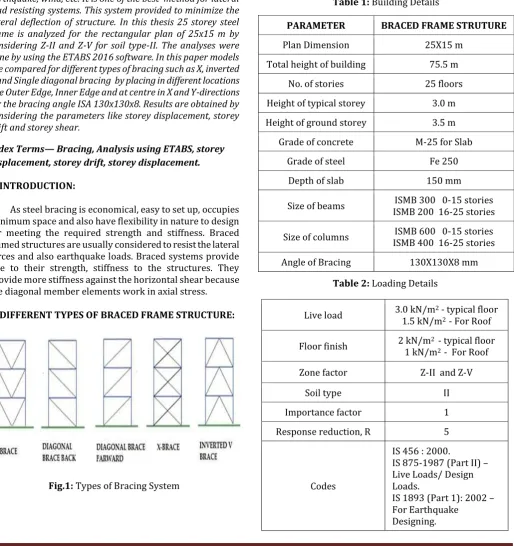
2. DIFFERENT TYPES OF BRACED FRAME STRUCTURE:
Fig.1: Types of Bracing System
[image:1.595.47.562.247.794.2]3. PROBLEM MODELING:
Table 1: Building Details
PARAMETER BRACED FRAME STRUTURE
Plan Dimension 25X15 m
Total height of building 75.5 m
No. of stories 25 floors
Height of typical storey 3.0 m
Height of ground storey 3.5 m
Grade of concrete M-25 for Slab
Grade of steel Fe 250
Depth of slab 150 mm
Size of beams ISMB 200 16-25 stories ISMB 300 0-15 stories
Size of columns ISMB 400 16-25 stories ISMB 600 0-15 stories
Angle of Bracing 130X130X8 mm
Table 2: Loading Details
Live load 3.0 kN/m1.5 kN/m2 - typical floor 2 - For Roof
Floor finish 2 kN/m1 kN/m2 - typical floor 2 - For Roof
Zone factor Z-II and Z-V
Soil type II
Importance factor 1
Response reduction, R 5
Codes
IS 456 : 2000.
IS 875-1987 (Part II) – Live Loads/ Design Loads.
IS 1893 (Part 1): 2002 – For Earthquake
© 2017, IRJET | Impact Factor value: 5.181 | ISO 9001:2008 Certified Journal | Page 2024
4. LOCATIONS OF BRACING PLACED:
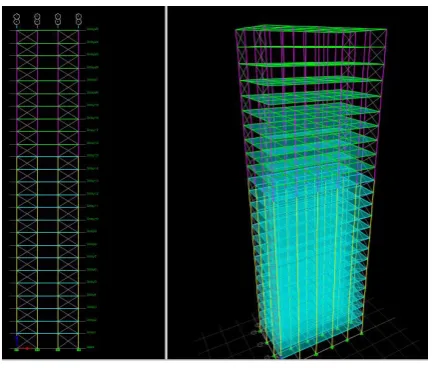
In this paper we considered three types of bracing such as X,A (inverted v) and Diagonal bracing systems at different locations like Outer edges, Inner edges and Centre for the seismic analysis for Zone II and V in X and Y directions as shown in the figure. Similarly for A and D type of bracing we placed as shown in the figure.
Fig.2: XBS in X direction at I.E
[image:2.595.54.541.69.794.2]Fig.3: XBS in X direction at O.E
Fig.4: XBS in X direction at Centre
Fig.5: XBS in Y direction at O.E
Fig.6: XBS in Y direction at Centre
5. RESULT AND DISCUSSIONS:
5.1 RESULTS FOR DISPLACEMENTS:
Table 3: Displacements values for Z-II in X and Y directions
STOREY DISPLACEMENT FOR Z-II
MODE L
X DIRECTION Y DIRECTION
OUTER EDGES
INNER EDGES
CENT RE
OUTER EDGES
CENTR E X
BRAC E
154.10 122.353 210.51
5 113.949 135.17
A BRAC
E
148.31
3 119.294
206.40
2 111.084
133.60 6
D BRAC
E
173.84
3 140.779
232.25
4 122.491
[image:2.595.326.545.82.272.2] [image:2.595.52.270.185.355.2] [image:2.595.320.546.294.482.2]© 2017, IRJET | Impact Factor value: 5.181 | ISO 9001:2008 Certified Journal | Page 2025
[image:3.595.36.280.85.238.2]Fig.7: Displacement of XSB in X direction for Z-II and Z-V
Table 4: Displacements values for Z-V in X and Y directions
STOREY DISPLACEMENT FOR Z-V
MOD EL
X DIRECTION Y DIRECTION OUT ER EDGE S INNE R EDGE S CENT RE OUT ER EDGE S CENT RE X BRA CE 554.7 75 440.4 72 757.8 56 410.2 18 486.6 13 A BRA CE 533.9 26 429.4 58 743.0 47 399.9 01 480.9 81 D BRA CE 625.8 34 506.8 03 836.1 14 440.9 66 520.0 61
Fig.8: Displacement of XSB in Y direction for Z-II and Z-V
DISCUSSION ON DISPLACEMENT FOR STEEL BRACING:
Displacement is the main parameter which helps to know the structural behavior due to the lateral loads acting on the structure.
The displacement in both the direction ( X and Y ) for response spectrum analysis is presented in the above table for seismic both Z-II and Z-V for all locations of bracings i.e Outer Edges (O.E), Inner Edges (I.E) and at Centre. The graphs for XSB are plotted and shown in the fig 7 and 8.
From the obtained results it is found that for both the seismic Zones, in both (X and Y) directions the displacement reduced when the location of bracing changes.
The max displacement values in X direction for both Z-II and Z-V is lesser for inverted V type of bracing when the bracing is placed at inner edges it reduced by 20 % compared to outer edges and 42 % for centre and for Y direction the displacement is minimum for inverted V type of bracing when it is placed at outer edges, reduced nearly 17 % compared to when it is placed at Centre location.
Therefore A bracing is better to provide at Inner Edges In X direction and at Centre in Y direction.
[image:3.595.44.280.292.748.2]5.2 RESULTS FOR STOREY DRIFT:
Table 5: Storey Drift values for Z-II in X and Y directions
STOREY DRIFT FOR Z-II
MODE L
X DIRECTION Y DIRECTION
OUTER EDGES INNER EDGES CENTR E OUTER EDGES CENTR E X BRACE 0.0026
3 0.002
[image:3.595.300.565.438.648.2]© 2017, IRJET | Impact Factor value: 5.181 | ISO 9001:2008 Certified Journal | Page 2026
[image:4.595.36.284.76.241.2]Fig.9: Drift of XSB in X direction for Z-II and Z-V
Table 6: Storey Drift values for Z-V in X and Y directions
STOREY DRIFT FOR Z-V
MODE L
X DIRECTION Y DIRECTION
OUTER
EDGES EDGES INNER CENTRE OUTER EDGES CENTRE X
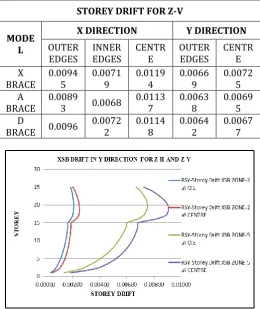
BRACE 0.00945 0.00719 0.01194 0.00669 0.00725 A
BRACE 0.00893 0.0068 0.01137 0.00638 0.00695 D
BRACE 0.0096 0.00722 0.01148 0.00642 0.00677
Fig.10: Drift of XSB in Y direction for Z-II and Z-V
DISCUSSIONS FOR DRIFT VALUES:
As the height of the building increases, drift stories also increases up to certain then decreases. From the results the drift values for A bracing is lesser compared to the other two types of bracing (X and D) when it is placed at the inner edges, it is reduced 24 % for outer edges and 40 % lesser at centre in X direction for both the Zones (II and V) and inn Y direction 8 % for Outer compared to Centre for both the Zones.
Thus, we can say A bracing system can be placed at Inner edges.
[image:4.595.313.560.114.498.2]5.3 RESULTS FOR STOREY SHEAR
Table 7: Storey Shear values for Z-II in X and Y directions
STOREY SHEAR FOR Z-II
MODE L
X DIRECTION Y DIRECTION
OUTER
EDGES INNER EDGES CENTRE OUTER EDGES CENTRE X
BRACE 659.616 659.616 659.057 659.057 659.616 A
BRACE 659.25 659.249 658.872 659.25 658.87 D
BRACE 659.058 659.058 658.777 659.059 658.779
[image:4.595.31.292.302.612.2]Fig.11: Storey Shear of XSB in X direction for Z-II and Z-V
Table 8: Storey Shear values for Z-V in X and Y directions
STOREY SHEAR FOR Z-V
MODE L
X DIRECTION Y DIRECTION
OUTER EDGES
INNER EDGES
CENTR E
OUTER
EDGES CENTRE
X BRACE
2374.6 2
2374.6 1
2372.6 0
2374.6
2 2372.60
A
BRACE 2373.3
2373.2 9
2371.9 4
2373.2
9 2371.95
D BRACE
2372.6 1
2372.6 0
2371.6 0
2372.6 1
[image:4.595.301.563.494.697.2]© 2017, IRJET | Impact Factor value: 5.181 | ISO 9001:2008 Certified Journal | Page 2027
Fig.12: Storey Shear of XSB in Y direction for Z-II and Z-V
DISCUSSIONS FOR STOREY SHEAR VALUES
The maximum Storey shear values for both the directions response spectrum analysis is presented in the above table for seismic both Z-II and Z-V for all locations of bracings i.e Outer Edges (O.E), Inner Edges (I.E) and at Centre.
The graphs of Storey Shear for X Steel Bracing (XSB) are plotted in X and Y direction as shown in the above fig.12.
6. CONCULUSION:
Bracing Structures gives more resistance to lateral deflection and also it suitable in earthquake prone areas.
The bracing system effectively reduces the lateral displacement and drift for the A bracing of the structure compared to other bracings.
By using A bracing it is possible to adopt openings for windows and doors which are critical in XBS because X-bracings run across the entire wall area.
Storey Shear increases for the Bracing models especially for the X bracing compared to inverted V (A type bracing) and Single Diagonal bracing.
7. SCOPE OF FUTURE WORK:
By using bracings in the structures, the displacement of the structure greatly reduced can be changed or altered. Hence the further study can be done by examining the behavior of the storey building due to wind load forces and Time history analysis.
We can also study on the behavior of Bending Moment, shear Force etc.
We can study other types of bracings in different Zones for the different soil type conditions.
We can study for the different sections in steel structures and compare with and without bracings.
REFERENCES
[1] Adithya.M, Swathi rani K.S, Shruthi H K and Dr.Ramesh B R (February 2015): "Study On Effective Bracing Systems for High Rise Steel Structures" SSRG International Journal of Civil Engineering (SSRG-IJCE) – Volume 2 Issue 2.
[2] Amol V. Gowardhan, G.D.Dhawale and Shende (2015) “A Review On Comparative Seismic Analysis Of Steel Frame With And Without Bracing By Using Software” International Journal Of Research Vol.3.
[3] A. Jesumi, M.G. Rajendran, (March-April 2013)“Optimal Bracing System for Steel Towers” International Journal of Engineering Research and Applications (IJERA) ISSN: 2248-9622 Vol. 3, Issue 2.
[4] A Kadid, D.Yahiaoui (2011) “Seismic Assessment of Braced RC Frames.”2011 Published by Elsevier Ltd, A. Kadid and D. Yahiaoui / Procedia Engineering 14 ,Pages2899–2905.
[5] A R Khaloo and M Mahdi Mohseni: (2008) “Nonlinear Seismic Behaviour of RC Frames with RC Braces” Asian Journal of Civil Engineering, Vol. 9, No6.