R E S E A R C H
Open Access
Effect of variety and drying method on the
nutritive value of corn for growing pigs
Quanfeng Li
†, Meng Shi
†, Chuanxin Shi, Dewen Liu, Xiangshu Piao, Defa Li and Changhua Lai
*Abstract
Background:This experiment was conducted to determine the nutritive value of corn from the north of China for growing pigs. The experiment examined corn variety (LS1, LS2, LS3 and LS4) grown in one location, drying method (sun dried and artificially dried) and different drying temperatures. Corn harvested at 20-25% moisture was dried to about 12% moisture by sun drying and artificially drying at 80, 100, or 120°C in a fluidized bed dryer. Ninety-six barrows (average BW of 33.4 ± 2.7 kg) were housed in individual metabolism crates to facilitate separate collection of feces and urine. A five-day collection period followed a seven-day diet acclimation period.
Results:The results indicated that variety significantly influenced (P< 0.01) the 1,000 kernel weight of corn but not the bulk weight. Variety also influenced the available energy content (digestible energy of dry matter,P< 0.01; metabolisable energy of dry matter,P< 0.01) and digestibility of organic matter (P< 0.01), as well as dry matter (P< 0.01) and gross energy (GE) content (P< 0.02). The drying method of corn significantly influenced the 1,000 kernel weight (P< 0.01), bulk weight (P< 0.01) and digestibility of ether extract (EE) (P< 0.01). No effect of drying temperature on the digestibility of organic matter, dry matter (DM), crude protein (CP), neutral detergent fiber (NDF), acid detergent fiber (ADF) and gross energy was observed, but gelatinization (P< 0.05) and test weight (P< 0.01) decreased with an increase in temperature.
Conclusions:Variety has a significant impact on the nutritive value of corn for growing pigs, and greater attention needs to be paid to these influences in the assignment of the nutritive value of corn given to growing pigs.
Keywords:Corn, Digestible energy, Drying method, Pigs, Variety
Background
Corn growers are usually confronted with difficulty in the safe storage of their grain crop because of a high moisture content (22-30%) at the time of harvest. This condition is especially pronounced in the north of China where the weather conditions are unfavorable for natural field drying. So, the purpose of drying is to lower the moisture content in grain to the safe storage content of about 14%. Therefore, most of the corn is artificially dried at a temperature of 120°C in Jilin, Liaoning, and Heilongjiang province, which are the biggest corn pro-ducing areas in China. In order to decrease the damage to corn from a high temperature, the low temperature drying process, which occurs at 80°C is used. However,
corn in the Shandong and Henan provinces, which are in the east of China, was dried in the sun.
As expected, there were many studies on corn variety in feeds, but the varieties studied were oil [1,2], high-lysine [3], low-phytate [4] and so on. There varieties are very special, and the planting area is not large. The var-ieties of corn used in feeds still are conventional varvar-ieties. However, there is a lack of congruent information on the variation in nutritive value as affected by conventional var-iety, drying method and drying temperature of corn. Therefore, the objectives of this experiment were to measure the influence of conventional variety on the nutritive value of corn and to compare estimates of the effects of drying method on the nutritive value of corn. An additional objective was to evaluate varying tem-perature during drying on the nutritive value of corn in growing pigs.
* Correspondence:[email protected] †Equal contributors
State Key Laboratory of Animal Nutrition, Ministry of Agriculture Feed Industry Centre, China Agricultural University, Beijing 100193, China
Materials and methods
The parts of this experiment that involved animals were conducted in the Metabolism Laboratory of the Ministry of Agriculture Feed Industry Centre (China Agricultural University, Beijing, China). The protocol for the experi-ment was reviewed and approved by the Institutional Animal Care and Use Committee at China Agricultural University.
Selection and preparation of the corn samples
Four corn variety samples (LS1, LS2, LS3 and LS4) were obtained from one location in the north of Hebei prov-ince. The four varieties were very widespread, and the planting area was very large. The varieties of hardness were classified as soft (LS1), hard (LS3), and of intermedi-ate hardness (LS2; LS4). Corn was hand-harvested at 20-25% moisture and was spread on a tarp on the ground for a maximum of one week prior to threshing and drying.
Grain samples from each variety were divided into four subplots of 200 kg each. One of the subplots was placed on an airfield and allowed to dry to about 12% moisture content after threshing. The remaining three subplots were dried in a fluidized bed dryer at 80, 100 or 120°C. Final moisture contents were about 12% (ranging from9.4 to 14.7%). At each drying temperature, the var-ieties were dried in a random order. Approximate drying times were 60, 50 and 40 min, respectively, for tempera-tures of 80, 100 and 120°C. When samples were re-moved from the dryer, they were cooled at room temperature before packaging in bags.
Animals, housing, and experimental design
Ninety-six barrows (initial body weight of 33.4 ± 2.7 kg) were used in this experiment. The pigs were Duroc × Landrace × Yorkshire crossbreeds. Pigs were individually housed in stainless steel metabolism cages (1.4 m × 0.45 m × 0.6 m). A feeder and a nipple drinker were in-stalled in each pen. The crates were located in an envir-onmentally controlled room with a temperature of 22 ± 1°C. Pigs were allotted to one of sixteen diets according to a completely randomized design, and each diet was measured with six pigs.
Diets, feeding, and sample collection
Sixteen diets were formulated to contain 96.8% of one of each of the corn samples and 3.2% minerals and vita-mins (Table 1). Corn was assumed to be the only source of energy in the diet, as the slight contribution of energy from the vitamin and mineral premix was assumed to be negligible. Vitamins, salt, and minerals were included in all diets to meet or exceed the estimated requirements for growing pigs [5].
Feed was provided twice daily as a mash, at 0800 and 1700 h. Water was freely available for each pig. During
the period of adjustment to the metabolism crates and diets, average daily feed intake was gradually increased until it was estimated to supply 4% of the BW deter-mined at the initiation of each adaptation period. During the collection period, all fresh fecal samples were col-lected as often as possible throughout the day from all pigs and stored at −20°C. The collection and sample preparation of feces and urine were conducted according to the methods described by Song et al. [2].
Chemical analyses
At the conclusion of the experiment, the fecal samples were dried at 60°C in a forced-air oven for 72 h. After drying, all samples were finely ground, and ground sam-ples of diets and feces were analyzed for DM [6], ether extract (EE) [7], and ash [6]. Kjeldahl N was determined according to the method of Thiex et al. [8]. The diets and feces samples were analyzed for NDF and ADF, and the content of NDF and ADF were determined using fil-ter bags and fiber analyzer equipment (Fiber Analyzer, Ankom Technology, Macedon, NY) following a modifi-cation of the procedure of Van Soest et al. [9]. The gela-tinized starch of corn samples was determined by enzymatic hydrolysis as described by Xiong et al. [10]. Urine samples (4 mL) were injected into 2 filter papers in a special crucible and then dried for 8 h in a 65°C drying oven prior to determination of the energy con-tent. The gross energy (GE) of urine was measured by injecting 4 mL of sample into 2 filter papers in a special crucible and then dried for 8 h in a 65°C drying oven to determine the energy content. The GE of feces and diets were measured using an automatic adiabatic oxygen bomb calorimeter (Parr 6400 Calorimeter, Moline, IL). The 1,000 kernel weight (g/1,000 seeds) was measured in each sample of test corn by first cleaning it of all Table 1 Composition of the experimental diets (as-fed basis) fed to growing pigs for comparison of the energy
digestibility between different corn samples
Ingredient, % Experimental diet
Corn 96.8
Antioxidant1 0.1
Calcium phosphate 1.7
Limestone 0.6
Salt 0.3
Vitamin and mineral premix2 0.5 1
Santoquin MAX composite antioxidant, contained no less than 10% Ethoxyquin, no less than 3% ButylatedHydroxytoluene (BHT) and Citric acid, provided by Novus International, Inc.
2
Premix provided the following per kg of complete diet for growing pigs: vitamin A, 5,512 IU; vitamin D3, 2,200 IU; vitamin E, 30 IU; vitamin K3, 2.2 mg;
vitamin B12, 27.6μg; riboflavin, 4 mg; pantothenic acid, 14 mg; niacin, 30 mg;
choline chloride, 400 mg; folacin, 0.7 mg; thiamine 1.5 mg; pyridoxine 3 mg; biotin, 44μg; Mn, 40 mg (MnO); Fe, 75 mg (FeSO4· H2O); Zn, 75 mg (ZnO); Cu,
foreign materials and then counting 1,000 seeds. The particle size were determined according to the method ASAE S319.4 (2008) [11].
Calculations and statistical analyses
The digestible energy (DE), metabolisable energy (ME) and apparent total tract digestibility (ATTD) of nutrients in the 16 feed samples were measured and then later converted to reflect the digestibility of the individual corn samples. The small portion of the experimental di-ets that consisted of minerals and vitamins (3.2%) was assumed to have a negligible contribution to the digest-ibility of GE.
The DE and ME contents of the 16 diets were calculated using Eq:DE = (GEi−GEf )/Ft, ME = (GEi – GEf– GEu)/ Ft, where DE is the DE content in diets (kcal/kg of DM), GEi is the total GE intake (kcal of DM), GEf is the GE content in feces (kcal of DM), Ft is the total feed intake (kg of DM), ME is the ME content in diets (kcal/kg of DM), and GEu is the GE content in urine (kcal of DM). The apparent total tract digestibility (ATTD, %) for en-ergy, organic matter (OM), DM, EE, ADF, NDF and CP was calculated using Eq: ATTD = [(Fi – Ff )/Fi] × 100, where Fi is the total intake (kcal or g) of respective com-ponent in the collection period, and Ff is the total fecal output (kcal or g) of respective component originating from the feed that was given during the collection period. Data were analyzed as a randomized complete block design by using the PROC MIXED procedure (SAS Inst. Inc., Cary, NC) with pig as the experimental unit. Main effects of variety and drying method inter-actions were tested. Orthogonal polynomial contrasts were used to detect linear and quadratic responses to drying temperature. Means were separated using the LSMeans procedure and the PDIFF option of SAS. Pig was the experimental unit for all calculations, and an alpha level of 0.05 was used to assess the significance of difference between means.
Results
The mean physical characterization and chemical com-position of the four corn varieties are presented in Table 2. The bulk weight of corn ranged from 716.1 to 765.8 g/L, with a mean value of 744.6 g/L (CV 3.0%). The 1,000 kernel weight was highly variable, and the content ranged from 282.2 to 356.6 g with a mean value of 318.4 g (CV 10.1%).
Drying the corn samples using different temperatures affected certain characteristics of the grain kernels. In a blind taste-comparison test, five individuals were given these samples of corn to taste. Test subjects found that a progressive brown darkening and parched corn odor and taste occurred in corn dried at 120°C. Even though the same hammer mill and screen were used in all cases in
the experiment, the particle size of corn decreased as drying temperatures increased, except for the variety of LS1. The EE, NDF, ADF, CP and ash contents were not significantly affected by drying temperature (Table 2). However, the DM content of corn increased linearly as drying temperature increased (linear,P< 0.01; quadratic,
P< 0.03).The difference between two drying methods was significant with regard to bulk weight and 1,000 ker-nel weight (P< 0.01). However, increasing the drying temperature decreased the bulk weight (linear, P< 0.01; quadratic, P< 0.01). There was no difference between varieties and drying methods for starch gelatinization (Table 3).
The DE and ME content of the 16 test corn samples and digestibility of nutrients are presented in Table 4. The interaction term between variety and drying method was not significant. The LS1 variety had a higher digestible en-ergy than LS2 (P< 0.05); while no differences among LS2, LS3 and LS4 were observed. The ATTD for OM, DM and GE in LS1 were greater (P< 0.05) than in all other corn varieties while no differences among LS2, LS3 and LS4 were observed. Acid detergent fiber and NDF digestibility coefficients varied from 34.6 to 51.3% and 45.2 to 51.0%, respectively, for the four varieties. The EE and CP frac-tions were digested to a much greater degree than the structural carbohydrates. Drying method did not affect the digestible energy content and digestibility of nutrients, with the exception of DE (as fed basis), ME (as fed basis) and the ATTD of EE.
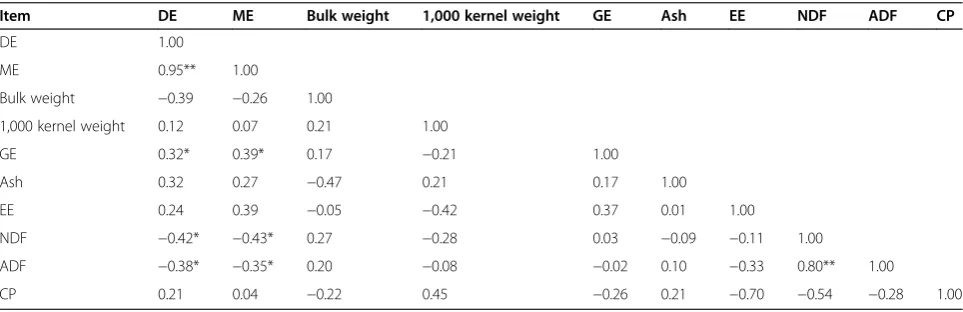
In the 16 corn samples, fibrous compounds had a nega-tive correlation with DE and ME content, while the correl-ation of GE with DE and ME content was positive (Table 5). The NDF content had the highest correlation of any characteristic (chemical or physical) with DE and ME content (r =−0.42; P< 0.01; r =−0.43; P< 0.01), followed by ADF (r =−0.38; P< 0.01; r =−0.35; P< 0.01) and GE (r = 0.32; P< 0.05; r = 0.39; P< 0.05). Interestingly, in the 16 corn samples with a bulk weight between 662.0 and 765.9 g/L, bulk weight was not correlated with DE and ME content ( r =−0.39; P> 0.05; r =−0.26; P> 0.05) (Table 5).
Discussion
Relationships of physical characteristics and energy content
density in wheat samples. Likewise, in poultry, there were no correlations between ME and bushel weight or weight per 1,000 kernels in wheat samples [15,16]. In China, bulk weight is the most important marker of grade index for most feed companies. However, physical parameters such as bulk weight and 1,000 kernel weight cannot be used to estimate nutritional value of corn ac-curately for pigs.
The particle size of corn samples decreased with dry-ing temperature, except for LS1. Drydry-ing temperature has substantial effects on breakage susceptibility, stress cracking, and dry-milling quality [17]. Increasing drying temperature increases breakage susceptibility [18,19].
The reason why particle size of LS1 was not affected by drying temperature may be that the LS1 was the soft corn hybrid.
Effects of variety on the nutritive value of corn
Although special varieties of corn, such as high-oil, high-lysine and NutriDense, were not used in this ex-periment, the results of this study indicate that corn genetics significantly influence the 1,000 kernel weight and available energy content. The DE and ME are the most important parameters used in characterizing the nutritional value of cereal grains for livestock. Although the variety of LS1 was not a NutriDense corn, the DE
Table 3 Effect of variety and drying method on the physical characteristics and starch gelatinization of corns for growing pigs
Item Variety
Sun dried
Artificially dried °C
SEM
P-value1 Variety Drying
method2 Air temperature
LS1 LS2 LS3 LS4 80 100 120 Linear Quadratic
Bulk weight, g 690.0 695.8 709.5 698.92 744.6 702.7 678.6 668.1 10.37 0.58 0.01 0.01 0.01
1,000 kernel weight, g/kg 322.8a 295.4b 276.2c 325.0a 318.4 303.1 300.6 297.4 4.70 0.01 0.01 0.71 0.94
Starch gelatinization of DM, % 17.03 18.24 18.09 15.19 16.42 18.91 18.88 14.33 1.35 0.48 0.37 0.06 0.06
DM, % 88.36 87.78 88.16 88.56 85.68 88.25 89.22 89.71 0.84 0.62 0.01 0.01 0.03
GE, MJ/kg 16.34 16.30 16.38 16.47 15.92 16.40 16.54 16.63 0.18 0.57 0.01 0.08 0.22
Particle size,μm 485.04 502.26 489.66 571.56 529.54 521.83 527.45 469.70 49.24 0.10 0.43 0.27 0.42
1
Interaction between variety and drying method was not significant (P> 0.10).
2
Contrast for Artificial dried vs. sun dried.
a-c
Means followed by the same letter within each row are not significantly different from each other (P> 0.05).
Table 2 Physical and chemical characterization of the corn samplesa
Variety Drying method
1,000 kernel weight, g
Bulk weight g/L
DM, % EE, % NDF, % ADF, % CP, % Ash, % GE,
MJ/kg Starch
gelatinization, % Particle size,μm
LS1 Sundried 330.4 716.2 85.35 3.17 9.15 2.11 7.79 1.25 15.88 12.34 538.09 ± 1.11
80°C 330.7 699.5 88.00 3.52 9.05 1.86 7.84 1.21 16.27 17.26 549.78 ± 1.12
100°C 317.0 662.0 90.63 3.51 9.03 2.20 7.80 1.35 16.92 18.60 619.47 ± 1.11
120°C 313.3 682.3 90.24 3.43 8.82 1.98 7.73 1.22 16.81 12.20 578.91 ± 1.12
LS2 Sundried 282.2 758.6 85.14 3.15 10.28 2.24 7.34 1.12 15.83 14.50 520.46 ± 1.10
80°C 269.5 716.9 88.01 3.74 10.03 2.12 7.38 1.20 16.45 19.92 501.04 ± 1.12
100°C 279.5 692.3 88.21 3.57 9.98 1.90 7.81 1.12 16.31 15.61 481.23 ± 1.09
120°C 273.9 670.5 89.77 3.78 10.05 2.16 7.28 1.19 16.60 13.46 506.32 ± 1.11
LS3 Sundried 304.6 738.2 85.93 3.21 10.49 2.27 7.11 1.17 16.00 15.62 541.38 ± 1.12
80°C 294.8 701.9 88.45 3.18 10.27 2.25 7.50 1.11 16.50 15.82 525.26 ± 1.12
100°C 296.3 678.8 88.93 3.50 10.65 2.37 7.25 1.20 16.45 19.67 512.40 ± 1.12
120°C 286.2 664.5 89.33 3.49 10.04 2.17 7.70 1.28 16.57 13.19 379.59 ± 1.14
LS4 Sundried 356.6 765.9 86.30 3.04 9.85 2.13 8.60 1.11 15.96 13.82 518.24 ± 1.11
80°C 317.4 692.8 88.53 2.85 9.42 2.15 8.91 1.17 16.37 13.73 511.25 ± 1.13
100°C 309.7 681.5 89.10 2.81 10.16 2.57 8.32 1.27 16.48 13.54 496.71 ± 1.12
120°C 316.5 655.5 89.50 2.68 10.28 2.14 8.94 1.29 16.55 12.57 413.96 ± 1.10
a
content in LS1 was 2% greater than in LS4 corn; this is very valuable trait for feed companies. The reason for this observation was the ATTD of nutrients in the LS1 were greater than the other. It is likely that natural dif-ferences among varieties of corn exist, as has been dem-onstrated for corn and other cereal grains [14,20,21] and for sweet lupins [22].
Effects of drying method and drying temperatures on the nutritive value of corn
The EE, NDF, ADF, CP, and ash contents were not sig-nificantly affected by drying temperature. The results are in agreement with those reported by Costa et al. [23]. A brown discoloration and a parched corn odor were also observed by Coates et al. [22] in corn dried at tempera-tures of 138 and 160°C. These characteristics suggest that a Maillard reaction has occurred in the grain kernel
[24]. The parched odor of the corns dried at 120°C might have originated in similar fashion as the flavors from Maillard reaction described by Hathaway et al. [25] and Coates et al. [23]. In this study, drying method affected the bulk weight and 1,000 kernel weight. Other researchers have found that bulk weight and 1,000 ker-nel weight of corn generally decreases with increasing drying temperatures [16,19,26]. A factor that may affect bulk weight and 1,000 kernel weight is artificial drying, which removes moisture within the kernel without chan-ging the kernel size.
With the exception of ATTD of EE, the available en-ergy content (DE of DM; ME of DM) and ATTD of nu-trients were not significantly affected by drying method. These results are in agreement with those reported by Costa et al. [23]. However, the ATTD of NDF and ADF for sundried corn samples were not significantly higher Table 4 Effect of variety and drying method on the nutritive value of corns for growing pigs
Item Variety
Sun dried
Artificially dried °C
SEM
P-value1 Variety Drying
method2 Air temperature
LS1 LS2 LS3 LS4 80 100 120 Linear Quadratic
DE of DM, MJ/kg 16.14a 15.86b 15.86b 15.82b 15.82 16.03 15.92 15.91 0.06 0.01 0.06 0.23 0.45
ME of DM, MJ/kg 15.87a 15.51b 15.61b 15.51b 15.57 15.76 15.63 15.61 0.06 0.01 0.06 0.19 0.40
Digestibility coefficients, %
Organic matter 91.56a 90.10b 90.21b 90.03b 90.24 90.77 90.48 90.41 0.27 0.01 0.31 0.45 0.73
Dry matter 90.03a 88.54b 88.70b 88.62b 88.66 89.43 88.96 88.85 0.30 0.01 0.23 0.20 0.41
Energy 89.58a 88.11b 88.00b 88.24b 88.02 89.04 88.47 88.41 0.34 0.02 0.13 0.21 0.40
NDF 57.01 48.20 45.78 45.24 52.28 50.20 46.33 47.43 3.35 0.09 0.27 0.62 0.78
ADF 51.32 41.94 34.65 34.58 48.54 40.92 36.27 36.76 4.47 0.06 0.06 0.57 0.79
Crude protein 80.81 78.56 76.76 78.56 78.99 79.37 77.17 79.16 1.18 0.15 0.75 0.91 0.38
Ether extract 61.13 65.25 64.07 63.71 59.18 66.46 66.83 67.68 1.39 0.31 0.01 0.53 0.82
1
Interaction between variety and drying method was not significant (P> 0.10).
2
Contrast for Artificial dried vs. sun dried.
a-b
Means followed by the same letter within each row are not significantly different from each other (P> 0.05).
Table 5 Correlation coefficients between chemical and physical characteristics and energy values of corn
Item DE ME Bulk weight 1,000 kernel weight GE Ash EE NDF ADF CP
DE 1.00
ME 0.95** 1.00
Bulk weight −0.39 −0.26 1.00
1,000 kernel weight 0.12 0.07 0.21 1.00
GE 0.32* 0.39* 0.17 −0.21 1.00
Ash 0.32 0.27 −0.47 0.21 0.17 1.00
EE 0.24 0.39 −0.05 −0.42 0.37 0.01 1.00
NDF −0.42* −0.43* 0.27 −0.28 0.03 −0.09 −0.11 1.00
ADF −0.38* −0.35* 0.20 −0.08 −0.02 0.10 −0.33 0.80** 1.00
CP 0.21 0.04 −0.22 0.45 −0.26 0.21 −0.70 −0.54 −0.28 1.00
than for artificially dried samples. The ATTD of nutri-ents and available energy contnutri-ents were not significantly different among corn dried at different temperatures. The percent of starch gelatinization did not increase with drying temperature. Our findings are not in agree-ment with increases in starch gelatinization percentage reported by Costa et al. [16]. The reason may be that the drying time, moisture, and processing condition in this study were not suited for starch gelatinization. Wood [26] showed that a high moisture content (30-50%) is re-quired for efficient gelatinization. Furthermore, when limited amounts of water are present, more heating time is needed to complete drying [27]. Chiang and Johnson [28] and Della Valle et al. [29] reported that decreasing the retention time of the sample during processing de-creased starch gelatinization. There was no extrusion process used in the present study, and the heating time was shorter than that of Costa et al. [16].
Conclusions
In conclusion, variety had a significant impact on the nutritive value of corn for growing pigs. Heat treatment had some effects on the physical characteristics of corn, but this did not affect the nutritive value of corn for swine. These data suggest that greater accountability of these factors is required when assessing the nutritive value of corn for use in pig feed.
Abbreviations
DE:Digestible energy; ME: Metabolizable energy; CP: Crude protein; NDF: Neutral detergent fibre; ADF: Acid detergent fibre; ATTD: Apparent total tract digestibility; EE: Ether extract; GE: Gross energy; DM: Dry matter; RSD: Residual standard deviation.
Competing interests
The authors declare that they have no competing interests.
Authors’contributions
QFL carried out the experiment trial, performed the statistics and drafted the manuscript. SM and XSP participated in design of the study. DWL and SH participated animal trial. DFL and CHL conceived the study, and participated in its design and coordination. All authors read and approved the final manuscript.
Acknowledgements
This research was financially supported by the National Key Technology R & D Program in the 11thFive Year Plan of China (2006BAD12B01) and Special
Public Sector Fund in Agriculture (200903006). Thanks to Chuanxin Shi, Zhongchao Li and Zhaoyu Liu for their practical support.
Received: 22 January 2014 Accepted: 19 March 2014 Published: 22 March 2014
References
1. Adeola O, Bajjalieh NL:Energy concentration of high-oil corn varieties for pigs.J Anim Sci1997,75:430–436.
2. Song GL, Li DF, Piao XS, Chi F, Yang WJ:Apparent ileal digestibility of amino acids and the digestible and metabolizable energy content of high-oil corn varieties and its effects on growth performance of pigs.
Arch Anim Nutr2003,57:297–306.
3. O’Quinn PR, Nelssen JL, Goodband RD, Knabe DA, Woodworth JC, Tokach MD, Lohrmann TT:Nutritional value of a transgenic high-lysine, high-oil corn for
young pigs. InReport of progress (Kansas State University. Agricultural Experiment Station and Cooperative Extension Service); 2010:116–121. 4. Linneen SK, DeRouchey JM, Goodband RD, Tokach MD, Dritz SS,
Nelssen JL, Snow JL:Evaluation of NutriDense low-phytate corn and added fat in growing and finishing swine diets.J Anim Sci2008,
86:1556–1561.
5. NRC:Nutrient requirements of swine 10th rev. ed.Washington DC, USA: National Academy Press; 1998.
6. AOAC:Official methods of analysis.17th edition. Arlington, VA, USA: Association of Official Analytical Chemists; 2000.
7. Thiex NJ, Anderson S, Gildemeister B:Crude fat, diethyl ester extraction, in feed, cereal grain, and forage (Randall/Soxtec/submersion method): collaborative study.J AOAC Int2003,86:888–898.
8. Thiex NJ, Manson H, Anderson S, Persson JA:Determination of crude protein in animal feed, forage, grain, and oilseeds by using block digestion with copper catalyst and steam distillation into boric acid: collaborative study.J AOAC Int2002,85:309–317.
9. Van Soest PJ, Robertson JB, Lewis BA:Methods for dietary fiber and non-starch polysaccharides in relation to animal nutrition.J Dairy Sci 1991,74:3568–3597.
10. Xiong YQ, Bartle SJ, Preston RL:Improved enzymatic method to measure processing effects and starch availability in sorghum grain.J Anim Sci 1990,68:3861–3870.
11. ASAE:Method of determining and expressing fineness of feed materials by sieving. ASAE standard S319.4.St. Joseph, MI: American Society of Agricultural and Biological Engineers; 2008.
12. Bhatty RS, Christison GI, Sosulski FW, Harvey BL, Hughes GR, Berdahl JD:
Relationships of various physical and chemical characters to digestible energy in wheat and barley cultivars.Can J Anim Sci1974,54:419–427. 13. Christison GI, Bell JM:An assessment of bulk weight and other simple
criteria for predicting the digestible energy values of feed grains.
Can J Plant Sci1975,55:515–528.
14. Anderson DM, Bell JM:The digestibility by pigs of dry matter, energy, protein and amino acids in wheat cultivars.I. Glenlea, Neepawa, Inia-66, Pitic-62 and Twin, compared with Bonanza barley.Can J Plant Sci1983,
63:385–391.
15. Stewart AH, Acamovic T, Taylor AG, Fraser H:An evaluation of wheat specific weight as a determinant of nutritive value for pigs and poultry.
Anim Sci1997, 66–66.
16. Costa PM, Jensen AH, Harmon BG, Norton HW:Effects of roasting and roasting temperatures on the nutritive value of high-moisture corn for swine.J Anim Sci1977,44:234–241.
17. Kirleis AW, Stroshine RL:Effects of hardness and drying air temperature on breakage susceptibility and dry-milling characteristics of yellow dent corn.Cereal Chem1990,67:523–528.
18. Peplinski AJ, Brekke OL, Griffin EL, Hall G, Hill LD:Corn quality as influenced by harvest and drying conditions.Cereal Foods World1975,20:145. 19. Gunaskaran S, Paulsen MR:Breakage resistance of corn as a function of
drying rates.Trans ASAE1985,28:2071–2093.
20. Pedersen C, Boersma MG, Stein HH:Energy and nutrient digestibility in NutriDense corn and other cereal grains fed to growing pigs.J Anim Sci 2007,85:2473–2483.
21. Fairbairn SL, Patience JF, Classen HL, Zijlstra RT:The energy content of barley fed to growing pigs: characterizing the nature of its variability and developing prediction equations for its estimation.J Anim Sci1999,
77:1502–1512.
22. Kim JC, Mullan BP, Heo JM, Hernandez A, Pluske JR:Variation in digestible energy content of Australian sweet lupins (Lupinus angustifolius L.) and the development of prediction equations for its estimation.J Anim Sci 2009,87:2565–2573.
23. Costa PM, Jensen AH, Harmon BG, Norton HW:The effects of roasting and roasting temperatures on the nutritive value of corn for swine.J Anim Sci 1976,42:365–374.
24. Moran ET Jr, Summers JD:Heat processing of wheat germ meal and its effect on utilization and protein quality for the growing chick: toasting and autoclaving.Cereal Chem1968,45:304–310.
25. Hathaway IL, Yung FD, Kiesselbach TA:The effect of drying temperature upon the nutritive value and commercial grade of corn.J Anim Sci1952,
11:430–440.
27. Sun Z, Yang W, Siebenmorgen T, Stelwagen A, Cnossen A:Thermomechanical transition of rice kernels.Cereal Chem2002,79:349–353.
28. Chiang BY, Johnson JA:Measurement of total and gelatinized starch by glucoamylase ando-toluidine reagent.Cereal Chem1977,54:429–435. 29. Della Valle G, Tayeb J, Melcion JP:Relationship of extrusion variables with
pressure and temperature during twin screw extrusion cooking of starch.J Food Eng1987,6:423–444.
doi:10.1186/2049-1891-5-18
Cite this article as:Liet al.:Effect of variety and drying method on the nutritive value of corn for growing pigs.Journal of Animal Science and Biotechnology20145:18.
Submit your next manuscript to BioMed Central and take full advantage of:
• Convenient online submission
• Thorough peer review
• No space constraints or color figure charges
• Immediate publication on acceptance
• Inclusion in PubMed, CAS, Scopus and Google Scholar
• Research which is freely available for redistribution