3232
Study Of Thermodynamic And Volumetric
Properties In Some Liquid Mixtures
A.Nagarjuna, G.V.Gangadhara rao, K.Govinda rao, T.Kalimulla
Abstract Densities and Speed of sound for the binary liquid mixtures of cyclohexanone with mole fractions of benzoates – Ethyl-4-hydroxy benzoate and
p-Methoxy benzoic acid have been estimated with the standard technique at 303.15, 308.15 and 313.15K. From these experimental results, different thermo-dynamic parameters such as enthalpy (H), adiabatic compressibility (βs), free length (Lf) ,molar volume (Vm) and their excess properties were determined. These excess parameters have been fitted to the Redlich–Kister type polynomial equation using the least square method. Further estimate the partial molar volumes (V ֿm, 1 ,V ֿm,2) from the results of Vm
E
.The intra/inter molecular interactions presence in the liquid mixtures was perceived by studying the deviations obtained in the excess properties.
Index
terms:
Densities, excess parameters, molecular interactions, partial molar volumes, Redlich–Kister type polynomial, speed of sound, standardtechnique
—————————— ——————————
1
I
NTRODUCTIONPhysico-chemical properties of fluid mixtures are important for understanding their thermo-physical behavior of liquid mixtures .This paper is used to understand the presence of
charge transfer, dipole-dipole and dipole-induced
interactions also hydrogen bonding in the mixture. Ethyl-4-hydroxy benzoate (C9 H10 O3) is the ethyl ester of p-hydroxy
benzoic acid. It is mainly used as antiseptics in cosmetics, food and medicine. It is also can be used as feed preservatives and antiseptic for bacteria. p -Methoxy benzoic acid (C8H8O3) has antiseptic property and it is
soluble in water, alcohols, and ethyl acetate because it is available in powder form. p- Methoxy benzoic acid has a boiling of about 280 o C and a melting of 184o C; it is a
metabolite of aniracetam. Ketones are trigonal
planar around the ketonic carbon, with C−C−O and C−C−C bond angles of approximately 120°.One of the most important ketone is cyclohexanone (C6H10O),it is a liquid
with a sweetish odour. Because of its low boiling point it is one of the few organic compounds that are infinitely soluble in water and it also dissolves many organic compounds. For this reason it is one of the most important industrial solvents being used as paints, varnishes, coatings, and nail-polish remover‘s e.t.c.. In the present study the experimental results of density and speed of sound were used to calculate various excess parameters also fit them into RK polynomial equation for the binary system of Cyclohexanone with benzoates at entire mole fraction range. Similar kinds of results were obtained by earlier workers carried out variety of research investigations on liquid mixtures. [1],[2],[3],[4],[5],[6],[7],[8],[9],[10],[30]
2
P
ROCEDURE FORP
APERS
UBMISSION2.1 Materials and Methods
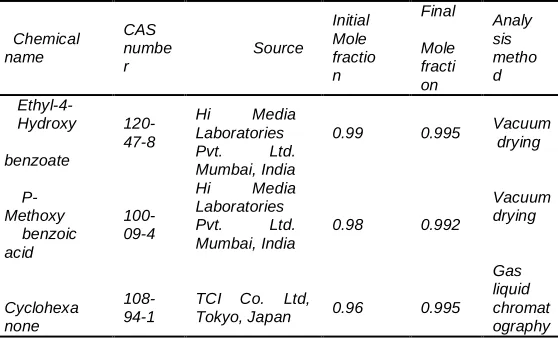
The purity analysis of substances were reported in table 01.The binary liquid mixtures were prepared just before start the experiment for different samples with the help of mass variation. The uncertainty in the final mole fraction was estimated to be less than ±0.0001. p - Methoxy benzoic acid and ethyl-4-hydroxy benzoate can be accessible in powder type and they were soluble in water with mixture of 530 mg/lr and 885 mg/lr at room temperature. The speed of sound was measured at
303.15K, 30815K and 313.15K using ultrasonic
interferometer (M-81S, M/s Mittal Enterprises, New Delhi, India) operating at a fixed frequency of 2 MHz with an accuracy of ±0.1m/s for the binary systems of Cyclohexanone with benzoates. The uncertainty in the speed of sound was found to be ±0.76 m/s. The densities of the pure components and their multi components were measured with 10 ml specific gravity bottle
Table 01: Purity analysis of chemicals studied
inhigh accurate digital electronic balance (Baijnath Premnath SF 400A, Kanpur, U.P) with an accuracy of ±0.00001 g. The uncertainty in the measured density was ±0.003 kg/m 3. The flow time has been measured after the attainment of bath temperature by each pure compound and mixture. The precision of experimentally measured values of density and speed of sound data was compared with their literature values and uncertainties are shown in table 03
3. THEORY
The values of excess properties with mole fraction for the studied binary system at three different temperatures have been calculated by using equations (1) to (5) and they are presented in the figure 1 to 4. Excess isentropic compressibility
Chemical name
CAS numbe r
Source
Initial Mole fractio n
Final
Mole fracti on
Analy sis metho d
Ethyl-4- Hydroxy benzoate
120-47-8
Hi Media
Laboratories
Pvt. Ltd.
Mumbai, India
Hi Media
Laboratories
Pvt. Ltd.
Mumbai, India
0.99 0.995 Vacuum drying
P-Methoxy benzoic acid
100-09-4 0.98 0.992
Vacuum drying
Gas liquid chromat ography
Cyclohexa none
108-94-1
TCI Co. Ltd,
3233
Ks E
= Ks - Ks id
Ks =
Kg
-1
ms -2 (1)
Where Ks
id
is the ideal isentropic compressibility relation recommended by Benson & Kiyohara[31].
Ks id
= ∑ {
( )
} - T (∑ ) (∑
∑ )
(2)
In which Ks i o
, Vio, ὰi o
, Cp,j o
are the isentropic compressibility, molar volume, isobaric thermal expansion coefficient and molar isobaric heat capacity of pure component i, T represents temperature and ɸi is volume fraction
Excess molar volume Vm
E= X
1M1+X2M2/ρ – (X1M1/ρ1 + X2M2/ρ2)
(3)
Excess free length Lf E
=Lf - KT (Ks id
)1/2 Lf= KT√ A o
(4)
KT represent a temperature dependent constant where
KT = (91.368 + 0.3565 T) * 10 - 8
Where R represents gas constant, T is absolute temperature
Excess Enthalpy HE = H-(X1H1 + X2H2) H = πi . V J. mol - 1
(5)
Where internal pressure πi = bRT *
+1/2
*
+ Pa
Where H represents the calculated value of enthalpy, Vm be the molar volume, ρ represent obtained density for the mixture and H1, H2 represents enthalpy X1, X2 represents
mole fractions ρ1, ρ2 be the densities,Vm1, Vm2 represent
molar volumes and M1, M2 represent molecular weights of
pure components 1 and 2, respectively. b stands for the cubic packing factor which is assumed to binary liquids ,K is temperature independent constant, R is the gas constant and T is the absolute temperature of binary mixtures.
The excess values were fitted to a Redlich- Kister type polynomial [22] with nonlinear Least – squares method
YE = X1 (1-X1) Σ
n
i=1 Ai(2 X1 – 1)
i-1
(6)
Standard deviation (σ) = [Σn
i=1(Y E
exp- Y E
cal)/N-m] 1/2
(7)
Where N and m are the numbers of data points and of adjustable parameters, respectively
The partial molar volumes for all the binary systems can be calculated using the formulae
V ֿm,1 =V E
m +V *
1 +X2(ծV E
m/ծX)P,T
(8)
V ֿm,2 = V E
m +V *
2 +X1(ծV E
m/ծX)P,T
(9)
The values of infinite dilution of partial and excess partial molar volumes for the binary system (VE,∞m,1,V
E,∞
m,2) can
be calculated by the following relations. VE,∞m,1= A0+A1+A2+A3+ - - - = V
∞ m,1 –V
* 1
(10)
VE,∞m,2= A0-A1+A2-A3+ - - - = V∞m,2 –V *
2
(11)
V ֿm,1 ,V ֿm,2 bePartial molar volumes, V *
1 , V *
2 are Molar
volumes of pure compounds and the coefficients A0,A1,A2
were calculated with RK polynomial equation
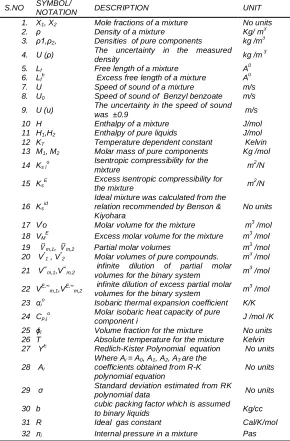
Table 2 List of symbols/Notations
S.NO SYMBOL/ NOTATION DESCRIPTION UNIT
1. X1, X2 Mole fractions of a mixture No units
2. ρ Density of a mixture Kg/ m3
3. ρ1,ρ2, Densities of pure components kg /m
3
4. U (ρ) The uncertainty in the measured
density kg /m
3
5. Lf Free length of a mixture A0
6. Lf E
Excess free length of a mixture A0
7. U Speed of sound of a mixture m/s
8. U0 Speed of sound of Benzyl benzoate m/s
9. U (u) The uncertainty in the speed of sound
was ±0.9 m/s
10. H Enthalpy of a mixture J/mol
11. H1,H2 Enthalpy of pure liquids J/mol
12. KT Temperature dependent constant Kelvin
13. M1, M2 Molar mass of pure components Kg /mol
14. Ks io Isentropic compressibility for the
mixture m
2
/N
15. Ks
E Excess isentropic compressibility for
the mixture m
2
/N
16. Ksid
Ideal mixture was calculated from the relation recommended by Benson & Kiyohara
No units
17. Vio Molar volume for the mixture m3 /mol
18. VM E
Excess molar volume for the mixture m3 /mol
19. ̅m,1, ̅m,2 Partial molar volumes m3 /mol
20. V*1 , V *
2 Molar volumes of pure compounds. m
3
/mol
21. V∞m,1,V ∞
m,2 infinite dilution of partial molar
volumes for the binary system m
3
/mol
22. VE,∞m,1,V E,∞
m,2
infinite dilution of excess partial molar
volumes for the binary system m
3
/mol
23. αi o
Isobaric thermal expansion coefficient K/K
24. Cp,jo Molar isobaric heat capacity of pure component i J /mol /K
25. ɸi Volume fraction for the mixture No units
26. T Absolute temperature for the mixture Kelvin
27. YE Redlich-Kister Polynomial equation No units
28. Ai
Where Ai = A0, A1, A2, A3 are the
coefficients obtained from R-K polynomial equation
No units
29. σ Standard deviation estimated from RK
polynomial data No units
30. b cubic packing factor which is assumed
to binary liquids Kg/cc
31. R Ideal gas constant Cal/K/mol
32. лi Internal pressure in a mixture Pas
Table 03: Comparison of experimental densities (ρ) and
speed of sound (U) of pure liquids with literature Values
Chemical Temp
(K)
Density(ρ) (
kg/m3)
Expt Lit
Speedof sound(U) ( m/s)
Expt Lit
Cp(J/
mol/K ) Ethyl-4-hydroxy benzoate 303.15
K 1.1035 - - - 1523.0
---
304.03b
P-Methoxy benzoic acid
303.15 K 1.1896 - - - 1559.6 --- 204.0b
Cyclohexa
none 303.15 K
0.93 18 0.936 5a 1406 .6 140 7.7a 200.4 b
Standard uncertainties ‗U‘ are U(X1+X2)
=0.0001, U (ρ) = 0.003 kg/m3
, U (u) = 0.76 m/s
a
3234
4 Results and discussion
4.1 Estimation excess thermodynamic parameters From fig 1 βs
E
may be explained high negative values rather than other terms of two opposing effects like breaking of molecular order of liquid mixture, packing of large sized molecules and dipolar interaction as well as hydrogen bonds between unlike components[11],[12],[13],[14]. From
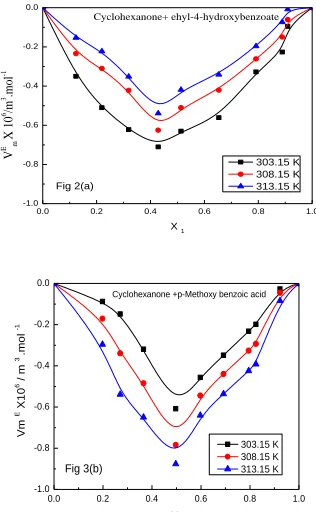
figures 2 and 3 also shows negative values of Vm
E
and Lf E
in the mixture shows negative values for entire mole fraction range. The negative variation signifies strong interactions between the components and it confirms that there exist like molecules and polar components in H-bond formation, also other chemical effects like dispersion and dipolar forces in the components of liquid mixtures [15],[16],[17],[18]
0.0 0.2 0.4 0.6 0.8 1.0
-1.0 -0.8 -0.6 -0.4 -0.2 0.0
S E X
1
0
12 / m 2. N
-1
X1
303.15 K 308.15 K 313.15 K
Cyclohexanone + ethyl-4-hydroxy benzoate
Fig 1(a)
0.0 0.2 0.4 0.6 0.8 1.0
-1.2 -0.9 -0.6 -0.3 0.0
S E X
1
0
12 / m 2. N
-1
X1
303.15 K 308.15 K 313.15 K Cyclohexanone +p-Methoxybenzoic acid
Fig 1(b)
Fig 1(a-b) Variation of excess adiabatic compressibility with respect to mole fraction of Cyclohexanone with Ethyl-4hydroxy benzoate/p-Methoxy benzoic acid at three different temperatures
0.0 0.2 0.4 0.6 0.8 1.0
-0.008 -0.006 -0.004 -0.002 0.000
Lf
E X
1
0
13
/
m
Cyclohexanone + ethyl-4-hydroxy benzoate
X1
303.15 K 308.15 K 313.15 K Fig 2(a)
0.0 0.2 0.4 0.6 0.8 1.0
-0.009 -0.006 -0.003 0.000
303.15 K 308.15 K 313.15 K
Cyclohexanone + p-Methoxy benozoic acid
Lf
E X
1
0
13
/
m
X1
Fig 2(b)
Fig 2(a-b) Variation of excess free length with respect to mole fraction of Cyclohexanone with Ethyl-4hydroxy benzoate/p-Methoxy benzoic acid at three different temperatures
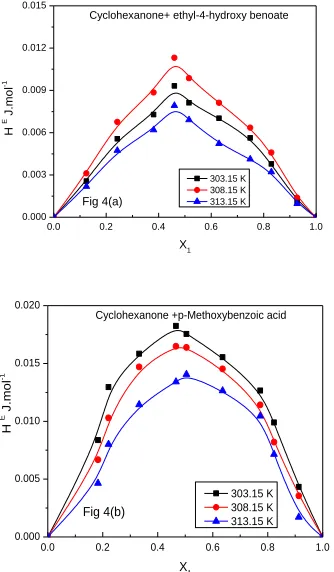
Fig 4 indicates positive variation of HE. The positive variations suggest that there exist weak interactions between the components of liquid mixture .It is observed that the molecular interaction between the components of liquid mixtures shows the non-ideal nature.
0.0 0.2 0.4 0.6 0.8 1.0
-1.0 -0.8 -0.6 -0.4 -0.2 0.0
Fig 2(a)
Cyclohexanone+ ehyl-4-hydroxybenzoate
303.15 K 308.15 K 313.15 K
V
E m
X 10
6/m 3.mol
-1
X 1
0.0 0.2 0.4 0.6 0.8 1.0
-1.0 -0.8 -0.6 -0.4 -0.2 0.0
V
m
E X
1
0
6 /
m
3 .mo
l
-1
X1
303.15 K 308.15 K 313.15 K
Cyclohexanone +p-Methoxy benzoic acid
3235
Fig 3(a-b) Variation of excess molar volume with respect to mole fraction of Cyclohexanone with Ethyl-4hydroxy benzoate/p-Methoxy benzoic acid at three different temperatures
Non-ideal liquid mixtures show considerable deviation from linearity in their physical behavior with respect to concentration and these have been interpreted as arising from the presence of strong or weak interactions[21],[23] .The deviations of theoretical values from the experimental one is due to the presence of molecular interaction, interstitial accommodation as molecules have different sizes and shapes and orientation of molecules etc.
0.0 0.2 0.4 0.6 0.8 1.0
0.000 0.003 0.006 0.009 0.012 0.015
H
E J
.mo
l
-1
Cyclohexanone+ ethyl-4-hydroxy benoate
303.15 K 308.15 K 313.15 K
X1
Fig 4(a)
0.0 0.2 0.4 0.6 0.8 1.0
0.000 0.005 0.010 0.015 0.020
H
E J
.mo
l
-1
X1
303.15 K 308.15 K 313.15 K Fig 4(b)
Cyclohexanone +p-Methoxybenzoic acid
Fig 4(a-b) Variation of excess enthalpy with respect to mole fraction of Cyclohexanone with Ethyl-4hydroxy benzoate/p-Methoxy benzoic acid at three different temperatures
4.2 RK polynomial equation: Authors have already reported
that the excess properties βs
E
, Lf E
, HE and Vm E
showed that
an examination in the trends of deviation dependence on X1
of these systems Cyclohexanone + benzoates, and the differences in interactions are mostly significant in mixtures are very flush in the components. From the treatment of excess thermo physical quantities for liquid mixtures
proposed by Desnoyers and Perron [20]in agreement with
the original statements of Redlich and Kister from equation (6&7), the table 4 conclude that the excess quantity (βs
E
, Lf
E
,HE and Vm E
) gives an overall view of the spring of the non-ideality in the mixtures but still can be quite evasive, especially for systems that shows strong interactions at huge suffusion.[27],[28],[29]
Table 04 Parameters (A k) and Standard Deviation (σ) for Cyclohexanone with ethyl -4-hydroxy benzoate/p-Methoxybenzoic acid at T= 303.15 K, 308.15K and 313.15K
parameter Temp(K) A0 A1 A2 σ
Cyclohexanone + ethyl-4-hydroxy benzoate
1012βS E
/(m2.N
-1
)
303.15 2.1706 -1.0728 -0.8269 0.3307
308.15 1.8284 -0.3832 -1.8109 0.2501
313.15 2.3340 -1.4372 -0.3082 0.3701
1013Lf E
/ (m)
303.15 7.1126 -5.8163 -2.9961 1.1245
308.15 11.0968 -9.6586 -2.5353 1.8117
313.15 12.3110 -12.5484 -3.1692 2.0385
106
VE/(m3.mol-1)
303.15 0.5758 0.1866 -0.3200 0.1384
308.15 0.6614 -0.0137 0.0292 0.1456
313.15 0.2921 0.0766 -0.2655 0.0668
HE/(J.mol-1)
303.15 0.0266 0.0065 -0.0265 0.0014
308.15 0.0421 -0.0003 0.0015 0.0010
313.15 0.0343 0.0072 -0.0068 0.0008
Cyclohexanone + p-Methoxy benzoic acid
1012βS E
/(m2.N
-1
)
303.15 -1.4711 -0.8596 0.1050 0.2588
308.15 -17347 -1.0377 0.1270 0.3098
313.15 -1.9373 -1.0147 0.2896 0.3396
1013LfE/ (m)
303.15 -17.3827 -8.7204 4.0539 2.9144
308.15 -20.5265 -9.0227 1.8669 3.5182
313.15 -23.2274 -9.7134 2.3137 3.9644
106
VE/(m3.mol-1)
303.15 2.3712 -0.1227 -1.0137 0.6402
308.15 2.7109 -0.0338 0.0471 0.8217
313.15 3.0296 0.1104 1.0045 0.9956
HE/(J.mol-1)
303.15 0.0426 0.0027 -0.0314 0.0008
308.15 0.0541 -0.0047 0.0005 0.0010
313.15 0.0467 -0.0042 -0.0125 0.0009
4.3 Estimation of Partial molar volumes
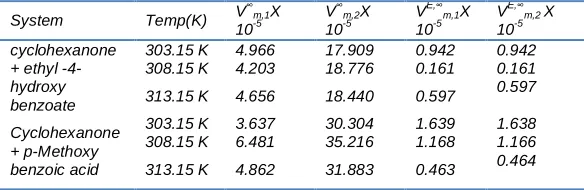
The molecular interactions present in the Cyclohexanone + benzoates are also reflected in terms of partial molar volumes .The obtained values of partial molar volumes are reported in Table 5 , also tabulated the infinite dilution values of partial molar volume and Excess partial molar volumes in table 6. By observing the below tables all the estimated values are positive, from which it concludes that weak interactions exist among the taking liquid mixtures are due to geometrical factors, hydrophilic interactions gives the higher degree of dissociation of solute-solute and solvent-solvent results in liquid mixtures[25],[26],[28]
Table 05 Partial molar volumes for Cyclohexanone with ethyl -4-hydroxy benzoate / p-Methoxy benzoic acid at
different temperatures Mole
fraction
cyclohexanone + ethyl -4-hydroxy benzoate
Mole fraction
Cyclohexanone + p-Methoxy benzoic acid V ֿm ,1x10
-5 V ֿm ,2x10
-5 V ֿm
,1x10-5 V ֿm ,2x10
-5
303.15K
0.0000 4.966 18.851 0.0000 3.637 21.389
0.1027 4.820 78.183 0.1581 4.457 97.962
0.1887 4.667 62.015 0.2236 4.273 53.068
0.2346 4.414 25.194 0.3357 4.097 52.232
0.3928 4.133 47.851 0.4657 3.876 14.318
0.4746 4.051 60.214 0.5445 3.255 15.419
0.5874 4.172 51.929 0.6930 2.774 73.431
0.6777 3.864 28.635 0.7195 4.284 19.473
0.7435 4.857 16.621 0.8173 3.101 27.124
0.9052 3.655 19.153 0.9583 4.953 21.294
1.0000 4.024 17.909 1.0000 5.276 23.027
308.15K
0.0000 4.203 18.937 0.0000 6.481 21.421
0.1027 4.128 65.891 0.1581 7.990 14.813
0.1887 4.192 13.564 0.2236 7.408 71.086
3236
0.3928 4.061 62.352 0.4657 5.817 25.180
0.4746 4.116 80.716 0.5445 3.851 26.389
0.5874 4.330 68.170 0.6930 3.489 12.756
0.6777 3.830 33.351 0.7195 4.105 20.164
0.7435 5.245 15.556 0.8173 3.098 29.619
0.9052 4.319 19.283 0.9583 6.353 22.107
1.0000 4.042 18.776 1.0000 5.313 22.587
313.15K
0.0000 4.656 19.037 0.0000 4.862 21.695
0.1027 4.317 26.288 0.1581 3.122 12.481
0.1887 4.199 24.678 0.2236 4.911 42.876
0.2346 4.226 16.830 0.3357 4.741 15.523
0.3928 4.260 71.295 0.4657 3.919 33.000
0.4746 4.179 14.148 0.5445 3.325 35.586
0.5874 4.070 44.183 0.6930 5.624 20.457
0.6777 4.247 14.477 0.7195 4.095 22.017
0.7435 3.583 20.262 0.8173 3.873 40.669
0.9052 7.773 18.902 0.9583 3.415 22.199
1.0000 4.059 18.440 1.0000 5.325 22.159
Table 06 Values of partial molar volume of the components
at infinite dilution (V∞m,1, V∞m,2) and excess partial molar
volume at infinite dilution (VE,∞m,1and VE,∞m,2) for all the
systems at three different temperatures
System Temp(K) V
∞
m,1X
10-5
V∞m,2X
10-5
VE,∞m,1X
10-5
VE,∞m,2 X
10-5 cyclohexanone
+ ethyl -4-hydroxy benzoate
303.15 K 4.966 17.909 0.942 0.942
308.15 K 4.203 18.776 0.161 0.161
313.15 K 4.656 18.440 0.597 0.597
Cyclohexanone + p-Methoxy benzoic acid
303.15 K 3.637 30.304 1.639 1.638
308.15 K 6.481 35.216 1.168 1.166
313.15 K 4.862 31.883 0.463 0.464
5.
C
ONCLUSIONExperimental results for Cyclohexanone with benzoates from 303.15K - 313.15K using standard techniques were tabulated, thermo physical properties and their excess data were computed by the obtained data also compared using the literature, due to charge transfer forces positive /negative values given by Lf
E, β s
E, HE and V m
E for all
systems over entire mole fraction at three different temperatures .The values of standard deviation and coefficients were obtained by fitting the excess parameters into Redlich-Kister polynomial equation. The determined values of partial molar volumes (V ֿm,1 ,V ֿm,2) reflects the
conclusion drawn from Vm
E
and the results explicit volumetric properties of binary system. This deviation in between molecules may be attributed in these properties for the polar- polar and non polar-non polar interaction between the molecules entire mole faction range.
A
CKNOWLEDGMENTAuthors are thankful to their research guide Dr. Shaik Babu, Dept. of physics (DST-FIST) sponsored department, K L E F, Deemed to be University, Guntur, A.P, India for his valuable suggestions and discussions. "Dr.Shaik.Babu
would like to thank Department of Science and
Technology (DST), Govt. of India, for the award of
DST-FIST Level-1 (SR/FST/PS-1/2018/35) scheme to
Department of Physics, KLEF"
R
EFERENCES[1] ]P. Nagababu, Shaik. Babu, Dheiver F. Santos ,
M. Gowrisankar, ― Binary mixtures of 2-
methoxyaniline with various functional groups (Thermodynamic and transport properties),‖Chem. data collect, vol.20 , no.2, pp. 100196, 2019
[2] Rodolfo R. Holanda, Dheiver F. Santos, Tatiana G.
D. Da Silva, Shaik.Babu, Cesar C.
Santana,Walisson J. Souza, ‖Molecular dyna
mics of acetate-based ionic liquids‖ Bull. Mater. Sci, vol 42 , no 3 ,2019
[3] Dheiver F. Santos, Shaik.Babu,‖Estimation of
Structural Parameters of Protic Ionic Liquids for Activity Coefficient Models and Calculations of LLE Phase Diagrams‖, Rus. J. Phys. Chem-A , vol.93, no.7, pp. 1312-1316, 2019
[4] K. Govinda Rao, Shaik. Babu ―Acoustic
Properties of Binary Liquid Mixtures Containing Dimethyl Formamide with Anilines At Different Temperatures‖, J.Pharm. Sci. Res, vol.11 no. 5,pp. 1930-1936, 2019
[5] K. Govinda Rao , Shaik. Babu ―Acoustic properties
of binary liquid mixtures containing n-Methyl formamide with anilines at different temperatures‖ Ras. J. Chem, vol.12, no.3, pp. 1110-1116,2019
[6] Shaik Parveen Sulthana, M. Gowrisankar,
Shaik.Babu, Dheiver Santos ―Investigation of ketoniceffect in molecular interactions of 2-methylcyclohexanone with aniline, N-methyl aniline and N,N-dimethyl aniline at various temperatures‖ Int.J. Ambt. Ene, pp. 1-11, 2019
[7] T.Kalimulla, Shaik.Babu, D.Das, M.Gowrisankar,
K.Govindarao‖Ultrasonic Investigations InBinary Liquid Mixtures Of 2- Methylcyclohexanone With Formamide,N-Methylformamide And N,N-Dimethyl forma ide At Different Temperatures‖ J.Pharm. Sci. Res, vol.11, no.7 , pp. 2645- 2655,2019
[8] T.Kalimulla, D.Das, M.Gowrisankar, K.Govindarao,
Babu.Shaik ―Thermodynamic and acoustic studies on various binary liquid mixtures‖ Ras.J.Chem, vol.12, no.4, pp. 1909-1918,2019
[9] T.Kalimulla, Shaik.Babu‖Excess Properties and
Partial Molar Volume of Binary Mixtures of amides with O-Chloroaniline‖Int. J.App.Eng.Res, Vol.14, no. 19, pp. 3787-3796, 2019
[10]D. Das, Shaik. Babu, S. Slama, N.O. Alzamel, F. Alakhras, N. Ouerfelli ―Investigation of molecular interaction in benzene + cyanex 923 binary mixtures of at 298.15 K with reduced Redlich-Kister functions‖ Rus. J.Phys. Chem-A, Vol.93, no.13, pp. 93-99, 2019
[11]D.Das, Shaik.Babu, N.Ouerfelli ―Corrigendum on
―Studies on molar volume, dielectric properties
and refractive indices of cyanex 923 +
benzene/xylene at 300 K‖J.Mol. liqds, vol.266, pp. 62-64,2018
[12]Shaik.Babu, R.Trabelsi, T.Srinivasa krishna,
N.Ouerfelli, A.Toumi‖Reduced Redlich–Kister
functions and interaction studies of Dehpa + Petrofin binary mixtures at 298.15 K‖ Phys . Chem. liqds, vol.57, no.4, pp. 536-546, 2019
[13]A.Nagarjuna, Shaik.Babu, K.Govinda rao,
N,N-3237
Dimethylaniline at Different Temperatures ‖ Asian. J. chem, vol. 30 , no.9, pp. 2008-2012, 2018
[14]A.Nagarjuna, Shaik.Babu ―Speed of Sound Studies
and behavior of Intermolecular Interactions of Benzyl Benzoate with acetone at different temperatures‖ Int. J.Engg. Sci. Inv, Special issue pp. 33-38,2018
[15]A.Nagarjuna, Shaik.Babu ―Viscometric and speed
of sound studies of the binary liquid mixtures of acetone with 2-propanol at 303.15K‖ Int. J.Engg. Sci. Inv, Special issue pp. 28-32,2018
[16]P.Nagababu, Shaik.Babu, Dheiver F. Santos,
M.Gowrisankar ― Investigation of molecular Interactions in binary mixtures of homologous series of aliphatic alcohols with 2-methyl cyclohexanone at various temperatures‖ Phys. Chem. Liqs .
[17]K.Govinda rao, M.Gnana kiran, Shaik.Babu,
D.Santos, ―Correlation studies of alkyl benzoates with alkanols at different temperatures‖ J.pharm. sci. res, Vol. 9, no. 5, pp. 624-628, 2017
[18]R.Trabelsi, Shaik.Babu, H.Salhi, N.Ouerfelli,
A.Toumi ―Investigations of the reduced Redlich-Kister excess properties of 1,4-dioxane+isobutyric acid binary mixtures at temperatures from 295.15K to 313.15K‖, Phys. Chem. liqds. Accepted (in press)
[19]S Thirumaran, J Ramesh ,‖Acoustic and excess
thermodynamical studies on 1-alkanols with dma in cyclohexanone at different temperatures‖, Ras. J. Chem ,Vol.2 , no.3, pp. 733-739,2009
[20]J E Desnoyers , G Perron ,‖Treatment of excess thermodynamic quantities for liquid Mixtures‖, J. sol. Chem,Vol. 26, no 8 , pp.749-755,1997
[21]R Kumar , S Jayasankar, V Kannappan , ‖Study of
molecular interactions in binary liquid mixtures‖ , IJPAP ,Vol.46, pp. 169-175,2008
[22]O Redlich , AT Kister ,‖Algebraic representation of
thermodynamic properties and the classification of solutions‖, Ind Eng Chem, Vol.40 , pp.345– 348,1948
[23]H. Salhi, Shaik. Babu, N. Al-Eidan, N.H. Mekni, N.
Al-Otaibi, K.Y. Alqahtani, N.A.Al-Omair, N.
Ouerfelli,‖On the reduced Redlich-Kister excess properties for 1,2-dimethoxyethane with propylene carbonate binary mixtures at temperatures (from 298.15 to 318.15) K‖. Med. J.Chem, Vol. 6, no.2 , pp. 33-41, 2017
[24]R C Reid, J M Prausnitz, B E Poling, ―The
Properties of Gases and Liquids‖, 5th
ed, (McGraw Hill book company, New York,1987)
[25]MF Hossain ,TK Biswas , MN Islam ,‖ Volumetric
and Viscometric studies on dodecyl
trimethylammonium bromide in aqueous and in aqueous amino acid solutions in premicellar region‖, Monat. Chem, Vol. 141,pp. 1297–1308, 2010
[26]J M McDowall, C A Vincent, ‖Viscosity behavior of
some simple electrolytes informamide solution‖. J .Chem. Soc, Faraday Transactions 1: Phys Chem in Condensed Phases, Vol. 70, pp.1862-1868,1974
[27]A.Nagarjuna, KV Yamini Kanth, G. Balaji Prakash,
Debashis Das,‖Molecularinteractions in binary liquid mixtures containing benzyl benzoate‖, Ras. J. Chem Vol.12, no. 4 , pp.1774 – 1782, 2019
[28]A. Nagarjuna, Shaik.Babu, K.Govinda rao, T.
Kalimulla, G.V Gangadhar rao, ―Thermo-
[29]acoustical and molecular interaction studies in
binary liquid mixtures at different tempera tures,‖ International journal of applied physics(SSRG-IJAP), Vol.5, no.3, pp. 11-21,2018 Sk.Suriya
shihab, K. Govinda rao, M.Gnana Kiran,
Shaik.Babu, S.Sreehari Sastry, ‖Excess
thermodynamic and acoustic properties for
equimolar mixture of methyl benzoate and alkanols with benzene at 303.15 K,‖ Ras. J.Chem, Vol.10, no. 1 pp.59-63, 2017
[30]A.Nagarjuna, Shaik.Babu, K. T.Kalimulla,G.V
Gangadhar rao, ―Investiga tion of inter molecular interactions in binary liquid mixtures‖Recent trends in Physics, chemistry and Allied sciences, Book chapter 19, pp.111-116, Sep 2019