R E V I E W
In Quest of Pathognomonic/Endophenotypic Markers
of Attention De
fi
cit Hyperactivity Disorder (ADHD):
Potential of EEG-Based Frequency Analysis and ERPs
to Better Detect, Prevent and Manage ADHD
This article was published in the following Dove Press journal: Medical Devices: Evidence and Research
Priya Miranda
1Christopher D Cox
2Michael Alexander
1Slav Danev
3Jonathan RT Lakey
11Department of Surgery and Biomedical Engineering, University of California Irvine, Irvine, California, USA;
2Department of Neurology, David Geffen School of Medicine, University of California, Los Angeles, California, USA; 3Medeia Inc, Santa Barbara, CA, USA
Abstract:
Attention de
fi
cit hyperactivity disorder (ADHD) is a chronic heritable
develop-mental delay psychiatric disorder requiring chronic management, characterized by
inatten-tion, hyperactivity, hyperkinectivity and impulsivity. Subjective clinical evaluation still
remains crucial in its diagnosis. Discussed are two key aspects in the
“
characterizing
ADHD
”
and on the quest for objective
“
pathognomonic/endophenotypic diagnostic markers
of ADHD
”
. The
fi
rst aspect brie
fl
y revolves around issues related to identi
fi
cation of
pathognomonic/endophenotypic diagnostic markers in ADHD. Issues discussed include
changes in ADHD de
fi
nition, remission/persistence and overlapping-symptoms cum
shared-heritability with its co-morbid cross-border mental disorders. The second aspect discussed is
neurobiological and EEG-based studies on ADHD. Given the neurobiological and temporal
aspects of ADHD symptoms the electroencephalograph (EEG) like NeuralScan by Medeia
appears as an appropriate tool. The EEGs appropriateness is further enhanced when coupled
with suitable behavior/cognitive/motor/psychological tasks/paradigms yielding EEG-based
markers like event-related-potential (ERPs like P3 amplitudes and latency), reaction time
variability (RTV), Theta:Beta ratio (TBR) and sensorimotor rhythm (SMR). At present, these
markers could potentially help in the neurobiological characterization of ADHD and either
help in identifying or lay the groundwork for identifying pathognomonic and/or
endopheno-typic EEG-based markers enabling its diagnosis, treatment and management.
Keywords:
ADHD, EEG, event related potential, reaction time
Introduction
While attention de
fi
cit hyperactivity disorder (ADHD) carries the distinction of
being among the most well-researched mental disorders still challenges remain
regarding its diagnosis, management and treatment. For instance, to date diagnosis
is based on subjective clinical examination using standard questionnaires and tests
that capture impairments in behavior and cognition.
1–7As ADHD traits (inattention, hyperactivity, hyperkinectivity and impulsivity)
have both a neurobiological and temporal aspect state-of-the-art
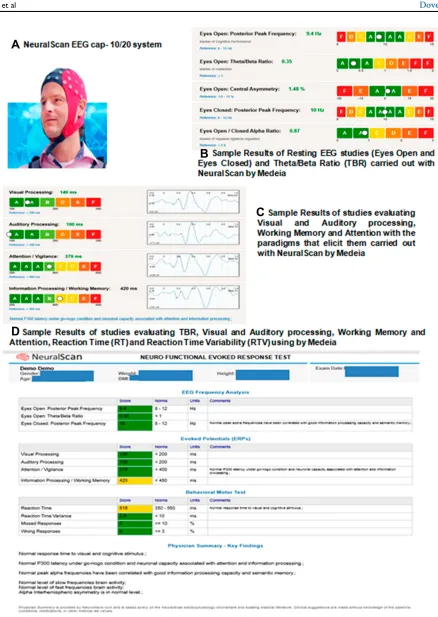
electroencephalogra-phy (EEG) machines like NeuralScan by Medeia (
Figure 1
) with its easy-to-wear
reusable 10/20 system EEG caps, user/clinician-friendly software and cloud-based
reporting make neurobiological characterization of ADHD possible. However, while
EEG-based con
fi
rmation of ADHD has received FDA approval, it has yet to be
Correspondence: Jonathan RT Lakey Department of Surgery, 333 City Blvd West, Suite 1600, Orange, CA 92868, USA
Tel +1-949-824-8022 Fax +1-714-456-6188 Email [email protected]
Medical Devices: Evidence and Research
Dove
press
open access to scientific and medical researchOpen Access Full Text Article
Medical Devices: Evidence and Research downloaded from https://www.dovepress.com/ by 118.70.13.36 on 24-Aug-2020
Figure 1EEG-based frequency analysis using (A) NeuralScan by Medeia showing demo results of: (B) Resting EEG (Eyes Open and Eyes Closed) and Theta/Beta ratio, (C) Visual and Auditory processing, Working Memory and Attention and (D) Theta/Beta ratio, Visual and Auditory processing, Working Memory, Attention Reaction Time (RT) and Reaction Time Variability (RTV).
Medical Devices: Evidence and Research downloaded from https://www.dovepress.com/ by 118.70.13.36 on 24-Aug-2020
approved in instances where the clinical diagnosis of
ADHD is negative, the aim being to prevent
over-diagnosis and misover-diagnosis.
8Recent features like
quantita-tive electroencephalogram (qEEG) and low-resolution brain
electromagnetic tomography (LORETA) have added both
a power and spatial component to EEG analysis.
9–11With
these new features, one can measure, capture and record
from Theta:Beta ratio (TBR) to a whole range of
EEG-based frequency analysis (alpha,
α
, beta,
β
, theta,
θ
, delta,
δ
,
gamma,
γ
, mu, sensorimotor rhythm (SMR)) to
event-related-potential (ERPs) components (P1, N1, P2, N2, P3,
N3, ERN, Pe, CNV, RT, amplitudes and latency) to reaction
time variability (RTV) to power and source analysis.
Furthermore depending on the paradigms and tasks used
to elicit these ERPs one can now achieve better
neurobio-logical, behavioral and psychological characterization and
guide management of ADHD. Thus, EEG machines like
NeuralScan are fast becoming potential pathognomonic
diagnostic tools.
Clinicians could easily study and assess
(a) Neurobiological and EEG-based risk factors of
cognitive impairment, hyperactivity and attention
that will either be potential markers or modi
fi
able
traits,
(b) responder and non-responders to treatment via
medication/behavioral therapy/neurofeedback,
(c) heritable brainwave alterations exclusive to ADHD
or shared with it co-morbid psychiatric disorders
and
(d) tailor treatment.
Taken together the EEG-based
fi
ndings could in turn add
enormous value in the quest for brain-based
pathognomo-nic and endophenotypic markers of ADHD. The bene
fi
t of
endophenotypic markers of ADHD would be that
diagno-sis would be more objective and less symptom-based
especially in light of symptom overlaps with other
cross-border co-morbid mental disorders. However,
endopheno-typing ADHD comes with its own challenge is that ADHD
also shares heritable traits with some of its co-morbid
mental disorders. With this in mind we sought to consider
together I) challenges in identifying markers of ADHD,
current II) neurobiology and III) EEG-based aspects on
ADHD in the hope of either identifying or laying the
framework for identi
fi
cation of potential pathognomonic/
endophenotypic markers of ADHD.
Challenges in Identifying
Endophenotypic/Pathognomonic
Markers of ADHD
Changes in Diagnostic Criteria
Changes in diagnostic criteria impact on: prevalence,
inci-dence, conversion and remission rates, comparison across
studies and long-term follow-up studies. The nosology of
ADHD has changed from the
“
incapacity to attend
”
to
a
“
Neurodevelopmental Neurocognitive Disorder
”
.
12–15Developments in neuropsychology, neuroimaging,
epide-miology,
genetics,
and
pathophysiology
contributed
to
Diagnostic
and
Statistical
Manual
for
Mental
Disorders (DSM) DSM-VI/DSM-VI-TR
’
s classi
fi
cation of
ADHD as ADHD with inattention (ADHD-I), hyperactivity
(ADHD-H), and combined (ADHD-C) subtypes.
5Barkley
further described ADHD.
as a disorder of executive dysregulation (in behavioral
inhibition, working memory, motivation, and motor
con-trol) rather than simply of attention and hyperactivity
16Barkley worked to ensure it was distinct from concentration
de
fi
cit disorder (CDD).
16–19Further developments in
mole-cular biology, psychometrics, and cognitive and affective
neurosciences led to ADHD being classi
fi
ed under
“
Neurodevelopmental
Disorders
”
and
“
Neurocognitive
Disorders
”
in DSM-V requiring symptoms to be present in
two or more environments.
6Based on the current de
fi
nition
of ADHD its prevalence is 2.2% in children which translates
to 1:45 children and 2.8% in adults, i.e. 1:36 adults. 50
–
65%
of childhood ADHD persists into adulthood with the
persis-tence rate of childhood ADHD being 47.4%. The higher
adult prevalence rate seen is a re
fl
ection of conversion of
children who were originally below the diagnostic thresholds
and self-reported or new cases of adult ADHD.
20–22Overlapping Symptoms of Cross-Border
Cum Co-Morbid Mental Disorders
While symptoms/behavior manifesting as a spectrum of
hues, tones, tints and shades, were originally used to frame
the diagnostic criteria they have also added to the confusion
due to symptom-sharing between cross-border cum
co-morbid mental disorders.
6,7,23,2480% of individuals with
adult
ADHD
have
at
least
one
other
co-morbid
condition.
23–27While the general consensus is to treat the
dominant functionally impairing illness the overlapping
symptoms make clear-cut diagnosis, treatment and
determi-nation of the burden of disease challenging
28–31Figure 2A
Medical Devices: Evidence and Research downloaded from https://www.dovepress.com/ by 118.70.13.36 on 24-Aug-2020
Individuals (%) with Other Mental Disorders with ADHD (n=349)
Within the ADHD (n=349) group Individuals (%) with
Other Mental Disorders
Deberdt W et al, BMC Psychiatry. 2015
12.5
10.8
15.8
16.7
18.6
23.3
0
5
10
15
20
25
Major Depressive Disorder (n=1468)
Bipolar Disorders (n=268)
Generalized AD (n=803)
Antisocial PD (n=24)
Borderline - PD (172)
Substance- Use Disorder (SUD)
(Eating/ Alcohol/ Substance
-Abuse/Dependence) (n=545)
Moo
d Diso
rdere
rs
Anx
iety
Dis
order
Pe
rsona
lity
Dis
order
s (PD)
Oth
er
Percentage (%)
A
B
Figure 2(A) ADHD and its cross-border co-morbidities: Illustration of symptom sharingandsymptoms unique.6,7
Percentage of Individuals with ADHD and selected symptom sharing (cross-border) psychiatric comorbidities (32).
Medical Devices: Evidence and Research downloaded from https://www.dovepress.com/ by 118.70.13.36 on 24-Aug-2020
provides an illustration of symptoms shared by and
symp-toms that distinguish ADHD and other mental disorders.
6,7Figure 2B
presents the results of a multinational
cross-sectional study in Europe to estimate the prevalence of
ADHD in adult outpatient psychiatric care facilities. Out of
n=2284 individuals included in the study, 349 had ADHD
(17.4%, n=2009 screened using DSM-V).
32Within the
ADHD subgroup (pie diagram) major depressive disorder
(MDD), generalized anxiety disorder (generalized AD) and
substance use disorder (SUD) were the most common
co-morbidities. Study results of the Regional ADHD Registry
database at 18 tertiary care ADHD centers (n=2861) in Italy
between 2011 and 2016 period were, 67% (n=1919) had
ADHD, among whom 34% (n=650) had ADHD alone and
the remaining had ADHD+
≥
1mental health co-morbidity
(learning disorders/sleep disorders/oppositional de
fi
ant
dis-order/anxiety disorders).
33The implications for
neurobiolo-gical and EEG-based studies on ADHD are overlapping
symptoms that could extend to overlaps in neurobiological
and EEG patterns.
Heritability of ADHD and Shared
Heritability of Its Co-Morbidities
Compounding the issue is the heritability and at times
shared heritability of both ADHD and its co-morbidities
and that ADHD is a heterogenous disorder with many
subtypes (ADHD-I, ADHD-H, and ADHD-C). Genetic
studies on ADHD include a) family, b) twin, c) candidate
genes, d)genome-wide approaches (GWAS), e) copy
num-ber variations (CNV), f) environmental risks and g)
endophenotypes.
34–47Siblings of ADHD probands are at
9-times greater risk of ADHD with twins both
monozygo-tic: MZ and dizygomonozygo-tic: DZ, sharing 100% and 50% genetic
inheritance, respectively, as well as environmental
expo-sure exhibit a heritability of ADHD of ~75%.
34–36A GWAS study worth mentioning in detail is one
carried out by the Brain Consortium (
Figure 3
) to
quan-tify the degree of overlap of genetic risk factors involved
in 10 psychiatric and 15 neurological disorders also
looking at 17 behaviour-cognitive phenotypes among
265,218 patients and 784,643 control participants (total
Attention Deficit Hyperactivity Disorder (ADHD), Autism Spectrum Disorder (ASD), Major Depressive Disorder (MDD), Anxiety disorders (generalized anxiety disorder, panic disorder, social phobia, agoraphobia, and specific phobias), Obsessive-Compulsive Disorder (OCD), Post-Traumatic Stress Disorder (PTSD) and Body Mass Index (BMI)
Additional Phenotypes
Cognitive
Smoking related Personality Types
Behav
ioral Cognitiv
e
Phenot
y
p
es
ADHD
Color Key-p-value0.8
0.6
0.4
0.2
0.05
0.001
<3.35x10⁴
Color Key -Genetic Correlation
0.8
0.6
0.4
0.2
0
-0.2
-0.4
-0.6
-0.8
-1
1 Color
Key-p-value
0.8
0.6
0.4
0.2
0.05
0.001
<2.30x10⁴
ADHD
Correlation between ADHD
& 9 Psychiatric Phenotypes
##
Correlation between ADHD & 16
Behavioral-Cognitive-and-Other Phenotypes ###
## Data from 1,58,028 patients and 3,65,993 control participants totaling 5,24,021 participants ### Data from 11,24,048 participants
Brainstorm Consortium, Anttila V, Bulik-Sullivan B, et al. Science. 2018
Figure 3Correlation illustrating the shared genetics of adhd with selected psychiatric co-morbidities and behavioral-cognitive phenotypes.
Medical Devices: Evidence and Research downloaded from https://www.dovepress.com/ by 118.70.13.36 on 24-Aug-2020
of 1,191,588 individuals).
46Results indicated that while
neurological disorders appeared distinct from each other
in terms of genetic risk, psychiatric disorders showed
a high degree of genetic correlation with each other.
Presented in
Figure 3
is the correlation between ADHD
and the other psychiatric disorders and the correlation
between ADHD and the behavioral-cognitive
pheno-types. This shared genetic etiology highlights the need
to re-de
fi
ne both clinical and diagnostic boundaries to
prevent diagnostic misclassi
fi
cation. Further,
endopheno-typing strategies need to ensure they re
fl
ect phenotypic
heterogeneity that correlates with genetic correlations
where psychiatric disorders are concerned.
Neurobiological Studies on ADHD
De
fi
cits in working memory, cognitive
fl
exibility, attention
and inhibition are seen in ADHD.
48–50Both magnetic
resonance imaging (MRI) and fMRI had highlighted the
role of
(a) The frontoparietal, dorsal frontostriatal composed
of the dorsolateral prefrontal cortex (PFC), dorsal
striatum (DS), and the thalamus: attention and
attention orientation),
(b) mesocorticolimbic circuits composed of the
orbito-frontal cortex (OFC), ventral striatum and nucleus
accumbens (NAcc), ventral tegmental area (VTA),
and anterior hippocampus: reward and emotional
processes, ie, motivation, frustration tolerance,
and reward anticipation and
(c) the default mode network (DMN) that includes the
medial prefrontal cortex (mPFC), posterior
cingu-late cortex (PCC), and cingu-lateral parietal cortex (LPC)
and the cognitive control networks (CCN) that
includes
the
dorsolateral
prefrontal
cortex
(DLPFC), anterior insular cortex (AIC), and
supra-marginal gyrus (SMG) in ADHD.
Studies on whole-brain structural MRI showed volumetric
reductions in the basal ganglia in children with this
reduc-tion attenuating by adulthood.
51–53These
fi
ndings help
establish ADHD as a disorder that involved delayed
neu-robiological development. Another
fi
nding that supported
this view was a longitudinal study of 223 children with
ADHD with 223 healthy controls which demonstrated that
ADHD children were 2
–
5 years behind in achieving
simi-lar cortical thickness as healthy controls.
54–56Studies on neural connectivity in ADHD using
diffu-sion MRI (dMRI) showed decreased fractional anisotropy
(anterior corona radiata, internal capsule, and forceps
minor and reduced orbitofrontal white matter organisation
(mesocorticolimbic circuits)).
57–59Resting-state functional
connectivity showed reduced connectivity within the
DMN and task-based functional connectivity revealed
increased activity for rest or introspective thought/tasks;
while in controls DMN deactivation occurred as they
transitioned to extrospective tasks a reduction in
deactiva-tion was seen in ADHD, which is possibly the cause of
lapses or errors in goal-directed behavior.
60–64In terms of
inhibitory control, a study of 287 individuals with ADHD
and 320 healthy controls found that those with ADHD
exhibit reduced activation in frontostriatal regions
includ-ing the right inferior frontal cortex, striatum, and
supple-mental motor cortex during tasks requiring response
inhibition.
64–66Functional MRI and diffusion tensor imaging studies
have revealed impairments in prefrontal-striatal networks
(inattention) and frontal-limbic networks (hyperactivity),
over-activation of DMN-activation of fronto-striatal and
fronto-parietal circuits, other frontal brain region and
sys-tems involved in executive function and attention to be
implicated in ADHD.
66–72In terms of neurotransmitters,
delayed maturation of certain dopaminergic neural
path-ways in children and adolescents with ADHD, lower
levels of available dopamine receptor and transporter
molecules in adults with ADHD and polymorphisms in
the serotonin transporter gene (associated with differential
response to ADHD treatment) and de
fi
ciencies in
gluta-mate signaling characterize the disorder.
73–77Electrophysiology and ADHD
Figure 1
illustrates the facility with which EEG frequency
analysis and ERP studies can be carried out using EEG
machines like the NeuralScan by Medeia. Presented below
are EEG-based studies on key aspects of ADHD.
Presented in
Tables 1
and
2
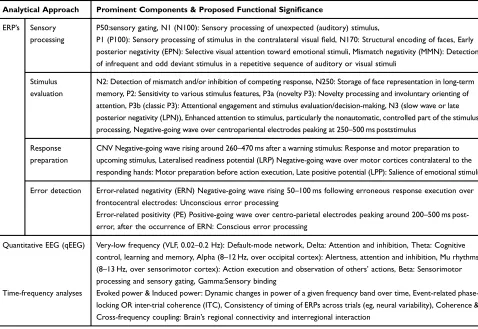
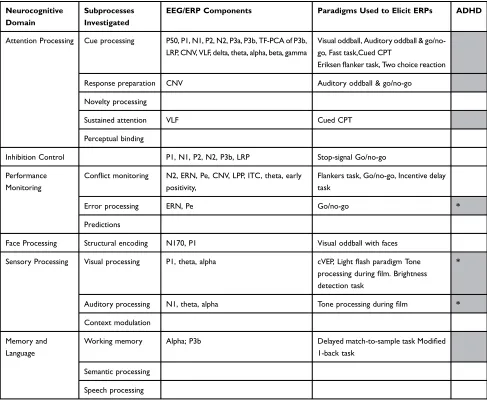
is a summary of the approach
followed in a recent review of EEG-based studies between
2000 and 2017 that examined ADHD-speci
fi
c cognitive
aspects (allocation of attentional resources, performance
monitoring, and processing).
78Findings of the review were
that in ADHD, in aspects of attention: orienting to cues,
signaling response preparation, monitoring of con
fl
ict,
rewarding feedback, and diminished inhibitory control were
seen in young adulthood. The review also highlighted the
need for studies between 16 and 26 age-group on ADHD.
Medical Devices: Evidence and Research downloaded from https://www.dovepress.com/ by 118.70.13.36 on 24-Aug-2020
With ADHD being a delay in neural development more
studies that cover childhood and young adulthood (till 25
years) are warranted. The review also highlighted the need
for genetically informed studies (family studies and twin
studies), studies across lifespan in executive functions and/
or decision-making processes, cross-border disorder diseases
comparisons, whether ADHD was classi
fi
ed based on self-,
parent- or teacher-reporting, neuroimaging and studies on
remission and persistence of ADHD.
Another key aspect brought out by this review is ERPs
subtypes exist based on the paradigm used to elicit them
with the odd ball paradigm and its variations being used to
study attention and ADHD. Paradigms used include;
●
Stimuli (visual vs. auditory) cued continuous
perfor-mance tasks (CPT), such as cue orienting (cue-trials),
response execution (go-trials), response inhibition (no-go
trials), trial conditions with inhibitory versus response
demands.
●
Performance monitoring (various facets of monitoring
within the same task) including; con
fl
ict (errors and
feed-back), context monitoring (e.g., social vs. non-social),
●
Face processing tasks (covering a range of positive
and negative emotions), emotional conditions.
●Other paradigms used to evaluate cognitive ability
include colour vision, orientation, brightness, pitch,
motion, cross-modality integration, etc.
Such psychological, functional, and behavioral studies keeping
in mind the structural, pathophysiological and environmental
aspects of ADHD will certainly go a long way in clarifying the
symptom and heritability sharing between ADHD, its
co-morbidities and cross-border disorders, aid in its
endopheno-typing and in identi
fi
cation of a diagnostic marker.
79–81ADHD, Attention, Cognitive
Performance, Default Mode Network
(DMN) Deactivation
The default mode network (DMN) which includes the medial
prefrontal cortex (mPFC), posterior cingulate cortex (PCC)/
precuneus and medial, lateral and inferior parietal cortex
medial prefrontal cortex (mPFC), posterior cingulate cortex
(PCC)/precuneus and medial, lateral and inferior parietal
Table 1
Analytic Approach Followed to Review EEG-Based Cognitive Studies on ADHD from 2000 to 2017
Analytical Approach Prominent Components & Proposed Functional Significance
ERP’s Sensory processing
P50:sensory gating, N1 (N100): Sensory processing of unexpected (auditory) stimulus,
P1 (P100): Sensory processing of stimulus in the contralateral visualfield, N170: Structural encoding of faces, Early posterior negativity (EPN): Selective visual attention toward emotional stimuli, Mismatch negativity (MMN): Detection of infrequent and odd deviant stimulus in a repetitive sequence of auditory or visual stimuli
Stimulus evaluation
N2: Detection of mismatch and/or inhibition of competing response, N250: Storage of face representation in long-term memory, P2: Sensitivity to various stimulus features, P3a (novelty P3): Novelty processing and involuntary orienting of attention, P3b (classic P3): Attentional engagement and stimulus evaluation/decision-making, N3 (slow wave or late posterior negativity (LPN)), Enhanced attention to stimulus, particularly the nonautomatic, controlled part of the stimulus processing, Negative-going wave over centropariental electrodes peaking at 250–500 ms poststimulus
Response preparation
CNV Negative-going wave rising around 260–470 ms after a warning stimulus: Response and motor preparation to upcoming stimulus, Lateralised readiness potential (LRP) Negative-going wave over motor cortices contralateral to the responding hands: Motor preparation before action execution, Late positive potential (LPP): Salience of emotional stimuli Error detection Error-related negativity (ERN) Negative-going wave rising 50–100 ms following erroneous response execution over
frontocentral electrodes: Unconscious error processing
Error-related positivity (PE) Positive-going wave over centro-parietal electrodes peaking around 200–500 ms post-error, after the occurrence of ERN: Conscious error processing
Quantitative EEG (qEEG) Very-low frequency (VLF, 0.02–0.2 Hz): Default-mode network, Delta: Attention and inhibition, Theta: Cognitive control, learning and memory, Alpha (8–12 Hz, over occipital cortex): Alertness, attention and inhibition, Mu rhythms (8–13 Hz, over sensorimotor cortex): Action execution and observation of others’actions, Beta: Sensorimotor processing and sensory gating, Gamma:Sensory binding
Time-frequency analyses Evoked power & Induced power: Dynamic changes in power of a given frequency band over time, Event-related phase-locking OR inter-trial coherence (ITC), Consistency of timing of ERPs across trials (eg, neural variability), Coherence & Cross-frequency coupling: Brain’s regional connectivity and interregional interaction
Medical Devices: Evidence and Research downloaded from https://www.dovepress.com/ by 118.70.13.36 on 24-Aug-2020
cortex is active when the brain is at rest and deactivates with
the onset of goal-directed tasks.
82–90Further, the DNM is
comprised of both task-positive (extrospective attention) and
task-negative (introspective attention) components with
attenuation being directly correlated to the degree of
com-plexity and cognitive challenge a task presents.
82–90DMN
oscillations are very low frequency (VLF) oscillations with
individuals with ADHD exhibiting reduced DMN
deactiva-tion when transideactiva-tioning from rest to a speci
fi
c task, ie,
increased reaction time variability (RTV).
91–93In a study
on adults with low and high levels of ADHD Broyd et al
compared EEG at rest and during a task that demanded
attention.
94While both groups exhibited equivalent attention
and performance via sLORETA it was found that both groups
showed atypical deactivation, ie, the DMN regions
deacti-vated
differed.
Attention-induced
DMN
deactivation
occurred in the medial prefrontal regions (mPFC) in those
with low-level ADHD while in those with high ADHD the
temporal regions were deactivated.
Inhibitory Control
A study on inhibition control and ADHD highlighted
de
fi
cits in the
‘
inhibition of interferences
’
and
“
action
inhibition
”
via
“
Simon Tasks
”
and
“
Go/Nogo tasks
”
.
Table 2
Neurocognitive Domains and the ERP Components Elicited via Appropriate Paradigms in EEG-Based Cognitive Studies on
ADHD from 2000
–
2017
Neurocognitive Domain
Subprocesses Investigated
EEG/ERP Components Paradigms Used to Elicit ERPs ADHD
Attention Processing Cue processing P50, P1, N1, P2, N2, P3a, P3b, TF-PCA of P3b, LRP, CNV, VLF, delta, theta, alpha, beta, gamma
Visual oddball, Auditory oddball & go/no-go, Fast task,Cued CPT
Eriksenflanker task, Two choice reaction Response preparation CNV Auditory oddball & go/no-go
Novelty processing
Sustained attention VLF Cued CPT
Perceptual binding
Inhibition Control P1, N1, P2, N2, P3b, LRP Stop-signal Go/no-go Performance
Monitoring
Conflict monitoring N2, ERN, Pe, CNV, LPP, ITC, theta, early positivity,
Flankers task, Go/no-go, Incentive delay task
Error processing ERN, Pe Go/no-go *
Predictions
Face Processing Structural encoding N170, P1 Visual oddball with faces Sensory Processing Visual processing P1, theta, alpha cVEP, Lightflash paradigm Tone
processing duringfilm. Brightness detection task
*
Auditory processing N1, theta, alpha Tone processing duringfilm *
Context modulation Memory and
Language
Working memory Alpha; P3b Delayed match-to-sample task Modified 1-back task
Semantic processing Speech processing
Note:EEG and ERP components where ADHD-autism spectrum disorder (ASD) shows an overlap.Boxes shaded greyindicates studies where the ERPs reflective of cogitative status in ADHD were elicited using appropriate paradigms. Blank cells indicate areas on EEG aspects of ADHD not yet studied. Note: Adapted from Lau-Zhu A, Fritz A, McLoughlin G. Overlaps and distinctions between attention deficit/hyperactivity disorder and autism spectrum disorder in young adulthood: Systematic review and guiding framework for EEG-imaging research.Neurosci Biobehav Rev. 2019;96:93–115. Creative Commons license and disclaimer.78
Available from:http://creativecommons. org/licenses/by/4.0/legalcode”http://creativecommons.org/licenses/by/4.0/legalcode
Medical Devices: Evidence and Research downloaded from https://www.dovepress.com/ by 118.70.13.36 on 24-Aug-2020
Findings revealed that inhibitory control operates on
a hierarchical
“
fi
rst come,
fi
rst serve
”
basis which is not
integrated in ADHD. The defect was attributed to
dysfunc-tions at the response selection level and fronto-parietal
cortices. The clinical bene
fi
t of this
fi
nding it that it
indi-cated that ADHD children required to be given simple
step-wise instruction arranged in priority rather than
com-plex situations requiring
“
if-then
”
decisions. Findings are
also suggestive that behavioural, pharmacological and
neurofeedback might help in this area.
95Cognitive and Neurophysiological Markers
of ADHD Persistence and Remission
Childhood ADHD tends to persist into adulthood.
96–98In
a six-year follow-up study of 279 individuals, 169 were
controls, all with IQ>70; 23 (21%) were remitters and the
remaining were individuals in whom ADHD persisted
among 110 individuals with childhood ADHD.
99Tests
admi-nistered included; i) diagnostic (Diagnostic Interview for
ADHD in adults, DIVA, Barkley Functional Impairment
Scale, BFIS, ii) IQ (Wechsler Abbreviated Scale of
Intelligence, WASI-III and digit span subtest for adults and
children)
and
iii)
activity
level
(Actigraphy).
100–107Neurophysiological tests using the i) the fast task,
ii)Go/No-Go (GNG) task, and iii) cued
fl
anker continuous performance
task (CPT-OX) paradigms to elicit and measure EEG-based
RTV, CNV, cue-P3, nogo-P3, commission error (CE) and
omission error (OE) as well as delta, theta, alpha and beta
power following Fast Fourier Transform (FFT) to evaluate
attentional and inhibitory processes.
102,108-113The study was able to identify key markers of i)
remis-sion: preparation-vigilance measures (CNV, delta activity,
RTV and OE) ii) moderator/s: IQ and iii) cognitive factors
that did not in
fl
uence the outcome of remission or
persis-tence: executive control measures of inhibition or working
memory (nogo-P3, CE and digit span backwards, DSB).
21Among the
fi
ndings, preparation-vigilance processes have
enormous clinical impact and potential in designing
non-pharmacological interventions (cognitive training and
neuro-feedback) for individuals with ADHD.
21In terms of
replication of results, this lack of association of executive
control measures with ADHD remission was seen in some
studies while in others no similar association was seen.
114–121Studies carried out to further examine factors in
fl
uen-cing ADHD remission by Cheung et al, Michelini et al and
James et al used the Fast Task with incentive paradigm and
measured
hypoarousal
via
skin
conductance
level
(SCL).
122–124ADHD remitters were similar to controls in
baseline allocation (P3) and fast-incentive CNV amplitude
both of which were found to be malleable components
under fast task conditions. However, ADHD remitters
differed to controls and were similar to ADHD persisters
in terms of baseline peripheral arousal (SCL) which was
also found to be modi
fi
able under fast-task conditions.
Thus, baseline SCL levels could prove as an enduring
marker both in ADHD remitters and persistors. Here too
treatment with MPH is found to improve both ADHD
symptoms and peripheral arousal.
125–127Cheung et al, Du Reitz et al and Michelini et al worked
on other aspects pertinent to diagnosis of ADHD
persis-tence and remittance studies.
123,128,129Du Rietz et al
examined cognitive-neurophysiological and movement
correlates of ADHD diagnosis of persistors and remitters
based on parent/teacher reporting (common practice for
childhood ADHD diagnosis) versus self-reported
(com-mon practice for adult ADHD diagnosis) a(com-mong the
same study population (6
–
year follow-up study).
123,128By DSM-V, ADHD persisters were 47% for
self-reporting and 79% for parent-self-reporting. A key
fi
nding of
the study was that self-report of ADHD persistence and
remission did not correlate with neurophysiological and
movement results obtained. The implications for follow-up
studies of childhood ADHD are that both self-reported and
parent/teacher reporting might need to be obtained.
128Michelini et al examined cognitive-performance
mea-sures and ERP
’
s involved in con
fl
ict monitoring: N2 and
error processing: error-related negativity, ERN, and
posi-tivity, Pe, from an arrow
fl
anker task with low-con
fl
ict and
high-con
fl
ict conditions. N2 is a frontocentral negative
de
fl
ection obtained at 200
–
400ms following a high
con-fl
ict/incongruent stimulus (two competing responses and
evaluation) when a correct response is made.
129–131If the
subject makes an error, the ERN is recorded (frontocentral
response-locked negative de
fl
ection at 0
–
150 ms) followed
by the Pe (centroparietal positive enhancement at 200
–
400
ms after response), ie, the ERN re
fl
ects unconscious
response-monitoring system following a mistake while
Pe represents conscious error processing to adjust response
strategy.
132–135While N2 (for
fl
anker task) showed no
difference between persisters and remitters, enhancement
of Pe (for Go/NoGo tasks) and ERN (for
performance-monitoring tasks) was seen both in this study and has been
reported in ADHD remitters.
130,136-141The
fi
ndings of this
study also illustrated the malleability of Pe and ERN and
Medical Devices: Evidence and Research downloaded from https://www.dovepress.com/ by 118.70.13.36 on 24-Aug-2020
in turn the possibility of nonpharmacological interventions
via Neurofeedback and behavioral training.
129Reaction Time (RT), Reaction Time
Variability (RTV), Malleability of RTV and
Response Speed
–
ERP
The EEG
’
s and ERP
’
s temporal precision was used by
Cheung et al to study the relationship between cognitive
performance via RTV both a heritable and malleable trait
and response speed.
122The group examined P3
ampli-tudes (attention allocation) and contingent negative
var-iation (CNV) a marker of preparation in 174 controls and
93 individuals with ADHD at baseline and following
fast-incentive conditions of a four-choice reaction time
task. P3 amplitudes were attenuated in ADHD
indivi-duals and RTV increased, with both ERP components
proving malleable to fast-paced reward conditions. Twin
studies have highlighted both heritability and the
rela-tionship between theta oscillations, RTV and ADHD.
142The CNV, re
fl
ecting cognitive anticipation and motor
preparation, has been shown to be another heritable trait
reduced in ADHD, neuro-developmentally delayed based
on topographical studies.
108,109,143-147A key aspect worth
noting is that the CNV calculated as the mean amplitude
at Cz or Pz, in milliseconds, varies in site and interval
depending both on the age group studied and the
para-digm used to elicit it.
144,146,147Studies have demonstrated the possibility of normalization
of P3 and CNV amplitudes in ADHD following stimulant
medication and methylphenidate (MPH) respectively.
148–151Studies using go/no-go tasks in combination with either
neu-rofeedback or rewards/incentives have also shown them to be
malleable to non-pharmacological techniques.
152–157One
aspect to be kept in mind when considering comparison and
ef
fi
cacy studies is that while these interventions did help
normalize response speeds in ADHD individuals, the use of
rewards/incentives further also increases CNV amplitudes and
reduces RTV/response times in healthy adults.
158Further as
the mode of action of MPH which normalize CNV amplitudes
is via the catecholaminergic pathway; the converse also
applies, ie, CNV could serve as a catecholaminergic system
marker.
108,158Cheung et al also looked at the relationship
between P3, CNV, RTVand intellectual quotient (IQ) between
controls and individuals with ADHD. While IQ exhibited
a negative association with P3 amplitude such an association
was absent among ADHD individuals.
122,159Reaction time variability (RTV) another candidate
neu-rocognitive marker of ADHD refers to the degree of
intra-individual variation in responding to a target stimulus, and
increased reaction time variability on attention tasks has
been commonly reported in ADHD youths.
65,160,161Frontal lobe damage increases RTV, while individual
dif-ferences in RTV predict inhibitory success, subjects with
increased RTV show greater activation during response
inhibition tasks.
162,163A recent study (n=1538 youths) examined the
relation-ship between ADHD symptoms, maps of dopaminergic gene
expression (DRD1 and DRD2 gene), brain structure
(ventro-medial prefrontal cortex, vmPFC), and reaction time
varia-bility
–
an index of lapses in attention. It also tested for
associations between brain structural correlates of ADHD
symptomatology and maps of dopaminergic gene expression.
Parent ratings, adolescent self-reports, and reaction time
variability were negatively associated with gray matter
volume (GMV), while DRD1 and DRD2 gene expression
were associated with brain structural correlates of ADHD
symptoms. Increased RTV on tasks of vigilant attention is
common when comparing children with ADHD versus
typi-cally developing controls.
65,161The hypothesis is that
increased RTV is linked to default mode network (DMN)
activity typically attenuated during goal-directed tasks, can
persist into periods of task-related processing and, as a result,
compete with task-speci
fi
c neural processing, eg, like
work-ing memory tasks.
63The vmPFC is a primary hub in the
brain
’
s DMN
–
a network posited to play a central role in
mind-wandering and task-unrelated thought. Although
spec-ulative, it is possible that the volumetric reductions in the
vmPFC may be linked to DMN dysfunction.
ADHD is characterized by greater intra-individual RTV
during cognitive tasks. One commonality among these
var-ious populations with increased RTVare problems with
atten-tion, although there seems to be considerable variability in the
types of attentional dif
fi
culties across populations (such as:
selective, sustained and divided attention, and combinations
of these).
164–167Studies on RTV and ADHD subtypes show
poor correlation, RTVand reduced white matter volume show
high correlation and RTV has been shown to improve with
both stimulant medication and cognitive training.
168–186Theta Beta Wave Power (TBR) and
ADHD
EEG studies on frequency analysis revealed an increase in
theta wave power and/or decrease of beta wave power
Medical Devices: Evidence and Research downloaded from https://www.dovepress.com/ by 118.70.13.36 on 24-Aug-2020
(TBR) in frontal areas, or a decrease in sensorimotor
rhythm (SMR) power in the central area.
187–210Theta
and TBR studies between 1930 and 1970 led to TBR to
being a candidate diagnostic marker both in children and
adults. However, TBRs variability with age, ADHD
sub-types, its 63% sensitivity and 58% speci
fi
city when
com-pared with clinical diagnosis of ADHD (gold standard)
and its poor correlation with ADHD symptoms (
r
=0.10
for children and
r
=
−
0.14 for adults) have raised questions
on its candidature.
187–210While some studies has revealed
THBR to be a reliable marker of ADHD resulting in it
being cleared by the FDA and the BlueCross others have
had contrary results.
211–213No consistent theta or theta/
beta increases to diagnostically useful levels were found
with ADHD. Thus, in order to prevent over diagnosis and
misdiagnosis the TBR has been advocated only as an
add-on tool following clinical diagnosis. However, TBR has
been very used successfully both as a tool to determine
treatment
ef
fi
cacy
and
as
a
neurofeedback,
NFB
tool.
187,191,208,209The effects of an acute dose (0.7 mg/kg) of
methylphe-nidate (MPH), known to improve home, school and
cog-nitive task performance were evaluated via quantitative
electroencephalography (QEEG) study following a
one-week washout period.
214The chief reason for use of
QEEG was that it enabled both temporal and spatial
study of attention using the continuous performance test
(CPT)
and
test
of
variables
of
attention
(T.O.V.
A.).
196,211,212,215,216Results of the study (n=20, 6
–
12years) were; for TOVA measures: omission error (oe,
p<0.01), commission errors (not-signi
fi
cant at p>0.05),
response time (RT, p<0.05) and standard deviation
(p<0.01) for MPH-washout versus MPH-single-dose.
MPH showed no brain wave frequency changes in the
resting EEG state. However following CPT, increase in
α
(right and left frontal and occipital areas),
β
activity (all
areas except temporal brain region) and
θ
/
β
ratio (right
frontal and parieto-occipital, and left temporal areas) was
seen with decrease in
θ
(occipital and right
temporo-parietal areas), and
δ
activity (occipito-parietal areas).
196Another controlled, randomized, multigroup design,
with pre-, post- and follow-up treatment phase study
eval-uated treatment ef
fi
cacy of Neurofeedback, NFB (n=19)
versus pharmacological, Rx (n=19, MPH: 1 mg/kilo/day)
therapy
versus
behavioral
therapy,
BT
(n=19)
and
ADHD.
177,191NFB: 30 sessions of
θ
/
β
training at 4/sessions
week (30-s initial baseline + 24-min, ie, six 4-min runs,
with a choice of 5 different screens like games, puzzles,
etc., with rewards to ensure reinforcement). BT: 15
one-on-one 50-min sessions of cognitive-behavioral therapy.
Parents training: 10 weekly 90-min sessions and teachers
training: 5 group sessions, 90 min each.
197–199Evaluators
were blinded to which child received which therapy. All
three therapies showed similar TBR improvements (p>0.05)
indicating that they were equally effective (Hypothesis (H),
H
Rx=H
NFB=H
BT). While global attention (
p
=0.002),
audi-tory attention (
p
=0.017) and visual attention (
p
=0.028) were
signi
fi
cant during treatment phase with the group on
med-ication (Rx) showing the most improvement, the differences
reached non-signi
fi
cance (NS) post-treatment. Classic
rest-ing-EEG patterns for children ADHD versus healthy
devel-oping controls indicate elevated
θ
and reduced
α
and
β
.
A study to determine if these resting-EEG patterns were
seen in adults evaluated 18 college students with ADHD
and 17 controls.
199Adults with ADHD also exhibited the
same neural abnormalities as children with ADHD with
decrease in
α
and
β
, increase in
θ
and
θ
/
β
when relative
power computation was carried out and this was more
marked for eyes closed that eyes opened condition. vi.P3:
In terms of P300 and ADHD, a recent meta-analysis
observed that while P3b amplitude declines with age in
non-ADHD controls, this decline was more marked in
individuals with ADHD.
78,217,218The neurobiological
aspects linked with this
fi
nding are that cortical maturation
in ADHD is delayed.
219The prefrontal cortex provides
input signals for the ventral attention network, which is in
turn linked with the P300b ERP component.
220Thus, if one
wanted to examine the contributions of the prefrontal cortex
to P3 generation it would be best to study prefrontal cortical
maturation and P3 both in adolescence and young
adulthood;
221P3 indexes attention and memory processes,
updating of mental representations stored in working
mem-ory based on novel incoming stimuli, attentional orienting
either rapid, or passive attentional shifts to new/unexpected
stimuli, or active attention shift due to a task.
222–227Auditory P3 amplitude increases across childhood-till 20
years whereas its latency decreases across lifespan.
225P3
amplitude also shows variations in terms of electrode
regions for which it is at peak across development.
223,224P300 variations have also been associated with,
externaliz-ing problems which are genetically mediated, social
infor-mation processing style and high levels of aggression. P300
variations have also been associated with the distributed
neural circuit including the lateral prefrontal cortex, both
of which have shown impairments in externalizing
disorders.
228–236P3 amplitudes have been also shown to
Medical Devices: Evidence and Research downloaded from https://www.dovepress.com/ by 118.70.13.36 on 24-Aug-2020
vary depending on the paradigm used to elicit them.
237–241One study examined P3 amplitudes and topographical maps
among the ADHD subtypes following the Go/NoGo task.
141The chief
fi
ndings are (
Figure 4
) individuals with ADHD
showed de
fi
cits in the anterior (frontal site) attentional
system. ADHD-I and ADHD-H groups showed
impair-ments for attention-demanding Go/NoGo respond-to-target
task, while the ADHD-H and ADHD-C exhibited slightly
less impairment for inhibition-demanding Go/NoGo
sup-press-to-target task.
141Sensori-Motor Rhythm (SMR) and ADHD
Several sleep disorders (sleep apnea and restless legs
syn-drome, idiopathic
“
sleep-onset insomnia
”
(SOI), also
called
“
delayed sleep phase syndrome
”
) are associated
with
ADHD.
242,243Sensori-motor
rhythm
(SMR)
Neurofeedback studies revealed that this intervention
nor-malized sleep and thus improved ADHD symptoms such
as inattention and hyperactivity/impulsivity, demonstrated
the role of sleep in cognition, reported that adult ADHD is
characterized by a higher prevalence of
“
evening types
”
,
characterized by a delayed circadian phase.
242–246Arns
et al demonstrated an association between high sunlight
intensity and low ADHD prevalence in ADHD.
242Several
studies have demonstrated that Sensori-motor rhythm
neu-rofeedback (SMR) results in increased sleep spindle
den-sity during sleep, decreased sleep latency and increased
total sleep time.
247,248Research has also demonstrated that
melatonin results in an increased sleep spindle density and
decreased sleep latency, suggesting overlap in the working
mechanisms of SMR neurofeedback and melatonin.
249Sleep spindles are generated by the GABA-ergic thalamic
reticular neurons and are synchronized through
glutama-tergic cortico-thalamic projections.
250SMR neurofeedback
had its most speci
fi
c effect on decreasing SOL. For TBR
neurofeedback no association between clinical
improve-ment and change in SOL or PSQI were found. Clinically,
TBR and SMR neurofeedback had similar effects on
symptom reduction in ADHD (inattention and
hyperactiv-ity/impulsivity); therefore, these results suggest
differen-tial effects and different working mechanisms for TBR and
SMR neurofeedback in the treatment of ADHD.
Sleep and ADHD
A meta-analysis of sleep (polysomnographic and EEG)
studies carried out over the last 15 years to examine
macro- and
microstructural
alterations
of
sleep in
ADHDS. Higher slow-wave activity (SWA) and theta
oscillations were found to occur in ADHD during
Non-REM (NNon-REM) and Non-REM sleep. Higher theta activity is
harmful to memory, performance and inhibitory control in
ADHD. These changes in brainwave patterns could be due
to delay in cortical maturation. Poor sleep quality in turn is
known to affect cognitive function.
187Resting State Studies and ADHD
A meta-analysis on resting state condition (eyes open and
closed) to examine the reliability of spectral analysis in
studying psychiatric disorders identi
fi
ed 67 out 184 studies
were ADHD. In the eyes closed condition for
ADHD-children power increases for delta and theta and decreases
across alpha, beta and gamma and increase in absolute
power for both delta and theta was seen. In the eyes
open condition, an increase was dominant in both delta
and theta for ADHD-children and in the delta band for
ADHD-adults. Decreases in absolute power were
domi-nant in the beta band for ADHD-children. Meta-analysis
revealed that diametrically opposite results for absolute
power vs relative power were only seen in the delta band
for ADHD-children in the eyes closed condition. Relative
power comparisons of controls to ADHD in children with
eyes closed yielded a highest consistency score of 7.0
while the highest consistency scores for absolute power
with eyes closed was 2.8 for ADHD in children.
251Neurofeedback (NFB) and ADHD
Meta-analysis of studies on neurofeedback where
stan-dard
’
neurofeedback protocols revealed three main factors
impacted NFB ef
fi
cacy:
fi
rst, a intensity of treatment, but
not treatment duration, second, using parent rating was
better than teacher rating and third, using high-quality
EEG equipment.
188,189Stimulant Medication and ADHD
A study was carried out to predict clinical gain and assess
the risk of acute side effects of stimulant medication
between without treatment (T1) and T2 on a single dose
of stimulant medication groups using resting EEG (3-min
eyes-closed, 3-min eyes-open), and 20 min cued visual
GO/NOGO. EEG spectra, ERPs, omissions, commissions,
RT, and RTV variability were computed. Excess theta in
the ADHD group on treatment (T2) indicated positive
treatment response and increased level of posterior alpha
indicative of posterior hypoarousal were seen in
non-responders.
191Medical Devices: Evidence and Research downloaded from https://www.dovepress.com/ by 118.70.13.36 on 24-Aug-2020
A
Peak Amplitude and Latency of the P3a and P3b components associated with Go/NoGo targets
B
Topographical Maps associated with Go/NoGo targets
Figure 4Attention among controls and individuals with self-reported ADHD captured via P3 following Go/NoGo Task Note: Adapted from Rodriguez PD, Baylis GC. Activation of brain attention systems in individuals with symptoms of ADHD.Behav Neurol. 2007;18(2):115–30. Creative Commons license and disclaimer available from: http://creativecommons.org/licenses/by/4.0/legalcode”http://creativecommons.org/licenses/by/4.0/legalcode.141
Medical Devices: Evidence and Research downloaded from https://www.dovepress.com/ by 118.70.13.36 on 24-Aug-2020
Pathagnomic/Endophenotyping
Markers of ADHD . . .. Are We There
Yet?
With the shared heritability and symptom overlap seen in
ADHD EEG-based endophenotyping holds promise in
de
fi
ning the etiology of ADHD.
80,81,252,253A recent
study on heritability/genotyping of attention and inhibition
processes in twins (67 male-only twin pairs) concordant
and discordant for ADHD via ERPs and
fl
anked CPT was
carried out. ERPs were obtained for cue (P3, CNV or
contingency negative variation), go (P3, N2) and nogo
trials (P3, N2). No phenotypic associations were found
between CPT-derived ERPs and ADHD.
78Do these
fi
nd-ings imply that the quest for
pathognomic/endophenotyp-ing markers of ADHD is a futile one?
The present paper looked at EEG-based studies of
ADHD on attention, cognitive performance, default mode
network (DMN) deactivation, inhibitory control, cognitive
and neurophysiological markers of ADHD persistence and
remission, reaction time (RT), reaction time variability
(RTV), malleability of RTV and response Speed
–
ERP,
Theta Beta wave power (TBR), P3, sensori-motor rhythm
(SMR), sleep, resting state studies, neurofeedback (NFB)
and stimulant medication. Study
fi
ndings illustrated
dis-tinct patterns in ADHD versus normal individuals. We also
looked
at
key
challenges
in
identifying
potential
pathognomic/endophenotyping markers of ADHD. Taken
together the present work points at a framework, a
step-wise systematic approach in the search for potential
mar-kers of ADHD (
Figure 5
):
Step-1: De
fi
ning the ADHD population and sub-groups
if required,
Step-2: Symptom grouping (psychological phenotyping),
Step-3: Carrying out appropriate EEG-based studies
(neu-robiological phenotyping) for each symptom,
Step-4: Genotyping,
Step-5: Environmental risk factor grouping,
Step-6: Looking for patterns, association or causation
depending on the study design.
Questions This Step-Wise Approach
Will Help Raise and Answer
* Could one predict persisters/remitters and responders/
non-responders via neurobiological/EEG-based studies?
* Could overlapping symptoms among the cross-border
co-morbid mental disorders extend to overlap in
neuro-biological and EEG patterns?
* If these psychiatric disorders share a common genetic
risk then what causes a particular psychiatric disorder to
dominate and clinically present? There are possibly
dis-tinct precipitating factors (genetic and non-genetic
Figure 5Diagrammatic illustration of the contributing factors to clinical phenotypic presentation of ADHD.
Medical Devices: Evidence and Research downloaded from https://www.dovepress.com/ by 118.70.13.36 on 24-Aug-2020
perhaps environmental) yet unknown that eventually
contribute to the clinical dominant outcome (
Figure 5
).
* Should shared genetic etiology highlight the need to
re-de
fi
ne clinical and diagnostic boundaries to
pre-vent diagnostic misclassi
fi
cation?
* Should endophenotyping strategies need to ensure
they re
fl
ect phenotypic heterogeneity that correlates
with genetic correlations where psychiatric disorders
are concerned?
* Could another possible strategy be
symptom-based-endophenotyping given the challenges in successful
endophenotyping, diagnosing and treating psychiatric
disorders with shared genetic heritability? For example,
studying executive functioning in schizophrenia and
ADHD or studying shared mechanism underlying
cog-nitive biases in anorexia nervosa, obsessive-compulsive
disorder (OCD) and schizophrenia.
47Conclusion
The quest for a pathognomonic marker for ADHD seems
challenging when one considers the overlapping symptoms
and shared heritability between its psychiatric co-morbidities
and cross-border disorders. For the same reasons,
endopheno-typing has also proved challenging. With de
fi
cits in
neurobiol-ogy via developmental delay being the core factor contributing
to behavioural and clinical symptoms seen, it seems logical
that neurobiological characterization of ADHD might hold the
answer to a pathognomonic marker for ADHD. The interplay
of heritable, developmental and environmental factors that
cause ADHD to manifest as a fully developed condition
while related disorders possessing the same risk factors do
not remain to be fully explained (
Figure 4
). However, among
the neurobiological tools available, EEG machines like
NeuralScan by Medeia are a cost-effective tool providing an
accurate temporal resolution which is vital in studying
atten-tion and inhibiatten-tion and fast task responses in ADHD. Through
these new state-of-the-art technologies it is now possible to
achieve both temporal and spatial (sLORETA) resolution and
power analysis (QEEG) which will enable and facilitate
step-wise neurobiological characterization, diagnosis and
manage-ment of ADHD. In addition, the EEG could help in identifying
potential EEG-based pathognomic/endophenotyping markers
of ADHD if a step-wise approach is followed. The framework
for identifying potential EEG-based
pathognomic/endopheno-typing markers of ADHD is described in the present paper that
takes into consideration the psychological and neurobiological
phenotypes seen, the EEG-patterns observed, the genotype
expressed and the environmental factors at play.
Disclosure
Dr Slav Danev is an employee of Medeia Inc, which
makes the Neuralscan product.
The authors report no other con
fl
icts of interest in this
work.
References
1. American Psychiatric Association. Diagnostic and Statistical Manual of Mental Disorders. 1st ed. Washington, DC, USA: American Psychiatric Association;1952.
2. American Psychiatric Association. Diagnostic and Statistical Manual of Mental Disorders. 2nd ed. Washington, DC, USA: American Psychiatric Association:;1968.
3. American Psychiatric Association. Diagnostic and Statistical Manual of Mental Disorders. 3rd ed. Washington, DC, USA: American Psychiatric Association;1980.
4. American Psychiatric Association. Diagnostic and Statistical Manual of Mental Disorders. 3rd rev ed. Washington, DC, USA: American Psychiatric Association;1987.
5. American Psychiatric Association. Diagnostic and Statistical Manual of Mental Disorders. 4th ed. Arlington, VA, USA: American Psychiatric Association; 1994. 20. American Psychiatric Association. Diagnostic and Statistical Manual of Mental Disorders, 4th text rev. ed.; American Psychiatric Association: Arlington, VA, USA, 2000.
6. American Psychiatric Association. Diagnostic and Statistical Manual of Mental Disorders. 5th ed. Washington, DC, USA: American Psychiatric Association;2013.
7. Kooij JJ, Huss M, Asherson P, et al. Distinguishing comorbidity and successful management of adult ADHD. J Atten Disord. 2012;16(5 Suppl):3S–19S. doi:10.1177/1087054711435361 8. Gloss D, Varma JK, Pringsheim T, Nuwer MR. Practice advisory:
the utility of EEG theta/beta power ratio in ADHD diagnosis: report of the guideline development, dissemination, and imple-mentation subcommittee of the American Academy of Neurology. Neurology.2016;87(22):2375–2379.
9. Lenartowicz A, Loo SK. Use of EEG to diagnose ADHD.Curr Psychiatry Rep. 2014;16(11):498. doi:10.1007/s11920-014-04 98-0
10. McLoughlin G, Makeig S, Tsuang MT. In search of biomarkers in psychiatry: EEG-based measures of brain function. Am J Med Genet B Neuropsychiatr Genet.2014;165:111–121. doi:10.1002/ ajmg.b.32208
11. Markiewcz R. The use of EEG biofeedback/neurofeedback in psychiatric rehabilitation.Psychiatr Pol.2017;51(6):1095–1106. doi:10.12740/PP/68919 Epub 2017 Dec 30.
12. Crichton A. An inquiry into the nature and origin of mental derangement: comprehending a concise system of the physiology and pathology of the human mind and a history of the passions and their effects.J Atten Disord.1798;12:200–204. [Cadell T Jr, Davies W, London [Reprint: Crichton A (2008) An inquiry into the nature and origin of mental derangement. On attention and its diseases. doi:10.1177/1087054708315137
13. Palmer E, Finger S. An early description of ADHD (Inattentive Subtype): dr Alexander Crichton and `Mental Restlessness’ (1798)Child Psychol Psychiatry Rev.2001;6:66–73.
14. Lange KW, Reichl S, Lange KM, Tucha L, Tucha O. The history of attention deficit hyperactivity disorder. Atten Defic Hyperact Disord.2010;2(4):241–255. doi:10.1007/s12402-010-0045-8 15. Carlew AR, Zartman AL. DSM nosology changes in
neuropsy-chological diagnoses through the years: a look at ADHD and mild neurocognitive disorder.Behav Sci (Basel).2016;7(1):1. doi:10. 3390/bs7010001
Medical Devices: Evidence and Research downloaded from https://www.dovepress.com/ by 118.70.13.36 on 24-Aug-2020