© 2017 IJSRST | Volume 3 | Issue 6 | Print ISSN: 2395-6011 | Online ISSN: 2395-602X Themed Section: Science and Technology
Computational Analysis of Many Body Interaction (MBI) Potential in Solids
Dr. Alka Singh
1, Dr. Navin Kumar
21Assistant Professor, Department of Pure and Applied Physics, Guru Ghasi Das Central University, Bilaspur,
Chhatisgarh, India
2Centre Coordinator, IGNOU Centre for Engineering, Muzaffarpur, Bihar, India
ABSTRACT
The difficulty of predicting stable crystal structures based on the knowledge of only the chemical composition has long puzzled the scientists and has been a stumbling block on the way to fully computational materials design. Many physical properties of the materials are predicated on the awareness of the interionic forces that bind the atoms together. Possibly, the principles of atomic bonding are the best illustrated by considering the interactions between two isolated atoms as they are brought into close proximity from an infinite separation. These differences cause difference in their mechanical, electrical and magnetic properties. It is due to the influence of these inter-atomic forces that the constituent particles of a crystal attain the positions corresponding to a minimum energy configuration and thus get bonded together. Present paper made elaborated study on the many body interactions in general and three body interaction in particular.
Keywords: MBI, Computational Analysis, Crystal Structures, TBI, vdW, SR, Anti-Symmetry
I.
INTRODUCTION
There exit atomic, molecular or inter-ionic forces, which bind the atoms or constituent particles together in a crystalline solid. A solid material whose constituent atoms, molecules, or ions are arranged in an orderly repeating pattern extending in all three spatial dimensions is known as a crystalline solid. The unit cell is given by its lattice parameters, the length of the cell edges and the angles between them, while the positions of the atoms inside, the unit cell are described by the set of atomic positions (Xi, yi ,zi) measured from a lattice
point. These binding forces in most cases are electrostatic in nature, but the distributions of electrons around the various particles are quantitatively different in different crystals. As compared to the other states of matter, the atoms or molecules are closely packed together by strong mutual forces of attraction in solids. The rearrangement of electrons takes place when atoms unite to form the molecules. The reason for this lies in the fact that when the ions are put in a lattice their electron wave-functions overlap and get deformed:
Figure 1.1 Major types of universal interactions priorto the development of x-ray diffraction crystallography; the study of crystals was based on the geometry of the crystals
The electroweak interactions are entirely responsible for the cohesion of solids. The other fundamental interactions seem to have limited significance in the engineering of crystal structure. The gravitational interaction becomes negligible due to very low masses of the atomic entities while strong interactions are restricted within nuclear range. Similarly, the magnetic interactions have only weak effect on the cohesion. Therefore, the major contributors for the cohesion of solid are the following electroweak interactions:
1. Electrostatic Coulomb Interaction Potential 2. Many Body Interaction (MBI) Potential
(A) Quantum Theory of Three Body Interaction (TBI) (B) Classical Theory of Three Body Interaction (TBI) 3. van der Waals Interaction (vdW)
4. Short Range (SR) Overlap Repulsive Interaction
Many Body Interaction (MBI) Potential ΦT(R):
The many-body interaction is a general name for a vast category of physical problems pertaining to the properties of microscopic systems made of a large number of interacting particles. Microscopic here implies that quantum mechanics has to be used to provide an accurate description of the system. A large
number can be anywhere from 3 to infinity (in the case
of a practically infinite, homogeneous or periodic system, such as a crystal), although three- and four-body systems can be treated by specific means (respectively the Faddeev and Faddeev-Yakubovsky equations) and are thus sometimes separately classified as few-body systems. In such a quantum system, the repeated interactions between particles create quantum correlations, or entanglement. As a consequence, the wave function of the system is a complicated object holding a large amount of information, which usually makes exact or analytical calculations impractical or even impossible. Thus, many-body theoretical physics most often relies on a set of approximations specific to the problem at hand, and ranks among the most computationally intensive fields of science.
These transferred charges, in turn, interact via their associated Coulomb field with al l other charges of the lattice and give rise to the long-range MBI [14-15] whose most significant component is the TBI. The existence of these TBI has been defined both by classical as well as quantum concepts, by Lowdin [14] and Lundqvist [15]. Extensive studies, carried out by Verma and Singh [16-17] and their co-workers have shown that these interactions have significant influence on lattice mechanical properties of ionic solids. It is well known that the ions during lattice vibrations surfer an appreciable amount of overlap and consequently their electron shells undergo deformation. This mechanism causes a transferof charge between the overlapping adjacent ions. Later Singh and Jog et al. in his thesis [43] and co-workers have exploited this model for the prediction of high pressure phase transitions in pure [18-20] and mixed ChSCs. A brief account of the quantum and classical theory of TBI is given below.
Quantum Theory of Three body Interaction (TBI)
This orthogonality causes the charge distribution to differ from the sum of the densities for free ions, the differences being more pronounced in the regions where the overlap between the atomic wave-functions is large. As a natural consequence of the anti-symmetry requirement on the wave function, this alteration in the electronic charge density causes a charge depletion. This does not mean that the electron-charge density is sum of charge densities for a system of free ions.
In orderto emphasize the above picture, let us consider a number of atoms or ions at i sites L=1, 2 etc. At every site L we have positive nucleus of charge L e
and number nL of electrons such that ZL(= ЄL -nL) is
the net ionic charge at L. The number density n( ⃗)of electrons in thecrystal can be expressed as
n ( ⃗ =∑ ⃗ ⃗ 1.1
Here nL ⃗ {= L e ⃗ — L } represents the
point (or monopole) charge of the lattice. Since the overlapdeformation density ⃗)is contributed by the multipoles, therefore, TBI may be considered to arise from monopole-multipole interaction which has been treated by Lindqvist [15] in order to explain the Cauchy discrepancy ( C1 2- C4 4) and the dipolar
electronic polarizabilities in ionic crystals. The monopole-quadrupole interaction have been treated by Herpin[24] interms of many body forces which also take account of the Cauchy violations and introduce a quadrupolar polarizability which is not well known experimentally or theoretically.
The above mentioned monopole-multipole interactions require only the knowledge of charge density and thus one has to search for an exact and realistic expression forA«(r). According to Lundqvist [15], this overlap density has been written as:
n ⃗ = ∑ ∑ ∑ 1.2
Where is a function dependent on the distance and identical to the overlap integrals? Its value is given by
= -∑ 1.3 Where
∫ 1.4
Is the overlap integral. Here, are the normalized one electron wave functions including spin such that
the index u. refers to an electron with quantum numbers n, 1, m and associated with an ion at a certain lattice point La. The symbol∫ mplies integration over the space coordinates (r) and summation over me spin coordinates ( ).
It may be noted from equation 4.6 that the integral of n ( ⃗) over iht unit cell is zero. Now, the interaction between this charges distribution of zero net charge with the ions in the lattice, regarded as point-charge, is given by:
ΦT (r) = ∑ ∑ ∑ 1.5 Where e is the elementary electron charge,
∑ denotes a summation where L is always
different from and . The symbol v Lu means the
integral defined as:
( ) = ∫ 1.6
Which has been exactly evaluated by Lowdin and Lundqvist and fund to give?
Φr(r) = ∑ ∑ ∑ wher 1.7
∑ ∑ 1.8
= ∫ 1.9
= ∫ 1.10
Here interactions are to bre extended over the half- spaces consisting and respectively.
Clearly, 1 and therefore we have
⃗ ⃗ ⃗ ⃗ 1.11
If L and L’denote two nn ions in binary crystals, the equation represents TBI due to overlap of electron wave-functions of the adjacent ions. For the fixed overlap integrals and fixed inter ionic distances, the function
is the measure of the differences of the positive ions. The equation 1.5 has been derived from the classical approach as discussedbelow.
Classical Theory of Three Body Interaction (TBI)
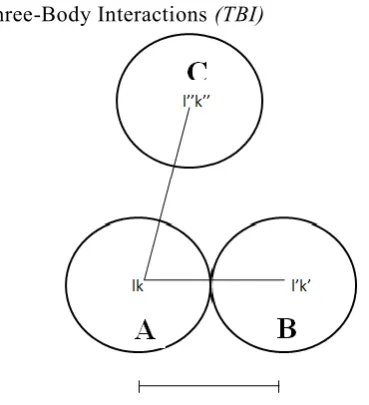
The existence of TBI can also be understood from classical theory of charge transfer mechanism. The expressions obtained by such theory have been found to be the same as those evaluated by Lowdin and Lundqviston the basis of quantum theory. In Order to understand the existence of TBI from the charge transfer mechanism, lei us consider three ions designated as A, B and C in an ionic crystal as shown in the Figure 4.3. These ions have been designated by a pair of indices (Ik), ( I ’ k ’ ) and ( I ” k ” ) where l the cell index is and k distinguishes the kth atom in
charge ± Ze. Here B is the nearest neighbour (nn) of A separated by a distance apart from A. C as any ion a distance | ⃗ | apart from A. The electron shells of ions A and B overlap during lattice vibrations and give rise to the transfer of a charge
dqk= ±Zefk(r(lk ,l”k")) = ±Zefk (r) 1.12
Whose amount depends on the degree of overlap, i.e., inter atomic separation (r ); 1
3fk(r) is a function which is significant only between
nearest neighbour nn ions and expressed as
( ) 1.13
Where Z=Zk|is the ionic charge parameter. The
occurrence of above transferred charge lead to a modified ionic charge of A (or B):
{ } { }
1.14
Here is the number of nn ions and since f(r) is a small quantity, (I + nf{r)) has been approximated as
* + * + 1.15
On similar arguments, we express the total charge on ion C as
{ } 1.16
where l"'k"') ion is not shown in Figure 4.3, but denotes the nn ion of C.
Three-Body Interactions (TBI)
Figure 1.2 When-the two neighbouring ions A and B
come closer to each other,
overlapping of the electron charge clouds result in a net change in charge on both of them.
In view of the modification of ionic charges clue to charge transfer mechanism iustrated above, the expression for the coulomb interaction energy (equation 4.4) between ion-pairs A and C gets modified. This modified Coulomb interaction w expressions Becomes
{ }
[ { ( )}] , ( )-
{ }
{ }
[ { ( )}] { ( )}
{ } { } { ( )} 1.17
II.
CONCLUSION
Here,
the first term is the well-known two-body Coulomb potential. The second term contains two parts specifying the contributions whose magnitude depends on the coordinates of three atoms and hence they are referred to as TBI. The last term represents a contribution due to four body interactions and is neglected in view of its smallness being a product of too small functions. Since the ion pairs are identical through the crystal, therefore, the same function f{r(l ,l’ ’)} can be used to represent the charge-imnsier between each ion pairs. The expression for the modified Coulomb energy for the whole crystal can be written as:Φ
∑ ∑ Φ { ( ) ∑ ∑
( )
[
( )] 1.22
Φ Φ Φ 1.18
Where the first term is the well known Coulomb potential. The second term is purely TBI energy given by:
Φ ∑ ∑ ∑ { ( ) (
Since each ion is surrounded by six nearest-neighbours of opposite type, therefore, the modified ionic charge becomes [25] . On simplification this ultimately gives
Φ * + Φ (r) +Φ 1.20
The above equation reveals clearly that the Coulomb part of the classical energy is modified by a factor ( ) due to TBI. The TBl parameter f(r) is proportional to the square of the overlap integrals [29] between two neighbouring ions and depends on the separation r between them. A functional form for f(r), suggested by Cochran [38], is
( ) 1.21 Where f0 is crystal independent parameter and p range parameter. The use of this analytical expression reduces the number of model parameters. The metallic state has historically been an important building block for studying properties of solids. The first theoretical description of metals was given by Paul Drude in 1900 with the Drude model, which explained electrical and thermal properties by describing a metal as an ideal gas of then-newly discovered electrons. He was able to derive the empirical Wiedemann-Franz law and get results in close agreement with the experiments. This classical model was then improved by Arnold Sommerfeld who incorporated the Fermi–Dirac statistics of electrons and was able to explain the anomalous behavior of the specific heat of metals in the Wiedemann–Franz law. In 1912, The structure of crystalline solids was studied by Max von Laue and Paul Knipping, when they observed the X-ray diffraction pattern of crystals, and concluded that crystals get their structure from periodic lattices of atoms In 1928, Swiss physicist Felix Bloch provided a wave function solution to the Schrödinger equation with a periodic potential, called the Bloch wave. Calculating electronic properties of metals by solving the many-body wavefunction is often computationally hard, and hence, approximation methods are needed to obtain meaningful predictions.[47] The Thomas–Fermi theory, developed in the 1920s, was used to estimate system
energy and electronic density by treating the local electron density as a variational parameter. Later in the 1930s, Douglas Hartree, Vladimir Fock and John Slater developed the so-called Hartree–Fock wave function as an improvement over the Thomas–Fermi model. The Hartree–Fock method accounted for exchange statistics of single particle electron wave functions. In general, it's very difficult to solve the Hartree–Fock equation. Only the free electron gas case can be solved exactly. Finally in 1964– 65, Walter Kohn, Pierre Hohenberg and Lu Jeu Sham proposed the density functional theory which gave realistic descriptions for bulk and surface properties of metals. The density functional theory (DFT) has been widely used since the 1970s for band structure calculations of variety of solids.
III.
REFERENCES
[1]. J. Pauling and E. B. Wilson, mCDgRAW Hill, New Yourk, Sec. 477, 1935.
[2]. D. C. Tayal, Himalayas, New Delhi, 1997. [3]. A. Besier, Mcgraw Hill, New York, 1995. [4]. J. E Mayer J. Chem. Phys. 1, 270, 1933.
[5]. F. London, Z. Phys. Chem. B11, 222, 270, 1930; Z Phys 63 (1930) 245.
[6]. C. Kittel, Willey Eastern, New Delhi, 1988. [7]. R. K. Singh, Physics Reprts (Netherlands) 85,
259,1982
[8]. A. M. Stoneham, AERE R, Harwell 9598, 1979. [9]. P. Tangney and S. Scandolo, J. Chem. Phys. 117,
8898, 2002; J. Chem. Phys. 119, 18, 2003.
[10]. A. Aguado. L. Bernasconi, and P. A. Madden, Chem. Phys. Lett. 356, 437, 2002.
[11]. A. Laio , S. Bernard, G.L. Chiarotti, and S. Scandolo, and E. Tosatti, Science 287, 1027, 2000.
[12]. F. Ercolessi and J. B. Adams, Europhys, Lett. 26, 583, 1994.
[13]. J. C. Slater and J. G. Kirkwood Phys. Rev. 37, 682-697, 1931.
[14]. P. O. Lowdin, Ark. Mat. Ast. Fys. 35A 30, 1947. [15]. S.O. Lundqvist, Ark, Fys. 6.25(1952); 9.35
[16]. R. K. Singh and M. P. B verma, Phys. Rev. B 2, 4288, 1970; J. Phys. C (Solid State Physics) 4, 2749.
[17]. M.P. Verma and R. K. Singh, Phys. Stat Sol. (b) 33, 769 (1969); 36, 335 (1969); 38, 851 (1970). [18]. Sadhna Singh and R.K. Singh, J High Pressure
Research, 21, 105, 2001.
[19]. D.C Gupta and R.K. Singh, Phys.Rev.B, 43, 1991. [20]. R.K. Singh and D.C Gupta Ind. J Pure and App.
Physics, 29, 473, 477, 1991.
[21]. Jyostsna Galgale, N. K. Gaur and R. K. Singh, J. Luminsence 713-717, 2001.
[22]. N. K. Gaur and Jyostsna Galgale, M. Manake and R. K. Singh J. Luminsence 755-759, 2001. [23]. W. Heitler and F. London, Z Physik. 44, 455,
1927.
[24]. A. Herpi, J. Phys, Radium, 14, 611, 1953.
[25]. W. Cochran, C. R. C. Crit Rev. Solid State Sci. 2, 1-44,1971.
[26]. G. L. Trigg (ed.) Encyclopedia of Applied Physics (VC11, New York), 8, 1997.
[27]. P.M. Chaikin, T.C. Lubensky, Cambridge University press.New Delhi. 1998.
[28]. D.C.Giancoli, Prentice Hall, New Jersey,1991. [29]. M.Chanda.Tata McGraw Hill,New Delhi,1995. [30]. R.Narayan, J. Phys. Chem.Solids
38,1097-1100,1977.
[31]. H.Margenau, N.Kestner,Pregeman Press.London. 1967.
[32]. J. ShanKar,G.C.Agarwal and R.P. Singh, J. Chem. Phys. 69,670, 1978.
[33]. M. P. Tosi, Solid State Physics, (Academic Press) 16-120,1964.
[34]. M. Born and J. E. Mayer, Z Phys. Chdem. 23, 358, 1932.
[35]. F. G. Fumi and M.P. Tosi, J. Phys. Chem. Solid, 23, 359 (1962).
[36]. J. E. Mayor and M.L. Huggins, J. Chem. Phys. 43, 795 1965.
[37]. D.W. Hatemeister , W. H. Flygare, J. Chem. Phys. 47, 14258 (1967).
[38]. D.W. Hatemeister and J. D. Zahrt, J. Chem. Phys. 40, 3584 (1966).
[39]. A. Einstein, Ann. Phys. 22, 180, 1907.