Themed Section: Education
A Study of Environmental Awareness among Higher Secondary School
Students
Kaleem Ansari Research Scholar, Department of Teacher Education, D. S. College, Aligarh, India
Dr. Jai Prakash Singh Associate Professor & Head, Department of Teacher Education, D. S. College, Aligarh, India
ABSTRACT
The issues of environmental problems and environmental education have been widely discussed in the last four decades all over the world at the several national and international workshops, conferences and seminars. People started realizing the urgent need of environmental education which will help individuals and social groups to acquire environmental awareness, knowledge, develop attitudes, skills and participation in solving environmental and its allied problems. In this study attempted to find out the environmental awareness among higher secondary school students on the basis of gender, class of study and stream of study. Total 180 higher secondary schools’ students recognized by U.P. board selected randomly from Aligarh city. For collecting data, the tool ‘Environmental Awareness Ability Measure’ developed by Dr. Praveen Kumar Jha was used. Mean,
standard deviation and t-ratio test has been used for analysis of data. Main findings of this study are 1). No significant difference in environmental awareness between 11th and 12th class students. 2). Significant difference in environmental awareness between Male and female students. 3). No significant difference in environmental awareness between arts and science stream students.
Keywords : Environmental Education, Environmental Awareness, Higher Secondary School Student.
I. INTRODUCTION
modernized day by day making use of the discoveries and innovations in the field of science and technology and by tapping natural resources for better living of the society.
Environmental education is the need of the hour. Environmental education will make us aware about the environmental problems that are looking over our heads and will equip us with knowledge to overcome these problems. Students, who are the future of tomorrow, have a critical role to play in making this world a better place to live in. They can act only if they understand why environmental problems arise and how they should be tackled. Environmental education will sensitize them towards their environment and develop in them necessary skills and attitudes to work together and individually for better Man - nature relationship. Realizing the need and importance of environmental education in India, recently several efforts have been made to reorient and reorganize school education and establish environmental education more formerly. School textbooks in all subject and at all levels have been revised to integrate environmental concepts.
II. NEED OF THE STUDY
Environmental crisis or maladies are the foremost and the most persistently changing problems, which are ready to wipe out the human civilization from this earth. A worldwide strategy is to be adopted to save the earth and to find ways and means for proper and equitable distribution of our natural resources so that it they remain sustainable and at the same time enough of them are left for the future generations. It is matter of concern for the environment that supreme Court of India has made it mandatory for all the educational institution of the country to teach environmental education as a compulsory subject. This will create awareness in the students about various issues concerning environment. Several factors affect the environmental awareness that students develop through environmental education.
Analyzing the research studies related to environment some questions have appeared in the mind of investigator.
• What environmental awareness is affected by class of students ?
• What environmental awareness is affected by stream of study ?
• What environmental awareness is affected by gender of students ?
Investigator has effort to find answer of these above questions.
III. STATEMENT OF THE PROBLEM
Statement of the problem is “A study of environmental awareness among higher secondary school students”.
IV. OBJECTIVES OF THE STUDY The objectives of the present study are as follows –
1. To compare environmental awareness among students of 11th and 12th class.
V. HYPOTHESES OF THE STUDY On the basis of objectives the following hypotheses have been constructed -
1. There is no significant difference in environmental awareness between 11th and 12th class students.
2. There is no significant difference in environmental awareness between Male and female students. 3. There is no significant difference in environmental awareness between science and arts stream
students.
VI. DELIMITATIONS OF THE STUDY
The delimitations of the present study are following –
1. Population of the present study consists of higher secondary school students of Aligarh city. 2. The study has been conducted on 160 students of 11th and 12th class only.
3. All the institutions which have been selected into this study are recognized by U.P. Board.
VII.METHOD OF THE STUDY The methodology adopted in the present study is descriptive survey method.
7.1 POPULATION OF THE STUDY
All the students of class 11th and 12th affiliated to U.P. Board of Aligarh city was taken as a population.
7.2 SAMPLE AND SAMPLING TECHNIQUE
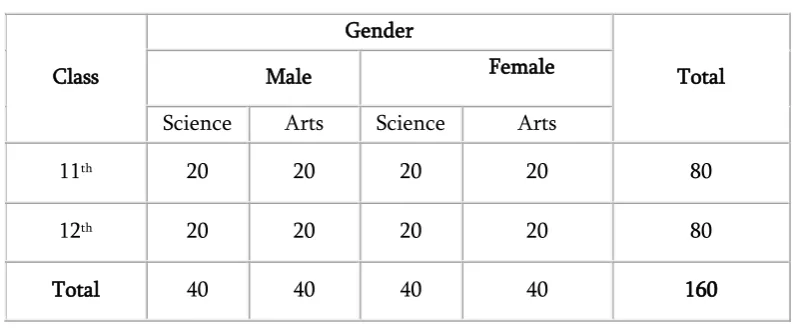
In the present study, random sampling technique has been used in the selection of the sample which consisted of 180 students from U.P. board recognized higher secondary school of Aligarh City. The variables distribution of the sample are presented in table 1.
Table – 1
7.3 TOOL
For collecting the data the tool was used for the present study ‘‘Environmental Awareness Ability Measure”(EAAM) which was developed by Dr. Praveen Kumar Jha . Tool contains total 51 items including 43 positively & 8 negatively worded were used. Reliability of this tool is by K-R Method is 0.84 and validity is 0.83.
Class
Gender
Total
Male Female
Science Arts Science Arts
11th 20 20 20 20 80
12th 20 20 20 20 80
7.4 STATISTICAL TECHNIQUES
By direct administration of the test data were collected from the students of higher secondary schools by
investigator. Mean, Standard deviation and ‘t’ test were the statistical techniques used for carrying out the analysis and interpretation of the data collected.
VIII. ANALYSIS AND INTERPRETATION
The data have been analysed by Mean, S.D, t-test and interpretation of data is given below.
Table -2. Comparison of Environmental Awareness of 11th And 12th Class Students.
Group of Students N M SD t - ratio Level of
Significance
11th Class 80 37.56 3.36
1.05 * NS
12th Class 80 38.14 3.63
*t-ratio is not significant at .05 level
It may observed from the table –2 , reveals that the mean scores of environmental awareness of 11th and 12th
class students are 37.56 and 38.14 respectively. When compared with the table value the obtained ‘t’ value 1.05 is not significant at .01 and .05 level of significance. Therefore the null hypothesis “There is no significant difference in environmental awareness between 11th and 12th class students.” is accepted. It means that students
of 11th and 12th class have equal environmental awareness.
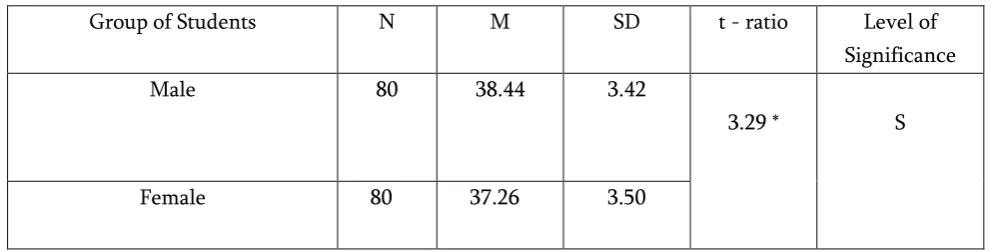
Table -3. Comparison of Environmental Awareness of Higher Secondary Level Male And Female Students.
Group of Students N M SD t - ratio Level of
Significance
Male 80 38.44 3.42
3.29 * S
Female 80 37.26 3.50
*t-ratio is significant at .01 level
It may observed from the table - 3, reveals that the mean scores of environmental awareness of higher secondary level male and female students are 38.44 and 37.26 respectively. When compared with the table
“There is no significant difference in environmental awareness between science and arts stream students.”, is
rejected. It means that higher secondary level male students have a more environmental awareness as compared to female students.
Table – 4. Comparison of Environmental Awareness of Science And Arts Stream Students.
Group of Students N M SD t - ratio Level of
Significance
Science Stream 80 38.28 2.95
1.49 *
NS
Arts Stream 80 37.46 3.95
*t-ratio is not significant at .05 level
It may observe from the table - 4, reveals that the mean scores of environmental awareness of science and arts stream students are 38.28 and 37.46 respectively. When compared with the table value the obtained ‘t’ value
1.49 is not significant at .01 and .05 level of significance. Therefore, the null hypothesis “There is no significant
difference in environmental awareness between science and arts stream students.” is accepted. It means that science and arts stream students of higher secondary school have equal environmental awareness.
IX. FINDINGS AND CONCLUSIONS OF THE STUDY
• The mean scores of 12th class are higher than the mean scores 11th class and the difference is not significant.
Hence null hypothesis framed in this case is accepted. It means that students of 11th and 12th class have
equal environmental awareness. The probable reason may be that both groups are taught and facilitated equally.
• The mean scores of male are higher than that of female at higher secondary level and the difference being significant. Hence, the null hypothesis framed in this case is rejected. It means that higher secondary level male students have more environmental awareness as compared to female students. This could be due to the reason that the syllabus prescribed for students at higher secondary level these topic more interest male students compare than female students and so, they develop a more awareness towards the environment.
• The mean scores of higher secondary level science stream are higher than the mean scores arts stream and the difference is not significant. Hence null hypothesis framed in this case is accepted. It means that science and arts stream students of higher secondary school have equal environmental awareness. The probable reason may be that both groups are taught and facilitated equally.
X. EDUCATIONAL IMPLICATIONS
The basis of findings of the study, few educational implications of the study may be indicated as follow –
• Teachers and parents should arrange special environmental awareness program in the form of seminars, conference, symposium and community visit to provide awareness to the teachers, students, parents and also masses.
• Formal system of education should also incorporate in its curriculum, elements of environmental awareness programme. This should be a compulsory part of the curriculum.
• Environmental education should be provided value oriented education in the light of environmental pollution.
• Special program should be launched to develop environmental awareness among the student. It is more beneficent and effective which is possible only through inclusion of special course on environmental education in the schools.
• Environmental awareness should be inculcated at an early stage and in a manner which includes more practical and less text book instruction.
REFERENCES
1. Mhajan,Poonam and Darbari, Nidhi (2014). A comparative study of environmental awareness of school students in relation to standard and sex. International journal of education and information studies. 4(1),pp 5-7 .
2. Sundravalli,T. (2012). Student teacher’s awareness on environmental pollution. International journal of teacher education research. 1(4), pp 52-58.
3. Khan,S.H. (2013). Study of attitude towards environmental awareness in relation to certain variables among senior secondary school students. International global research analysis. 2(4), pp 42-44.
4. Nikhat and Shafeeq, N.Y.(2024). Environmental awareness among professional and non professional undergraduate student of Aligarh Muslim University, Aligarh. International journal of advancement in education and social sciences. 2(4), pp 11-15.
5. Thakur, K. (2012). A study of environmental awareness among senior secondary school students of Chandigarh. Research analysis and evaluation. 4 (38), pp 16-18.
6. Ghosh, Kumud (2014). Environmental awareness among secondary school students of Golaghat district in the state of Assam and their attitude towards environmental education. IOSR journal of humanities and social science .19(3), pp 30-34.
7. Saxena, Preeti and Srivastava Pallavi (2012). Environmental awareness of senior secondary students in relation to their eco-friendly behaviour. Research scapes.1 (2).
8. Dubey,Ruchi (2007). A study of the relationship between achievement in environmental studies and formal reasoning among IX class students. Journal of educational studies.5 (1), pp14-16.
9. Shobeiri, S. M.,Omidvar, B. and Prahallada, N. N. (2007). A comparative study of environmental awareness among secondary School students in Iran and India. International journal of environmental research. 1(1),pp 28-35.