22 & 23.04.2017
In association with
I
nternational
Journal of
Scientific
Research in
Science and
Technology
Dynamic Optimization Scheduling Techniques for Huge Data Centres in
Cloud Computing Using QPSO Techniques
R. Sundarajan
*1, R. Arveena
*2*Associate professor, IT Department, KalasalingamUniversity, Virudhunagar, Tamilnadu, India 2
PG Scholar, IT Department,Kalasalingam University,Virudhunagar, Tamilnadu, India
ABSTRACT
Load-balanced scheduling for huge server in clouds, in which a lot of information should be exchanged much of the time among a great many interconnected servers, is a key and testing issue. Existing Openflow based scheduling schemes, be that as it may, statically set up routes only at the initialization stage of data transmissions, which suffers from dynamical flow distribution and changing network states in data centers and often results in poor system performance. A novel dynamical load-balanced scheduling(DLBS) approach for boosting the system throughput while adjusting workload progressively. Here how we calculate the performance of the time delay and then optimize the performance of virtual machine. So in this process we optimizing dynamic scheduling and the process is how efficiently allocate the cloudlet in virtual machine using Quantum behaved particle swarm optimization (QPSO) to provide better and more efficient scheduling routing which is beneficial for both user and service provider. We used cloudsim tool to analyse how it optimized compared then previous result so far.
Keywords : Dynamic Load balancing, QPSO, Cloud Computing, Optimization
I.
INTRODUCTION
Load balancing is a method to distribute workload across one or more interfaces, hardware devices, etc. It is a migration of a load from source node to lightly loaded destination node.
Load balancing approach may be static or dynamic. In the static algorithm, earlier learning about the system is as of now known which incorporates handling power, memory, execution and information about client's prerequisites. This calculation needn't bother with the data in regards to current condition of the system. Those having genuine level of disadvantages if there should arise an occurrence of sudden disappointment of framework asset assignments and furthermore errand can’t be moved amid its execution for load adjusting.
Dynamic load balancing, when we apply load balancing while processing is called dynamic load balancing. Here there are two methods when an iterative method, final destination node estimated by several iterative stages. When an direct method, final destination node is
selected in one step. Balance section is in charge of deciding instatement handle where virtual machine will begin. Work balancing is done in like manner and it gets the most extreme usage of the assets as per the information estimate in advance. A portion of the outcome demonstrates that specialists receiving the appropriated critical thinking methods are productive and successful in adjusting data centers and combining heterogeneous burdens. When we are considering the load balancing concept we have to remember some of the facts that contribute in it such as Throughput, Execution time, Delay time, processing time like that. Those are all plays important role in cloud computing concept as well as performing in the datacenter. Either of these patterns might deal with huge amount of data, but a storage solution would be hard to handle efficiently while treating their data undifferentiated.
Global optimization:
decisions. These decisions can be spoken to with factors in a capacity, and the outcome represented by the capacity assessment. Consequently lead to a given capacity is to look for the parameters which prompt to the biggest, or littlest, conceivable result. Regardless of whether the biggest or littlest esteem is sought relies on upon the specific application, however for either case; the issue can essentially be turned to produce the other. This permits all issues to be dealt with as minimization issues, which will be the situation for the optimized result.
II.
RELATED WORK
Before In earliest decades, noteworthy consideration has been dedicated to the task assignment and load adjusting in conveyed frameworks. Despite the fact that there have been some related overviews about this subject, each of which just made an extremely preparatory survey on the condition of specialty of one single sort of circulated framework. To associate the reviews in changing sorts of circulated frameworks and make an exhaustive scientific categorization on them, this study basically arranges and audits the delegate thinks about on Task allocation and load balancing as per the general qualities of fluctuating disseminated frameworks. To begin with, this study condenses the general qualities of characteristics of distributed and dynamic load balancing system. Based on these general qualities, this overview surveys the reviews on task assignment and work load balancing as for the accompanying perspectives: 1) ordinary control models; 2) ordinary resource optimization method 3) Strategies for accomplishing dependability; 4) common coordination mechanism among heterogeneous nodes; and 5) typical models considering network structures. For every perspective, we compress the current reviews and talk about the future research based upon the
previous result. Through the overview, the related reviews here can be surely known based of how they can fulfill the general qualities of appropriated frameworks.
In this previous research, they address the load-balanced scheduling problem through balancing transmission traffic dynamically and globally in cloud data centers. Aiming at two typical OpenFlow architectures: FPN and FTN, they proposed and implemented a set of efficient scheduling algorithms DLBS-FPN and DLBS-FTN respectively. Compared with previous scheduling schemes for load balancing and path selection, those algorithms have two main advantages. Firstly, our algorithms can adapt to dynamical network states and changing traffic requirements through updating load imbalance factor δ(t) and accordingly balancing the transmission load slot by slot during data transmissions. Next, our algorithms can globally balance transmission traffic in the whole network by means of evaluating link, path and network bandwidth utilization ratio proposed in this paper.
In synopsis, they can find that their DLBS shows a higher data transmission usage rate than LOBUS and RR in three transmission designs during the underlying stage, and conveys more transmission load before comparing basic time.
In this way, they can infer that their DLBS can effectively adjust the worldwide load so that it altogether enhances throughput, transmission delay and data transfer capacity use rate particularly under non-uniform system transmission designs.
Both of DLBS approach are mainly used other scheduling algorithms to improve their efficiency to shortly the response from the user herewith we consider the throughput.
III.
ALGORITHM DESCRIPTION
Apply DTA Algorithm
In this module the data can be analysis for every process related to the cloud and then the time can be calculated related to the data centre analysis and then the related broker node can be created. Then the allocation of the data to the virtual machine can be processed related to the time analysis.
Figure 1.1 Time chart occur in the process
After the Evaluation of Delay Time Algorithm we found out the time delay that occurs in our job to allocate the schedule in server. Based upon the analysis we have to give the optimisation to improve the performance. Fig 1.1 shows the time occur in each cloudlet to process their job.
One of the current advancements in pso is the utilization of Quantum laws of mechanics to watch the conduct of PSO. A few variations of QPSO incorporate change based PSO, where transformation is connected to the Mbest (mean best) and Gbest (worldwide best) places of the molecule, likewise in one of the variations of QPSO an irritation steady is included. Besides to the best of our insight no one has utilized the idea of recombination administrator in QPSO.
Quantum-carried on molecule swarm advancement (QPSO) calculation is a worldwide joining ensured calculation, which beats unique PSO in pursuit capacity yet has less parameter to control. In our work, we recommended a quantum based particle swarm optimisation with highest weighted mean good position according to minimum fitness values of positions. It is clearly understand that the QPSO has good performance speed, resulting in superior balance between the local and global seek algorithm, and thus producing better performance outcome. The implemented QPSO is tested
on several capabilities and then compared with PSO and then with Delay time Algorithm Particle Swarm Optimization (PSO) is moderately a more up to date expansion to a class of population based scan method for tackling numerical streamlining issues. The particles or individuals from the swarm fly through a multidimensional scan space searching for a potential arrangement.
IV.
PSEUDOCODE
The computational steps of QPSO algorithm are given by:
Step 1: Instate the swarm with consistently appropriated irregular numbers.
Step 2: Find out mbest using formula.
Step 3: Update particle position using fitness equation.
Step 4: Assess the fitness estimation of every molecule and then find minimum fitness.
Step 5:In the event that the present fitness esteem is superior to the best fitness esteem (Pbest) in history
At that point Update Pbest by the present fitness esteem.
Step 6: Modified gbest (global best)
Step 7: Determine a new value using that equation.
Step 8: In the event that the new particle is superior to the speculative particle in the group which having minimum fitness value then replace the particle having minimum fitness function.
Step 9: Go to further until maximum iteration be reached.
Mean best (mbest) of the corpuscle is characterized by mean of the superior places of all particles, are consistently circulated irregular values in the interim [0, 1]. The parameters are called compression development coefficient. The flow chart of recommended QPSO used in our domain are shown in fig 1.3
Figure 1.2 Pseudo code of QPSO
V.
Flow diagram
It shows the process of QPSO that should be done in dynamic load balancing and the step by step process that should be applied in the implementation of this paper. Fig 1.3 shows the flow diagram of Quantum based particle swarm optimization.
Figure 1.3 Flow chart of proposed QPSO
VI.
Experimental results
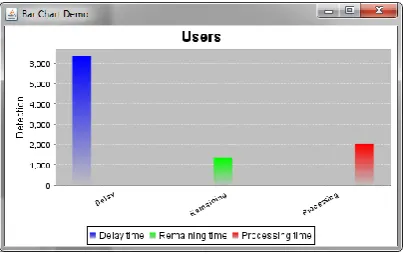
The implementation of Delay time Algorithm is to calculate the processing time, Delay time and remaining time in the scheduling process.
Figure 1.4 Time executed in the process
As we immerge Q PSO algorithm in Dynamic Load balancing for efficient retrieve of server response at the same time give optimised result for the load balancing scheduling approach in cloud computing concept.
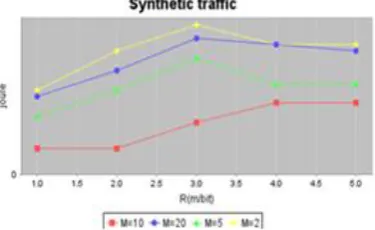
The performance of QPSO in load balancing technique is compared with other optimisation algorithm and got best result when compared. It improves the performance and decrease the execution period of the task. Fig 1.5 shows the synthetic traffic that occurred in the virtual machine with multiple jobs taken.
Figure 1.5 Traffic occurred in the process
VII.
CONCLUSION
Task assignment and work load balancing have been seriously inquired about in past decades; an extensive number of related reviews and outcome have been exhibited as regards of this subject. First of all we consider load balancing and then to optimised dynamic load balancing DLBS approach for maximizing the network throughput while balancing the workload dynamically. The process is under how efficiently allocate the cloudlet in virtual machine using Quantum based particle swarm optimisation algorithm. It showed their efficiency while performing their optimisation.
Compared with other traditional algorithms, the experiment results on standard testing functions showed that the recommended algorithm has the superior optimization ability, with enhancement in both convergence speed and time execution those demonstrate the effectiveness of the QPSO that applied in load balancing concept.
VIII.
REFERENCES
[1] Feilong Tang Member, IEEE, Laurence T. Yang
Senior Member, IEEE, Can Tang, Jie Li Senior
Member, IEEE, and Minyi Guo Senior Member,
IEEE A Dynamical and Load-Balanced
FlowScheduling Approach for Big Data Centers inCloud.
[2] Luyu Wang, Shiyou Yang, Jin Huang, Fumio Kojima, Futoshi Kobayashi, Hiroyuki Nakamoto. (2016) An adaptive quantum-behaved particle swarm optimizer for global optimization of inverse problem. International Journal of Applied
Electromagnetics and Mechanics52
:1-2793-799. Online publication date: 29-Dec-2016
[3] Obaid Ur Rehman, Shiyou Yang, Shafi Ullah Khan. (2017) A modified quantum-based particle swarm optimization for engineering inverse problem. COMPEL - The international journal for computation and mathematics in electrical and
electronic engineering36:1168-187.
[4] Z.Z.Cao, M.Kodialam and T.V.Lakshman. Joint Static and Dynamic Traffic Scheduling in Data Center Networks. in Proceedings of IEEE INFOCOM 2014, pp.2445-2553
[5] Maolong Xi, Xiaojun Wu, Xinyi Sheng, Jun Sun, Wenbo Xu. (2016) Improved quantum-behaved particle swarm optimization with local search strategy. Journal of Algorithms &
Computational Technology174830181665402.
[6] Chia-Yu Wang, Pei-Rong Li, Chia-Lin Tsai, Kai-Ten Feng. (2016) Load-balanced user association and resource allocation under limited capacity backhaul for small cell networks. 2016 IEEE 27th Annual International Symposium on Personal,
Indoor, and Mobile Radio
Communications(PIMRC)1-5.
[7] Tianyu Liu, Licheng Jiao, Wenping Ma, Ronghua Shang. (2017) Quantum-behaved particle swarm optimization with collaborative attractors for nonlinear numerical problems.
[8] Tianyu Liu, Licheng Jiao, Wenping Ma, Ronghua Shang. (2017) Quantum-behaved particle swarm optimization with collaborative attractors for nonlinear numerical problems.
[9] Yang Wang, Yangyang Li, Licheng Jiao. (2016) Quantum-inspired multi-objective optimization evolutionary algorithm based on decomposition. Soft Computing 20:83257-3272.
[10] Jui-Yu Wu An improved quantum-behaved particle swarm optimization method for solving constrained global optimization problems, 15th International Symposium on Communications and Information Technologies(ISCIT)Year:2015
[11] Quantum-Behaved Particle Swarm Optimization with Cooperative Coevolution for Large Scale Optimization Na Tian2015 14th International Symposium on Distributed Computing and Applications for Business Engineering and
Science (DCABES)Year: 2015
optimization with collaborative attractors for nonlinear numerical problems.
[13] Gulshan Soni; Mala Kalra A novel approach for load balancing in cloud datacenter 2014 IEEE International Advance Computing Conference
(IACC)Year:2014.
[14] Hybrid Memetic and Particle Swarm Optimization for Multi Objective Scientific Workflows in CloudK. Padmaveni; D. John Aravindhar2016
IEEE International Conference on Cloud
Computing in Emerging