A Knowledge Based Educational (KBEd) framework
for enhancing practical skills in engineering distance
learners through an augmented reality environment
Venkatesh Chennam Vijay
A thesis submitted in partial fulfilment of the requirement of
Birmingham City University for the degree of
DOCTOR OF PHILOSOPHY
February 2017
Faculty of Computing, Engineering and Built
Environment (CEBE)
Abstract
The technology advancement has changed distance learning teaching and learning
approaches, for example, virtual laboratories are increasingly used to deliver
engineering courses. These advancements enhance the distance learners practical
experience of engineering courses. While most of these efforts emphasise the
importance of the technology, few have sought to understand the techniques for
capturing, modelling and automating the on-campus laboratory tutors’ knowledge. The
lack of automation of tutors’ knowledge has also affected the practical learning
outcomes of engineering distance learners. Hence, there is a need to explore further on
how to integrate the tutor's knowledge, which is necessary for imparting and assessing
practical skills through current technological advances in distance learning. One
approach to address this concern is through the use of Knowledge Based Engineering
(KBE) principles. These KBE principles facilitate the utilisation of standardised
methods for capturing, modelling and embedding experts’ knowledge into engineering
design applications for the automation of product design. Hence, utilising such
principles could facilitate, automating engineering laboratory tutors’ knowledge for
teaching and assessing practical skills. However, there is limited research in the
application of KBE principles in the educational domain. Therefore, this research
explores the use of KBE principles to automate instructional design in engineering
distance learning technologies. As a result, a Knowledge Based Educational (KBEd)
framework that facilitates the capturing, modelling and automating on-campus tutors’
knowledge and introduces it to distance learning and teaching approaches.
This study used a four-stage experimental approach, which involved rapid prototyping
The developed prototype was further refined through internal and external expert group
using face validity methods such as questionnaire, observation and discussion. The
refined prototype was then evaluated through welding task use-case. The use cases were
assessed by first year engineering undergraduate students with no prior experience of
welding from Birmingham City University. The participants were randomly separated
into two groups (N = 46). One group learned and practised basic welding in the
proposed KBEd system, while the other learned and practised in the conventional
on-campus environment. A concurrent validity assessment was used in determining the
usefulness of the proposed system in learning hands-on practical engineering skills
through proposed KBEd system. The results of the evaluation indicate that students
who trained with the proposed KBEd system successfully gained the practical skills
equivalent to those in the real laboratory environment. Although there was little
performance variation between the two groups, it was rooted in the limitations of the
system’s hardware. The learning outcomes achieved also demonstrated the successful
application of KBE principles in capturing, modelling and transforming the knowledge
from the real tutor to the AI tutor for automating the teaching and assessing of the
practical skills for distance learners. Further the data analysis has shown the potential
of KBEd to be extendable to other taught distance-learning courses involving practical
Acknowledgements
“Dream is not that you see in sleep, dream is something that does not let you sleep”
- A.P.J Abdul Kalam
I would like first to say a huge thank you to my Director of Studies Professor Mel Lees
for all his support and for keeping me hungry to learn new things while undertaking my
research. Without his guidance and encouragement, this PhD would not have been
achievable.
I would also like to thank my second supervisors, Parmjit Chima and Professor Craig
Chapman, for their support and constant feedback. In particular, my deepest gratitude
goes to Craig for providing me with the best facilities and training in the
Knowledge-Based Engineering (KBE) Lab. Thanks are also due to KBE Lab team members Dr
Krishna Sapkota, Dr William Byrne, Dr Raju Pathmeswaran and Dr Feroz Farazi for
helping me in my implementation.
I am thankful to the engineering technicians Martin Reeves and David Philips at
Birmingham City University for their endless support in collecting data from the
students. My sincere thanks also go to Professor Peter Larkham, Professor Hanifa Shah
and Sue Witton, who gave access to the research facilities. Without their precious
support, it would not have been possible to conduct this research. I am thankful to Steve
Gould for his comments and suggestions in improving my thesis. I am also very grateful
to the Faculty of Computing, Engineering and the Built Environment (CEBE) of
Birmingham City University for funding the research project.
I would like to thank my friends; Dr Gerald Feldman, Dr Mani Seethapathy and
Sikander Khan for their continuous encouragement. My special thanks also go to my
but by no means least, I would like to thank my wife Zhao Man. Without her love and
kind words, this thesis would not have been completed. Finally, thank you God, for
Table of Contents
List of Figures ... VIII List of Tables ... XII List of Abbreviations ... XV
Chapter 1 Introduction and background... 1
1.0 Introduction ... 1
1.1 Problem statement ... 2
1.2 Research questions ... 4
1.3 Research objectives ... 4
1.4 Overview of research design ... 4
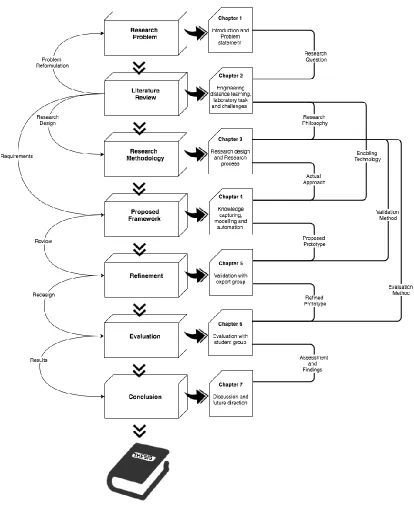
1.5 Structure of the thesis ... 6
1.6 Chapter summary and conclusions ... 9
Chapter 2 Literature review ... 11
2.0 Introduction ... 11
2.1 History of the engineering laboratory ... 12
2.2 Demand for practical skills from engineering employers ... 14
2.3 Learning and teaching theories involved in engineering ... 18
2.3.1 Kolb’s experimental learning cycle ... 19
2.3.2 The index of learning styles ... 21
(a) Sensory and intuitive learners... 22
(b) Visual and auditory learners ... 23
(c) Inductive and deductive learners ... 24
(d) Active and reflective learners ... 25
(e) Sequential and global learners ... 26
(a) Bloom’s taxonomy ... 27
(b) Webb’s Depth of Knowledge ... 28
(c) Hess’ Cognitive Rigor Matrix ... 30
2.4 Distance learning background ... 31
2.4.1 Engineering distance learning approaches ... 34
2.4.2 Non-traditional laboratories (remote and virtual) ... 37
2.4.3 Virtual and augmented reality ... 40
2.5 Challenge one: imparting practical skills to engineering distance learners ... 46
2.6 Challenge two: assessing practical skills in engineering distance learners ... 47
2.7 Knowledge capturing, modelling and automation approaches and practices .... 48
2.7.1. Knowledge-based engineering (KBE) approach ... 52
2.7.2 Semantic-based modelling ... 56
2.7.3 Artificial intelligence ... 60
2.8 Chapter summary and conclusions ... 65
Chapter 3 Methodology ... 72
3.1 Research Design ... 72
3.1.1 Introduction ... 72
3.1.2 Approach to the prototype ... 75
(a) Introduction ... 75
(b) Rapid prototyping background... 76
(c) Application of rapid prototyping in this research ... 77
3.1.3 Approach to validation ... 78
(a) Introduction ... 78
(b) Construct validity background ... 79
(c) Application of construct validity approaches in this research ... 81
(d) Experimental validity and reliability issues ... 82
3.2 Research Process ... 84
3.2.1 Phase 1: Literature review ... 85
3.2.2 Phase 2: Design and development of the KBEd prototype ... 88
3.2.3 Phase 3: Validation with expert group ... 91
(a) Participants ... 92
(b) Data collection ... 94
(c) Data analysis ... 96
3.2.4 Phase 4: Evaluation with student groups ... 97
(a) Participants ... 98
(b) Data collection ... 99
(c) Independent variable ... 100
(d) Dependent variable ... 100
(i) Fundamental skill (FS) ... 101
(ii) Preparation skill (PPS): ... 101
(iii) Procedural skill (PS) ... 102
(iv) Executional skill (ES): ... 102
(v) Task outcome (TO) ... 104
(vi) Number of second attempts (NSA): ... 104
(e) Data analysis ... 104
3.3 Chapter summary and conclusions ... 106
Chapter 4 Implementation ... 107
4.1 Knowledge capture ... 107
4.1.1 Capturing process knowledge ... 109
4.1.2 Capturing fundamental knowledge ... 112
4.1.3 Capturing task knowledge ... 113
4.1.4 Capturing executional knowledge ... 115
4.2 Knowledge modelling ... 118
4.2.2 Formal modelling ... 122
4.2.3 Knowledge automation ... 128
4.3 Artificial intelligence (AI) tutor ... 132
4.3.1 State machine graphs (SMG) ... 135
4.3.2 Teaching state machine graph (TSMG) ... 135
Scenario example for TSMG: ... 137
4.3.3 Assessing state machine graph (ASMG) ... 137
Scenario example for ASMG ... 139
4.3.4 Dialog state machine graph (DSMG) ... 140
Scenario example for DSMG ... 142
4.3.5 Measuring state machine graph (MSMG) ... 143
Scenario example for MSMG ... 145
4.4 Augmented reality environment ... 147
4.4.1 Object modelling phase ... 148
(a) Acquiring: ... 149
(b) Modifying: ... 149
(c) Converting: ... 149
4.4.2 Object codifying phase ... 151
(a) Positioning: ... 152
(b) Scripting: ... 153
(i) Interactivity characteristics: ... 154
(ii) Welding characteristics ... 154
4.4.3 Pre-testing phase ... 159
4.4.4 Object transforming phase ... 159
(a) Camera conversion: ... 160
(b) Interactivity conversion stage: ... 161
4.4.5 Post testing with internal experts ... 162
(b) Scenario Two: ... 165
(c) Scenario Three: ... 165
(d) Scenario Four: ... 166
(e) Scenarios Five and Six: ... 166
(f) Scenario Seven: ... 167
4.5 Chapter summary and conclusions ... 169
Chapter 5 Validation with the expert group ... 171
5.1 Introduction ... 171
5.2 Face validity ... 173
5.3 Expert group and results gathered ... 176
(i) Realism and usability validity questions results ... 178
(ii) Knowledge content questions results ... 186
(iii) General validity questions ... 194
5.4 Discussion ... 201
5.5 Chapter summary and conclusions ... 204
Chapter 6 Validation with students ... 206
6.1 Introduction ... 206
6.2 Learning processes involved in the AR and conventional environments ... 208
6.3 Concurrent validity measuring parameters ... 211
6.4 Concurrent validity results and analysis... 215
6.4.1 Fundamental skill ... 215
6.4.2 Procedural skill ... 217
6.4.3 Preparation skill ... 219
6.4.4 Executional skill ... 221
(a) Torch holding... 221
(b) Hand speed ... 223
(d) Penetration ... 226
(e) Tack weld ... 228
(f) 20mm weld ... 230
(g) Main weld ... 232
6.5 Discussion ... 235
6.6 Chapter summary and conclusions ... 239
Chapter 7 Conclusion and recommendations ... 241
7.1 Summary ... 241
7.1.1 Problem statement ... 241
7.2 Findings for the research questions and their objectives ... 243
7.2.1 Research questions ... 243
7.2.2 Research objectives ... 243
7.3 Research outcomes and findings ... 243
(a) Research Objective 1 ... 244
(b) Research Objective 2 ... 244
(c) Research Objective 3 ... 245
(d) Research Objective 4 ... 245
(i) Null hypothesis 1 ... 246
(ii) Null hypothesis 2 ... 246
(e) Research questions ... 247
(f) Conclusions: ... 248
7.4 Contribution to theory and practice ... 250
7.4.1 Knowledge capturing method for gathering on-campus tutor knowledge ... 250
7.4.2 Knowledge modelling structure ... 250
7.4.3 Assessment automation ... 251
7.5 Limitations of the study ... 252
7.6 Recommendations for further research... 253
7.6.1 Enhancing safety practices in the AR environment ... 253
7.6.2 Improving the accuracy of the depth factor ... 254
7.6.3 Implementing the framework for practical tasks in other domains... 254
References ... 256
Appendix 1: List of Publications ... 294
Appendix 2: Health and safety hierarchical structure ... 295
Appendix 3: Knowledge captured using procedural, product and diagnostics (three) columns ... 300
Appendix 4: Scripts used in codifying Interactivity characteristics ... 307
Appendix 5: Scripts used in creating welding characteristics ... 313
Appendix 6: Scripts used in creating welding arc and sound ... 315
Appendix 7: Script used in measuring the hand movement and speed ... 321
List of Figures
Figure 1.1: Thesis outline ... 7
Figure 2.1: UK Standard for Professional Engineering Competence. Source:
Engineering Council (2013) ... 14
Figure 2.2: Essential and harder skills to hire. Adapted from Committee for Economic
Development (2015) ... 16
Figure 2.3: Forecast on job opportunity 2020 report: (a) overall and (b) engineering.
Source: Carnevale et al. (2013) ... 17
Figure 2.4: Examination of the way engineering students prefer to learn. Source:
Clark et al. (2013) ... 18 Figure 2.5: Kolb’s experimental learning cycle. Adopted from Kamis and Topi
(2007). ... 20
Figure 2.6: Dimensions of learning and teaching styles. Source: Felder and Silverman
(1988). ... 22
Figure 2.7: Revised Bloom’s taxonomy. Source: Baruch College (2014). ... 28 Figure 2.8: Webb’s Depth of Knowledge levels. Source: Webb (2010). ... 29 Figure 2.9: Hess’ Cognitive Rigor matrix, integrating the DOK levels of Bloom’s
taxonomy levels. Adapted from Edtech (2015). ... 30
Figure 2.10: Four components of distance education. Adapted from Schlosser and
Simonson (2006). ... 32
Figure 2.11: Comparison between real, virtual and remote laboratory practical
learning outcomes. Adapted from Ma and Nickerson (2006)... 40
Figure 2.12: Reality-to-virtual continuum. Source: Milgram and Kishino (1994). ... 41
Figure 2.13: World’s first AR head-mounted display. Source: Tamura (2002). ... 42
Figure 2.14: AR and VR stereoscopic vision principal. Source: Mozilla Developer
Network (2016). ... 43
Figure 2.15: AR technology used in industrial applications: (a) Volkswagen’s AR
after car crash analysis, (b) a car body resized thorough AR and (c) AR-assisted
factory and plant planning. Adapted from Fiorentino et al. (2002) and Friedrich et al.
(2002). ... 44
Figure 2.17: Nonaka’s knowledge model. Adapted from Nonaka and Konno (1998).
... 50
Figure 2.18: Knowledge automation framework. Source: Curran et al. (2010). ... 51
Figure 2.19: KBE methodology. Source: Lohith and Devaraja (2013). ... 53
Figure 2.20: Various knowledge acquisition techniques. Adapted from Akhavan and Shahabipour (2014). ... 58
Figure 2.21: Use of AI. (a) First AI program, (b) First self-manoeuvering robot, (c) First robot (AIBO) to mimic actual dogs’ behaviour, (d) First AI to match human thinking in playing chess and (e) AI in serious gaming from early 2000 for dialogue. Sources: Newell et al. (1957); Nilsson (1984); Hornby et al. (2000); Schaeffer and Plaat (1997) and Factor-Tech (2015). ... 62
Figure 2.22: A simple finite state machine: (a) FSM representing the brain of amonster; (b) monster avatar attacking player on seeing him. Adapted from: Fernando (2013). ... 65
Figure 3.1: Research onion diagram. Adapted from Saunders et al. (2009). ... 74
Figure 3.2: Traditional prototype method vs rapid prototype method ... 77
Figure 3.3: Categorisation of validity approaches. Adapted from Diamantopoulos et al. (2012) ... 80
Figure 3.4: Procedural phases involved in the study ... 85
Figure 4.1: Knowledge capturing technique stages ... 109
Figure 4.2: Process storyboard for teaching and assessing the welding task ... 111
Figure 4.3: Health and safety hierarchical structure (for magnified image refer to Appendix 2) ... 112
Figure 4.4: Three welding tasks performed by students. (a) flat plate welding; (b) t-joint welding and (c) saucer welding. ... 115
Figure 4.5: Knowledge modelling phases ... 119
Figure 4.6: Informal modelling logical blocks ... 120
Figure 4.7: Algorithm from the constructed rule ... 121
Figure 4.8: Learning object structure ... 123
Figure 4.9: Ontology class diagram ... 124
Figure 4.10: Relational logic involved for the ‘hasAI’ axiom ... 127
Figure 4.11: Knowledge automation process flow ... 129
Figure 4.12: Published JSON output for an individual query ... 131
Figure 4.14: Teaching state machine graph (TSMG) ... 136
Figure 4.15: Assessing state machine graph (ASMG) ... 139
Figure 4.16: Dialog state machine graph (DSMG) ... 141
Figure 4.17: Measuring state machine graph (MSMG) ... 144
Figure 4.18: MSMG for measuring overall learning outcome ... 146
Figure 4.19: AR development phases ... 148
Figure 4.20: Positioning of objects in 3D space ... 153
Figure 4.21: Critical objects and components embedded with scripts... 155
Figure 4.22: Generated waypoint with coordinates and time stamp ... 157
Figure 4.23: Welding characteristics algorithm logic ... 158
Figure 4.24: Converting the VR camera to an AR camera ... 160
Figure 4.25: Scenario one: user selection of safety equipment (a) mask; (b) glove; (c) footwear and (d) apron. ... 164
Figure 4.26: Scenario two: (a) user placing the selected plate and (b) degreasing and removing the burrs on the plate. ... 165
Figure 4.27: Scenario three: user set-up of voltage and wire fed speed for the chosen plate thickness. ... 165
Figure 4.28: Scenario four: (a) user placing the magnet; (b) tack welding the corners and (c) appearance of welding when contact is made at the plate edges. ... 166
Figure 4.29: Scenarios five and six: (a) user performance of 20mm welding from left corner; (b) 20mm welding from right corner and (c) user performing main welding in the middle, with AI continuously notifying the hand speed of the user. ... 167
Figure 4.30: Scenario seven: user hitting the welded plate with the hammer to test the welding outcome. ... 168
Figure 4.31: AI tutor’s actions: (a) pointing out the mistakes made by the learners and (b) guiding learners on how to rectify them... 169
Figure 5.1: Process involved in the expert validation. ... 172
Figure 5.2: Expert group categorization with respect to welding and AR skills ... 177
Figure 5.3: Categorization of questions ... 178
Figure 6.1: Concurrent validity with two groups of students ... 207
Figure 6.2: On-campus environment learning process ... 209
Figure 6.3: AR environment learning process ... 210
Figure 6.5: Torch holding performance comparison chart between AR and on-campus
trained learners. (Total number of participants 46: AR (23) and on-campus (23)) ... 221
Figure 6.6: Hand speed performance comparison chart between AR and on-campus
trained learners. (Total number of participants 46: AR (23) and on-campus (23)) ... 223
Figure 6.7: Technique performance comparison chart between AR and on-campus
trained learners. (Total number of participants 46: AR (23) and On-campus (23)) .. 225
Figure 6.8: Weld penetration outcome comparison chart between AR and on-campus
trained learners. (Total number of participants 46: AR (23) and on-campus (23)) ... 227
Figure 6.9: Tack weld outcome comparison chart between AR and on-campus trained
learners. (Total number of participants 46: AR (23) and on-campus (23)) ... 229
Figure 6.10: 20mm weld outcome comparison chart between AR and on-campus
trained learners. (Total number of participants 46: AR (23) and on-campus (23)) ... 231
Figure 6.11: Main weld outcome comparison chart between AR and on-campus
trained learners. (Total number of participant 46: AR (23) and on-campus (23)) ... 232
Figure 6.12: Welding test outcome comparison chart between AR and on-campus
List of Tables
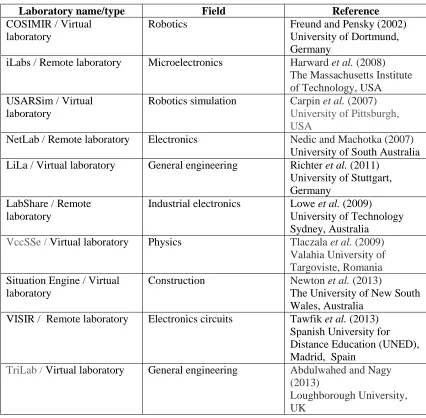
Table 2.1: List of engineering virtual and remote laboratories developed for academic
propose in the last decade. Adapted from Potkonjak et al. (2016) ... 36
Table 2.2: Comparison between virtual and remote laboratories. Adapted from Nedic et al. (2003). ... 38
Table 2.3: Various knowledge acquisition techniques. Adapted from Akhavan and Shahabipour (2014). ... 55
Table 2.4: Use of ontology in various sectors for modelling domain knowledge. Adapted from Sanya and Shehab (2014). ... 59
Table 2.5: List of merits and demerits of AI-techniques and their application in current serious games in mimicking real-world characters’ behaviour. Adapted from Sweetser and Wiles (2002). ... 64
Table 3.1: Keywords, key strings and search engines used in the literature search .... 87
Table 4.1: List of practical tasks for first year on-campus engineering students ... 109
Table 4.2: Learning outcomes of basic welding ... 110
Table 4.3: Proposed three-column approach ... 114
Table 4.4: Executional parameters. Adapted from Porter et al. (2006) ... 116
Table 4.5: Critical range for executional parameters. Adapted from Porter et al. (2006) ... 117
Table 4.6: List of propositions and their relational functions ... 126
Table 4.7: Rule syntax and description ... 130
Table 4.8: Logical blocks used in various state machine graphs. ... 134
Table 4.9: Modelled 3D objects ... 150
Table 4.10: List of internal and external libraries used for object codification. Adapted from Unity3D (2016). ... 151
Table 4.11: List of hands gestures to interact with augmented objects ... 162
Table 4.12: Changes suggested by the experts in each of the iteration ... 163
Table 5.1: Face validity assessment used in similar studies ... 174
Table 5.2: Questions used to gather experts’ feedback ... 175
Table 5.3: Results and interpreted comments for question two ... 179
Table 5.5: Results and interpreted comments for question six ... 182
Table 5.6: Results and interpreted comments for question seven... 183
Table 5.7: Results and interpreted comments for question twelve ... 185
Table 5.8: Results and interpreted comments for question three ... 187
Table 5.9: Results and interpreted comments for question eight ... 188
Table 5.10: Results and interpreted comments for question ten ... 189
Table 5.11: Results and interpreted comments for question eleven ... 190
Table 5.12: Results and interpreted comments for question thirteen ... 191
Table 5.13: Results and interpreted comments for question fourteen ... 193
Table 5.14: Results and interpreted comments for question five ... 195
Table 5.15: Results and interpreted comments for question nine ... 196
Table 5.16: Results and interpreted comments for question fifteen ... 197
Table 5.17: Results and interpreted comments for question seventeen ... 198
Table 5.18: Results and interpreted comments for question eighteen ... 200
Table 5.19: Changes made with respect to comments provided in the realism and usability validity questions. ... 202
Table 6.1: Performance measuring techniques used in similar studies ... 213
Table 6.2: Description of measuring parameters ... 215
Table 6.3: Concurrent validity results of fundamental and procedural skills of AR learners (n=23) vs on-campus learners (n=23) ... 216
Table 6.4: Concurrent validity results offundamental and procedural skill of AR learners (n=23) vs On-campus learners (n=23)... 218
Table 6.5: Concurrent validity of preparation skill of AR learners (n=23) vs on-campus learners (n=23) ... 220
Table 6.6: Torch holding results for torch holding skill between AR and on-campus learners ... 222
Table 6.7: Hand speed results for hand speed skill between AR and on-campus learners ... 224
Table 6.8: Technique results for executional technique between AR and on-campus learners ... 226
Table 6.10: Tack weld results for executional technique for AR and on-campus
learners ... 230 Table 6.11: 20mm weld results for executional technique of AR and on-campus
learners ... 231 Table 6.12: Main weld results for executional technique of AR and on-campus
learners ... 233 Table 6.13: Number of attempts made by the learners who failed at the first attempt to
List of Abbreviations
3D = 3 Dimensional
ABET = Accreditation Board for Engineering and Technology
AC = Abstract Conceptualization
AE = Active Experimentation
AI-Tutor = Artificial Intelligent-Tutor
AIChE = American Institute of Chemical Engineers
Amp = Amperage
AR = Augmented Reality
ASMG = Assessing State Machine Graph
BCU = Birmingham City University
CE = Concrete Experience
CR = Cognitive Rigor
DA = Drag Angle
DL = Distance Learning
DOK = Depth of Knowledge
DP = Degreasing the Plate
DSMG = Dialog State Machine Graph
ECPD = Engineers Council for Professional Development
ERS = Earth Strap
ES = Executional Skill
EWI = Edison Welding Institute
FBX = Filmbox
FS = Fundamental Skill
FSM = Finite State Machine
GA = Genetic Algorithm
GDEB = General Dynamics Electric Boat
GL = Gas Level
GUI = Graphical User Interface
HMD = Head-Mounted see-though Display
ICARE-form = Illustrations, Constraints, Activities, Rules, Entities – form
ICT = Information and Telecommunication Technology
ITSs = Intelligent Tutoring Systems
JSON = JavaScript Object Notation
KADS = Knowledge Acquisition and Documentation Structuring
KB = Knowledge-Base
KBE = Knowledge-Based Engineering
KBEd = Knowledge-Based Education
KBS = Knowledge-Based Systems
KC = Knowledge Capture
KM = Knowledge Modeling
KNOMAD = The Global Knowledge Partnership on Migration and Development
KOMPRESSA = Knowledge-Oriented Methodology for the Planning and Rapid Engineering of Small-Scale Applications
LE = Learning Environment
MBTI = Myers-Briggs Type Indicator
MOKA = Methodology and software tools Oriented to Knowledge based engineering Applications
MSMG = Measuring State Machine Graph
MTMM = Multitrait -Multimethod Matrix
NASA = National Aeronautics and Space Administration
NN = Neural Networks
NSA = Number of Second Attempts
OWL = Web Ontology Language
PC = Personal Computer
PM = Placing Magnets
PPS = Preparation Skill
PS = Procedural Skill
RDF = Resource Description Framework
RO = Reflective Observation
STELLA = Systems Thinking, Experimental Learning Laboratory with Animation
SW-On = Switching-On
SWEET = Semantic Web for Earth and Environmental Terminology
SysML = Systems Modeling Language
TO = Task Outcome
TS = Travel Speed
TSMG = Teaching State Machine Graph
UML = Unified Modeling Language
VR = Virtual Reality
VRSIM = Virtual Reality Simulator
WA = Work Angle
Chapter 1
Introduction and background
“Dream, Dream, Dream, Dreams transform into thoughts and thoughts result in action”
- A.P.J Abdul Kalam
1.0 Introduction
The importance of practical experience in engineering courses has significantly
increased since the 19th century, as the mode of teaching has shifted towards
constructivist pedagogy, emphasizing the importance of knowledge through experience
(Feisel and Rosa, 2005). This has been due to the increasing demand from industries
for engineering graduates equipped with both theoretical knowledge and practical
hands-on skills (Corter et al., 2007). In university education, the relatively recent
concept of distance learning (e-learning) has encouraged the participation level of
learners who are physically away from the on-campus environment, by providing them
with improved access (Zhu and Liu, 2009; Barbour and Reeves, 2009). Although
teaching practically is different from teaching theoretically, in an educational domain
learning practical skills is associated with lab instructors and workshops equipped with
special equipment and involves long periods of time to practise or rehearse techniques
(Ma and Nickerson, 2006); the knowledge of the laboratory instructor plays an integral
part in developing and assessing the practical skills of the learner.
Therefore, in the distance learning environment ‘imparting practical experience’ and
‘assessing’ the engineering practical skills become two major challenges (Peterson and
Feisel, 2002; Wu et al., 2008). As hands-on ‘know-how’ practical skills are critical for
engineering disciplines, delivering them by a distance learning mode becomes a major
hurdle for education providers (Bennett and Lori 2004; Aguilar et al., 2011;
education through technologies such as “virtual and remote learning”, one has to note
that these have been extensively developed for disciplines such as management and
computer science, but are relatively underdeveloped in engineering science disciplines
(Murphy and Manzanares, 2008; Rajaei and Aldhalaan, 2011). Moreover, the concept
of distance learning in engineering science subjects such as mechanical and automotive
engineering is still in its infancy (Perry et al., 2008; Anis, 2011; Laurillard 2013;
Potkonjak et al., 2016), as it limits practical engineering skills acquirable through the
existing distance learning environment.
1.1 Problem statement
In the modern era, the acceptance and use of technologies are growing rapidly in both
academic and industrial domains. Technologies such as virtual and augmented reality
have taken teaching and learning down more innovative and interesting paths (Bricken,
1991). Apart from these technologies, other distance learning technologies such as
Moodle and webinars have been in use for several years and are still being used by a
number of universities offering distance learning courses, mainly in teaching theoretical
concepts. Among these, virtual reality (VR), which is one of the components of distance
learning, has been extensively used in the educational domain for teaching practically
based subjects (Sherman and Craig, 2002; Youngblut, 1998). In a virtual reality
environment, the virtual world replaces the real world, whereas in an augmented reality
environment the system enhances the real world by superposing virtual contents onto
it. The term augmented reality (AR) refers to the enrichment of the real world with a
complementary virtual world, where visual information and 3D objects are tied to the
physical environment (Ferdinand et al., 2005; Buchmann et al., 2004).
medical, construction, engineering and aviation disciplines, among many others (Lee
and Wong, 2008; Santana et al., 2010; Lee, 2012; Wang et al., 2013; Ong and Andrew,
2013). However, very little attention has been paid to the methods and approaches to
follow in developing and automating these environments for teaching and assessing
practical skills for engineering distance learners (Sottilare et al., 2013; Li and Zhou,
2015). As laboratory and fieldwork activities performed by students are taught and
monitored face-to-face by subject experts, capturing, modelling and codifying the
on-campus tutor’s knowledge and applying it to a virtual tutor in a distance-learning
environment becomes a critical requirement. This research focuses on developing a
method that captures and models the on-campus tutor’s knowledge into a
knowledge-based education (KBEd) framework for automating laboratory teaching and assessment
processes in a distance learning environment and for enhancing the practical skills of
engineering distance learners. Further, the study examines the effectiveness and
efficiency of the proposed knowledge-based educational (KBEd) framework that
integrates artificially intelligent (AI) tutors and an augmented reality (AR) environment
for training students in practical engineering skills. More specifically, it aims to validate
the transformation of practical skills acquired from the proposed distance-learning
environment to a real on-campus one. This research was conducted at Birmingham City
University (UK); the case organization runs a mechanical engineering course, in which
first year students learn several fundamental practical tasks related to the subject.
Among these taught practical tasks, basic welding is not part of the real academic
assessment and does not influence the academic score of the student, which was chosen
as the use case for testing the framework. The following are the research questions and
1.2 Research questions
Can the principles and practice of knowledge based engineering be applied to
acquire the knowledge of a tutor to create a knowledge based educational
framework?
Can this framework be embodied into an augmented reality environment that
would allow study by distance learners?
Can engineering learners acquire practical skills in an augmented reality
environment?
1.3 Research objectives
1. To establish research landscape by identifying and reviewing the ‘best
practices’ and issues on delivering practical skills for engineering distance
learners.
2. To capture, model and automate on-campus tutor knowledge for teaching and
assessing practical skills.
3. To design and develop an augmented reality environment for learning.
4. To evaluate the performance of the augmented reality environment.
1.4 Overview of research design
This research was conducted with Birmingham City University’s first year engineering
undergraduate course. The case organisation teaches a number of laboratory tasks
among it which is basic welding, which is not part of the real academic assessment and
is not associated with the academic score of students, was selected as the use-case for
the research. The on-campus laboratory tutors’ knowledge was captured, modelled and
automated by adopting knowledge-based engineering (KBE) principles to fit the
applications in addressing the needs of large numbers of product variants to meet
individual customer needs (Tseng and Jiao, 1996; Cooper and Fan, 1999; Wognum and
Trappey, 2008). This research used KBE principles in mimicking laboratory tutors
behaviour through knowledge automation by robust capturing and modelling
techniques like artificial intelligence (AI) and semantics (ontology) in teaching and
assessing practical skills in engineering distance learners. Furthermore, the automated
knowledge was embedded into an augmented reality environment using state of the art
augmented reality technology to allow student to practise hands-on engineering skill by
interacting with augmented objects.
A mixed method four-stage experimental approach was used to conduct this research,
which involved students with no prior experience of welding; randomly assigned
participants were separated into two groups (N = 46). One group learned and practised
basic welding in the proposed augmented reality environment with the guidance of an
AI tutor, while the other learned and practised in the conventional on-campus
environment with the guidance of a real tutor. After completion of the training, each
of the participants from both groups was asked to perform the learned welding task in
the on-campus environment using real equipment and resources without any guidance.
A concurrent validity assessment was used in determining the usefulness of the
proposed system in learning hands-on practical engineering skills. More specifically,
the usefulness was determined by measuring whether the practical skills acquired by
the learners from the proposed system were transferable to a real laboratory
1.5 Structure of the thesis
The thesis consists of seven chapters, including this introduction (Figure 1.1). Chapter
2 provides the background of the research and the main issues surrounding engineering
distance learning. Sections 2.2 and 2.3 critically review the importance of the laboratory
activity and the practical ‘know-how’ skills for employers. Section 2.4 critically
reviews the existing theories and practices in teaching and learning engineering
laboratory activities. Section 2.5 provides the history of distance learning and its core
components, while sections 2.5.1 and 2.5.2 discuss different distance learning
approaches such as remote and virtual laboratories and their state of the art in
universities offering engineering distance learning. Section 2.5.3 explores in detail two
of the technological advances in distance learning technologies – virtual reality (VR)
and augmented reality (AR). Sections 2.7 and 2.8 discuss the two key challenges facing
current engineering distance learning. Taking these sections as the starting point,
sections 2.8, 2.8.1, 2.8.2 and 2.8.3 introduce possible solutions by discussing the
knowledge capturing, modelling and automation techniques that have been used in
industries for automating expert knowledge in computer applications. Having discussed
the literature and identified the research gap and possible ways of addressing it,
Chapter 3 explains the rest of the research journey in two major sections. Section 3.1
explains the research design by providing the research standpoint and understanding of
research methodology. Section 3.1.2 provides different development approaches that
are in practice, while section 3.1.2(b) presents the background and principles involved
in the selected method rapid prototyping; section 3.1.2(c) explains how the selected
development methods would be used in this research. Section 3.1.3 explores different
experimental validation approaches and their limitations, and section 3.1.3(b) explains
techniques. Subsequently, section 3.1.3(c) explains how the selected validation
approaches will be used in this research.
Figure 1.1: Thesis outline
Sections 3.1.3(d) and 3.1.3(f) explain how the experimental reliability and ethical issues
were addressed with respect to the selected development and validation approaches.
selected approaches in addressing the research objectives. Section 3.2.1 explains the
KBEd blueprint and the implementation steps involved in building the prototype and
sections 3.2.2 and 3.2.3 discuss how the validation and evaluation was carried out with
expert groups and student groups. In addition, these sections provide a detailed
explanation of the participant selection process and the data collection and analysis
techniques involved in it.
Chapter 4 explains in detail each of the building blocks of the KBEd prototype that was
presented in Chapter 3. Section 4.1 presents the proposed three column approach and
the knowledge capturing stages involved in capturing the fundamental, task and
executional knowledge of experts. With the completion of knowledge capture, section
4.2 explains how the data from the paper was modelled into a computerised
environment for automation. Section 4.2.1 presents the informal modelling of
knowledge, which is then formally modelled ontologically in section 4.2.2. Further,
section 4.2.3 explains how the knowledge automation was performed through the
ontological queries. Section 4.3 describes how the knowledge model from the
ontological process was then processed into the artificial intelligence (AI) tutor through
the use of state machines, while section 4.3.2 presents the structure of the teaching state
machine graph (TSMG) involved in teaching the learners by feeding them with
appropriate textual, audio and video knowledge. Section 4.3.3 presents the assessing
state machine graph (ASMG) in automating the continuous monitoring of learners’
actions and assessing them. Section 4.3.4 presents the dialog state machine graph
(DSMG) in automating the dialog conversation between the AI tutor and the learner
and section 4.3.5 presents the measuring state machine graph (MSMG), in which the
learning outcomes of the learner are measured through a proposed Level, Depth and
particular, the selected use-case ‘welding’ relies heavily on hand movement. Section
4.4 elaborates on how the laboratory equipment required for performing the welding
was modelled, codified and transformed into an augmented reality environment.
Chapter 4 also includes a section regarding the changes made to the KBEd system in
the light of information gathered from internal experts through the iterative prototyping
method. Once the system had been developed and refined through internal experts’
suggestions, the next stage of the research concerned the evaluation of the proposed
KBEd system.
Chapter 5 presents the face validity results from the external experts in testing the
readiness and usability of the proposed KBEd system. In addition, section 5.4 discusses
the outcome of the results and the changes that needed to be made before evaluating
them with students. Chapter 6 presents the concurrent validity that was conducted
between the two groups of students in evaluating the effectiveness and the efficiency
of the proposed system in learning practical engineering skills when away from the
on-campus environment. Finally, in section 6.5 the students’ evaluation results are
discussed and the thesis conclusion and recommendations for future research work are
presented in Chapter 7.
1.6 Chapter summary and conclusions
This chapter sought to introduce the research in hand and explored the research
issues and challenges. It also establishes the research questions and presented the
aim and objectives for conducting the study. In addition, it presented the overview of
methodological steps of the research, which is addressed in detail in the Chapter 3.
were written and connected to each other. Literature, related to key issues that are
Chapter 2
Literature review
“All Birds find shelter during a rain. But Eagle avoids rain by flying above the Clouds”
- A.P.J Abdul Kalam
2.0 Introduction
The previous chapter introduced the research in hand and established the justification
for undertaking the study. This chapter explores and reviews the existing state of the
art pertaining to the key challenges related to the study. This chapter reviews the
following five major topics:
1. Engineering laboratory – establishing the landscape of current research.
2. Demand for practical skills from engineering employers – exploring the
importance of ‘know-how' skills among past, current and future engineering
employers and critically reviewing current engineering educators’ standpoints
with respect to established practice.
3. Learning and teaching theories – an in-depth literature review of the existing
cognitive theories and their applications for teaching and learning engineering
laboratory activities.
4. Distance learning – state of the art distance learning approaches; tools and
techniques for delivering engineering curriculums by modern technology and
their limitations.
5. Knowledge automation – review of the methods and techniques that have been
used in capturing, modelling and codifying knowledge into distance learning
2.1 History of the engineering laboratory
In the 1950’s, engineering learning placed greater emphasis on practical work.
Engineers who graduated in earlier times were more practically oriented, but lacked the
underpinning theoretical concepts (Grinter, 1955; Committee of College and University
Examiners, 1956). Later, the emphasis shifted more towards teaching theoretical
concepts, which also led to inconsistent learning outcomes, since students lacked the
practical knowledge required for industrial jobs (Roth, 1994). To overcome the above
inconsistency, universities, industries and researchers constructed their own pedagogy
(Loo, 1997). Among these new approaches, Kolb’s (1985) experimental learning theory
was widely used, as it helped to achieve the right balance between theory and practical
skills. During the last decade , universities such as Cornell, Union College, Vale, MIT
and many others emphasized laboratory instruction and practical experience for new
generations of engineers (Bisantz and Victor, 2002; Hofstein and Vincent, 2004;
Newton, 2013). The first engineering taught course that involved practical aspects and
fieldwork was from the American Society of Civil Engineers (Felder and Rebecca,
2003). One of its early technical divisions was surveying, which provided a practical
work environment (Kamis and Heikki, 2007). Subsequently, laboratories and fieldwork
were made mandatory for engineering education (McGourty et al., 2002; Wankat,
2004).
Along with new pedagogical approaches, engineering accreditation process also in
parallel has increased the quality of the delivery of engineering modules; these
accreditations defined a set of learning objectives that needed to be achieved (Stephan,
2002). The first engineering education accreditor was the American Institute of
Chemical Engineers (AIChE) in 1925, which was followed by the Engineers Council
for Engineering and Technology (ABET) (Reynolds and Bruce, 1993; Carlson et al.,
1997). In the UK, Engineering Council accreditation helps to ensure that engineering
education meets world-class standards and assists students in acquiring
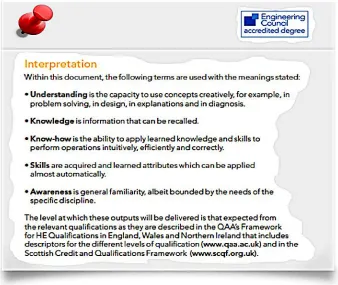
industry-relevant skills. Figure 2.1 provides the set of learning outcomes that needs to be
achieved by engineering students in the UK in order to qualify as a professional
engineer (Engineering Council, 2013). This research focuses mainly on the
‘know-how’ learning outcome, which focusses more on knowing how to perform hands-on
activities in solving problems. Hands-on experience is one of the fundamental skills
required from an industry point-of-view (Wojciechowski and Wojciech, 2013). As
these ‘know-how’ practical skills in courses such as mechanical and automotive
engineering are vital, imparting and assessing them requires comprehensive teaching
and learning methods. The following section provides a detailed review of the
importance of ‘know-how’ practical skills among engineering employers and their
Figure 2.1: UK Standard for Professional Engineering Competence. Source: Engineering Council (2013)
2.2 Demand for practical skills from engineering employers
Practical know-how is the skills that are required by the students to become more
successful learners and practitioners in their respective fields of study (Bennett et al.,
1999; Biggs, 2003; Allan and Clarke, 2007). The terminology regarding practical
know-how skills differs from country to country, where terminologies such as
‘employability-skill’, ‘key-skill’, ‘essential-skill’, ‘necessary-skill’, ‘generic-skill’ or
‘work-ready skill’ have the same meaning (NCVER, 2003). Although academic
qualifications are the most important criterion from an employer’s point-of-view,
Hamzah and Abdullah (2009) and Mavrikios et al.(2013) suggest that possessing
know-how skills such as critical thinking and problem solving through actions makes the
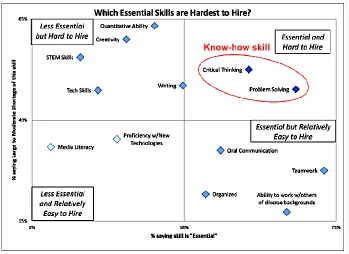
individual different from others. This is further evident from the Committee for
engineering employees (Figure 2.2); in the past decade the importance and emphasis of
degree qualifications with practical know-how skills have become essential.
Further, Meier et al. (2000) and Adamson and Darling-Hammond (2012) state that true
academic success is not defined in terms of what students can remember, but what they
can do with their learned knowledge. This is evident in today’s engineering profession,
as technical competencies have become much needed skills for engineering graduates
to secure jobs in industry (Benjamin et al., 2012; Stephens, 2013). This has caused
engineering institutes to face unprecedented pedagogical challenges (Lucena et al.,
2008; Shury et al., 2010), meaning that engineering educators now face challenges in
providing a balanced curriculum with both academic and practical rigours to produce
‘work-ready’ graduates (Gunn et al., 2010). Reports in the past from The Chronicle of
Higher Education (2011), BBC News Education and Family (2012) and Mail Online
(2013) have stated that employers believe that college graduates lack know-how skills.
According to Crawley (2002), Spinks et el. (2006), Crossman and Clarke (2010),
Mohd-Yusof et al. (2011), Hassan et al. (2011), Phang et al. (2012), Hassim et al.
(2013) and Khoo (2015), this is because the present pedagogical model in most
universities is one-way, in which students are passive recipients and learning is more
by rote for most of practical activities Gill et al. (2008) and RAEng (2010) criticise the
above view, saying creating such a balance would be not easy within the limited
Figure 2.2: Essential and harder skills to hire. Adapted from Committee for Economic Development (2015)
In the UK, the number of dropouts from engineering science subjects in both regular
and distance learning modes has increased in recent years (DIUS, 2008; RAEng, 2008).
Ofsted (2010) points out the same pedagogical issue and further warns there might be
an unprecedented shortage of employable graduates. In addition, Carnevale et al.’s
(2013)
report on jobs and requirements for 2020 suggests that overall employment is
expected to increase from 140.6 million to 164.6 million, and thus a serious change is
required in teaching and learning methods to motivate students and produce
engineering graduates with employability skills (Figure 2.3). In response to this, CDIO
(2013), an engineering educational research organisation, suggests that the problem
could be resolved by developing academically relevant and industrially attractive
Figure 2.3: Forecast on job opportunity 2020 report: (a) overall and (b) engineering. Source: Carnevale et al. (2013)
Apart from industries and research organizations, various engineering institutes such as
the National Academy of Engineering (2005), The Royal Academy of Engineering
(2007) and Duderstadt (2008) have also emphasised the importance of engineering
know-how skills in helping students to progress well in their workplace. One such
report was Clark and Andrews’ (2013) study, in which they examined how their
engineering graduates were expected to learn before delivering the course (Figure 2.4);
more than 85% were interested in learning through actively building things, which was
indirectly aligned with the current industrial skill requirements.
Further, several engineering institutes in different developing countries such as India,
China, Brazil, Malaysia, Thailand and Nigeria have also acknowledged the skills
shortages among graduates applying for industrial jobs (Skill and Work, 2015). They
have also made efforts in recent years to reach their cities as well as villages through
new teaching and learning technology to motivate and train students in employment
skills and to equip them to compete against the rest of the world (Abdullah el al., 2007;
Mishra, 2010; Sunthonkanokpong, 2011; Fisher, 2013; Kalam and Rajan, 2014;
Figure 2.4: Examination of the way engineering students prefer to learn. Source: Clark et al. (2013)
As the literature indicates, new requirements from industries and rapid changes in
technologies have emphasized not only degree qualifications, but also the need for
know-how skills in engineers to understand, execute and adapt to the real-world
challenges. With this in mind, engineering educators have adapted new teaching and
learning theories and approaches to achieve the desired learning outcomes (UNESCO,
2012). The remainder of the chapter critically reviews and analyses how practical
engineering skills are being taught, learned and assessed; further, we review the current
trends and challenges facing engineering distance learners.
2.3 Learning and teaching theories involved in engineering
Learning and teaching theories are interlinked with each other as each is mutually
relevant (Meyers, 1986). Various literature discusses the different theories employed
for different learning and teaching purposes (Bigge, 1982; Brown et al., 2000; Arends
2014). This research focuses on the engineering domain and thus has eliminated several
theories developed from other fields of study. In engineering, most of the learning and
teaching theories are based on Kolb’s experimental learning cycle Kolb (1993), in
cycle involving experience, observation and reflection (formulation) and then testing.
Kolb suggests appropriate teaching styles for each of the phases in this cycle.
2.3.1 Kolb’s experimental learning cycle
Kolb’s learning cycle was based on Kurt Lewin’s cycle of learning proposed for control
engineering; Kolb generalized it and made it popular (Adelman, 1993). Kolb’s
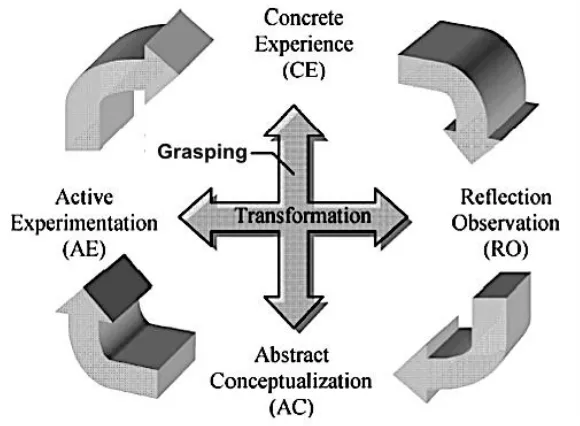
experimental learning cycle is an iterative process consisting of four learning modes
(see Figure 2.5): concrete experience (CE), reflective observation (RO), abstract
conceptualization (AC), and active experimentation (AE), through which knowledge is
acquired by a combination of ‘grasping’ and ‘transforming’ experience. Grasping
occurs through concrete experience and abstract conceptualization (CE – AC) and
transforming is achieved through reflective observation and active experimentation
(RO - AE) (Abdulwahed and Nagy, 2009). In the cyclic process, concrete experience
serves as the starting point; emphasis is placed on observation and then the observations
made are analysed and reflected upon through reflective observation. These reflected
observations are then developed into an initial implication in abstract conceptualization
and actively tested in the acquisition of new experience. Vince (1988) examines the
experimental cycle more closely and suggests that learners need not follow the whole
cycle, but should acquire the ability to choose the right mode for their grasping and
transforming process. For instance, some learners who prefer grasping new information
through their own senses and concrete reality can concentrate more on concrete
experience rather than abstract conceptualization. On the other hand, students who
prefer processing or transforming their acquired information into knowledge by seeing
and analysing actions performed by others, rather than jumping in and start doing things
themselves, can concentrate more on reflective observation. Felder and Silverman
but each of the cyclic processes presents us with a choice, patenting and identifying the
right ones by eliminating the rest is represented as learning style.
Figure 2.5: Kolb’s experimental learning cycle. Adopted from Kamis and Topi (2007).
Knowing the learning style of the student is of great importance for educators, since
this helps them in determining the right pedagogical approach (Fletcher et al., 2008).
Further, Garcia-Otero and Teddlie (1992) and Anitha and Deisy (2013) suggest that
learners should be made aware of their learning style, as this helps them to have better
understanding and quickly transform their acquired knowledge into practice. Moreover,
Kolb has been aligned with the same thoughts, stressing that learners should know all
the learning styles available for each of the learning modes and suggesting learning
styles for each of the modes in the cyclic process. This involves four type of learning
styles - activist, reflector, theorist and pragmatist (Kolb, 1976). However, Mumford and
Honey (1986) feel that the learning styles suggested by Kolb do not satisfy all kind of
learners. Later, Felder and Silverman (1988) developed a four dimensional model
known as the index of learning styles, which served all the learning preferences with
respect to Kolb’s learning cycle and which was widely accepted in engineering
2.3.2 The index of learning styles
Learning in a traditional engineering setting occurs through a two-stage process (Koob
and Joanie, 2002) involving the reception and processing of information. At the
reception stage, the teacher presents the information and students observe what they
require and ignore the rest. The second stage involves the processing of the received
information by memorizing or reflecting on their previous knowledge, or by interacting
with the tutor by asking for further explanation. Felder and Silverman (1988) classify
learners using four dimensions and asking the following questions:
What type of information does the student tend to perceive? – Sensory or
Intuitive learners
What kind of sensory channel is more effective in transferring the information
to the student? – Visual or Auditory learners
How does the student prefer to process the received information as knowledge?
– Active or Reflective / Inductive or Deductive
Finally, how does the student progress towards understanding? – Global or
Sequential learners
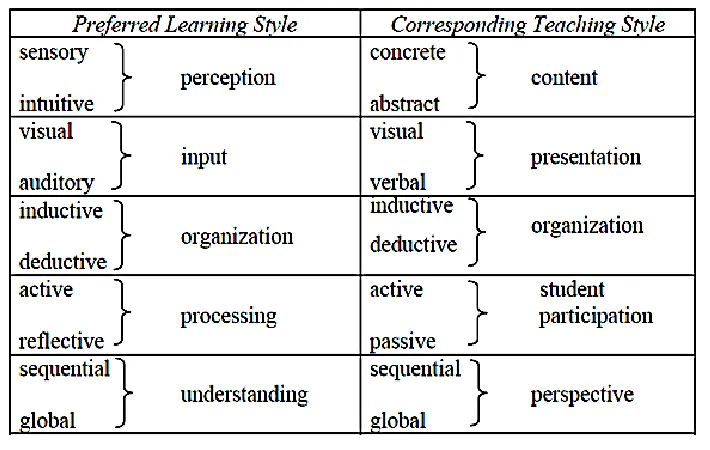
With these four proposed dimensions, the learning style and its corresponding teaching
style can theoretically be classified into 32 or (25) diverse styles to satisfy each of the
Figure 2.6: Dimensions of learning and teaching styles. Source: Felder and Silverman (1988).
(a) Sensory and intuitive learners
Jung (1971) introduced the theory of sensory and intuition, as the two ways in which
students tend to perceive taught concepts. Sensory students observe and gather
information through their direct senses, such as listening, seeing or feeling. On the other
hand, intuitive students perceive the information through the unconscious mind in
indirect ways such as through the imagination, instincts and assumptions. According to
Carlyn (1977), every leaner can use both these ways of perception, but most of the time
they tend to use only one of them. Later, this theory was further developed as an
instrument known as the Myers-Briggs Type Indicator (MBTI) to measure the degree
to which the learner prefers sensory or intuition in perceiving information (Briggs,
1998). The MBTI has helped the education provider, industries and other training
institutes for decades to access the learning styles and various behavioural tendencies
of learners. Most of the engineering subjects taught in the classroom emphasize the
intuitive teaching-style and involve traditional lectures and use of words and symbols
engineering learners are of the sensing type, thereby emphasising the major mismatch
between the teaching and learning styles in present engineering taught subjects.
However, Beetham and Sharpe’s (2013) and Demirkan’s (2016) studies suggest that
both types are important in engineering education, as engineering tasks require a sound
understanding of theoretical principles and experimental processes. Therefore,
Kereluik et al. (2013) suggests that for engineering education to be effective the
material presented should be understandable to both types of learners. The next section
further classifies sensory and intuitive learner styles in receiving information.
(b) Visual and auditory learners
Students generally receive information in three different ways. Some remember things
by seeing pictures, diagrams and demonstrations; these are classified as visual learners.
Others remember things through listening to verbal explanations rather than visual
demonstration, and are classified as auditory learners. The remaining learners are
kinaesthetic; they remember things by performing activities related to the taught
concept or theories. According to Koh and Chua (2012), most college students are
either visual or kinesthetic. However, the information presented by teachers is largely
through lectures (auditory) or through a visual representation of the lecture information
consisting of words and mathematical symbols. Gohardaniet al. (2014) and Abanteet
al. (2014) believe that irrespective of the mismatch in teaching and learning styles,
delivering lectures (auditory style) with some visual content is the optimal way of
teaching all students satisfactorily. This is also evident from the study conducted by
Stice (1987) on the Socony vacuum oil company, which measured the efficiency and
degree of information retention among all three types of learners; about 10 percent of
the students retained what they learned through reading and 26 percent of them
increased when they used a combination of learning techniques; 50 percent of them
managed to retain the information by learning through seeing and listening, and more
than 90 percent by listening and then by performing activities. Consequently, Özyurt
and Hacer (2015) suggest that engineering institutes should have a blend between
lectures (auditory and visual) and hands-on tasks (kinaesthetic) in order to achieve
higher information retention among different kinds of learners.
(c) Inductive and deductive learners
Students process received information in two ways; the inductive is more of a natural
human learning style, in which students process the information by relating to their own
experience rather than to a defined set of principles. On the other hand, the deductive
is more of a natural human teaching style, in which students relate the received
information to taught engineering principles (Prince and Felder, 2006). According to
Chaturvedi and Haider (2015), most of the engineering curriculum falls under the
deductive style, in which teachers start from basic fundamentals and then procedurally
move toward design and development. Further, Felder and Silverman’s (1988) study
identified how teachers viewed themselves with respect to inductive or deductive
styles; out of 46 professors, half identified themselves as purely deductive, meaning
they required their students to follow taught principles rather than learning through their
own creative thoughts. Kolb (2014) states that even though the deductive is an elegant
way of teaching, students become more dependent on their teachers to solve problems
rather than solving them by themselves. Spitzer (2013), Daly et al. (2014) and Barak
(2016) support this by stating that inductive teaching is vital for engineering learners,
as it increases problem solving abilities, academic achievement, creative thoughts and
information retention. Ahmad et al. (2014) and Wankat and Oreovicz (2015) suggest a
deductive style to teach the theoretical principles and then using inductive style
activities to transfer the taught principles to physical problems.
(d) Active and reflective learners
After receiving and processing the information through either of the above styles,
students convert it into knowledge, which can be further classified into two categories
(KoIb, 2014). Knowledge acquired through active experimentation is based on
performing some physical activity in testing the processed information, whereas
reflective observation is more passive, involving examination or manipulation of the
processed information when converting it into knowledge. According to Entwistle and
Ramsden (2015), most engineering students are active experimentation learners and
Goltz-Wasiucionek and Wierzbicka (2016) state that learners who fall under sensory
type mostly acquire their knowledge through active experimentation. However, Cox
and Tsai (2013) disagree on the dependence between sensory and active styles,
claiming that after perceiving information sensory learners could acquire knowledge
either through active experimentation or by reflective observation. According to
Ozaktas (2013), active learners do not process knowledge through symbolizing, but
require some kind of experimentation in order to do so. However, the outcome of the
performed experiments requires reflection to acquire long-term knowledge retention
and thereby suggests that both are of equal importance. In addition, although the way
of processing the knowledge is classified into two categories, Kim et al. (2013) and
Loeb (2015) believe that both the active and reflective go hand in hand by allowing
engineering learners to have a better understanding of fundamental ideas through
reflective knowledge and evaluation of ideas through active experimentation. The
following section discusses different ways of presenting learning material for students
(e) Sequential and global learners
Learning material in most of engineering institutes is presented in a sequential way, in
which once the student has learnt and mastered the presented information, they then
move on to the next level (Felder and Soloman, 2000). However, this type of
presentation does not suit learners who take longer to understand the presented material
than other students. Silverman (1987) classifies the former/latter as global learners, who
jump directly to more complex stages, rather than progressing steadily. According to
Watterson et al. (2013), presenting the learning material in a global way to suit global
learners is difficult within the academic timeline, although Hanna and Latchem (2013)
state that global learners are more important for the future of engineering, as they can
think about and correlate solutions from multidisciplinary domains. Stieger et al.’s
(2014) and Pervin et al.’s (2015) studies have suggested that global learners have a
higher risk of dropping out from engineering education, as they struggle to keep pace
with their fellow classmates in meeting the expectations of the teacher. Daly et al.
(2014) suggest that this could be addressed by providing adequate time and by
encouraging students to think out-of-box through creative tasks involving
multidisciplinary learning materials.
Although the learning style is of great importance for knowledge