IJSRR, 7(4) Oct. – Dec., 2018 Page 1529
Research article
Available online www.ijsrr.org
ISSN: 2279–0543
International Journal of Scientific Research and Reviews
Unsubstantiated Machine Learning In For Delay Tolerance Mobile
Networks
Jeyakumar V.
Dept., of Computer Science KG College of Arts & Science Coimbatore
ABSTRACT
This paper incorporates fog networking into heterogeneous cellular networks that square measure composed of a high power node (HPN) and lots of low power nodes (LPNs). The locations of the fog nodes that square measure upgraded from LPNs square measure nominative by modifying the unsupervised soft-clustering machine learning rule with the final word aim of reducing latency. The clusters square measure made consequently in order that the leader of every cluster becomes a fog node. The planned approach considerably reduces the latency with relevancy the straightforward, however sensible, Voronoi tessellation model, but the development is finite and saturates. Hence, closed-loop error management systems are going to be challenged in meeting the hard latency demand of 5G systems, in order that open-loop communication is also needed to fulfill the 1ms latency demand of 5G networks.
Index Terms—Machine learning, unsupervised clustering, fog networking.
Mr.V. Jeyakumar
Asst., Professor
IJSRR, 7(4) Oct. – Dec., 2018 Page 1530
INTRODUCTION
Stringent latency needs of 5G applications have driven a paradigm shift within the state-of-art 4G networks supported the thought of constructing cloud nearer to the top devices referred to as fog networking 1, 2. In fog networking, some nodes, e.g., access points, tiny cells, routers, mobiles, square measure specialised as fog nodes in an exceedingly cloud-to-things time 2. to manage and supply services to the top devices. A promising plan is to include fog networking into heterogeneous networks (HetNets) that square measure composed of a high power node (HPN) and plenty of low power nodes (LPNs), wherever some LPNs square measure upgraded as fog nodes. this could significantly enhance the performance of the state-of-art HetNets not solely mitigating interference among LPNs through the management capability of fog nodes however conjointly offer service to the top devices counting on the storage capability of fog nodes.
Despite the apparent advantages of fog networking in HetNets, this specification comes with its own queries like that LPN nodes ought to become fog nodes, and what ought to be the amount of fog nodes? during this paper, the previous question is mentioned, i.e., the locations of LPNs that square measure upgraded to fog nodes square measure found assumptive that the amount of fog nodes square measure given as a priori data and also the locations of all LPNs at intervals a cell square measure well-known. a lot of exactly, LPNs that square measure upgraded to fog nodes square measure determined supported associate degree unsupervised soft cluster machine learning algorithmic program 3. Consequently, LPNs square measure clustered so the leaders of every cluster, i.e., cluster-heads, square measure upgraded to fog nodes. There should be a metric to control cluster and also the metric here is to scale back latency.
IJSRR, 7(4) Oct. – Dec., 2018 Page 1531
compression, and special effects. Cluster analysis itself isn't one specific algorithmic rule, however the overall task to be solved . It is achieved by varied algorithms that disagree considerably in their understanding of what constitutes a cluster and the way to with efficiency realize them. in style notions of clusters embrace teams with tiny distances between cluster members, dense areas of the info area, intervals or specific applied mathematics distributions. cluster will so be developed as a multi-objective improvement downside. the acceptable cluster algorithmic rule and parameter settings (including parameters like the gap operate to use, a density threshold or the quantity of expected clusters) rely on the individual knowledge set and supposed use of the results. Cluster associate degreealysis in and of itself isn't an automatic task, however associate degree repetitive method of information discovery or interactive multi-objective improvement that involves trial and failure. it's typically necessary to change knowledge preprocessing and model parameters till the result achieves the required properties.
NETWORK MODEL AND PROBLEM FORMULATION
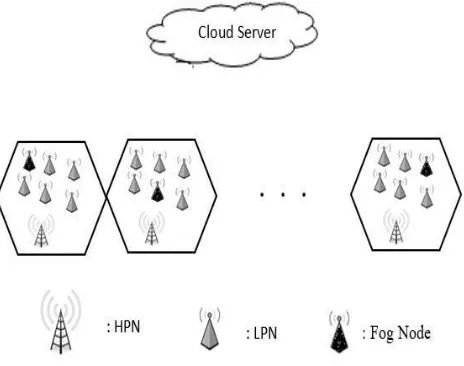
Fog networks consists of a knowledge plane and an impression plane. within the knowledge plane, fog computing and also the associated computing services attempt to attain shopper objectives via its distinctive options like dense geographical distribution, native resource pooling, latency reduction and backbone information measure savings to attain higher quality of service (QoS). within the management plane, fog networking will coordinate several devices to mitigate interference, which, within the scope of this paper, area unit the LPNs. A representative heterogeneous networking arrangement that shows a cloud server, fog nodes, LPNs and a HPN is shown in
Fig. 1
IJSRR, 7(4) Oct. – Dec., 2018 Page 1532
This network model inherently raises the question of the locations of fog nodes and their service area. Regarding the service area of fog nodes, the simplest approach is to employ the Voronoi tessellation model so that each LPN selects a fog node at the closest Euclidean distance. Indeed, this approach corresponds to the K-means hard clustering algorithm in machine learning 3. The main which degrades the performance of the communication, and thus increases the latency. Based on this motivation, a soft clustering algorithm that reduces the latency is discussed in the next section so that any LPN can be a fog node according to the quality of the channel and one LPN can be probabilistically connected to many fog nodes. Notice that it is well-known that a soft-clustering algorithm performs better than hard clustering 3
A NOVEL FUZZY CLUSTERING ALGORITHM
Generalized fuzzy c-means clustering algorithm with improved fuzzy partitions (GIFP_FCM) is a novel fuzzy clustering algorithm. However when GIFP_FCM is applied to image segmentation, it is sensitive to noise in the image because of ignoring the spatial information contained in the pixels. In order to solve this problem, a novel fuzzy clustering algorithm with non local adaptive spatial constraint (FCA_NLASC) is proposed in this paper. In the proposed method, a novel non local adaptive spatial constraint term is introduced to modify the objective function of GIFP_FCM. The characteristic of this technique is that the adaptive spatial parameter for each pixel is designed to make the non local spatial information of each pixel playing a different role in guiding the noisy image segmentation. Segmentation experiments on synthetic and real images, especially magnetic resonance (MR) images, are performed to assess the performance of an FCA_NLASC in comparison with GIFP_FCM and fuzzy
c-means clustering algorithms with local spatial constraint. Experimental results show that the proposed method is robust to noise in the image and more effective than the comparative algorithms.
Assume that the number of fog nodes and the LPN are known a priori, and there is a data set composed of the geographical locations of the LPNs such as X = fx1; x2; ; xN g 2 R 2where N is the total
number of LPNsand K of them will be upgraded to fog nodes. Hence, this data set is clustered with the following objective function so that the leader of the clusters or cluster-heads give the locations of the fog nodes as F = ff1; f2; ; fKg 2R2.
N K
∑ k∑
(1) J = F ( nkf(xn; fk))
IJSRR, 7(4) Oct. – Dec., 2018 Page 1533
The optimization of (1) forms the clusters where nk shows the probability of connection between
one LPN and a fog node, i.e., nk 2 [0; 1]. Note that if this was a hard clustering K-means algorithm, nk
would be either0or1. In particular, f(xn; fk)measures the similarity of any data point xn for n = 1; 2; ; N
with a fog node fk for k = 1; 2; ; K, andmultiplying it with nk constitutes the objective function.
The primary aim of maximizing (1) is to determine a clustering that reduces the latency within the network. To do so, the LPNs are clustered according to their channel strength, which means that each LPN associates with fog nodes that have channels above a certain quality. It is important to emphasize that each LPN can be associated from multiple fog nodes depending on the soft clustering algorithm whose details are presented below.
Algorithm-1: Low latency clustering algorithm
1. Set the number of fog nodes that will be upgraded from LPNs and the number of LPNs that are given as a priori information.
2. Specify the quality of channels among all LPNs. 3. Find the fog nodes according to the channel quality.
4. Determine the probability of connection between fog nodes and LPNs according to the channel quality.
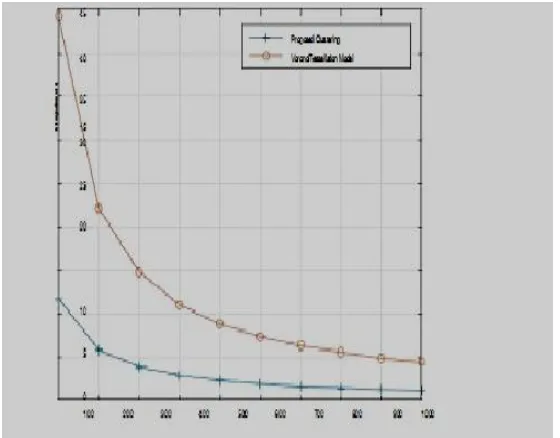
IJSRR, 7(4) Oct. – Dec., 2018 Page 1534 Fig. 2. Latency of the proposed algorithm compared to the Voronoi model as a function of bandwidth for K = 8.
One further important point is that the latency calculations are performed with open-loop communications, which means that there is no ACK mechanism for transmitted packets. It is clear that all latency values will be at least doubled when an ACK is required since unsuccessful transmission requires a retransmission and an additional ACK that increases the latency more than two-fold. Based on these discussions, it is certainly challenging to decrease the latency to 1 ms. Our results show that the latency decreases with bandwidth up to a point and after this point the latency saturates and does not decrease further. As a result, it can be deduced that open loop communication is likely necessary to meet the challenging 1 ms requirement in addition to intelligent clustering algorithms. So, to achieve 1 ms latency, it may be necessary to replace the widely used automatic repeat request (ARQ) or hybrid automatic repeat request (HARQ) with open loop communica-tion at the expense of reliability. One promising approach that can be employed to address the network reliability problem is the recently proposed Diversity Coding-Network Coding (DC-NC) which is based on the synergistic combination of diversity coding and network coding [4]. A thorough latency analysis combining the proposed clustering and DC-NC to minimize the latency in fog networking will be considered in future work.
REFERENCES
1. F. Bonomi et al: Fog Computing and its Role in the Internet of Things, Proc. Wksp. Mobile Cloud Computing, Helsinki, Finland Aug.2012 ; 13-16.
IJSRR, 7(4) Oct. – Dec., 2018 Page 1535
3. C. M. Bishop, Pattern Recognition and Machine Learning, Springer, Aug. 2006.