PARAMETRIC OPTIMIZATION OF TIG WELDING FOR
M1020 USING TAGUCHI-GREY RELATION BASED DESIGN
METHOD
Dipankar Saha
1, Sravanam Sushma
2, Mallikarjun Jalageri
31
Mechanical Engineering Department, Sphoorthy Engineering College, Hyderabad,Telangana India
2
Mechanical Engineering Department, Sphoorthy Engineering College, Hyderabad,Telangana, India
3
Mechanical Engineering Department, K L University, Vaddeswaram Andhra Pradesh, India
ABSTRACT
There are number of welding methods available for welding materials such as shielded metal arc welding, Gas
metal arc welding, Flux cored arc welding, submerged arc welding, electro slag welding, electron beam
welding, and Gas Tungsten arc welding methods. The choice of the welding depends on several factors;
primarily among them are the compositional range of the material to be welded, the thickness of the base
materials and type of current. Tungsten inert gas (TIG) welding is the most popular gas shielding arc welding
process used in many industrial fields. Other arc welding processes have limited quality when they are
compared to TIG welding processes. However, TIG welding also needs improvements regarding spatter
reduction and weld quality of the bead. Shielding gas in TIG welding is desirable for protection of atmospheric
contamination. TIG welding process has the possibility of becoming a new welding process giving high quality
and provides relatively pollution free. In this project the influence of the process parameters i.e travel speed,
current and gas flow rate on bead geometry and hardness of the weldment was studied which is produced by
TIG welding.TIG Machines settings, and shielding gases which are most important in determine arc stability,
arc penetration and defect free welds. To do this a thorough literature survey is carried out on various aspects
of the proposed topic, in various peer-reviewed journals, patents, books and other research resources. Suitable
range of current, the thickness of the base metal, the travel speed of carriage , the gas flow rate were identified
which is required for high quality TIG welding process.
Keywords
:
TIG welding, Shielding gas, Travel speed, Current.I. INTRODUCTION
MATERIAL
Carbon Steel Bright M1020. M1020 carbon steel bar is a merchant grade plain carbon steel bar containing nominally 0.20% carbon. Bead on plate is welded by TIG welding process on the specimen of mild steel plate of the following size and specification.
Table 1: Material specification: Mild steel of designation M1020
C Si Mn P S
0.15-0.25 ≤ 0.35 0.30-0.90 ≤ 0.050 ≤ 0.050
Specimen size: 200mm×50mm×16.5mm
Application of the application of the material: Suitable for general engineering applications where the lower strength of this grade is sufficient. Grade M1020 is not able to be through-hardened and is not hardenable by either flame or induction hardening processes. It can be case hardened by a blank carburizing process. Applications such as fasteners of various types, engineering applications where strength is not the major consideration (shafts, jack handles, threaded bar) and a grade is required that can be readily welded.
II. DESIGN OF EXPERIMENT (DOE)
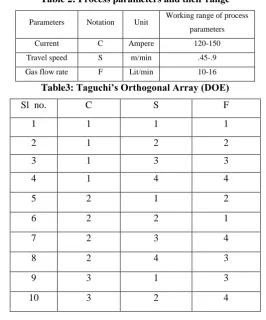
The experiment is carried out applying most influential process parameters [3] viz. current, travel speed, gas flow rate at four different levels. In order to reduce the numbers of experimental runs, time and cost from full factorial design, [4] the Taguchi’s L16 orthogonal array[5] has been incorporated and according to that sixteen numbers of experimental runs are estimated in the experiment. Applied process parameters and design of experiment (DOE), as per Taguchi’s L16 orthogonal array are furnished in table no 1 and 2 respectively.
Table 2: Process parameters and their range
Parameters Notation Unit Working range of process parameters
Current C Ampere 120-150
Travel speed S m/min .45-.9
Gas flow rate F Lit/min 10-16
Table3: Taguchi’s Orthogonal Array (DOE)
Sl no. C S F
1 1 1 1
2 1 2 2
3 1 3 3
4 1 4 4
5 2 1 2
6 2 2 1
7 2 3 4
8 2 4 3
9 3 1 3
12 3 4 2
13 4 1 4
14 4 2 3
15 4 3 2
16 4 4 1
III. EXPERIMENTATION
In the present experiment a set of sixteen identical specimens is welded and bead on plate welding is formed. Weldment are formed at room temperature on plates of sixteen specimens by applying the process control parameter as per design of experiment. Three process parameters viz. current, travel speed, gas flow rate at four different levels are applied and allowed to cool down normally, no force cooling is applied. All specimens are cross sectioned at the position where uniformed weldment is formed and then the section surface is mirror finished followed by etching with natal solution i.e. 10% nitric acid solution in distilled water in room atmospheric condition to get a clear view of weldment.The appeared weld bead geometry such as reinforcement, weld zone, and heat affected zone (HAZ) [6] are identified. In each region of geometry, measurement is taken at three points and considered their average value.
IV. DATA ANALYSIS
After collecting the data of bead geometry of individual samples analysis has been carried out based on Grey Relational Theory.
Table4: Measured experimental data related to bead geometry
Sl no HAZ width (mm)
Bead width (mm)
Penetration (mm)
Reinforcement (mm)
1 1.72 7.74 1.15 1.76
2 1.17 8.04 1.39 1.75
3 1.1 6.78 2.04 1.88
4 1.05 5.73 1.11 1.87
5 1.75 10.34 2.51 2.14
6 0.65 7.67 3.22 2.35
7 1.02 6.55 1.73 1.68
8 0.9 7.11 2.88 2.25
9 1.88 13.08 2.29 2.88
10 1.21 10.11 3.32 3.17
11 1.18 5.13 0.99 1.45
12 0.95 7.61 1.75 1.29
14 1.65 13.23 2.15 2.65
15 1.47 7.06 1.76 1.64
16 0.87 8.15 1.01 1.47
Fig.1: Variation of bead geometry along with travel speed and current
For Lower-is-Better (LB) criterion
) ( min ) ( max ) ( ) ( max ) ( k y k y k y k y k x i i i i i
………(i)
For Higher-is-Better (HB) criterion
) ( min ) ( max ) ( min ) ( ) ( k y k y k y k y k x i i i i i
………...(ii)
Grey relational coefficient
ε
i(k)
ε
i(k) = [Δ
min+ ψΔ
max] / [Δ
0i(j) + ψΔ
max] ………..
(iii)
Where Δ
0i= difference of the absolute value
Ψ is the distinguishing coefficie
nt 0≤ψ≤1
function optimization problem using the combination of Taguchi approach and Grey relational analyses. Higher is the value of Grey relational grade, the corresponding factor combination is said to be close to the optimal.
Table5: Normalized value and Grey relation coefficient value for each performance
characteristics
Sl no.
Normalized value of
HAZ
Normalized value of
Bead width
Normalized value of Penetration
Normalized value of Reinforcement
GRC for HAZ
GRC for Bead width
GRC for Penetration
GRC for Reinforcement
1 0.130081 0.322222 0.038186 0.75 0.364985 0.424528 0.342041 0.666667 2 0.577236 0.359259 0.095465 0.755319 0.54185 0.438312 0.35599 0.671429 3 0.634146 0.203704 0.250597 0.68617 0.577465 0.385714 0.400191 0.614379 4 0.674797 0.074074 0.02864 0.691489 0.605911 0.350649 0.339822 0.618421 5 0.105691 0.64321 0.362768 0.547872 0.358601 0.583573 0.439664 0.52514
6 1 0.31358 0.53222 0.43617 1 0.421436 0.516646 0.47
7 0.699187 0.175309 0.176611 0.792553 0.624365 0.377446 0.377818 0.706767 8 0.796748 0.244444 0.451074 0.489362 0.710983 0.39823 0.476678 0.494737
9 0 0.981481 0.310263 0.154255 0.333333 0.964286 0.420261 0.371542
10 0.544715 0.614815 0.556086 0 0.523404 0.564854 0.529709 0.333333
11 0.569106 0 0 0.914894 0.537118 0.333333 0.333333 0.854545
12 0.756098 0.306173 0.181384 1 0.672131 0.418821 0.379186 1
13 0.406504 0.909877 1 0.398936 0.457249 0.84728 1 0.454106
14 0.186992 1 0.27685 0.276596 0.380805 1 0.40878 0.408696
15 0.333333 0.238272 0.183771 0.81383 0.428571 0.396282 0.379873 0.728682 16 0.821138 0.37284 0.004773 0.904255 0.736527 0.443593 0.334397 0.839286
Overall Grey Relation Grade
𝛾𝑖 = 1𝑛 𝑛𝑘=1𝜀𝑖 k
……… (iv)
Where n= number of process responses.
Table6: Overall Grey relational grade
Expt. No. Grey relational grade
1 0.449555
2 0.501895
3 0.494437
4 0.478701
5 0.476744
6 0.602021
7 0.521599
9 0.522355
10 0.487825
11 0.514583
12 0.617534
13 0.689659
14 0.54957
15 0.483352
16 0.588451
Table 7: Response table for signal to noise ratio
Factors Grey Relation Grade
Level 1 Level 2 Level 3 Level 4 Delta Rank
C -6.362 -5.543 -5.458 -4.837 1.525 1
S -5.562 -5.457 -5.964 -5.217 0.747 2
F -5.432 -5.731 -5.659 -5.379 0.352 3
Fig.2: SN ratio plot for overall relational grade
From the information from the above fig. and with the help of MINITAB software optimization was done and the optimal process control parametric combination is C4S1F4.
V. DISCUSSIONS ON RESULTS
Within the present experimental domain and subsequent analysis it is established that the welding current has the highest influence on bead geometry in the weld sample of M1020 followed by travel speed and gas flow rate has the lowest influence. The optimal parametric combination for bead geometry was C4S1F4 i.e current 120 ampere, travel speed .45m/min and gas flow rate 16lit/min, within the experimental domain.
VII. ACKNOWLEDGEMENT
Sphoorthy engineering college, Hyderabad for providing facilities to do the experimental work.
REFERENCES
[1] Nirmalendhu Choudhury, Ramesh Rudrapati and Asish Bandyopadhyay, “Design Optimization of Process Parameters for TIG Welding Based on Taguchi Method”, International Journal of Current Engineering and Technology, Special Issue-2, February 2014.
[2] G. Magudeeswaran , Sreehari R. Nair , L. Sundar and N. Harikannan, “Optimization of process parameters of the activated tungsten inert gas
welding for aspect ratio of UNS S32205 duplex stainless steel welds”, Science Direct, 25 July 2014. [3] Ugur Esme, Melih Bayramoglu, Yugut Kazancoglu and Sueda Ozgun, “Optimization of Weld Bead
Geometry in Tig Welding Process Using
Grey Relation Analysis and Taguchi Method”, Materials and technology, Vol. 3, pp.143–149, 2009. [4] Dinesh Kumar.R, Elangovan.S and Siva Shanmugam.N, “Parametric Optimisation of Pulsed – Tig Welding
Process in Butt Joining of 304l
[5] Austenitic Stainless Steel Sheets”, International Journal of Research in Engineering and Technology, Vol. 3, Special Issue, Jun-2014.
[6] Ravinder and S. K. Jarial, “Parametric Optimization of TIG Welding on Stainless Steel (202) & Mild Steel by using Taguchi Method”,
International Journal of Enhanced Research in Science Technology & Engineering, Vol. 4, Issue 6, pp.484-494, June-2015
[7] Dara Eshwar and Dr. A.C.S. Kumar, “Taguchi Based Mechanical Property Optimization of as Weld Al-65032 Alloy Using Tig Welding”,